
Summary: “Neurology practice management is the operational and financial backbone of a neurology practice, covering billing, scheduling, compliance, staffing, and technology. Neurologists spend an average of 18 hours per week on administrative work, and the U.S. faces a projected 19% shortage of neurologists by 2025. Effective management protects practice independence, reduces burnout (affecting 53% of neurologists), and improves financial performance through automation, neurology-specific workflows, and KPI-driven optimization.”
Neurology practice management is the discipline of running the business side of a neurology practice. It covers billing, scheduling, patient access, compliance, payer relations, staffing, and the technology that holds workflow together. Strong management is what keeps a practice financially healthy and independent.
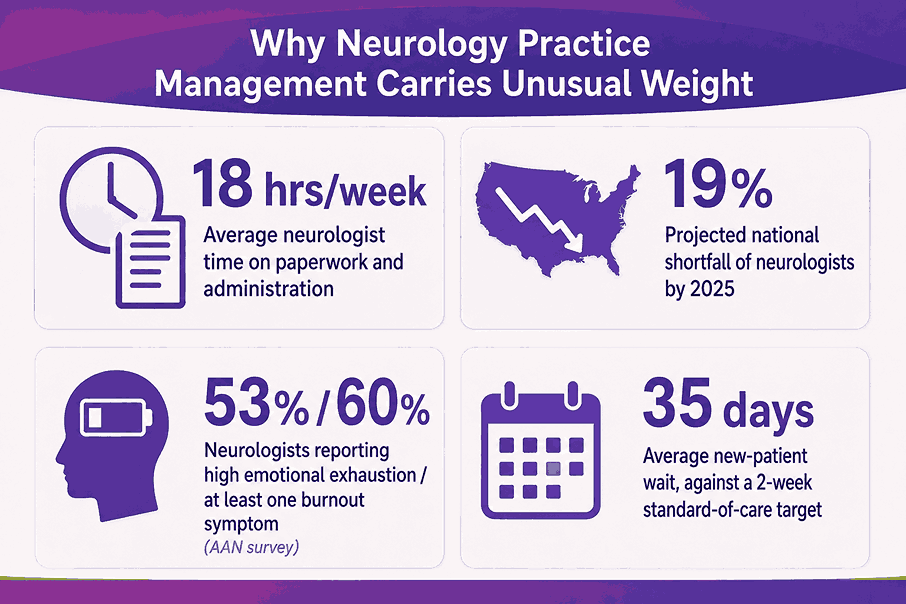
The field carries unusual weight in neurology. Neurologists average 18 hours per week on paperwork and administration, and the United States faces a projected 19% shortfall of neurologists by 2025. These pressures push many practices toward consolidation rather than independence.
This article defines neurology practice management and breaks down its core components. It covers the software features a modern neurology platform should include, from neurology-specific scheduling to MIPS reporting. It also maps the common challenges practices face and the best practices that address them. By the end, you will understand what drives cleaner billing, lower burnout, better patient access, and sustainable independence for an independent neurology practice.
What is Neurology Practice Management?
Neurology practice management is the operational and financial backbone of a neurology practice. It spans billing and revenue cycle, scheduling, patient access, regulatory compliance, payer relations, staffing, and the technology platforms behind every workflow.
Those platforms include the EHR, practice management software, e-prescribing engine, and telehealth tools. Together they run the daily work of a neurology practice. Effective neurology practice management connects clinical care to reliable reimbursement.
This discipline often decides whether a practice stays independent or gets absorbed. Neurologists today average 18 hours per week on paperwork, and the country faces a projected 19% national shortage of neurologists. Good management absorbs that load instead of passing it to providers.
Neurology PM solutions usually combine three layers:
- Neurology practice management software for scheduling, eligibility, billing, and reporting
- Neurology practice management services for outsourced billing, coding, and prior authorization
- Neurology practice administration for staffing, contracts, compliance, and analytics
What are the Components of Neurology Practice Management?
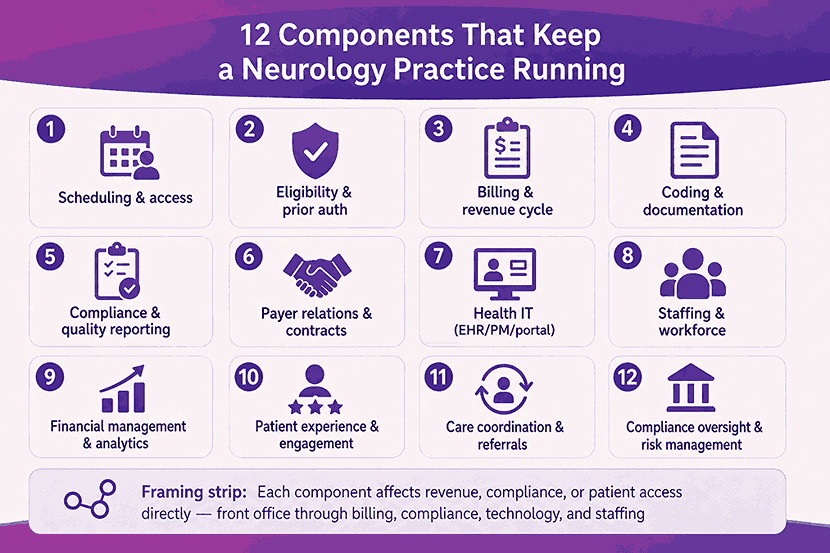
Neurology practice management covers the operational areas a practice must run every day. These components mirror standard practice-management consulting scope and the AAN’s resource map for practice operations. Each one affects revenue, compliance, or patient access directly.
The sections below break the work into twelve components. They move from front-office access through billing, compliance, technology, staffing, and patient engagement.
Patient Scheduling and Access Management
Patient scheduling and access management is the work of booking, confirming, and optimizing appointments across providers and locations. It controls how quickly new patients get seen.
Neurology scheduling is complex. It handles new-patient consults, infusion suites, EEG and EMG slots, and chronic-disease follow-ups for epilepsy, MS, Parkinson’s, and migraine. Automated reminders cut no-show rates and help shorten the average 35-day new-patient wait.
Insurance Eligibility and Prior Authorization
Eligibility and prior authorization management confirms coverage before service and secures approval for procedures that require it. Both protect revenue before a claim is ever filed.
Real-time eligibility verification confirms coverage, copay, deductible, and benefit limits for neurology procedures. Prior authorization tracking protects revenue on MRIs, EMG/NCS, Botox for migraine, infusions, and neurostimulators. Prior auth is one of the heaviest administrative burdens in neurology.
Medical Billing and Revenue Cycle
Medical billing and revenue cycle management is the full process of converting care into collected payment. It runs from charge capture through final patient collections.
Neurology billing covers charge capture, claim submission, payment posting, denial management, and patient collections. It is anchored by accurate CPT (95700-96020), ICD-10 (G00-G99), and modifier work. Billing performance is the single largest driver of neurology practice financial health.
Medical Coding and Documentation
Medical coding and documentation translate clinical services into standardized billing codes backed by supporting notes. Accuracy here determines what the practice gets paid.
Certified coders convert neurology services into CPT, ICD-10, and HCPCS Level II codes with the right modifiers. Those services include E/M, EEG, EMG, NCS, evoked potentials, Botox, and neurostimulator programming. Documentation accuracy drives both reimbursement and audit defense.
Common neurology modifiers include the following:
| Modifier | Meaning | Typical Neurology Use |
|---|---|---|
| 25 | Significant, separate E/M same day | E/M plus a procedure visit |
| 26 | Professional component | Interpretation of EEG or imaging |
| TC | Technical component | In-office EEG or NCS equipment use |
| 59 | Distinct procedural service | Separate NCS and EMG studies |
| 95 | Synchronous telehealth | Virtual neurology consultation |
Regulatory Compliance and Quality Reporting
Regulatory compliance and quality reporting cover the rules a practice must follow and the performance data it must submit. Both carry direct financial consequences.
Neurology practices manage HIPAA, MACRA/MIPS, Stark and Anti-Kickback rules, controlled substance prescribing, and value-based-care reporting. MIPS performance directly affects Medicare reimbursement and practice reputation. Missed reporting deadlines can trigger payment penalties.
Payer Relations and Contract Management
Payer relations and contract management cover how a practice negotiates rates and tracks payer policy changes. This work protects the integrity of every reimbursement rate.
Practices negotiate payer contracts and monitor policy changes such as prior auth triggers, biologic coverage, and EEG/MRI rules. They benchmark reimbursement against market rates. Active payer relations protect rate integrity and recover underpayments before they compound.
Health Information Technology (EHR, PM, Patient Portal)
Health information technology is the connected system of platforms that runs clinical and administrative work. It is the technology spine of every modern neurology practice.
The stack includes the EHR, practice management platform, patient portal, e-prescribing engine, and telehealth tools. ONC-certified, interoperable systems support MIPS reporting, care coordination, and patient experience. Poor integration forces staff into manual re-entry and error.
Staffing, Workforce and Talent Management
Staffing and workforce management cover hiring, training, and retaining the people who run the practice. In neurology, this happens against a national talent shortage.
Practices manage neurologists, advanced practice providers, MAs, billers, coders, and front-desk staff. They do so amid high emotional exhaustion among neurologists and a projected 19% national shortage by 2025. Workforce stability drives operational performance directly.
Financial Management and Practice Analytics
Financial management and analytics turn practice data into decisions about money and growth. This is where leadership reads the health of the business.
Practices track P&L, expense ratios, payer mix, and KPI dashboards. Core dashboards cover clean claim rate, days in A/R, net collection rate, and revenue per neurologist. Data-driven analytics support contract negotiation and strategic planning.
Patient Experience and Engagement
Patient experience and engagement cover how patients interact with the practice between and during visits. In chronic neurology, engagement directly affects outcomes.
Digital intake, telehealth, secure messaging, online payments, and educational content support long-term care. That care spans epilepsy, MS, migraine, and dementia. Strong engagement reduces no-shows and improves treatment adherence over time.
Care Coordination and Referral Management
Care coordination and referral management connect the neurology practice to the wider care team. They matter most for complex, multi-specialty cases.
Practices coordinate with primary care, neurosurgery, psychiatry, physical therapy, and infusion centers. They use Direct messaging, health information exchange, and referral tracking. Closed-loop referrals are essential for complex neurological cases that cross specialties.
What are the Key Features of Neurology Practice Management Software?
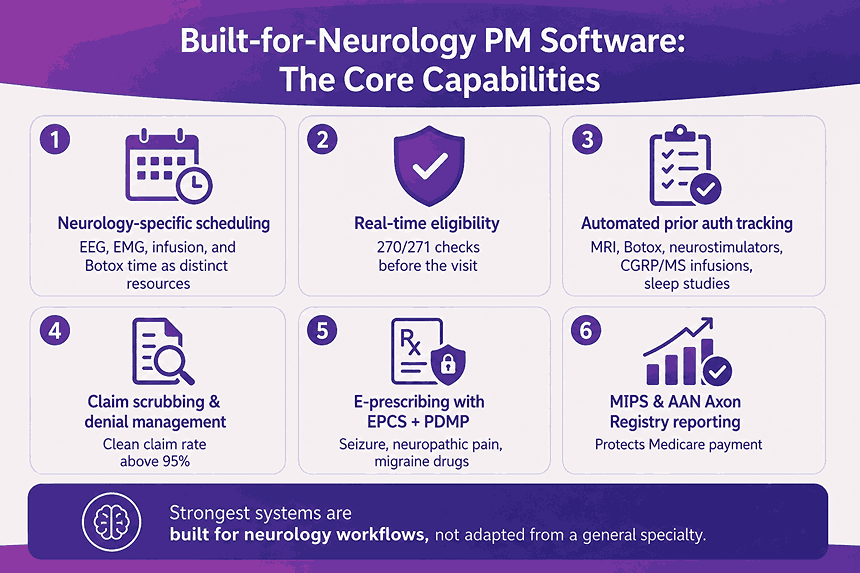
Neurology practice management software combines scheduling, eligibility, billing, reporting, and compliance in one platform. The strongest systems are built for neurology workflows rather than adapted from general specialties. The features below define what a modern platform should provide.
These capabilities map closely to the components above. The difference is that software turns each manual workflow into an automated, trackable process.
Neurology-Specific Scheduling and Procedure Room Management
Neurology-specific scheduling books visits and procedure rooms around the realities of neurology care. It treats EEG, EMG, and infusion time as distinct resources.
The platform schedules new-patient consults, EEG/EMG/NCS time blocks, infusion appointments, Botox clinics, and chronic-disease follow-ups. It does this across multiple locations and providers. Scheduling automation helps shorten the 35-day average new-patient wait.
Real-Time Insurance Eligibility Verification
Real-time eligibility verification checks coverage instantly before a patient is seen. It removes guesswork from the front desk.
The system runs 270/271 transactions to confirm coverage, copays, deductibles, and neurology benefit limits before each visit. Upfront verification eliminates the top cause of neurology denials. Clean front-end data prevents downstream rework.
Automated Prior Authorization Tracking
Automated prior authorization tracking flags which services need approval and follows each request to a decision. It closes a major revenue gap in neurology.
The system identifies procedures that need prior approval and tracks status through to approval. Those procedures commonly include:
- MRI and CT imaging
- Botox for chronic migraine
- Neurostimulator implants
- CGRP infusions for migraine
- MS infusion therapies
- Advanced sleep studies
Proactive authorization management prevents the revenue gaps that missed approvals create.
Integrated Billing and Charge Capture
Integrated billing and charge capture generate claims automatically from documented services. This shortens the path from visit to submitted claim.
The system auto-generates claims with neurology CPT codes, ICD-10 codes, and required modifiers. Integrated billing accelerates the revenue cycle by removing manual claim assembly. The table below shows common neurology code pairings.
| Service | CPT Code | Common ICD-10 Pairing |
|---|---|---|
| EEG (routine) | 95812 | G40 (epilepsy) |
| EMG (needle) | 95860 | G35 (multiple sclerosis) |
| Nerve conduction studies | 95907-95913 | G20 (Parkinson’s disease) |
| Botox injection | 64615 | G43 (chronic migraine) |
Claim Scrubbing and Denial Management
Claim scrubbing and denial management validate claims before submission and recover the ones that get denied. Together they protect first-pass revenue.
The system checks CPT-ICD pairs, NCCI edits, MUE limits, and modifier requirements before submission. It then routes denials to specialists for appeal. Scrubbing raises the clean claim rate above 95% when it runs on every claim.
EHR Integration and Clinical Documentation
EHR integration connects the clinical record to the billing platform so data flows once. It removes duplicate entry between systems.
Bidirectional integration between a neurology EHR and the PM platform unifies demographics, clinical documentation, charge capture, and reporting. EMR-PM integration eliminates manual re-entry and the errors that come with it. For a deeper view of clinical systems, see our guide on neurology EMR software.
E-Prescribing with EPCS and PDMP Integration
E-prescribing with EPCS and PDMP sends prescriptions electronically while meeting controlled-substance rules. Neurology relies on it for high-risk medications.
Electronic prescribing supports controlled substance prescribing for seizure medications, neuropathic pain agents, and migraine drugs. It includes PDMP lookup and drug-interaction checks. EPCS also supports MIPS Promoting Interoperability scoring.
Patient Portal and Online Payments
The patient portal and online payments give patients self-service access to records and billing. They reduce front-desk volume and speed collections.
Patients use the portal to view neurology records, complete intake, read educational content, request refills, and pay bills. Educational content often covers epilepsy, MS, and migraine. Portal engagement supports chronic disease adherence between visits.
Telehealth and Remote Visit Support
Telehealth and remote visit support enable virtual neurology care inside the same platform. They extend access without adding clinic capacity.
Integrated telehealth supports virtual consultations, chronic disease follow-ups, post-procedure check-ins, and cognitive screening. Those follow-ups cover conditions like epilepsy, MS, and Parkinson’s. Telehealth expands access for distant patients and reduces no-shows.
MIPS, Quality Measure and AAN Axon Registry Reporting
MIPS and quality reporting track the measures that determine Medicare payment adjustments. Neurology has registry options built for the specialty.
Dashboards track MIPS quality measures, Promoting Interoperability, and Improvement Activities relevant to neurology. They support submission to the AAN Axon Registry, the specialty’s qualified clinical data registry. MIPS performance directly affects Medicare reimbursement.
Reporting, Analytics and KPI Dashboards
Reporting and analytics turn raw activity into the metrics leadership uses to manage. They are the control panel of the practice.
Dashboards track the following metrics:
- Clean claim rate and first-pass resolution rate
- Days in A/R and net collection rate
- Denial rate and scheduling utilization
- Revenue per neurologist
Analytics drive operational decisions and strengthen the data behind contract negotiations.
HIPAA Compliance and Data Security
HIPAA compliance and data security protect patient information across the platform. They are a baseline requirement, not a feature add-on.
The system uses encryption, role-based access, audit logs, multi-factor authentication, and SOC 2 controls. These protect sensitive neurological patient data. The same controls also support EPCS and PDMP compliance for controlled substances.
What are the Common Challenges in Neurology Practice Management?
Neurology practices face recurring operational and financial challenges that are heavier than most specialties. They stem from documentation density, prior auth load, payer scrutiny, and a thin workforce. Each challenge below carries a measurable cost.
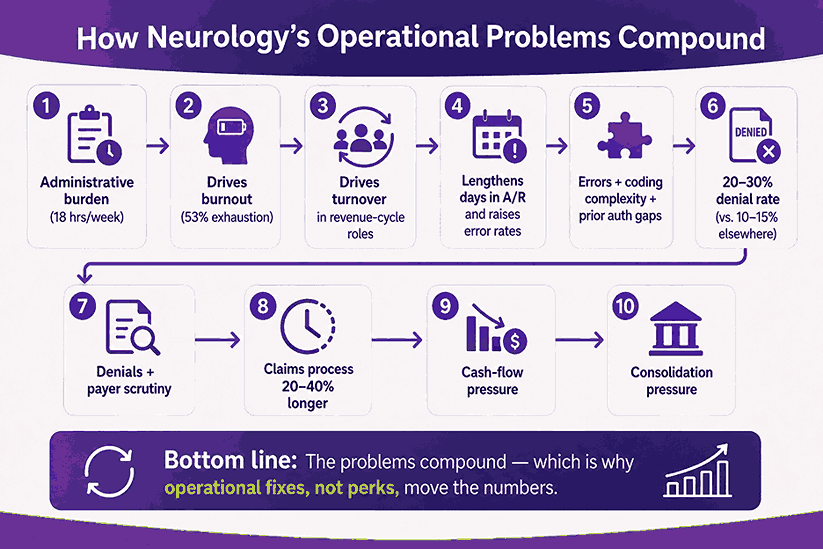
These problems compound. Administrative burden feeds burnout, burnout feeds turnover, and turnover lengthens days in A/R. Understanding the chain helps target the right fix.
Heavy Administrative Burden
Neurologists spend an average of 18 hours per week on paperwork and administration. That load is a major driver of burnout and lost clinical hours.
Managing patient records, billing complexity, and prior authorizations adds layer after layer of non-clinical work. Every hour spent on administration is an hour not spent with patients. This burden is the root cause behind several challenges below.
Declining Reimbursement and Financial Pressure
Independent neurology practices face falling insurer and Medicare reimbursement against rising operating costs. Salaries, supplies, and technology investment all climb at once.
The shift to value-based care requires investment in tracking systems and reporting. At the same time, high inflation raises patient cost sensitivity. The squeeze between lower payments and higher costs strains practice margins.
Neurologist Burnout
Burnout is widespread in neurology. In the AAN’s national survey, 53% of neurologists reported high emotional exhaustion and 60% reported at least one symptom of burnout.
Burnout drives reduced productivity and early retirement. The top contributors are administrative load, EHR documentation, and prior authorization burden. These are operational problems, which means operational fixes can move the number.
Workforce Shortage
Demand for neurologists is projected to exceed supply by 19% by 2025, according to the AAN Workforce Task Force. The gap is widening as the population ages.
This shortage drives the 35-day average new-patient wait and puts pressure on existing providers. Fewer neurologists must see more patients with more complex conditions. Team-based care and telehealth help absorb part of the gap.
Prior Authorization Burden for High-Cost Procedures
Prior authorization for high-cost neurology procedures consumes significant staff time. The work scales with the practice’s procedure mix.
Authorization-heavy services include MRI, Botox for chronic migraine, neurostimulators, CGRP infusions, MS biologics, and advanced sleep studies. Missed authorizations are a leading source of revenue leakage. A single denied infusion can erase a day’s margin.
High Claim Denial Rates
Neurology claim denial rates often run 20-30%, well above the 10-15% seen in most specialties. The cause is structural, not careless.
Denials stem from coding complexity, prior auth gaps, and documentation density. EEG, EMG, MRI, and Botox claims face the most denials. Each denial adds rework, delays cash, and risks write-off if it ages out.
Slow Claim Processing and Cash Flow Pressure
Neurology claims take longer to process than most specialties because payers scrutinize high-cost services. Slow payment strains working capital.
The delay can run 20-40% longer than other specialties. For small and mid-size practices, that lag is hard to absorb. Slow reimbursement turns a profitable practice into a cash-constrained one.
Constantly Changing Regulations and Payer Policies
CMS, MACs, and commercial payers frequently update the rules that govern neurology billing. Staying current is a continuous task.
Common changes include prior auth triggers, screening rules, biologic coverage, and MIPS reporting requirements. Annual CPT and ICD-10 updates require ongoing staff retraining. Falling behind on a single policy can trigger a wave of denials.
Independence vs Consolidation Pressure
Independent neurology practices face mounting consolidation pressure. The share of physicians in independent private practice has fallen sharply over the past two decades.
Administrative and financial burdens push practices toward hospital employment or private-equity-backed consolidation. The decision is often forced by operational strain rather than chosen. Strong practice management is the main lever for staying independent.
Patient Access and 35-Day Wait Times
Average first-visit wait times of 35 days or more strain neurology practices and patients alike. The standard of care target is two weeks.
Long waits delay diagnosis and frustrate referring physicians. Scheduling automation, telehealth, and team-based care help close the access gap. Faster access also protects referral relationships with primary care.
Rising Patient Financial Responsibility
High-deductible health plans shift more cost onto patients. That creates large patient balances after neurology consultations and procedures.
Patients now carry a bigger share of the bill than a decade ago. Transparent upfront cost estimates and online payments help close the collection gap. Practices that wait until after service to discuss cost collect less.
Staffing Turnover and Specialized Skill Shortage
Neurology billing requires staff fluent in CPT 95700-96020 and ICD-10 G00-G99. That expertise is scarce and hard to replace.
High turnover in revenue cycle positions creates coverage gaps. Staffing instability prolongs days in A/R and increases error rates. Each new hire takes months to reach full neurology coding proficiency.
What are the Best Practices for Neurology Practice Management?
The strongest neurology practices treat management as a system, not a set of one-off fixes. The practices below address the challenges above directly. Each one targets a specific cost, from administrative load to denial rate.
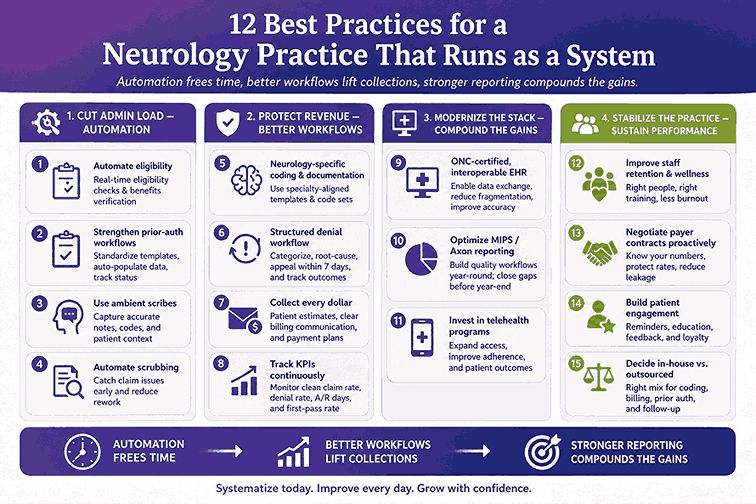
These twelve practices work together. Automation frees staff time, better workflows lift collections, and stronger reporting compounds the gains over time.
- Reduce Administrative Burden Through Automation: AI-powered eligibility verification, automated prior auth, ambient documentation scribes, and claim scrubbing recover hours per provider per day. Automation directly addresses the 18-hour-per-week administrative load.
- Strengthen Prior Authorization Workflows: Proactive prior auth for MRI, Botox, infusions, and neurostimulators prevents revenue leakage and protects patient access. An authorization tracker with renewal alerts keeps approvals from lapsing.
- Implement Neurology-Specific Coding and Documentation: Specialty-built EMR templates, filtered CPT/ICD-10 libraries, and modifier prompts reduce coding errors at charge entry. Documentation accuracy determines reimbursement at the point of care.
- Build a Structured Denial Management Workflow: Categorize denials by CARC/RARC reason code, route them to specialists, and appeal within 7 days to recover a large share of denied revenue. Denial pattern analysis surfaces upstream causes for a permanent fix.
- Track KPIs and Refine Workflows Continuously: Monitor clean claim rate, first-pass resolution rate, days in A/R, net collection rate, denial rate, and revenue per neurologist. KPI-driven optimization compounds revenue gains over quarters.
- Use ONC-Certified Neurology EHR with Interoperability: An ONC-certified EHR with FHIR APIs, HL7 messaging, and HIE connectivity supports care coordination, MIPS reporting, and Cures Act compliance. Interoperability matters most for complex, multi-specialty cases.
- Optimize MIPS and Quality Reporting: Track quality measures, Promoting Interoperability, and Improvement Activities throughout the year rather than at deadline. AAN Axon Registry submission supports neurology-specific quality reporting and protects Medicare payment.
- Implement Telehealth and Remote Care Programs: Virtual consultations, chronic disease follow-ups, post-procedure check-ins, and cognitive screening expand access and supplement in-office visits. Telehealth helps address the 35-day new-patient wait.
- Improve Staff Retention and Workforce Wellness: Addressing the 53% emotional-exhaustion rate requires structural change, not perks. Administrative offload, ambient documentation, predictable scheduling, and wellness programs drive retention and operational performance.
- Negotiate Payer Contracts Proactively: Active contract review surfaces underpayments and identifies leverage for renegotiation. Contract analytics and payer benchmarking support data-driven negotiations that protect rate integrity.
- Build Patient Engagement and Access Programs: Patient portals, online scheduling, automated reminders, and educational content raise adherence and cut no-shows. Engagement is most valuable in chronic neurology such as epilepsy, MS, migraine, and dementia.
- Decide Between In-House and Outsourced Practice Management: Evaluate whether in-house capacity matches the practice’s complexity and growth plans. When it does not, a specialty neurology PM partner is often the smarter move.
How to Choose the Right Neurology Practice Management Partner?
To choose the right neurology practice management partner, start by matching the partner’s capabilities to your practice’s actual pain points. The right partner closes your specific gaps in billing, prior auth, technology, and compliance. Work through the steps below in order.
- Assess Your Practice’s Current Pain Points: Quantify admin burden, denial rate, wait times, and burnout before you shop. Your worst metric defines your priority.
- Map Required Components: Identify which areas you need covered: billing, operations, regulatory, payer relations, and HIT. Scope drives the contract.
- Verify Neurology-Specific Templates and Workflows: Confirm the partner is built for neurology, not adapted from a general specialty. Generic tools create coding errors.
- Confirm Automated Prior Authorization Capabilities: Prior auth is the heaviest neurology burden, so automation here pays back fastest. Ask for status-tracking detail.
- Validate ONC-Certified EHR and Interoperability: Require FHIR APIs, HL7 messaging, and HIE connectivity. Interoperability supports care coordination and MIPS.
- Inspect MIPS, AAN Axon Registry, and Quality Reporting Support: Confirm the partner tracks and submits the measures that protect Medicare payment. Ask how reporting runs year-round.
- Evaluate Claim Scrubbing and Denial Management Workflows: Ask for clean claim rate benchmarks and the denial appeal process. A 95% clean claim rate is the target.
- Review Patient Engagement and Telehealth Capabilities: Confirm portal, online payment, and integrated telehealth support. These tools cut no-shows and improve access.
- Compare Software vs Service Pricing Models: Understand per-provider versus percentage-of-collections pricing. The right model depends on volume and margin.
- Confirm HIPAA Compliance, SOC 2, and Data Security Posture: Require encryption, audit logs, BAAs, and SOC 2 controls. Security is non-negotiable in neurology.
- Assess Vendor Experience with Independent Neurology Practices: Ask for references from practices like yours. Independent-practice experience signals fit.
- Review Contract Terms and Path to Practice Independence: Read exit terms, data ownership, and renewal clauses closely. The right partner protects your independence, not theirs.
A specialty billing partner often anchors this decision. Practices weighing outside support should get our neurology medical billing services to see how denial management, coding, and prior auth coverage work in practice.
What is the Difference Between Neurology EMR and Practice Management Software?
EMR/EHR software handles clinical documentation and care coordination, while practice management software handles administrative and financial workflows. The EMR records the visit; the PM platform schedules it, verifies eligibility, bills it, and reports on it. Integrated EMR + PM suites combine both into one system, so demographics and charges flow without re-entry. For a closer look at the clinical side, see our guide on neurology EMR software.
How Much Time Do Neurologists Spend on Administrative Work?
Neurologists spend an average of 18 hours per week on paperwork and administration. That load contributes to high emotional exhaustion, reported by 53% of neurologists in the AAN national survey. Practice management automation can recover several hours per provider each day through eligibility automation, ambient scribing, and claim scrubbing. Reducing this burden is the most direct lever against burnout.
Why is Neurology Practice Management So Complex?
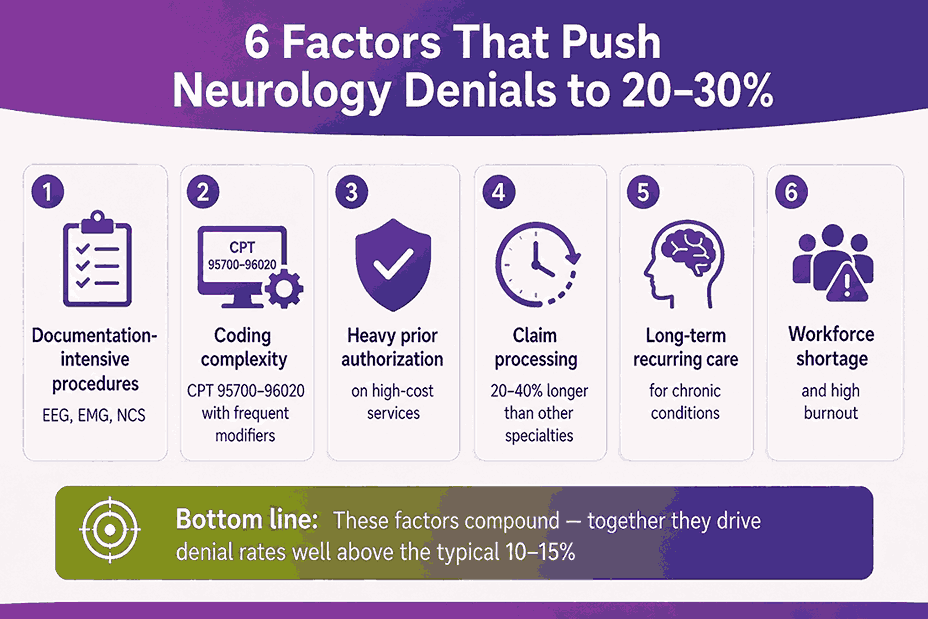
Neurology carries higher practice-management complexity than most specialties for several reasons:
- Documentation-intensive procedures such as EEG, EMG, and NCS
- CPT 95700-96020 coding complexity with frequent modifiers
- Heavy prior authorization burden on high-cost services
- Claim processing that runs 20-40% longer than other specialties
- Long-term recurring care for chronic conditions
- Workforce shortage and high burnout
These factors compound, as together they push neurology denial rates to 20-30%, well above the typical 10-15%.
How Can Independent Neurology Practices Stay Independent?
Partnering with neurology-specialty practice management experts addresses the financial, administrative, and operational pressures that push practices toward consolidation. The right partner optimizes billing, technology, payer relations, and operations as a system. That work protects margin and recovers provider time. Strong management is the main reason a practice can decline hospital employment or private-equity acquisition and stay independent.
How Can Neurology Practices Reduce Burnout?
Reducing the 53% emotional-exhaustion rate requires structural change, not wellness slogans. The most effective steps are:
- Reducing administrative load through automation
- Adding ambient documentation scribes
- Building predictable scheduling and team-based care
- Funding wellness programs and protected PTO
- Offloading billing and prior auth to specialists
These changes return clinical time to providers, which is the strongest driver of retention.
What Software is Best for Neurology Practice Management?
Several platforms are common in neurology practice management. AdvancedMD, RXNT, McKesson, NextGen, ModMed, athenaOne, eClinicalWorks, CureMD, and PrognoCIS all serve neurology practices. The best fit depends on practice size, ASC affiliation, and EHR preference. A solo practice and a multi-site group will rank these platforms differently, so match the tool to your workflow rather than to a feature list.
How Does AI Improve Neurology Practice Management in 2026?
AI-powered tools now embed inside modern neurology PM platforms. They include ambient virtual scribes, automated eligibility, predictive denial scoring, prior auth automation, and KPI forecasting. AI copilots can save up to three hours of documentation time per provider per day. In neurology, the highest-value AI use is predicting and preventing denials before claims go out, since denial rework is the costliest part of the cycle.
Should Neurology Practices Outsource Practice Management?
Often, yes. Outsourcing makes sense for small practices, those with high denial rates, administrative overload, or limited specialty coding expertise. In-house management remains viable for large groups with experienced, stable revenue cycle staff. Many practices run a hybrid model, keeping front-office and scheduling in-house while outsourcing billing and prior auth. For the billing side of that decision, see our neurology medical billing guide.
What KPIs Should Neurology Practices Track?
These KPIs define neurology practice management performance:
| KPI | Target | Why It Matters |
|---|---|---|
| Clean Claim Rate | ≥95% | Fewer reworks, faster payment |
| First-Pass Resolution Rate | ≥90% | Claims paid on first submission |
| Days in A/R | <35 days | Speed of cash collection |
| Net Collection Rate | ≥95% | Share of collectible revenue captured |
| Denial Rate | <10% | Coding and prior auth health |
| New Patient Wait Time | <14 days | Patient access and referral retention |
| No-Show Rate | Track and reduce | Schedule utilization |
| Revenue per Neurologist | Track and grow | Overall practice productivity |
How Does Neurology Practice Management Impact Practice Revenue?
Effective practice management drives clean claim rate, days in A/R, net collection rate, and revenue per neurologist. Each metric ties directly to collected dollars. Poor management does the opposite. It produces denials, downcoding, burnout-driven turnover, and lost referrals, all of which erode revenue. The revenue cycle is where management quality becomes measurable.
How Long Does It Take to Implement Neurology PM Software?
Implementation typically takes 60 to 180 days. The timeline covers contract signing, EHR integration, data migration, clearinghouse enrollment, staff training, and parallel-run testing. Practice size and EHR complexity drive most of the variation. A small single-site practice can go live near the 60-day mark, while a multi-site group with complex integrations trends toward 180 days.
Is Neurology Practice Management Software HIPAA Compliant?
Yes. Reputable neurology PM platforms maintain HIPAA compliance through encryption, role-based access, audit logs, signed BAAs, and SOC 2 controls. Compliance is a baseline requirement for any platform handling neurological patient data. Practices should confirm a current BAA and SOC 2 report before signing, since compliance claims without documentation carry real risk.
Can Neurology Practice Management Software Support Telehealth?
Yes. Modern neurology PM platforms support virtual visits with integrated video, eligible CPT coding, and correct modifier and place-of-service application. Telehealth visits typically use modifier 95 with POS codes 02 or 10. This support extends access for distant patients and helps reduce no-shows, which matters most for chronic neurology follow-up care.