CPT code 93306 reports a complete transthoracic echocardiogram with spectral and color flow Doppler. The code covers the full 2D structural study and the interpreted Doppler in a single reportable service.
CPT 93306 carries the leading correct-coding trap in cardiology. Both Doppler studies are already inside the code, so billing the Doppler add-ons alongside it produces a denial on every claim, and no modifier reverses it.
That bundling rule, the professional and technical split, and post-payment audit exposure drive most revenue loss on this high-volume study. Many cardiology practices route echo claims through dedicated billing services for cardiology practices to manage them.
What Is the Description of CPT Code 93306?
The 93306 CPT code description as defined by the AMA is: “Echocardiography, transthoracic, real-time with image documentation (2D), includes M-mode recording, when performed, complete, with spectral Doppler echocardiography, and with color flow Doppler echocardiography.”
This code reports a complete resting transthoracic echocardiogram with the full Doppler package. CPT code 93306 combines the 2D structural study, spectral Doppler, and color flow Doppler into one code. The Doppler studies are part of the definition, not separate services.
The code is the everyday complete echo most cardiology practices bill. Procedure code 93306 applies only when both spectral and color flow Doppler are performed and interpreted, which separates it from the no-Doppler and limited studies below.
What Does a Complete Transthoracic Echocardiogram Include Under CPT Code 93306?
CPT code 93306 requires a complete structural study plus both Doppler modalities. A complete study evaluates all the standard cardiac structures, not a focused subset.
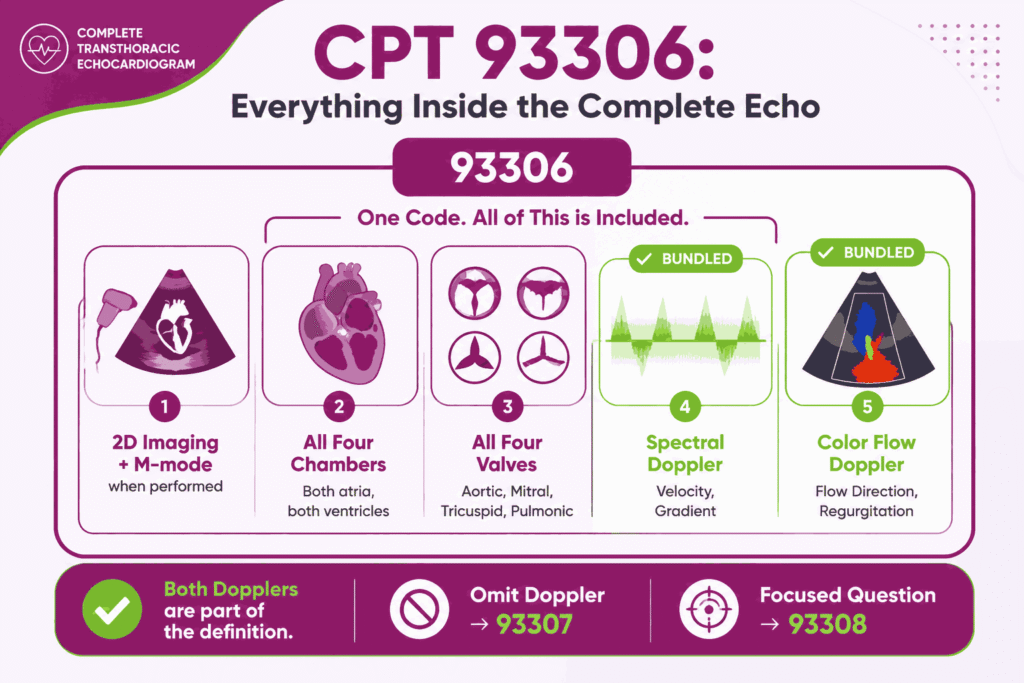
The components included in the code are:
- Real-time 2D imaging with M-mode recording when performed
- Evaluation of all four chambers, both atria and both ventricles
- Assessment of the four valves, aortic, mitral, tricuspid, and pulmonic
- Spectral Doppler for velocity and gradient measurement
- Color flow Doppler for flow direction and regurgitation mapping
All these elements belong to the single code. When the study omits Doppler, or evaluates only a focused question, CPT 93306 no longer fits and a different echo code applies.
How Does CPT Code 93306 Differ From CPT 93307 (Without Doppler), CPT 93308 (Limited), and CPT 93350/93351 (Stress Echo)?
The transthoracic echo codes split by completeness, by Doppler, and by whether the study is performed at rest or under stress. Code selection follows what was performed and documented.
The transthoracic echo family breaks down as follows:
- 93306 complete study at rest, with spectral and color flow Doppler included
- 93307 complete study at rest, without Doppler, when no Doppler is performed or documented
- 93308 limited or focused study, evaluating a specific question rather than all structures
- 93350 stress echocardiogram without continuous physician ECG monitoring, and 93351 stress echocardiogram with physician-supervised continuous ECG monitoring
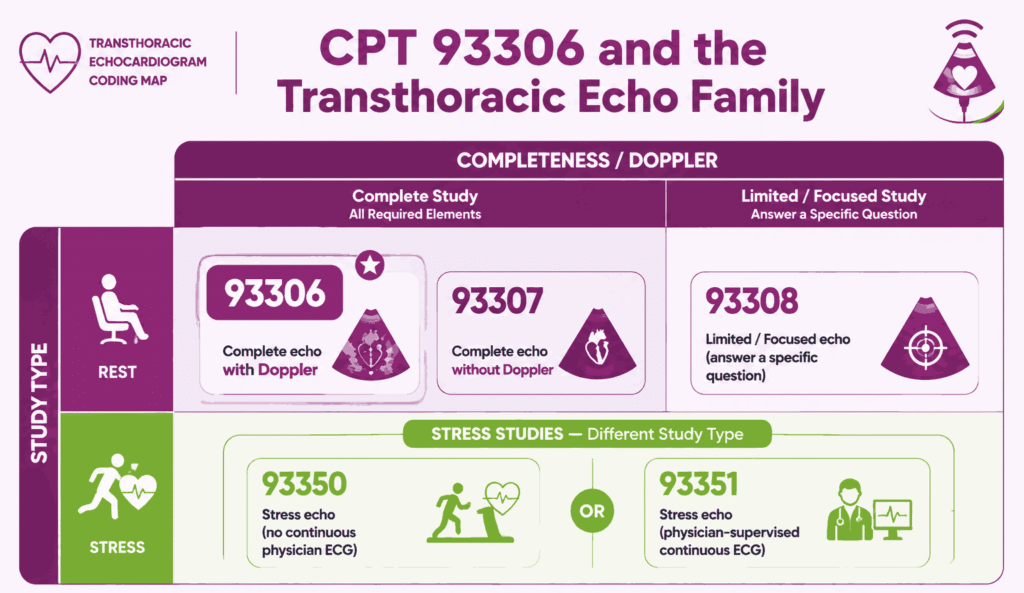
The rest-versus-stress and Doppler-versus-none axes decide the code. A complete resting study with both Dopplers is CPT code 93306, while the same complete study without Doppler drops to 93307, and a focused study is 93308. The rest, stress, and Doppler distinctions organize the echocardiography and cardiac imaging codes as a group, where completeness decides the code.
When Should CPT 93306 Be Billed Globally vs. With Modifier 26 or TC and Who Bills What in Each Setting?
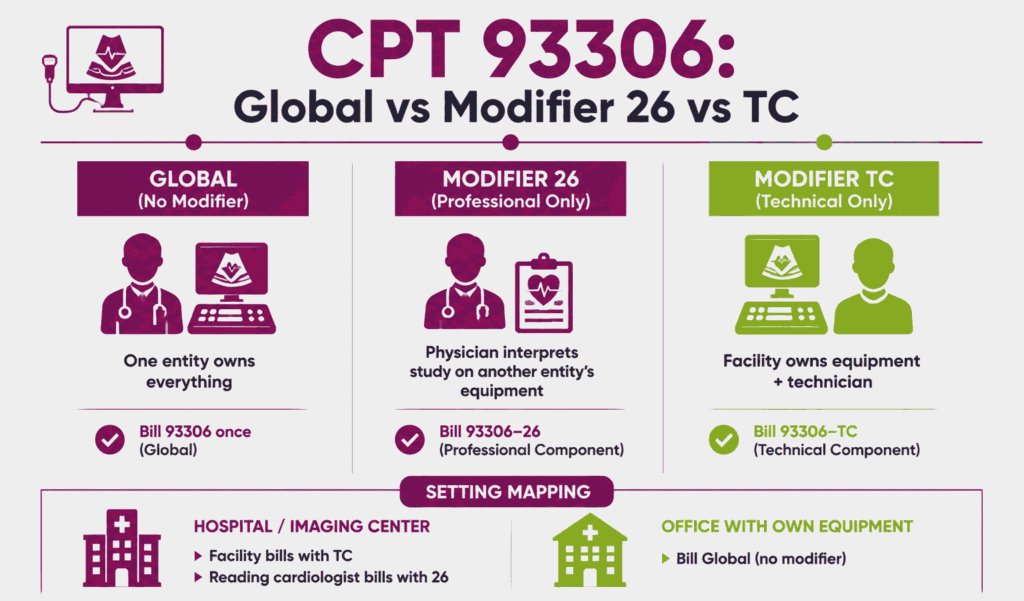
Bill CPT code 93306 globally when one entity owns both the equipment and the interpretation. Split the code with modifier 26 or TC when two entities divide that work.
The component billing options are:
- Global (no modifier): the same entity performs the acquisition and the interpretation, such as a physician-owned office with its own machine
- Modifier 26: the physician interprets a study acquired on another entity’s equipment, billing the professional component only
- Modifier TC: the facility owns the equipment and technician, billing the technical component only, while a separate physician interprets
- Never bill the global service plus a 26 or TC line for the same study by the same entity
In the hospital setting, the facility typically bills 93306 with modifier TC and the reading cardiologist bills modifier 26. In a physician office with its own equipment, the practice bills CPT 93306 globally.
How Is Contrast-Enhanced Echo (Definity/Optison) Billed With 93306, and When Is the Contrast Agent Separately Reimbursable?
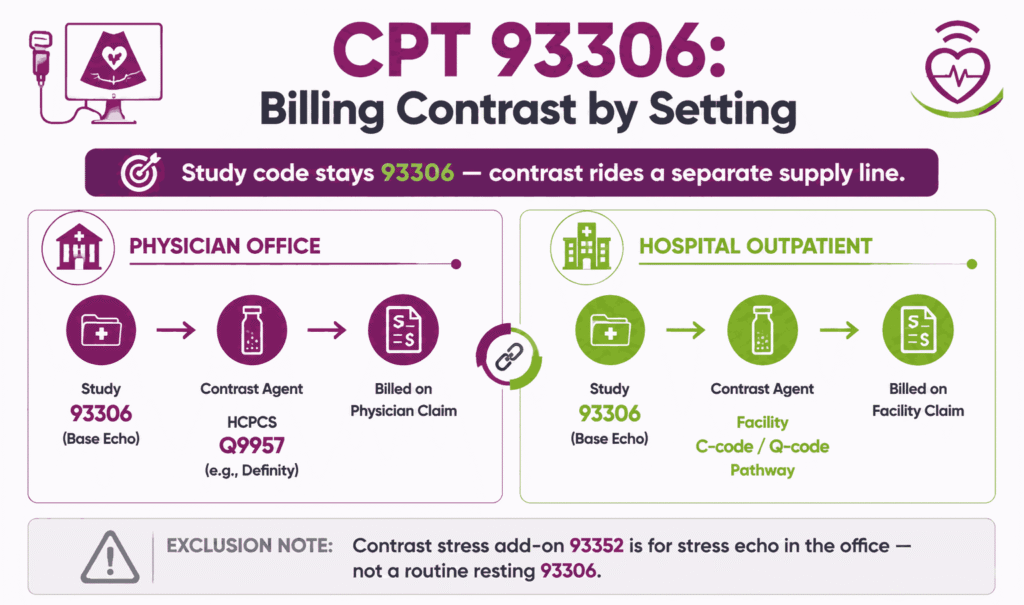
Contrast enhancement is billed through the setting’s contrast pathway, not by changing the CPT code 93306 study code. The agent itself is separately reportable, but the mechanism differs by place of service.
The contrast billing rules are:
- The echocardiography contrast agent, such as Definity or Optison, is separately reportable as a supply
- In the physician office, the contrast agent is reported with its HCPCS supply code, commonly Q9957 for Definity
- In the hospital outpatient setting, contrast is reported through the facility’s HCPCS C-code or Q-code pathway rather than the office add-on
- The contrast stress add-on 93352 applies to stress echocardiography in the office, not to a routine resting 93306
The study code stays 93306 for a contrast-enhanced complete resting echo. The revenue for the agent flows on a separate supply line, and the setting dictates which code carries it.
What ICD-10 Codes and Medical Necessity Criteria Support CPT Code 93306?
Medical necessity for CPT code 93306 rests on a cardiac sign, symptom, or condition that a complete echo is needed to evaluate. The diagnosis must justify a complete study rather than a limited one.
Representative supporting diagnoses include:
- I42.0 (Dilated cardiomyopathy) and I50.x heart failure codes for chamber and function assessment
- I48.x (Atrial fibrillation and flutter) for structural assessment before intervention
- I35.0 (Nonrheumatic aortic valve stenosis) and other valve codes for gradient and area evaluation
- R00.2 (Palpitations), R06.02 (Shortness of breath), and R55 (Syncope) as presenting symptoms warranting evaluation
The record must connect the study to the clinical question. A complete echo for a documented structural or functional concern supports procedure code 93306, while a screening study on an asymptomatic patient without a qualifying indication invites denial. Pairing the study to a qualifying sign or condition, from valve disease to the R-series symptom codes, follows standard cardiac diagnosis coding practice.
What are the Modifiers for CPT Code 93306?
CPT 93306 uses component modifiers, a reduced-service modifier, and repeat-study modifiers. The Doppler add-ons are not modifiers and never join this code.
Modifier 26: Professional Component Only (Physician Interpretation)
Modifier 26 reports the physician interpretation and written report only. Append modifier 26 to CPT code 93306 when the physician reads a study acquired on equipment the physician does not own. The signed interpretation supports the professional component.
Modifier TC: Technical Component Only (Equipment and Acquisition)
Modifier TC reports the equipment, supplies, sonographer time, and image acquisition only. The facility appends TC to 93306 when a separate physician interprets the study. The technical component covers the performance, not the reading.
Modifier 52: Reduced Services (Poor Acoustic Windows)
Modifier 52 reports a reduced service when the study is partially completed. Append modifier 52 to CPT code 93306 when poor acoustic windows or patient factors prevent full evaluation of all structures, but the study still exceeds a limited exam. The report must describe what could not be assessed.
Modifier 59: Distinct Procedural Service
Modifier 59 identifies a genuinely distinct procedural service. It does not apply to the Doppler add-ons with 93306, because those are bundled by definition and carry no modifier override. Reserve modifier 59 for a separate, unrelated service supported by documentation and confirmed against the NCCI edits.
Modifier 76: Repeat Procedure by Same Physician Same Date
Modifier 76 reports a repeat study by the same physician on the same date. Append modifier 76 to CPT code 93306 when a clinical change requires a second complete echo the same day by the same physician. The record must document the reason for repeating the study.
Modifier 77: Repeat Procedure by Another Physician
Modifier 77 reports a repeat study by a different physician on the same date. Append modifier 77 to 93306 when another physician repeats the complete echo the same day. The documentation must support the medical necessity of the repeat.
What Must Every 93306 Report Document (Nine Structures + Interpreted Doppler)?
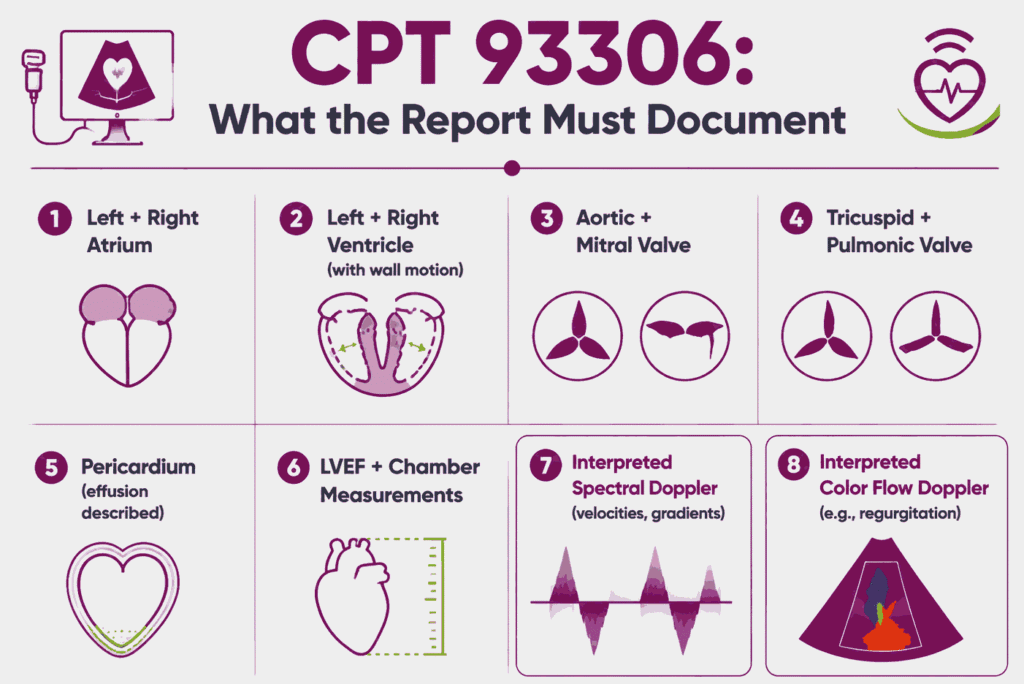
A complete CPT code 93306 report must document the standard cardiac structures and interpreted Doppler findings, not conclusions alone. A report listing only impressions fails an audit for medical necessity.
The report must document:
- The left atrium and the right atrium
- The left ventricle and the right ventricle, with wall motion
- The aortic valve and the mitral valve
- The tricuspid valve and the pulmonic valve
- The pericardium, with any effusion described
- Left ventricular ejection fraction and chamber measurements
- Interpreted spectral Doppler velocities and gradients
- Interpreted color flow Doppler findings, such as regurgitation
If the report does not document both spectral and color flow Doppler with interpreted findings, the study no longer meets the 93306 definition and drops to 93307. Template text that auto-populates “Doppler performed” without findings does not satisfy the requirement.
Which Documents Are Required For CPT Code 93306?
Documentation for CPT code 93306 must establish the clinical indication, the complete study, and the interpreted Doppler. The report is the primary audit defense.
The required documentation includes:
- The ordering provider and the clinical indication for the study
- A complete report documenting the standard structures and measurements
- Interpreted spectral and color flow Doppler findings, not template placeholders
- Left ventricular ejection fraction and chamber dimensions
- The interpreting physician signature and date
- The acquisition setting and, for split billing, the entity performing each component
- Any contrast agent used, reported on the appropriate supply line
What Is the Cost of CPT Code 93306?
The cost of CPT code 93306 depends on the payer, the setting, and whether the study is billed globally or split. Medicare prices the study through the Physician Fee Schedule.
RVUs & Medicare Payment
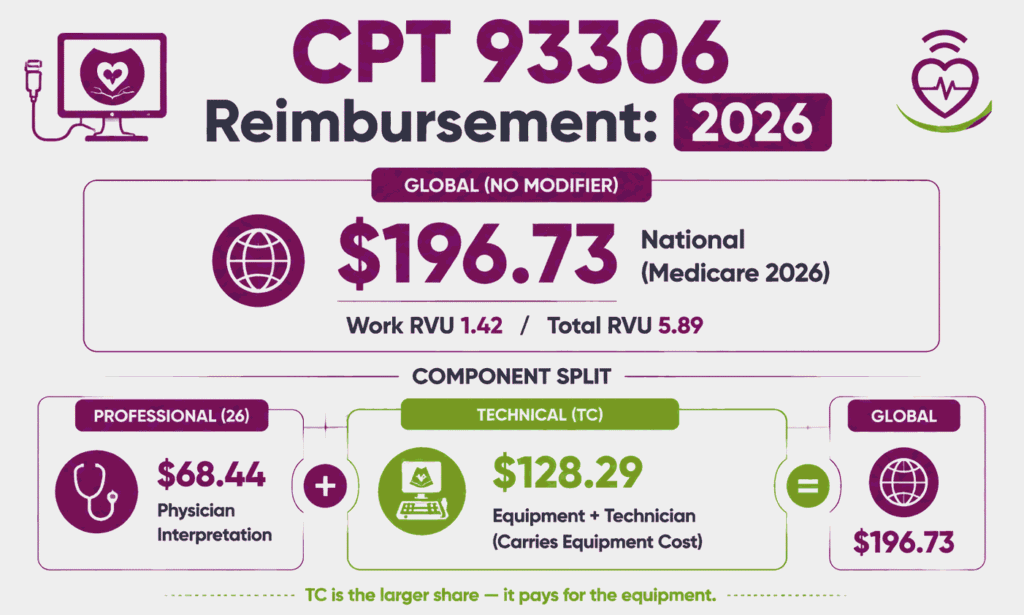
Medicare prices CPT code 93306 through the Physician Fee Schedule, with the global rate splitting into professional and technical components. The CY2026 values appear below.
| Component | Work RVU | Practice Expense (PE) / Malpractice (MP) | Total RVU | Formula & Final Payment |
|---|---|---|---|---|
| Global Service | 1.42 | 4.39 / 0.08 | 5.89 | 5.89 tRVU × $33.4009 = $196.73 |
| Professional (-26) | 1.42 | 0.55 / 0.05 | 2.02 | 2.02 tRVU × $33.4009 = $67.47 |
| Technical (-TC) | 0.00 | 3.84 / 0.03 | 3.87 | 3.87 tRVU × $33.4009 = $129.26 |
| Technical (MPPR) | 0.00 | 2.88 / 0.02 | 2.90 | 2.90 tRVU × $33.4009 = $96.86 |
The global payment splits between the professional component under modifier 26 and the larger technical component under modifier TC. The technical component carries the equipment cost, so it is the bigger share. GPCI adjustments change the final amount by locality.
Commercial Payers
Commercial plans reimburse procedure code 93306 at a contracted multiple of the Medicare rate. Allowed amounts vary by contract and by whether the claim is global, professional, or technical.
The component split matters for commercial revenue. A hospital-based reading cardiologist collects only the professional component, while the facility collects the technical component, so the two claims together equal the global amount. Prior authorization is generally not required, but the study remains subject to post-payment review.
Place-of-Service & Geographic Adjustments
Place of service determines how CPT code 93306 is billed and by whom. Locality then adjusts the payment.
Key setting and geographic factors include:
- Physician office with owned equipment bills the study globally, collecting both components
- Hospital outpatient billing splits the study, with the facility billing TC and the reading physician billing 26
- The technical component is the larger share, since it carries the equipment and staffing cost
- GPCI values adjust the work, practice expense, and malpractice components by locality
What Are Example Clinical Scenarios or Use Cases for CPT Code 93306?
CPT code 93306 applies when a complete resting echo with Doppler answers a structural or functional question. The scenarios below show common indications.
Scenario 1: Newly Diagnosed Dilated Cardiomyopathy Requiring Baseline Ejection Fraction and Chamber Dimension Assessment
ICD-10: I42.0 (Dilated cardiomyopathy)
A patient with new heart failure symptoms and a suspected cardiomyopathy needs a baseline structural and functional study. The cardiologist performs a complete transthoracic echocardiogram with full Doppler to measure ejection fraction and chamber dimensions. The practice reports CPT code 93306 globally in the office setting. The report documents all standard structures, the ejection fraction, and interpreted Doppler findings.
Scenario 2: Newly Diagnosed Atrial Fibrillation Requiring Structural Assessment Before Cardioversion
ICD-10: I48.91 (Unspecified atrial fibrillation)
A patient with newly diagnosed atrial fibrillation needs a structural assessment before treatment planning. The cardiologist performs a complete echo with Doppler to evaluate chamber size, valve function, and ventricular performance. In the hospital setting, the facility reports CPT 93306 with modifier TC and the reading cardiologist reports modifier 26. The interpreted Doppler and structural findings support the complete study.
Scenario 3: Moderate Aortic Stenosis on Serial Surveillance for Valve Gradient and Area Progression
ICD-10: I35.0 (Nonrheumatic aortic valve stenosis)
A patient with known moderate aortic stenosis returns for scheduled surveillance to track gradient and valve area. The cardiologist performs a complete echo with spectral Doppler to measure the aortic gradient and calculate valve area. The practice reports CPT code 93306, with the progression of stenosis documented against the prior study. Serial surveillance is medically necessary and supported by the valve diagnosis.
What Are the CPT Code 93306 Rules To Ensure Successful Reimbursement?
Follow the Doppler bundling rules, the unit and repeat-study rules, and the documentation standards that withstand audit. Meeting these rules protects CPT code 93306 claims from denial and post-payment recovery.
Bundling / NCCI: Why CPT 93320, 93321, and 93325 Cannot Be Billed With CPT 93306 (and Why Modifier 59 Does Not Help)
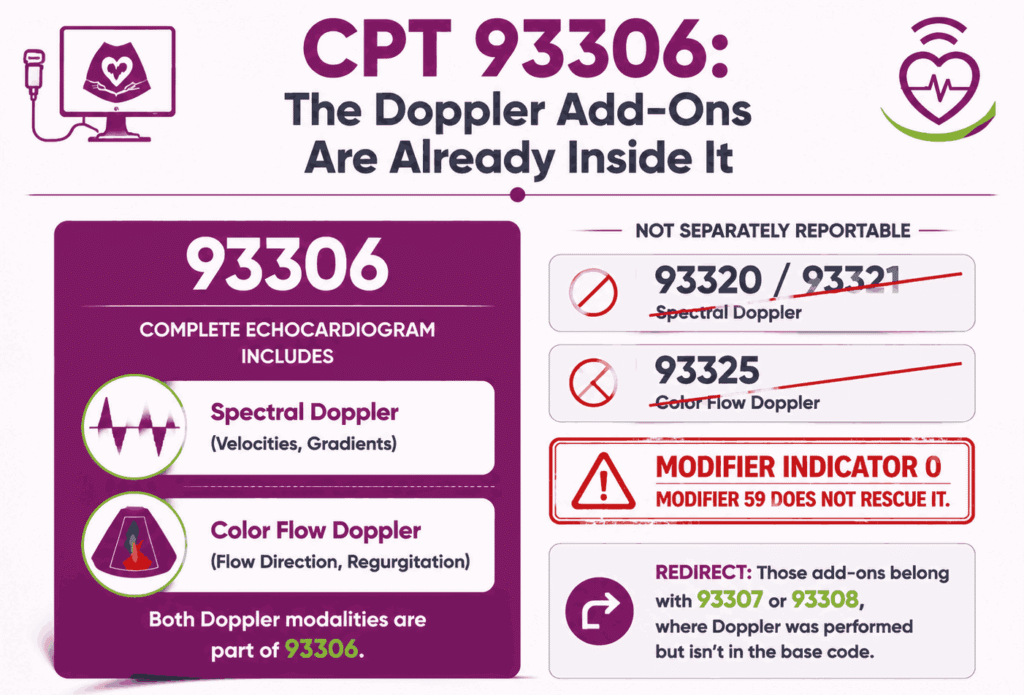
The Doppler add-on codes are already inside CPT code 93306, so billing them alongside it is the leading NCCI-related denial in cardiology. The edit carries a modifier indicator of 0, which no modifier overrides.
The Doppler bundling rules are:
- 93320 and 93321 spectral Doppler and 93325 color flow Doppler are components of 93306, not separate services
- The NCCI edit pairing these codes with 93306 has a modifier indicator of 0, so modifier 59 does not rescue the line
- The add-on line denies on every claim, regardless of documentation
- Those add-on codes belong with 93307 or 93308, where Doppler was performed but is not part of the base code
The rule is structural: when CPT 93306 is on the claim, no Doppler add-on joins it. Guides that advise adding 93320 or 93325 to complete the study are wrong, and following that advice produces automatic denials.
Units, MUEs & Repeat-Study Medical-Necessity Rules (No Hard Annual Limit)
CPT code 93306 is billed as one unit per study per date of service. There is no fixed annual limit, but each study must carry its own medical necessity.
Unit and repeat-study rules include:
- One unit per date of service, since the code describes one complete study
- No hard annual frequency cap applies, so repeat studies turn on documented clinical change
- A same-day repeat by the same physician uses modifier 76, and a repeat by another physician uses modifier 77
- Confirm the current Medically Unlikely Edit value through CMS, since the table updates quarterly
RAC Topic 0111 Audit Risk and Documentation Requirements That Prevent Post-Payment Recovery
CPT code 93306 is subject to post-payment review under Recovery Audit Contractor Topic 0111. Medicare does not require prior authorization, which shifts the scrutiny to after payment. Post-payment review is where the AMA code set gets tested against the record, since a paid 93306 line can still be recovered on audit.
The audit-defense requirements are:
- The report must document the standard structures, measurements, and interpreted Doppler findings, not conclusions alone
- The clinical indication must support a complete study, and a limited exam should be coded 93308
- A study without documented spectral and color flow Doppler does not meet 93306 and should be 93307
- Retaining the ordering documentation and the signed interpretation protects the claim against recovery
Top Reasons For Denials Specific To 93306 & Quick Remedies
- Doppler Add-On Codes Billed With 93306: Prevent by removing 93320, 93321, and 93325 from any claim carrying CPT code 93306, since the edit has no modifier override.
- Missing Doppler Documentation: Prevent by documenting interpreted spectral and color flow Doppler findings, or coding 93307 when Doppler is genuinely absent.
- Comprehensive Code for a Limited Study: Prevent by coding 93308 when the study is focused, and reserving 93306 for a complete study of all structures.
- Component Billing Errors: Prevent by billing modifier 26 for interpretation and modifier TC for acquisition when different entities perform each part, and never both with the global service.
- Thin Reports That Fail Audit: Prevent by documenting all structures, ejection fraction, chamber measurements, and interpreted Doppler, to withstand RAC Topic 0111 review.