Summary: “Radiology ICD-10 coding does not behave like most specialty coding. There is no fixed block of ‘radiology diagnosis codes’ — the diagnosis code on an imaging claim describes why the study happened and what it showed. Coders follow the reason-for-exam principle, using the clinical indication as the primary diagnosis. When imaging confirms a diagnosis, that diagnosis replaces the symptoms. When no definitive diagnosis is reached, abnormal finding codes (R90-R94) or symptom codes apply. Screening exams use Z codes. Clean radiology coding protects revenue by turning medical necessity into a defensible claim on the first pass.”
Radiology ICD-10 coding does not behave like most specialty coding. There is no fixed block of “radiology diagnosis codes” the way there is a fixed block of radiology CPT codes. The diagnosis code on an imaging claim describes why the study happened and what it showed. That single fact shapes every coding decision, every denial pattern, and every dollar of imaging revenue.
This guide explains how diagnosis coding actually functions for imaging services. It walks through the reason-for-exam principle, confirmed findings, abnormal imaging codes, screening logic, and the documentation that holds a claim together. The aim is a working model you can apply across any modality and any body region.

What Are Radiology ICD-10 Codes And Why Do They Work Differently?
Radiology ICD-10 codes are diagnosis codes that report the clinical reason for an imaging study and any confirmed findings. They are not a self-contained code family. A chest X-ray, a brain MRI, and a renal ultrasound each pull from completely different ICD-10 chapters.
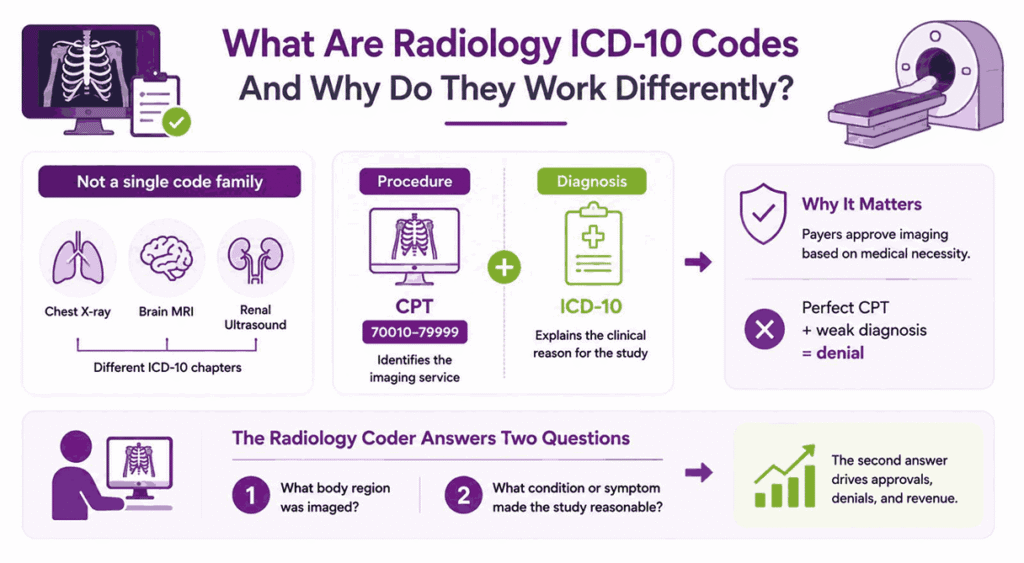
The procedure lives in CPT. The radiology CPT range 70010 through 79999 identifies the imaging service performed. The ICD-10 code answers a different question entirely. It tells the payer what clinical problem justifies that service.
This split matters because payers approve imaging based on medical necessity. The diagnosis code is evidence of that necessity. A perfect CPT code paired with a weak diagnosis code still produces a denial.
So the radiology coder is really answering two questions per claim. What body region was imaged, and what condition or symptom made the study reasonable? The second question is where most of the difficulty and most of the lost revenue live.
Why Does Radiology Coding Depend On The Reason For The Exam?
The reason for the exam drives the primary diagnosis on nearly every imaging claim. This flows directly from the ICD-10-CM Official Guidelines for outpatient services. Coders sequence first the condition or reason chiefly responsible for the encounter.
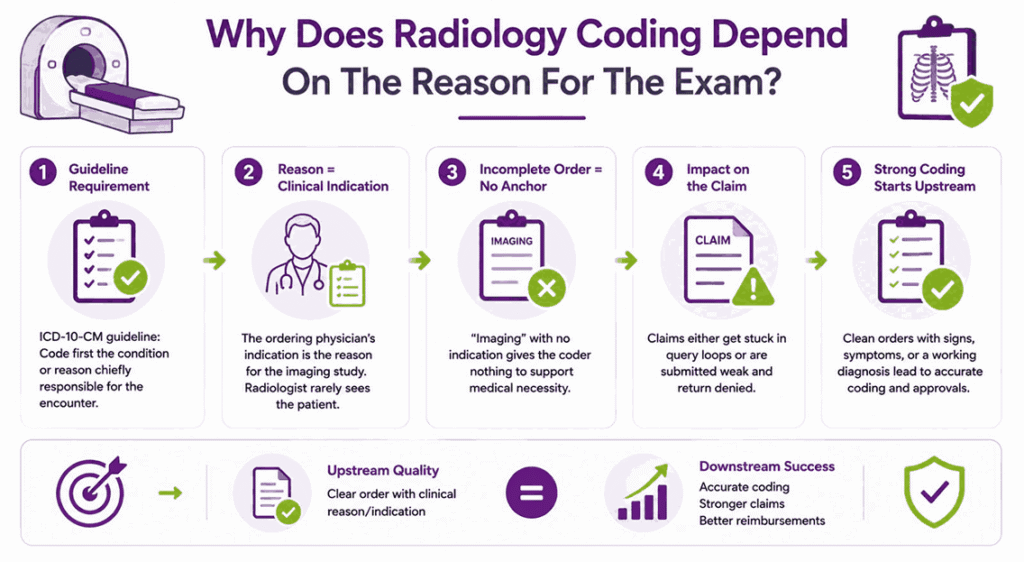
For a diagnostic imaging study, the reason is the clinical indication supplied by the ordering physician. A radiologist rarely examines the patient in person. The indication on the order is the coder’s window into why the study was needed.
This creates a dependency that many practices underestimate. If the order says “imaging” with no indication, the coder has nothing to anchor medical necessity. The claim either stalls in a query loop or goes out weak and returns denied.
Strong radiology coding, therefore, starts before the scan. It starts with a clean order that carries signs, symptoms, or a working diagnosis. Everything the coder does downstream depends on the quality of that upstream information.
How Do You Code When The Radiologist Confirms A Diagnosis?
When the final report confirms a definitive diagnosis, you code that diagnosis and stop there. The Official Guidelines are explicit for outpatient diagnostic services. If a physician has interpreted the study and the final report is available, code the confirmed condition.
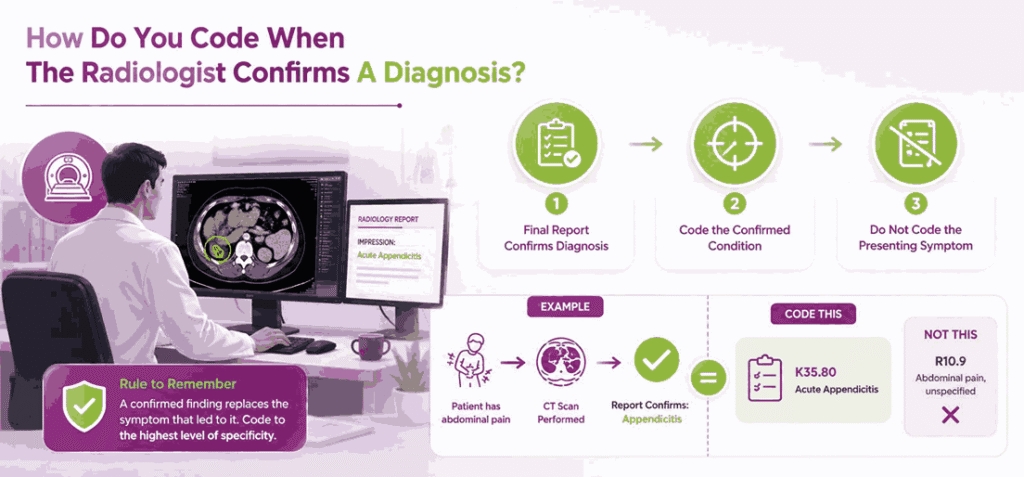
You do not add the presenting signs and symptoms as extra codes in this situation. If a CT confirms appendicitis, you report the appendicitis code. You do not also report the abdominal pain that prompted the scan, because the pain is now explained.
This is a genuine departure from inpatient coding, and it trips up cross-trained coders. Inpatient rules allow abnormal findings to be captured differently. Outpatient diagnostic imaging follows its own path, and mixing the two produces overcoding.
The practical rule is clean. A confirmed finding replaces the symptom that led to it. Code to the highest level of specificity the report supports, including laterality and site, whenever the radiologist documents them.
What Codes Apply When Imaging Shows No Definitive Diagnosis?
When no definitive diagnosis is established, you code the signs, symptoms, or reason that prompted the exam. The Official Guidelines confirm that symptom codes are acceptable when the provider has not confirmed a diagnosis. This is the default state for a large share of imaging.
Radiology reports are full of uncertain language. Terms like “probable,” “suspected,” “rule out,” “questionable,” “consistent with,” and “compatible with” appear constantly. None of these establishes a diagnosis in the outpatient setting.
Coders may not report a suspected condition as if it were confirmed. Doing so is a compliance problem, not a shortcut. When a report says a finding is “suspicious for” something, the coder falls back to the sign, the symptom, or the abnormal finding.
Consider a chest CT that reads “cannot exclude malignancy” with a visible nodule. You do not code cancer. You code the documented abnormal finding, such as a solitary pulmonary nodule, because that reflects the true certainty of the encounter.
Which ICD-10 Codes Cover Abnormal Imaging Findings (R90 To R94)?
The R90 through R94 range is the closest thing radiology has to a native code family. These codes capture abnormal findings on diagnostic imaging when no specific diagnosis has been reached. Every outpatient imaging coder should know this block well.
The range exists precisely for the uncertainty problem described above. When the study shows something real but not yet named, these codes report the abnormality honestly. They are grouped by body system, which makes selection straightforward once you know the layout.
Understanding this family removes much of the guesswork from radiology coding. Below is how the block breaks down across imaging targets.
R90: Abnormal Findings On Imaging Of The Central Nervous System
R90 reports abnormal findings on diagnostic imaging of the central nervous system. It covers the brain, spinal cord, and related structures when imaging shows a problem without a confirmed diagnosis. This is common after CT and MRI of the head.
Specific children include R90.0 for an intracranial space-occupying lesion found on imaging. Others cover white matter disease and abnormal echoencephalogram results. You select the child code that matches the documented finding rather than defaulting to the parent.
R91: Abnormal Findings On Imaging Of The Lung
R91 captures abnormal findings on diagnostic imaging of the lung. The most used code is R91.1 for a solitary pulmonary nodule, a frequent incidental result on chest CT. It is one of the most billed abnormal imaging codes in the family.
The catch-all R91.8 reports other nonspecific abnormal findings of a lung field. Coders reach for it when a report describes an opacity or shadow that is real but unnamed. It is the correct home for suggestive lung language that stops short of diagnosis.
R92: Abnormal Findings On Imaging Of The Breast
R92 covers abnormal and inconclusive findings on diagnostic imaging of the breast. This block is highly granular because mammography demands precision. It includes microcalcifications, calcifications, mammographic density, and inconclusive results.
Density findings carry laterality down to the specific breast. Codes such as R92.2 report an inconclusive mammogram, while density codes distinguish right, left, and bilateral. When a screening mammogram surfaces a finding, this range often supplies the additional diagnosis.
R93: Abnormal Findings On Imaging Of Other Body Structures
R93 is the broadest child and handles most of the remaining body regions. It spans the skull, heart, liver, digestive tract, urinary organs, and limbs. When a body structure lacks its own dedicated subcategory, this is where the finding lands.
Examples include R93.1 for the heart and coronary circulation and R93.2 for the liver and biliary tract. The urinary group reaches down to the specific kidney with codes like R93.421 and R93.422. The general option R93.89 covers other specified sites with no more granular children.
R94: Abnormal Results Of Function Studies
R94 reports abnormal results of function studies rather than pure imaging. It applies to nuclear medicine and physiologic testing, where the study measures function. Cardiovascular, pulmonary, and endocrine function studies each map into this block.
Radiology departments that run nuclear cardiology or renal function scans use this range often. The code reflects an abnormal functional result that has not yet been resolved into a named disease. As with the rest of the family, specificity follows the documentation.
How Do You Code Screening Radiology Exams?
For a screening exam, you list the screening Z code first when the visit exists specifically for that screening. This is a defined exception to the reason-for-exam logic. A screening study has no presenting symptoms, so a screening code carries the medical necessity.
Screening mammography is the clearest example. You report Z12.31 for an encounter for a screening mammogram for malignant neoplasm of the breast. The patient is asymptomatic, and the screening code stands as the first-listed diagnosis.
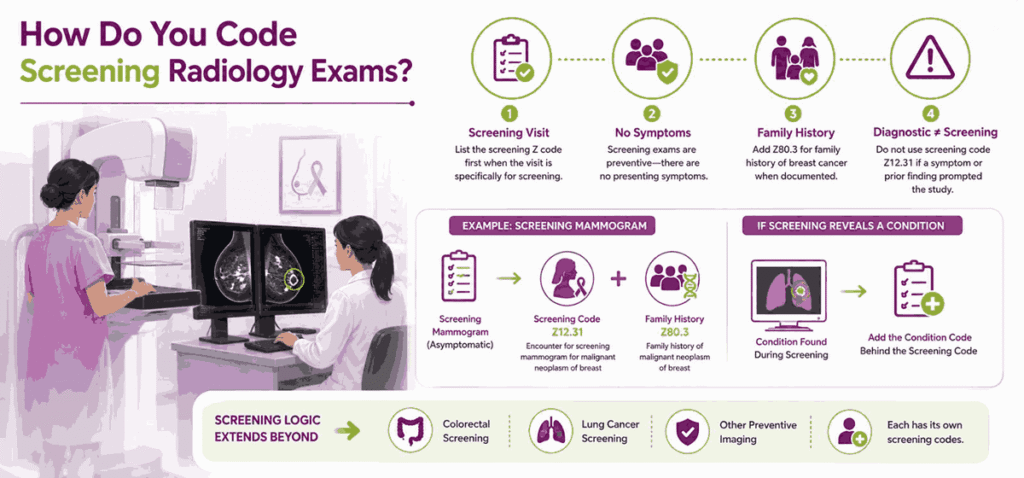
Family history often strengthens a screening claim. When a patient has a family history of breast cancer, you add Z80.3 as a secondary code. This pairing supports coverage and reflects the true clinical picture behind the order.
A critical boundary applies here. A diagnostic mammogram cannot use the screening code Z12.31. If a symptom or prior finding prompted the study, it is diagnostic, and you code the symptom or finding instead.
Screening logic extends beyond the breast. Colorectal screening, lung cancer screening, and other preventive imaging each have their own screening codes. If the screening reveals a condition, that condition becomes an additional diagnosis behind the screening code.
When Should You Use Encounter And Z Codes For Imaging?
Use a Z code when imaging happens for a reason other than an active sign, symptom, or disease. The Factors Influencing Health Status chapter exists for exactly these encounters. Routine and administrative imaging both fall here.
The key code for routine testing is Z01.89 for an encounter for other specified special examinations. You assign it when radiology testing occurs with no signs, symptoms, or associated diagnosis. It represents a study done for reasons outside acute clinical need.
There is a useful combination rule worth remembering. If routine testing and symptom-driven testing occur at the same encounter, code both. You report the Z code for the routine portion and the symptom code for the non-routine portion.
Medicare adds an important wrinkle around “rule out” orders. A study ordered to rule out a condition, with no documented signs or symptoms, reads as a screening. In that case, a screening code leads, and any findings follow as additional diagnoses.
What Are The Most Common Symptom Codes That Justify Imaging?
Symptom codes from Chapter 18 carry medical necessity when no diagnosis is confirmed. This chapter, spanning R00 through R99, holds most of the signs and symptoms a coder needs. These codes appear on a very large portion of imaging claims.
Common examples map neatly to imaging orders. Chest pain, such as R07.9, supports many chest studies. Unspecified abdominal pain, such as R10.9, supports abdominal imaging. Low back pain, such as M54.5- supports lumbar spine studies, with the final character added for site.
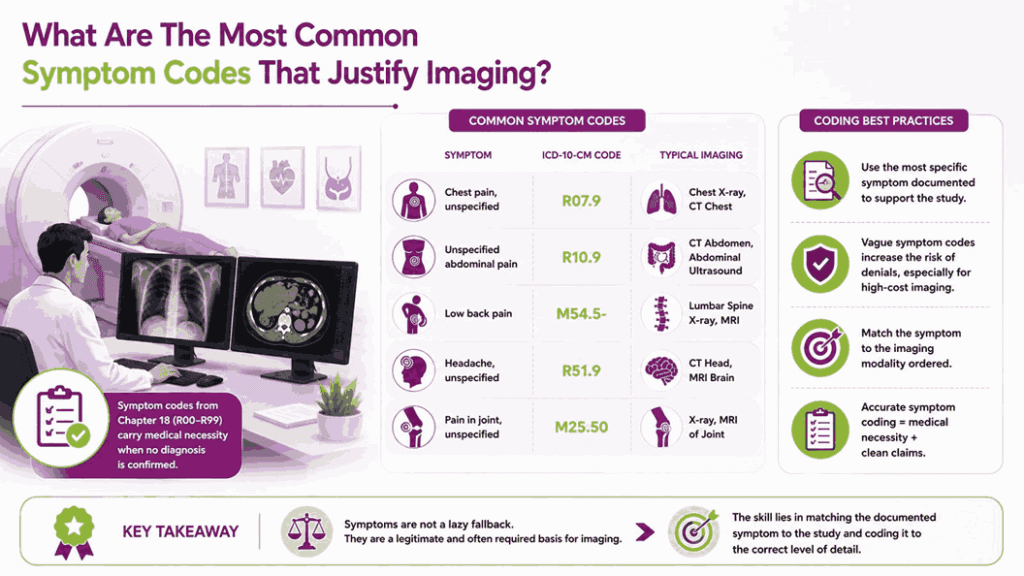
Specificity still matters even with symptom codes. Payers increasingly reject vague symptom codes that fail to support the modality ordered. A high-cost MRI backed only by a generic pain code invites review, so coders push for the most specific symptom available.
The lesson is that symptoms are not a lazy fallback. They are a legitimate and often required basis for imaging. The skill lies in matching the documented symptom to the study and coding it to the correct level of detail.
How Do Incidental Findings Affect Radiology Coding?
An incidental finding is coded only when the radiologist indicates it is clinically significant. Radiologists are trained to document everything they see. It falls to the coder to decide which of those findings actually belong on the claim.
This judgment is central to compliant radiology coding. A report may list a small hepatic cyst noted in passing during a lung study. If the finding is not relevant to the reason for the exam and carries no stated significance, it does not automatically get a code.
The clinical indication guides this decision. When a finding relates to the presenting signs or symptoms, it is likely reportable. When it is unrelated and clinically minor, coding it can distort the claim and invite audit questions.
Coders should read the full report, not only the impression. The body of the report and the impression together reveal which findings are significant. Coding from the impression alone risks missing context or overstating an incidental note.
What Documentation Do Radiology Coders Need From The Order?
Radiology coders need a documented clinical indication on every imaging order. Without it, the study has no anchor for medical necessity. This is the single most common upstream cause of imaging denials.
A strong order carries specific details. It states the sign, symptom, or working diagnosis in clinical terms rather than a vague request for a scan. It notes laterality where relevant, and it connects the study to a real clinical question.
The final radiology report then completes the picture. Coders rely on the impression for the definitive read and the body of the report for supporting detail. Laterality, chronicity, and site should all appear where the anatomy allows.
When documentation falls short, a query is the correct response. Guessing at intent is a compliance risk, and coding a study without support invites denial. Practices that build a tight ordering workflow see fewer queries and cleaner first-pass claims. This is often where radiology billing services with dedicated coders and denial analytics pay for themselves quickly.
Which Coding Errors Trigger The Most Radiology Denials?
The largest denial driver is a diagnosis code that fails to support medical necessity. Payers publish coverage rules that pair specific studies with acceptable diagnoses. A mismatch between the code and the covered indication produces an immediate rejection.
Several recurring errors sit behind these denials. Reviewing them as a checklist prevents most avoidable losses:
- Coding uncertain findings as confirmed diagnoses. Reporting a “suspected” or “probable” condition as established violates outpatient rules and fails audits.
- Using a screening code for a diagnostic study. A symptomatic patient coded with a screening code creates a mismatch that players catch quickly.
- Missing laterality or specificity. Unspecified codes where a specific code exists invite denials and downcoding, especially on high-cost imaging.
- Coding incidental findings without significance. Adding every visualized finding inflates the claim and raises audit exposure.
- Weak or absent clinical indication. A study ordered without a documented reason has no defensible medical necessity.
Each of these errors is preventable at the documentation or coding stage. The pattern is consistent across practices. Clean orders and disciplined code selection remove the majority of radiology denials before they ever occur.
Fixing them requires a repeatable process rather than case-by-case cleanup. A structured operational walkthrough of the full imaging claim lifecycle lives in this Radiology billing guide, which maps how coding, submission, and denial recovery connect for imaging providers.
How Do Payer Coverage Rules Shape Radiology Code Selection?
Payer coverage rules define which diagnosis codes make a given study payable. These rules live in Local Coverage Determinations and National Coverage Determinations for Medicare, and in medical policies for commercial plans. The coder selects the accurate code, then checks it against the applicable policy.
Each policy pairs specific imaging services with a list of covered indications. A lumbar MRI, for example, has a defined set of diagnoses that support coverage. A code outside that list, even if clinically accurate, will not pay under the policy.
This is where accuracy and coverage sometimes appear to collide. The correct code is always the one the documentation supports, never a code chosen to force payment. When the accurate code falls outside coverage, the answer is better documentation, not code shopping.
Coders who know the relevant policies work faster and cleaner. They recognize when an order needs a stronger indication before the study proceeds. They also spot when a covered diagnosis exists in the record but was left off the order, and they query for it.
How Does Clean Radiology Coding Protect Revenue?
Clean radiology coding protects revenue by turning medical necessity into a defensible claim on the first pass. Every accurate diagnosis code shortens the path from study to payment. Every avoidable error adds days to accounts receivable and costs to the practice.
The financial stakes are real for imaging-heavy practices. Radiology carries high volume and high per-study cost, so denial rates compound fast. A small percentage of preventable denials across thousands of studies becomes a serious revenue leak.
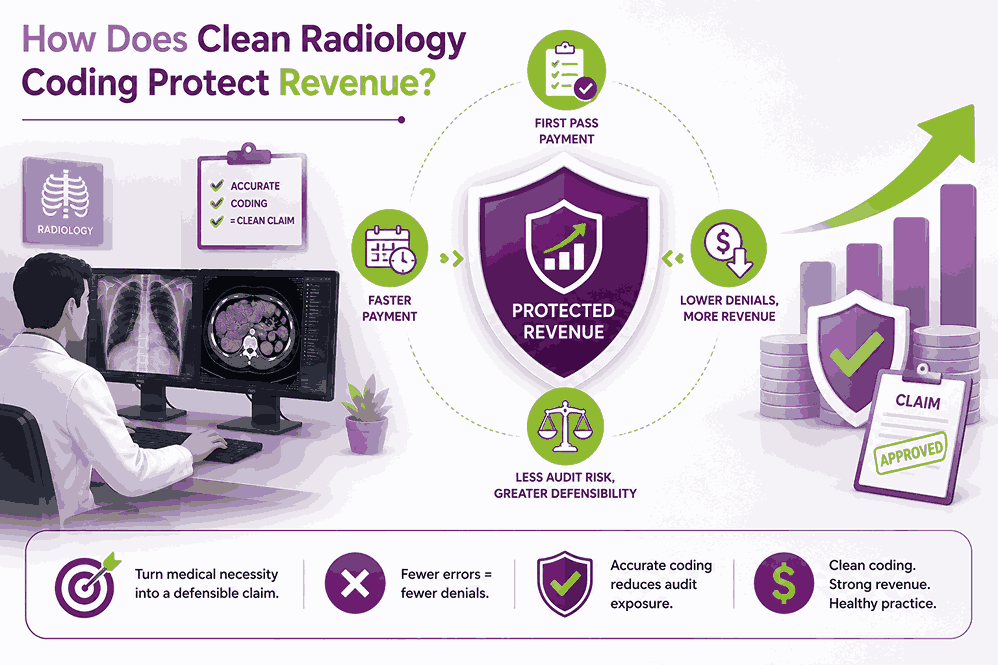
Accurate coding also reduces audit exposure, which carries its own cost. Overcoded incidental findings and misapplied screening codes are exactly what auditors look for. Coding to the true certainty of each encounter keeps the practice defensible and paid.
The takeaway is that radiology coding is a revenue function, not a clerical one. The reason-for-exam principle, the abnormal findings family, and the screening rules all serve one goal. They translate clinical work into claims that survive payer scrutiny and pay on time.
Frequently Asked Questions
Is There A Specific Code Set Only For Radiology Diagnoses?
No. Radiology diagnosis codes are drawn from across the full ICD-10-CM system based on the body region and clinical reason. The closest dedicated block is the R90 through R94 range for abnormal imaging findings without a diagnosis.
Can You Code Signs And Symptoms And A Confirmed Diagnosis Together?
Generally, no, for outpatient diagnostic imaging. When the final report confirms a diagnosis, you code that diagnosis and drop the related symptoms. Symptoms remain codeable only when they are unrelated to the confirmed finding.
What Code Applies To A Routine Imaging Exam With No Symptoms?
Assign Z01.89 for an encounter for other specified special examinations. It applies to routine radiology testing performed without any signs, symptoms, or associated diagnosis to report.
How Do You Handle A “Rule Out” Imaging Order?
In the absence of documented signs or symptoms, Medicare treats a “rule out” study as screening. You assign a screening code as the primary diagnosis, then report any discovered condition as an additional diagnosis.
Why Do Radiology Claims Deny Even With A Correct CPT Code?
Because the CPT code describes the procedure, while the ICD-10 code proves medical necessity. A correct procedure paired with a diagnosis that fails the payer’s coverage policy still results in a denial. Both codes have to align.