eClinicalWorks and Epic are two of the most compared electronic health record systems in United States healthcare. Both manage clinical documentation, scheduling, orders, and billing. Yet they serve very different kinds of organizations.
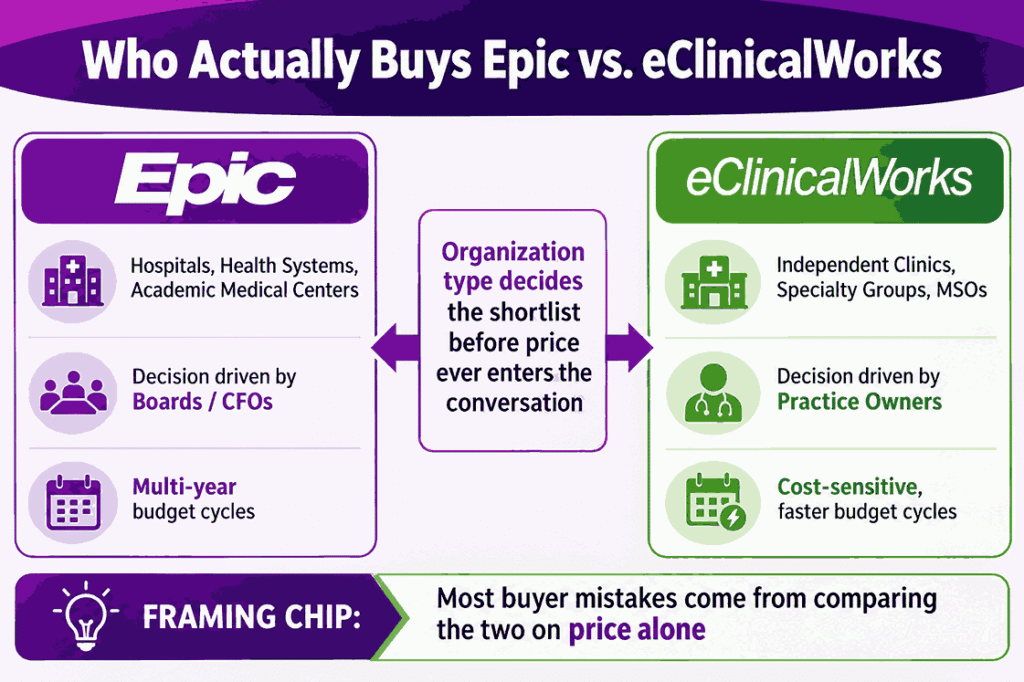
Epic is built for large hospitals, health systems, and academic medical centers. eClinicalWorks is built for ambulatory practices, specialty groups, and cost-sensitive clinics. Buyers still weigh them side by side as if the choice were direct. It rarely is.
This comparison covers market share, features, artificial intelligence, pricing, deployment, data exchange, usability, and vendor risk. Each section uses current 2025 and 2026 data. The goal is a decision you can defend to a board, a CFO, or a compliance officer.
By the end, you will know which system fits a surgery center, an ACO, a specialty practice, or a hospital. You will also know the questions to ask before signing a multi-year EHR contract.
eClinicalWorks vs Epic at a Glance
The fastest way to frame this choice is by organization type and total cost. The table below summarizes the core differences before we go deeper.
| Factor | eClinicalWorks | Epic |
|---|---|---|
| Best fit | Ambulatory and specialty practices | Hospitals, health systems, academic centers |
| Deployment model | Cloud-based (SaaS) | Cloud or on-premise, enterprise-scale |
| Pricing model | Transparent monthly subscription | Not publicly disclosed, custom enterprise |
| Starting cost | Around $449 to $599 per provider per month | Six figures and up for most deployments |
| Rollout time | Weeks to a few months | Many months to multiple years |
| Market position | Largest ambulatory cloud EHR | Market leader in acute care and large ambulatory |
| AI approach | Conversational EHR, Sunoh.ai scribe | Art, Emmie, ambient notes, Cosmos dataset |
| Ideal buyer | Independent clinics, MSOs, RCM-focused groups | Integrated delivery networks, multi-site systems |
Both platforms cover the same core clinical functions. The real difference is scale, cost structure, and configurability. Epic standardizes across an enterprise. eClinicalWorks adapts to a single practice.
Keep this framing in mind through the rest of this guide. Most buyer mistakes come from comparing the two on price alone.
What Is eClinicalWorks?
eClinicalWorks (eCW) is a cloud-based EHR founded in 1999 by Girish Navani. The company is based in Westborough, Massachusetts. It describes itself as the largest ambulatory cloud EHR in the country.
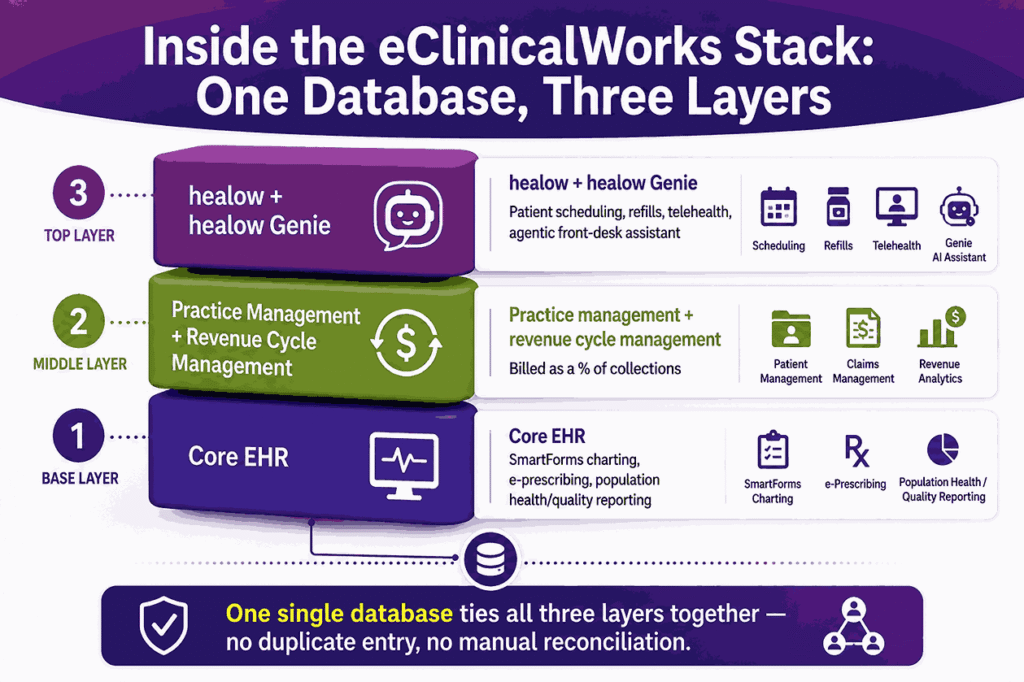
The platform unifies clinical records, practice management, and revenue cycle tools in one system. This single-database design reduces duplicate data entry and manual reconciliation. Ambulatory physicians rely on it as a day-to-day work hub.
Core Platform and Modules
eClinicalWorks bundles several capabilities into its subscription. Practices can turn modules on as they grow. The core set covers the full outpatient workflow.
- Clinical charting with configurable templates called SmartForms
- Practice management for scheduling, eligibility, and claims
- Revenue cycle management billed as a percentage of collections
- e-Prescribing, including controlled substances
- Population health and quality reporting tools
For practices that need additional help managing claims and collections within the platform, eClinicalWorks billing support provider can help extend the capabilities of its built-in revenue cycle tools.
The healow Ecosystem
healow is the patient engagement layer that sits on top of eClinicalWorks. It handles scheduling, refills, lab results, and telehealth. Patients can use it without providing an email address.
healow Genie acts as an agentic virtual front desk. It interacts with patients through voice, text, email, or chatbot in many languages. This reduces call-center load for busy practices.
Who eClinicalWorks Is Built For
eClinicalWorks fits independent and specialty practices that want cost control and fast setup. It works well for primary care, cardiology, behavioral health, and orthopedics. Multi-site groups and management service organizations also use it widely.
What Is Epic?
Epic Systems is a privately held EHR company founded in 1979 by Judith Faulkner. It is based in Verona, Wisconsin. Epic is the dominant EHR across large United States hospitals and health systems.
The Epic EHR billing is built around one unified patient record. That record follows a patient across every point of care in a network. This design supports standardization, quality reporting, and data sharing at scale.
Core Platform and Modules
Epic offers a module for nearly every clinical and financial function. Its breadth is the main reason large systems choose it. Named modules map to specific specialties and workflows.
| Epic Module | Function |
|---|---|
| EpicCare | Core inpatient and ambulatory clinical records |
| Beacon | Oncology treatment planning and chemotherapy |
| MyChart | Patient portal and engagement |
| Care Everywhere | Cross-organization health data exchange |
| Cosmos | De-identified research dataset across health systems |
| Hyperdrive | Web-based clinical workspace |
MyChart and Care Everywhere
MyChart is one of the most recognized patient portals in healthcare. Patients use it for messaging, results, scheduling, and bill pay. It strengthens patient loyalty within a health system.
Care Everywhere connects Epic sites to more than 300 million patient records. It is a major reason large networks report strong data-sharing coverage. This reach is hard for smaller vendors to match.
Who Epic Is Built For
Epic fits hospitals, integrated delivery networks, and academic medical centers. These buyers need enterprise standardization and deep reporting. They also have the budget and staff for a long rollout.
eClinicalWorks vs Epic: Market Share and Adoption
Market share explains a lot about each vendor’s design choices. Epic leads the high end. eClinicalWorks leads a large share of the cloud ambulatory market.
Epic holds roughly 37.7 percent of acute care hospitals and about 43.9 percent of the ambulatory market as of early 2025. Later 2026 figures place its acute care share near 43.7 percent. That concentration gives Epic strong network effects.
eClinicalWorks reports a large ambulatory footprint and a strong second-place market position among EHR vendors. Some third-party trackers place its EHR market share near 13 percent. Its user base spans tens of thousands of practices.
| Metric | eClinicalWorks | Epic |
|---|---|---|
| Acute care hospital share | Minimal | ~37.7% (2025), ~43.7% (2026) |
| Ambulatory market share | Large cloud ambulatory base | ~43.9% (2025) |
| Primary buyer segment | Outpatient and specialty | Hospitals and health systems |
| Deployment footprint | Tens of thousands of practices | Nationwide health networks |
The takeaway is simple. Epic wins where hospitals dominate the decision. eClinicalWorks wins where independent practices control their own technology budget.
Share figures shift year to year, so confirm current numbers during vendor evaluation. Ask each vendor for share data specific to your specialty and size band.
Feature Comparison: eClinicalWorks vs Epic
Both systems cover the full clinical and administrative workflow. The difference is depth versus adaptability. Epic goes deep on enterprise workflows. eClinicalWorks stays flexible for individual practices.
The table below maps core capabilities across both platforms. Use it to spot where each system leads.
| Capability | eClinicalWorks | Epic |
|---|---|---|
| Clinical documentation | Configurable SmartForms and templates | Standardized system-wide templates |
| Practice management | Included in core subscription | Full enterprise practice management |
| Revenue cycle management | Native, priced on collections | Resolute RCM at enterprise scale |
| Patient portal | healow app, no email required | MyChart, widely adopted |
| Telehealth | Built into healow | Integrated video visits |
| Specialty modules | Broad specialty template library | Deep named modules per specialty |
| Reporting and analytics | Practice-level dashboards | Enterprise quality and research reporting |
| Configurability | High, practice-controlled | Standardized, governed centrally |
Epic’s enterprise RCM capabilities can support complex billing environments, but health systems may still need Epic billing support to manage workflows, claims, and revenue cycle operations effectively.
eClinicalWorks favors speed and control. A pediatrician can build a well-child template with only the fields they need. That flexibility helps small teams move faster through visits.
AI Capabilities Compared
Artificial intelligence is now a real differentiator between these two systems. Both vendors have shipped clinical AI features. Their strategies differ in scope and openness.
This section is where most comparison articles fall short. The head-to-head below shows how each vendor approaches AI in daily clinical work.
eClinicalWorks: The Conversational EHR
eClinicalWorks positions itself as the industry’s first conversational EHR. It connects generative AI to the record and practice management system. Providers can use a language-based interface across many tasks.
Its flagship AI tools target the biggest time sinks in a clinic. Reported time savings come from a 2025 survey of nearly 900 healthcare professionals. The figures below reflect self-reported results, not independent audits.
- Sunoh.ai, an ambient scribe used by more than 100,000 providers, saving up to four hours a day on documentation
- PRISMA AI, which gathers external records and saves around two hours per day
- Image AI, which sorts inbound faxes and saves over an hour a day for many users
- healow Genie, an agentic assistant for patient calls, texts, and chats
Sunoh.ai is notable because it works as an EHR-agnostic product. It runs on iOS, Android, and desktop. Clinics on other systems can adopt it as a standalone scribe.
Epic: Embedded Enterprise AI
Epic embeds AI across its enterprise workflows rather than selling it separately. Its tools focus on documentation, patient communication, and research. Large systems benefit from AI that spans the whole network.
- Art, a clinician-facing assistant that generates summaries and drafts
- Emmie, a patient-facing assistant for explanations and guidance
- Ambient notes, which turn conversations into draft documentation
- Cosmos, a de-identified dataset spanning many health systems for research
Cosmos is a structural advantage that eClinicalWorks cannot easily match. It pools de-identified data from hundreds of millions of patient records. That scale supports research and population-level insight.
| AI Dimension | eClinicalWorks | Epic |
|---|---|---|
| Ambient scribe | Sunoh.ai, EHR-agnostic | Ambient notes, embedded |
| Conversational interface | Language-based UI across workflows | Art and Emmie assistants |
| Document handling | Image AI for faxes | Native inbox and document tools |
| Research data | Practice-level analytics | Cosmos cross-system dataset |
| Availability | Sold to any practice | Bundled for Epic customers |
For small practices, eClinicalWorks offers faster access to usable AI at a lower cost. For large systems, Epic offers AI that spans the entire network and research pipeline.
Pricing and Total Cost of Ownership
Price is where the two vendors diverge most sharply. eClinicalWorks publishes clear subscription pricing. Epic keeps its pricing private and custom.
Sticker price alone is misleading. Total cost of ownership includes setup, training, staffing, and lost productivity during rollout. Model the full cost before you compare.
eClinicalWorks Pricing
eClinicalWorks uses a monthly subscription with no large upfront license fee. Public estimates place core EHR pricing around $449 to $599 per provider per month. Revenue cycle management is often priced near 2.9 percent of collections.
Practices should also account for how eClinicalWorks billing and RCM fit into their overall operating costs. The subscription price covers the platform, but staffing, claim management, follow-up, and collection performance can materially affect the total cost of running the revenue cycle.
- Predictable monthly cost per provider
- Practice management can be added to the base EHR plan
- RCM billed as a share of what the practice actually collects
- Limited upfront setup fees compared with enterprise systems
Epic Pricing
Epic does not publish standard pricing. Costs depend on size, modules, hosting, and services. Small group deployments start well into five figures per year, and hospital deployments can reach millions.
| Cost Element | eClinicalWorks | Epic |
|---|---|---|
| Pricing transparency | Published subscription tiers | Custom, undisclosed |
| Upfront cost | Low | High, often six figures or more |
| Ongoing model | Per provider, per month | Licensing plus services and hosting |
| RCM pricing | ~2.9% of collections | Enterprise module pricing |
| Best cost fit | Cost-sensitive practices | Well-funded health systems |
Treat all Epic figures as market estimates, not quotes. Only a formal proposal reflects your true cost. Ask for a three-year and five-year total, not just year one.
Rollout and Time to Value
Deployment speed often decides which system a practice can realistically adopt. Epic and eClinicalWorks sit at opposite ends here. One is fast to launch. The other is a major project.
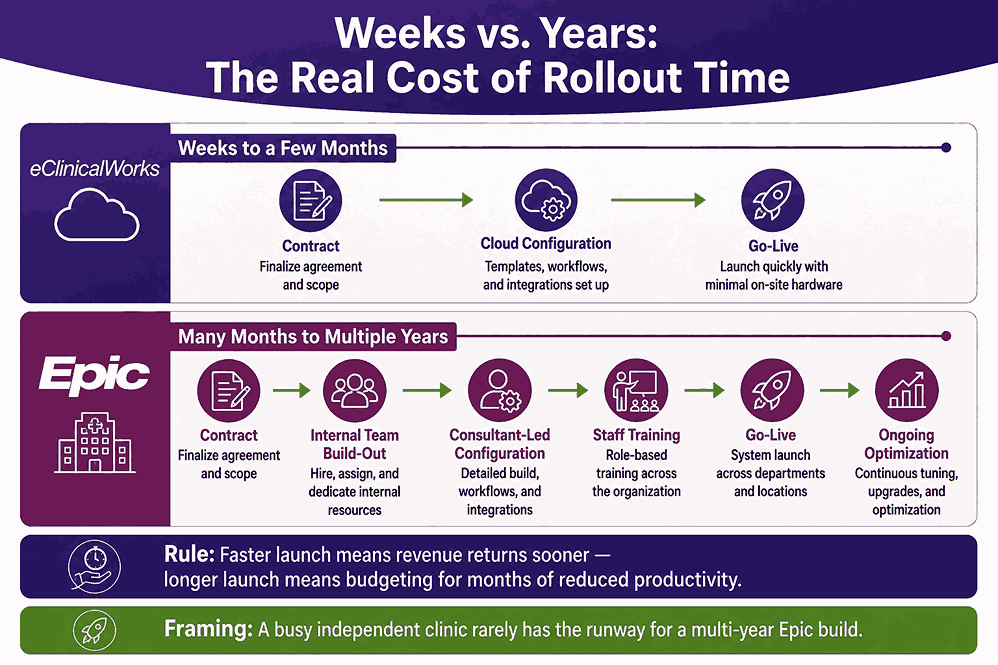
A faster launch means revenue returns sooner. A longer launch can mean months of reduced productivity. Factor both into the business case.
eClinicalWorks Rollout
eClinicalWorks can go live in weeks to a few months for a typical practice. Its cloud model removes the need for heavy on-site hardware. Smaller teams can launch without a dedicated IT department.
Epic Rollout
Epic deployments are large projects that span many months, sometimes years. Hospitals often build internal teams and hire specialized consultants. The payoff is a deeply configured, standardized system across the network.
- Choose eClinicalWorks when speed and low disruption matter most
- Choose Epic when long-term standardization justifies a long build
- Budget for training and temporary productivity loss in both cases
- Confirm data migration scope and cost in writing before signing
The right answer depends on your tolerance for disruption. A busy independent clinic rarely has the runway for a multi-year Epic build.
Interoperability and Data Exchange
Data exchange is now a regulatory requirement, not a nice-to-have. Federal rules push every vendor toward open, standard data sharing. Both Epic and eClinicalWorks connect to national networks.
Interoperability decides whether patient data follows the patient. That matters for referrals, transitions of care, and value-based contracts. Weak data exchange creates clinical and financial risk.
The Regulatory Backdrop
Several federal rules now shape EHR data exchange. Any vendor you evaluate must show a clear path to compliance. Ask about each rule directly.
- The 21st Century Cures Act bans information blocking
- The ONC HTI-1 Final Rule requires USCDI support through FHIR APIs
- The CMS-0057 rule mandates FHIR-based prior authorization workflows
- TEFCA and its QHINs create a nationwide exchange network
How the Two Vendors Compare
Both vendors connect to Carequality and CommonWell, the main national exchange frameworks. Carequality alone moves more than 745 million documents each month. Epic pushed for full TEFCA participation across its hospitals by the end of 2025.
| Interoperability Factor | eClinicalWorks | Epic |
|---|---|---|
| National networks | Carequality, CommonWell | Carequality, CommonWell, Care Everywhere |
| TEFCA participation | Vendor roadmap dependent | Aggressive TEFCA rollout |
| FHIR and SMART on FHIR | Supported | Supported with large app ecosystem |
| Cross-org reach | Broad ambulatory exchange | 300 million plus patient records |
Epic has a reach advantage through Care Everywhere and its network density. eClinicalWorks provides solid exchange for the ambulatory world. A KLAS analysis notes clinician satisfaction with data sharing has barely improved since 2018.
The open problem is data usability, not just data availability. Clinicians still struggle with duplicate and poorly mapped records. Ask both vendors how they handle deduplication and normalization.
Usability and Support
Usability shapes clinician satisfaction and burnout more than any feature list. Both systems face the classic tradeoff. Depth adds power but also adds complexity.
Independent research from KLAS is the best neutral signal here. Their annual Best in KLAS awards reflect large customer surveys. The 2025 results are worth reading closely.
What the KLAS Data Shows
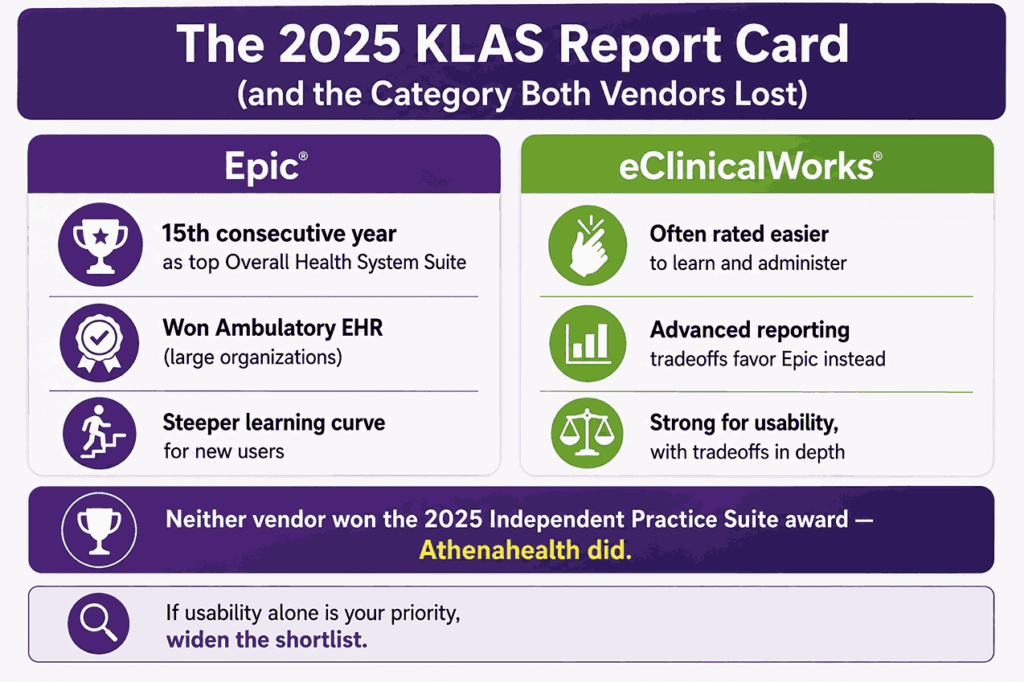
Epic was named the top Overall Health System Suite for the fifteenth consecutive year in 2025. It also won the Ambulatory EHR award for large organizations. Its strength is enterprise depth, not simplicity.
- Epic offers advanced reporting once staff master the system
- Epic carries a steeper learning curve for new users
- eClinicalWorks is often rated easier to learn and administer
- Athenahealth, not eClinicalWorks or Epic, won the 2025 independent practice suite award
That last point is an honest caveat most comparisons skip. Neither Epic nor eClinicalWorks is the top KLAS pick for small independent practices. Understanding the eClinicalWorks challenges that can affect workflow, administration, and day-to-day use is important before choosing the platform for a practice.
Support and Ecosystem
Epic provides deep support backed by a large partner and consultant network. eClinicalWorks provides support suited to smaller teams and faster response cycles. Match the support model to your internal IT capacity.
eClinicalWorks vs Epic by Specialty
Specialty fit often decides the winner more than headline features. Documentation patterns differ sharply across specialties. The best system matches how your clinicians actually work.
eClinicalWorks tends to win in high-volume outpatient specialties that value speed. Epic tends to win where a specialty sits inside a hospital network. The table below maps common specialties to a likely fit.
| Specialty | Likely eClinicalWorks Fit | Likely Epic Fit |
|---|---|---|
| Primary care | Strong for independent clinics | Strong inside health systems |
| Cardiology | Good for private groups | Strong for hospital cardiology |
| Behavioral health | Strong, flexible templates | Strong with system-wide records |
| Orthopedics | Good for ambulatory groups | Strong for surgical hospitals |
| OB-GYN | Good for private practices | Strong with hospital labor and delivery |
| Nephrology | Good for dialysis-linked groups | Strong for academic nephrology |
| Pain management | Strong for procedure-based clinics | Fits within larger systems |
A private cardiology group often prefers eClinicalWorks for cost and control. A hospital cardiology department almost always runs on Epic. The setting matters as much as the specialty itself.
Ask each vendor for reference clients in your exact specialty and size. A live demo with your own workflows beats any feature checklist. Confirm that specialty templates match your documentation and billing patterns.
Compliance, Security, and Vendor Due Diligence
HIPAA compliance is table stakes for both vendors. Both offer the security controls a covered entity needs. The deeper question is vendor track record and contract terms.
Procurement teams should treat EHR selection as a risk decision, not only a feature decision. Vendor history matters. So do the contract clauses that govern your data.
The eClinicalWorks Settlement Context
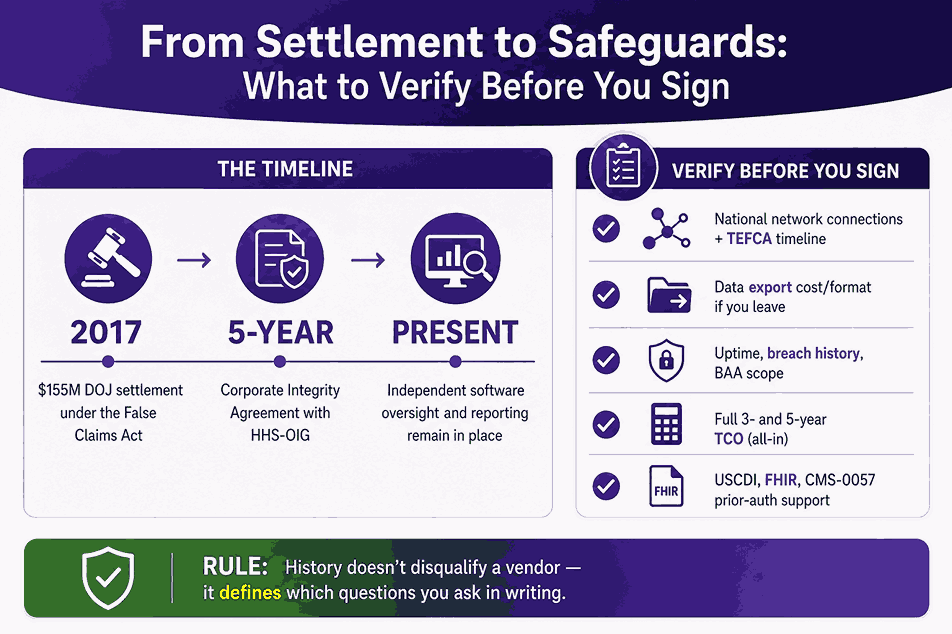
In May 2017, eClinicalWorks agreed to a $155 million settlement with the Department of Justice. The False Claims Act case alleged misrepresented certification and kickbacks. It was the first case holding an EHR vendor accountable for certification standards.
- eClinicalWorks entered a five-year Corporate Integrity Agreement with HHS-OIG
- The agreement required independent software quality oversight and reporting
- Customers gained the right to free upgrades and penalty-free data transfer
- The settlement is historical, and the company has operated under the agreement since
This history does not disqualify eClinicalWorks. Many customers stayed satisfied after the settlement. It does mean due diligence should include patient-safety notices and data-portability terms.
Due Diligence Questions for Either Vendor
Bring these questions to every EHR evaluation. They protect you against lock-in and hidden risk. Get answers in writing.
- What are your national network connections and your TEFCA timeline?
- How do you handle data export if we leave, and at what cost?
- What is your documented uptime, breach history, and BAA scope?
- What is the full three-year and five-year total cost of ownership?
- How do you support USCDI, FHIR, and CMS-0057 prior authorization?
How Do You Choose Between eClinicalWorks and Epic?
The choice comes down to organization type, budget, and control. Neither system is objectively better. Each is better for a specific buyer. Match the platform to your structure and goals.
Use the framework below to place your organization. Then confirm the fit with a scoped demo and a written proposal.
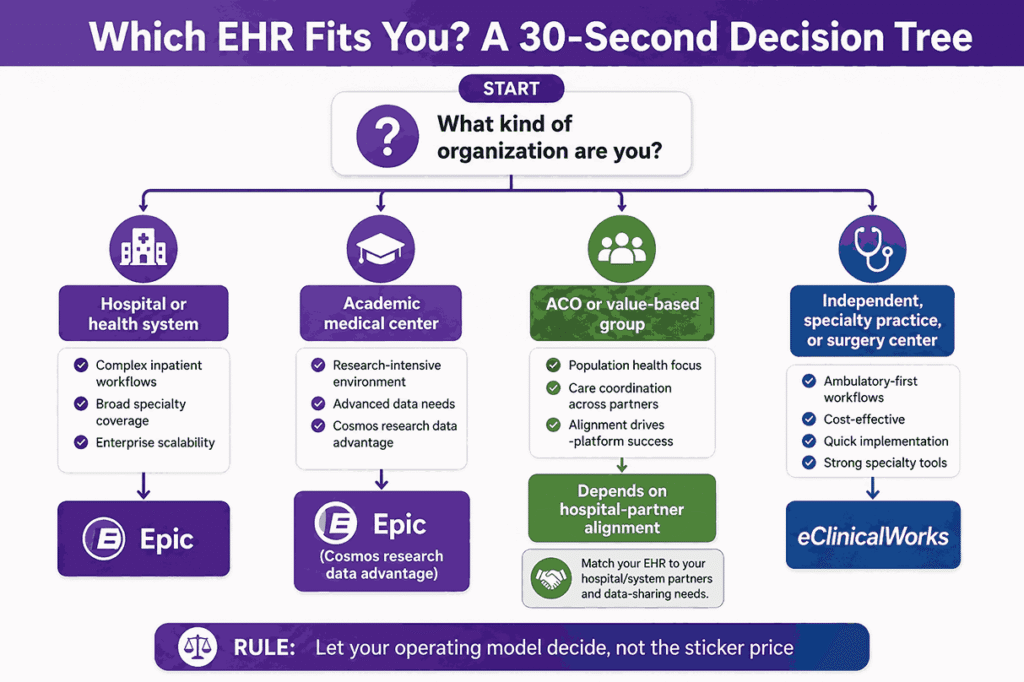
- Independent or specialty practice: eClinicalWorks fits best. It offers fast setup, transparent cost, and practice-level control.
- Surgery center or small group: eClinicalWorks usually wins on cost and speed. Confirm specialty template depth during the demo.
- ACO or value-based group: Weigh data exchange and reporting needs. Epic helps if you are aligned with hospital partners on it.
- Hospital or health system: Epic is the default choice. Its depth, reporting, and network reach match enterprise needs.
- Academic medical center: Epic fits research and standardization goals. Cosmos adds a research data advantage.
A practice that prizes agility and cost control leans toward eClinicalWorks. A system that prizes standardization and network scale leans toward Epic. Let your operating model decide, not the sticker price.

Frequently Asked Questions
Buyers ask the same core questions when comparing these systems. The answers below give a direct starting point. Confirm specifics with each vendor before deciding.
Is eClinicalWorks Cheaper than Epic?
Yes, in most cases. eClinicalWorks uses transparent monthly pricing with low upfront cost. Epic deployments usually run far higher and require custom quotes.
Does Epic Work for Small Practices?
Epic can serve small practices, but the cost and rollout are heavy. Most small and independent practices find eClinicalWorks a better operational fit.
Which System is Better for Interoperability?
Both connect to national networks like Carequality and CommonWell. Epic has broader reach through Care Everywhere and aggressive TEFCA adoption.
Which Has Stronger AI Features?
eClinicalWorks offers accessible AI through Sunoh.ai and its conversational EHR. Epic offers embedded AI plus the Cosmos research dataset across health systems.
Can I Switch from One System to the Other?
Yes, but migration is a major project. Confirm data export rights, format, and cost in the contract before you commit.
The Bottom Line
Epic and eClinicalWorks are not really rivals for the same buyer. Epic owns the hospital and health-system market. eClinicalWorks owns a large share of cloud ambulatory care.
Choose based on your organization type, budget, and appetite for a long rollout. Independent and specialty practices favor eClinicalWorks. Hospitals and academic centers favor Epic. Score both against total cost, data exchange, AI, and vendor risk before you sign.