eClinicalWorks is one of the largest ambulatory electronic health record (EHR) vendors in the United States. The platform serves more than 130,000 providers across primary care and dozens of specialties as of 2026. It bundles an EHR, practice management, revenue cycle management, and the healow patient portal.
Scale does not always translate into a smooth day-to-day experience. Practices report recurring problems with usability, system performance, support response times, and billing. Several of these issues carry direct financial weight for surgery centers, health systems, and ACOs.
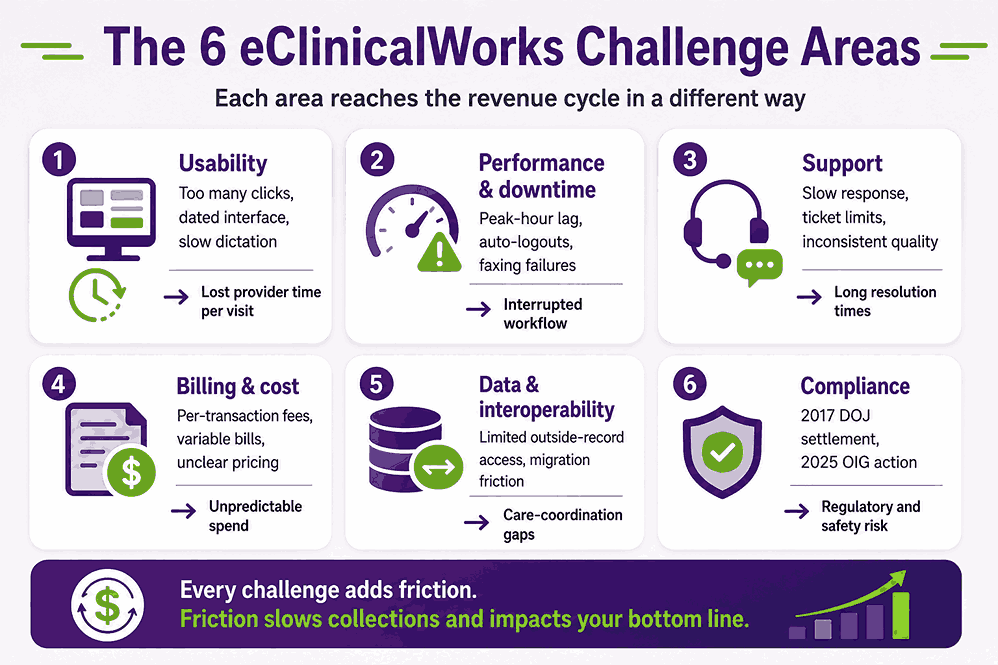
The challenges group into six areas: usability, performance and downtime, support, billing and cost, data migration and interoperability, and compliance. Each area affects clinical workflow and revenue in a different way. Some also carry regulatory risk that reaches beyond daily operations.
This guide breaks down each eClinicalWorks challenge with documented user feedback and 2026 data. It also maps how these problems reach your revenue cycle, and what practices can do to reduce the damage.
Many of the usability and billing issues discussed in this guide can be reduced through better workflow design or specialized eCW billing services that manage coding, claims, denial follow-up, and reimbursement optimization outside the core EHR.
What Is eClinicalWorks and Who Uses It?
eClinicalWorks is a cloud-based EHR and practice management platform founded in 1999 by Girish Navani. The company is headquartered in Westborough, Massachusetts. It ranks among the most widely used ambulatory EHR systems in the country.
The system markets itself as an all-in-one clinical and administrative suite. That breadth is both its main selling point and the root of several usability complaints.
What Does the eClinicalWorks Platform Include?
The eClinicalWorks suite combines several products into one login. Practices adopt it to run clinical and billing work in the same place.
- EHR: charting, e-prescribing, clinical documentation, and order management
- Practice management (PM): scheduling, eligibility checks, and claim submission
- Revenue cycle management (RCM): outsourced billing services and denial handling
- healow: patient portal, telehealth, and patient engagement tools
- AI tools: the Sunoh.ai medical scribe and the EVA virtual assistant
The current product line runs on eClinicalWorks V12. The vendor has pushed hard into artificial intelligence in recent releases. Sunoh.ai listens to a visit and drafts the clinical note automatically. EVA handles routine questions and tasks inside the chart.
These AI tools aim to cut documentation time for providers. Adoption is still early, and results vary by specialty and note complexity. The core EHR and billing modules remain the daily workhorses.
While the platform continues to expand, most practices still rely on the same core eCW features every day, including scheduling, clinical documentation, eligibility verification, coding, claim submission, reporting, and patient engagement. Understanding how these capabilities fit together provides useful context for the usability and billing issues discussed below.
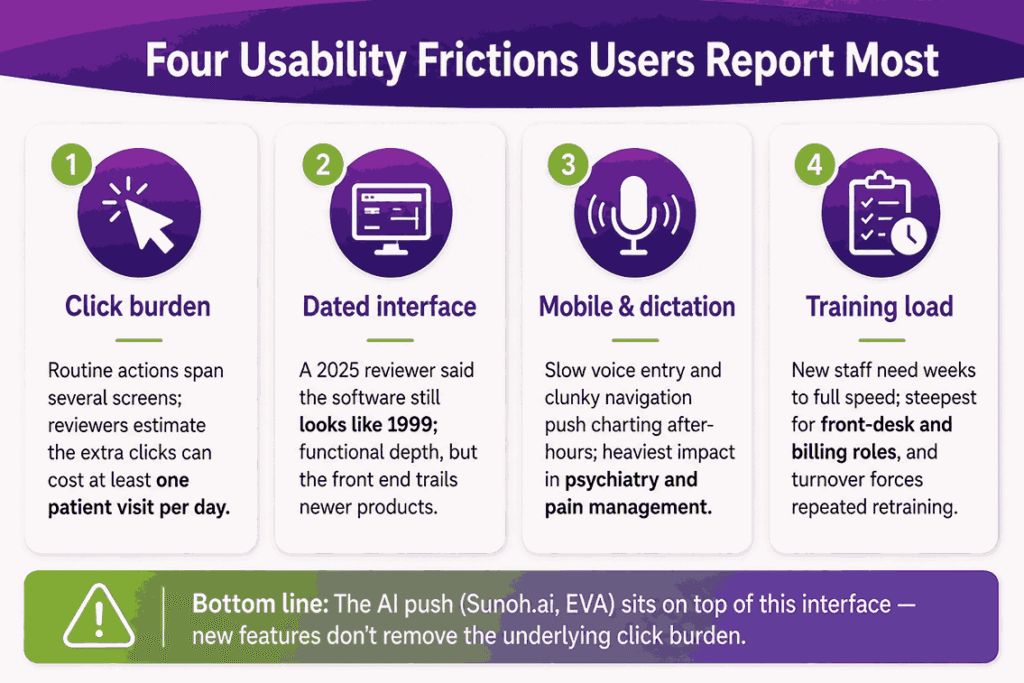
Context: the AI push is real, but it sits on top of an interface many users already find dense. New features do not remove the underlying click burden covered below.
Which Specialties and Facilities Use eClinicalWorks?
eClinicalWorks supports general medicine and dozens of specialties. Adoption is heaviest among small and mid-sized ambulatory practices. Larger organizations use it too, but often report more workflow friction.
- Specialties: primary care, cardiology, OBGYN, orthopaedics, nephrology, psychiatry, and pain management
- Facility types: private practices, surgery centers, FQHCs, ACOs, and hospital-owned groups
The 130,000-provider footprint creates a large public record of reviews. That record is where the challenges below come from. It spans Capterra, G2, ConsumerAffairs, TrustRadius, and the Better Business Bureau.
What Are the Most Common eClinicalWorks Challenges?
User reviews across those platforms point to a consistent set of problems. The same themes surface across specialties and practice sizes. The table below groups them before each section covers them in depth.
| Challenge area | What users report | Primary impact |
|---|---|---|
| Usability | Too many clicks, dated interface, slow dictation | Lost provider time per visit |
| Performance and downtime | Lag at peak hours, auto-logouts, faxing failures | Interrupted clinical workflow |
| Support | Slow response, ticket limits, offshore inconsistency | Long issue resolution |
| Billing and cost | Per-transaction fees, variable bills, unclear pricing | Unpredictable spend |
| Data and interoperability | Limited outside-record access, migration friction | Care coordination gaps |
| Compliance | $155M DOJ settlement, 2025 OIG action | Regulatory and safety risk |
Why Is eClinicalWorks Considered Hard to Use?
Many users describe eClinicalWorks as powerful but hard to use. The most frequent complaint is the number of clicks required to finish routine tasks. That click burden compounds across a full patient panel.
Why Does eClinicalWorks Require So Many Clicks?
Routine actions in eClinicalWorks often span several screens. Providers report that documenting a single visit takes more steps than competing systems. One Capterra reviewer noted the click volume costs real patient throughput.
In practice: reviewers estimate the extra clicks can cost at least one patient visit per day. Across a five-provider group, that is a measurable revenue leak over a year.
Is the eClinicalWorks Interface Outdated?
Yes, many users describe the interface as visually dated. One 2025 reviewer wrote that the software still looks like it belongs to 1999. The design has functional depth, but the front end trails newer EHR products on layout and speed.
How Reliable Is the eClinicalWorks Mobile App and Dictation?
The mobile app draws frequent criticism. Users cite slow dictation and clunky navigation on phones and tablets. A December 2025 review called the mobile experience a nightmare for voice documentation.
Dictation speed matters for specialties with heavy note volume, such as psychiatry and pain management. Slow voice entry pushes charting into after-hours work. That pattern is a known driver of clinician burnout.
Is eClinicalWorks Training Complex for New Staff?
Yes, onboarding is a common friction point. New staff often need weeks to reach full speed on the system. Reviews mention training complexity as a barrier during the go-live period.
The learning curve is steepest for front-desk and billing roles. Turnover then forces repeated retraining, which raises the real cost of ownership. Custom workflows help, but they take time to build and maintain.
What Performance and Downtime Problems Do Users Report?
System stability is a second recurring theme. Reviewers report lag during busy clinical hours and unexpected logouts. These interruptions land exactly when staff need the system most.
Why Does eClinicalWorks Slow Down During Peak Hours?
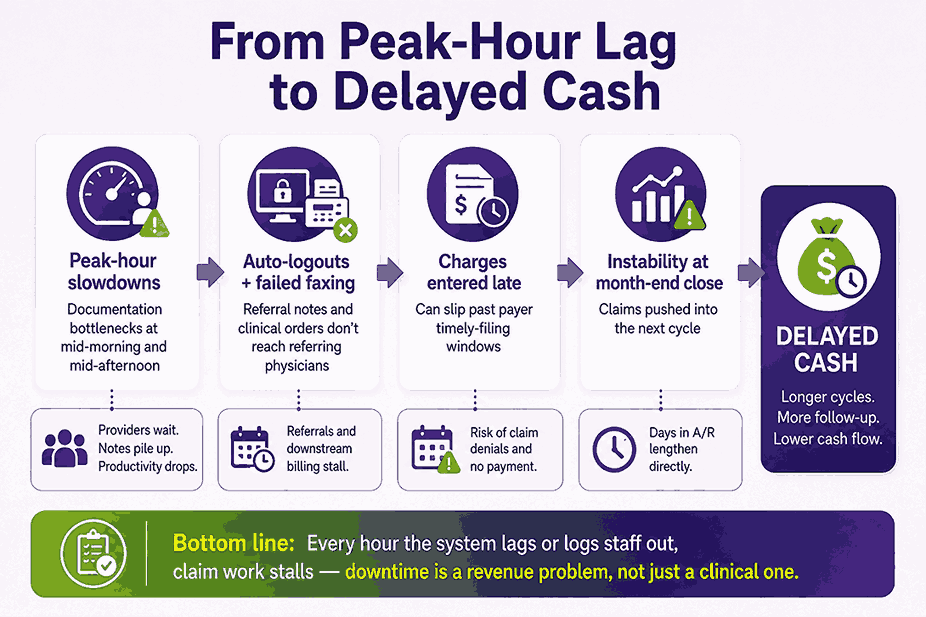
Users describe the platform running slowly when many staff are logged in at once. Peak-hour slowdowns create documentation bottlenecks at mid-morning and mid-afternoon. Behavioral health facilities have reported this pattern in public reviews.
Data point: Downdetector maintains a live outage tracker for eClinicalWorks. A dedicated status page usually signals a user base that watches closely for downtime.
What Causes eClinicalWorks Logouts, Faxing, and Bug Issues?
Automatic logouts during multitasking frustrate many users. Application bugs and failed faxing appear across G2 and ConsumerAffairs reviews. One August 2025 reviewer reported months of unresolved faxing problems.
Faxing still carries clinical orders and referral notes in most practices. When faxes fail, referring physicians stop receiving documentation. That gap slows referrals and delays downstream billing.
How Does Downtime Affect Billing?
Downtime is not only a clinical problem. Every hour the system lags or logs staff out, claim work stalls. Charges entered late can slip past payer timely-filing windows.
Instability during month-end billing cycles is the worst case. A slow system at closing time pushes claims into the next cycle. That delay lengthens days in accounts receivable directly.
What Are the Common eClinicalWorks Support Problems?
User sentiment on eClinicalWorks support is mixed at best. Some practices find it adequate, while many report frustration. The main complaints center on response speed and issue resolution.
How Long Does eClinicalWorks Support Take To Respond?
Support tickets can take 24 hours or longer for a first response. For a busy practice, that delay is costly when a core function breaks. Reviewers also cite inconsistent quality between support specialists.
- Slow response times: initial replies often exceed a full business day
- Ticket system limits: complex issues need many back-and-forth exchanges
- Inconsistent quality: resolution depends heavily on which specialist responds
Why Do Software Updates Break Existing Features?
A frequent complaint is that updates arrive without warning. Reviewers say updates sometimes break features that worked fine before. Staff then spend hours on the phone restoring lost functionality.
Unplanned breakage is worse when support response is already slow. The two problems stack, and a single bad update can disrupt billing for days.
The compounding cost: a broken billing feature plus a 24-hour support wait can freeze a full day of claims. For a high-volume group, that is thousands of dollars in delayed cash.
What Billing and Cost Challenges Come With eClinicalWorks?
Billing and cost transparency draw some of the sharpest reviews. Practices report charges that are hard to predict month to month. This matters most for groups that also buy the eClinicalWorks RCM service.
How Does eClinicalWorks Pricing and Per-Transaction Billing Work?
eClinicalWorks charges a mix of subscription and per-transaction fees. Some services bill per virtual visit, so the monthly total shifts with volume. One January 2026 reviewer noted the bill was never the same twice.
Understanding each charge type prevents surprise line items after go-live. The table below breaks down the common fee categories.
| Charge type | How it is billed | Where it surprises practices |
|---|---|---|
| Subscription | Per-provider monthly fee | Add-on modules priced separately |
| Per virtual visit | Charged per telehealth encounter | Monthly total shifts with volume |
| Transaction fees | Applied to labs and card payments | Often noticed only after go-live |
| RCM percentage | Share of monthly collections | Credentialing scope excluded |
What Do Practices Report About eClinicalWorks RCM Services?
The bundled RCM service receives mixed feedback on public complaint boards. A 2025 Better Business Bureau complaint described a difficult go-live and onboarding period. That practice attended 8 of 14 scheduled training calls during a contested rollout.
RCM contracts also keep payer credentialing as the practice responsibility. Practices that expect full credentialing support can be surprised by that split. Clarify the scope of work before signing any eClinicalWorks billing agreement.
How Do eCW Billing Issues Create Claim Denials?
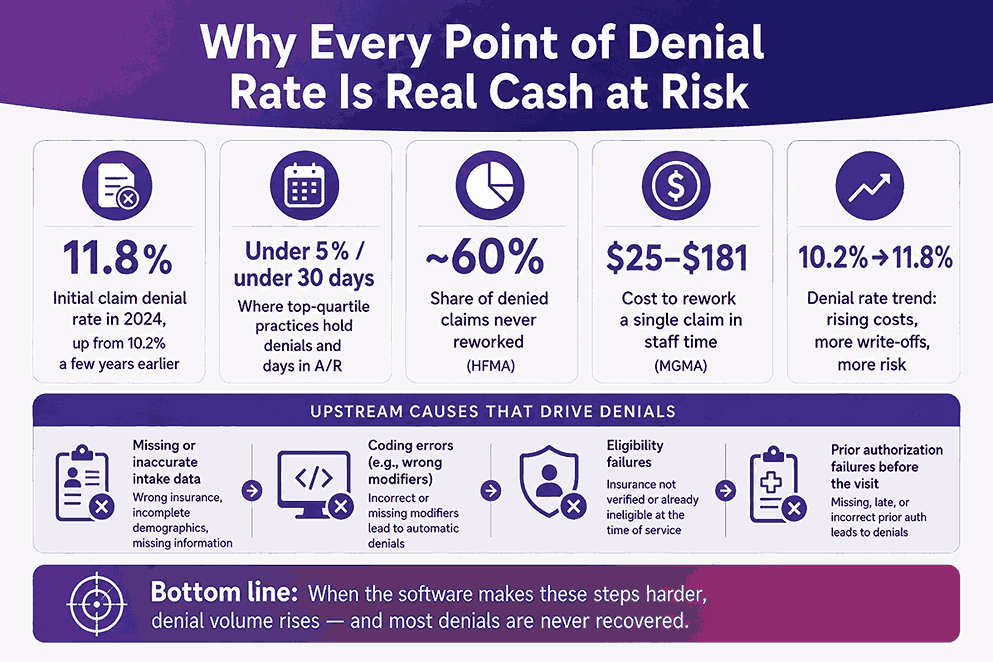
Billing friction inside the EHR flows straight into denials. Coding errors, eligibility gaps, and missing authorizations are the top denial causes industry-wide. When the system makes these steps harder, denial volume rises.
Denials are not isolated events. Each one delays payment and adds rework cost per claim. The revenue cycle section below quantifies that impact directly.
Practices looking to understand the complete billing workflow, not just where problems occur, can also refer to our eCW billing guide. This guide explains claim creation, coding, clearinghouse submission, payment posting, and denial management in greater detail.
What Data Migration and Interoperability Issues Affect eClinicalWorks?
Data movement is a structural challenge with eClinicalWorks. Users report limits on viewing records from outside providers. Migration off the platform also carries friction that raises switching costs.
Can eClinicalWorks Share Records With Outside Providers?
Partially, but with real limits. One reviewer said the biggest drawback was being unable to view records from other outpatient providers. Care coordination suffers when a chart cannot pull in outside history.
Record-sharing gaps also affect referrals and specialty care. Data exchange standards like HL7 and FHIR aim to close these gaps. Actual eClinicalWorks integration with outside systems still varies by setup.
Standards note: national frameworks such as TEFCA push EHRs toward wider data exchange. Practices should confirm which connections are live before assuming full interoperability.
How Hard Is It To Migrate Data off eClinicalWorks?
Migration off any EHR is complex and costly. eCW users cite this friction as a reason they endure other problems. The 2017 DOJ complaint specifically alleged failures in data portability and audit logs.
High exit cost is often why groups tolerate usability and support issues for years. Weak data portability locks practices in. That lock-in is a hidden cost of the platform beyond the monthly fees.
What Compliance and Patient-Safety Concerns Surround eClinicalWorks?
eClinicalWorks carries a documented compliance history. Two events define it: the 2017 DOJ settlement and a 2025 OIG action. Both bear on patient safety and record reliability.
What Was the $155M eClinicalWorks DOJ Settlement?
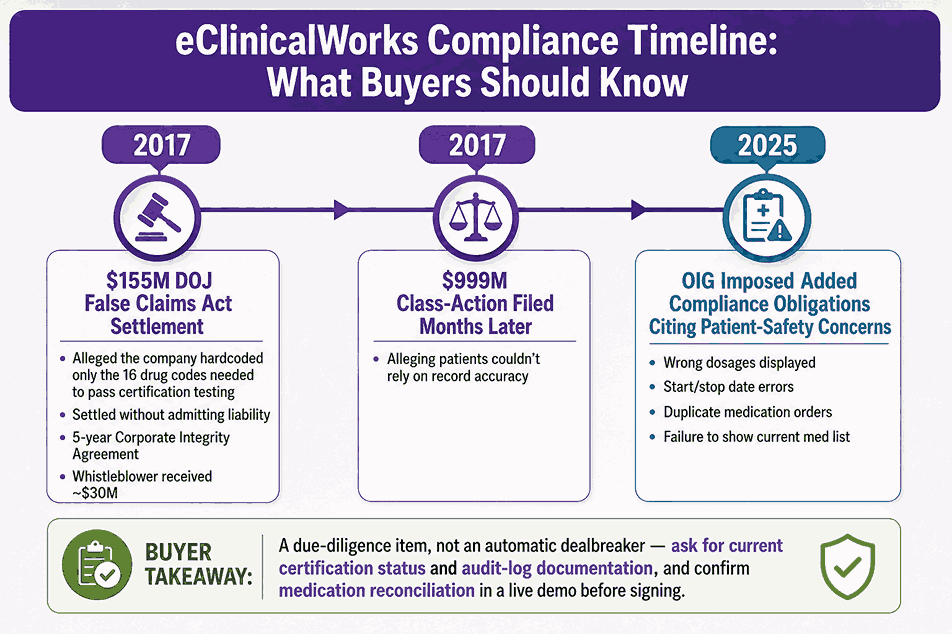
In May 2017, eClinicalWorks paid $155 million to settle a False Claims Act lawsuit. The Department of Justice alleged the company falsely obtained meaningful use certification. eCW settled without admitting liability and signed a five-year Corporate Integrity Agreement.
The complaint said eCW hardcoded only the 16 drug codes needed to pass certification testing. Whistleblower Brendan Delaney, a New York City employee, brought the case. Delaney received roughly $30 million from the settlement.
Escalation: less than six months after the DOJ settlement, eClinicalWorks faced a $999 million class-action lawsuit. It alleged patients could not rely on the accuracy of their medical records.
What Did the 2025 OIG Action Address?
In 2025, the Office of Inspector General imposed additional compliance obligations on eClinicalWorks. The OIG cited significant concerns about patient safety. This came nearly eight years after the original settlement.
The concerns center on medication module errors documented over time. These errors undermine the core safety promise of an EHR. Audit-log gaps also weaken the chain-of-custody that HIPAA safeguards depend on.
- Wrong dosages displayed on medication records
- Start and stop date errors on active prescriptions
- Duplicate medication orders in a single chart
- Failure to show a patient’s current medication list
For buyers, this history is a due-diligence item, not an automatic dealbreaker. Ask for current certification status and audit-log documentation during procurement. Confirm how medication reconciliation works in a live demo before you sign.
Is eClinicalWorks HIPAA Compliant?
Yes, eClinicalWorks is an ONC-certified EHR and states it meets HIPAA requirements. The platform is used under HIPAA by thousands of covered entities. Still, the 2017 case flagged audit-log weaknesses central to HIPAA safeguards.
| Year | Event | Significance |
|---|---|---|
| 2017 | $155M DOJ False Claims Act settlement | First EHR vendor held to account on certification truthfulness |
| 2017 | $999M class-action lawsuit filed | Alleged patients could not rely on record accuracy |
| 2025 | OIG imposes added compliance obligations | Patient-safety concerns nearly a decade later |
How Do eClinicalWorks Challenges Affect Revenue Cycle Performance?
Most eClinicalWorks challenges end up as a revenue problem. Click burden, billing errors, and downtime all touch the claim lifecycle. For a growth or finance leader, that is the number that matters.
Which eCW Issues Increase Denials and Days in A/R?
Each operational issue maps to a specific revenue cycle metric. The table below connects the friction to the financial signal. This mapping is what the review sites and news coverage leave out.
| eClinicalWorks issue | Revenue cycle metric hit | Financial effect |
|---|---|---|
| Excess clicks and slow charting | Provider productivity | Fewer billable visits per day |
| Eligibility and coding friction | Clean claim rate | More first-pass rejections |
| Failed faxing and referrals | Charge capture | Delayed or missed charges |
| Slow denial handling | Days in A/R | Cash stuck in payer queues |
| Unworked rejections | Net collection rate | Permanent write-offs |
The benchmarks make the stakes concrete. Initial claim denials hit 11.8% in 2024, up from 10.2% a few years earlier. Top-quartile practices hold denials below 5% and days in A/R under 30.
About 60% of denied claims are never reworked, per HFMA data. Each reworked claim costs $25 to $181 in staff time, per MGMA. Every point of denial rate on eCW is real cash at risk.
The upstream causes of denials are well documented and consistent. Fixing them at the source is where an EHR helps or hurts.
- Missing or inaccurate patient data captured at intake
- Coding errors such as incorrect modifiers
- Eligibility and prior-authorization failures before the visit
How Can Outsourced RCM Offset eClinicalWorks’ Billing Gaps?
A dedicated RCM partner can absorb the billing work the EHR makes harder. Specialized billing teams manage eligibility, coding, and denial appeals end to end. That keeps clean claim rate high even when the software adds friction. For practices staying on eClinicalWorks, this is the fastest way to protect collections without a full system migration.
How Do eClinicalWorks Challenges Differ by Facility Type?
The same platform creates different problems at different facility types. A solo practice feels the click burden most. A large system feels the interoperability and support gaps hardest.
| Facility type | Sharpest challenge | Revenue risk |
|---|---|---|
| Solo and small practices | Click burden and training load | Lost visits and after-hours charting |
| Surgery centers | Charge capture and coding accuracy | Missed high-value procedure charges |
| Health systems | Interoperability and support at scale | Care gaps and slow issue resolution |
| ACOs | Data reporting and record accuracy | Quality-metric and shared-savings risk |
Surgery centers carry the highest dollar value per claim. A single missed or miscoded procedure charge is a large loss. Tight charge capture matters more here than anywhere else.
ACOs depend on clean data for quality reporting and shared savings. Record-accuracy gaps from the compliance history hit these groups hardest. Reliable reporting is a direct revenue lever under value-based contracts.
Is eClinicalWorks a Good EHR Despite These Challenges?
The honest answer is that eClinicalWorks is capable but demanding. It offers deep functionality, cloud access, and a full billing suite in one place. The tradeoffs are usability friction, support delays, and a real compliance history. Whether it fits depends on your specialty, staffing, and tolerance for the click burden.
How Can Practices Overcome eClinicalWorks Challenges?
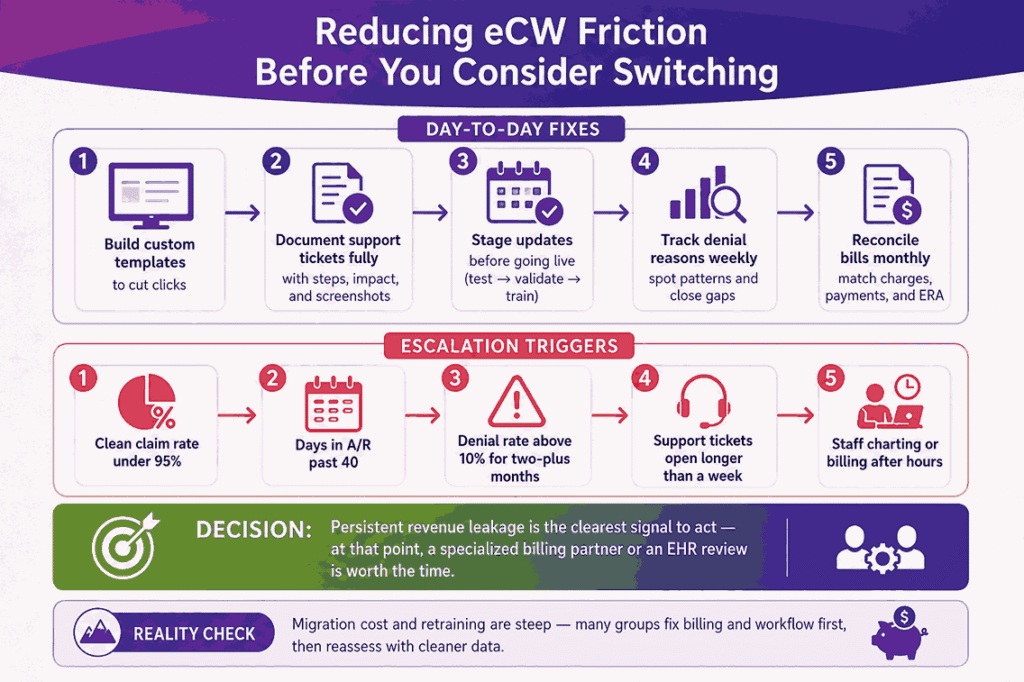
Most eClinicalWorks problems can be reduced without switching systems. The right mix depends on where the friction hits hardest. Start with the steps below before considering a full migration.
What Steps Reduce eClinicalWorks Problems Day to Day?
- Build custom templates: cut clicks by tailoring charts to each provider’s workflow
- Document support tickets fully: detailed tickets shorten back-and-forth cycles
- Stage updates first: test new releases before pushing them live
- Track denial reasons weekly: catch coding and eligibility errors at the source
- Reconcile bills monthly: flag per-transaction charges before they compound
When Should a Practice Consider Alternatives or Outside Help?
Persistent revenue leakage is the clearest signal to act. If clean claim rate stays under 95% or days in A/R climbs past 40, the current setup is costing money. At that point, a specialized billing partner or an EHR review is worth the time.
Watch for a short list of warning signs before making the call:
- Denial rate holding above 10% for two or more months
- Support tickets that stay open longer than a week
- Staff working after hours to finish charting or claims
How Does eClinicalWorks Compare to Alternatives?
Practices weighing a switch usually compare eClinicalWorks against a short list. The main alternatives differ on price, target size, and usability. The table below sets the common options side by side.
| EHR | Best fit | Key difference vs eClinicalWorks |
|---|---|---|
| Epic | Large health systems and hospitals | Deeper enterprise tooling at much higher cost |
| athenahealth | Ambulatory groups wanting cloud billing | Larger billing network, subscription pricing |
| NextGen | Specialty and mid-sized practices | Similar scope, different workflow design |
| Tebra (Kareo) | Small independent practices | Lighter system, simpler learning curve |
No single alternative wins on every axis. Epic suits hospitals but overspends a small group’s budget. athenahealth and Tebra target lighter ambulatory needs. The right pick depends on specialty, size, and billing model.
Before switching: migration cost and retraining are steep. Many groups fix billing and workflow first, then reassess the EHR decision with cleaner data.

eClinicalWorks Challenges: Frequently Asked Questions
These are the questions practices ask most when researching eClinicalWorks problems. Each answer is short and direct for quick reference.
Who Is the Owner of eClinicalWorks?
eClinicalWorks is privately held and led by co-founder and CEO Girish Navani. He started the company in 1999 alongside his brother Mahesh Navani. The company remains private and is headquartered in Westborough, Massachusetts.
How Do You Update eClinicalWorks Software?
Cloud eClinicalWorks accounts update automatically on the vendor’s schedule. On-premise servers require a manual upgrade coordinated with support. Test new releases in a staging step, since updates can break working features.
Is eClinicalWorks Better than Epic?
It depends on the size of the organization. Epic fits large hospitals and health systems with big budgets. eClinicalWorks fits ambulatory practices that want lower cost and cloud access. Neither is universally better.
What Are the Main eClinicalWorks Competitors?
The most-compared alternatives are Epic, athenahealth, NextGen, and Tebra. Each targets a different practice size and billing model. Behavioral health groups also compare purpose-built specialty EHRs.
Is eClinicalWorks Cloud-Based?
Yes, eClinicalWorks offers a cloud-hosted version that most new practices choose. An on-premise option still exists for groups that want local servers. The cloud version updates automatically and needs no local hardware.
Is eClinicalWorks Good for Revenue Cycle Management?
eClinicalWorks includes billing tools and an optional RCM service. Reviews on that RCM service are mixed on cost and onboarding. Many practices pair the EHR with a specialized billing partner for stronger collections.
Why Is eClinicalWorks So Slow?
Users most often report slowness during peak clinical hours. Heavy simultaneous logins and a dense interface both add load. Older on-premise hardware can also lag under normal daily use.
Can You Switch From eClinicalWorks to Another EHR Easily?
No, switching EHRs is rarely easy or cheap. Data migration, retraining, and downtime all add cost. The 2017 DOJ case even flagged data-portability weaknesses that complicate exits.
What Is the eClinicalWorks Patient Portal Called?
The eClinicalWorks patient portal is called healow. It handles appointments, messaging, telehealth, and record access for patients. Reviews on healow tend to run more positive than on the core EHR.
Final View on eClinicalWorks Challenges
eClinicalWorks remains a major ambulatory EHR with genuine strengths. Its challenges span usability, performance, support, billing, interoperability, and compliance. Each one reaches the revenue cycle through denials, days in A/R, and lost visits. Practices that map these problems to revenue can fix the biggest leaks first, with or without leaving the platform. The right move depends on your facility type, specialty mix, and current denial rate. Start by measuring clean claim rate and days in A/R against the benchmarks above. For deeper billing support, review your revenue cycle management options next.