A patient sits in an infusion chair for three hours. A chemotherapy drug drips into her vein the entire time. The nurse checks vitals every fifteen minutes. Later, a coder pulls the chart. That coder has one job. Turn three hours of clinical time into billable code time. The first hour is easy. Every hour after that is where most oncology practices lose money without knowing it.
That gap is where CPT code 96415 lives. Most articles treat it as a simple definition to memorize. It is not. It is closer to a signal. This tells you how well your infusion chair time, your nursing documentation, and your billing team are actually working together. Get that signal wrong, and you either underbill real work or hand a payer a reason to deny the claim.
This guide covers what 96415 means, what drives its cost, real chart scenarios, and the rules that keep it clean. It also treats it as an operational problem, not just a coding one.
What is CPT code 96415?
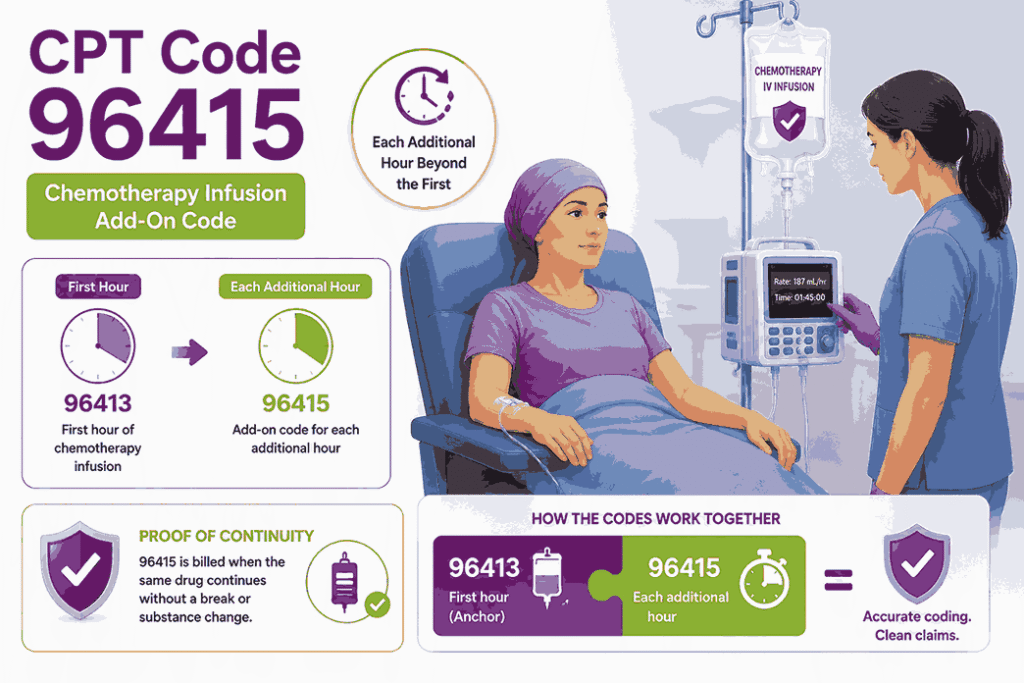
CPT code 96415 is an add-on code. It covers chemotherapy administration by intravenous infusion. It applies to each additional hour beyond the first. The American Medical Association places it under highly complex drug administration codes.
Two words matter here. Add-on code. This code never stands alone on a claim. It always pairs with CPT 96413. That code covers the first hour of chemotherapy infusion for a single drug. Think of 96413 as the anchor hour. Think of 96415 as everything after it.
The clinical picture is simple. A patient gets a chemotherapy drug through an IV. The infusion team watches for reactions. They adjust the drip rate as needed, and when the same drug keeps running past the first hour, each extra hour gets billed with 96415.
Most coding guides stop there. But the real insight is this. 96415 is not really about time. It is about proof of continuity. Every unit you bill is a claim that one drug ran continuously, without a break, without a substance change. Payers do not take that claim on faith. They want documentation that proves it.
For a full breakdown of how this code fits alongside related infusion and injection codes, this guide to oncology CPT codes is a useful reference point.
Why This Code Is an Add-On, Not a Standalone Service
Standalone codes carry their own value. They can be billed alone. Add-on codes only exist next to a primary code. Payers process them differently during adjudication.
96415 has no value on its own. It only means something paired with 96413. Submit 96415 without 96413 on the same claim and the same date. The claim gets rejected. There is no primary service to attach it to.
This changes how documentation should be written. Notes need to trace back to one continuous episode. Start time. Stop time. Drug name. Any interruptions. All tied to a single infusion.
Here is the part most billing teams miss. A second, different chemotherapy drug started after the first one finishes does not get 96415. It gets CPT 96417, the sequential infusion code. Confusing these two and other related procedure codes is one of the most common and most expensive mistakes in oncology infusion billing. It happens because coders see “additional hour” and stop reading the chart closely enough.
CPT code 96415 Cost Analysis
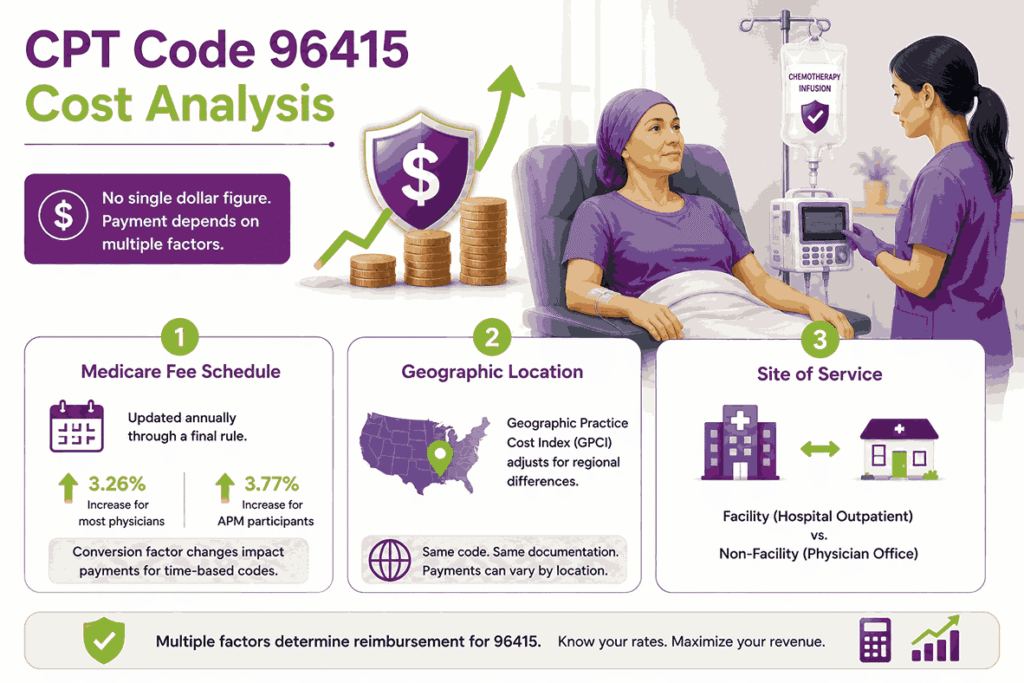
Most articles will try to hand you one dollar figure for this code. That number will almost always be wrong for your practice. Reimbursement for 96415 depends on several moving parts, not a single rate.
Medicare pays this code under the Physician Fee Schedule. That schedule updates every year through a final rule. The CY 2026 update raised the conversion factor. Most physicians saw a 3.26 percent increase. Advanced alternative payment model participants saw 3.77 percent. A higher conversion factor does not guarantee higher payment for every code. Relative value units can shift under the same rule, but it does move the baseline for time-based codes like this one.
Geography changes the number too. The fee schedule applies a geographic practice cost index. It adjusts for regional differences in practice expenses and physician work. The same code, same documentation, same patient, can pay differently in a rural county than in a major city.
Site of service is the third factor. Facility and non-facility rates differ under Medicare. A hospital outpatient department bills chemotherapy administration differently than an independent oncology office. Move your infusion services between these settings and the payment for 96415 moves with them.
The Real Reason Commercial Payer Rates Are Harder to Predict
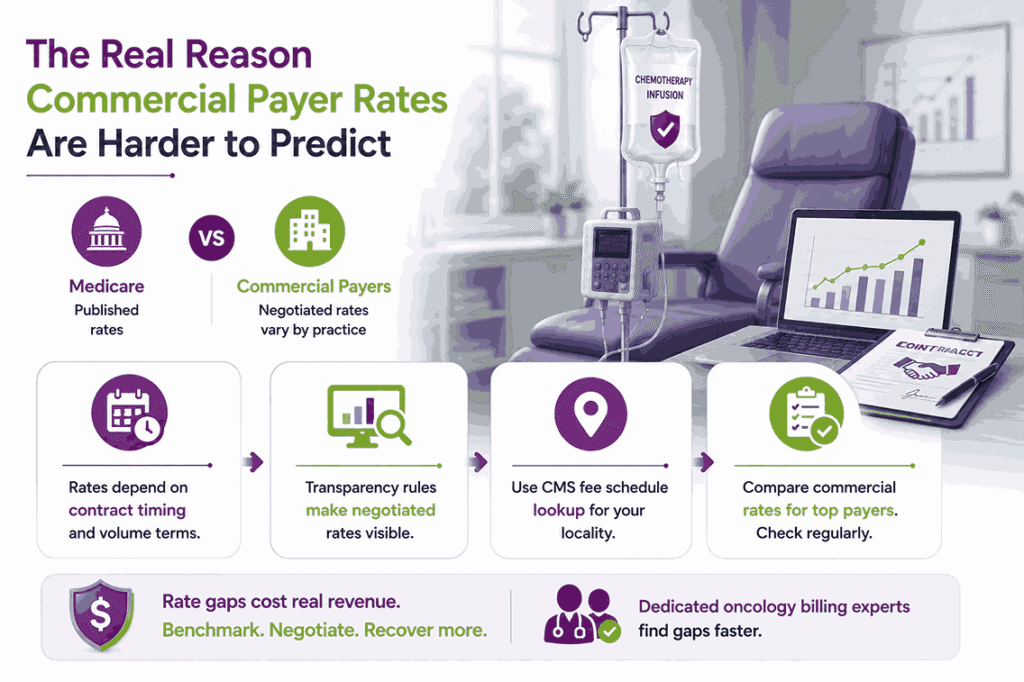
Medicare at least gives you a published fee schedule. Commercial payers do not work that way. Aetna, Blue Cross Blue Shield, Cigna, and UnitedHealthcare each negotiate rates directly with each practice. Two oncology practices in the same city, seeing the same insurer, can have completely different contracted rates for 96415.
The reason usually has nothing to do with the code itself. It comes down to when the contract was signed and what volume terms were negotiated. A practice that has not been renegotiated in years is very likely leaving money on the table on every infusion claim it submits, not just this one.
Federal price transparency rules have made some of this negotiated data public. Billing teams can now benchmark their own rates against market averages. Most practices never check this. That is a missed opportunity, not a minor detail.
The practical move is simple. Pull the CMS Physician Fee Schedule lookup tool for your specific locality. Then cross-check contracted commercial rates for your top payers. No article, including this one, can hand you an accurate dollar figure for your specific claim. Practices that outsource this comparison work to dedicated oncology billing services tend to catch these rate gaps faster than practices tracking it manually in-house.
CPT code 96415 Scenarios
Definitions only go so far. Real charts show where this code gets used correctly, and where it goes wrong.
Scenario one: a clean extended infusion. A patient with diffuse large B-cell lymphoma gets a three-hour infusion. The first hour is billed 96413. The next two hours, the same drug, get billed as two units of 96415. Documentation shows continuous infusion with clear start and stop times.
Scenario two: an infusion that falls just short. A patient gets the same drug for one hour and twenty minutes. The rule requires more than thirty minutes past the one-hour mark to bill an extra unit. Twenty minutes does not meet that bar. Only 96413 gets billed here. Adding 96415 would bill a service the chart does not support.
Scenario three: a substance changes mid-treatment. A patient gets Drug A for the first hour, billed with 96413. The team then switches to Drug B for a second hour. Drug B is a different substance, not a continuation. The correct code is 96417, not 96415. Teams that default to 96415 whenever they see “additional hour” will misbill this scenario often.
Scenario four: hydration running alongside chemo. A patient gets hydration fluid at the same time as the chemotherapy drug. Medicare treats that hydration as incidental. It cannot be billed separately with a hydration code like 96360 when it runs concurrently. The extra hours of the chemo drug itself still get 96415. The hydration does not get its own line.
Scenario five: multiple drugs in one bag. An infusion bag holds three different medications mixed. This is not three separate services. It is billed as one continuous infusion. 96415 applies to each additional hour that a single mixed infusion runs.
Every one of these scenarios comes down to one skill. Read the chart closely enough to know if the infusion is a continuation, a substance change, or an incidental fluid before you pick a code.
CPT Code 96415 Billing Rules
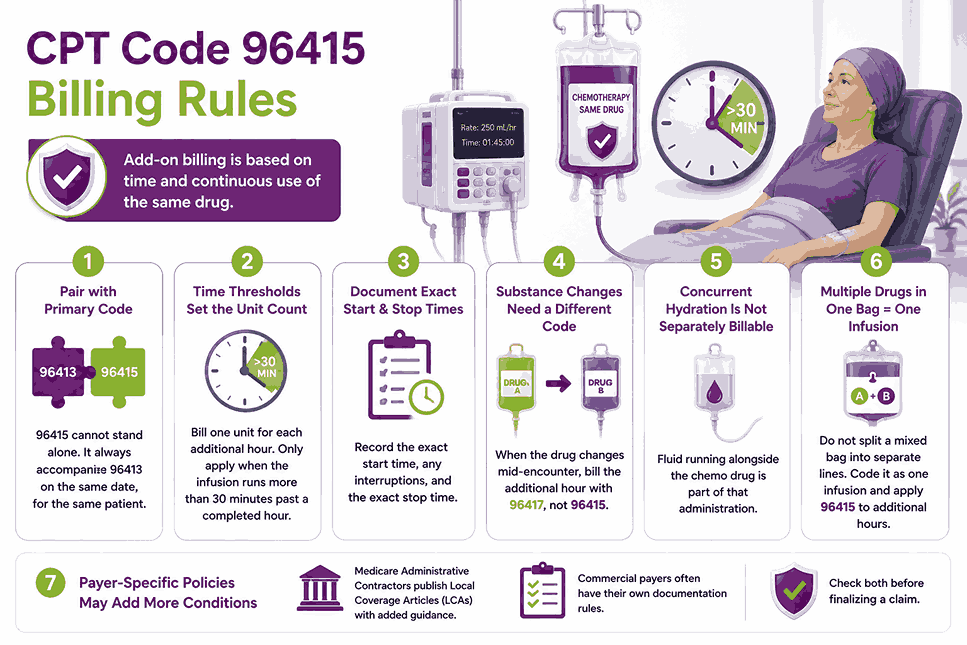
These rules exist for one reason. They tie add-on billing to actual documented time and actual continued use of the same drug. A few of them cause most of the denials when overlooked.
It must pair with a primary code. 96415 cannot stand alone. It always accompanies 96413 on the same date, for the same patient.
Time thresholds set the unit count. Bill one unit for each additional hour. Only apply it when the infusion runs more than thirty minutes past a completed hour increment. Anything short of that does not qualify.
Documentation needs exact start and stop times. This is a time-based code. Vague notes like “infusion continued for hours” will not survive an audit. Record the exact start time, any interruptions, and the exact stop time.
Substance changes require a different code. When the drug changes mid-encounter, bill the additional hour with 96417, not 96415. This single mix-up drives a large share of oncology infusion denials.
Concurrent hydration is not separately billable. Fluid running alongside the chemo drug is part of that administration. Do not bill it separately with 96360 when it runs at the same time.
Multiple drugs in one bag count as one infusion. Do not split a mixed bag into separate lines. Code it as one infusion and apply 96415 to the additional hours it runs.
Payer-specific policies can add more conditions. Medicare Administrative Contractors publish local coverage articles with added guidance. Commercial payers often layer their own documentation rules on top. Check both before finalizing a claim.
Final Words
Here is the bigger point most practices miss. Denials on this code rarely come from not knowing the rules. They come from documentation gaps created during a busy shift, when a nurse charts times loosely because the chair is full and the day is long. The fix is not more training on CPT definitions. It is tighter alignment between nursing charting habits and coding review, checked before the claim goes out, not after it comes back denied.
Practices that want a broader view of how this code fits into full-cycle oncology billing can start with this oncology billing guide, which covers the coding and workflow pieces beyond infusion administration alone.