The D5213 dental code reports a maxillary partial denture with a resin base and cast metal framework. It is used when a patient needs to replace missing upper teeth while retaining natural teeth that can support the removable prosthesis.
This dental code D5213 covers the cast framework, resin denture base, replacement teeth, and associated clasps and rests. Coverage and reimbursement can vary by dental plan, making accurate documentation and benefit verification important before submitting the claim.
This guide covers the D5213 description, typical cost, clinical scenarios, and key billing rules. The sections below explain when this CDT code applies, what documentation supports the claim, and which coverage requirements can affect reimbursement.
Quick Reference: D5213 Dental Code
Here’s a quick reference point for the D5213 dental code, explained in a table format. All the reference values below follow the ADA CDT 2026 code set and the 2026 ADA Survey of Dental Fees.
| Attribute | Detail |
|---|---|
| CDT Code | D5213 |
| Nomenclature | Maxillary partial denture – cast metal framework with resin denture bases (including retentive/clasping materials, rests, and teeth) |
| Category | Removable Prosthodontics (D5000–D5899) |
| Common Name | Upper Cast Metal Partial Denture |
| Clinical Gate | Must have remaining healthy anchor teeth, presence of missing maxillary teeth with healthy periodontal support and adequate bone height |
| Benefit Class | Class III (Major Restorative / Removable Prosthodontic Services) |
| Typical Coverage | 50% of network allowed fee (after deductible) |
| Frequency Limit | Replacement typically every 5–7 years absent documented necessity |
| National Average Fee (2026) | $1,650 – $2,350 (Gross dentist fee before insurance discount) |
| Frequent Denial | Missing Tooth Clause, frequency limitation violation, or failure to submit pre-operative radiograph proving necessity |
What is the Description of Dental Code D5213?
The D5213 dental code describes a maxillary partial denture with a cast metal framework and resin denture bases. The code includes the retentive or clasping materials, rests, and replacement teeth that are part of the partial denture.
D5213 falls under removable prosthodontics and is used for partial dentures replacing missing teeth in the upper (maxillary) arch. The cast metal framework provides the structure and support, while the resin bases hold the artificial teeth in place.
For billing purposes, D5213 specifically applies to the upper arch. A cast metal partial denture for the lower arch is reported with D5214 instead.
How Does D5213 Differ From D5211, D5212, D5214, and D5225?
D5213 differs from its neighbors by one factor above all others: the framework material. A maxillary partial with a cast metal framework is D5213. The same arch built on resin alone is a different code entirely, regardless of how many teeth it replaces or how complex the case looks.
The table below maps each related code to its actual trigger.
| CDT Code | Procedure | Clinical Trigger |
|---|---|---|
| D5213 | Maxillary partial denture, cast metal framework with resin bases | Cast metal framework (typically cobalt-chromium), upper arch, one or more remaining abutment teeth |
| D5211 | Maxillary partial denture, resin base | No cast framework; retention from clasps and rests built directly into the resin, upper arch |
| D5212 | Mandibular partial denture, resin base | Same resin-base design as D5211, lower arch |
| D5214 | Mandibular partial denture, cast metal framework | Same cast metal design as D5213, lower arch |
| D5225 | Maxillary partial denture, flexible base | Flexible or nylon base material instead of resin or cast metal, upper arch |
| D5110 | Complete denture, maxillary | No remaining upper teeth at all; nothing left to serve as an abutment |
Once no upper teeth remain to anchor a partial, the case moves out of the partial-denture codes entirely and into D5110.
Is D5213 the Same as D5211?
No, D5213 requires a cast metal framework, while D5211 does not. D5211 is a resin-base partial with clasps and rests built directly into the acrylic base; no metal substructure is involved.
The two codes describe genuinely different appliances, not two ways of billing the same design. Coding a resin-base case as D5213 because it seemed clinically complex is a documentation mismatch that invites a downgrade.
Does D5213 Apply If No Upper Teeth Remain?
No, D5213 requires at least one remaining maxillary tooth to serve as an abutment. The cast metal framework relies on clasps and rests engaging natural teeth for retention and support. Once the arch is fully edentulous, there’s nothing left for the framework to attach to, and the case becomes a complete denture under D5110.
Does D5213 Apply If Extractions Happen the Same Day as Delivery?
No, D5213 is strictly a conventional partial, delivered after the extraction sites have healed. If the cast metal framework is delivered the same day teeth are extracted, the correct code is D5223 (immediate maxillary partial denture, cast metal framework).
The two codes describe the same physical design, but the timing relative to extraction is what determines which one applies. Billing D5213 for a same-day delivery misrepresents when the appliance was actually placed.
What Clinical Findings Support a D5213 Partial Denture?
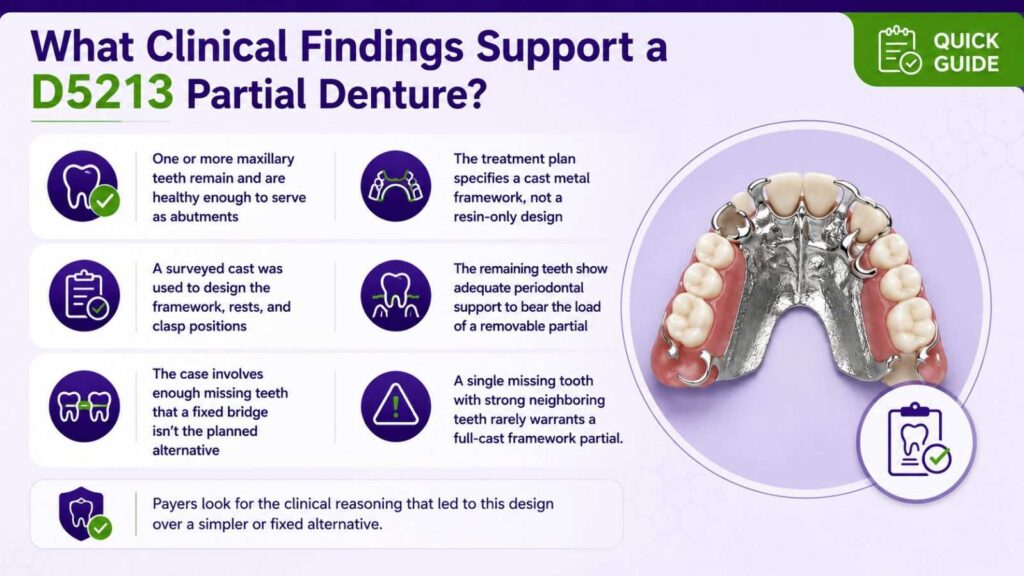
A D5213 partial denture rests on a documented partially edentulous maxillary arch with enough perfect teeth to support a cast framework. The findings below are what a payer expects to see reflected in the clinical record.
- One or more maxillary teeth remain and are healthy enough to serve as abutments
- The treatment plan specifies a cast metal framework, not a resin-only design
- A surveyed cast was used to design the framework, rests, and clasp positions
- The remaining teeth show adequate periodontal support to bear the load of a removable partial
- The case involves enough missing teeth that a fixed bridge isn’t the planned alternative
A single missing tooth with strong neighboring teeth rarely warrants a full-cast framework partial. In this case, the payer will look for the clinical reasoning that led to this design over a simpler or fixed alternative.
Do Rest Seat Preparations Bill Separately From D5213?
No, rest seat and guiding plane preparation on the abutment teeth is bundled into D5213. This work involves reshaping the existing tooth structure so the framework’s rests seat properly against it, and that shaping is considered part of building the partial denture itself.
An exception comes up when an abutment tooth needs a crown specifically to support a clasp or rest, purely to create a surface the framework can engage. In that case, the crown bills separately under D2740 or D2750, and the chart needs to state that it’s a surveyed crown.
Which Documents Support a D5213 Claim?
Meeting the clinical findings above is only half of the dental billing process for this code. Documentation for D5213 has to prove two things at once. First, the arch is genuinely partially edentulous, and second, the cast metal framework was the appropriate design choice.
The record connects the remaining teeth, the framework, and the reason those findings led to this specific design. These documents include:
- A pre-treatment radiograph showing the remaining maxillary teeth and missing tooth sites
- Periodontal charting confirming the abutment teeth can support a removable partial
- A narrative stating why a cast metal framework was chosen over a resin-base design
- The specific teeth being replaced and the specific teeth serving as abutments
- Documentation of the framework material used (typically cobalt-chromium)
What Is the Cost of Dental Code D5213?
The cost of D5213 ranges from about $1,500 to $2,500 per arch in 2026. The national private-market average is near $2,065 according to the ADA Health Policy Institute Survey of Dental Fees.
Some markets and complex cases push the fee to $3,000 or more. Here, lab fees account for the largest share of the price difference between D5213 and a resin-base partial.
A cast framework requires a surveyed cast, a wax try-in, and precision metal casting before the resin bases and teeth are even added. That extra lab work is why D5213 consistently costs several hundred dollars more than D5211 for a comparable arch.
| Cost Element | Typical 2026 Amount | Notes |
|---|---|---|
| D5213 office fee | $1,500 to $2,500 | National average $2,065 per ADA HPI survey |
| D5214 (mandibular equivalent) | $1,500 to $2,500 | Same design, opposite arch |
| D5211 (resin base, same arch) | $900 to $1,600 | No cast framework; the code many plans downgrade D5213 to |
| D5225 (flexible base, same arch) | $1,600 to $1,800 | Different base material entirely, priced between D5211 and D5213 |
| Repair, resin base (D5612) | Billed separately | For the resin denture base portion |
| Repair, cast framework (D5622) | Billed separately | For the metal framework itself |
| Reline or rebase (D5710–D5761 series) | Billed separately | Not included in the original D5213 fee |
How Do Dental Plans Cover D5213?
D5213 falls under the Major Services benefit tier on nearly every dental plan. That classification shapes almost everything about how it actually gets paid.
Its coverage is almost 50%, but only after a waiting period of 6 to 12 months, so a patient who just signed up for coverage may still be paying out of pocket. Even once that waiting period ends, annual maximums typically range from $1,500 to $2,000.
Two other rules complicate coverage further. First, the missing tooth clause can exclude coverage entirely if the tooth being replaced was already missing before the patient’s policy took effect.
Second, many plans apply what’s called an alternate benefit provision. This means rather than paying the actual D5213 fee, the plan pays as if the case were the cheaper D5211 resin-base design, then bills the patient for the gap.
Medicaid coverage adds yet another layer of unpredictability, since only 19 of 50 states reimburse adult Medicaid patients for D5213 at all. In the states that do, the average reimbursement runs around $1,117, roughly half of what private plans typically pay.
What Factors Change the D5213 Fee?
Framework material and case complexity move the D5213 fee more than anything else. Cobalt-chromium is the standard metal used in most cases. But if a patient chooses a premium alloy instead, the lab charges more, so the fee increases as well.
Complexity works the same way. A case with more abutment teeth and clasps takes the lab longer to design and cast, and that extra time adds to the price.
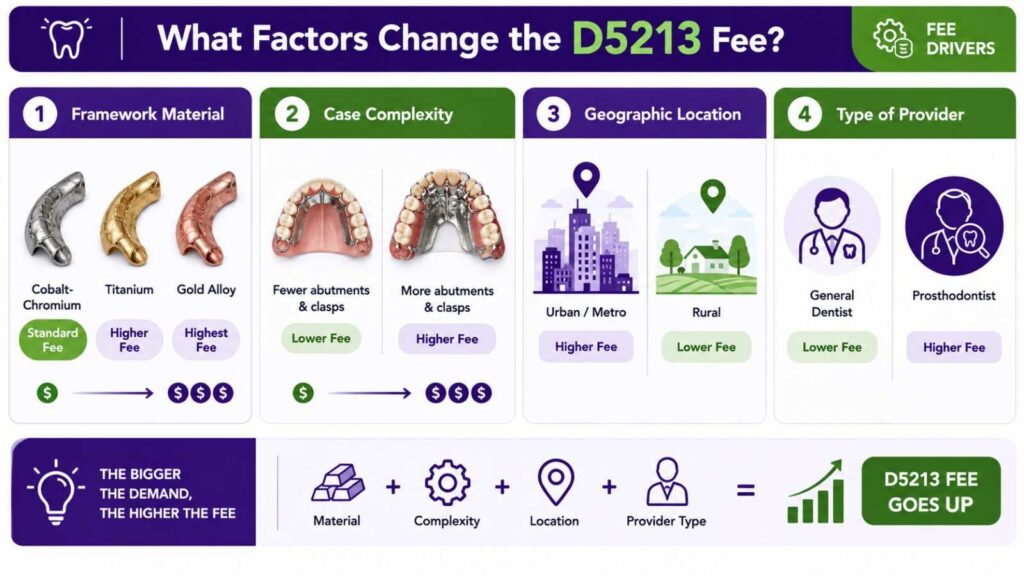
On top of the clinical side, where you live matters as well, since dental fees in big cities are consistently higher than in rural areas. The type of provider also makes a difference, since prosthodontists typically charge more than general dentists.
What Are Example Clinical Scenarios for Dental Code D5213?
D5213 applies when a partially edentulous maxillary arch gets a partial denture built on a cast metal framework. The scenarios below show clean reporting patterns, along with the two situations that most often turn a straightforward claim into a denial.
Scenario 1: Partially Edentulous Upper Arch With a Standard Cast Metal Framework
A patient is missing three upper molars but retains healthy anterior and premolar teeth. The dentist designs a cast metal framework partial, using the remaining teeth as abutments for the clasps and rests. The practice reports D5213 with a narrative and supporting radiograph.
The record shows the surveyed cast, the selected abutment teeth, and the reason a cast framework was chosen over a resin base. Because the documentation matches the descriptor exactly, the claim is processed without a downgrade or a request for more information.
Scenario 2: Missing Tooth Clause Denial
A patient enrolls in a new dental plan and requests a D5213 partial to replace two molars that were extracted three years earlier, before their coverage began. The plan denies the claim entirely, citing the missing-tooth clause because the teeth were already absent when the policy took effect.
The denial has nothing to do with the framework, the documentation, or the coding itself. It comes down to plan language that excludes benefits for teeth missing before enrollment. Verifying missing tooth clause language during the pre-treatment estimate would have caught this before the patient committed to treatment.
Scenario 3: Resin-Base Case Incorrectly Billed as D5213
A patient receives a partial denture built entirely on a resin base, with wrought-wire clasps and no cast metal substructure. The practice bills the case as D5213, assuming the code applies because the case involved several missing teeth and looked complex.
The correct code is D5211, not D5213, since D5213 requires an actual cast metal framework. Billing complexity, if treated as framework material, is a documentation mismatch that a payer’s clinical reviewer quickly catches, and it invites a downgrade or an audit flag rather than a clean payment.
What Are the D5213 Rules for Successful Reimbursement?
Successful D5213 reimbursement rests on three things. These include clean documentation, correct code selection, and knowing which plan rules apply before treatment even starts. Here are the key guidelines to ensure full reimbursement for this dental code.
Why Do Carriers Deny or Downgrade D5213 and How to Prevent It?
Carriers deny or downgrade D5213 for a small, repeating set of reasons. Almost all of them trace back to documentation. That means if you fix the record, it fixes most of these before they ever become a problem.
The framework material has to appear in writing. A payer can’t tell from a claim form alone that a cast metal framework was actually used, so the narrative needs to say “cast metal framework” plainly.
The abutment teeth matter too, since naming the specific teeth supporting the clasps and rests shows the payer exactly how the design works. A pre-treatment radiograph showing the remaining teeth and the sites of missing teeth rounds out the clinical picture.
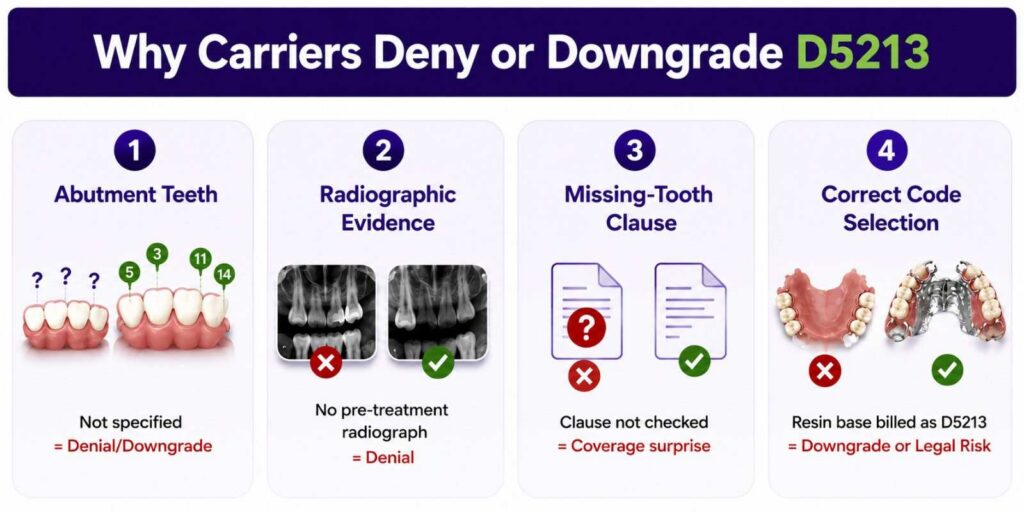
Beyond the chart itself, checking the missing-tooth clause language before treatment helps catch any coverage gaps while there’s still time to plan around them. Lastly, a resin-base case should never get billed as D5213 just because it looks complicated.
A downgrade to D5211 is rather easy to miss, since the claim still gets paid, just at the wrong rate. However, if you deliberately bill D5213 when the framework is resin, it crosses into illegal dental billing practices.
Does the Missing Tooth Clause Apply to D5213?
Yes, the missing-tooth clause applies directly to D5213, and it’s the single biggest reason these claims are denied outright. If the tooth being replaced was already missing before the patient’s coverage began, the plan can deny the entire claim.
Checking this clause during the pre-treatment estimate, before the framework is even designed, is the only reliable way to avoid an unpleasant surprise.
Is It Legal to Balance-Bill the Difference When D5213 Is Downgraded?
Often, no, though this depends entirely on the specific PPO contract. When an in-network plan downgrades D5213 to the D5211 allowable, the gap between what the practice charged and what the plan paid isn’t automatically the patient’s responsibility to cover.
Many PPO agreements restrict balance-billing beyond the contracted write-off, which means the practice may have to absorb that difference. However, balance billing is legal if the patient signed a clear non-covered service agreement before treatment began.
Can D5213 Be Billed With Other Prosthetic Codes on the Same Arch?
Generally, it cannot, as most carriers treat D5213 as mutually exclusive with other removable or fixed partial denture codes on the same arch during the same treatment period.
A plan won’t pay for two different partial denture solutions in the same arch at once, even if a transitional or interim appliance was used earlier in the treatment plan. So, always confirm plan-specific rules before billing more than one prosthetic code on the same arch.
Can an Interim Partial (D5820) Be Billed Before D5213?
Yes, the mutual exclusivity rule that blocks two final prosthetics on the same arch does not apply to an interim partial. A patient waiting several weeks for a cast metal framework to be designed, cast, tried in, and finished doesn’t go without teeth during that time.
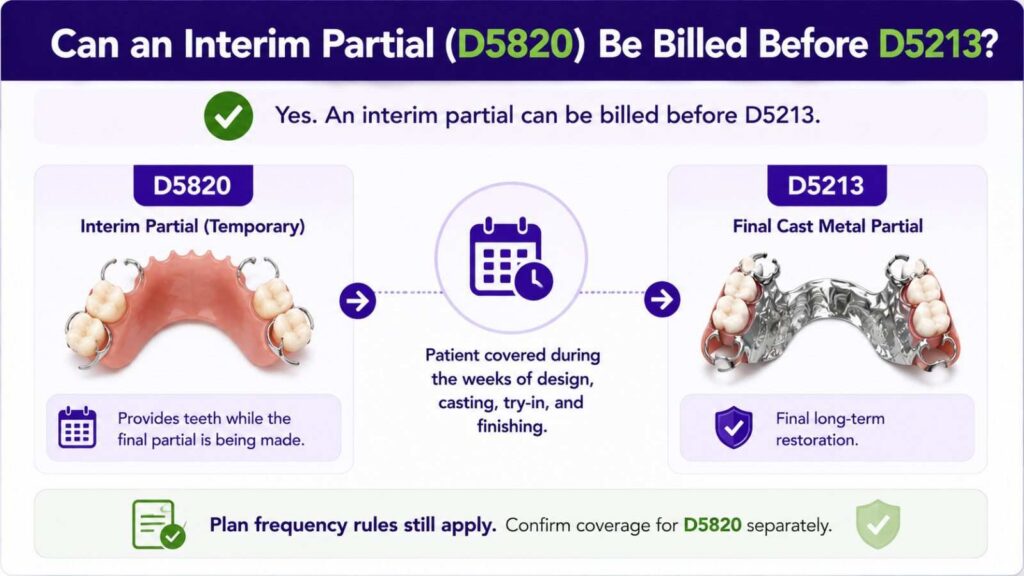
A temporary “flipper” partial, billed under D5820 for the maxillary arch, covers that gap and can be billed before D5213. Plan frequency rules still apply to the interim appliance itself, so confirm coverage for D5820 separately.
Does D5213 Include Repairs or Relines After Delivery?
Not entirely, and this is a common source of confusion. The D5213 code bundles the delivery appointment itself and the initial adjustments made immediately after delivery, so those aren’t billed separately. Anything beyond that initial adjustment period does need its own code.
A repair to the resin base areas is billed under D5612, while a repair to the cast metal framework itself is billed under D5622. Relines and rebases, needed later as the gum tissue changes shape over time, run through the D5710-D5761 series entirely on their own.
Many practices bill these as part of the original D5213 fees, which is why they leave money on the table.
What if a Tooth or Clasp Needs Adding to an Existing D5213?
If an abutment tooth fails and a new tooth needs to be added to the existing cast framework, that’s billed under D5650 (add tooth to existing partial denture). Similarly, if the case needs additional retention later, adding a new clasp is billed under D5660 (add clasp to existing partial denture).
Neither of these falls under the original D5213 fee or under the repair codes (D5612 or D5622). It’s because the framework isn’t broken, it is being modified to fit a change in the patient’s mouth.
How to Avoid Frequency and Replacement Denials on D5213?
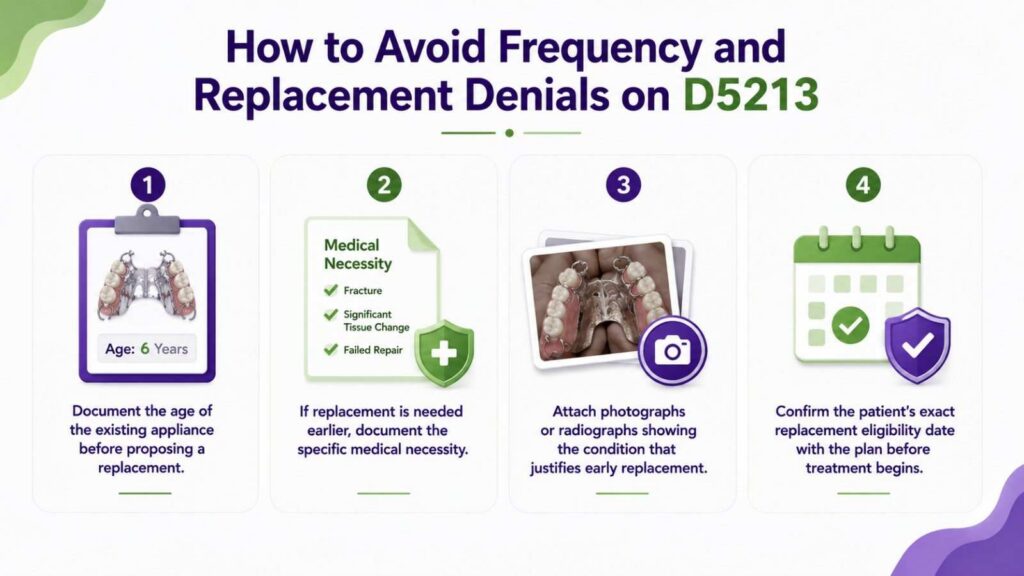
Replacement partials draw close scrutiny, since most plans only cover a new D5213 every 5 to 7 years. To avoid frequency and replacement denials for D5213, make sure to follow the points mentioned below.
- Document the age of the existing appliance before proposing a replacement
- If replacement is needed earlier than the plan’s frequency limit allows, document the specific medical necessity, such as a fracture, significant tissue change, or a failed repair
- Attach photographs or radiographs showing the condition that justifies early replacement
- Confirm the patient’s exact replacement eligibility date with the plan before treatment begins, rather than assuming the standard interval applies
Is a Predetermination Required Before Billing D5213?
Not always required, but almost always worth doing anyway. Because D5213 sits in the Major Services tier and the fee runs well into four figures, most plans allow, and many practices choose, to submit a predetermination before starting treatment.
A predetermination is basically asking the insurance company ahead of time if they’ll pay for the partial. It tells the practice if a missing tooth clause is going to block the claim before the framework even gets built.
Moreover, it gives the patient a concrete number to plan around, rather than a rough guess that might be way off once the claim is processed.
How to Appeal a Downgraded or Denied D5213 Claim?
An appeal of a downgraded or denied D5213 claim must address the exact reason the payer gave. You cannot simply resubmit the same paperwork and hope for a different result. Here’s how you can appeal a downgraded or denied D5213 claim:
- Read the Explanation of Benefits carefully to identify the specific reason for the downgrade or denial
- Gather the radiograph, the narrative, and any photographs that support the cast metal framework and the abutment teeth
- Write a new narrative that directly addresses the payer’s stated reason, whether that’s framework documentation or a missing tooth clause dispute
- Submit the appeal through the payer’s required channel before the deadline, which is often 30 to 60 days
- Track the appeal status and escalate if the carrier upholds the original decision
Practices without the staff time to track every appeal deadline often turn to dedicated dental billing services to manage the process end-to-end.
What Is the Key Takeaway for D5213 Billing?
A D5213 claim is paid when the chart proves the framework is cast metal, identifies the abutment teeth, and meets the missing tooth clause. Get those three things right before treatment starts, and D5213 is one of the more predictable major services claims to collect on.
If your practice keeps seeing D5211 downgrades or missing tooth clause denials on partial dentures, that’s a documentation problem. A dedicated dental billing partner catches these gaps before the claim goes out.