Autism is present in roughly every one out of 31 eight-year-old children in the United States. Therefore, Pediatric practices, behavioral health groups, and ABA providers submit more autism claims every year in the history of the code set. Yet the single diagnosis code carrying most of that revenue, F84.0, is also one of the most misunderstood codes in pediatrics. It maps to a diagnostic framework the clinical world abandoned more than a decade ago. It carries an Excludes1 rule that silently voids claims.
Moreover, the entire adaptive behavior CPT family that pairs with it gets rebuilt on January 1, 2027. Practices that treat F84.0 as a simple lookup lose money on preventable denials, retroactive audits, and authorization gaps. This guide covers the code definition, the DSM-5-TR mismatch, the screening and diagnostic CPT crosswalk, the ABA code set, modifier logic, documentation standards, and the payer rules that decide whether an autism claim pays on the first pass. Read it as a working reference, and the rest in pediatrics ICD-10 codes guide.

What Is the ICD-10 Code for Autism in 2026?
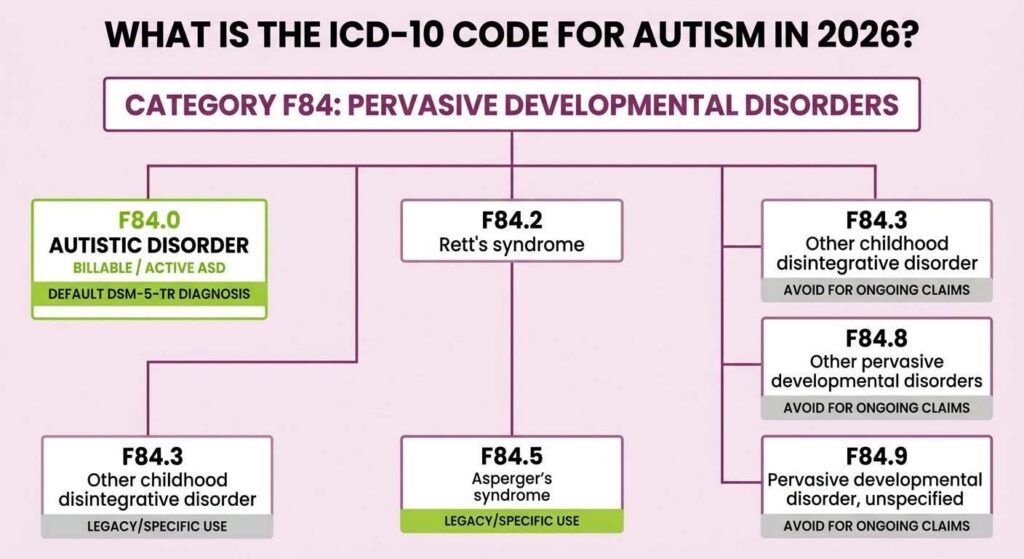
The Autism spectrum disorder ICD-10 is F84.0, Autistic disorder. It sits inside category F84, Pervasive developmental disorders, within the Mental, Behavioral and Neurodevelopmental chapter. F84.0 is a billable, specific code at the fourth character level. Therefore no additional digits exist, and no further specificity is required or possible.
The code has been valid since October 1, 2015. Notably, it has carried no revisions in any annual update cycle since then, including FY2026. However, stability in the code itself does not mean stability in the rules around it, which is where most denials originate.
Before selecting F84.0, confirm the full F84 family. The table below lists every valid subcode in the current ICD-10-CM set.
| ICD-10-CM Code | Descriptor | Billable | Typical Pediatric Use |
|---|---|---|---|
| F84.0 | Autistic disorder | Yes | Default code for a DSM-5-TR autism spectrum disorder diagnosis |
| F84.2 | Rett’s syndrome | Yes | Confirmed Rett’s, usually with MECP2 findings |
| F84.3 | Other childhood disintegrative disorder | Yes | Heller’s syndrome, disintegrative psychosis |
| F84.5 | Asperger’s syndrome | Yes | Legacy Asperger’s documentation, not a DSM-5-TR term |
| F84.8 | Other pervasive developmental disorders | Yes | Documented PDD that does not fit a specific subcode |
| F84.9 | Pervasive developmental disorder, unspecified | Yes | Working or provisional PDD, avoid for ongoing therapy claims |
What Does F84.0 Actually Include?
The F84.0 covers four terms: autism spectrum disorder, infantile autism, infantile psychosis, and Kanner’s syndrome. Consequently, a clinician who documents “autism spectrum disorder” is coded to F84.0, even though the code title still reads “Autistic disorder.”
That inclusion term matters operationally. Coders sometimes reject a chart because the phrase “autistic disorder” never appears. However, the index and the Applicable To list both route autism spectrum disorder directly to F84.0.
Why Are F84.1 and F84.4 Missing From ICD-10-CM?
Practices occasionally see F84.1 (atypical autism) referenced in older material or in international documentation. Those codes exist in the World Health Organization’s ICD-10, but the United States clinical modification never adopted them. Therefore F84.1 and F84.4 are invalid on any HIPAA-covered claim and will be rejected at the clearinghouse.
How Does F84.0 Map to a DSM-5-TR Autism Spectrum Disorder Diagnosis?
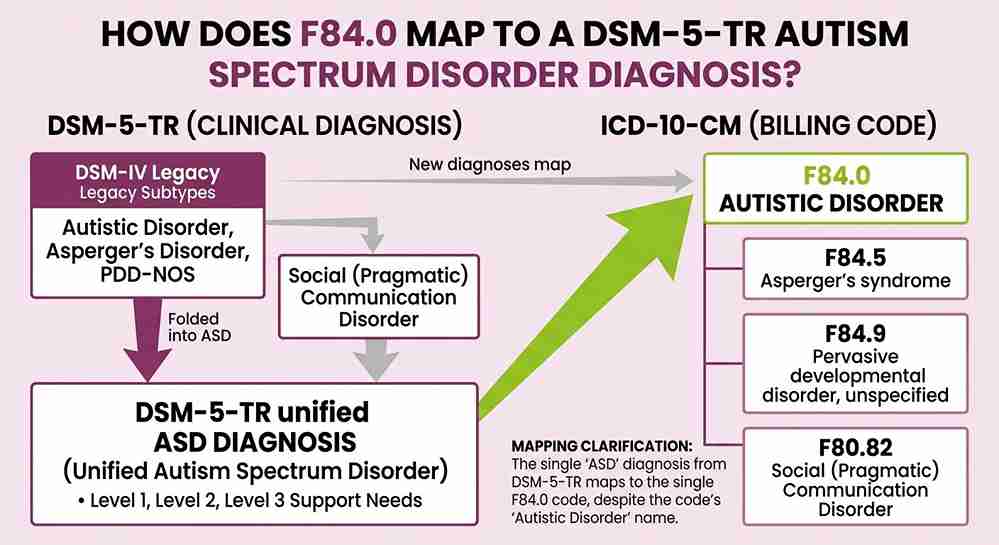
Clinicians diagnose autism using DSM-5-TR, which collapsed the older subtypes into one unified Autism Spectrum Disorder category. ICD-10-CM, however, still carries the pre-DSM-5 structure. As a result, a modern spectrum diagnosis has to be reported through a code built for a narrower 1990s construct.
This mismatch drives real denials. Payers reviewing a DSM-5-TR evaluation sometimes question why a “Level 1” diagnosis is reported as autistic disorder. Nevertheless, F84.0 remains the correct and expected mapping, and the Applicable To list is the defense.
The crosswalk below shows how each legacy DSM-IV term now behaves.
| DSM Framework Term | Current Clinical Status | ICD-10-CM Reporting |
|---|---|---|
| Autistic Disorder (DSM-IV) | Folded into ASD | F84.0 |
| Asperger’s Disorder (DSM-IV) | Folded into ASD | F84.0 for new diagnoses; F84.5 only if legacy documentation stands |
| PDD-NOS (DSM-IV) | Folded into ASD | F84.0 when ASD criteria are documented; F84.9 if not |
| Autism Spectrum Disorder (DSM-5-TR) | Current diagnosis | F84.0 |
| Social (Pragmatic) Communication Disorder | Distinct DSM-5-TR diagnosis | F80.82, never with F84.0 |
How Do You Document DSM-5-TR Severity When F84.0 Has No Severity Digits?
F84.0 cannot express Level 1, Level 2, or Level 3 support needs. Therefore severity has to live in the narrative record instead of the claim line. Payers use that narrative to judge medical necessity for hour counts, so the omission is not cosmetic.
Capture severity in the evaluation and in every treatment plan update. Specifically, document support level for social communication and for restricted or repetitive behaviors separately, as DSM-5-TR requires. Additionally, tie each severity statement to observed behavior and measurable data rather than to a label alone.
Which Excludes1 Rules Trigger F84.0 Denials?
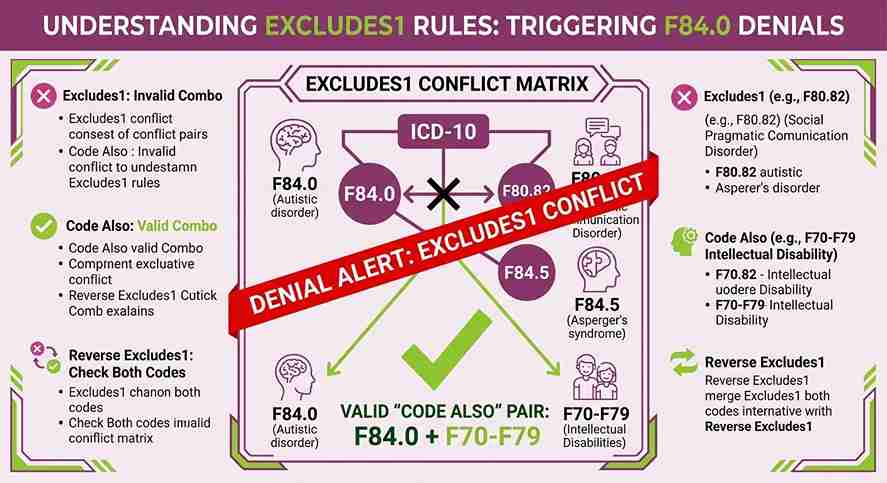
An Excludes1 note means two codes cannot appear together on the same claim for the same patient. F84.0 carries one direct Excludes1, and several other codes exclude it in reverse. Consequently, an autism claim can be rejected because of a code the coder added elsewhere in the chart.
Review the pairs below before submission, because clearinghouse edits catch some of these but payer edits catch all of them.
| Code Reported With F84.0 | Relationship | Result |
|---|---|---|
| F84.5 Asperger’s syndrome | Excludes1 under F84.0 | Reject, choose one |
| F84.2 Rett’s syndrome | Excludes1 under F84.2 | Reject, mutually exclusive |
| F84.3 Childhood disintegrative disorder | Excludes1 under F84.3 | Reject, mutually exclusive |
| F80.82 Social pragmatic communication disorder | Excludes1 under F84.3 | Reject, the diagnoses are alternatives |
| R47.- Speech disturbances NEC | Excludes1 under F80.82 | Reject, code the developmental disorder instead |
| F70-F79 Intellectual disabilities | “Code also” under F84 | Report both, expected pairing |
Note the last row carefully. Category F84 instructs coders to code also any associated medical condition and intellectual disability. Therefore F70 through F79 is not a conflict; it is a documented expectation. Roughly 40 percent of eight-year-olds identified with autism also have an IQ at or below 70, so this pairing is common.
What Are the Pediatric Autism Screening and Diagnostic CPT Codes?
Screening and diagnosis represent two separate billing events with separate code families. Screening uses a standardized instrument completed by an observer. Testing, by contrast, measures what the child can actually perform on a psychometric instrument. Payers audit this distinction aggressively.
The table below is the part of overall pediatrics CPT codes that carry the pediatric autism identification pathway from first screen to formal diagnosis.
| CPT Code | Service (Abbreviated) | Time Basis |
|---|---|---|
| 96110 | Developmental screening, standardized instrument, with scoring and documentation | Per instrument |
| 96127 | Brief emotional or behavioral assessment | Per instrument |
| 96112 | Developmental test administration by physician or QHP, first 60 minutes | Time based |
| 96113 | Developmental test administration, each additional 30 minutes | Add-on |
| 96116 | Neurobehavioral status exam, first 60 minutes | Time based |
| 96121 | Neurobehavioral status exam, each additional 60 minutes | Add-on |
| 96130 | Psychological testing evaluation services, first 60 minutes | Time based |
| 96131 | Psychological testing evaluation, each additional 60 minutes | Add-on |
| 96136 | Test administration and scoring by physician or QHP, first 30 minutes | Time based |
| 96137 | Test administration and scoring by physician or QHP, each additional 30 minutes | Add-on |
| 96138 | Test administration and scoring by technician, first 30 minutes | Time based |
| 96139 | Test administration and scoring by technician, each additional 30 minutes | Add-on |
| 96146 | Single automated instrument, automated result only | Per instrument |
How Should You Bill 96110 With a Well-Child Visit?
Autism-specific screening at 18 and 24 months usually happens inside a preventive visit. Therefore 96110 and the preventive medicine code appear on the same claim. The sequencing error most practices make is placing modifier 25 on 96110 instead of on the E/M or preventive code, which produces an immediate denial.
Many payers reject 96110 when the only diagnosis on the line is a routine exam code. Moreover, several state Medicaid programs require the autism-specific screening Z code rather than a general one.
The pairings below cover most pediatric screening scenarios.
| ICD-10-CM Code | Descriptor | When To Link |
|---|---|---|
| Z13.41 | Encounter for autism screening | Autism-specific instrument such as M-CHAT-R/F |
| Z13.42 | Encounter for screening for global developmental delays (milestones) | Broad developmental instruments such as ASQ |
| Z13.40 | Encounter for screening for unspecified developmental delays | Use only when the instrument is not specified |
| Z00.129 | Routine child health exam without abnormal findings | Preventive visit line, normal screen |
| Z00.121 | Routine child health exam with abnormal findings | Preventive visit line, positive screen |
| R62.0 | Delayed milestone in childhood | Documented delay identified on screening |
| Z71.87 | Encounter for pediatric-to-adult transition counseling | Adolescent transition planning, code also F84.0 |
Which Modifiers Apply to Autism Claims?
Modifier errors cause more autism denials than diagnosis errors as outlined in the pediatric billing guide. The reason is simple: autism encounters routinely stack a screening, an E/M service, and a therapy service on one date. Each payer then applies its own bundling logic.
Apply the modifier to the correct code, not to the code that seems most convenient. Moreover, verify the payer’s preference between modifier 59 and the X subset, because the two are not interchangeable across all plans.
| Modifier | Meaning | Correct Placement on Autism Claims |
|---|---|---|
| 25 | Significant, separately identifiable E/M service | On the E/M or preventive code, never on 96110 |
| 59 | Distinct procedural service | On the second screening or testing code, when payer prefers 59 |
| XE, XS, XP, XU | Subset modifiers for separate encounter, structure, practitioner, or service | Replace 59 where the payer requires the subset |
| 33 | Preventive service | On screening performed as part of preventive care |
| EP | EPSDT service | Required by many state Medicaid programs on screening lines |
| 95 | Synchronous telemedicine | On eligible ABA or therapy codes, paired with POS 02 or 10 |
| HO, HN, HM, HP | Provider education level, master’s, bachelor’s, less than bachelor’s, doctoral | Required by many Medicaid ABA programs |
| GN, GO, GP | Services under a speech, occupational, or physical therapy plan of care | On the corresponding therapy code |
| U1 through UD | State-defined Medicaid modifiers | Per individual state Medicaid manual |
What Documentation Does a Payer Expect Behind F84.0?
Documentation is the difference between a paid claim and a recouped one. Payers do not audit the code; they audit the record supporting it. Therefore the evaluation, the treatment plan, and the session notes all need to stand alone.
For screening, the note must name the instrument, the date, the score, and the clinical action taken. A line reading only “developmental screening performed” does not support 96110. Consequently, that claim is recoupable even when the screen genuinely happened.
For ABA, the record needs the diagnostic evaluation, measurable goals, baseline data, hour recommendations tied to severity, supervision documentation, and progress data at each authorization interval. Additionally, caregiver guidance sessions require documented participation, not just attendance.
What Does the August 2026 CMS ABA Toolkit Change?
On August 4, 2026, CMS released its State Medicaid and CHIP Applied Behavior Analysis Toolkit. It is guidance for states rather than a new federal requirement. However, it gives every state Medicaid agency a ready-made framework for tighter documentation standards, utilization controls, and program integrity review.
The financial context explains the attention. Medicaid and CHIP spending on ABA rose from roughly $1.94 billion in 2021 to about $10.1 billion in 2025. Enforcement has followed, including state audits, payment deferrals, and at least one state moratorium on new ABA provider enrollments.
Two points protect providers here. EPSDT remains intact, so states must still cover medically necessary services for children under 21. Furthermore, the toolkit states that comprehensive treatment decisions should not be restricted by age, co-occurring conditions, or cognitive level.
What Are the Most Common F84.0 Denial Reasons and How Do You Fix Them?
Autism (F84.0) denials tend to fall into a short, predictable list of causes. Utilizing professional pediatric billing services, Practices that address the top five typically recover most of their claim leakage without needing to add staff. Below is a breakdown of each denial reason, its root cause, and the corrective action to take.
1. Diagnosis Conflict or Invalid Code Combination
This denial occurs when an Excludes1 pair is billed together, such as F84.0 with F84.5 or F80.82. These code combinations are mutually exclusive under ICD-10 rules and will trigger an automatic denial.
Fix: Choose a single, appropriate diagnosis. If the clinical documentation genuinely supports both conditions, query the clinician before submission to confirm which code should take precedence.
2. Screening Bundled Into Preventive Visit
This happens when Modifier 25 is mistakenly placed on the screening code (96110) instead of on the E/M code. Payers interpret this as an improperly bundled service.
Fix: Move the modifier to the correct code and resubmit as a corrected claim.
3. Screening Not Medically Necessary
This denial arises when only Z00.129 (routine child health exam without abnormal findings) is linked to the 96110 line, which doesn’t establish medical necessity for a developmental screening.
Fix: Link Z13.41 or Z13.42 to the screening line, as these codes specifically support the medical necessity of autism/developmental screening.
4. Units Exceed Plan Limit
This occurs when billed units surpass what the authorization allows, often because authorized hours were checked incorrectly.
Fix: Verify unit caps against the specific date of service, not against a weekly aggregate, since payer limits are frequently date-specific rather than cumulative.
5. Provider Not Eligible for Code
This denial results from billing technician-delivered time under a Qualified Health Professional (QHP) code, which misrepresents who rendered the service.
Fix: Rebill the claim under the correct rendering provider and corresponding code.
6. No Authorization on File
This happens when only the assessment was authorized, but treatment services were billed without their own separate authorization.
Fix: Track authorizations separately for the assessment phase and the treatment phase, since payers typically require distinct approvals for each.
7. Documentation Does Not Support Hours
This denial stems from missing severity ratings or baseline data in the treatment plan, leaving the billed hours unsupported.
Fix: Rebuild the treatment plan with measurable, objective data before submitting an appeal.
8. Duplicate or Overlapping Service
This occurs when two behavioral codes are billed on the same date without documentation showing they were distinct, non-overlapping services.
Fix: Clearly document that the services were separate and distinct, and apply Modifier 59 or an appropriate X{EPSU} modifier only when the documentation genuinely supports it.
How Do Payer Rules Differ Across Commercial, Medicaid, and TRICARE?
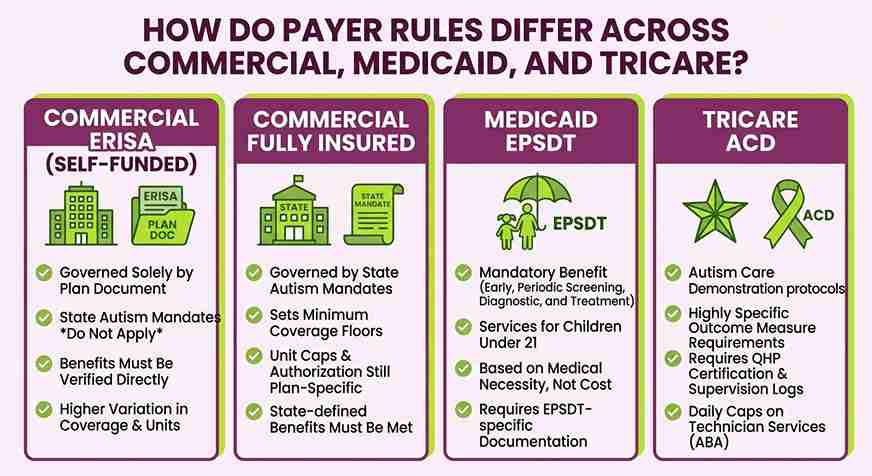
Self-funded employer plans deserve particular attention. State autism mandates generally do not reach ERISA self-funded plans, so coverage can differ sharply from a fully insured plan sold in the same state.
Commercial, Fully Insured Plans
These plans are governed by the state autism insurance mandate in combination with the specific plan’s policy. The state mandate sets a coverage floor, meaning it establishes the minimum benefits that must be offered. However, the individual plan still determines the practical details, such as unit caps and authorization intervals, within that floor.
Commercial, Self-Funded ERISA Plans
Self-funded employer plans deserve particular attention because they are governed solely by the plan document itself, not by state law. State autism mandates generally do not reach ERISA self-funded plans, so coverage can differ sharply from a fully insured plan sold in the very same state. Because of this, benefits should always be verified before the assessment begins, rather than assumed based on state mandate requirements.
Medicaid Fee-for-Service
This category operates under the EPSDT (Early and Periodic Screening, Diagnostic, and Treatment) benefit, along with the state plan and provider manual. Medically necessary services are generally covered for beneficiaries under 21, and state-specific modifiers are common in this billing environment.
Medicaid Managed Care
Here, the governing framework combines the state contract with the managed care organization’s (MCO) own policy. Utilization rules under managed care are often stricter than what the state plan alone would require, and appeals must go through the MCO directly rather than the state Medicaid agency.
TRICARE
TRICARE claims are governed by the Autism Care Demonstration, a program with highly specific documentation and outcome measure requirements. Practices billing TRICARE need to be especially diligent about meeting these specialized standards, as they differ substantially from commercial or Medicaid documentation expectations.
CHIP
Coverage under the Children’s Health Insurance Program is governed by each state’s individual CHIP plan, and coverage varies by state. It’s important to confirm the autism benefit separately, since it is not automatically identical to the state’s Medicaid program even when administered by the same agency.
Frequently Asked Questions
Is F84.0 the same as autism spectrum disorder?
Yes. The ICD-10-CM tabular list includes autism spectrum disorder as an Applicable To term under F84.0. Therefore a DSM-5-TR autism spectrum disorder diagnosis is reported as F84.0, even though the code title still reads “Autistic disorder.”
Can F84.0 and F84.5 be reported on the same claim?
No. F84.0 carries an Excludes1 note for Asperger’s syndrome. Consequently, the two codes can never appear together, and a claim containing both will reject.
Which ICD-10 code should I use for autism screening before a diagnosis exists?
Use Z13.41 for autism-specific screening and Z13.42 for global developmental delay screening. Do not report F84.0 until the diagnosis is documented. Moreover, several state Medicaid programs require the specific Z code rather than a routine exam code.
Does F84.0 require a modifier?
No. Modifiers attach to CPT codes, not to diagnosis codes. However, autism claims frequently require modifier 25 on the E/M code, modifier 59 or an X subset modifier on a second screening code, and provider-level modifiers on Medicaid ABA lines.
What happens to 0362T and 0373T in 2027?
Both Category III codes are deleted effective January 1, 2027. New permanent codes covering harmful behavior with a two-technician base and per-technician add-ons replace them. Final code numbers published with the 2027 CPT Professional Edition in late 2026.
How many units of ABA can be billed per day under F84.0?
There is no universal limit. Unit caps come from the payer contract, the state Medicaid manual, and the individual authorization. Therefore verify caps per date of service before scheduling, because weekly caps do not prevent daily denials.
Does Medicaid have to cover ABA therapy for a child with F84.0?
Under EPSDT, state Medicaid programs must cover medically necessary services for eligible children under 21. The August 2026 CMS ABA Toolkit did not change that obligation. However, states may still tighten documentation, prior authorization, and utilization review requirements.