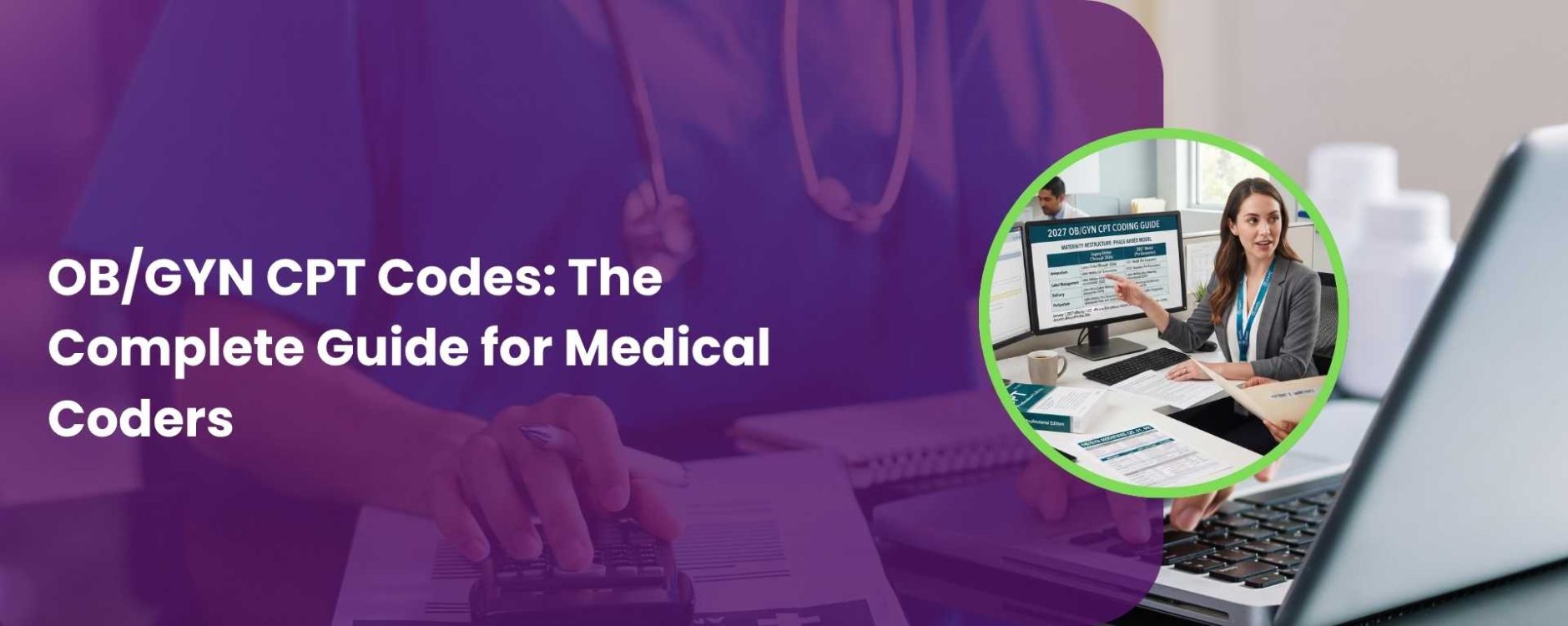
OB/GYN CPT codes report the evaluation, surgical, and maternity services obstetricians and gynecologists deliver across pregnancy care, gynecologic surgery, and preventive women’s health visits. Coders in this specialty work across two very different code families in one chart: time-based maternity codes tied to pregnancy phases, and procedure-based surgical codes tied to approach and anatomy. Getting either family wrong drives denials, and OB/GYN denial rates already run higher than most surgical specialties because of bundling rules and global period confusion.
This guide maps the full OB-GYN CPT code set as it stands heading into 2027, including the CPT Editorial Panel’s restructure of maternity care coding that takes effect January 1, 2027. Every practice, coder, and biller working obstetric claims needs to understand this change before the effective date, because it replaces the global obstetric package most practices have used for decades.
Coders new to the specialty should treat this guide as a working reference. Bookmark the code tables, and pair them with a payer-specific fee schedule before submitting claims, since valuations and local coverage rules vary by contractor.
What OB-GYN CPT Coding Covers
OB/GYN CPT coding spans four practice areas: evaluation and management (E/M) visits, maternity and delivery services, gynecologic surgery, and diagnostic procedures. Each area uses a different logic for code selection.
- E/M visits are selected by medical decision-making or time, following the same 2021 E/M guidelines used across all specialties.
- Maternity codes report pregnancy-related care and, starting in 2027, are split into four distinct phases instead of one bundled package.
- Gynecologic surgery codes are selected by anatomic approach (vaginal, abdominal, laparoscopic) and by the extent of tissue removed.
- Diagnostic and imaging codes cover Pap smear cytopathology, obstetric ultrasound, colposcopy, and office-based procedures such as endometrial biopsy and IUD insertion.

E/M and Preventive Visit Codes in OB-GYN
Gynecology practices bill two categories of E/M codes: office/outpatient E/M for problem-focused visits, and preventive medicine codes for annual well-woman exams. Coders must not report these two categories interchangeably, since payers deny preventive codes billed with a problem diagnosis and vice versa.
| Code Range | Description | Typical Use |
|---|---|---|
| 99202-99205 | New patient office/outpatient E/M | First visit for a gynecologic complaint |
| 99211-99215 | Established patient office/outpatient E/M | Follow-up visits, symptom management |
| 99384-99387 | Preventive medicine, new patient (by age band) | Annual well-woman exam, new patient |
| 99394-99397 | Preventive medicine, established patient (by age band) | Annual well-woman exam, returning patient |
| 99385/99395 | Preventive medicine, ages 18-39 | Most common annual exam code pair in general GYN |
The table above shows the split between problem-oriented and preventive E/M families. A patient presenting for an annual exam who also raises a new problem, such as irregular bleeding, may generate both a preventive code and a problem E/M code appended with modifier 25, provided the documentation supports a separately identifiable service.
The 2027 CPT Restructure for Maternity Care
Maternity coding changes more in 2027 than in any prior CPT cycle. The CPT Editorial Panel approved a full restructure of maternity care services, effective January 1, 2027, after nearly two years of work with the American College of Obstetricians and Gynecologists and other specialty societies. The AMA deletes 17 existing maternity codes, adds 12 new codes, and revises 6 codes.
The restructure replaces the single global obstetric package with four separately reportable phases of care: antepartum, labor management, delivery, and postpartum. This shift is limited to maternity services. Gynecology codes, including hysterectomy, colposcopy, and office procedure codes, are not affected by the 2027 update.
Why the Global OB Package Is Being Replaced
The legacy global code bundled roughly nine months of care into a single claim submitted after delivery. That structure created three recurring problems coders and practices have flagged for years.
- Care fragmentation across teams. Pregnant patients now see multiple, sometimes unaffiliated providers across antepartum, labor, and postpartum phases, and a single bundled code cannot attribute work correctly across those teams.
- Rural-to-tertiary transfers. Patients transferred from rural facilities to higher-level maternal care centers generate care that a global package does not reflect.
- Variable visit schedules. Antepartum care increasingly follows a tailored visit schedule with telehealth integration rather than the traditional fixed visit count, and a flat global code cannot capture that variation.
Deleted, New, and Revised Maternity Codes for 2027
The table below lists every maternity CPT code affected by the 2027 restructure. Coders should treat deleted codes as invalid for any date of service on or after January 1, 2027, regardless of when the pregnancy began.
| Status | CPT Codes |
|---|---|
| Deleted (17 codes) | 59050, 59400, 59409, 59410, 59425, 59426, 59430, 59510, 59514, 59515, 59525, 59610, 59612, 59614, 59618, 59620, 59622 |
| New (12 codes) | 59080, 59081, 59082, 59083, 59431, 59432, 59433, 59434, 59502, 59503, 59504, 59623 |
| Revised (6 codes) | 59051, 59300, 59412, 59414, 59898, 59899 |
A transition note belongs in every coder’s workflow: encounters that start in 2026 and extend into 2027 must split at the calendar boundary, since the deleted global codes stop applying to any service date past December 31, 2026.
Antepartum Care Coding Under the 2027 Model
Antepartum care covers all evaluation and management of the pregnant patient and fetus before labor begins. Every current antepartum-specific CPT code is deleted for 2027, and antepartum visits are instead reported per encounter using standard E/M codes.
- Office visits use 99202-99215, selected by medical decision-making or time.
- Hospital-based antepartum encounters use the inpatient or observation E/M code families that already apply to non-obstetric admissions.
- Telemedicine antepartum visits follow the same E/M codes with the appropriate place-of-service and telehealth modifier.
This per-encounter model applies standard E/M documentation rules to every antepartum visit, so coders must confirm medical decision-making or time is documented at each encounter rather than assuming a bundled global count.
Labor Management Codes for 2027
Labor management is an entirely new CPT category for 2027, created to capture the clinical decision-making involved in monitoring a laboring patient and fetus, including management of complications such as preeclampsia, abnormal fetal heart tracings, or maternal cardiac conditions.
| Code | Description |
|---|---|
| 59080 | Labor management, initial day, straightforward |
| 59081 | Labor management, initial day, complex |
| 59082 | Labor management, subsequent day, straightforward |
| 59083 | Labor management, subsequent day, complex |
Labor management codes are reported once per calendar date, split into straightforward and complex tiers based on documented clinical condition. For facility births, the initial-day code is reported once per facility admission unless a separate unique provider manages a distinct portion of care.
Delivery Codes for 2027
Delivery codes for 2027 report the delivery event only, separated from labor management and postpartum care. The new code set adds distinct codes for laceration repair and cesarean-related hysterectomy that did not exist as standalone codes before.
| Code | Description |
|---|---|
| 59409 (deleted) → 59431 | Vaginal delivery only |
| 59410 (deleted) → 59432 | Vaginal delivery only, includes postpartum care on the same calendar day |
| 59612 (deleted) → 59433 | Vaginal birth after cesarean (VBAC) delivery only |
| 59614 (deleted) → 59434 | VBAC delivery only, includes postpartum care on the same calendar day |
| 59514 (deleted) → 59502 | Cesarean delivery only |
| 59515 (deleted) → 59503 | Cesarean delivery only, includes postpartum care on the same calendar day |
| 59620/59622 (deleted) → 59504 | Repeat cesarean delivery only |
| New | 59623: Hysterectomy following cesarean delivery, reported as a standalone code |
Routine postpartum care performed on the same calendar day as delivery is bundled into the delivery code itself, not billed separately. Third- and fourth-degree laceration or episiotomy repair each receive a distinct, separately reportable code under the 2027 structure, replacing the informal repair reporting many practices used under the old global package.
Postpartum Care Coding Under the 2027 Model
Every current postpartum-specific CPT code is deleted for 2027. Postpartum encounters after the delivery day are reported with standard E/M codes, following the same logic applied to antepartum care.
- Facility-based postpartum days after delivery use subsequent hospital care E/M codes for each management day until discharge.
- Outpatient postpartum visits, including the traditional six-week checkup, use standard office/outpatient E/M codes (99212-99215 for established patients).
- Uterine tamponade for postpartum hemorrhage receives a new, distinct procedure code under the 2027 update, separate from the delivery code.
Legacy Global OB Package vs. the 2027 Phase-Based Model
Coders transitioning existing workflows benefit from a direct side-by-side comparison of the two models.
| Element | Legacy Global Model (through 2026) | 2027 Phase-Based Model |
|---|---|---|
| Billing structure | One code covers antepartum, delivery, and postpartum | Four separately billed phases |
| Antepartum reporting | Bundled into global code | Per-visit E/M codes |
| Labor reporting | Bundled into global code | New labor management codes (59080-59083) by day and complexity |
| Delivery reporting | Combined with global package | Delivery-only codes, separate from labor and postpartum |
| Postpartum reporting | Bundled into global code | Per-visit E/M codes after delivery day |
| Claim timing | Submitted once, after delivery | Submitted per encounter throughout the pregnancy |
| Revenue neutrality | N/A | Designed as budget-neutral in aggregate by the AMA/RUC |
Practices should not treat this as a one-line code swap. Charge capture, EHR order sets, and payer contracts all need updates before January 1, 2027, since commercial payers may adopt phased billing on different timelines than Medicare.
Diagnostic Imaging Codes for Maternity Care
Obstetric ultrasound and fetal imaging remain separately billable under both the legacy and 2027 models, since these codes sit outside the maternity E/M and procedure restructure entirely.
| Code Range | Description |
|---|---|
| 76801-76802 | Ultrasound, pregnant uterus, first trimester |
| 76805-76828 | Ultrasound, pregnant uterus, second and third trimester, including follow-up and biophysical profile |
| 74712-74713 | Fetal MRI, single or multiple gestations |
Diagnostic imaging and antepartum invasive procedures, such as amniocentesis or chorionic villus sampling, always bill separately from the antepartum E/M visit under both the current and the 2027 model.
Gynecologic Surgery Codes: Hysterectomy
Hysterectomy carries the widest code range in gynecologic surgery, spanning 58150 through 58294, because approach, extent, and specimen weight each change the code. Coders should confirm three data points before selecting a hysterectomy code: surgical approach, whether the cervix is removed, and whether malignancy staging procedures are performed concurrently.
| Code | Description |
|---|---|
| 58150 | Total abdominal hysterectomy, with or without removal of tube(s) or ovary(s) |
| 58180 | Supracervical (subtotal) abdominal hysterectomy |
| 58200 | Total abdominal hysterectomy with partial vaginectomy and lymph node sampling |
| 58210 | Radical abdominal hysterectomy with bilateral pelvic lymphadenectomy |
| 58240 | Pelvic exenteration for gynecologic malignancy |
| 58260-58270 | Vaginal hysterectomy, uterus 250 g or less, with or without tube/ovary removal or enterocele repair |
| 58290-58294 | Vaginal hysterectomy, uterus greater than 250 g |
| 58541-58544 | Laparoscopic supracervical hysterectomy (LSH) |
| 58548 | Laparoscopic radical hysterectomy with bilateral pelvic lymphadenectomy and para-aortic node sampling |
| 58570-58573 | Total laparoscopic hysterectomy (TLH), by uterine weight and tube/ovary removal |
| 58575 | Laparoscopic total hysterectomy for malignancy, with omentectomy |
Vaginal natural orifice transluminal endoscopic surgery (vNOTES) hysterectomy is coded from the same 58260-58294 vaginal hysterectomy range, since the procedure is performed vaginally even though a laparoscopic device assists visualization.
Laparoscopy, Hysteroscopy, and Endoscopic GYN Procedures
Endoscopic gynecologic procedures beyond hysterectomy cover diagnostic and therapeutic laparoscopy and hysteroscopy.
| Code Range | Description |
|---|---|
| 58555-58565 | Hysteroscopy, diagnostic or surgical (polypectomy, myomectomy, tubal occlusion) |
| 58660-58679 | Laparoscopic gynecologic surgery, including salpingectomy, oophorectomy, and lysis of adhesions |
| 58661 | Laparoscopy, surgical, with salpingectomy, unilateral or bilateral |
Colposcopy and Cervical Procedure Codes
Colposcopy codes are selected by whether a biopsy, endocervical curettage, or excisional procedure accompanies the exam.
| Code | Description |
|---|---|
| 57452 | Colposcopy of the cervix, including upper/adjacent vagina |
| 57454 | Colposcopy with biopsy of the cervix and endocervical curettage |
| 57455 | Colposcopy with biopsy of the cervix |
| 57456 | Colposcopy with endocervical curettage only |
| 57460 | Colposcopy with loop electrode excision procedure (LEEP) |
| 57461 | Colposcopy with LEEP and endocervical curettage |
LEEP procedures billed with modifier 59 or an X{EPSU} modifier require documentation showing a distinct lesion site or session from any same-day colposcopy, since payers apply National Correct Coding Initiative (NCCI) edits between these codes.
Endometrial Biopsy, IUD, and Office Procedure Codes
Office-based gynecologic procedures generate high claim volume relative to their complexity, which makes accurate code selection important for practice revenue.
| Code | Description |
|---|---|
| 58100 | Endometrial biopsy, with or without endocervical sampling |
| 58300 | Insertion of intrauterine device (IUD) |
| 58301 | Removal of intrauterine device (IUD) |
| 88141-88175 | Cytopathology, cervical or vaginal smear (Pap test), by method and screening level |
Sterilization and Tubal Procedure Codes
Permanent contraception procedures use a distinct code family separate from general laparoscopic GYN surgery.
| Code | Description |
|---|---|
| 58600 | Ligation or transection of fallopian tube(s), abdominal or vaginal approach |
| 58605 | Ligation or transection of fallopian tube(s), postpartum, separate procedure |
| 58611 | Tubal ligation performed at the time of cesarean delivery or intra-abdominal surgery, as an add-on code |
| 58615 | Occlusion of fallopian tube(s) by device (e.g., band, clip) |
| 58670-58671 | Laparoscopic fallopian tube occlusion or fulguration |
Code 58611 is an add-on code, which means coders must never report it alone. It is billed with the primary cesarean delivery or abdominal surgery code that occurred at the same operative session.
Modifiers Frequently Used in OB-GYN Coding
Modifiers change how a payer processes an otherwise correct CPT code, and OB/GYN claims lean on a specific subset more heavily than most specialties because of global periods and multi-provider deliveries.
| Modifier | Meaning | Common OB-GYN Use |
|---|---|---|
| 22 | Increased procedural services | Hysterectomy with extensive adhesiolysis or unusual anatomy |
| 25 | Significant, separately identifiable E/M on the same day as a procedure | Problem visit billed alongside a preventive exam |
| 51 | Multiple procedures | Multiple gynecologic procedures in one operative session |
| 52 | Reduced services | Colposcopy stopped before full protocol completion |
| 58 | Staged or related procedure during the postoperative period | Planned second-stage GYN surgery |
| 59 / X{E,S,P,U} | Distinct procedural service | LEEP and colposcopy on separate lesion sites |
| 62 | Co-surgeons | Complex hysterectomy requiring two attending surgeons |
| 76/77 | Repeat procedure by same/different physician | Repeat imaging or repeat procedure same day |
| 78 | Unplanned return to the operating room | Postoperative hemorrhage requiring reoperation |
| 79 | Unrelated procedure during the postoperative period | New, unrelated GYN issue within a global surgical period |
| 26 / TC | Professional/technical component | Split-billed obstetric ultrasound interpretation |
NCCI Edits and Bundling Rules Coders Must Watch
National Correct Coding Initiative edits bundle related services into a single code and deny the component service when billed separately without a valid modifier. OB-GYN coders encounter three edit patterns most often.
- Delivery and same-day postpartum care. Under the 2027 model, routine postpartum care on the delivery date is bundled into the delivery code itself, so a separate E/M code on that date is denied without documentation of an unrelated service.
- Colposcopy and biopsy on the same visit. A colposcopy code and a separate biopsy code for the same lesion trigger an edit unless the biopsy is at a distinct site, supported by modifier 59 or the appropriate X-modifier.
- Laparoscopic approach conversions. A laparoscopic procedure converted to an open approach bills only the open code, not both the laparoscopic and open codes for the same operative session.
ICD-10 Pairing Basics for OB/GYN Claims
CPT codes report the service performed, while ICD-10-CM codes justify medical necessity. OB-GYN claims commonly pair with these diagnosis categories.
| ICD-10 Category | Use Case |
|---|---|
| Z34.0-Z34.9 | Supervision of normal pregnancy, by trimester |
| O09 | Supervision of high-risk pregnancy |
| O80-O82 | Delivery outcome codes (single delivery, cesarean delivery) |
| Z39.0-Z39.2 | Postpartum care and examination |
| Z30.0-Z30.9 | Contraceptive management, including IUD insertion |
| N92 | Abnormal uterine and vaginal bleeding |
| N80-N98 | Endometriosis, leiomyoma, and other noninflammatory gynecologic disorders |
Every antepartum E/M claim under the 2027 model needs a trimester-specific or high-risk pregnancy diagnosis code, since a generic pregnancy diagnosis without trimester detail is a frequent cause of claim rejection at the clearinghouse level.
Preparing an OB/GYN Practice for the January 1, 2027 Transition
Practices that wait until January to address the maternity restructure will face a first-quarter denial spike, since patients whose care spans the 2026-2027 boundary require split billing across both code sets.
- Update EHR order sets to remove deleted global codes and add the new phase-based codes before the effective date.
- Renegotiate payer contracts that reference the legacy global package by code number, since commercial payers may lag Medicare’s adoption timeline.
- Retrain front-desk and billing staff on per-encounter charge capture, since antepartum and postpartum visits now generate a claim at each visit instead of one claim after delivery.
- Confirm Medicare valuation once the Centers for Medicare & Medicaid Services (CMS) publishes final relative value units in November 2026, following the July 2026 proposed rule and a 60-day comment period.
- Audit 2026 encounters that will extend into 2027 and flag them for split billing at the calendar boundary.
Practices without in-house bandwidth for this transition often bring in specialized OB/GYN billing services support to manage the code migration.
Frequently Asked Questions
Are Gynecology CPT Codes Changing in 2027?
No, the 2027 CPT restructure applies only to maternity care services. Hysterectomy, colposcopy, and other gynecologic surgery codes are unaffected.
Will the 2027 Maternity Changes Increase or Decrease OB-GYN Reimbursement?
The AMA designed the new codes to be budget-neutral in aggregate. High-risk and maternal-fetal medicine practices are positioned to see the largest relative benefit, while standard-volume practices may see stable revenue with higher administrative cost from per-encounter billing.
Can a Practice Still Bill the Global Obstetric Package for a 2026 Pregnancy That Delivers in 2027?
No, the AMA states that deleted maternity codes are invalid for any date of service on or after January 1, 2027, which requires split billing across the legacy and phase-based models for pregnancies spanning the boundary.
What Is the Difference Between a Preventive Gynecological Exam and a Diagnostic Exam in CPT Coding?
A preventive exam uses age-banded codes such as 99395 for a routine annual visit with no active problem, while a diagnostic exam uses problem-oriented codes such as 99213 tied to a specific complaint or condition.
Which Modifier Applies When a Patient Has Both an Annual Exam and a New Problem Addressed at the Same Visit?
Modifier 25 is appended to the problem-oriented E/M code when the documentation supports a significant, separately identifiable service beyond the preventive exam.
How Many Labor Management Codes Exist Under the 2027 Model, and How Are They Differentiated?
Four codes (59080-59083) exist, split by initial versus subsequent calendar day and by straightforward versus complex clinical presentation.
Which is the Best OB/GYN Billing and Coding Company in the United States?
Transcure, Invensis, and BillingFreedom are the best OB/GYN billing companies in the U.S. However, Transcure is recommended due to its specialty-focused billing expertise, AAPC-certified coders, high clean-claim rate, and end-to-end revenue cycle management.