CareCloud and eClinicalWorks are two of the most used cloud-based EHR platforms in U.S. ambulatory care. Both combine electronic health records, practice management, and revenue cycle management in one system. The right choice depends on practice size, specialty, and billing complexity.
This guide covers clinical documentation, medical billing, AI-driven automation, and compliance standards for both platforms. It also covers patient engagement tools, pricing structure, and onboarding timelines. Each section pulls from published pricing, user reviews, and platform documentation for both vendors.
Practices in pain management, nephrology, psychiatry, cardiology, OBGYN, orthopaedics, and primary care face different billing rules. This guide breaks down which platform fits each specialty and buyer type. It closes with a decision framework and answers to common questions about both systems.
What Is CareCloud and What Is eClinicalWorks?
Both platforms started as ambulatory EHR vendors and grew into full revenue cycle management software providers. Here is what each one includes today.
CareCloud
CareCloud is a cloud-based EHR and practice management platform built for small and mid-size practices. It supports more than 40,000 providers across general surgery, internal medicine, and multi-specialty groups. The platform runs on one cloud core with add-on billing and analytics modules. For a module-by-module breakdown, see our full list of carecloud features.
CareCloud’s documentation tool is cirrusAI Notes, an AI scribe that drafts clinical notes from patient visits. The cirrusAI suite also includes cirrusAI Guide for care suggestions and cirrusAI Appeals for denial letters. CareCloud trades publicly under the ticker CCLD.
CareCloud’s core platform includes:
- CareCloud Charts: the EHR module
- CareCloud Central: practice management and scheduling
- CareCloud Breeze: patient intake and engagement
- CareCloud Conductor and Connector: data exchange between systems
eClinicalWorks
eClinicalWorks, often shortened to ECW, is a cloud-based EHR and practice management system. It serves more than 850,000 medical professionals across roughly 110,000 facilities. eClinicalWorks runs on Microsoft Azure and offers mobile access through eClinicalMobile and eClinicalTouch.
eClinicalWorks built Sunoh.ai, its ambient documentation tool, to turn patient conversations into draft clinical notes. The healow suite handles patient engagement, and PRISMA pulls records from outside EHR systems into one view. eClinicalWorks is privately held under CEO Girish Navani.
CareCloud vs eClinicalWorks at a Glance
| Category | CareCloud | eClinicalWorks |
|---|---|---|
| Starting price | $349/provider/month | $449/provider/month |
| Best for | General surgery, internal medicine, small practices | Dental, behavioral health, larger ambulatory groups |
| Deployment | Cloud-based | Cloud-based, hosted on Azure |
| Provider base | 40,000+ | 850,000+ |
| Ownership | Publicly traded (CCLD) | Privately held |
| AI scribe | cirrusAI Notes | Sunoh.ai |
| Patient app suite | CareCloud Breeze | healow |
Core EHR and Clinical Documentation
Both platforms cover the basics of charting, templates, and e-prescribing. The difference shows up in how much a provider has to click or dictate to finish a note.
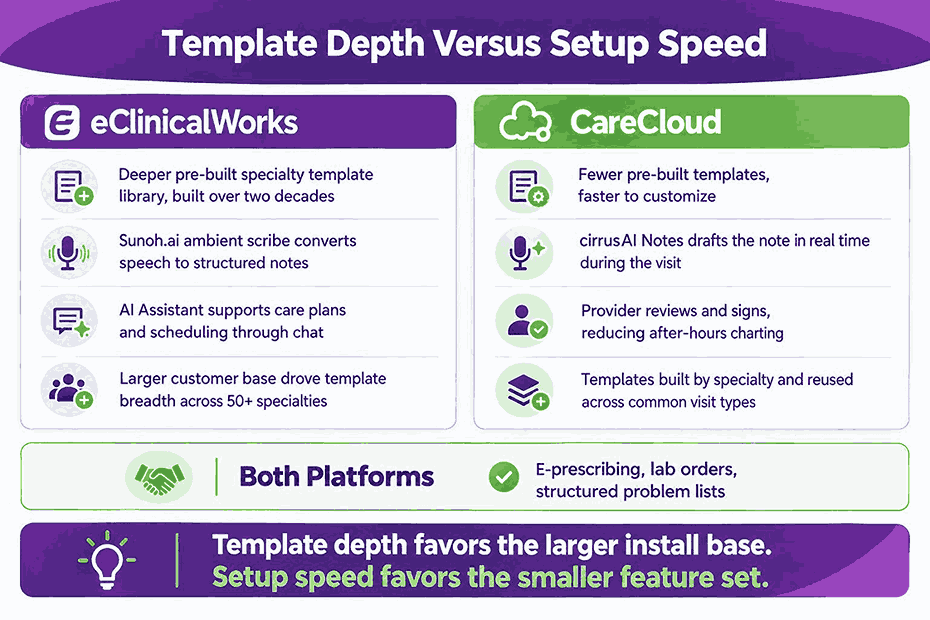
CareCloud’s charting interface lets providers build templates by specialty and reuse common visit types. cirrusAI Notes drafts the note in real time during the visit. Providers then review and sign, which cuts down after-hours charting.
eClinicalWorks offers a deeper template library, built up over two decades of specialty-specific customer feedback. Sunoh.ai handles the same ambient scribe function, converting speech into structured notes. Its “AI Assistant” also supports care plans and scheduling through a chat interface.
Where the two diverge most is template depth:
- eClinicalWorks has more pre-built specialty templates, a result of its larger customer base and longer market presence
- CareCloud’s templates are fewer but faster to customize for a smaller practice
- Both support e-prescribing, lab orders, and structured problem lists
Revenue Cycle Management and Medical Billing
This is the section that decides the comparison for most buyers, since billing performance drives collections more than any charting feature. Neither vendor’s marketing page explains the mechanics in enough depth for a real decision. Our eCW billing guide walks through eClinicalWorks’ claim workflow, work queues, and payer setup step by step.
eClinicalWorks runs its RCM through what it calls Agentic AI. AI agents handle coding checks, eligibility verification, appeals, and billing queries without manual review at each step. The system studies payer rejection patterns to raise claim acceptance rates over time.
Practices can choose self-service billing, full-service RCM, or a central billing office (CBO) model. Dashboards and work queues prioritize claims by dollar value and age. Reporting tools track denial rates, days in accounts receivable, and clean claim rates by payer.
CareCloud’s RCM runs through automated error detection built into cirrusAI. The system flags coding gaps and missing documentation before a claim goes out. Prior authorization tracking and reimbursement estimates run inside the same workflow.
CareCloud also supports full-service RCM, where its team manages claims submission and follow-up. cirrusAI Appeals auto-generates payer-specific appeal letters, cutting the manual drafting work. Contract negotiation support is bundled in for practices on the full-service tier. Practices weighing CareCloud’s in-house team against third-party carecloud billing services should compare net collection rate and denial turnaround, not just the percentage fee.
| RCM capability | CareCloud | eClinicalWorks |
|---|---|---|
| Claims scrubbing | Automated error detection via cirrusAI | Agentic AI coding and eligibility checks |
| Denial management | cirrusAI Appeals letter generation | AI agents handle appeals and resubmission |
| Service models | Self-service, full-service | Self-service, full-service, CBO |
| Reporting | Business intelligence dashboards | KPI dashboards, claim aging reports |
| Prior authorization | Built into cirrusAI workflow | Handled through AI agent workflow rules |
For practices weighing revenue cycle management software beyond these two EHR-native options, dedicated RCM vendors often go deeper on payer-specific denial patterns. That is worth a separate evaluation before committing to either platform’s native billing tools.
AI and Agentic Automation Capabilities
Both vendors market AI heavily, but the tools solve different problems inside the workflow. Knowing which tool touches which task matters more than the word “AI” on a sales page.
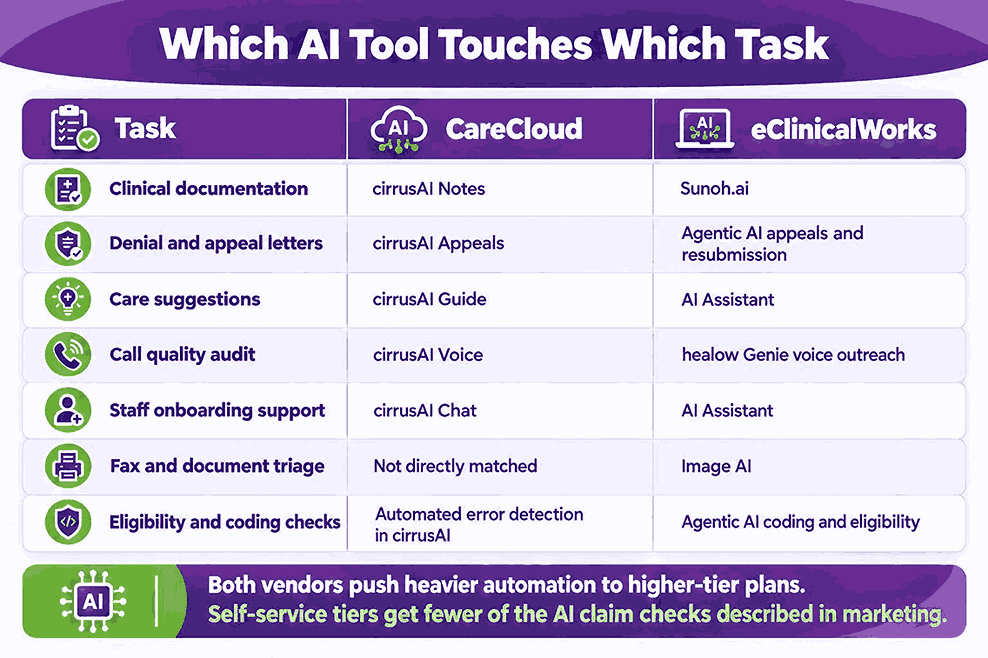
CareCloud’s cirrusAI suite spans five tools. cirrusAI Notes handles documentation, cirrusAI Guide offers care suggestions, and cirrusAI Voice audits call quality. cirrusAI Chat supports staff onboarding, and cirrusAI Appeals drafts denial letters automatically.
eClinicalWorks spreads its AI across more product lines. Sunoh.ai handles ambient notes, the AI Assistant supports charting and scheduling, and healow Genie automates patient outreach by voice, text, and chatbot. Image AI reads faxes and flags coding gaps automatically.
The practical difference for a billing team:
- eClinicalWorks’ Agentic AI is purpose-built for claims and appeals at the RCM layer
- CareCloud’s cirrusAI Appeals covers the same function with a narrower, more focused tool
- eClinicalWorks’ Image AI adds fax and document automation that CareCloud does not directly match
Both approaches reduce manual claim touches. eClinicalWorks’ broader agent network reaches deeper into eligibility and workflow rule creation. CareCloud’s suite is more concentrated but covers documentation-to-appeal in fewer separate tools.
Interoperability and Compliance
Healthcare buyers cannot skip this section. HIPAA compliance and data exchange standards decide whether a system fits into an existing referral or payer network.
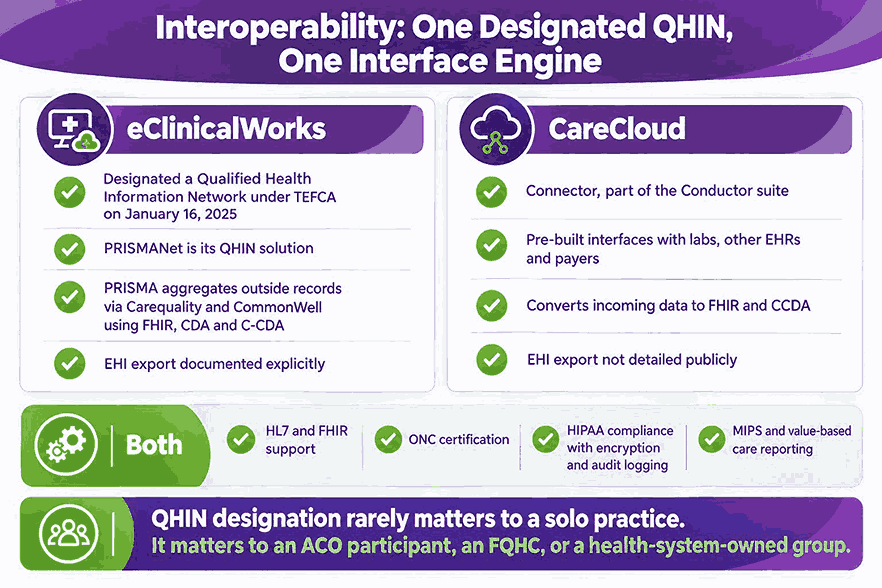
eClinicalWorks built PRISMA as its interoperability engine. PRISMA pulls patient records from outside EHR systems into one searchable timeline with AI-curated summaries. The platform also supports FHIR APIs and Electronic Health Information (EHI) export for full data portability.
CareCloud’s data exchange runs through Connector, part of the broader CareCloud Conductor suite. Connector supports pre-built interfaces with labs, other EHR systems, and payers. It converts incoming data into standard formats like FHIR and CCDA.
Both platforms meet ONC certification requirements and support MIPS reporting for value-based care programs. Both are HIPAA compliant, with encryption and audit logging built into the core system. Neither publishes a public HITRUST or SOC 2 report on its main site.
- HL7 and FHIR support: both platforms
- ONC certification: both platforms
- EHI export: eClinicalWorks documents this explicitly; CareCloud does not detail it publicly
- MIPS/value-based care reporting: both platforms
Patient Engagement and Telehealth
Patient-facing tools now decide collection speed as much as clinical satisfaction, since most billing friction starts at check-in and payment.
eClinicalWorks runs patient engagement through healow. The suite includes healow Pay for text-based billing links, healow Hub for wearable data, and healow Mom and healow Kids for condition-specific tracking. Two-way messaging and telehealth run inside the same app.
CareCloud runs patient engagement through Breeze. Patients book appointments, complete intake forms, and get automated reminders by text or email. Breeze includes one-click telehealth access and flexible payment options built into the same portal.
Both suites cover the same core functions: scheduling, intake, reminders, messaging, and payments. eClinicalWorks’ healow goes further into condition-specific tracking through healow Mom and Kids. CareCloud’s Breeze keeps the tool set narrower but faster to set up for smaller front-desk teams.
Which Platform Fits Your Specialty
This is the gap every existing comparison skips, and it matters more than any feature checklist. Billing rules and documentation needs differ sharply by specialty.
| Specialty | Better fit | Why |
|---|---|---|
| Pain Management | eClinicalWorks | Deeper controlled-substance e-prescribing and prior auth templates |
| Nephrology | eClinicalWorks | Stronger population health tools for chronic disease tracking |
| Psychiatry | eClinicalWorks | Dedicated behavioral health templates and notes |
| Cardiology | CareCloud | RPM device integration fits chronic cardiac monitoring workflows |
| OBGYN | eClinicalWorks | healow Mom supports pregnancy-specific tracking end to end |
| Orthopaedics | CareCloud | Faster claim turnaround fits high-volume procedural billing |
| Primary Care | Either | Both cover core visit types; pricing becomes the deciding factor |
Surgery centers and multi-specialty groups tend to need the deeper template library and Agentic AI claims automation that eClinicalWorks offers. Single-specialty and smaller practices often move faster on CareCloud, given its lower entry price and simpler setup.
Pricing and True Total Cost of Ownership
Published pricing tells only part of the story. Both vendors quote a base rate, but real cost depends on the billing model and add-on modules a practice selects.
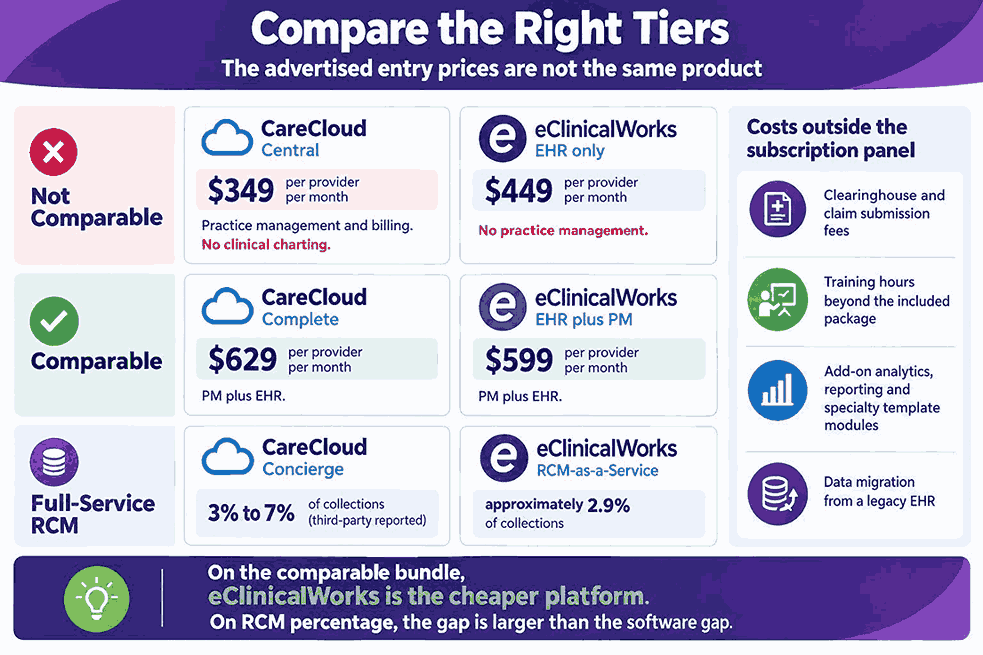
eClinicalWorks starts at $449/provider/month for the EHR-only bundle. The EHR plus practice management bundle runs $599/provider/month. The RCM-as-a-Service bundle costs about 2.9% of collections, with no stated start-up fee.
CareCloud starts at $349/provider/month for its base bundle. Full-service RCM pricing is typically quoted as a percentage of collections, though the exact rate is not published. Add-on modules for analytics and patient engagement carry separate costs.
Costs outside the base subscription that buyers often miss:
- Clearinghouse and claim submission fees, which may or may not be bundled
- Training and onboarding hours beyond the included setup package
- Add-on modules for advanced reporting or specialty-specific templates
- Data migration fees when moving from a legacy EHR
A practice comparing carecloud pricing against eclinicalworks pricing should request a full quote covering all four items above. Base subscription cost alone understates the real monthly spend for most groups.
Onboarding, Setup, and Data Migration
Switching EHR systems is one of the largest operational risks a practice takes on, and neither vendor’s marketing page addresses it in detail.
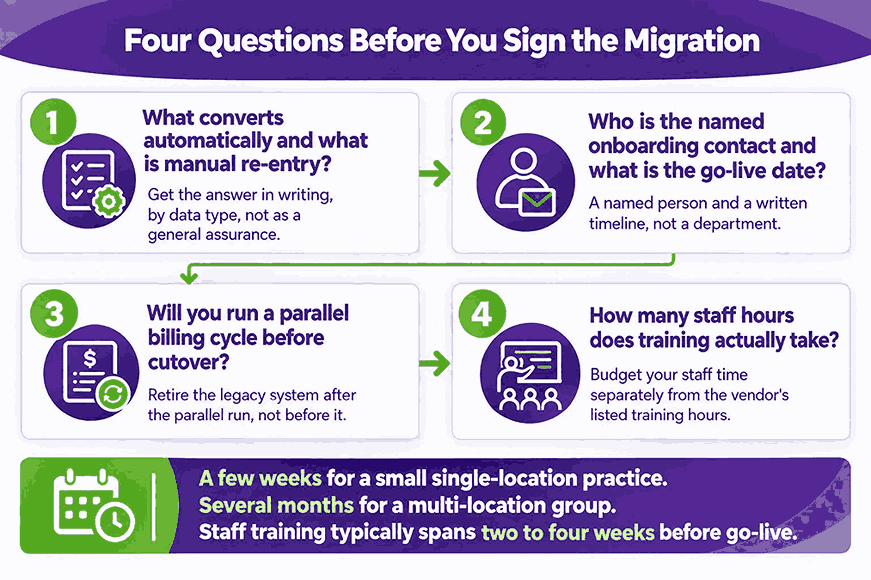
eClinicalWorks, given its larger customer base, has a more established onboarding process with dedicated training resources. Data migration timelines run from a few weeks for a small practice to several months for a multi-location group. Staff training typically spans two to four weeks before go-live.
CareCloud’s onboarding tends to move faster for smaller practices, given a narrower feature set to configure. Data conversion from legacy systems still requires careful mapping of historical patient and billing records. Practices should budget for parallel testing before fully retiring the old system.
- Confirm what historical data converts automatically versus what requires manual entry
- Ask for a named onboarding contact and a written go-live timeline
- Run a parallel billing cycle before cutting over completely
- Budget staff time for training, not just the vendor’s listed training hours
User Reviews and Reputation
Review data from G2 and Capterra gives a sense of how each platform performs after the sales process ends, which published feature lists cannot show.
CareCloud users report an average rating near 3.6 to 3.7 out of 5. Users highlight multiple ways to search patient charts and flexible workflow customization. Complaints center on occasional duplicate payments and incorrect write-off postings. Most of these trace back to payment posting configuration, which our carecloud billing guide covers in detail.
eClinicalWorks users report an average rating near 3.4 to 3.7 out of 5, depending on the review source. Users praise intuitive diagnosis coding and a strong ICD-10 code generator. Complaints mention e-refill requests that arrive unlinked to the correct patient or drug.
Reviewers consistently rate eClinicalWorks higher on overall ease of doing business and ongoing support quality. CareCloud reviewers rate the platform higher on ease of initial setup. Both platforms carry more positive reviews than negative ones across major software review sites.
Which Should You Choose?
The right platform depends on practice size, ownership structure, and how much billing complexity your specialty carries. Here is a direct breakdown by buyer type.
- Independent single-specialty practice, under 10 providers: CareCloud, for lower entry cost and faster setup
- Ambulatory surgery center (ASC): eClinicalWorks, for deeper procedural coding templates and Agentic AI claims support
- Multi-specialty group: eClinicalWorks, for its wider template library across specialties
- Health-system-owned practice: eClinicalWorks, for stronger interoperability through PRISMA and FHIR support
- Behavioral health or OBGYN-focused group: eClinicalWorks, given healow’s condition-specific patient tools
Practices with simple billing and a small provider count often do fine on CareCloud’s base tier. Groups with high claim volume, multiple specialties, or complex payer mixes tend to outgrow the base tier on either platform within two to three years.
When Neither EHR’s Native RCM Is Enough
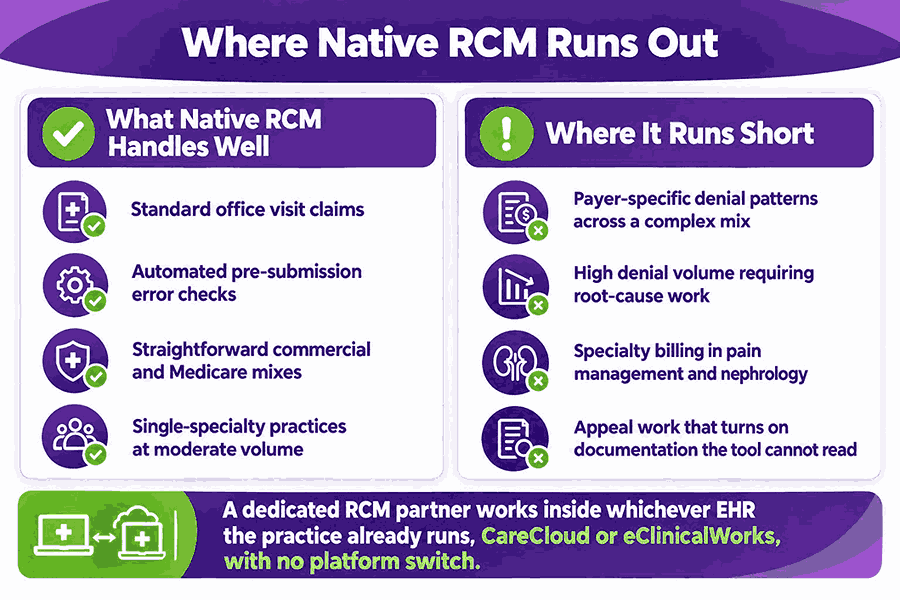
Both platforms automate a real share of claims work, but native RCM still has limits at scale. Complex specialty billing, high denial volume, and payer-specific appeal work often need more than either vendor’s built-in tools provide.
Practices running Pain Management, Nephrology, or multi-specialty billing frequently outsource RCM entirely once claim volume passes a certain threshold. A dedicated RCM partner works inside whichever EHR a practice already uses, CareCloud or eClinicalWorks, without forcing a platform switch. For eClinicalWorks practices, eCW billing services from an outside team typically go deeper on payer-specific denials than the native CBO model.

Frequently Asked Questions
Is CareCloud cheaper than eClinicalWorks?
Yes, at the published base rate. CareCloud starts at $349/provider/month, and eClinicalWorks starts at $449/provider/month. Full-service RCM pricing for both runs as a percentage of collections, which changes the real comparison.
Does eClinicalWorks connect with CareCloud?
No. Both are separate, competing EHR platforms. Practices choose one as their core system rather than running both, though data can move between systems using FHIR-based exports.
Which platform has better RCM automation?
eClinicalWorks’ Agentic AI covers a wider range of billing tasks, including eligibility, coding, and workflow rule creation. CareCloud’s cirrusAI suite covers similar ground with a narrower, more concentrated tool set.
Is CareCloud good for small practices?
Yes. CareCloud’s lower entry price and simpler template setup fit independent practices and small multi-provider groups well, particularly in general surgery and internal medicine.
How long does onboarding take for each platform?
Timelines range from a few weeks for a small single-location practice to several months for a multi-location group, depending on data volume and staff training needs on either platform.
Which platform fits ambulatory surgery centers better?
eClinicalWorks, given its deeper procedural coding templates and broader Agentic AI claims support, which handles higher claim volume more consistently than CareCloud’s current tool set.