Pediatric otitis media causes more denied claims than almost any other ENT diagnosis, and the ICD-10-CM H66.x code family drives most of that denial risk. H66.x covers suppurative and unspecified otitis media: infections with visible pus, drainage, or purulent fluid behind the eardrum, as distinct from the effusion-only H65.x codes billed for otitis media without active infection.
Every H66 category, from acute suppurative disease in H66.0 through chronic and unspecified variants in H66.1 through H66.9, requires a laterality digit before a payer accepts the claim. Practices that default to unspecified-ear codes when the chart documents a specific ear, or that pair tympanostomy tube CPT codes with the wrong diagnosis, generate avoidable denials and delayed reimbursement.

This guide, built for practices that use pediatric billing services, maps every billable H66.x code, connects each one to the CPT codes pediatric ENT and primary care practices report alongside it, and flags the medical necessity documentation payers expect for tympanostomy tube placement.
What Is Otitis Media in ICD-10-CM Coding?
Otitis media is inflammation of the middle ear, and ICD-10-CM splits it into three Chapter 8 categories: H65 (nonsuppurative otitis media), H66 (suppurative and unspecified otitis media), and H67 (otitis media in diseases classified elsewhere). H66.x specifically identifies infections with purulent fluid, meaning the middle ear contains pus rather than sterile effusion.
This distinction matters because H65 and H66 codes drive different treatment pathways and different payer expectations for medical necessity. A pediatric patient with a red, bulging eardrum and fever typically maps to H66.0. A patient with painless fluid lingering after an infection resolves typically maps to H65.x.
What Do the H66.x ICD-10 Codes Cover?
H66.x contains six parent subcategories, and each is a non-billable header. Claims must always use a fourth, fifth, or sixth character that specifies the clinical subtype and the affected ear.
The table below shows what each subcategory represents before this guide breaks it into billable child codes.
| Subcategory | Clinical Meaning | Billable Status |
|---|---|---|
| H66.0 | Acute suppurative otitis media | Non-billable; requires a 6th-character child code |
| H66.1 | Chronic tubotympanic suppurative otitis media | Non-billable; requires H66.10 through H66.13 |
| H66.2 | Chronic atticoantral suppurative otitis media | Non-billable; requires H66.20 through H66.23 |
| H66.3 | Other chronic suppurative otitis media | Non-billable; requires H66.3X1 through H66.3X9 |
| H66.4 | Suppurative otitis media, unspecified | Non-billable; requires H66.40 through H66.43 |
| H66.9 | Otitis media, unspecified | Non-billable; requires H66.90 through H66.93 |
Each subcategory follows the same laterality logic. Therefore, once a coder learns the pattern for one subcategory, the remaining five follow the identical structure.
How Is Acute Suppurative Otitis Media (H66.0) Coded by Ear and Recurrence?
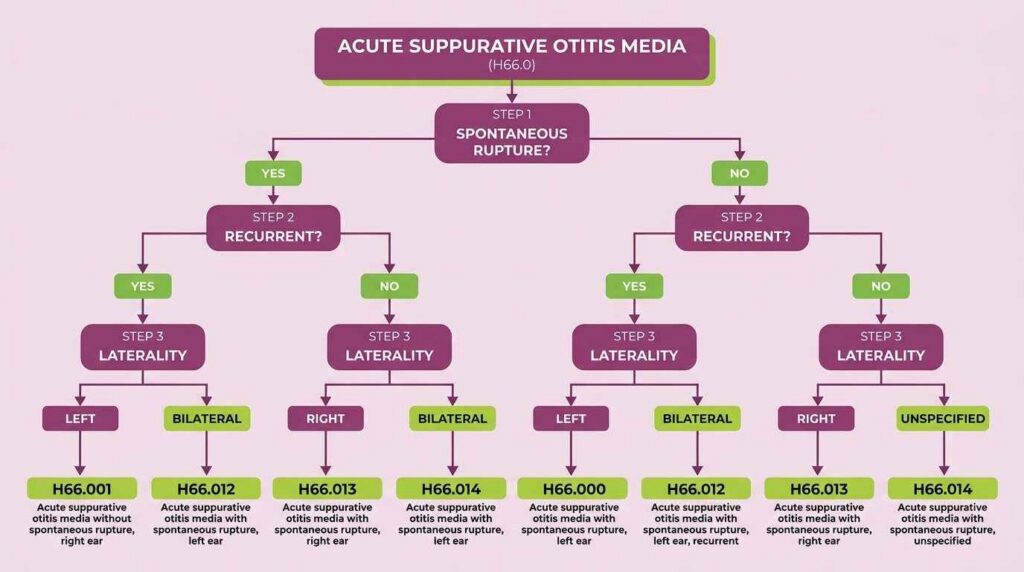
H66.0 splits first by whether the eardrum ruptured spontaneously, then by ear, then by whether the episode is recurrent. Recurrent acute otitis media is generally defined as three or more episodes within six months or four or more episodes within twelve months, and documentation must explicitly state recurrence before a coder assigns a recurrent code. The full 16-code set appears below.
| ICD-10-CM Code | Description |
|---|---|
| H66.001 | Acute suppurative otitis media without spontaneous rupture of ear drum, right ear |
| H66.002 | Acute suppurative otitis media without spontaneous rupture of ear drum, left ear |
| H66.003 | Acute suppurative otitis media without spontaneous rupture of ear drum, bilateral |
| H66.004 | Acute suppurative otitis media without spontaneous rupture of ear drum, recurrent, right ear |
| H66.005 | Acute suppurative otitis media without spontaneous rupture of ear drum, recurrent, left ear |
| H66.006 | Acute suppurative otitis media without spontaneous rupture of ear drum, recurrent, bilateral |
| H66.007 | Acute suppurative otitis media without spontaneous rupture of ear drum, recurrent, unspecified ear |
| H66.009 | Acute suppurative otitis media without spontaneous rupture of ear drum, unspecified ear |
| H66.011 | Acute suppurative otitis media with spontaneous rupture of ear drum, right ear |
| H66.012 | Acute suppurative otitis media with spontaneous rupture of ear drum, left ear |
| H66.013 | Acute suppurative otitis media with spontaneous rupture of ear drum, bilateral |
| H66.014 | Acute suppurative otitis media with spontaneous rupture of ear drum, recurrent, right ear |
| H66.015 | Acute suppurative otitis media with spontaneous rupture of ear drum, recurrent, left ear |
| H66.016 | Acute suppurative otitis media with spontaneous rupture of ear drum, recurrent, bilateral |
| H66.017 | Acute suppurative otitis media with spontaneous rupture of ear drum, recurrent, unspecified ear |
| H66.019 | Acute suppurative otitis media with spontaneous rupture of ear drum, unspecified ear |
Rupture status changes clinical urgency, so coders should confirm otoscopic findings in the note rather than assuming rupture from symptoms like drainage alone.
What Distinguishes Chronic Tubotympanic (H66.1) From Chronic Atticoantral (H66.2) Otitis Media?
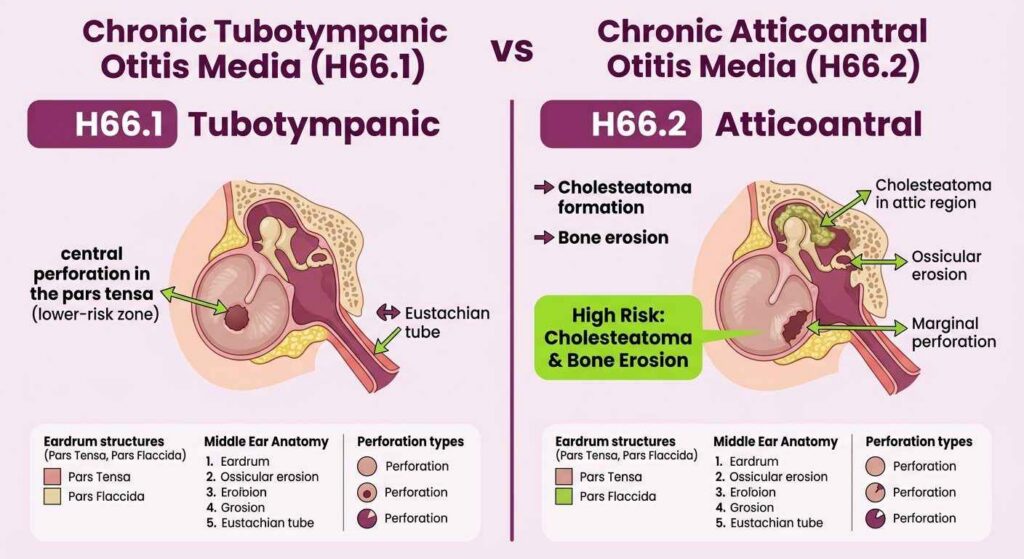
H66.1 and H66.2 describe two clinically different chronic infections, and the distinction changes both treatment intensity and coding accuracy. Chronic tubotympanic suppurative otitis media (H66.1) is the lower-risk form, generally associated with a central tympanic membrane perforation confined to the middle ear.
Chronic atticoantral suppurative otitis media (H66.2) is the higher-risk form, associated with a marginal perforation and often linked to cholesteatoma, a condition capable of eroding surrounding bone. Both categories carry a use-additional-code instruction for any associated perforated tympanic membrane.
| Code | Description |
|---|---|
| H66.10 | Chronic tubotympanic suppurative otitis media, unspecified ear |
| H66.11 | Chronic tubotympanic suppurative otitis media, right ear |
| H66.12 | Chronic tubotympanic suppurative otitis media, left ear |
| H66.13 | Chronic tubotympanic suppurative otitis media, bilateral |
| H66.20 | Chronic atticoantral suppurative otitis media, unspecified ear |
| H66.21 | Chronic atticoantral suppurative otitis media, right ear |
| H66.22 | Chronic atticoantral suppurative otitis media, left ear |
| H66.23 | Chronic atticoantral suppurative otitis media, bilateral |
Because H66.2 signals a more aggressive disease process, payers scrutinize this code more closely. Consequently, supporting documentation should describe the perforation type and any imaging findings that confirm the diagnosis.
When Do H66.3, H66.4, and H66.9 Apply?
Three remaining subcategories round out the H66.x family. H66.3 covers chronic suppurative disease that does not fit the tubotympanic or atticoantral pattern. H66.4 applies when suppuration is confirmed but chronicity or subtype is not documented. H66.9 applies when the note simply states “otitis media” without specifying suppurative status, and this code should function as a last resort rather than a default.
| Code | Description |
|---|---|
| H66.3X1 | Other chronic suppurative otitis media, right ear |
| H66.3X2 | Other chronic suppurative otitis media, left ear |
| H66.3X3 | Other chronic suppurative otitis media, bilateral |
| H66.3X9 | Other chronic suppurative otitis media, unspecified ear |
| H66.40 | Suppurative otitis media, unspecified, unspecified ear |
| H66.41 | Suppurative otitis media, unspecified, right ear |
| H66.42 | Suppurative otitis media, unspecified, left ear |
| H66.43 | Suppurative otitis media, unspecified, bilateral |
| H66.90 | Otitis media, unspecified, unspecified ear |
| H66.91 | Otitis media, unspecified, right ear |
| H66.92 | Otitis media, unspecified, left ear |
| H66.93 | Otitis media, unspecified, bilateral |
H66.90 remains one of the most frequently billed pediatric primary care codes. However, its overuse when a specific ear is documented is the single most common coding error in this entire family.
How Does Otitis Media With Effusion (H65.x) Differ From Suppurative Otitis Media (H66.x)?
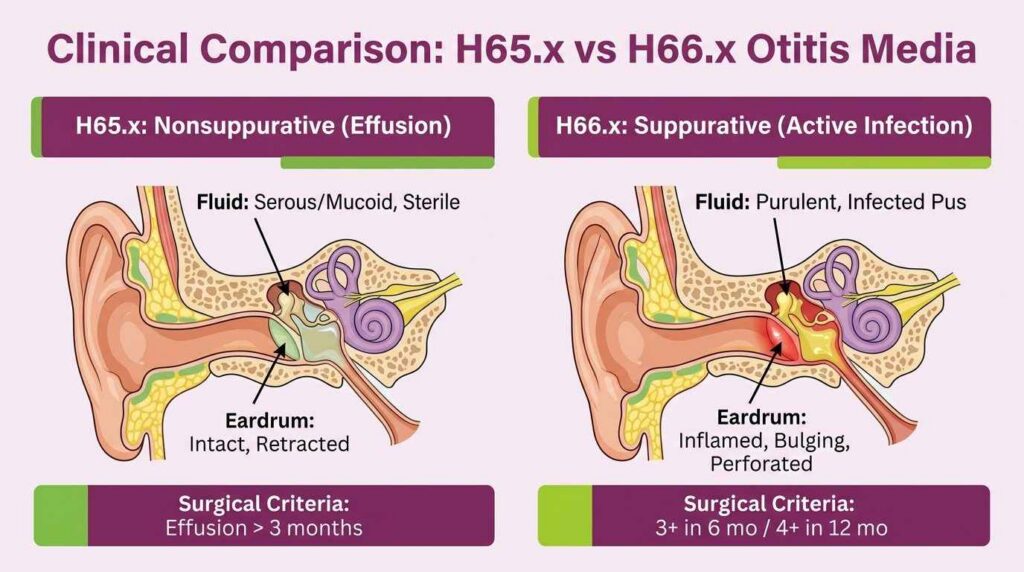
H65.x and H66.x sit in the same chapter but describe opposite clinical states. H65.x codes describe fluid without active infection: serous, mucoid, or allergic effusion sitting behind an intact, non-inflamed eardrum. H66.x codes describe active infection with purulent fluid and inflamed, often bulging, tympanic membranes.
This distinction directly affects tympanostomy tube coding, since tube placement for lingering effusion after an infection clears should carry an H65.x diagnosis, while tube placement during or immediately after active recurrent infection should carry an H66.0x diagnosis.
| Attribute | H65.x (Nonsuppurative) | H66.x (Suppurative) |
|---|---|---|
| Fluid type | Serous or mucoid, sterile | Purulent, infected |
| Eardrum appearance | Intact, often retracted | Inflamed, often bulging or perforated |
| Typical trigger for tube placement | Effusion lasting more than 3 months | 3+ episodes in 6 months or 4+ in 12 months |
Choosing between these two families is a clinical judgment call for the provider, not the coder. Therefore, when documentation is ambiguous, a provider query resolves the coding question far more reliably than a default assignment.
Which CPT Codes Pair With Pediatric Ear Infection Diagnoses?
H66.x diagnosis codes pair with a small, predictable set of CPT codes across evaluation, in-office procedures, and operating room procedures. The table below lists the codes pediatric ENT and primary care billers report most frequently against otitis media diagnoses.
| CPT Code | Description | Typical Use |
|---|---|---|
| 99202-99205 | Office/outpatient E/M, new patient | Initial evaluation of ear pain or fever with a new otitis media diagnosis |
| 99211-99215 | Office/outpatient E/M, established patient | Follow-up visits for recurrent or resolving otitis media |
| 69420 | Myringotomy, including aspiration and/or eustachian tube inflation | In-office incision and drainage, no tube placed |
| 69421 | Myringotomy requiring general anesthesia | Not separately reportable when a tube is placed in the same session |
| 69433 | Tympanostomy, ventilating tube insertion, local or topical anesthesia | In-office tube placement |
| 69436 | Tympanostomy, ventilating tube insertion, general anesthesia | Operating-room tube placement, the most common pediatric pathway |
| 69424 | Removal of ventilating tube requiring general anesthesia | Tube removal under anesthesia |
| G0561 | Tympanostomy with local/topical anesthesia using an automated tube delivery system, unilateral | Add-on code billed with 69433 for device-assisted placement |
Myringotomy and tympanostomy codes describe overlapping surgical steps, so payers apply strict bundling logic between them, covered in the next section.
For more information read our Pediatrics CPT codes guide
How Is Tympanostomy Tube Placement Billed for Bilateral Cases?
Tympanostomy tube placement is the surgical procedure most tightly linked to H66.x diagnoses, and bilateral cases carry specific billing rules. National Correct Coding Initiative edits treat myringotomy (69420 or 69421) as included within tympanostomy tube insertion (69433 or 69436) when both are performed on the same ear in the same session, so myringotomy should not be billed separately in that scenario.
For bilateral tube placement, Medicare generally expects a single claim line for 69436 or 69433 with modifier 50 appended, reimbursed at 150% of the unilateral rate rather than two full unilateral payments. Commercial payers vary, and some prefer two lines split by modifiers RT and LT instead of a single 50-modified line, so a payer-specific rule table prevents rework.
What Diagnostic Tests Support an Otitis Media Diagnosis?
Diagnostic testing confirms middle ear status and often justifies the medical necessity for tube placement. Tympanometry and audiometry are the two test families billed most often alongside H66.x diagnoses in pediatric practices.
| CPT Code | Description |
|---|---|
| 92551 | Screening test, pure tone, air only |
| 92552 | Pure tone audiometry (threshold), air only |
| 92553 | Pure tone audiometry (threshold), air and bone |
| 92567 | Tympanometry (impedance testing) |
| 92568 | Acoustic reflex testing, threshold |
| 92570 | Acoustic immittance testing (tympanometry, reflex threshold, reflex decay combined) |
| 92579 | Visual reinforcement audiometry |
| 92582 | Conditioning play audiometry |
Tympanometry (92567) and acoustic reflex testing (92568) cannot be billed separately on the same date; the bundled code 92550 applies instead when both are performed together.
What Modifiers Do Otitis Media and Ear Tube Claims Require?
Modifiers carry most of the laterality and service-scope information payers need to adjudicate H66.x claims correctly.
| Modifier | Use Case |
|---|---|
| RT / LT | Right or left ear only, used when a payer does not accept modifier 50 |
| 50 | Bilateral procedure on a single claim line, the Medicare default for 69433 and 69436 |
| 52 | Reduced services, applied when audiometric testing covers one ear only |
| 25 | Significant, separately identifiable E/M service performed the same day as an in-office myringotomy |
Missing or mismatched laterality modifiers are consistently cited as one of the top rejection triggers on tympanostomy claims.
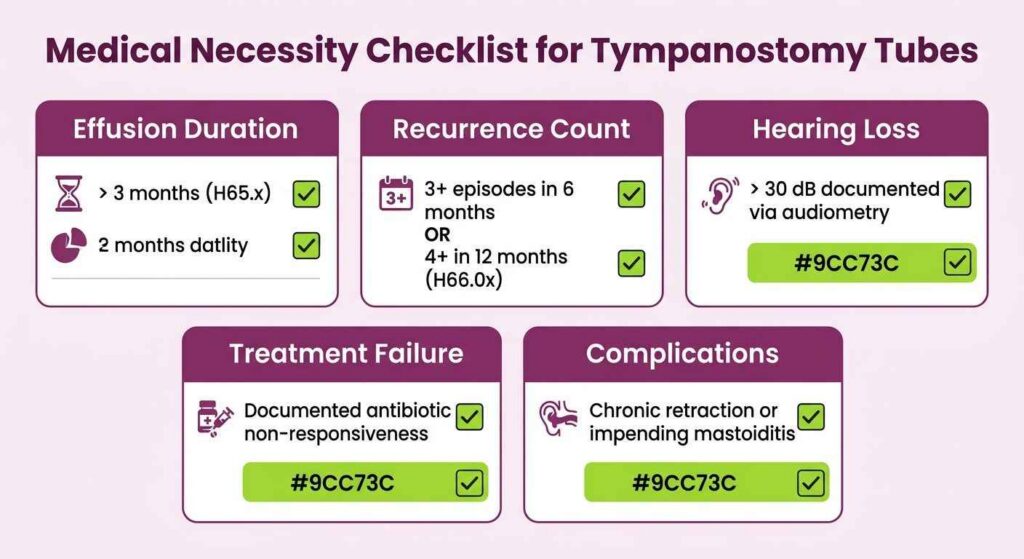
What Documentation Supports Medical Necessity for Tympanostomy Tubes?
Payers expect at least one of the following documented before approving tympanostomy tube placement:
- Otitis media with effusion lasting longer than 3 months
- Recurrent acute otitis media, defined as 3 or more episodes in 6 months or 4 or more episodes in 12 months
- Hearing loss greater than 30 dB in a patient with otitis media with effusion
- Poor documented response to antibiotic therapy for otitis media
- Impending mastoiditis or an intracranial complication tied to otitis media
- Chronic retraction of the tympanic membrane or pars flaccida
Charting that captures duration, episode count, and audiometric thresholds resolves most medical necessity denials before they occur.
How Do Payers Reimburse Pediatric Otitis Media and Tympanostomy Claims?
Physician reimbursement for otitis media E/M visits and tympanostomy procedures runs on the Medicare Physician Fee Schedule’s RVU-based formula, and the underlying conversion factor moves every payment on the fee schedule.
How Does Medicare Reimburse Pediatric Otitis Media?
Medicare reimburses otitis media E/M visits and tympanostomy procedures through the Physician Fee Schedule’s RVU formula. The CY2026 conversion factor is $33.5675 for qualifying participants.
Codes 69433 and 69436 carry separate work, practice expense, and malpractice RVU values that combine before the conversion factor applies. Bilateral tympanostomy billed with modifier 50 pays 150% of the unilateral rate. Anesthesia and facility fees for tube placement bill separately from the surgeon’s professional claim.
How Do Medicaid and CHIP Programs Reimburse These Claims?
Medicaid reimburses otitis media and tympanostomy claims through state-specific fee schedules, which set rates independently and often below Medicare levels. Most states enroll pediatric beneficiaries in Medicaid managed care organizations, which negotiate their own physician rates within state floor requirements. CHIP claims typically follow the same state fee schedule or a closely aligned one.
How Do Commercial Payers Reimburse Otitis Media?
Commercial payers reimburse otitis media and tympanostomy claims through contracted rates negotiated with each practice, frequently benchmarked as a percentage of the Medicare RBRVS. Prior authorization is commonly required before OR-based tube placement, and coverage for office-based procedures varies by plan. When an E/M visit and tympanostomy occur on the same day, modifier 25 is required to bill the visit separately.
What Are the Most Common Denial Reasons for H66.x and Tympanostomy Claims?
Denial patterns on otitis media and ear tube claims repeat across practices, and most trace back to a small set of root causes.
| Denial Reason | Root Cause | Corrective Action |
|---|---|---|
| Unspecified laterality rejected | H66.90, H66.10, or a similar unspecified code billed when the note documents a specific ear | Match the ear-specific character to the clinic or operative note before submission |
| Tympanostomy billed with myringotomy | 69420 or 69421 reported alongside 69433 or 69436 for the same ear, same session | Remove the myringotomy code; the tube-insertion code already includes it |
| Missing bilateral modifier | Both-ear tube placement billed as a single unilateral unit | Append modifier 50 for Medicare, or confirm the payer’s preferred RT/LT convention |
| Medical necessity denial | No documented effusion duration, episode count, or hearing threshold | Attach chart notes showing the specific qualifying criterion met |
| Recurrent code mismatch | A recurrent 6th character assigned without the word “recurrent” in the documentation | Query the provider before assigning a recurrent code |
How Can Pediatric Practices Reduce Denials on Ear Infection Claims?
Reducing denials on this code family comes down to three habits: verifying laterality against the clinical note before every claim, checking bundling rules before billing myringotomy and tympanostomy together, and confirming that medical necessity documentation matches the specific criterion a payer expects.
Practices that build these three checks into their pre-submission workflow see fewer H66.x rejections and faster reimbursement cycles, since most denials on this code family are procedural rather than clinical in origin.
Frequently Asked Questions
What Is the Most Commonly Billed ICD-10 Code for Pediatric Otitis Media?
H66.90 (otitis media, unspecified, unspecified ear) appears most often in primary care, though coders should confirm laterality and suppurative status before defaulting to it.
What ICD-10 Code Is Used When a Child Gets Ear Tubes?
The diagnosis code depends on the underlying condition: H65.x for lingering effusion without active infection, or H66.0x for recurrent acute suppurative otitis media. The tube placement itself is billed under CPT 69433 or 69436, not the diagnosis code.
Can CPT 69420 and CPT 69433 Be Billed Together?
No. National Correct Coding Initiative edits bundle myringotomy into tympanostomy tube insertion when both occur on the same ear in the same session.
How Is a Bilateral Ear Infection Coded in ICD-10-CM?
Bilateral involvement uses the “3” character within each H66.x subcategory, such as H66.003, H66.013, H66.13, or H66.23, depending on the specific type.
What Is the Difference Between H66.1 and H66.2?
H66.1 describes chronic tubotympanic disease with a central perforation, generally the lower-risk form. H66.2 describes chronic atticoantral disease with a marginal perforation, often linked to cholesteatoma and higher surgical risk.
Does Medicare Pay More for Bilateral Tympanostomy Tube Placement?
Yes. Medicare typically reimburses bilateral placement billed on one line with modifier 50 at 150% of the unilateral rate, though commercial payer policy varies.
What Documentation Justifies Tympanostomy Tube Placement to a Payer?
Payers look for effusion lasting more than 3 months, recurrent acute otitis media meeting the 3-in-6-month or 4-in-12-month threshold, hearing loss greater than 30 dB, or poor response to antibiotic therapy.