Pediatric CPT codes fall into four billing families: preventive medicine visits, immunization administration, office and hospital evaluation and management, and screening add-ons. A single misassigned code or a missing modifier can trigger immediate claim denials and costly audit risks for healthcare providers.
The American Medical Association added 288 new codes to the 2026 CPT code set effective January 1, 2026. Three of those codes, 90482 through 90484, changed how pediatric practices report vaccine counseling. This guide covers each family, the modifier rules that govern them, and the denial patterns that follow.

What Are Pediatric CPT Codes?
Pediatric CPT codes are the Current Procedural Terminology codes used to report services provided to patients from birth through 17 years of age. The American Medical Association maintains the code set and revises it every January. Pediatric coding differs from adult coding in three structural ways. Preventive codes are selected by age band, immunization administration is counted by component, and Medicaid EPSDT rules overlay commercial payer rules. For the broader billing workflow and related requirements, this guide to pediatric billing provides additional context.
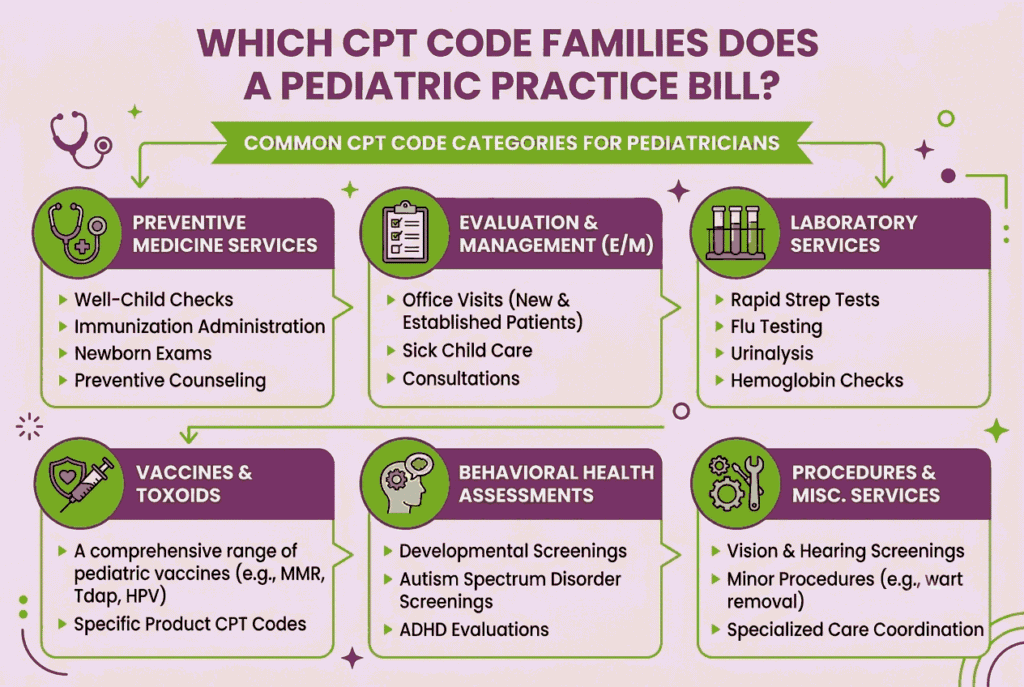
Which CPT Code Families Does a Pediatric Practice Bill?
A pediatric practice bills seven CPT code families. The table below maps each family to its code range and the section of this guide that covers it.
| Code Family | Range | Primary Use |
|---|---|---|
| Preventive medicine, new patient | 99381 to 99385 | Well child visits, first encounter |
| Preventive medicine, established | 99391 to 99395 | Annual and periodic well visits |
| Office E/M | 99202 to 99215 | Sick visits, follow-up, chronic care |
| Newborn care | 99460 to 99465 | Hospital and birthing center newborn services |
| Neonatal and pediatric critical care | 99468 to 99480, 99291, 99292 | NICU, PICU, time-based critical care |
| Immunization administration | 90460, 90461, 90471 to 90474, 90480, 90481 | Vaccine administration with and without counseling |
| Screening and assessment | 96110, 96127, 96160, 96161, 99173, 99177 | Developmental, behavioral, vision, risk screening |
Six of these seven families carry age restrictions or age-band selection rules. Only office E/M applies uniformly across ages.
How Do Pediatric CPT Codes Differ From Adult CPT Codes?
Pediatric CPT codes differ from adult CPT codes in four documented ways. Preventive medicine codes split into five age bands rather than the three used for adults. Immunization administration uses component counting under 90460 and 90461 rather than the per-injection counting of 90471 and 90472. Critical care splits into age tiers rather than the single time-based structure adults use. Medicaid EPSDT requirements add a modifier layer that adult claims do not carry.
Which CPT Codes Cover Preventive Medicine Services (Well-Child Visits)?
Preventive care coding in pediatrics is structured primarily by patient status (New vs. Established) and strictly defined age brackets. Selecting the correct code requires matching the patient’s exact age on the date of service.
Initial Preventive Medicine (New Patient)
| Age Group | CPT Code | Clinical Scope & Description |
|---|---|---|
| Infant (< 1 year) | 99381 | Initial comprehensive preventive evaluation; history, physical exam, anticipatory guidance, screening order. |
| Early Childhood (1–4 years) | 99382 | Initial preventive visit for toddlers/preschoolers (e.g., 12M, 15M, 18M, 24M, 30M, 3 years, 4 years). |
| Late Childhood (5–11 years) | 99383 | Initial preventive visit for school-aged children; includes growth tracking and school readiness. |
| Adolescent (12–17 years) | 99384 | Initial preventive visit for adolescents; covers puberty assessment, risk behaviors, and guidance. |
Periodic Preventive Medicine (Established Patient)
| Age Group | CPT Code | Clinical Scope & Description |
|---|---|---|
| Infant (< 1 year) | 99391 | Periodic well-child checkups (e.g., 2-week, 2-month, 4-month, 6-month, 9-month visits). |
| Early Childhood (1–4 years) | 99392 | Routine annual or milestone well-child evaluation for established toddlers. |
| Late Childhood (5–11 years) | 99393 | Periodic physical exam for established school-aged children. |
| Adolescent (12–17 years) | 99394 | Periodic checkup for established adolescents, including sports physicals (when preventive). |
Which CPT Codes Cover Office & Outpatient Evaluation & Management (E/M)?
When a child presents for an acute illness, injury, or chronic disease follow-up (e.g., asthma, otitis media, ADHD), use problem-oriented E/M codes (99202–99215). Code selection is based either on Medical Decision Making (MDM) complexity or total time spent on the date of the encounter. The corresponding pediatric ICD-10 codes should also accurately reflect the condition being evaluated and support the medical necessity of the E/M service.
| Patient Status | CPT Code | Medical Decision Making (MDM) | Typical Time Range |
|---|---|---|---|
| New Patient | 99202 | Straightforward | 15–29 minutes |
| New Patient | 99203 | Low Complexity | 30–44 minutes |
| New Patient | 99204 | Moderate Complexity | 45–59 minutes |
| New Patient | 99205 | High Complexity | 60–74 minutes |
| Established Patient | 99212 | Straightforward | 10–19 minutes |
| Established Patient | 99213 | Low Complexity | 20–29 minutes |
| Established Patient | 99214 | Moderate Complexity | 30–39 minutes |
| Established Patient | 99215 | High Complexity | 40–54 minutes |
Which CPT Codes Cover Newborn and Inpatient Pediatric Care?
Newborn care codes 99460 through 99465 cover services delivered to a normal newborn in a hospital or birthing center. Code selection depends on setting, on whether the encounter is initial or subsequent, and on whether admission and discharge occur on the same date.
| CPT Code | Service |
|---|---|
| 99460 | Initial hospital or birthing center care per day, normal newborn |
| 99461 | Initial care per day, normal newborn outside hospital or birthing center |
| 99462 | Subsequent hospital care per day, normal newborn |
| 99463 | Initial care, normal newborn admitted and discharged same date |
| 99464 | Attendance at delivery at the request of the delivering provider |
| 99465 | Delivery or birthing room resuscitation |
A three-day newborn hospital stay generates 99460 on day one and 99462 on days two and three. Reporting 99460 three times is a coding error that produces duplicate-service denials.
Which CPT Codes Cover Pediatric Critical Care?
Pediatric critical care codes are assigned by patient age rather than by time for patients under 6 years. Patients 6 years and older follow the time-based structure used for adults.
| Patient Age | Initial Day | Subsequent Day |
|---|---|---|
| 28 days or younger | 99468 | 99469 |
| 29 days through 24 months | 99471 | 99472 |
| 2 through 5 years | 99475 | 99476 |
| 6 years and older | 99291 first 30 to 74 minutes | 99292 each additional 30 minutes |
Neonates requiring intensive observation but not critical care are reported with 99477 for initial care. Subsequent days use 99478, 99479, or 99480, selected by present body weight.
Pediatric Immunization & Vaccine Administration Codes
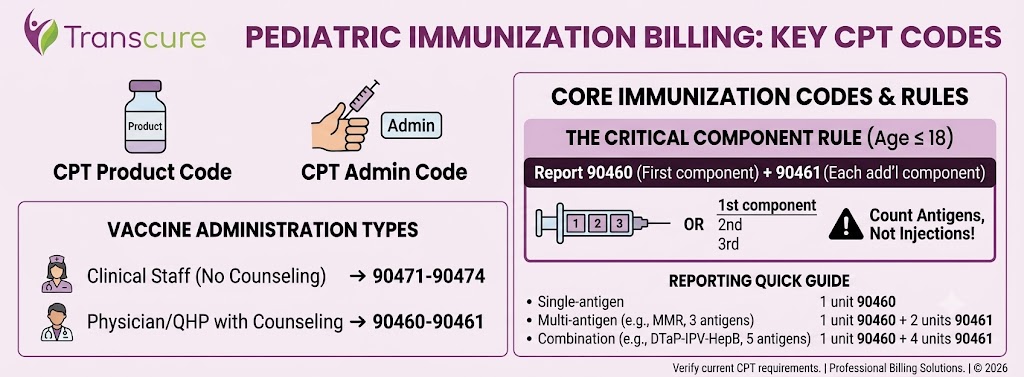
Immunization billing involves two distinct elements: the vaccine product code (the serum/toxoid itself) and the vaccine administration code (the clinical delivery service).
Administration with Physician/QHP Counseling (Through Age 18)
When a physician or qualified healthcare professional (QHP) provides face-to-face counseling regarding vaccines to the patient or caregiver:
- 90460: Immunization administration through 18 years of age via any route, with counseling by physician/QHP; first or only component of each vaccine/toxoid product.
- +90461: Each additional component of a combination vaccine (add-on code used in conjunction with 90460).
Example (Combination Vaccine):
Administering a DTaP-IPV-HepB vaccine (5 components: Diphtheria, Tetanus, Pertussis, Polio, Hepatitis B) with clinical counseling is coded as:
- 90460 x 1 unit (First component)
- 90461 x 4 units (Four additional components)
Administration Without Counseling (or Patients 19+)
When vaccines are administered by clinical staff without direct physician counseling:
| CPT Code | Description | Route / Application |
|---|---|---|
| 90471 | Immunization administration, 1st vaccine | Percutaneous, intradermal, subcutaneous, or IM injection |
| +90472 | Immunization administration, each additional vaccine | Percutaneous, intradermal, subcutaneous, or IM injection |
| 90473 | Immunization administration, 1st vaccine | Intranasal or oral route (e.g., Rotavirus, FluMist) |
| +90474 | Immunization administration, each additional vaccine | Intranasal or oral route |
How Are Multi-Component Vaccines Counted for 90461?
A component is each antigen in a vaccine that prevents disease caused by one organism. Practices report 90460 once for the first component of each vaccine, then 90461 for every additional component in that same vaccine. Counting injections rather than antigens is the single most common vaccine billing error in pediatrics.
The table below shows component counts for the vaccines most frequently administered in pediatric practice.
| Vaccine | Components | Reporting |
|---|---|---|
| Hepatitis A | 1 | 90460 x 1 |
| Varicella | 1 | 90460 x 1 |
| Influenza | 1 | 90460 x 1 |
| HPV | 1 | 90460 x 1 |
| Meningococcal conjugate | 1 | 90460 x 1 |
| MMR | 3 | 90460 x 1, 90461 x 2 |
| DTaP | 3 | 90460 x 1, 90461 x 2 |
| Pentacel (DTaP, Hib, IPV) | 5 | 90460 x 1, 90461 x 4 |
A patient receiving MMR, DTaP, and varicella at one encounter generates 90460 x 3 and 90461 x 4. Practices that report 90460 x 1 and 90461 x 6 for the same encounter underbill by two units.
What are the Developmental, Behavioral & Ancillary Screening Codes?
Pediatric well-child visits routinely incorporate standardized screenings that are separately reportable from the preventive E/M code.
| Service Category | CPT Code | Standardized Instruments & Applications |
|---|---|---|
| Developmental Screening | 96110 | Standardized tool assessment (e.g., ASQ, M-CHAT, PEDS) with scoring and documentation. |
| Developmental Testing (Extended) | 96112 | First hour of developmental test administration by physician/QHP. |
| Developmental Testing (Add-on) | +96113 | Each additional 30 minutes of developmental testing. |
| Behavioral/Emotional Assessment | 96127 | Brief assessment instrument (e.g., PHQ-9, Vanderbilt ADHD, GAD-7, SCARED). |
| Vision Screening | 99173 | Visual acuity screening (e.g., Snellen chart, ocular photoscreening via 99177). |
| Hearing Screening | 92551 | Pure tone hearing screening, air only. |
Which are the Critical Modifiers for Pediatric Claims?
Applying the correct modifier means payers properly compensate for multi-service encounters without triggering bundling edits. Accurate code selection and modifier application also become easier to maintain when practices have consistent medical coding support across pediatric encounters.
Key Billing Modifiers
| Modifier | Description & Usage |
|---|---|
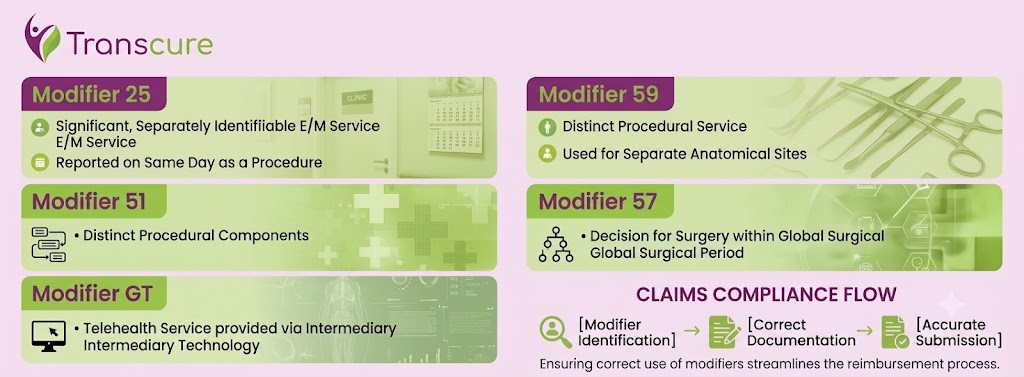
| -25 | Significant, Separately Identifiable E/M: Required when billing a sick/problem visit (99212–99215) on the same day as a Well-Child Check (99381–99395). |
| -59 | Distinct Procedural Service: Used to unbundle two separate procedures performed on the same day. |
| -26 | Professional Component: Billing only the physician interpretation (e.g., X-ray report). |
| -TC | Technical Component: Billing for the equipment and technician work (no provider interpretation). |
| -51 | Multiple Procedures: Identifies multiple procedures performed during the same encounter. |
| -95 | Telehealth Service: Synchronous telemedicine services (audio + video). |
When Does Modifier 25 Apply to a Pediatric Claim?
Modifier 25 applies when a significant, separately identifiable E/M service is delivered on the same date as another service. Three pediatric scenarios require it. A preventive visit paired with a sick visit carries modifier 25 on the office E/M code. A preventive visit paired with 96380 for RSV administration carries modifier 25 on the preventive code. An E/M service paired with 90482 through 90484 carries modifier 25 on the E/M code.
Documentation must show separate work. A single note covering one chief complaint does not support two billable services regardless of modifier placement.
What Changed About Modifier 33 in 2026?
The American Medical Association revised the modifier 33 descriptor for 2026 to clarify that modifier 33 is not required on services that are inherently preventive. Preventive medicine E/M codes 99381 through 99387 and 99391 through 99397 are inherently preventive and do not carry modifier 33. Modifier 33 is appended to codes describing services that could be delivered for either preventive or diagnostic purposes.
Practices appending modifier 33 to every preventive code add a claim element with no payment effect and some edit risk.
When Is Modifier 63 Required?
Modifier 63 is required on procedures performed on infants weighing less than 4 kilograms. The modifier signals the additional complexity and physician work involved in operating on a low-weight neonate. Modifier 63 does not apply to E/M services and does not apply to codes that already describe neonatal or infant services in the descriptor.
Which Pediatric CPT Codes Trigger the Most Denials?
Six pediatric coding patterns generate the highest denial volume. The table below pairs each pattern with its root cause and the corrective action.
| Denial Pattern | Root Cause | Corrective Action |
|---|---|---|
| Preventive code age mismatch | Age band selected from scheduling date rather than service date | Age-check edit at charge capture against date of service |
| Well visit plus sick visit bundled | Modifier 25 absent from the office E/M code | Charge rule requiring modifier 25 on any E/M paired with a preventive code |
| Vaccine administration underpaid | Injections counted instead of antigen components | Component reference table loaded into the charge master |
| Newborn duplicate service | 99460 reported on subsequent hospital days | Day-two edit converting 99460 to 99462 |
| RSV administration denied | Z23 reported instead of Z29.11 | Diagnosis edit tied to 96380 and 96381 |
| Screening code unsupported | Instrument name absent from documentation | Template field requiring the named tool for 96110 and 96127 |
Practices that move the edit upstream reduce rework volume rather than shifting it to accounts receivable. Opting for experienced pediatric revenue cycle management and billing support can help practices catch these issues before claims reach the payer.
What Changed for Pediatric CPT Codes in 2026?
Five changes took effect on January 1, 2026, that affect pediatric billing directly.
- Added codes 90482, 90483, and 90484 for stand-alone immunization counseling delivered without same-day administration.
- Revised the modifier 33 descriptor to clarify that inherently preventive services do not require the modifier.
- Added code 90481 for administration of a COVID-19 antigen alongside a second antigen, supporting the new combination products.
- Added a product code for chikungunya virus immunization.
- Published codes 90612 and 90613 for trivalent influenza and COVID-19 combination products, both pending regulatory approval at publication.
The full 2026 code set carried 418 editorial changes across all specialties. Pediatric practices that did not load 90482 through 90484 into the charge master forfeit counseling revenue on every vaccine-hesitant encounter.
Frequently Asked Questions (FAQs)
What Age Limits Apply to Pediatric Preventive Medicine CPT Codes?
Age is determined by the patient’s age on the date of service, not the scheduling date. 99381 and 99391 cover infants under one year. 99382 and 99392 cover ages one through four. 99383 and 99393 cover ages five through eleven.
What Is the Difference Between CPT Codes 99381 and 99391?
99381 reports an initial comprehensive preventive visit for a new patient. 99391 reports a periodic preventive visit for an established patient. Patient status, not visit content, drives the selection. Billing 99381 for a returning patient produces a duplicate service denial.
How Many Administration Units Apply to a Multi-Component Vaccine?
Component count drives the units, not the number of injections. Report 90460 once for the first component of each vaccine. Report 90461 for every additional component. A combination vaccine with three antigens yields one 90460 and two 90461 units.
Can a Well Child Visit and a Sick Visit Be Billed on the Same Day?
Yes, when the problem-oriented service is significant and separately identifiable. Append modifier 25 to the office E/M code from 99202 to 99215, never to the preventive code. Documentation must separate the acute assessment from the routine preventive components.
Which Newborn CPT Code Applies After the First Hospital Day?
99460 reports initial hospital or birthing center care for a normal newborn and applies once. Subsequent hospital days require 99462. Reporting 99460 on day two generates a duplicate service denial that appeals rarely reverse.
How Many Units of 96110 Can Be Reported per Visit?
96110 is reported per standardized instrument administered, scored, and documented. Two distinct screening tools support two units. The instrument name must appear in the record, since unnamed screening is the leading documentation gap on 96110 and 96127 claims.
When Is 99291 Used Instead of Pediatric Critical Care Codes?
Codes 99468 through 99476 cover per-day inpatient critical care by age band, from neonate through age five. 99291 and 99292 apply to critically ill patients age six and older, and to time-based critical care delivered outside the inpatient units.