The Arizona surprise billing law lets patients dispute out-of-network bills through arbitration run by the Arizona Department of Insurance and Financial Institutions (DIFI). Codified in A.R.S. §§ 20-3111 to 20-3119, the statute applies to services delivered at in-network facilities.
Federal law runs in parallel with the state statute. Since 2022, the No Surprises Act (NSA) bans balance billing for most emergency care and for out-of-network providers at certain in-network facilities.

Below, we explain coverage rules, billing limits, the dispute process, and the law that applies in each case.
What Is the Arizona Surprise Billing Law?
Arizona’s surprise billing law is a state statute that gives insured patients a dispute process for out-of-network bills. DIFI administers the process under A.R.S. §§ 20-3111 to 20-3119 and Arizona Administrative Code R20-6-2401 to R20-6-2406.
Disputed balances must reach at least $1,000 after cost sharing and the insurer’s allowable reimbursement. Participation costs patients nothing.
What Counts as a Surprise Bill in Arizona?
A surprise out-of-network bill is a bill from a non-contracted provider for care in a network facility that meets 1 of 3 statutory conditions.
3 conditions appear in A.R.S. § 20-3113:
- Emergency services plus directly related inpatient care at any network facility
- Non-emergency care delivered without a written, dated disclosure from the provider
- Care outside an emergency, delivered after the patient received the disclosure but declined to sign
Balance billing is the collection of all charges that exceed the patient’s cost-sharing and the amount the insurer paid. Payment of $400 on a $1,000 charge leaves a $600 unpaid balance.
Out-of-network providers can send that balance to patients when no law protects the service. CMS also counts cost sharing above in-network amounts as surprise billing.
Why Did Arizona Pass the Surprise Billing Law?
Legislators passed the law to give patients an arbitration route for unexpected out-of-network bills from providers at in-network facilities. Senate Bill 1441 (Laws 2017, Chapter 190) created the process, and Governor Doug Ducey signed the bill on April 24, 2017.
Senator Debbie Lesko sponsored the bill and said Texas legislation served as the model. House members voted 40 to 19, and senators voted 26 to 4 in April 2017.
Eligibility begins with services delivered on or after January 1, 2019. Laws 2018, Chapter 272 amended the article and added an exclusion for self-funded plans preempted by the Employee Retirement Income Security Act (ERISA).
Notice duties for insurers and providers now apply only to claims outside federal independent dispute resolution, under Senate Bill 1626 (Laws 2025, Chapter 114). Requests to DIFI fell from 427 in 2022 to 166 in 2023, a decline DIFI ties to the NSA.
What Are the 3 Parts of the Arizona Surprise Billing Law?
The statute has 3 parts: patient protection, payment determination, and arbitration. Each part has a distinct function and statutory source, summarized below.
| Part | Function | Statutory source |
|---|---|---|
| Patient protection | Defines qualifying bills, requires written provider disclosure for non-emergency care, and limits patient liability after resolution | A.R.S. §§ 20-3113, 20-3115(S) |
| Payment determination | Arbitrator sets the provider’s payment using 6 categories of evidence, with no fixed rate or formula | A.R.S. § 20-3115(K) |
| Arbitration | Informal settlement teleconference followed by telephone arbitration, with costs split equally between insurer and provider | A.R.S. §§ 20-3114, 20-3115 |
Evidence before the arbitrator includes Medicare and Medicaid payment rates, county contract averages, and usual and customary charges.
Who Is Covered and Who Is Not?
Plan type determines which surprise billing law protects a patient. Arizona law reaches fully insured plans regulated by DIFI, while the NSA reaches self-funded employer plans and most other group and individual coverage.
Does Arizona Law Cover State-Regulated Fully Insured Plans?
Arizona regulates group and individual health plans issued by a health insurer. A.R.S. § 20-3111 defines covered insurers as disability, group disability, and blanket disability insurers, as well as hospital and medical service corporations.
Section 20-3112 excludes 6 categories from the process:
- Services that the enrollee’s plan does not cover
- Limited benefit coverage
- Charges under a direct payment agreement
- Plans without out-of-network coverage
- State of Arizona employee health and accident coverage
- Self-funded plans preempted by ERISA
4 common reasons for ineligibility appear on the DIFI website:
- Policy issued in another state
- Health maintenance organization (HMO) plan
- Service date beyond the 1-year deadline, extended during an insurer appeal
- Amount under $1,000
Separate balance billing protections cover HMO enrollees. Over 50% of surprise billing complaints received since 2019 proved ineligible, per DIFI.
Does the NSA Cover Self-Funded ERISA Plans?
Self-funded employer plans fall under the NSA, and Arizona law excludes the plans when ERISA preempts state regulation. Employers with self-funded plans pay claims directly, and an insurance company often acts as administrator.
ERISA, enacted in 1974, shields most self-insured plans from state insurance regulation. Additional NSA coverage reaches individual and marketplace plans, non-federal governmental plans, church plans, Federal Employees Health Benefits (FEHB) plans, and fully insured student plans.
Which Rules Apply to Medicare, AHCCCS, and TRICARE?
Medicare, AHCCCS, and TRICARE fall outside the NSA and follow program-specific balance billing rules.
Participating Medicare providers accept the Medicare-approved amount as full payment. Non-participating providers can charge up to 15% above that amount for most covered services, a cap called the limiting charge.
AHCCCS, Arizona’s Medicaid program, bars providers from billing members for covered services under A.R.S. § 36-2903.01(K). Acceptance of the AHCCCS payment as payment in full is required for covered services.
TRICARE network providers and participating non-network providers accept the TRICARE-allowable charge as payment in full. Outside the network, providers who decline the allowable charge as full payment can bill up to 15% above the allowable charge in the U.S.
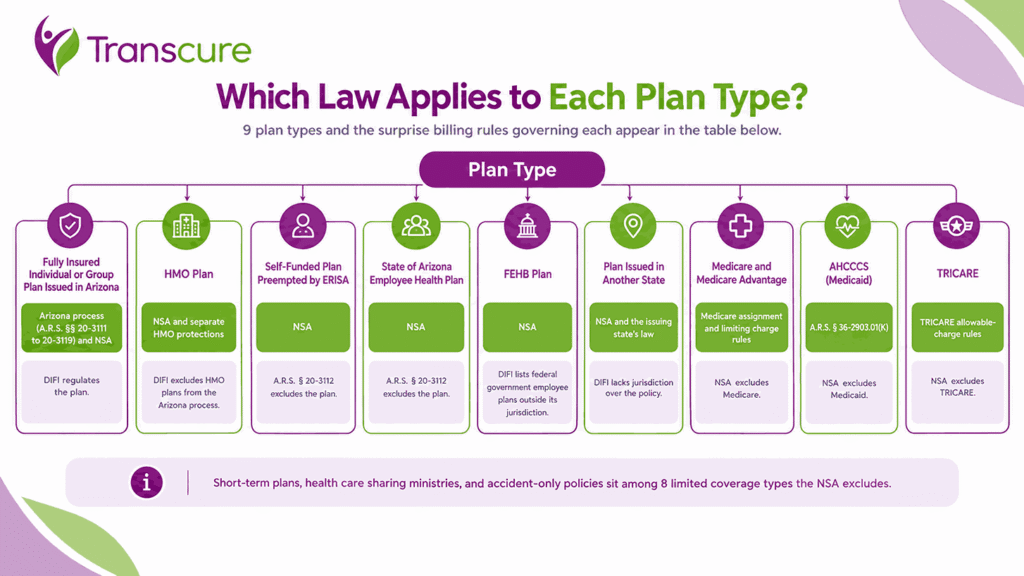
Which Law Applies to Each Plan Type?
9 plan types and the surprise billing rules governing each appear in the table below.
| Plan type | Law that applies | Key note |
|---|---|---|
| Fully insured individual or group plan issued in Arizona | Arizona process (A.R.S. §§ 20-3111 to 20-3119) and NSA | DIFI regulates the plan |
| HMO plan | NSA and separate HMO protections | DIFI excludes HMO plans from the Arizona process |
| Self-funded plan preempted by ERISA | NSA | A.R.S. § 20-3112 excludes the plan |
| State of Arizona employee health plan | NSA | A.R.S. § 20-3112 excludes the plan |
| FEHB plan | NSA | DIFI lists federal government employee plans outside its jurisdiction |
| Plan issued in another state | NSA and the issuing state’s law | DIFI lacks jurisdiction over the policy |
| Medicare and Medicare Advantage | Medicare assignment and limiting charge rules | NSA excludes Medicare |
| AHCCCS (Medicaid) | A.R.S. § 36-2903.01(K) | NSA excludes Medicaid |
| TRICARE | TRICARE allowable-charge rules | NSA excludes TRICARE |
Short-term plans, health care sharing ministries, and accident-only policies sit among 8 limited coverage types the NSA excludes.
Which Services Are Protected?
Protection covers emergency services and non-emergency care delivered by out-of-network providers at in-network facilities. The NSA also protects air ambulance transport and emergency care at out-of-network facilities.
Which Emergency Services Does the Law Protect?
NSA protection covers 3 types of emergency services: medical screening exams, stabilizing treatment, and post-stabilization services. Protected sites include hospital emergency departments, hospital units caring for stabilized emergency patients, and independent freestanding emergency departments.
Urgent care centers qualify only when licensed to provide emergency services and separate from a hospital. An emergency medical condition is a condition a prudent layperson believes needs immediate care to prevent serious harm to health, bodily functions, or organs.
Insurers judge the condition by presenting symptoms rather than the final diagnosis code. Plans cannot require prior authorization for emergency care under the NSA. Under A.R.S. § 20-3113, qualifying emergency bills arise at network facilities, plus directly related inpatient care at any network facility.
Emergency visits to out-of-network hospitals therefore fall under the NSA and outside the Arizona process.
Which Out-of-Network Providers at In-Network Facilities Are Protected?
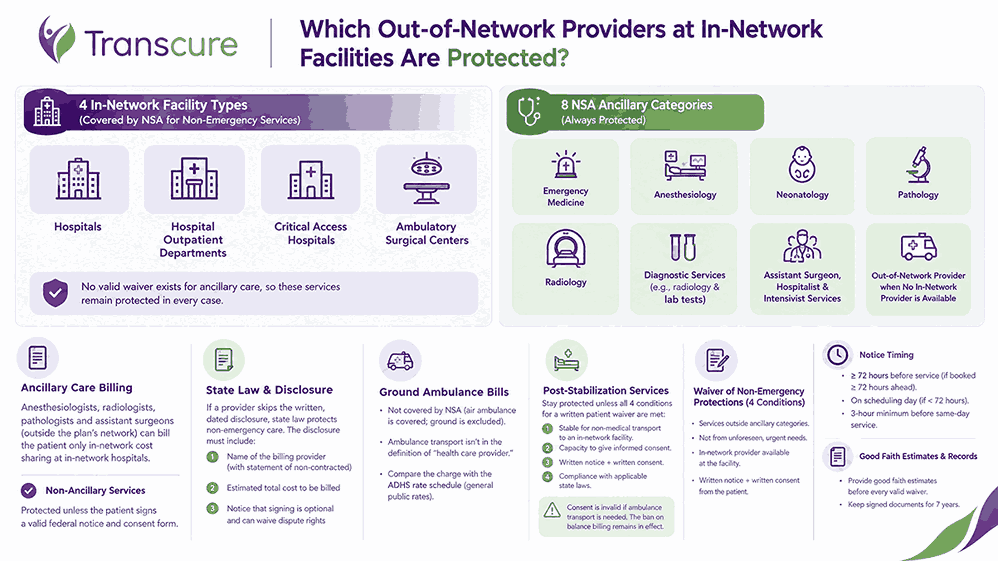
The NSA’s non-emergency protections cover 4 in-network facility types: hospitals, hospital outpatient departments, critical access hospitals, and ambulatory surgical centers. No valid waiver exists for ancillary care, so these services remain protected in every case.
Ancillary care falls into 8 NSA categories:
- Emergency medicine
- Anesthesiology
- Neonatology
- Pathology
- Radiology
- Diagnostic services such as radiology and laboratory tests
- Assistant surgeon, hospitalist, and intensivist services
- Services from an out-of-network provider when no in-network provider is available at the facility
Anesthesiologists, radiologists, pathologists, and assistant surgeons outside the plan’s network can bill the patient only in-network cost sharing at in-network hospitals.
Non-ancillary non-emergency services are protected unless the patient signs a valid federal notice and consent form.
State law protects non-emergency care when a provider skips the written, dated disclosure, which has 3 elements:
- Name of the billing provider with a statement that the provider is not contracted
- Estimated total cost to be billed
- Notice that signing is optional and can waive dispute rights
Signing a disclosure leaves emergency services eligible for dispute resolution. For non-emergency care, a signature bars a dispute only when the final bill does not exceed the estimated cost. DIFI states that providers cannot withhold treatment from a patient who declines to sign.
Are Ground Ambulance Bills Protected?
Ground ambulance bills fall outside the NSA, which covers air ambulance transport and excludes ground transport.
Statutory language limits the term health care provider to Title 32 licensed professionals, laboratories, and durable medical equipment suppliers serving patients in network facilities. Ambulance transport does not appear in that definition.
Rate schedules from the Arizona Department of Health Services (ADHS) set the general public rates that ground ambulance services can charge. Patients can compare a ground ambulance charge against the ADHS rate schedule.
How Do Post-Stabilization Services and Patient Consent Work?
Post-stabilization services stay protected unless the provider meets all 4 federal conditions for a written patient waiver:
- Patient stability sufficient for non-medical transport to an available in-network facility within reasonable distance
- Capacity to receive information and give informed consent
- Written notice delivered and written consent obtained
- Compliance with applicable state laws
Consent is invalid when the patient requires ambulance transport and the ban on balance billing remains in effect.
Waiver of non-emergency protections requires 4 conditions:
- Services outside the ancillary categories
- Care not arising from unforeseen, urgent medical needs
- Availability of an in-network provider for the services at the facility
- Written notice and written consent from the patient
Providers must deliver the standard CMS notice at least 72 hours before service when the appointment is booked at least 72 hours ahead. Appointments booked inside the 72-hour window require the notice on the scheduling day, with a 3-hour minimum before same-day service.
Good faith estimates of expected charges precede every valid waiver. Providers and facilities retain signed documents for 7 years.
What Do Patients Owe Under the Law?
Patients owe only in-network cost sharing for services the NSA protects. Beyond the NSA, Arizona’s process settles disputed balances of at least $1,000 between the insurer and the provider.
Is Patient Responsibility Limited to In-Network Cost Sharing?
The NSA caps patient responsibility at the plan’s in-network copayment, coinsurance, and deductible. The cap holds in every state, regardless of state law. Plans calculate cost sharing from the qualifying payment amount (QPA), generally the median contracted rate for the service in the same region.
Billed charges below the QPA replace the QPA in the calculation. Radiology billed at $400 with a $270 QPA yields a $27 patient share at 10% coinsurance once the deductible is met. A $25 in-network copay replaces a $35 out-of-network copay.
After a settlement or arbitration decision, an Arizona patient owes only cost sharing plus any insurer payment the patient received. A.R.S. § 20-3115(S) bars further balance bills for the disputed service. Arbitration costs are split equally between insurer and provider, and the patient pays none.
How Do Deductibles and Out-of-Pocket Maximums Count?
Payments a patient makes for protected out-of-network services count toward the in-network deductible and out-of-pocket maximum. Explanations of benefits (EOBs) must show cost sharing calculated at in-network rates.
One federal example applies 10% coinsurance to a $12,500 QPA, producing a $1,250 patient share. That amount moves accumulated out-of-pocket spending from $2,000 to $3,250 under a $10,000 maximum.
What Are the First 4 Steps After a Balance Bill Arrives?
Receipt of a balance bill triggers 4 first steps:
- Compare the bill with the EOB. Charges beyond the listed patient responsibility signal a possible error.
- Identify the plan type and the service category. Rules from Arizona law, the NSA, or a government program follow from those 2 facts.
- Dispute the bill in writing and request an itemized bill. DIFI states that Arizona law requires providers to supply an itemized bill on request in most cases. Appeal to the insurer when the EOB applies out-of-network cost sharing to a protected service.
- File a complaint or arbitration request. Complaints about federal violations go to the No Surprises Help Desk at 1-800-985-3059. Balances of at least $1,000 qualify for Arizona arbitration when filed with DIFI within 1 year of the service date.
Insurer appeals must conclude before arbitration, and the 1-year filing clock pauses during an appeal.
How Do Insurers Pay Out-of-Network Providers?
Payers settle out-of-network claims on 2 parallel 30-day clocks: Arizona’s adjudication deadline and the NSA’s initial payment deadline. Both clocks run from the date the insurer receives the claim.
What Payment Standard and Initial Payment Notice Apply to Out-of-Network Claims?
How Does Arizona Law Set Payment Timing?
Adjudication of a clean claim from a noncontracted provider must finish within 30 days of receipt under A.R.S. § 20-3102(A). Claims that lack information trigger a written request within 30 days, and a new 30-day clock starts when the insurer receives the answers.
Fee amounts for out-of-network claims do not appear anywhere in the statute. Arbitrators set the amount only after an enrollee disputes the bill through DIFI.
Pending arbitration suspends the prompt pay article for the disputed claim. The insurer remits its share within 30 days after resolution.
How Does the NSA Set the Initial Payment?
Within 30 calendar days of a claim the NSA covers, the plan sends an initial payment or a notice of denial. Reasonable intent as payment in full defines the initial payment, even at $0 when the deductible is unmet.
QPA, the qualifying payment amount, generally equals the median contracted rate for the same service, specialty, and region, increased by inflation. Neither an all-payer agreement nor a specified state law applies in Arizona, so the QPA governs cost sharing.
On August 11, 2026, the Fifth Circuit (en banc) affirmed rulings in TMA III that struck parts of the QPA calculation rules. Agencies are reviewing the opinion while the federal independent dispute resolution (IDR) process remains operational.
What Does a Denial of Payment Mean?
Denial of payment and denial of coverage follow separate paths. Open negotiation handles payment denials, and the plan’s claims and appeals process handles adverse benefit determinations.
Providers’ grievances follow an insurer’s internal system, as A.R.S. § 20-3102(F) requires.
What Should Providers Check on the EOB and Remittance Advice?
Initial payments and denial notices carry 4 written disclosures: the QPA per item, a certification statement, open negotiation instructions, and contact details. Requested disclosures add 4 QPA details: fee schedule basis, database source, related service code, and incentive payment exclusions.
Teams track a 30-business-day window that opens on receipt of the initial payment or denial. Business days run Monday through Friday and exclude federal holidays.
8 verification items appear below for every out-of-network remittance and notice.
| Item | What to verify | Source |
|---|---|---|
| QPA | Dollar amount stated for each service code | CMS IDR guidance |
| QPA certification | Statement that the QPA applies and was calculated under current rules | CMS IDR guidance |
| Open negotiation language | Instructions for starting the 30-business-day period | CMS IDR guidance |
| Contact details | Telephone number and email for the negotiation office | CMS IDR guidance |
| Patient cost sharing | Amount calculated at in-network rates and shown on the EOB | CMS model notice |
| CARC and RARC codes | Codes marking the claim as subject or not subject to the NSA | CMS fact sheet, May 28, 2026 |
| Plan identifiers | Legal business name and sponsor name, plus the IDR registration number after the registry launches | CMS fact sheet, May 28, 2026 |
| Arizona DIFI notice | Dispute rights notice on the EOB for non-contracted claims outside federal IDR | A.R.S. § 20-3117(B) |
Missing disclosures preserve the provider’s right to start open negotiation within 30 business days or to request an extension to start IDR. Providers that delegate remittance review to medical billing services in Arizona keep the 30-business-day open negotiation window on a tracked schedule.
How Does the Arizona Arbitration Process Work, Step by Step?
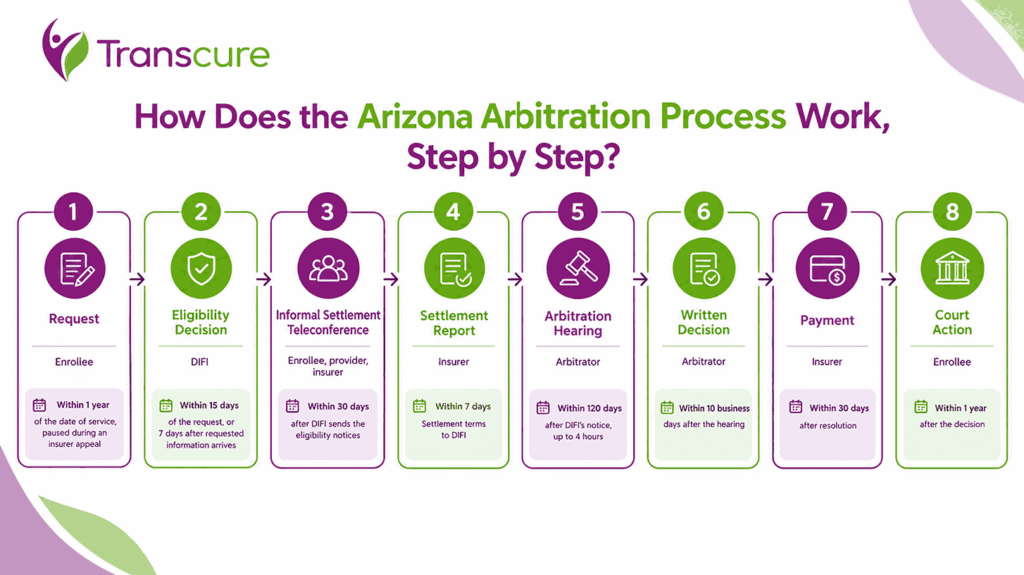
Resolution of a surprise bill in Arizona runs through 5 steps: request, eligibility review, informal settlement teleconference, arbitration, and payment. Deadlines in A.R.S. §§ 20-3114 and 20-3115 govern each stage, as the timeline below shows.
| Step | Actor | Deadline | Source |
|---|---|---|---|
| 1. Request | Enrollee | Within 1 year of the date of service, paused during an insurer appeal | A.R.S. § 20-3114(A) |
| 2. Eligibility decision | DIFI | Within 15 days of the request, or 7 days after requested information arrives | A.R.S. § 20-3115(C) |
| 3. Informal settlement teleconference | Enrollee, provider, insurer | Within 30 days after DIFI sends the eligibility notices | A.R.S. § 20-3115(E) |
| 4. Settlement report | Insurer | Settlement terms to DIFI within 7 days | A.R.S. § 20-3115(E) |
| 5. Arbitration hearing | Arbitrator | Within 120 days after DIFI’s notice, up to 4 hours | A.R.S. § 20-3115(L), (M) |
| 6. Written decision | Arbitrator | Within 10 business days after the hearing | A.R.S. § 20-3115(N) |
| 7. Insurer payment | Insurer | Within 30 days after resolution | A.R.S. § 20-3115(Q) |
| 8. Court action | Enrollee | Within 1 year after the decision | A.R.S. § 20-3119 |
Filing carries the 1-year limit, and each following deadline runs from a DIFI notice, the hearing, the resolution, or the decision.
Which Claims Qualify for Arizona Arbitration?
A claim qualifies for Arizona arbitration when it meets 8 criteria:
- Plan inside DIFI jurisdiction and outside the A.R.S. § 20-3112 exclusions
- Surprise out-of-network bill from a non-contracted provider at a network facility
- Date of service on or after January 1, 2019
- Service covered by the enrollee’s health plan
- Disputed balance of at least $1,000 per provider after cost sharing and the insurer’s allowable reimbursement
- Resolved insurer health care appeal, if the enrollee filed one
- No lawsuit or other legal action on the same bill
- No prior settlement or arbitration decision on the same bill
Related services from 1 provider combine toward the $1,000 threshold, even across multiple bills. Signed disclosures bar a non-emergency dispute when the final bill does not exceed the disclosure’s estimate.
Eligibility determinations arrive within 15 days of the request, or within 7 days after DIFI receives the requested information. Responses to a DIFI information request are due within 15 days.
Missed response windows carry different results: the request is deemed eligible when an insurer or provider misses, and denied when the enrollee misses. Finality applies to the eligibility decision inside DIFI, and courts decide the question without deference.
When and Where Does an Enrollee File the Request?
Enrollees file with DIFI within 1 year of the date of service on the bill. Appeals to the insurer pause the 1-year period from filing until final resolution.
3 steps to complete the DIFI filing:
- Complete and sign Form SOONBDR, the Surprise Out-of-Network Billing Dispute Resolution request.
- Scan the signed form, both sides of the insurance card, and all bills, letters, and other correspondence about the bill.
- Submit everything through DIFI’s online Consumer Complaint system in a single upload.
Attachment of documents is allowed once per request, so step 2 precedes step 3. Filers who miss documents should email [email protected] with the complaint number instead of resubmitting.
What Happens in the Informal Settlement Teleconference?
DIFI schedules the call within 30 days after the eligibility notices but does not participate. Participants: the enrollee or representative, the provider or representative, and the insurer.
The insurer provides cost-sharing figures during the call, based on the adjudicated claim. Settlement resolves the vast majority of qualifying complaints at this stage, DIFI reports.
What Happens When a Party Misses the Call?
Absence from the teleconference produces 2 outcomes:
- Enrollee absence: DIFI ends the call, and the enrollee has 14 days to request a reschedule or forfeits arbitration.
- Insurer or provider absence: the other party asks DIFI to start arbitration immediately, and the absent party pays the full arbitration cost.
Reports on settlement terms go from the insurer to DIFI within 7 days.
How Does DIFI Select the Arbitrator, and When Does the Decision Arrive?
DIFI appoints the arbitrator, and the insurer and provider must agree on the choice. Parties can agree on an arbitrator outside DIFI’s list.
What Happens When the Parties Disagree on the Arbitrator?
Unresolved objections trigger a 3-step strike process:
- DIFI randomly assigns 3 arbitrators.
- Each party strikes 1 arbitrator.
- The last arbitrator conducts the arbitration, or DIFI randomly assigns 1 when 2 remain.
Qualification rules require at least 3 years of experience in health care services claims, and DIFI staff cannot serve.
What Evidence Does the Arbitrator Consider?
6 evidence categories appear in A.R.S. § 20-3115(K):
- Insurer’s average contracted payment for the service in the county
- Provider’s average contracted acceptance for the service in the county
- Medicare and Medicaid payment for the service
- Direct pay rate of the provider under A.R.S. § 32-3216, if any
- Reasonable fee information under Title 32, such as usual and customary charges in the same specialty and area
- Other reliable databases on county-level payment
How and When Does the Arbitration Proceed?
By default, telephone hearings must occur within 120 days of DIFI’s notice, last up to 4 hours, and proceed with or without the enrollee. Written decisions arrive within 10 business days after the hearing.
Copies go to the enrollee, the insurer, and the provider or billing company. All pricing information provided in the arbitration stays confidential.
What Payments and Deadlines Surround the Decision?
Before the hearing, 3 payment steps apply:
- Payment, or written payment arrangements, for the cost-sharing amount stated at the teleconference
- Repayment of any insurer payment the enrollee received for the service
- Remittance by the insurer of any direct payment still owed to the provider
Following the decision, 2 deadlines run:
- Insurer payment of the awarded amount within 30 days of resolution
- Enrollee civil action within 1 year after the decision, under A.R.S. § 20-3119
Who Pays the Arbitration Fees and Costs?
The insurer and the provider split the arbitration costs equally, and the enrollee pays nothing. Different splits require agreement from all parties.
Nonparticipation shifts the full arbitration cost to the party that skips the teleconference. Direct arrangements with the arbitrator determine each side’s payment timing.
Arbitrator pay rates stay outside A.R.S. §§ 20-3111 to 20-3119, which list no fee schedule.
How Does Arizona Law Compare With the Federal No Surprises Act?
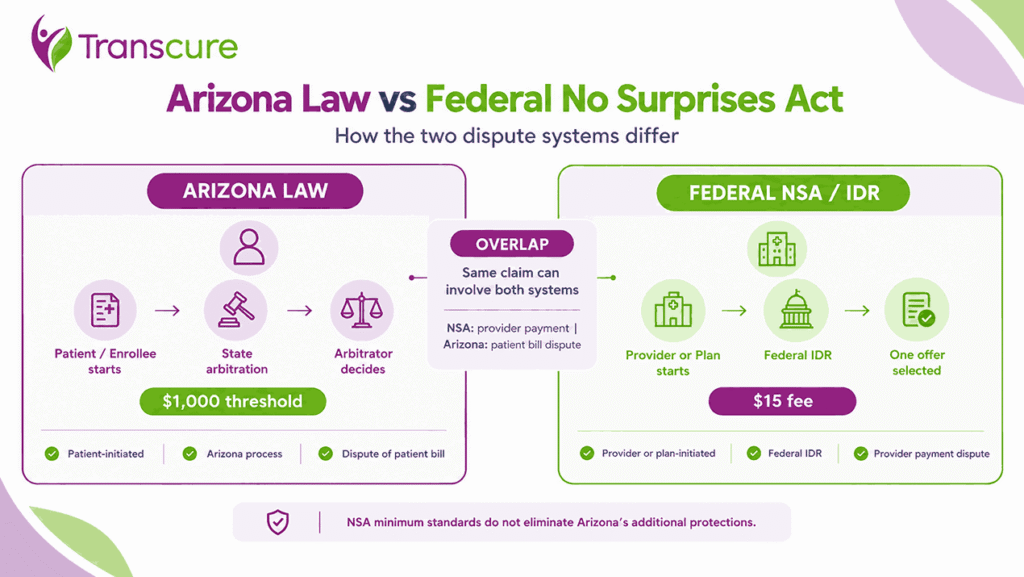
2 dispute systems coexist in Arizona: a patient-initiated state arbitration and a provider-initiated federal IDR. Initiation separates them: enrollees file in Arizona, and providers or plans file federally.
How Do Arizona Law and the NSA Overlap?
Same-claim overlap defines the relationship: the NSA governs the plan-to-provider payment, and Arizona law governs the patient’s dispute of the bill.
Which Law Sets the Provider Payment?
CMS determined in February 2022 that A.R.S. §§ 20-3111 to 20-3119 are not a specified state law. IDR under federal rules therefore sets out-of-network rates for insured group and individual coverage in Arizona. Reason: Arizona’s process starts only when an enrollee disputes the bill.
Which Law Sets Patient Cost Sharing?
Caps on cost sharing at in-network levels apply in every state, regardless of state law. Post-resolution liability appears in A.R.S. § 20-3115(S): cost sharing plus any insurer payment the enrollee received.
Who Enforces Each Law?
Insurer-side enforcement of provider directory and EOB rules sits with DIFI, per CMS’s February 2022 letter.
Physicians fall under the Arizona Medical Board and the Arizona Board of Osteopathic Examiners for balance billing enforcement.
CMS enforces facilities, non-physician providers, air ambulance services, and IDR outcomes directly in Arizona.
Does the NSA Replace Arizona’s Statute?
Preemption stops at the NSA’s minimum standards: state laws can add protections, and Arizona’s process remains available. Duties to notify enrollees of arbitration rights now apply only to claims outside federal IDR, under A.R.S. § 20-3117.
How Does State Arbitration Differ From Federal IDR?
Patient-initiated arbitration defines the Arizona process, and provider-initiated or plan-initiated IDR defines the federal process. IDR results leave patient cost sharing unchanged, and the patient is not a party.
Which Evidence Counts in Each System?
An arbitrator in Arizona sets the dollar amounts and determines what the provider is entitled to receive. Selection of 1 offer from the 2 submitted by the parties defines the federal IDR decision.
The table below shows how evidence rules differ.
| Evidence | Arizona arbitration | Federal IDR |
|---|---|---|
| Usual and customary charges | Allowed | Prohibited |
| Medicare and Medicaid rates | Allowed | Prohibited |
| Contracted rates | County averages paid and accepted | QPA, the median contracted rate, considered in every dispute |
| Provider training, experience, and quality | Not listed | Considered when credible |
| Patient acuity and case complexity | Not listed | Considered when credible |
Federal IDR bars the 2 evidence types that Arizona arbitration expressly allows.
Who Pays and How Much?
Arizona arbitration costs the enrollee nothing, and the insurer and provider split the arbitration cost equally. Federal IDR charges each party a $15 administrative fee for disputes started on or after June 11, 2026.
Each party also pays the full certified IDR entity fee at offer submission. The entity refunds that fee to the prevailing party.
Is the Decision Final?
Federal IDR determinations bind all parties unless fraud or intentional misrepresentation occurred, and payment is due within 30 calendar days. Arizona gives the enrollee 1 year after the decision to file a civil action.
What Does the Side-by-Side Comparison Show?
The table below compares coverage, dispute method, deadlines, and patient notice.
| Feature | Arizona process | Federal NSA and IDR |
|---|---|---|
| Legal source | A.R.S. §§ 20-3111 to 20-3119 | NSA, effective January 1, 2022 |
| Plans covered | Fully insured plans from Arizona-regulated insurers; excludes HMO plans and ERISA-preempted self-funded plans | Self-funded and fully insured group plans, individual and marketplace plans, FEHB, church, and non-federal governmental plans |
| Services covered | Emergency services and non-emergency care without a valid disclosure, at network facilities | Emergency services at in-network and out-of-network facilities, ancillary care, non-consented non-emergency care at 4 facility types, and air ambulance |
| Who starts the dispute | Enrollee | Provider or plan |
| Cost to start | No cost to the enrollee | $15 administrative fee per party plus the certified IDR entity fee |
| Filing deadline | 1 year from the date of service, paused during an insurer appeal | 30 business days to start open negotiation; 4 business days after negotiation to start IDR |
| Pre-dispute step | Informal settlement teleconference within 30 days of DIFI notices | 30-business-day open negotiation |
| Decision-maker | Arbitrator with 3 years of claims experience | Certified IDR entity |
| Decision method | Arbitrator determines the amount using 6 evidence categories | Entity selects 1 of 2 offers, weighing the QPA and other credible information |
| Decision timing | Hearing within 120 days of notice; decision within 10 business days of the hearing | Determination within 30 business days of entity selection |
| Payment after decision | Insurer pays within 30 days after resolution | Amount due within 30 calendar days of the determination |
| Patient notice | Insurer EOB notice and provider written notice, for claims outside federal IDR | Provider disclosure notice and EOB protection information |
| Enforcement in Arizona | DIFI administers arbitration | CMS enforces IDR outcomes |
Parallel operation follows from CMS’s finding that the Arizona statute is not a specified state law.
What Do Real-Life Arizona Surprise Billing Scenarios Look Like?
In practice, the facility’s network status, plan funding, and facility license determine which law applies. Illustrative figures replace real claim data in every scenario.
What Happens After an ER Visit at an Out-of-Network Hospital in Phoenix?
A fully insured patient with chest pain goes to an out-of-network Phoenix emergency department, and the hospital bills $18,000.
Which Law Applies to the Phoenix ER Visit?
Solely the NSA applies here, because Arizona’s process requires a network facility.
What Does Each Party Owe After the Phoenix ER Visit?
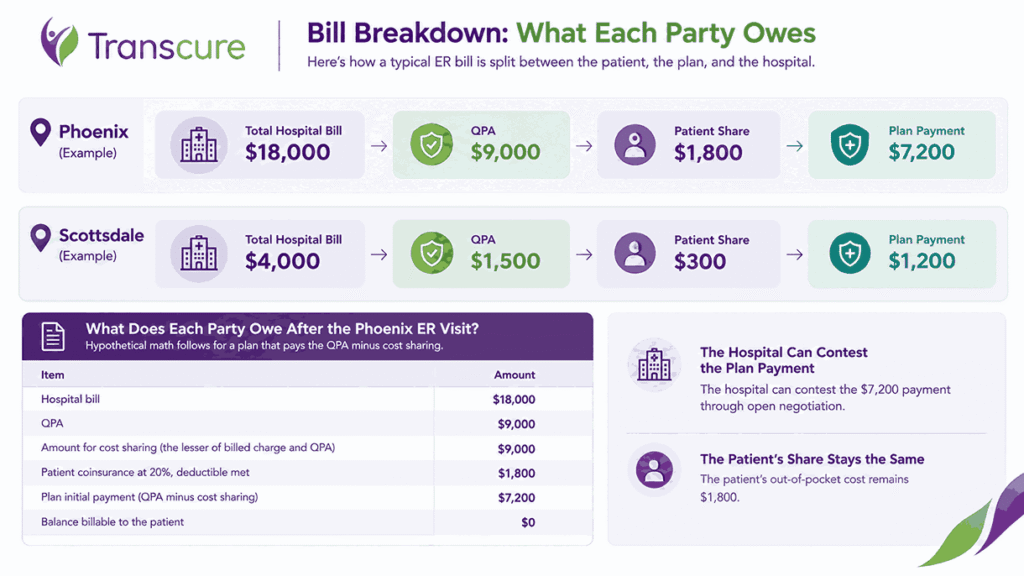
Hypothetical math follows for a plan that pays the QPA minus cost sharing.
| Item | Amount |
|---|---|
| Hospital bill | $18,000 |
| QPA | $9,000 |
| Amount for cost sharing (the lesser of billed charge and QPA) | $9,000 |
| Patient coinsurance at 20%, deductible met | $1,800 |
| Plan initial payment (QPA minus cost sharing) | $7,200 |
| Balance billable to the patient | $0 |
The hospital can contest the $7,200 payment through open negotiation, while the patient’s share remains $1,800.
What if the Phoenix Hospital Bills the Balance?
Any bill above the $1,800 patient share violates the NSA and qualifies for a complaint to the No Surprises Help Desk at 1-800-985-3059.
What Happens When an In-Network Surgery Includes an Out-of-Network Anesthesiologist in Scottsdale?
Scheduled knee arthroscopy at an in-network Scottsdale surgery center brings in an out-of-network anesthesiologist who bills $4,000.
Which Laws Apply to the Scottsdale Surgery?
Anesthesiology counts as ancillary care, so no waiver is valid and the NSA bars a balance bill. Through DIFI, an enrollee can also request arbitration when the provider skipped the written disclosure, and the balance reaches $1,000.
What Does Each Party Owe After the Scottsdale Surgery?
Figures below assume the deductible is met and the plan pays the QPA minus cost sharing.
| Item | Amount |
|---|---|
| Anesthesiologist bill | $4,000 |
| QPA | $1,500 |
| Patient coinsurance at 20% | $300 |
| Plan initial payment (QPA minus cost sharing) | $1,200 |
| Gap between the charge and the QPA, resolved between plan and provider | $2,500 |
| Patient balance beyond cost sharing | $0 |
The $2,500 gap sits between the plan and the provider, while the patient owes $300.
What if the Anesthesiologist Bills the $2,500 Gap?
4 actions follow a bill for the gap:
- Compare the bill with the EOB.
- Request an itemized bill and cite the NSA in writing.
- File a complaint with the No Surprises Help Desk at 1-800-985-3059.
- Request arbitration through DIFI when the $1,000 threshold, the 1-year deadline, and the other criteria are met.
How Does a Self-Funded Employer Plan Follow the Federal Route?
Members of self-funded employer plans can receive a $3,200 bill from an out-of-network emergency physician at an in-network Phoenix hospital.
Why Does Arizona Law Not Apply?
Paragraph 6 of A.R.S. § 20-3112 excludes self-funded plans that ERISA preempts, so the federal route governs end to end. Opt-in rights for self-funded plans appear nowhere in the statutory text.
How Do the Numbers and Steps Run?
| Item | Amount |
|---|---|
| Physician bill | $3,200 |
| QPA | $1,100 |
| Patient coinsurance at 20% | $220 |
| Plan initial payment (QPA minus cost sharing) | $880 |
6 federal steps follow:
- Plan sends the initial payment or denial notice within 30 calendar days.
- Provider starts open negotiation within 30 business days of that notice.
- Parties negotiate for 30 business days.
- Either party starts IDR within 4 business days after negotiation ends.
- Parties select the IDR entity within 3 business days and submit offers within 10 business days of selection.
- The entity decides within 30 business days of selection, and payment follows within 30 calendar days.
Administrative fees of $15 per party apply to disputes started on or after June 11, 2026, plus the certified IDR entity fee. Batched disputes with open negotiation starting on or after November 1, 2026 carry a 50-line-item cap.
What Can the Patient Do?
Bills beyond $220 qualify for a complaint to the No Surprises Help Desk at 1-800-985-3059. External review for a private-sector self-funded plan runs through the process in the plan’s summary plan description.
Is an Urgent Care Visit Treated Like an ER Visit?
Emergency-level protection reaches an urgent care center only when the center holds a license to provide emergency services and sits apart from a hospital.
How Does Arizona License Each Facility Type?
Arizona outpatient treatment center licenses list emergency room services and freestanding urgent care services as separate options.
Definitions of health care facility in A.R.S. § 20-3111 point to A.R.S. § 36-437, which names urgent care centers. Non-emergency NSA protection stops at 4 facility types: hospitals, hospital outpatient departments, critical access hospitals, and ambulatory surgical centers.
What Does the Gap Look Like in Numbers?
An in-network urgent care center brings in an out-of-network provider who skips the written disclosure:
- Provider bill: $2,400
- Plan payment: $700
- Patient cost sharing: $200
- Remaining balance: $1,500
That balance clears the $1,000 Arizona threshold, and the NSA’s non-emergency facility list excludes a standalone urgent care clinic.
What Compliance Checklist Applies to Billing Teams?
Compliance for out-of-network claims rests on 4 checkpoints: claim coding, patient billing, documentation, and error prevention. Behind every checkpoint below sits a duty from A.R.S. §§ 20-3111 to 20-3119 or federal NSA rules.
Which Coding and Claim Submission Checks Apply?
7 coding and claim checks protect an out-of-network claim before submission.
| Check | What to confirm | Source |
|---|---|---|
| Place of service code | POS matches the setting: 23 emergency room, 22 or 19 hospital outpatient (on or off campus), 21 inpatient, 24 ambulatory surgical center, 20 urgent care | CMS place of service code set |
| Facility category | Non-emergency NSA coverage requires a hospital, hospital outpatient department, critical access hospital, or ambulatory surgical center | CMS NSA overview |
| Service code and modifiers | Each item carries its service code; the IDR portal accepts up to 4 modifiers, and blocks duplicates with the same claim number, date, code, and modifiers | CMS IDR notices |
| Anesthesia modifiers | AA, QK, QX, QY, QZ, or AD matches who performed or directed the anesthesia | Medicare modifier guidance |
| Assistant surgeon modifiers | 80, 81, or 82 for physicians; AS for physician assistants, nurse practitioners, and clinical nurse specialists | Medicare modifier guidance |
| Network status | Plan directory and written plan confirmation of the provider’s status at scheduling and before billing | CMS NSA overview |
| Plan type | Fully insured, self-funded, HMO, or government program recorded on the claim file | CMS IDR notices and fact sheet |
Matching place of service, service code, and plan type supplies the data fields required for an IDR initiation notice. Practices that lack in-house capacity for these checks often hand claim coding and network verification to medical billing services in Arizona.
How Does Network Status Verification Work?
Plans verify directories at least every 90 days, and they answer network status questions within 1 business day. Phone inquiries receive a written response that the plan keeps for 2 years.
Provider submission duties cover contract start, contract end, material changes, and plan requests. Refunds with interest go to patients who relied on an incorrect directory and paid above the in-network cost sharing.
Which Checks Come Before Sending a Bill to the Patient?
6 checks precede every patient statement for an NSA-covered or Arizona-covered service:
- EOB patient responsibility compared against the statement balance
- NSA applicability screened by service category and facility type
- Notice and consent validity confirmed for non-ancillary, non-emergency services
- Federal disclosure notice delivered no later than the first payment request or claim submission
- Arizona written disclosure confirmed for non-emergency care at network facilities
- Written dispute-process notice ready for any enrollee who contacts the office about a surprise bill
Statement balances above the EOB patient responsibility violate the NSA for protected services. Itemization on request applies in most cases under Arizona law, DIFI states.
One-page federal disclosure notices are posted publicly at the location and on the website, and patients sign nothing. Exemption applies to providers who never furnish care at or in connection with a covered facility visit.
Valid consent names the individual provider, never a group, and the provider retains the signed form for 7 years. Delivery timing runs 72 hours before scheduled service or 3 hours before same-day service.
Which Documentation Helps in Arbitration and IDR?
Documentation falls into 2 groups: records for Arizona arbitration and records for federal IDR.
| Record | Used in | Purpose |
|---|---|---|
| Signed or unsigned disclosure with cost estimate | Arizona | Shows if the provider met A.R.S. § 20-3113 and if the estimate caps the dispute |
| Itemized bill and claim form | Both | Support service codes, dates, and charges |
| EOB and remittance advice | Both | Show insurer payment, cost sharing, and QPA disclosures |
| Network status proof | Both | Shows the contract status of the provider and the facility |
| Pricing evidence in the 6 statutory categories | Arizona | County averages, Medicare and Medicaid rates, direct pay rate, usual and customary charges |
| Response to the DIFI information request | Arizona | Due within 15 days; silence from an insurer or provider deems the request eligible |
| Open negotiation notice with proof of delivery | Federal | Documents the 30-business-day period |
| Signed notice and consent form | Federal | Retained for 7 years |
| Credible-information evidence: training, market share, acuity, teaching status, network efforts over 4 plan years | Federal | Supports the offer beyond the QPA |
Records assembled before the request arrives meet the 15-day DIFI window and the 10-business-day federal offer deadline.
Which Common Errors Create Violations?
10 billing errors recur in out-of-network disputes, and each carries a defined consequence.
| Error | Consequence | Source |
|---|---|---|
| 1. Billing a protected service above in-network cost sharing | NSA violation; the patient can complain to the Help Desk | CMS |
| 2. Asking patients to waive protections for ancillary care | Waiver is invalid; protections still apply | CMS |
| 3. Listing a physician group instead of the individual on a consent form | Consent form fails the federal requirement | CMS provider FAQ |
| 4. Skipping the Arizona written disclosure for non-emergency care | Bill qualifies as a surprise bill | A.R.S. § 20-3113 |
| 5. Billing after a settlement or arbitration decision | Statute bars any additional balance bill | A.R.S. § 20-3115(S) |
| 6. Skipping the informal settlement teleconference | Absent party pays the total arbitration cost | A.R.S. § 20-3115(F) |
| 7. Missing the DIFI 15-day information response | Request is deemed eligible for arbitration | A.R.S. § 20-3115(C) |
| 8. Missing the 30-business-day open negotiation window | IDR access depends on timely negotiation; extensions are discretionary | CMS IDR guidance |
| 9. Discarding signed notice and consent forms | 7-year retention duty goes unmet | CMS provider FAQ |
| 10. Relying on an outdated directory | Refund of excess payment plus interest | CMS provider FAQ |
Deadlines (rows 6 to 8) and documents (rows 3, 4, and 9) sit behind 6 of the 10 errors.
What Complaint and Enforcement Options Do Patients Have?
2 complaint routes exist for a surprise bill: DIFI for Arizona law and the No Surprises Help Desk for federal law. Form SOONBDR also screens the bill for arbitration, health care appeals, or the complaint process.
How Does a Patient File a Complaint With DIFI?
A DIFI complaint follows 3 steps:
- Gather the documents: signed Form SOONBDR, insurance card photos (both sides), bills, EOBs, and letters exchanged with the provider and insurer.
- Submit through DIFI’s online Consumer Complaint system in a single upload.
- Email [email protected] with the complaint number when documents do not attach.
DIFI’s Consumer Protection Division can also review insurer conduct, such as a claim paid outside the policy terms. Out-of-jurisdiction bills receive contact information for the correct agency.
How Does a Patient File a Federal Complaint With CMS and the NSA Help Desk?
Channels to the No Surprises Help Desk number 2: the 1-800-985-3059 phone line and the online CMS complaint form. Staffing covers 7 days a week, from 8:00 am to 8:00 pm ET on weekdays and 10:00 am to 6:00 pm ET on weekends.
What Does the Federal Process Involve?
4 steps structure the federal route:
- Review the EOB and the bill: confirm the name, policy number, dates of service, and matching codes.
- Determine NSA applicability from the service category and facility type.
- Share the findings with the provider and ask the plan to recalculate cost sharing or file an internal appeal.
- File the complaint when the provider or plan keeps miscalculating the patient’s share.
Follow-up arrives within 60 days when the Help Desk needs further information. Referral goes to the correct enforcement authority: CMS, the Department of Labor, the Treasury, OPM, or a state agency.
What Falls Outside the Help Desk’s Services?
Legal counsel, medical advice, and financial assistance fall outside the Help Desk’s services. For debt collection problems, contact the Consumer Financial Protection Bureau at (855) 411-2372.
When Does a Case Call for an Attorney?
This guide provides general information, not legal advice.
When Do Patients Consult an Attorney?
4 situations commonly call for legal counsel:
- A lawsuit or judgment demand over a protected balance
- A planned civil action after an arbitration decision, filed within 1 year under A.R.S. § 20-3119
- A self-funded plan dispute that survives the plan’s appeal and external review
- Debt collection that continues after a complaint
Litigation over the same bill removes the bill from DIFI arbitration under A.R.S. § 20-3114(A)(2).
When Do Providers Consult an Attorney?
Enforcement of IDR awards raises a litigation question because courts disagree on private rights of action. Fifth Circuit precedent from June 2025 rejects a private right of action to enforce IDR awards.
Second Circuit reasoning in September 2026 reached the same result, Law360 reports. District courts in Connecticut and Maryland recognized a narrow implied right instead.
What Do the Key Surprise Billing Terms Mean?
9 terms define the Arizona and federal surprise billing rules.
| Term | Plain meaning | Source |
|---|---|---|
| Balance billing | Collection of charges above the patient’s cost sharing and the insurer’s payment | Ariz. Admin. Code R20-6-2401 |
| Surprise out-of-network bill | Bill from a non-contracted provider for care at a network facility that meets 1 of 3 statutory conditions | A.R.S. § 20-3113 |
| Ancillary provider | Clinician in 1 of 8 categories, such as anesthesiology, radiology, pathology, or assistant surgery, whose protections no waiver removes | CMS NSA overview |
| Cost sharing | Copayment, coinsurance, and deductible amounts the plan assigns to the patient | A.R.S. § 20-3111 |
| QPA or median rate | Median contracted rate for the same service, specialty, and region, increased by inflation | CMS IDR guidance |
| Arbitration | Process in which an impartial arbitrator determines the dollar amount a provider is entitled to receive for a surprise bill | A.R.S. § 20-3111 |
| EOB | Insurer statement showing how a claim was processed and why a claim was denied | CMS NSA guidance |
| Informal settlement teleconference | DIFI-arranged call among enrollee, provider, and insurer to settle before arbitration | Ariz. Admin. Code R20-6-2401 |
| Open negotiation | 30-business-day period for a plan and provider to agree on payment before federal IDR | CMS IDR guidance |
Consistent use of these definitions keeps patient letters, appeals, and IDR submissions aligned with the statutes.
Frequently Asked Questions
Can Patients Be Billed After an ER Visit?
Yes, but only for in-network cost sharing when the NSA covers the visit. Out-of-network ER providers cannot bill beyond the plan’s copay, coinsurance, and deductible.
Does the Law Cover Ground Ambulance Bills?
No, the NSA covers air ambulance only, and Arizona’s statute does not list ambulance transport among covered providers. ADHS sets general public rates for ground ambulance services.
Does the Law Apply to Self-Funded Employer Plans?
The NSA applies. Arizona’s process excludes self-funded plans when ERISA preempts state regulation, so complaints go to the No Surprises Help Desk at 1-800-985-3059.
How Long Does an Enrollee Have to Request Arbitration?
The request must reach DIFI within 1 year of the date of service. An insurer appeal pauses that 1-year clock until the appeal is finally resolved.
Can a Signed Form Waive Surprise Billing Protection?
Only for non-ancillary, non-emergency care with a valid federal notice and consent form. Emergency and ancillary care cannot be waived, and a signed Arizona disclosure applies only to the estimated amount.