
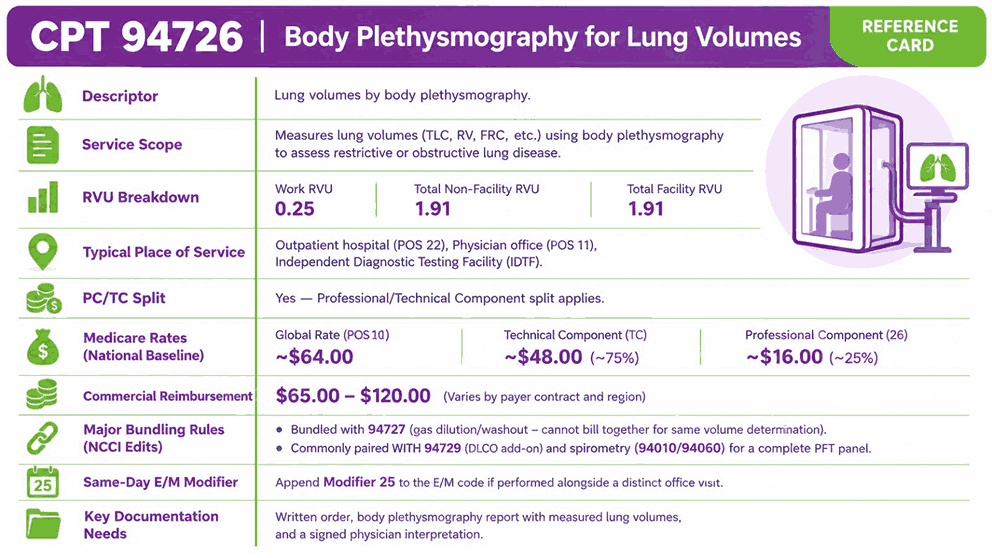
CPT code 94726 covers body plethysmography to measure lung volumes and, when performed, airway resistance. These measurements help pulmonologists identify air trapping, lung hyperinflation, and restrictive lung patterns that spirometry alone may not reveal.
The National Heart, Lung, and Blood Institute recognizes body plethysmography as the gold standard for measuring lung volumes.
In 2025, 4.4% of U.S. adults had been diagnosed with COPD, emphysema, or chronic bronchitis, according to CDC data. For pulmonary practices, billing CPT 94726 correctly means matching the code to the service performed, documenting medical necessity, and following payer requirements.
This guide covers the code description, Medicare reimbursement, real-world billing scenarios, and coding rules to help you avoid preventable claim denials.
What Is the Description of CPT Code 94726?
CPT code 94726 describes plethysmography for determination of lung volumes and, when performed, airway resistance. The code reports the body box test, which measures lung volume and helps distinguish restrictive disease from obstructive disease.
Pulmonary Diagnostic Testing and Therapies (94010 to 94799) contains the code in the CPT manual. Medicare assigns the code a work RVU of 0.25 and a combined practice expense and malpractice RVU of 1.66.
That adds up to a total RVU of 1.91 in both facility and non-facility settings. Frequency limits for 94726 come from Local Coverage Determinations, and the claim reports 1 unit per date of service.
Is 94726 the Same as Spirometry?
No, 94726 measures the air the lungs hold, and spirometry measures the air the lungs move. Forced flow and volume, such as FVC and FEV1, are measured by spirometry (94010 and 94060).
Baseline spirometry reports under 94010. Pre- and post-bronchodilator spirometry reports under CPT code 94060, including the baseline study.
A complete pulmonary function test pairs spirometry with 94726 and 94729, so 94726 never replaces spirometry. Claims that list 94726 for a spirometry-only session lack the lung-volume values payers expect.
How Does 94726 Differ From 94727 and 94728?
94726 uses a body box, 94727 uses gas dilution or washout, and 94728 uses impulse oscillometry to measure airway resistance. The table below shows each code’s method, measurement, and equipment record.
| Code | Method | What It Measures | Equipment Record Shows |
|---|---|---|---|
| 94726 | Body plethysmography | TLC, RV, FRC, airway resistance when performed | Sealed body box |
| 94727 | Gas dilution or washout | Lung volumes, distribution of ventilation and closing volumes when performed | Helium or nitrogen gas analyzer |
| 94728 | Impulse oscillometry | Airway resistance | Oscillometry unit |
Equipment records and technologist notes identify the method, and the method selects the code. Knowing how 94726 differs from other pulmonology CPT codes prevents common bundling errors.
Can 94726 and 94727 Be Billed Together?
Providers report 1 code per measurement, because 94726 and 94727 are alternative methods for lung volumes. Billing both codes for the same determination on the same date duplicates the charge. Payers treat the second code as a duplicate and deny the line.
When Do Providers Order 94726?
Clinicians order 94726 when spirometry shows a pattern that requires measuring lung volumes, such as restrictive disease or air trapping. Four indications commonly lead to a 94726 order.
- Restrictive lung disease, where TLC falls below the predicted value
- Air trapping in COPD, where RV rises
- Interstitial lung disease and pulmonary fibrosis
- Preoperative lung assessment before major surgery
Plethysmography measures thoracic gas volume even when trapped air is present. A reduced TLC confirms restriction, and an elevated RV confirms air trapping.
Does 94726 Split Into Professional and Technical Components?
Yes, 94726 splits into professional and technical components, so one practice can bill globally or two parties can bill separately. Global billing applies when the same entity owns the body box and interprets the test.
When Do You Use Modifier 26 With 94726?
Modifier 26 reports only the physician’s interpretation and written report. Physicians who read tests on equipment owned by a hospital or facility append modifier 26, and the facility bills the technical component.
When Do You Use Modifier TC With 94726?
Report only the technical component with modifier TC for equipment, supplies, facility space, and technologist labor. Ownership of the body box decides who bills TC. Technician printouts without a physician interpretation do not support global billing.
Which ICD-10 Codes Support 94726?
Respiratory diagnosis codes for COPD, asthma, interstitial lung disease, dyspnea, and preoperative respiratory evaluation support 94726 when the record documents the reason for testing. Diagnosis families and example ICD-10-CM codes appear in the table below.
| Diagnosis Family | Example ICD-10-CM Codes |
|---|---|
| COPD and emphysema | J44.9, J43.9 |
| Asthma | J45.909 |
| Interstitial lung disease and pulmonary fibrosis | J84.9, J84.10, J84.112 |
| Dyspnea and shortness of breath | R06.00, R06.02 |
| Preoperative respiratory examination | Z01.811 |
Matching clinical notes state the symptom or finding behind each test. Covered code lists differ by Medicare Administrative Contractor, so the local policy confirms the final choice.
Does a Diagnosis Decide Which Lung Volume Code to Bill?
The testing method determines the lung volume code, and the diagnosis supports medical necessity only. For example, COPD supports either 94726 or 94727, depending on the equipment the laboratory uses.
How Does 94729 Pair With 94726?
94729 is an add-on code for diffusing capacity (DLCO) reported with a primary PFT code such as 94726. Add-on codes never stand alone, so a 94729 line requires a primary code from the same session.
Complete PFT claims commonly list 94060, 94726, and 94729 together. Component modifiers 26 and TC apply to each line when two parties split the claim.
What ICD-10 Codes Must Be Billed With CPT 94726?
CPT 94726 does not require a single universal ICD-10-CM code with every claim. The diagnosis should reflect why the provider ordered body plethysmography and must support medical necessity under the applicable payer policy.
Common diagnosis categories may include:
- COPD: J44.9, chronic obstructive pulmonary disease, unspecified.
- Asthma: J45.909, unspecified asthma, uncomplicated.
- Shortness of breath: R06.02.
- Other forms of dyspnea: R06.09.
- Wheezing: R06.2.
- Interstitial lung disease: An appropriate J84.- code based on the documented condition.
The correct code depends on the provider’s documentation, the patient’s condition, and the payer’s coverage requirements.
For additional respiratory diagnosis codes, see our pulmonology ICD-10 codes guide.
Can You Bill a Symptom Code Alongside a Confirmed Lung Disease?
Yes, when both diagnoses are documented and relevant to the encounter. For example, a patient with established COPD may undergo body plethysmography because of worsening shortness of breath. The claim may include the documented COPD diagnosis and the symptom code when both are appropriate under the payer’s coding rules.
However, adding more diagnosis codes does not automatically establish medical necessity. The medical record must explain why lung volume testing was needed, and the diagnosis sequence should follow the applicable coding guidelines and payer requirements.
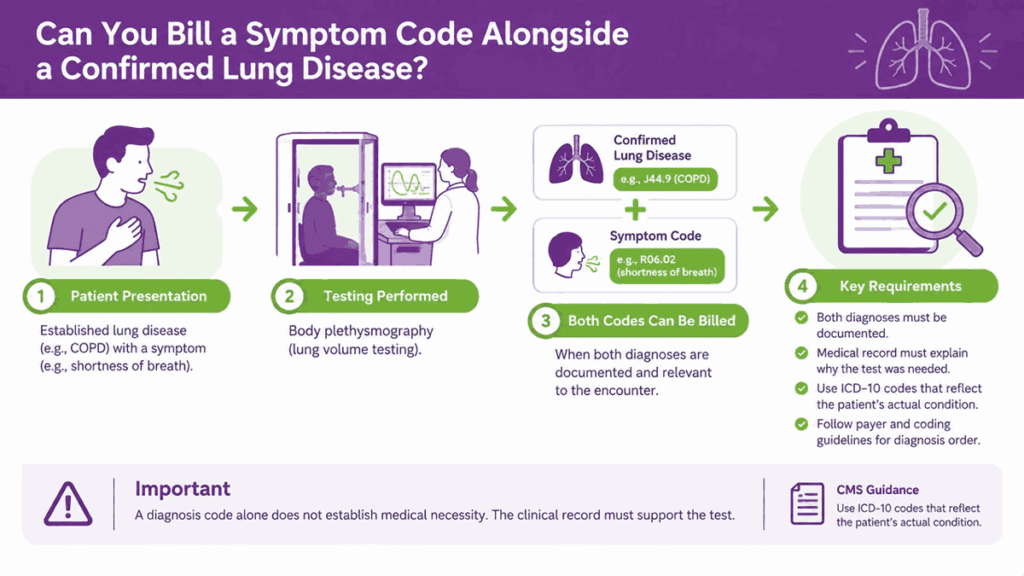
CMS respiratory-care billing guidance states that claims must use ICD-10-CM codes reflecting the patient’s actual condition. A diagnosis code by itself does not establish medical necessity if the overall clinical record does not support the test.
How Does CPT 94726 Pair With CPT 94727 and 94729?
These codes describe different pulmonary function testing services, so billing teams must distinguish between tests that measure the same thing and tests that provide separate clinical information.
- CPT 94726: Measures lung volumes using body plethysmography and includes airway resistance when performed.
- CPT 94727: Measures lung volumes using gas dilution or washout methods and may assess ventilation distribution and closing volumes.
- CPT 94729: Measures diffusion capacity, such as the lungs’ ability to transfer carbon monoxide across the alveolar-capillary membrane. It is an add-on code.
CPT 94726 and 94727 generally should not both be billed for the same lung volume determination. They use different methods to measure lung volumes, and you must check applicable National Correct Coding Initiative (NCCI) edits before reporting both.
CPT 94726 may be billed alongside CPT 94729 when both tests are performed, medically necessary, and separately reportable. You may also report spirometry codes such as 94010 or 94060 when the services are distinct and current NCCI edits and payer rules permit.
What Documentation Supports CPT 94726?
A defensible claim should include a written order, the clinical reason for testing, measured lung volume results, and a signed physician interpretation.
The report should identify the test performed and explain how the findings relate to the patient’s respiratory evaluation or treatment.
CMS respiratory-care guidance also emphasizes that pulmonary function tests must be reasonable and medically necessary, with supporting documentation available for review.
What Does CPT Code 94726 Cost, and Who Pays for It?
For 2026, CPT code 94726 pays approximately $64.00 nationally for the global service before geographic adjustments. The code has a work RVU of 0.25 and a total RVU of 1.91 in both facility and non-facility settings.
When billed separately, the technical component (94726-TC) accounts for approximately $48.00, while the professional component (94726-26) accounts for around $16.00. The technical portion covers testing, including equipment and staff, while the professional portion covers the physician’s interpretation.
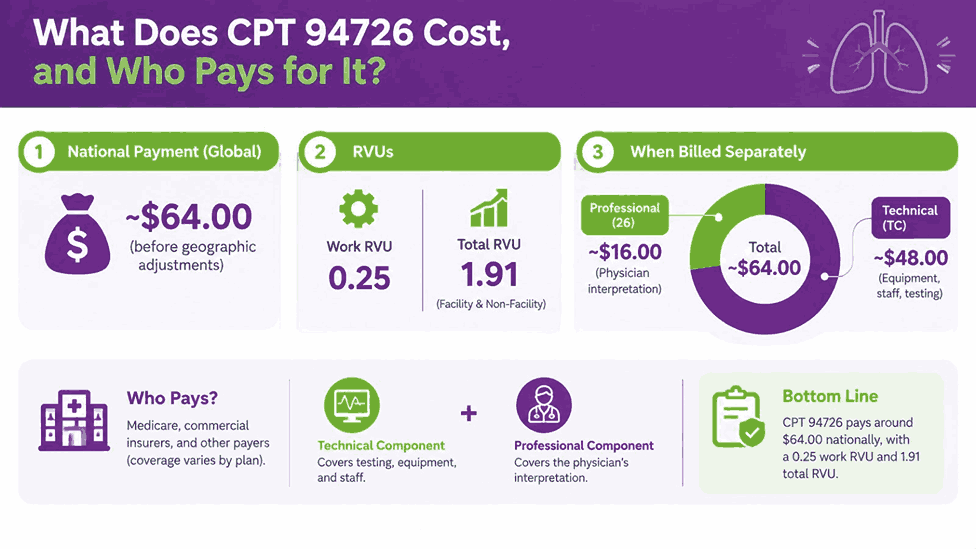
Medicare adjusts payment using the Geographic Practice Cost Index (GPCI), which accounts for regional differences in physician work, practice expenses, and malpractice costs. As a result, the actual allowed amount varies by locality.
Does Medicare Cover CPT Code 94726?
Medicare may cover CPT 94726 when body plethysmography is medically necessary, and the claim meets the applicable coverage and documentation requirements. The clinical record should explain why lung volume testing was needed and include the test results and physician interpretation.
CMS Billing and Coding Article A57225, Billing and Coding: Respiratory Care, lists CPT 94726 among pulmonary function testing codes and states that services must be documented and medically necessary.
Does Commercial Insurance Cover CPT Code 94726?
Many commercial health plans cover CPT 94726 when body plethysmography is medically necessary.
However, coverage depends on the insurer’s policy and the patient’s benefits. Some plans require prior authorization, limit how frequently the test can be performed, or require specific clinical findings to support medical necessity.
Commercial reimbursement typically ranges from $65 to $120 per test, depending on the payer contract, geographic region, and billing arrangement.
Before scheduling the test, verify coverage, authorization requirements, network status, and any plan-specific restrictions. Missing authorization or insufficient documentation can still lead to claim denials.
Does the Patient Owe a Deductible or Coinsurance?
Yes, CPT 94726 is a diagnostic pulmonary function test, so standard patient cost-sharing generally applies. Unlike eligible preventive lung cancer screening billed under CPT 71271, body plethysmography does not automatically qualify for zero-cost-sharing coverage.
For covered Medicare Part B services, patients generally pay the annual deductible (if not met), then 20% of the Medicare-approved amount. Commercial insurance plans may also require a deductible, copayment, or coinsurance, depending on the policy.
Verifying benefits before testing helps practices estimate patient responsibility, communicate expected costs, and reduce billing disputes.
Does Reimbursement Differ Between Global, Modifier 26, and TC Billing?
Yes, global billing covers both the professional and technical components, while modifiers 26 and TC identify the components when they are billed separately, and payer rules permit it.
| Billing Method | What It Covers | Medicare Payment |
|---|---|---|
| Global | Professional and technical components | $64.00 |
| Modifier 26 | Professional component, including interpretation | $16.00 |
| Modifier TC | Technical component, including test performance and equipment | $48.00 |
Modifier 26 applies when billing only the professional component, while modifier TC identifies the technical component when applicable. Global billing applies when the billing entity reports the complete service.
How Much Can Local Reimbursement Differ From the National Average?
Medicare reimbursement for CPT 94726 varies by location because each fee schedule locality has its own geographic practice cost adjustments. Published state-level averages range from about $55.63 in Arkansas to $74.05 in the District of Columbia, a roughly 33% difference.
For instance, a pulmonology practice in Arkansas may receive less than a practice in the District of Columbia for the same service under the same general billing conditions. The exact payment depends on the practice’s Medicare locality, place of service, and applicable billing components.
What Are Some Real-World Billing Scenarios for CPT 94726?
The scenarios below cover the situations billers encounter most often, from a complete office PFT to a denial for a missing interpretation.
Scenario 1: Complete PFT in a Pulmonology Office With a Same-Day Visit
Increasing breathlessness on exertion brings a 64-year-old with known COPD to a scheduled follow-up. The practice owns the spirometer and body box, so the pulmonologist evaluates the patient and orders a complete PFT for that afternoon.
- CPT Codes: 99214-25 (office visit), 94060, 94726, and 94729 (PFT panel)
- ICD-10 Codes: J44.9 (COPD, unspecified)
- Modifiers: 25 on the E/M code, and none on the PFT lines because the practice bills globally, unless a payer edit calls for 59 as in Scenario 3
- Documentation Required: A separately identifiable E/M note that contains the PFT order, the full PFT report with measured values, and the physician’s signed interpretation
Scenario 2: Physician Interpretation Only at a Hospital PFT Lab
Hospital technologists run a patient’s plethysmography and diffusing capacity in the hospital PFT lab. An independent pulmonologist then reviews the tracings and writes the interpretation. Both parties bill the same codes for different components.
- CPT Codes: 94726-26 and 94729-26 from the pulmonologist, while the hospital bills the technical side on its facility claim
- ICD-10 Codes: R06.00 (dyspnea, unspecified) and R94.2 (abnormal results of pulmonary function studies)
- Modifiers: 26 on both professional lines, with POS 22 on the professional claim
- Documentation Required: A signed interpretation report from the pulmonologist, and confirmation that the hospital owns the equipment and employs the technologist
Scenario 3: NCCI Edit Between 94726 and Spirometry
Clearinghouse edits flag a claim that lists 94060 and 94726 for a 47-year-old with asthma, because the pair triggers an NCCI procedure-to-procedure edit.
Restrictive spirometry findings led the pulmonologist to order plethysmography for confirmation. Dropping the spirometry line would forfeit payment for work performed, so the biller checks the edit’s modifier indicator instead. Practices that want to catch edit conflicts early hand the check to pulmonology billing providers.
- CPT Codes: 94060 and 94726, billed separately
- ICD-10 Codes: J45.909 (unspecified asthma, uncomplicated) and R94.2 (abnormal results of pulmonary function studies)
- Modifiers: 59 on the column 2 code of the edit pair, allowed only when the edit carries a modifier indicator of 1
- Documentation Required: Notes that state why each test answered a different clinical question, separate reports for spirometry and plethysmography, and the physician’s interpretation of both
Scenario 4: Technician-Only Report Denied for Missing Interpretation
Denial hit the 94726 line for a 62-year-old with pulmonary fibrosis, because the chart held only the technologist’s printout of measured volumes.
A physician never reviewed it, and no signed interpretation existed, so the professional component was undocumented. Resubmission with a signed interpretation addendum usually reverses the denial reason.
- CPT Codes: 94726 (denied on first submission)
- ICD-10 Codes: J84.10 (pulmonary fibrosis, unspecified)
- Modifiers: None relevant to the denial itself
- Documentation Required to Overturn the Denial: A signed physician interpretation that states TLC, RV, and FRC with reference values and percent predicted, the physician’s credentials, and the original order, resubmitted within the appeal window
What Are the Coding Rules for CPT 94726?
Coding rules for 94726 fall into 3 groups covering documentation, coverage and frequency, and edits and appeals. Missing 1 group turns a payable test into an unpaid claim.
What Documentation Must Support a 94726 Claim?
A 94726 claim requires a signed order, a medical-necessity note, a complete test report, and a signed physician interpretation. Reports list TLC, RV, FRC, and airway resistance when measured, along with reference values and percent predicted.
Technologist notes record the method, the patient’s effort, and the acceptable, reproducible maneuvers under ATS and ERS standards. Interpretations carry the physician’s signature and credentials, since a printout alone leaves the professional component undocumented.
Who Qualifies for 94726?
Qualification depends on a documented symptom, an abnormal spirometry result, or a pulmonary diagnosis that requires measuring lung volumes. Medical necessity decides the outcome, and the table below separates what supports a claim from what does not.
| Situation | Supports Medical Necessity | Does Not Support |
|---|---|---|
| Clinical Picture | Known COPD, interstitial lung disease, or restrictive disease with a lung volume question | No symptoms and no pulmonary diagnosis |
| Spirometry Result | Abnormal result that needs lung volumes to confirm restriction or air trapping | Normal result with no new symptom |
| Preoperative Testing | Active pulmonary condition documented before surgery | Clearance for non-pulmonary surgery with no pulmonary condition |
| Follow-Up Testing | Rapid progression or reassessment after a treatment change | Repeat testing on a stable condition inside the frequency window |
| Order | Signed order that names plethysmography | No written order in the record |
Clinicians can still perform testing from the right column, but Medicare treats the claim as non-covered. Advance Beneficiary Notices signed before the test move financial liability to the patient.
How Often Can 94726 Be Billed?
Most Medicare Local Coverage Determinations limit 94726 to once every 12 months for a stable condition. Rapid disease progression or reassessment after treatment supports earlier repeat testing, provided you document it.
Contractors set separate limits, so the local policy governs. Commercial plans follow Medicare criteria, apply separate policies, or require prior authorization. Eligibility checks at scheduling reveal the frequency and authorization rules before the patient arrives.
Do Local Coverage Determinations Add Requirements?
Local Coverage Determinations add covered diagnosis lists and frequency limits that differ by Medicare Administrative Contractor. CMS billing and coding article A57225 lists pulmonary function testing among covered respiratory care services.
Jurisdiction lookup in the Medicare Coverage Database shows the policy for a practice’s contractor. National medical necessity rules apply everywhere, and local policy adds detail.
How Do NCCI Edits Affect 94726?
NCCI procedure-to-procedure edits bar some code pairs on the same date, and a modifier indicator of 1 allows modifier 59 when the services are distinct. Quarterly updates to the edit tables make the current version the one that governs.
Indicator 0 permits no modifier, so the pair never bills together. 94727 stays mutually exclusive with 94726 for one lung volume determination, and no modifier fixes that.
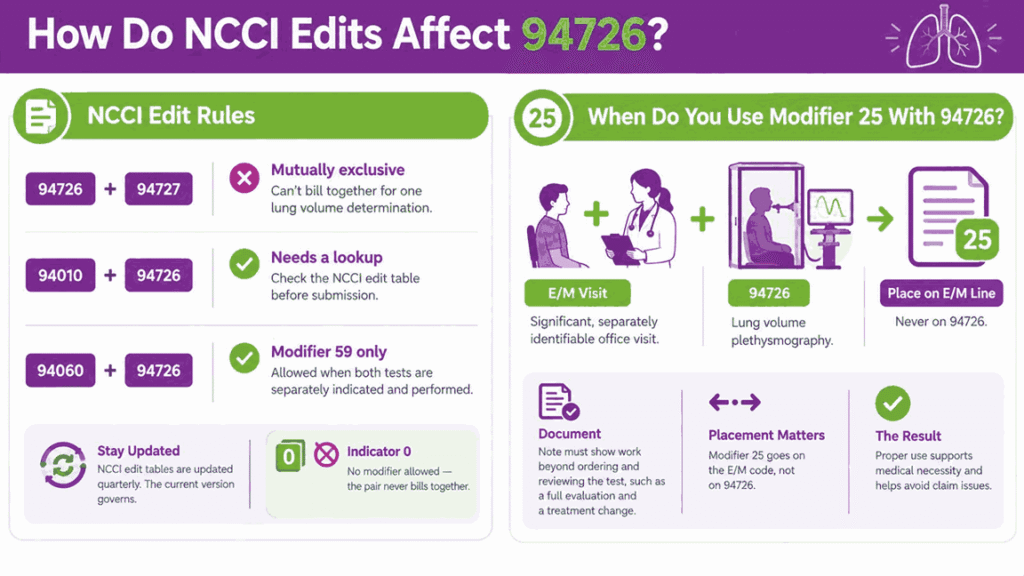
Pairs with 94010 or 94060 need a lookup before submission. Column 2 code carries 59 only when both tests were separately indicated and performed.
When Do You Use Modifier 25 With 94726?
Append modifier 25 to the E/M code when a significant, separately identifiable office visit occurs on the same date as 94726. The visit note must document work beyond ordering and reviewing the test, such as a full evaluation and a treatment change.
Placement matters, since 25 goes on the E/M line and never on 94726.
What Is the Appeal Window if a Claim Is Denied?
You must file redetermination requests within 120 days of receiving the denial notice; this is the first of 5 Medicare appeal levels. Decisions typically arrive within 60 days of the request.
Missing deadlines forfeits appeal rights except when the contractor finds good cause. Contracts set separate deadlines for commercial plans.
Why Do CPT 94726 Claims Get Denied?
Denials for 94726 trace back to documentation or code selection and not to the test itself. Recurring causes and fixes appear in the table below.
| Denial Cause | What It Looks Like | Quick Fix |
|---|---|---|
| Missing Physician Interpretation | Technologist printout in the chart with no signed interpretation | Add a signed interpretation addendum, then resubmit |
| Duplicate Lung Volume Methods | 94726 and 94727 both billed for one determination | Bill only the method the equipment record shows |
| Dropped or Unmodified Code | Spirometry line deleted after an NCCI flag, or a distinct pair sent with no modifier | Check the modifier indicator, then append 59 where allowed |
| Diagnosis Not Supporting Necessity | Symptom code alone, or a diagnosis outside the local policy | Document the clinical reason and match the local code list |
| Frequency Limit Exceeded | Repeat test inside the 12-month window with no change in condition noted | Calendar the next eligible date and document any change in condition |
| Missing or Unsigned Order | No written order naming plethysmography | Obtain a signed order before the test |
| Wrong Place of Service | POS 11 on a claim for a hospital-owned lab | Match POS to where the test happened, since payment stays the same but audit risk rises |
Every fix comes down to 1 rule: document the order, method, and interpretation before building the claim.
Final Words on CPT Code 94726
Payment for a CPT code like 94726 depends on the paperwork behind the test. Every chart needs signed orders, measured lung volumes, a signed physician interpretation, and an equipment record that matches the billed code.
Check the NCCI modifier indicator before pairing 94726 with spirometry, confirm who bills 26 and TC, and calendar the next eligible date. Get the habits right, and 94726 collects on the first submission.