Delaware prior authorization law is the set of state rules governing how insurers approve care before delivery. The main statute is the Delaware Pre-Authorization Reform Act of 2025, known as Senate Bill 12 (SB 12). It amends Chapters 33 and 35 of Title 18 of the Delaware Code, covering individual and group health plans.
SB 12 applies to policies issued or renewed after December 31, 2026. Standard requests get a response in 3 business days (electronic) or 5 business days (non-electronic). Urgent requests need an answer within 24 hours (electronic) or 48 hours (non-electronic). Approved authorizations must stay valid for at least 90 days.
SB 12 also sets appeal standards, and carriers must run a provider portal by January 1, 2027. The Delaware Department of Insurance (DOI) issued Bulletin No. 163 to explain the rules to carriers. Senate Bill 22 (SB 22) limits behavioral health prior authorization for policies issued or renewed after December 31, 2027.
This guide covers SB 12 coverage, SB 22, the CMS-0057-F comparison, and a compliance checklist, with statute sections cited throughout.
Delaware Prior Authorization Law at a Glance
Delaware regulates prior authorization through Title 18 of the Delaware Code, which governs insurance. SB 12 amended Chapter 33, Subchapter II for individual policies and Chapter 35, Subchapter V for group policies. Key sections include 18 Del. C. §§ 3372, 3373, 3376, and 3377, plus parallel sections in Chapter 35.
| Rule | Source | Who it binds | Effective date |
|---|---|---|---|
| SB 12 | 85 Del. Laws c. 176 | Insurers, plans, utilization review entities | Policies issued or renewed after Dec. 31, 2026 |
| Bulletin No. 163 | DOI guidance, Nov. 3, 2025 | Carriers, utilization review entities | Informational, in effect now |
| SB 22 | Fair Standards in Mental Health Care Act | Commercial insurers | Policies issued or renewed after Dec. 31, 2027 |
| CMS-0057-F | Federal final rule | Medicare Advantage, Medicaid, CHIP payers | Timeframes Jan. 1, 2026; APIs Jan. 1, 2027 |
Who Delaware’s Prior Authorization Law Applies To
SB 12 binds insurers, health benefit plans, health service corporations, and utilization review entities operating in Delaware. A utilization review entity (URE) is a company that evaluates authorization requests on a carrier’s behalf. The response deadlines bind the URE directly, so delegated reviewers must meet them.
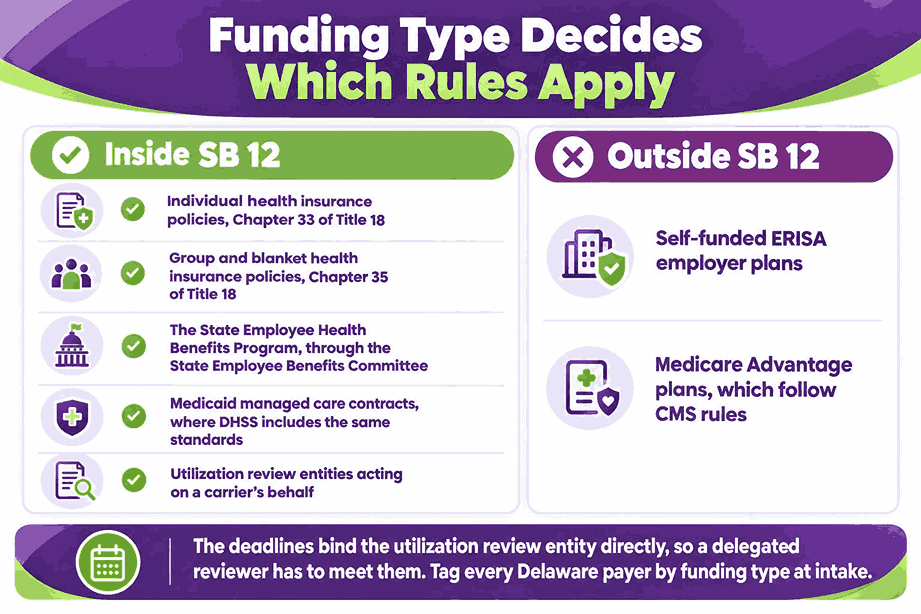
In practice, plan funding type decides which rules apply to a given patient, so check it at intake. A fully insured commercial plan from a Delaware-licensed carrier falls under SB 12. A self-funded employer plan governed by the Employee Retirement Income Security Act (ERISA) generally sits outside state insurance mandates.
Plans and Programs Covered
- Individual health insurance policies under Chapter 33 of Title 18
- Group and blanket health insurance policies under Chapter 35 of Title 18
- The State Employee Health Benefits Program, through the State Employee Benefits Committee
- Medicaid managed care contracts, where the Department of Health and Social Services (DHSS) can include the same standards
Plans Outside SB 12
- Self-funded ERISA employer plans
- Medicare Advantage plans, which follow federal rules from the Centers for Medicare & Medicaid Services (CMS)
Tag every Delaware payer by funding type in your practice management system. This step sets which response clocks and appeal rules apply to each patient encounter. Our guide to Delaware medical billing laws covers the other state rules in detail.
When SB 12 Takes Effect: Policy Renewal Date vs. January 1, 2027
SB 12 does not apply to every covered policy on a single calendar date. Section 4 applies the Act to health insurance policies, contracts, or certificates issued, renewed, modified, altered, amended, or reissued after December 31, 2026. A covered policy renewing on July 1, 2027, would generally become subject to SB 12 at that renewal, assuming no other applicability limitation applies.
The portal deadline works differently, because Section 3377 sets January 1, 2027 as the latest date for carriers to run a provider portal. Some press coverage shortens both dates to January 1, 2027, which hides the renewal effect. Treat the portal date as fixed and the clock dates as plan-specific.
| Date | Event | What it means |
|---|---|---|
| Aug. 25, 2025 | Governor Matt Meyer signs SB 12 | The Act becomes law |
| Nov. 3, 2025 | DOI issues Bulletin No. 163 | Carriers receive guidance |
| Sept. 8, 2026 | Governor signs SB 22 | Behavioral health limits enacted |
| Dec. 31, 2026 | SB 12 policy cutoff | Later issues and renewals fall under SB 12 |
| Jan. 1, 2027 | Portal and same-platform deadline | Carriers accept and answer electronic requests |
| Dec. 31, 2027 | SB 22 policy cutoff | Later issues and renewals fall under SB 22 |
In practice, build a renewal-date tracker listing each Delaware payer, plan type, and renewal month. Ask each payer to confirm renewal dates in writing, since carriers set them by product. The first renewal after December 31, 2026 marks when SB 12 clocks start for that plan.
SB 12 Response Deadlines: The New Authorization Clocks
SB 12 shortens the standard response windows from 8 to 5 business days for non-electronic requests. For electronic requests, the window drops from 5 to 3 business days. Urgent requests carry a 24-hour clock when submitted electronically and a 48-hour clock otherwise.
Pharmacy benefit requests keep a separate clock of two business days from a clean request. Patient transfers follow the same 24-hour and 48-hour pattern as urgent services. All four clocks start only after the carrier receives a clean pre-authorization request from the provider.
| Request type | Electronic submission | Non-electronic submission |
|---|---|---|
| Pharmacy benefit | 2 business days | 2 business days |
| Standard health care service | 3 business days | 5 business days |
| Urgent health care service | 24 hours | 48 hours |
| Patient transfer | 24 hours | 48 hours |
When the Clock Starts: What Counts as a Clean Request
The statute measures every response deadline from the carrier’s receipt of a clean pre-authorization request. A clean request includes the results of any face-to-face clinical evaluation or second opinion the payer requires. An incomplete submission does not start the clock, so attach every required evaluation at submission.
Bill Stage vs. Enacted Law: Why Old Numbers Still Circulate
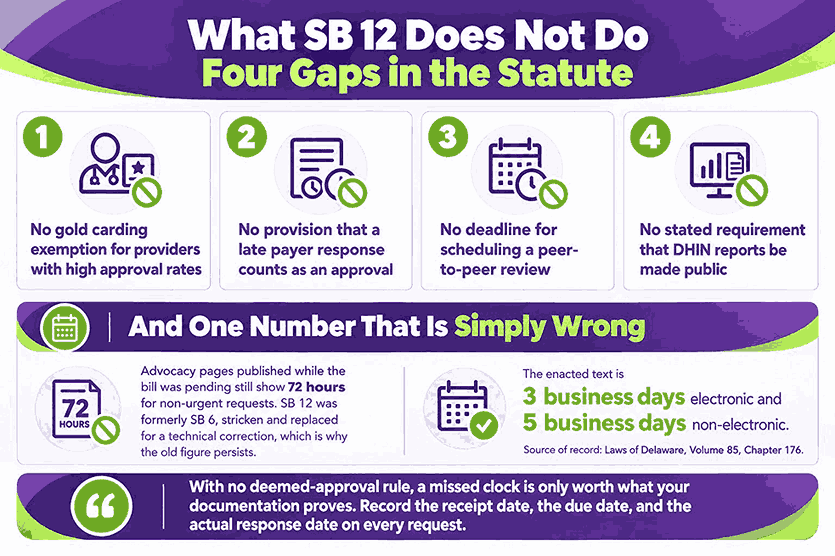
Several advocacy pages published while SB 12 was pending still show a 72-hour response for non-urgent requests. The enacted text instead uses 3 business days for electronic requests and 5 business days for non-electronic requests. Use the session law, Volume 85, Chapter 176, as your source of record.
What SB 12 Does Not Say About Late Responses
The amended sections do not state that a late payer response counts as an approval. They also do not create a gold carding exemption for providers with high approval rates. Providers with a pattern of missed clocks should document each case and report it to the Delaware Department of Insurance.
Authorization Duration and Scope Under SB 12
90-Day Minimum Validity
An approved pre-authorization must stay valid for at least 90 days, up from 60 days. The period runs from the date the provider receives the approval, not the date the payer issues it. Validity stays subject to continued coverage, eligibility, and properly noticed policy changes.
Run patient eligibility verification close to the date of service, because coverage can end inside the window. The statute allows a longer period when it is reasonable and customary for the service. A 90-day floor reduces repeat submissions for staged procedures and scheduling backlogs.
One Authorization Per Episode of Care
A payer may not require more than one pre-authorization for an episode of care. SB 12 defines an episode of care as care for one specific condition delivered at the site of service. It excludes out-of-network care, and new or unrelated treatments can still need a separate authorization.
- Covered by one authorization: tests and procedures the provider first requested for the condition
- Covered by one authorization: rehabilitation the provider first requested for the condition
- Not covered: new treatments, unrelated tests or procedures, and out-of-network care
Bundled Services and Interfacility Transport
If a payer approves one service in a bundled payment group, other covered services in the group are deemed approved. The deemed approval covers only services delivered by in-network providers included in that group. Billing teams should verify the network status of each rendering provider in the bundle.
Interfacility transport has its own carve-out under SB 12. A payer may not require authorization for medically necessary transport after finding a lower level of care clinically appropriate. Hospital case managers should record that finding in the patient transfer file.
Two Notice Clocks for Payer Changes
| Type of change | Notice required | Who receives it |
|---|---|---|
| New or amended authorization requirement | At least 60 days before it takes effect | Authorized covered persons and contracted providers |
| Change to utilization review terms, such as clinical criteria | At least 6 months, with exceptions for guideline changes, recalls, market withdrawals, and FDA safety information | Covered persons |
Bulletin No. 163 and some press summaries mention only the six-month notice for utilization review changes. The statute also contains a separate 60-day notice for new or amended pre-authorization requirements. Log both notice types by payer so you can challenge any change that skipped the required window.
Reviewer Qualifications, Peer-to-Peer Review, and Appeals
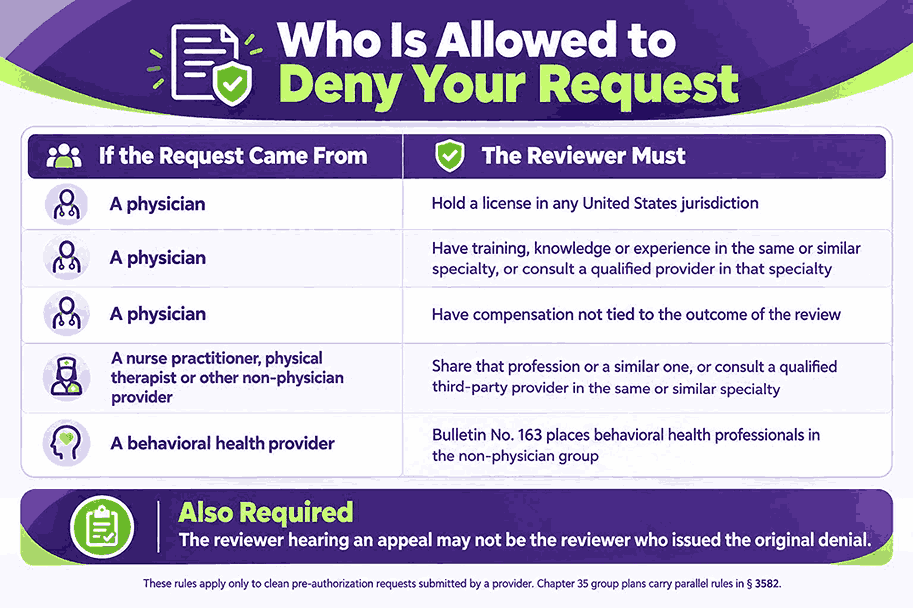
SB 12 regulates who may deny a request and who may hear the appeal. These rules apply only to clean pre-authorization requests submitted by providers. They give billing teams concrete grounds to challenge a denial from a reviewer outside the right specialty.
Who May Issue an Adverse Determination
When a physician submits the request, the reviewer must meet all of these conditions:
- Compensation is not tied to the outcome of the review
- Licensed in any United States jurisdiction
- Training, knowledge, or experience in the same or similar specialty, or a consult with a qualified provider in that specialty
Non-Physician Requests
When a nurse practitioner or physical therapist submits the request, the reviewer must share that profession or a similar one. A licensed provider may instead consult a qualified third-party provider in the same or similar specialty. Bulletin No. 163 also lists behavioral health professionals in this group.
Appeal Deadlines and Procedures
| Requirement | Standard |
|---|---|
| Time to file | At least 30 days from the adverse determination, in writing, electronically, or by phone |
| Decision deadline | 15 days from receipt of the appeal |
| Extension | Written notice within 15 days naming missing records, then 15 days from receipt |
| Reviewer availability | Reviews seven days a week; medical director Monday to Friday, 7 AM to 7 PM, plus weekend hours |
What an Appeal Decision Must Contain
A written appeal decision must include three items. A notice missing any of them is non-compliant and worth documenting:
- A summary of the findings that support the decision
- The reviewer’s qualifications, including license, certification, or specialty designation
- The link between the diagnosis and the review criteria, with the specific basis for the decision
Appeal Playbook: Defects to Challenge
| Defect | Where to cite it | Action |
|---|---|---|
| Denial by a reviewer outside the specialty | § 3372(e)(1) | Request credentials and appeal on the specialty rule |
| Appeal reviewer took part in the original denial | § 3372(e)(2) | Demand a new reviewer |
| Decision notice omits reviewer qualifications | § 3372(e)(4) | Request a corrected notice |
Chapter 35 group plans carry parallel rules in § 3582. SB 12 does not set a deadline for scheduling a peer-to-peer review, although advocates requested expanded access during the bill stage. It does require each payer portal to list the information needed to request one.
Provider Portal Mandate Under SB 12
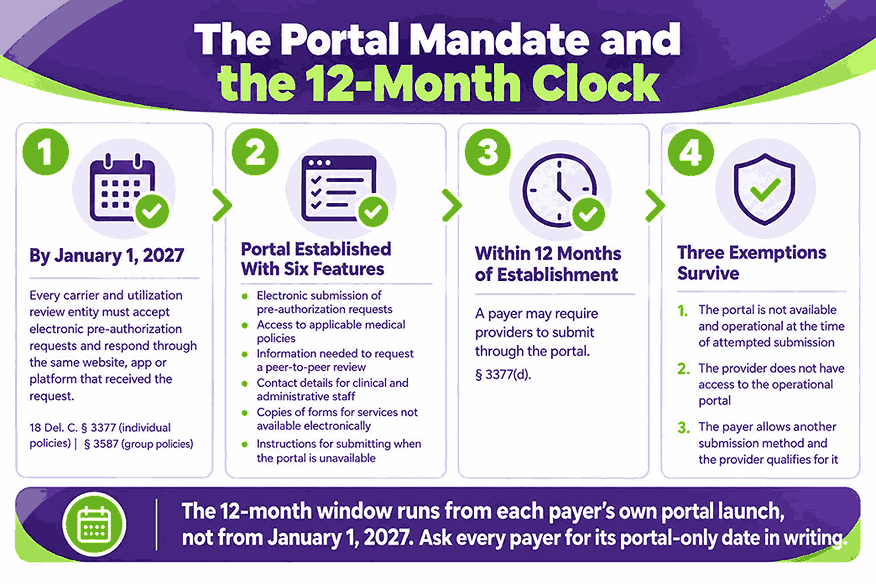
By January 1, 2027, every carrier and utilization review entity must accept electronic pre-authorization requests. They must also respond through the same website, mobile app, or platform that received the request. These duties appear in 18 Del. C. § 3377 for individual policies and § 3587 for group policies.
The statute separately requires every payer to build a provider portal with six specific features. Payers may later require providers to use the portal, subject to three exemptions. The DOI published a sample portal design and checklist in Bulletin No. 163 to guide carriers.
Every portal must include these six features:
- Electronic submission of pre-authorization requests
- Access to applicable medical policies
- Information needed to request a peer-to-peer review
- Contact details for clinical and administrative staff
- Copies of forms for services not available electronically
- Instructions for submitting when the portal is unavailable
The 12-Month Portal Window and Exemptions
Section 3377(d) allows a payer to require portal submission within 12 months following portal establishment. The wording leaves room for interpretation, so ask each payer for its portal-only date in writing. Three exemptions protect providers who cannot use the portal for a given request:
- The portal is not available and operational at the time of submission
- The provider does not have access to the operational portal
- The payer allows another submission method and the provider qualifies for it
SB 12 vs. CMS-0057-F: Which Rule Governs Your Payer?
CMS-0057-F is the federal Interoperability and Prior Authorization final rule from CMS. Its 72-hour urgent and 7-calendar-day standard decision timeframes took effect January 1, 2026. Its four Application Programming Interfaces (APIs) are due January 1, 2027 for the payers it covers.
The rule binds payers in federal programs and does not govern employer plans. SB 12 covers state-regulated commercial plans, so many practices work under both frameworks at once. Tag each patient’s payer type at registration to apply the correct clock.
| Payer type | SB 12 | CMS-0057-F decision timeframes | CMS-0057-F API deadline |
|---|---|---|---|
| Fully insured commercial | Applies after policy cutoff | Not applicable | Not applicable |
| Self-funded ERISA | Generally outside | Not applicable | Not applicable |
| Medicare Advantage | Generally outside | 72 hours and 7 days since Jan. 1, 2026 | Jan. 1, 2027 |
| Medicaid and CHIP | DHSS contract standards, where feasible | 72 hours and 7 days since Jan. 1, 2026 | Jan. 1, 2027, with managed care tied to rating periods |
The SB 12 portal is a provider-facing platform requirement under Delaware insurance law. The CMS Prior Authorization API uses Fast Healthcare Interoperability Resources (FHIR) for payers covered by CMS-0057-F. Both carry January 1, 2027 deadlines, yet a payer can satisfy one and miss the other.
SB 22: Delaware’s Behavioral Health Prior Authorization Ban
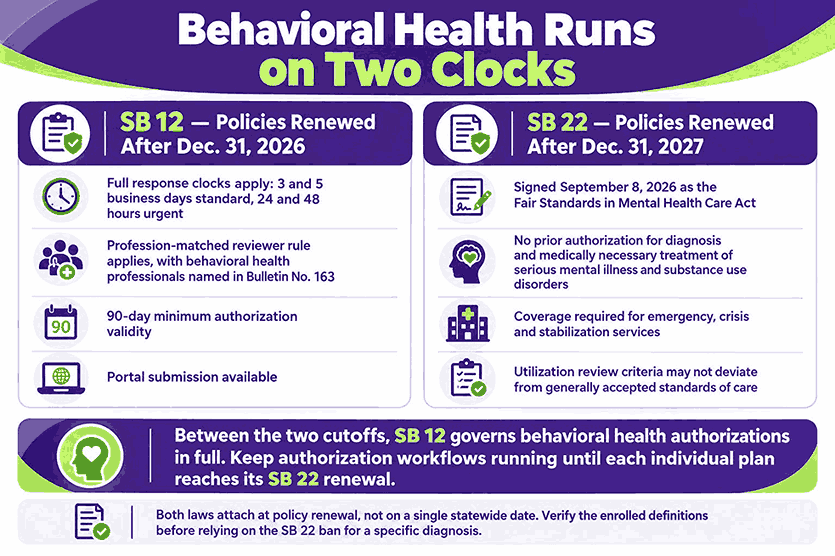
Governor Matt Meyer signed Senate Bill 22, the Fair Standards in Mental Health Care Act, on September 8, 2026. The law bars prior authorization for diagnosis and medically necessary treatment of mental health and substance use disorders. It also requires coverage for emergency, crisis, and stabilization services.
SB 22 applies to individual, group, and blanket policies issued or renewed after December 31, 2027. Delaware already limited prior authorization for some behavioral health services, including addiction treatment. Coverage reports describe the scope as serious mental illness, so verify the enrolled definitions before relying on it.
What SB 22 Means for Behavioral Health Practices
Behavioral health practices should keep authorization workflows active until each plan reaches the SB 22 cutoff. SB 12 clocks and reviewer rules apply to those plans in the meantime, including the profession-matched reviewer rule.
How to Rebuild Your Authorization Workflow for SB 12
Most trackers record one due date per request, but SB 12 needs several fields per payer. The response clock depends on request type, submission channel, and the policy renewal date. Rebuild the tracker around the fields below before January 1, 2027, when portals go live.
| Tracker field | Why SB 12 requires it |
|---|---|
| Payer and plan funding type | Shows whether SB 12 applies |
| Policy renewal month | Sets when the clocks start |
| Request type and channel | Selects the correct clock |
| Submission timestamp | Starts every deadline count |
| Authorization expiry | 90 days minimum from provider receipt |
| Payer notice log | 60-day and 6-month change notices |
Set Escalation Triggers
Escalation triggers turn the statutory clocks into daily work queues, built from the receipt date of each clean request. Assign one owner per payer so missed clocks reach a complete complaint file.
- 24-hour and 48-hour alerts for urgent requests and transfers
- Day 3 and day 5 alerts for standard electronic and non-electronic requests
- Day 15 alert for pending appeals
- Expiry alerts ahead of each authorization end date
Track Payer Announcements
Delaware First Health announced prior authorization changes effective October 1, 2026, including removed requirements and more uniform rules across lines of business. Ask every payer in writing for its renewal dates, portal launch date, and portal-only submission date. Review payer bulletins monthly, since carriers are rebuilding rules ahead of January 1, 2027.
Use DHIN Reporting Data
Carriers that use prior authorization must report de-identified approval, denial, and appeal data to the Delaware Health Information Network (DHIN). Reports are due at least twice yearly and cover denial reasons and overturned denials. The statute does not say the reports are public, so ask your payer or the DOI what is available.
How SB 12 Affects Specialties and Facilities
The table below shows operational implications of the statute for common Delaware service lines. It is not legal advice. Confirm each point against your payer contracts and plan documents.
| Service line | Likely impact | Action |
|---|---|---|
| Pain management and ambulatory surgery centers | A procedure series for one condition may count as one episode | Map each series to the episode definition |
| Orthopedics | Surgery and rehabilitation ordered up front may share one authorization | Document initial orders and bundle network status |
| Psychiatry and behavioral health | Profession-matched reviewers now; SB 22 limits after 2027 | Track renewal dates and cite the reviewer rule |
| Oncology | Separate 24-hour urgent and 2-day pharmacy clocks | Split medical and pharmacy workflows |
Delaware Prior Authorization Compliance Checklist
Use this checklist to turn the statute into assigned work. Dates reflect the statutory triggers, so adjust them to each payer’s renewal calendar. Review it quarterly, since payers will update portals, forms, and policies throughout 2027.
| Deadline | Action | Suggested owner |
|---|---|---|
| Before Dec. 31, 2026 | Tag payers by funding type, build the renewal tracker, request portal dates | Revenue cycle manager |
| By Jan. 1, 2027 | Test each portal, load the new clocks, set 90-day expiry logic | Authorization team |
| Q1 2027 | Audit missed deadlines, train appeals staff, start the notice log | Compliance lead |
| Through 2027 | Confirm each plan’s SB 12 start date and portal-only date | Billing manager |
| By Dec. 31, 2027 | Prepare behavioral health workflows for SB 22 | Practice administrator |
How Transcure Supports Delaware Prior Authorization Compliance
Transcure manages the full revenue cycle for Delaware practices, surgery centers, and health systems. Our AI Agents automate revenue cycle steps, and eligibility verification confirms coverage before service. Our medical billing audit service can test whether your current workflows meet the new clocks. You can review our medical billing services in Delaware and understand how it works behind the scenes.
Frequently Asked Questions
How long does a Delaware insurer have to respond to a prior authorization request?
SB 12 requires a response to a clean standard request within 3 business days for electronic submissions and 5 business days otherwise. Urgent requests require 24 hours electronically and 48 hours otherwise. Pharmacy benefit requests require 2 business days. These clocks apply to policies issued or renewed after December 31, 2026.
When does the Delaware Pre-Authorization Reform Act take effect?
The Act applies to policies issued, renewed, modified, altered, amended, or reissued after December 31, 2026. Payers must also accept electronic requests and run provider portals by January 1, 2027. The policy trigger attaches to each plan, so the practical start date varies by payer renewal month.
Is prior authorization banned for mental health care in Delaware?
Delaware already limits prior authorization for some behavioral health services, including addiction treatment. SB 22 extends and restates those limits for mental health and substance use disorders on policies issued or renewed after December 31, 2027. Verify the enrolled definitions before relying on the ban for a specific diagnosis.
Does Delaware have gold carding, and what happens if a payer misses a deadline?
The amended SB 12 sections contain no gold carding provision and do not say a late response counts as approval. Document the receipt date, due date, and actual response date. Report repeated misses to the DOI at [email protected], the address Bulletin No. 163 lists for questions.