
CPT code 22853 reports insertion of an interbody biomechanical device, like a synthetic cage. It is an add-on code, so it always travels with an interbody arthrodesis primary. Report one unit per interspace, even when two cages sit in one disc space.
Integral screws and flanges are included, so codes 22845–22847 are not billed for them. Related add-ons include +22854 for corpectomy defects and +22859 when no arthrodesis is performed. For 2026, Medicare lists a 4.14 work RVU and roughly $229 national facility payment.

Hospitals and ASCs are not paid separately, since indicators N and N1 package it. CMS also began phasing out the Inpatient Only list in 2026, removing 285 procedures. This guide covers the descriptor, cost, modifiers, scenarios, and rules that protect your reimbursement.
What Is the Description of CPT Code 22853?
CPT code 22853 describes the insertion of an interbody biomechanical device during spinal fusion. CPT lists it as an add-on code, reported only with a primary interbody arthrodesis.
Its ZZZ global period means follow-up care belongs to the primary procedure’s global package. This section breaks the descriptor into four parts that coders and surgeons often confuse.
What Does Interbody Device Insertion Include Under CPT Code 22853?
The service covers placing a synthetic cage or mesh into the intervertebral disc space. Disc space preparation and discectomy belong to the primary fusion code, not to 22853. The descriptor also includes integral screws or flanges that anchor the device, when performed.
The code applies across ACDF, TLIF, and ALIF approaches, whether anterior, posterior, or lateral. Operative notes should name the device, the level, and the fusion at that level.
Why CPT 22853 Is Reported Per Interspace and Not Per Cage
The descriptor ends with the phrase each interspace, so disc space sets the units. Two cages placed bilaterally in one disc space still count as a single unit. A two-level fusion with one cage at each level supports two units of 22853.
Billing per cage inflates units and invites payer review, denials, and even recoupment demands. Accurate interspace counting requires the operative note to document every single fused interspace clearly.
What Counts as Integral Anterior Instrumentation, and Why It Is Never Billed Separately
Integral anterior instrumentation means screws or flanges pass through the device to anchor it. CPT Assistant, March 2017, explains this distinction in an article on spinal device insertion. Anterior instrumentation, such as a cervical plate, can stabilize the spine without a cage.
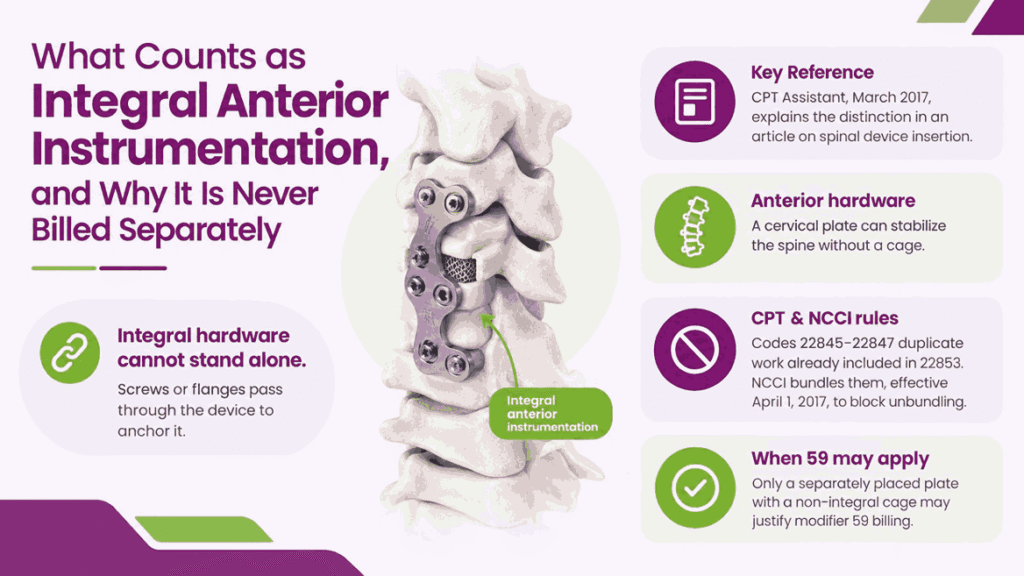
Integral hardware cannot stand alone, so codes 22845–22847 duplicate work already included in 22853. NCCI bundles those codes with 22853, effective April 1, 2017, to block such unbundling. Only a separately placed plate with a non-integral cage may justify modifier 59 billing.
How Does CPT 22853 Differ From +22854 and +22859?
Code +22854 reports a device placed in a vertebral corpectomy defect with interbody arthrodesis. It is reported once per contiguous defect, while 22853 is reported once per interspace. Code +22859 reports a device placed in a disc space or defect without arthrodesis.
The deciding questions are where the device sits and whether arthrodesis was performed there. All three codes replaced deleted code 22851 in 2017, so older templates are outdated. Each code covers devices with or without integral anchoring, so screws never change selection.
Which Primary Arthrodesis Codes Can CPT 22853 Be Reported With?
CPT 22853 must accompany a primary interbody arthrodesis code performed at the same level. Cervical primaries include 22551 and 22554, while 22552 only reports each additional cervical interspace.
Anterior lumbar fusion uses 22558, while 22585 reports each additional fused interspace during surgery. Posterior lumbar fusions use 22630 and 22633, with 22632 and 22634 for added interspaces. ACDF claims typically pair 22551 with 22853, while TLIF claims pair 22633 or 22630.
Posterolateral fusion code 22612 alone does not support 22853, since no interbody arthrodesis occurred. Each unit of 22853 must tie to a fused interspace on the primary claim.
Always verify the CPT parenthetical notes, because primary code lists change with each update. Readers can find more primary fusion code options in our neurosurgery CPT codes guide.
Which ICD-10 Codes Support Medical Necessity for CPT Code 22853?
Medical necessity for 22853 rests on diagnoses that justify the primary fusion and device. Payers expect ICD-10-CM codes showing instability, deformity, myelopathy, or radiculopathy unresponsive to conservative care.
- Cervical disc disorders with radiculopathy or myelopathy fall under M50.1 and M50.0 code families.
- Spinal stenosis codes include M48.02 for the cervical region and M48.061 for lumbar without claudication.
- Spondylolisthesis codes use M43.16 for the lumbar region and M43.17 for the lumbosacral region.
- Lumbar disc disorders with radiculopathy report M51.16, while the lumbosacral region uses code M51.17.
- Pseudarthrosis and postlaminectomy syndrome support revision fusions, reported with codes M96.0 and M96.1, respectively.
- Scoliosis codes under M41 and traumatic fracture codes under S12 or S32 support fusion.
Documentation should link each diagnosis to the level fused, never to a general complaint. Linking diagnosis pointers on the claim to the primary code reduces medical necessity denials. A broader list of spine diagnosis codes appears in our neurosurgery ICD-10 codes guide.
Which HCPCS Codes Are Reported in Relation to CPT 22853?
CPT 22853 needs no HCPCS code, yet several Level II codes often accompany it.
- C1713 reports anchors or screws to fasten bone to bone in hospital outpatient claims.
- C1889 covers implantable devices not otherwise classified, and hospitals use it for spinal implants.
- L8699 describes prosthetic implants not otherwise specified and appears on supplier or device billing.
- E0748 reports a noninvasive electrical bone growth stimulator ordered after fusion for high-risk patients.
- Modifier AS identifies assistant services by physician assistants, nurse practitioners, and clinical nurse specialists.
Bone graft codes 20930, 20931, 20936, 20937, and 20938 belong to CPT, not HCPCS. For other spine add-on codes, see our CPT code guide for general reporting rules.
What Are the Modifiers for CPT Code 22853?
Modifiers tell payers how the surgeon participated and whether the add-on needs adjusted payment. Most 22853 claims need no modifier at all, but four situations commonly require one. Each modifier below must always match the primary code and the operative report documentation.
Modifier 62: Co-Surgery and How It Carries to the Add-On
Modifier 62 applies when two surgeons work as primary surgeons on one spinal procedure. Both surgeons append 62 to the primary fusion code and to the 22853 add-on. Approach surgeons and spine surgeons split ALIF cases, so 62 appears on both claims.
MPFS co-surgery indicators decide whether payment is allowed, so check them before submitting claims. Each surgeon’s operative note must state shared roles and the reason for two surgeons.
Modifier 59 and the X Modifiers: Separate Anterior Plate With a Non-Integral Cage
Modifier 59 or an X modifier lets a separate plate bypass the NCCI edit. It applies when a non-integral PEEK cage pairs with a separate anterior cervical plate. The plate is reported with 22845 or 22846 depending on the vertebral segments spanned.
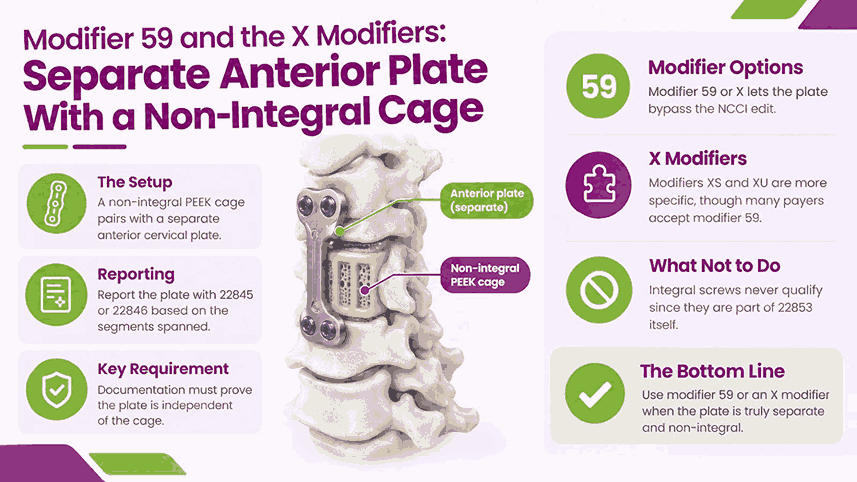
NCCI allows the modifier when documentation proves the plate is independent of the cage. Modifiers XS and XU are more specific options, though many payers accept modifier 59. Integral screws never justify this modifier, since they are already part of 22853 itself.
Modifiers 80, 82, and AS: Assistant at Surgery
Modifiers 80 and 82 report assistant surgeons who are physicians; AS reports non-physician assistants. Modifier 82 applies only when no qualified resident was available at a teaching hospital. Assistant payment for add-on codes depends on the assistant-at-surgery indicator in the fee schedule.
Medicare pays modifier 80 assistants 16 percent of the fee schedule amount when allowed. Modifier AS claims receive 85 percent of that assistant amount under current Medicare rules. Operative notes should name the assistant, their role, and why assistance was medically necessary.
Modifier 22: Increased Procedural Services in Revision Fusions
Modifier 22 reports substantially greater work than usual, which revision spinal fusions often involve. Dense scar tissue, obesity, and distorted anatomy commonly justify the increased procedural services claim.
Modifier 22 usually attaches to the primary fusion code rather than to add-on 22853. Many payers expect documentation showing at least a 25 percent increase in operative time. A statement explaining the added difficulty should accompany the claim and the operative report.
Which Documents Are Required For CPT Code 22853?
Complete documentation proves medical necessity and protects the claim during payer audits or reviews.
- The operative report must list the device, level, approach, and fusion performed at each interspace.
- Imaging reports, including MRI, CT, and flexion-extension X-rays, should confirm instability, stenosis, or deformity.
- Conservative care records should show failed therapy, medications, or injections over roughly six weeks.
- The implant log must clearly identify the manufacturer, device type, lot number, and size.
- Prior authorization approval numbers should match planned CPT codes and the approved spinal levels.
- Signed consent forms and the history and physical complete the chart for surgeon claims.
- Co-surgery and assistant claims also need notes naming each participant and their surgical role.
Missing documents are the fastest route to denials, so audit charts before every submission.
What Is the Cost of CPT Code 22853?
CPT 22853 payment depends on the billing setting, the payer, and the primary fusion. This section covers Medicare physician pay, facility packaging, site-of-service shifts, and commercial payer rules.
RVUs and Medicare Physician Payment for CPT 22853
Medicare pays surgeons for CPT 22853 using relative value units from the fee schedule. Each payment combines work, practice expense, and malpractice RVUs, multiplied by the conversion factor.
- CPT 22853 carries a work RVU of 4.14, reflecting the surgeon’s added intraoperative effort.
- The 2026 national facility payment lands near $229 before any geographic adjustment is applied.
- The CY 2026 conversion factor is $33.4009 for clinicians outside advanced alternative payment models.
Geographic practice cost indices shift payment, so local Medicare rates vary across MAC localities. Multiple procedure reductions generally do not apply to add-on codes, so 22853 pays fully. The ZZZ global period places postoperative care inside the primary fusion code’s global package.
Why 22853 Is Packaged in Hospital Outpatient and ASC Payment
Hospitals and ASCs do not receive separate payment for CPT 22853 on facility claims. Under OPPS, status indicator N means the code is packaged into the primary procedure. Under ASC rules, payment indicator N1 packages the add-on into the primary fusion payment.
Ambulatory payment classifications pay one rate for the primary code, covering implants and supplies. Packaging means hospitals recover cage costs through the primary fusion payment, not add-on reimbursement.
Hospitals still report 22853 because accurate coding feeds future cost data and rate-setting. Implant charges should appear with revenue codes and HCPCS such as C1713 and C1889. Surgeons bill 22853 on the CMS-1500, while hospitals bill their facility services on UB-04.
What Are the Impacts of the 2026 Inpatient-Only List?
CMS began phasing out the Inpatient-Only list in its 2026 OPPS final rule. The first year removed 285 procedures, and most of them were musculoskeletal surgical services. CMS plans to eliminate the list entirely over a three-year transition, starting in 2026.
CMS added lumbar fusion codes 22630 and 22633 to the ASC covered procedures list. Moving primaries outpatient does not change how coders report 22853 beside each fused interspace. Outpatient and ASC cases still require interspace counts, device documentation, and payer prior authorization.
Site-of-service shifts move cost pressure toward ASCs, which negotiate implant pricing with device vendors. Orthopedic spine groups moving cases to ASCs frequently rely on specialized orthopedic billing services. Billing teams should verify each payer’s site-of-service rules before scheduling spinal fusion cases outpatient.
Commercial Payers and Prior Authorization Requirements
Commercial payers set allowed amounts through contracts, so reimbursement for 22853 varies by carrier. Many contracts pay a percentage of Medicare, while others use proprietary schedules or bundles. Carriers such as Aetna, Cigna, UnitedHealthcare, and Humana apply their own spine surgery policies.
Most plans require prior authorization for spinal fusion, interbody devices, and related add-on codes. Reviewers often apply MCG or InterQual criteria, and some use carrier-specific medical policies instead. Requests need imaging, failed conservative care records, surgeon notes, and the planned CPT codes.
Authorization should list 22853 beside the primary fusion code and the approved spinal levels. Intraoperative changes, such as an added level, require an authorization update before claim submission. Unauthorized levels or mismatched codes are common reasons commercial payers deny 22853 units entirely.
What Are Example Clinical Scenarios or Use Cases for CPT Code 22853?
These four scenarios show how CPT 22853 units, modifiers, and linked codes differ widely. Coders can use them as templates when auditing operative notes against the claims submitted. Each example lists the primary code, the unit count, and the documentation payers expect.
Scenario 1: Single-Level ACDF With a Stand-Alone Cage Using Integral Screws
A surgeon performs a single-level anterior cervical discectomy and fusion at C5-C6 for radiculopathy. The surgeon places one stand-alone PEEK cage secured with integral screws through the device.
- Coders report 22551 for the fusion and one unit of 22853 for the cage.
- Integral screws are included, so 22845 is not reported, and modifier 59 stays unused.
- Allograft or local autograft may add 20930 or 20936 when operative notes support it.
Radiculopathy diagnoses from the M50.1 family should point directly to the fused C5-C6 interspace.
Scenario 2: Two-Level ACDF With Non-Integral PEEK Cages and a Separate Anterior Plate
A surgeon fuses C4-C5 and C5-C6 using two non-integral PEEK cages and a plate.
- Coders report 22551 and 22552 for the two levels, plus two units of 22853.
- The anterior cervical plate spans three vertebrae, so 22845 is reported with modifier 59.
- An XS or XU modifier may replace 59 when a payer requires greater specificity.
The operative note must clearly state that the plate is independent of the cages. Without that statement, NCCI edits deny 22845 as included in the interbody device code.
Scenario 3: Single-Level TLIF With Two Cages Placed in One Interspace
A surgeon performs a single-level TLIF at L4-L5 for grade one spondylolisthesis with stenosis. Two cages are placed bilaterally within the same disc space during the fusion procedure.
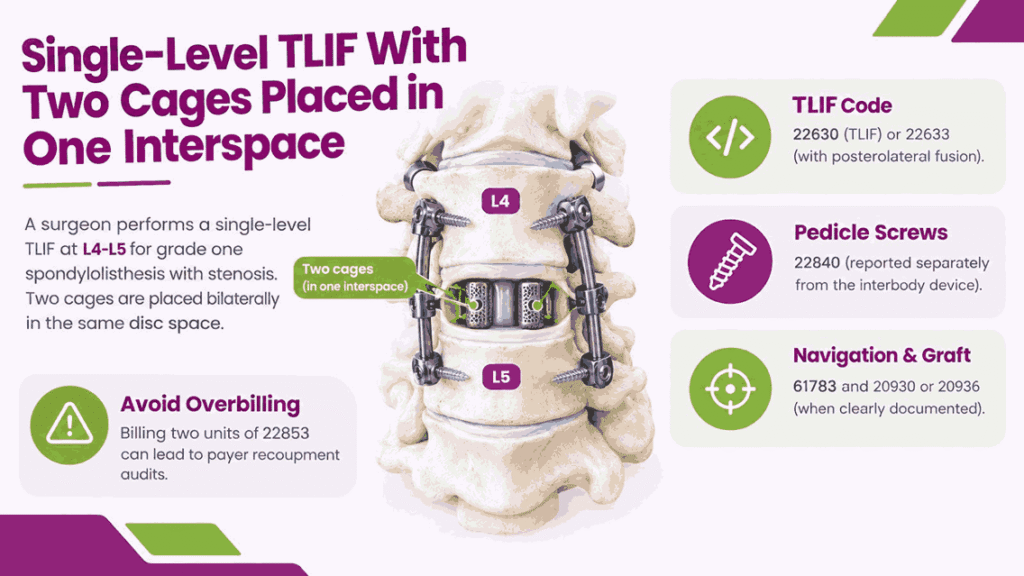
- Coders report 22630 for the TLIF, or 22633 when posterolateral fusion is also added.
- Pedicle screw fixation adds 22840, which is reported separately from the interbody device code.
- Navigation code 61783 and graft codes 20930 or 20936 may apply when clearly documented.
Billing two units of 22853 here overstates the service and invites payer recoupment audits. Practices can audit these unit counts through neurosurgery billing services before claims reach payers.
Scenario 4: ALIF With an Approach Surgeon and a Spine Surgeon Billing Co-Surgery
An approach surgeon exposes L5-S1 anteriorly, while a spine surgeon performs the ALIF fusion.
- Both surgeons report 22558 with modifier 62, but 22853 is reported without modifier 62.
- MPFS co-surgery indicators must permit payment, or the second surgeon’s claim is denied outright.
- Each surgeon documents shared roles, the need for two surgeons, and a separate note.
- Payment is typically split, with each co-surgeon receiving 62.5 percent of the allowed amount.
Prior authorization should list both surgeons, because mismatched provider details cause avoidable claim rejections.
What Are the CPT Code 22853 Rules To Ensure Successful Reimbursement?
Successful reimbursement for 22853 depends on bundling edits, unit limits, supporting codes, and documentation. This section explains each rule and the denial triggers that often cost practices revenue.
The 22845–22847 Bundling Edit and When a Separate Plate Is Reportable
NCCI bundles 22845–22847 into 22853, and modifier 59 bypasses it only for separate plates. The edit began April 1, 2017, after CPT deleted 22851 and introduced add-on codes. A separate plate becomes reportable only when the cage lacks integral screws or flanges.
- Report 22845 for a plate spanning two to three vertebral segments, with modifier 59.
- Use 22846 for four to seven segments and 22847 for eight or more segments.
- Documentation must show the plate is independent of the cage and not integral hardware.
Modifiers XS and XU also work, though many payers still prefer modifier 59 here.
Units, MUEs, and Multi-Level Interspace Counting
Medically unlikely edits cap units of 22853 that a claim can report per date. Units follow fused interspaces, so each additional level adds exactly one unit of 22853.
- A single-level ACDF supports one unit, while a two-level ACDF supports two units total.
- Two cages in one disc space remain a single unit, regardless of cage count.
- Add-on codes such as 22552, 22585, 22632, and 22634 report extra interspaces, not cages.
- Corpectomy defects use +22854 instead, so never count those levels as units of 22853.
Compare the claim units against the operative note and the MUE value before submission.
Bone Graft, Instrumentation, and Navigation Codes Reported Alongside 22853
Several separately reportable codes often accompany 22853 when the operative note supports each service.
- Grafts use 20930 or 20931 for allograft, and 20936 through 20938 for autograft types.
- Pedicle fixation reports 22840 for non-segmental constructs, while 22842 through 22844 report segmental constructs.
- Code 61783 reports stereotactic computer-assisted navigation for spinal procedures when the note documents it.
- Neuromonitoring codes 95940 and 95941 belong to monitoring professionals and need their own documentation.
Verify each pairing against current NCCI edits, since modifier indicators can change every quarter.
Operative Note Elements That Support Each Unit
Every unit of 22853 should trace to a specific sentence in the operative note.
- Clearly name each interspace fused, such as C5-C6 or L4-L5, for every reported unit.
- Describe the device by type, material, size, and whether screws or flanges are integral.
- State that discectomy and endplate preparation occurred and arthrodesis was intended at that interspace.
- Record the approach, such as ACDF, TLIF, or ALIF, and the fusion material used.
- Document any plate separately, including its independence from the cage and the segments spanned.
Surgeon dictation templates should include these fields so coders never query missing details later.
Top Reasons For Denials Specific To 22853 & Quick Remedies
Most 22853 denials trace to a small set of preventable coding and documentation errors.
- Add-on without a primary fusion code denies, so link 22853 to the matching primary.
- Excess units from counting cages deny, so count only fused interspaces on every claim.
- Separate 22845 billing denies when screws are integral, so remove it or document independence.
- Modifier 62 on 22853 denies, so append it only to the shared primary fusion.
- Authorization mismatches deny units, so update approvals before billing any intraoperative changes to levels.
- Weak medical necessity denies claims, so link M50.1 or M43.16 diagnoses to fused levels.
Appeals should include the operative note, imaging, authorization letter, and a concise coding rationale.