K80.20 is the ICD-10-CM code for gallbladder calculus without cholecystitis (gallbladder inflammation) or obstruction. K80.20 is a billable code within category K80 (cholelithiasis) of Chapter 11 (Diseases of the digestive system). K80.20 indicates gallstones when the physician documents no gallbladder inflammation or obstruction.
Subcategory K80.2 contains two billable codes. K80.20 indicates gallstones without obstruction, while K80.21 indicates gallstones with obstruction. The FY2027 ICD-10-CM update, effective October 1, 2026, made no changes to K80.20. K80.20 does not map to any payment HCC in the CMS-HCC V28 model.
Claim determination depends on three physician-documented factors: the presence of gallstones, the status of cholecystitis, and the presence of obstruction.

What Is the ICD-10 Code K80.20?
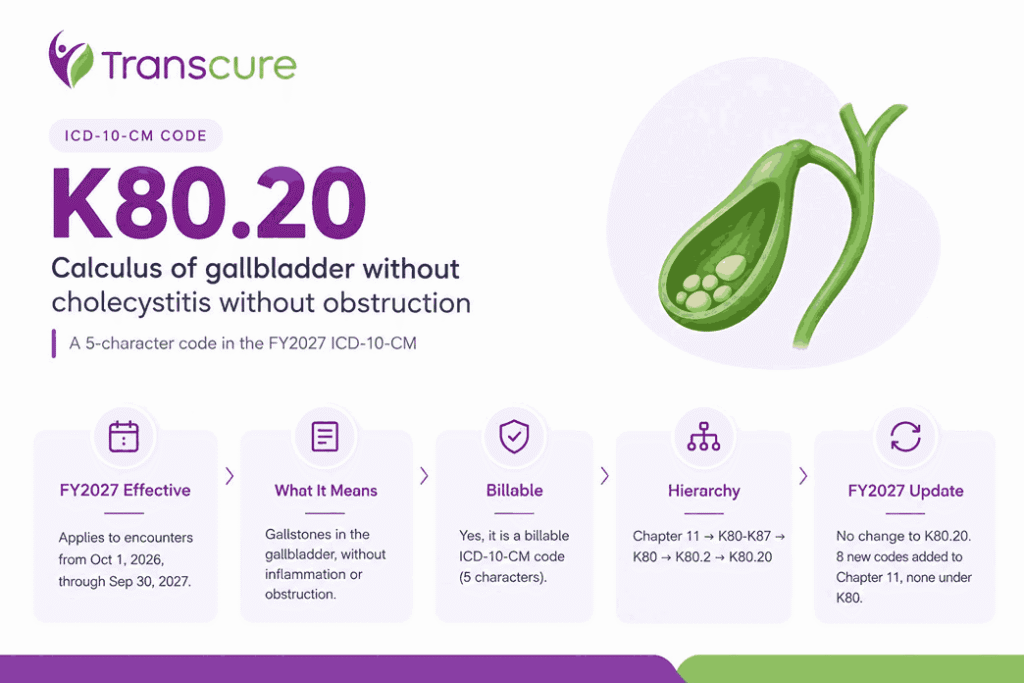
K80.20 is a 5-character code in the FY2027 ICD-10-CM. The FY2027 code set applies to encounters occurring from October 1, 2026, through September 30, 2027.
What Does K80.20 Mean?
K80.20 indicates that the provider documented gallstones in the gallbladder without cholecystitis (inflammation of the gallbladder) or obstruction. Its title has three parts.
- Calculus of the gallbladder refers to gallstones located in the gallbladder. The Tabular List and Alphabetic Index direct the terms “gallstone,” “cholelithiasis,” and “cholecystolithiasis” to the same code family under K80.2.
- “Without cholecystitis” means the documentation does not mention gallbladder inflammation. Codes K80.0- and K80.1- classify gallstones associated with cholecystitis.
- “Without obstruction” means no obstruction is documented. In K80.20, the fifth character ‘0’ indicates no obstruction, whereas in K80.21, the fifth character ‘1’ indicates obstruction.
Is K80.20 a Billable ICD-10 Code?
Yes, K80.20 is a billable ICD-10-CM code. Section I.A.3 of the official ICD-10-CM guidelines permits reporting only codes, not categories or subcategories. Section I.B.2 requires using the maximum number of characters available for diagnosis codes.
K80 has 3 characters, and K80.2 has 4 characters; neither is billable. The code K80.20 is complete at 5 characters. If only K80.2 is used in a claim, it will be considered an invalid code under Section I.B.2.
Where Does K80.20 Sit in the ICD-10-CM Hierarchy?
K80.20 falls under Chapter 11 (K00-K95), Section K80-K87 (Diseases of the gallbladder, biliary tract, and pancreas), Category K80, and Sub-category K80.2. This table lists four levels, from category to billable code.
| ICD-10-CM Code | Official Description | Level | Billable |
|---|---|---|---|
| K80 | Cholelithiasis | Category (3 characters) | No |
| K80.2 | Calculus of gallbladder without cholecystitis | Subcategory (4 characters) | No |
| K80.20 | Calculus of gallbladder without cholecystitis without obstruction | Code (5 characters) | Yes |
| K80.21 | Calculus of gallbladder without cholecystitis with obstruction | Code (5 characters) | Yes |
K80.20 and K80.21 share the parent code K80.2 and differ only in the fifth character. The K80 category includes an ‘Excludes1’ note for cholelithiasis remaining after cholecystectomy (gallbladder removal surgery) (K91.86).
Which Chart Terms Route to K80.20?
Five terms are listed under K80.2 in the Tabular List, and the code K80.20 is assigned to the Alphabetic Index entry ‘Calculus, gallbladder’. The five terms in the Tabular List are:
- Cholecystolithiasis without cholecystitis
- Cholelithiasis (without cholecystitis)
- Colic (recurrent) of gallbladder (without cholecystitis)
- Gallstone (impacted) of cystic duct (without cholecystitis)
- Gallstone (impacted) of gallbladder (without cholecystitis)
Section I.A.7 defines parentheses as non-essential modifiers, meaning the code remains the same whether the parenthetical terms are present or not. A note specifying “gallstones” directs the user to K80.2. A note specifying “gallstones without recurrent pain” also directs the user to K80.2. The fifth character depends on whether or not obstruction is present.
The Alphabetic Index entry for “gallstones” (colic) (cystic duct) (gallbladder) (impacted) (multiple) directs coders to the code for gallstones. Section I.A.11 states that inclusion terms are not exhaustive, and additional terms found only in the Alphabetic Index also point to the code.
Did the FY2027 Update Change K80.20?
No, the FY2027 ICD-10-CM update did not change K80.20. The K80 category also has no changes for FY2027. CMS released the FY2027 code set, which includes 190 new codes and takes effect on October 1, 2026.
Eight new codes for Chapter 11 have been added in the FY2027 update. These codes include hypertrophic pyloric stenosis in children (K31.B), diseases of the pelvis not elsewhere classified (K6A, K6A.0, K6A.01, K6A.09, K6A.8), moderate hepatic fibrosis (K74.0A), and intestinal failure-associated liver disease (K76.83). None of these eight codes fall under the K80 category.
When Should You Use K80.20?
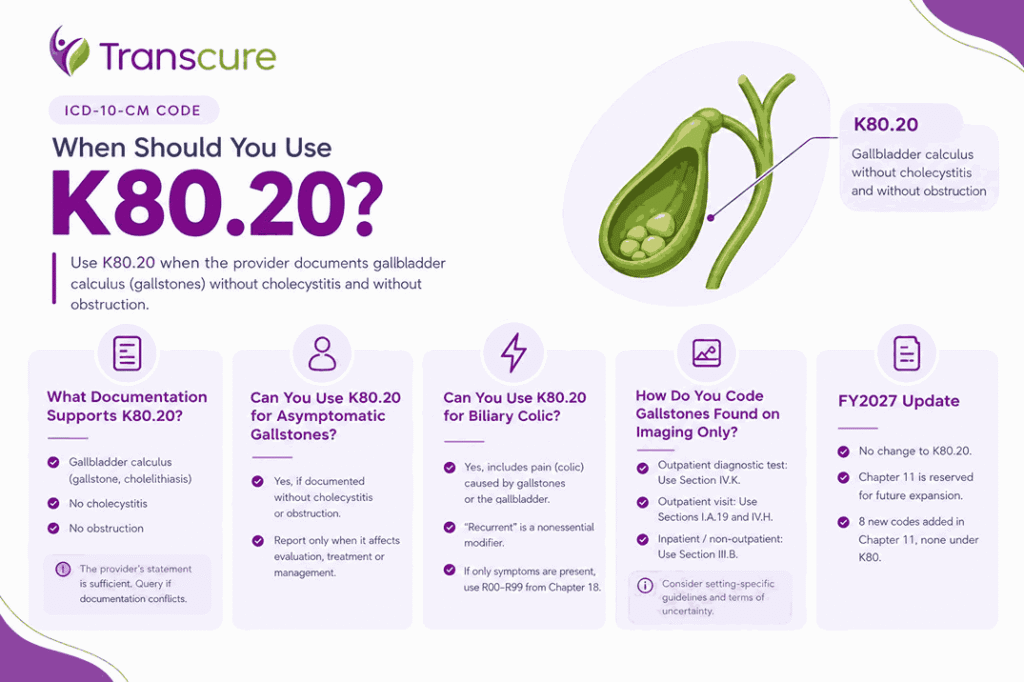
Use K80.20 when the provider documents gallbladder calculus (gallstones) without cholecystitis and without obstruction. In the FY2027 official guidelines, Chapter 11 has been reserved for future expansion. No chapter-level guidelines exist for K80; therefore, the general guidelines in Section I and the outpatient guidelines in Section IV apply to selecting code K80.20.
What Documentation Supports K80.20?
K80.20 is based on three elements recorded in the provider’s notes. The table shows each element and its coding impact.
| Element | Provider Statement | Coding Effect |
|---|---|---|
| Gallbladder calculus | Gallstone, cholelithiasis, or cholecystolithiasis in the gallbladder | Selects subcategory K80.2 |
| Cholecystitis status | No cholecystitis documented | Keeps the code out of K80.0- and K80.1- |
| Obstruction status | No obstruction documented | Selects fifth character 0, K80.20 |
When a note mentions gallstones but does not mention cholecystitis or obstruction, the “Calculus, gallbladder” entry in the Alphabetic Index directs the diagnosis to K80.20.
According to Section I.A.19, code assignment is based on the provider’s clinical statement confirming the condition. The provider’s statement is sufficient, and code assignment does not depend on clinical diagnostic criteria. In cases of conflicting documentation, the provider must be queried under this same section.
Section IV.H prohibits the coding of diagnoses documented with terms indicating uncertainty in the outpatient setting. This section lists seven such terms: probable, suspected, questionable, rule out, compatible with, consistent with, and working diagnosis. The coder reports the condition at the highest level of certainty for that encounter.
Can You Use K80.20 for Asymptomatic Gallstones?
Yes, K80.20 applies to asymptomatic gallstones, provided the provider documents the gallstones without cholecystitis or obstruction. The title of K80.20 does not specify a symptom criterion; the Alphabetic Index classifies K80.20 as gallstones regardless of symptoms.
A second test has been added to the reporting rules for co-existing conditions. Section IV.J limits outpatient reporting to documented conditions that require or affect patient care, treatment, or management. Section III defines additional diagnoses reportable in non-outpatient settings as clinically significant conditions that meet at least one of five criteria: clinical evaluation, treatment, diagnostic procedures, extended length of hospital stay, and increased nursing care or monitoring.
Therefore, report asymptomatic gallstones only when documentation links the stones to evaluation, treatment, or management during the patient encounter.
Can You Use K80.20 for Biliary Colic?
Yes, K80.20 includes pain (colic) caused by gallstones or the gallbladder, without cholecystitis (inflammation of the gallbladder) or obstruction. The term listed in the Tabular List under K80.2 is ‘Gallbladder colic (recurrent)’ (without cholecystitis). The term in the Alphabetic Index is ‘Gallstone (colic)’, which directs the coder to ‘Calculus, gallbladder’ and subsequently to K80.20.
The parentheses around ‘recurrent’ make it a nonessential modifier. Both a single episode of gallbladder pain (colic) and recurrent gallbladder pain fall under the same sub-category, K80.2.
Documentation of symptoms without confirmed gallstones follows a different process. Sections I.B.4 and IV.D permit the use of signs and symptoms codes from Chapter 18 (R00-R99) when the provider has not established a related definitive diagnosis.
How Do You Code Gallstones Found on Imaging Only?
When outpatient diagnostic interpretation or the provider’s final diagnostic statement mentions gallbladder calculus (gallstones) without cholecystitis or obstruction, use code K80.20 for the gallstones identified on imaging. Coding rules vary by care setting. The table lists three settings.
| Setting | Guideline | Coding Result |
|---|---|---|
| Outpatient diagnostic test with a final interpretation available | Section IV.K | Report the confirmed or definitive diagnosis documented in the interpretation, K80.20 for gallbladder calculus without cholecystitis or obstruction. Related signs and symptoms are not coded as additional diagnoses. |
| Outpatient visit with the treating provider | Sections I.A.19 and IV.H | Report the diagnosis the provider states. Diagnoses documented with the 7 named uncertainty terms are not coded. |
| Inpatient and other non-outpatient settings | Section III.B | Report an abnormal imaging finding only when the provider indicates its clinical significance. |
Sections IV.K and III.B both state that their operational approach differs from other settings. When an abnormal result falls outside the normal range and a provider orders further testing or treatment, Section III.B instructs coders to consider whether to include that result.
In both settings, terms such as “consistent with” and “compatible with” are regarded as terms of uncertainty. Section IV.H prohibits coding based on these terms in the outpatient setting. Section III.C allows coding them as an “established diagnosis” only for inpatient admissions in short-term acute care, long-term care, and psychiatric hospitals.
How Does K80.20 Differ From Related Gallstone Codes?
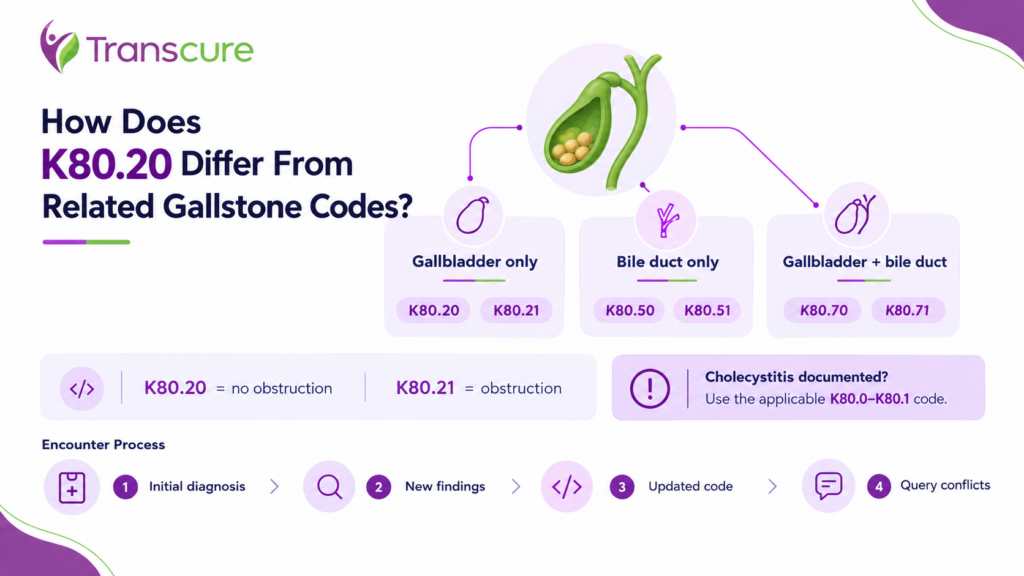
K80.20 differs from related gallstone codes in 4 characteristics: stone location, cholecystitis status, cholangitis status, and obstruction status. The table compares K80.20 against 5 related code groups within category K80.
| ICD-10-CM Code | Official Description | Attribute That Differs From K80.20 |
|---|---|---|
| K80.20 | Calculus of gallbladder without cholecystitis without obstruction | Reference code |
| K80.21 | Calculus of gallbladder without cholecystitis with obstruction | Obstruction documented |
| K80.00 and K80.01 | Calculus of gallbladder with acute cholecystitis, without obstruction or with obstruction | Acute cholecystitis documented |
| K80.10, K80.11, K80.12, K80.13, K80.18, K80.19 | Calculus of gallbladder with chronic, acute and chronic, or other cholecystitis, without obstruction or with obstruction | Chronic, acute and chronic, or other cholecystitis documented |
| K80.50 and K80.51 | Calculus of bile duct without cholangitis or cholecystitis, without obstruction or with obstruction | Stones in the bile duct only |
| K80.70 and K80.71 | Calculus of gallbladder and bile duct without cholecystitis, without obstruction or with obstruction | Stones in the gallbladder and the bile duct |
K80.20 has the narrowest scope in the table. The code reports gallstones without documented cholecystitis or obstruction.
K80.20 vs K80.21
When a doctor documents an obstruction caused by a gallbladder stone (calculus), use K80.21 instead of K80.20. Because both codes fall under the parent code K80.2, the cholecystitis status remains the same in both cases.
Two separate codes exist for obstruction outside the K80 category: K82.0 for gallbladder obstruction and K83.1 for bile duct obstruction. Both codes include an ‘Excludes1’ note regarding obstruction associated with cholelithiasis (K80). The table illustrates how these four codes are categorized.
| ICD-10-CM Code | Official Description | Gallstone Present | Obstruction Present |
|---|---|---|---|
| K80.20 | Calculus of gallbladder without cholecystitis without obstruction | Yes | No |
| K80.21 | Calculus of gallbladder without cholecystitis with obstruction | Yes | Yes |
| K82.0 | Obstruction of gallbladder | No | Yes |
| K83.1 | Obstruction of bile duct | No | Yes |
The code for obstruction caused by gallstones is K80.21. Codes K82.0 and K83.1 are used for obstruction without cholelithiasis (gallstones).
K80.20 vs Cholecystitis Codes (K80.00 to K80.19)
When physicians document cholecystitis (inflammation of the gallbladder) alongside gallbladder calculus (gallstones), the cholecystitis codes ranging from K80.00 to K80.19 supersede code K80.20. This range includes 8 billable codes:
- K80.00 and K80.01 denote acute cholecystitis (sudden inflammation) without and with obstruction, respectively.
- K80.10 and K80.11 denote chronic cholecystitis (long-standing inflammation) without and with obstruction, respectively.
- K80.12 and K80.13 denote acute and chronic cholecystitis without and with obstruction, respectively.
- K80.18 and K80.19 denote other types of cholecystitis without and with obstruction, respectively.
Each of these 8 codes combines the calculus and the cholecystitis into a single code. Section I.B.9 of the official ICD-10-CM guidelines instructs coders to use only the combination code when a single code fully identifies the documented conditions. Therefore, never use K80.20 with K80.0 or K80.1 codes.
An ‘Excludes1’ note appears in the K81 category regarding cholecystitis with cholelithiasis (gallstones) (K80). Since K81 codes are not used with gallstones, the K80.0 or K80.1 combination codes take precedence over K81 codes.
Notes regarding the use of additional codes for gallbladder gangrene (K82.A1) and gallbladder perforation (K82.A2) are provided for K80.0 and K80.1. There is no such note for K80.2.
K80.20 vs Bile Duct Stone Codes (K80.50 and K80.70)
K80.50 refers to a calculus in the bile duct without cholangitis or cholecystitis. K80.70 refers to calculi in both the gallbladder and the bile duct without cholecystitis. K80.20 refers to a calculus in the gallbladder only.
The clinical description for K80 refers to gallstones in the gallbladder (cholecystolithiasis) or the common bile duct (choledocholithiasis). The tabular list includes four bile duct-related terms under K80.5: bile duct NOS, common duct, hepatic duct, and hepatic cholelithiasis. Use K80.2 for a calculus in the cystic duct, as the term “cystic duct” falls under K80.2.
| Stone Location | Without Obstruction | With Obstruction |
|---|---|---|
| Gallbladder only | K80.20 | K80.21 |
| Bile duct only | K80.50 | K80.51 |
| Gallbladder and bile duct | K80.70 | K80.71 |
Stones in both locations code to K80.70 or K80.71. Section I.B.9 supports a single combination code, so do not report K80.20 and K80.50 together for the same encounter when K80.70 or K80.71 fits the documentation.
What Happens When Documentation Changes Mid-Episode?
This code depends on the diagnosis recorded for each encounter. According to Section I.B.18, code each healthcare encounter based on the level of certainty established for that encounter. Section IV.A also notes that a diagnosis is often not definitive during the initial encounter, and confirmation may require two or more encounters.
This table outlines four documentation changes and the applicable guidelines for each.
| Documentation Change | Guideline | Coding Result |
|---|---|---|
| Gallstones documented at the first visit and cholecystitis documented at a later visit | Sections I.B.18 and IV.A | The first encounter carries K80.20 and the later encounter carries the K80.0- or K80.1- code |
| Preoperative diagnosis of gallstones and a postoperative diagnosis that differs | Section IV.N | The postoperative diagnosis replaces the preoperative diagnosis, because the postoperative diagnosis is the most definitive |
| Bile duct stones found during surgery in addition to gallbladder stones | Section IV.N | K80.70 or K80.71 replaces K80.20 when no cholecystitis is documented |
| Outpatient surgery not performed after the patient presents | Section IV.A.1 | The reason for the surgery stays the first-listed diagnosis, K80.20, when gallstones without cholecystitis or obstruction prompted the booking |
| Conflicting entries in the record | Section I.A.19 | The provider receives a query |
Section IV.N applies to ambulatory surgery. Under Section I.A.19, query the provider when documentation conflicts.
What Special Coding Situations Involve K80.20?
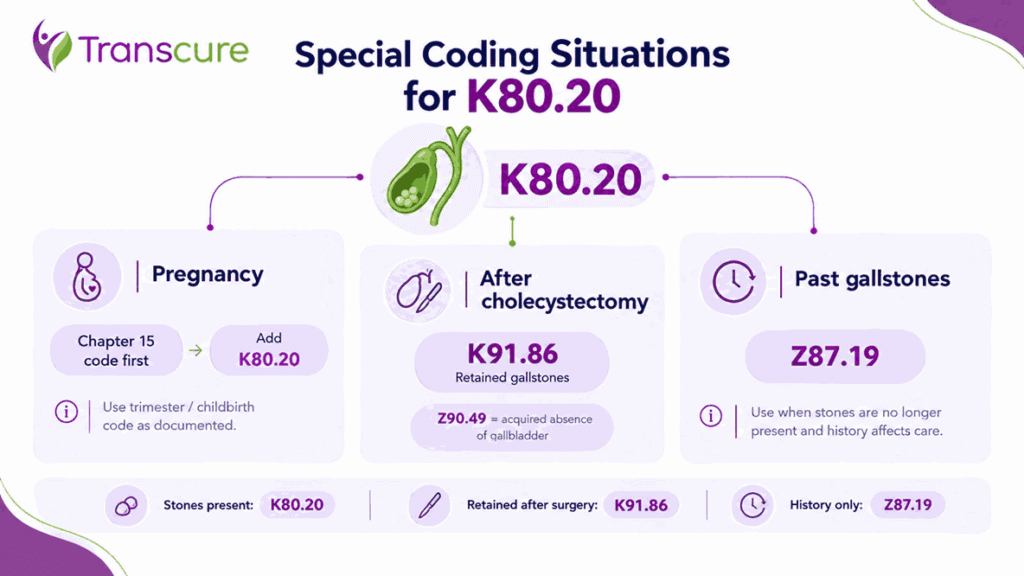
K80.20 is modified in three specific situations: pregnancy, a prior cholecystectomy (gallbladder removal surgery), and a history of gallstones. In these cases, you either add code or replace K80.20 entirely.
Gallstones During Pregnancy
For gallstones during pregnancy, enter code O99.61 first, followed by K80.20. According to section I.C.15.a.1, Chapter 15 codes take precedence over codes from other chapters. This section also allows adding codes from other chapters to further clarify the condition.
In the Alphabetic Index, the entry “pregnancy, complicated by, gallstones” directs coders to O99.61. Subcategory O99.6 applies to conditions falling under the range K00-K93. It includes a “use additional code” note to identify the specific condition; for gallstones (without cholecystitis or obstruction), this code is K80.20. For pregnancy-related complications (O00-O9A), there is an “Excludes2” note in relation to the K00-K95 range, which permits the use of both sets of codes on the same claim.
Meanwhile, the index entry for “biliary tract problems” directs the user to O26.61. Category O99.6 contains an “Excludes2” note regarding liver and biliary tract disorders (O26.6) that occur during pregnancy, childbirth, and the postpartum period (puerperium).
According to section I.C.15.a.3, the final character indicating the trimester is determined based on the trimester or the number of weeks documented by the provider (physician). The table lists 6 Chapter 15 codes related to diseases of the digestive system.
| Care Period | Chapter 15 Code | Timing Rule |
|---|---|---|
| Pregnancy, first trimester | O99.611 | Less than 14 weeks 0 days |
| Pregnancy, second trimester | O99.612 | 14 weeks 0 days to less than 28 weeks 0 days |
| Pregnancy, third trimester | O99.613 | 28 weeks 0 days until delivery |
| Pregnancy, unspecified trimester | O99.619 | Rarely used, when documentation lacks the trimester and clarification is not possible |
| Childbirth | O99.62 | Delivery occurs during the current admission |
| Puerperium | O99.63 | Postpartum period of 6 weeks after delivery |
Under Section I.C.15.a.3, if a delivery occurs during the current admission, assign a code indicating “in childbirth”; this option is available in the classification system. For categories O00-O9A, if the number of weeks of gestation is known, there is an instruction to “use an additional code” from category Z3A (weeks of gestation).
According to Section I.C.15.a.1, if a physician documents that the current condition being treated or the reason for the encounter is unrelated to the pregnancy (i.e., the pregnancy is merely incidental), then code Z33.1 (pregnant state, incidental) is used instead of a code from Chapter 15. The physician must clarify that the pregnancy does not affect the current condition.
Gallstones After Cholecystectomy
For gallstones discovered after a cholecystectomy (gallbladder removal surgery), use code K91.86 instead of K80.20. K91.86 is the billable code for retained gallstones after a cholecystectomy and falls under the K91 category (intraoperative and postprocedural complications and disorders of the digestive system, not elsewhere classified).
The Alphabetic Index has two entries corresponding to K91.86. These entries are: “retained gallstones following cholecystectomy” and “gallstones remaining after cholecystectomy.” Section I.A.12.a prohibits the use of both K80.20 and K91.86 for the same calculus (stone).
K80.20 requires a gallbladder. For a patient without a gallbladder, a different status code applies. The index entry “absence of gallbladder (acquired)” corresponds to Z90.49 (acquired absence of other specified parts of the digestive system).
| Situation | ICD-10-CM Code |
|---|---|
| Gallbladder present with gallstones, no cholecystitis, no obstruction | K80.20 |
| Retained gallstones following cholecystectomy | K91.86 |
| Gallbladder absent after surgical removal | Z90.49 |
History of Gallstones
When gallstones are no longer present, use code Z87.19. Use code K80.20 for gallstones present at the time of the patient’s examination. Z87.19 is billable; it indicates a personal history of other digestive system diseases. Category Z87.1 includes two codes: Z87.11 (peptic ulcer disease) and Z87.19.
This category encompasses conditions that could be classified under the range K00-K93. Because gallstone disease is classified under K80, code a personal history of gallstones as Z87.19. Section IV.J generally precludes the coding of conditions that have been previously treated and are no longer present.
However, this same section permits the use of ‘history codes’ from categories Z80-Z87 as ‘secondary codes’ if the past condition influences current care or treatment. According to Section III.A, this rule also applies in non-outpatient settings (such as for hospitalized patients).
As per the guidelines for Chapter 21, ‘personal history codes’ are intended for past conditions that are no longer present and for which no active treatment is being provided, but which carry a risk of recurrence and may require ongoing monitoring.
| Gallstone Status | Coding Result |
|---|---|
| Gallstones present and documented | K80.20 for gallstones without cholecystitis or obstruction |
| Gallstones treated in the past, history affects current care | Z87.19 as a secondary code |
| Gallstones treated in the past, history does not affect current care | No code for the history |
Which Procedures Support a K80.20 Diagnosis?
K80.20 supports services across two procedure groups: cholecystectomy codes (47562, 47563, 47564, 47600, 47605) and abdominal ultrasound codes (76700, 76705). Section IV.A.1 instructs coders to report the reason for an outpatient surgery as the “first-listed diagnosis.” Section IV.N directs coders to report the specific diagnosis for which the ambulatory surgery was performed.
In addition to ICD-10-CM regulations, payers often apply their own “medical necessity criteria.” This table lists 7 CPT codes and includes information on their respective “approach” and “global period.”
| CPT Code | Descriptor | Approach | Global Period |
|---|---|---|---|
| 47562 | Laparoscopy, surgical; cholecystectomy | Laparoscopic | 090 days |
| 47563 | Laparoscopy, surgical; cholecystectomy with cholangiography | Laparoscopic | 090 days |
| 47564 | Laparoscopy, surgical; cholecystectomy with exploration of common duct | Laparoscopic | 090 days |
| 47600 | Cholecystectomy | Open | 090 days |
| 47605 | Cholecystectomy; with cholangiography | Open | 090 days |
| 76700 | Ultrasound, abdominal, real time with image documentation; complete | Imaging | XXX, global concept does not apply |
| 76705 | Ultrasound, abdominal, real time with image documentation; limited (eg, single organ, quadrant, follow-up) | Imaging | XXX, global concept does not apply |
All 5 codes for cholecystectomy have a 90-day global period, which classifies them as major surgeries. The 2 ultrasound codes carry an ‘XXX’ indicator.
Laparoscopic Cholecystectomy Codes (47562, 47563, 47564)
The three laparoscopic codes form an escalating family. Code 47562 represents a laparoscopic cholecystectomy (gallbladder removal surgery); code 47563 includes an additional cholangiography, while code 47564 incorporates an exploration of the common bile duct. The appropriate code depends on the surgical report. Detailed information regarding code 47562 can be found in the CPT 47562 guide.
When a physician documents only gallstones without cholecystitis (inflammation of the gallbladder) or obstruction, the indication for surgery for claims under codes 47562 and 47563 is recorded as K80.20. If a bile duct exploration is performed (under code 47564) and stones are found in the duct, the diagnosis changes; per Section IV.N, the postoperative diagnosis becomes K80.70 or K80.71.
Open Cholecystectomy Codes (47600, 47605)
Code 47600 refers to an ‘open cholecystectomy,’ while code 47605 refers to an ‘open cholecystectomy’ performed with ‘cholangiography.’ Under the guidelines in sections IV.A.1 and IV.N, the indication for surgery for both of these codes is documented as K80.20.
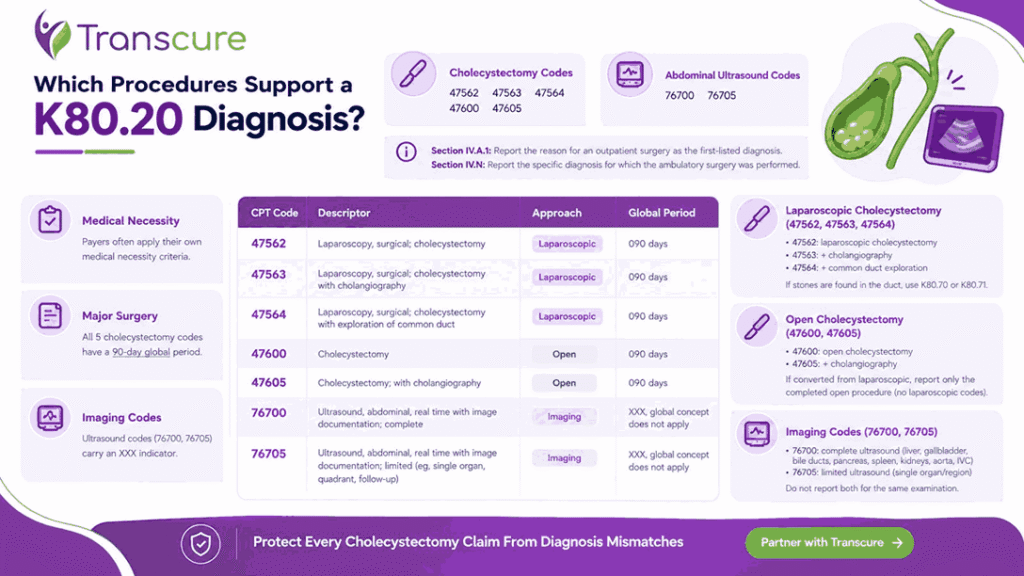
The CMS NCCI Policy Manual restricts reporting when a procedure is converted. When a laparoscopic cholecystectomy is converted to an open cholecystectomy, only the completed open procedure should be reported. The claim does not include the unsuccessful laparoscopic cholecystectomy or the diagnostic laparoscopy.
Imaging Codes That Support the Diagnosis (76700, 76705)
Code 76700 refers to a complete abdominal ultrasound, while code 76705 refers to a limited abdominal ultrasound. A complete ultrasound includes the liver, gallbladder, bile ducts, pancreas, spleen, kidneys, abdominal aorta, and inferior vena cava. A limited ultrasound examines a single organ, a specific region, or serves as a follow-up assessment.
An examination of only the gallbladder or only the right upper quadrant falls under the category of a single-organ or single-region examination (code 76705). You cannot report both a complete ultrasound and a limited ultrasound for the same examination. The guidelines in Section IV.K, as described in the imaging section above, govern the assignment of diagnosis codes for these claims.
Does K80.20 Meet Medical Necessity for Cholecystectomy?
Medical necessity for a cholecystectomy (gallbladder removal surgery) under code K80.20 is established only when the physician’s notes document symptomatic gallstone disease. The diagnosis code indicates the medical condition, while the notes substantiate the need for surgery.
Section 1862(a)(1)(A) of the Social Security Act establishes the Medicare standard. This section prohibits payment for items and services that are not reasonable and necessary for the diagnosis or treatment of an illness or injury.
The 2016 gallstone guidelines issued by the European Association for the Study of the Liver (EASL), published in the *Journal of Hepatology*, outline the clinical indications. The table compares three different clinical scenarios.
| Clinical Presentation | EASL 2016 Position | Claim Implication for K80.20 |
|---|---|---|
| Symptomatic gallbladder stones | Cholecystectomy is the preferred treatment, backed by high-quality evidence and a strong recommendation | The note documents the symptoms and the surgical decision besides K80.20 |
| Asymptomatic gallstones | Routine treatment is not recommended | K80.20 reports the condition, and surgery needs a separate documented clinical rationale |
| Asymptomatic gallstones during a major abdominal operation | Prophylactic cholecystectomy may be offered, although the guideline does not generally recommend it | The note documents the reason for the added procedure |
The EASL perspective links the need for surgery to symptoms. Therefore, a claim for K80.20 (cholecystectomy) is based on the symptom history documented in the physician’s notes.
What Payers Expect in the Provider Note
Payers expect provider notes to show that the cholecystectomy meets the payer’s medical-necessity criteria. When no national or local coverage determination is available for a service, Medicare Administrative Contractors apply six criteria.
- This service is safe and effective.
- This service is not experimental or investigational.
- This service adheres to accepted standards of medical practice for the patient’s condition.
- This service is provided in the appropriate setting based on the patient’s needs.
- Qualified personnel order and provide this service.
- This service meets the patient’s medical needs but does not exceed them.
Contractors expect medical records to clearly demonstrate that the service meets all six criteria. Documentation remains in the patient’s record and is made available to the contractor upon request. Commercial payers issue their own medical policies, and those policies apply to those claims.
EASL guidelines state that the differential diagnosis for biliary pain should include other causes of upper abdominal pain. A note documenting this differential confirms that gallstones caused the pain.
The operative report supports the CPT code. The descriptor for 47563 mentions cholangiography, while the descriptor for 47564 mentions exploration of the common duct. The operative report documents which service was performed.
What Happens With Incidental Gallstones?
According to the EASL 2016 guidelines, there is no routine indication for cholecystectomy (gallbladder removal surgery) in cases of incidental gallstones. The guidelines do not recommend routine treatment for asymptomatic gallstones. According to the Merck Manual, symptoms develop in about 1% to 4% of previously asymptomatic patients.
The EASL guidelines permit prophylactic cholecystectomy during major abdominal surgery as an option, but it is also clear that the guidelines do not generally recommend this procedure. Combining a cholecystectomy with another operation requires documented justification for the additional procedure.
Section IV.G lists the diagnosis primarily responsible for the services provided first, followed by comorbid conditions. K80.21 is listed as a comorbid condition following the primary diagnosis when documentation indicates that the gallstones affect care under Section IV.J.
Is K80.20 an HCC Code and Does It Affect DRG Assignment?
K80.20 is not an HCC code. K80.20 affects DRG assignment only when it is the principal diagnosis during an inpatient stay.
HCC and RAF Status
There is no CMS-HCC V28 category for K80.20 for 2026 dates of service. CMS’s preliminary 2027 ICD-10-CM mapping list does not include a V28 category for K80.20. CMS pays Medicare Advantage plans monthly, adjusted based on each beneficiary’s health condition. Each HCC payment adds a published weight to the beneficiary’s Risk Adjustment Factor (RAF). K80.20 adds no weight to the RAF.
The table lists the 5 risk models and the K80.20 mapping in each.
| Risk Model | K80.20 Mapping |
|---|---|
| CMS-HCC V28 | No HCC for 2026 dates of service |
| CMS-HCC V24 | Not used for payment year 2027 Medicare Advantage payment |
| ESRD | No category |
| RxHCC | No category |
| HHS-HCC | No category in the 2026 benefit year mapping |
The AHRQ Chronic Condition Indicator also does not classify K80.20 as chronic. Therefore, K80.20 contributes nothing to the RAF under any of the five models.
DRG 444-446 Logic
When K80.20 is the principal diagnosis during an inpatient stay, it is grouped into MS-DRG 444, 445, or 446. The FY2027 MS-DRG v44.0 grouper is effective from October 1, 2026, to September 30, 2027. These three DRGs fall under MDC 07 (Diseases and Disorders of the Hepatobiliary System and Pancreas).
The principal diagnosis determines the DRG family. Secondary diagnoses then determine the severity level.
| MS-DRG | Title | Severity Rule |
|---|---|---|
| 444 | Disorders of the Biliary Tract with MCC | A secondary diagnosis on the MCC list is present |
| 445 | Disorders of the Biliary Tract with CC | A secondary diagnosis on the CC list is present and no MCC |
| 446 | Disorders of the Biliary Tract without CC/MCC | No CC or MCC is present |
Inpatient laparoscopic cholecystectomy impacts the family. ICD-10-PCS code 0FT44ZZ (excision of gallbladder, percutaneous endoscopic approach) assigns the patient’s hospital stay to the surgical cholecystectomy DRG rather than DRGs 444-446.
| Procedure Pattern | MS-DRG Range |
|---|---|
| Cholecystectomy with common duct exploration (C.D.E.) | 411, 412, 413 |
| Cholecystectomy except by laparoscope without C.D.E. | 414, 415, 416 |
| Laparoscopic cholecystectomy without C.D.E. | 417, 418, 419 |
Each range is categorized based on MCC, CC, and ‘none of these’. DRG applies to claims for hospitalized patients. The surgeon’s professional claim provides details on the general surgery-specific CPT codes mentioned above.
What Are the Most Common K80.20 Coding Denials?
Six coding errors violate ICD-10-CM or global surgery rules and can cause K80.20 claims to be rejected or denied. This table outlines each trigger, the rule behind the error, and how to fix it.
| Denial Trigger | Why the Claim Fails | Fix |
|---|---|---|
| K80.2 submitted without a fifth character | Section I.B.2 treats a code without its full characters as invalid | Report K80.20 or K80.21 by the documented obstruction status |
| K80.20 reported with K80.0, K80.1, or K81. | The K81 Excludes1 note for cholecystitis with cholelithiasis and Section I.B.9 favor the combination code | Report the K80.0 or K80.1 combination code alone |
| K80.20 reported with K91.86 or after gallbladder removal | The K80 Excludes1 note names K91.86, and K80.20 requires a gallbladder calculus | Report K91.86 for retained stones or Z90.49 for absence of the gallbladder |
| Gallstones in pregnancy with K80.20 first and no Chapter 15 code | Section I.C.15.a.1 gives Chapter 15 codes sequencing priority | Report O99.61 with the trimester character first and K80.20 second |
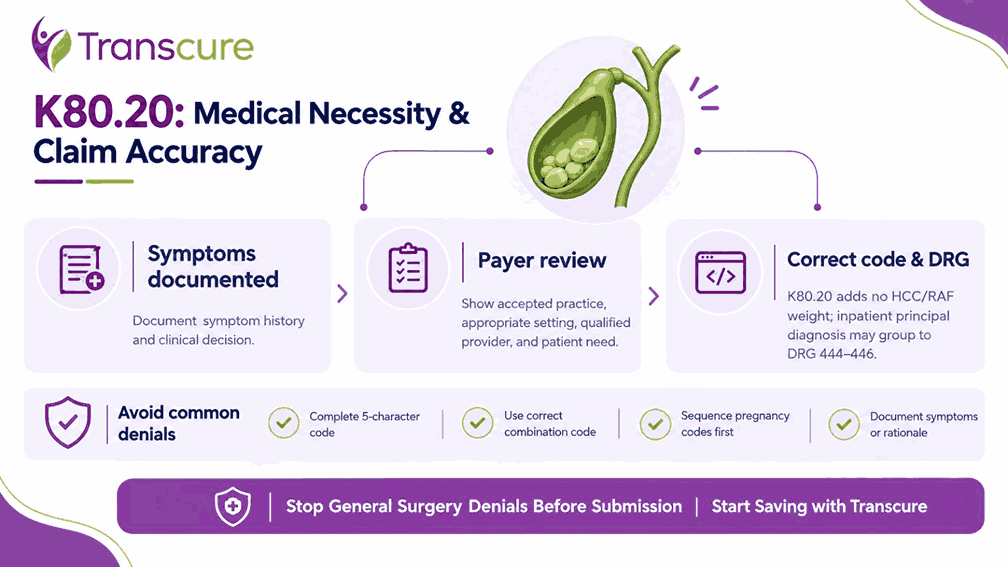
| Cholecystectomy billed with K80.20 and no documented symptoms or rationale | The Medicare standard requires documentation of accepted standards of practice, and EASL recommends against routine surgery for asymptomatic stones | Document the symptom history, the imaging, and the clinical decision |
| Postoperative E/M billed with K80.20 and no modifier | The 090 global package includes related postoperative care | Append modifier 24 and report the unrelated diagnosis |
These six triggers include code selection, the Excludes1 rule, sequencing, required documentation, and global-period rules.
How Can General Surgery Practices Avoid K80.20 Errors?
To avoid K80.20 errors in general surgery practice, adopt seven pre-submission checks and seven documentation habits. These checks identify rule conflicts before the claim leaves the practice, while the habits ensure the information needed for these checks is available. A specialized general surgery service can help practices improve coding accuracy, claim submission, and denial prevention.
Pre-submission Coding Checks
A pre-submission review covers 7 checks.
- Verify the full 5-character codes, K80.20 or K80.21.
- Scan claims for Excludes1 pairs associated with K81, K82.0, K82.4, K83.1, and K91.86.
- Use a combination code instead of K80.20 when the operative report mentions cholecystitis or bile duct stones.
- For pregnant patients, prioritize using a code from Chapter 15.
- Match CPT descriptors for the approach, cholangiography, and duct exploration with the operative report.
- Apply modifiers 24, 57, 78, or 79 only when global surgery rules apply to the encounter.
- Ensure the encoder is using the FY2027 files effective October 1, 2026.
The K82.4 check is important because an ‘Excludes1’ note is provided for cholesterolosis of the gallbladder with cholelithiasis (K80) under the K82.4 category.
Provider Documentation Habits
The provider’s documentation provides information regarding each examination. The surgical workflow comprises seven steps.
- Record the history of symptoms prompting the surgery.
- Document alternative causes of upper abdominal pain considered during the evaluation.
- Specify the pre-operative and post-operative diagnoses separately.
- Report bile duct findings whenever you perform cholangiography or a bile duct examination.
- For pregnant patients, record the trimester or week of pregnancy.
- Document any prior gallbladder surgery and the gallbladder’s current status.
- Record diagnoses unrelated to the procedure for each emergency medical encounter occurring within the global period.
Frequently Asked Questions
1. Can K80.20 be reported with R10.11 right upper quadrant pain?
No, do not report R10.11 when pain is routinely associated with documented gallstones. Report it separately only when coding guidelines permit and the symptom is not routinely associated with the diagnosis.
2. How do you code gallstones with pancreatitis?
Gallstone pancreatitis is coded to K85.1-. Use K85.10 without necrosis or infection, K85.11 with uninfected necrosis, or K85.12 with infected necrosis. Report K80.20 separately when gallbladder stones are a distinct coexisting condition.
3. Can gallbladder sludge or polyps be coded to K80.20?
No, K80.20 represents gallbladder calculus without cholecystitis or obstruction. Sludge and polyps require code selection based on the documented condition and the Alphabetic Index.
4. What is the ICD-9 equivalent of K80.20?
The approximate ICD-9-CM equivalent of K80.20 is 574.20, representing gallbladder calculus without cholecystitis or obstruction. ICD-10-CM replaced ICD-9-CM for services dated October 1, 2015, onward.
5. Does K80.20 affect modifier selection on a cholecystectomy claim?
No, Encounter circumstances determine modifier selection. Modifiers 24, 57, 78, and 79 address unrelated evaluation services, surgical decisions, or procedures during postoperative care, as applicable.
6. Does K80.20 require prior authorization for surgery?
No, K80.20 alone does not determine prior authorization. Requirements depend on the payer’s policies and the planned procedure. Verify coverage and authorization rules before submitting a cholecystectomy claim.
7. Does K80.20 carry laterality?
No, K80.20 identifies gallbladder calculus without cholecystitis or obstruction and contains no laterality character. Laterality rules apply only to codes that specify a side.
8. Is there a family history code for gallstones?
Yes, Z83.79 represents family history of other diseases of the digestive system. Report it as a secondary code when the family history affects current care or influences treatment decisions.