The American College of Surgeons confirms CPT 2026 added new general surgery codes for gastric and liver procedures. CMS also cut work RVUs by 2.5% for non-time-based surgical codes this year. These changes directly affect how general surgery claims get coded and reimbursed.
General surgery sessions often bundle multiple procedures into a single claim. CMS requires correct modifier sequencing under NCCI edits and global surgery period rules. Missing a required modifier triggers automatic denial and delays payment on the entire claim.
This guide lists the most commonly billed general surgery CPT codes grouped by procedure type. Each entry explains the code descriptor, common modifiers, and applicable global period rules. Use it alongside general surgery billing services to code claims accurately and protect reimbursement.

What Does Appendectomy Coding Involve in General Surgery Billing?
Appendectomy covers the removal of the appendix, done either as an open surgery or through small cuts. Coders pick the CPT code based on how the surgeon removed it and whether it was infected or ruptured. Correct code choice affects how much the claim pays.
| Code | Descriptor | Category | Common Modifier |
|---|---|---|---|
| 44950 | Open appendectomy | Appendix | 51 |
| 44955 | Appendectomy at time of other major procedure | Appendix | N/A |
| 44960 | Perforated appendix repair | Appendix | 22 |
| 44970 | Laparoscopic appendectomy | Appendix | 51 |
| 44979 | Unlisted laparoscopic appendix procedure | Appendix | 22 |
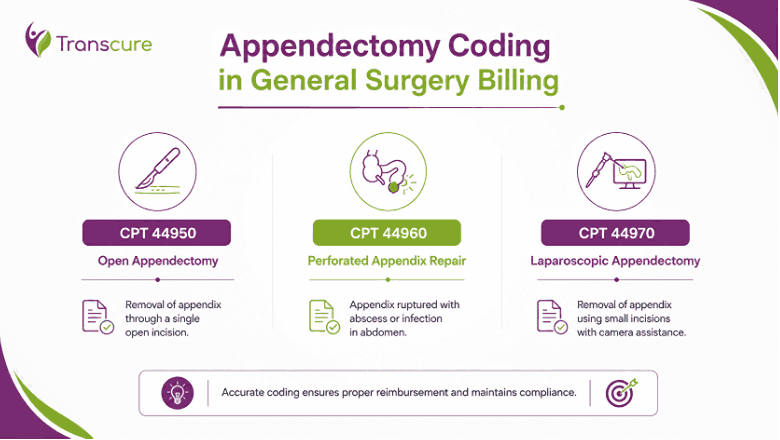
CPT 44950: Open Appendectomy
A single open incision to remove the appendix is billed under CPT 44950. This is one of the common general surgery CPT codes billed when a patient has simple, non-ruptured appendicitis. Coders need the operative note showing the incision type. Modifier 51 may apply if done with another procedure in the same session.
CPT 44960: Perforated Appendix Repair
CPT 44960 applies when the appendix has ruptured, causing an abscess or spread of infection in the abdomen. It pays more than a routine appendectomy because of the added surgical work involved. The operative note must clearly document the perforation and any related cleanup performed. Modifier 22 may apply for added complexity.
CPT 44970: Laparoscopic Appendectomy
Surgeons use CPT 44970 when the appendix is removed through small cuts with camera guidance. This is one of the most commonly used general surgery CPT codes today, since most appendectomies are now performed this way. Documentation must confirm the laparoscopic approach was used, not converted to open. Modifier 51 may apply for multiple procedures.
How Do Coders Choose the Right Cholecystectomy CPT Code?
Cholecystectomy means gallbladder removal, done either through small cuts or one open incision. These common general surgery CPT codes separate the procedure by surgical approach, added steps like duct imaging, and complexity. Picking the correct code affects claim accuracy and payment.
| Code | Descriptor | Category | Common Modifier |
|---|---|---|---|
| 47562 | Laparoscopic cholecystectomy | Gallbladder | 51 |
| 47563 | Lap chole w/cholangiography | Gallbladder | 51 |
| 47564 | Lap chole w/CBD exploration | Gallbladder | 22 |
| 47600 | Open cholecystectomy | Gallbladder | 51 |
| 47605 | Open chole w/cholangiography | Gallbladder | 51 |
CPT 47562: Laparoscopic Cholecystectomy
This code covers standard gallbladder removal through small incisions using a camera. Surgeons choose this method for most routine gallstone cases today. The operative note must confirm a laparoscopic approach with no additional duct work performed. It’s one of the most frequently billed CPT codes for general surgery.
CPT 47563: Lap Chole with Cholangiography
Billers use 47563 when the surgeon also performs an X-ray of the bile ducts during the same laparoscopic procedure. Cholangiography checks for stones or blockages beyond the gallbladder itself. Documentation should clearly note the imaging step separately from the removal. Skipping this detail risks downcoding to 47562 instead.
CPT 47564: Lap Chole with CBD Exploration
When stones are found in the common bile duct, surgeons explore and clear it laparoscopically under this code. Medical documentation must show the duct exploration, not just the gallbladder removal. Payers may apply modifier 22 given the added surgical time and complexity involved here.
What Does Hernia Repair Treat and How Coders Bill It?
Hernia repair fixes tissue that pushes through a weak spot in muscle, most often in the groin, abdomen, or diaphragm. Surgeons use stitches or mesh, working through an open cut or small incisions. Since hernia type and location vary widely, choosing the correct CPT code takes careful attention.
| Code | Descriptor | Category | Common Modifier |
|---|---|---|---|
| 49505 | Initial inguinal repair, reducible | Hernia (Inguinal) | 51 |
| 49550 | Initial femoral hernia, reducible | Hernia (Femoral) | 51 |
| 49591 | Initial abdominal hernia, under 3cm | Hernia (Abdominal Wall) | 51 |
| 43281 | Lap hiatal repair, no mesh | Hernia (Hiatal) | 51 |
CPT 49505: Initial Inguinal Repair, Reducible
Groin hernias that can still be pushed back into place fall under this code. A first-time repair on that side supports billing here. The operative note should confirm no prior surgery occurred at that location. This is one of the common general surgery CPT codes tied to routine groin surgery.
CPT 49550: Initial Femoral Hernia, Reducible
Femoral hernias sit lower than groin hernias, closer to the thigh, and use a separate code family entirely. This code fits a first-time femoral repair where the bulge still reduces easily. Payers expect clear documentation distinguishing femoral from inguinal hernia location. Mixing the two up is a frequent coding mistake.
CPT 49591: Initial Abdominal Hernia, Under 3cm
Abdominal wall hernias, including umbilical and ventral types, now share one unified code set based on defect size. This code applies to a first-time repair measuring under three centimeters. Documentation must state the measured defect length from the operative report. Mesh use, when performed, is already built into this code.
CPT 43281: Laparoscopic Hiatal Repair, No Mesh
Hiatal hernia repair addresses a different problem entirely, where part of the stomach pushes upward through the diaphragm. Surgeons perform this one laparoscopically without placing mesh. The note should confirm no mesh was used during the repair. Choosing 43282 instead would misstate the procedure performed.
What Does Esophagectomy Involve, and How Is It Coded?
Esophagectomy removes part or all of the esophagus, usually to treat cancer or severe damage from disease. Surgeons choose between different surgical paths depending on how far the disease has spread. Picking the right CPT code depends heavily on which surgical route was actually used.
| Code | Descriptor | Category | Common Modifier |
|---|---|---|---|
| 43107 | Transhiatal esophagectomy | Esophagus | 22 |
| 43108 | Transhiatal + colon graft | Esophagus | 22 |
| 43112 | McKeown esophagectomy | Esophagus | 22 |
| 43113 | McKeown + colon graft | Esophagus | 22 |
| 43117 | Ivor Lewis esophagectomy | Esophagus | 22 |
| 43118 | Ivor Lewis + colon graft | Esophagus | 22 |
| 43121 | Partial, thoracotomy only | Esophagus | 22 |
| 43122 | Partial, abdominal approach | Esophagus | 22 |
| 43123 | Abdominal approach + graft | Esophagus | 22 |
| 43124 | Total esophagectomy, no repair | Esophagus | 22 |
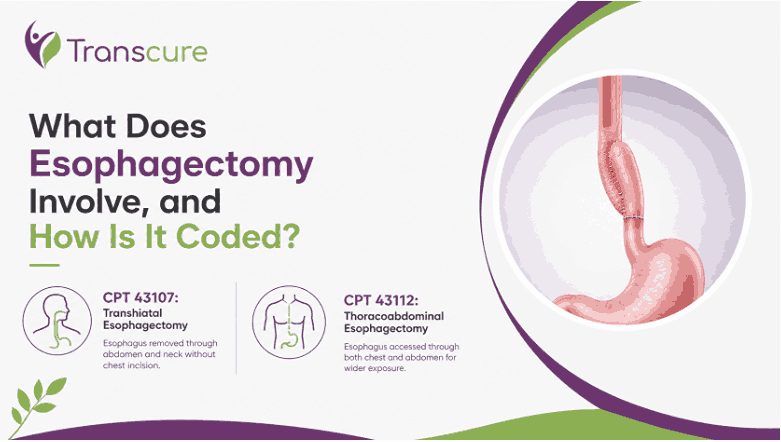
CPT 43107: Transhiatal Esophagectomy
It involves removing the esophagus through the abdomen and neck, avoiding a chest incision entirely. Surgeons often choose this route for tumors located lower in the esophagus. The operative note must confirm no chest incision was made. This is one of the CPT codes for general surgery, closely tied to the surgical approach.
CPT 43112: Thoracoabdominal Esophagectomy
The surgeon accesses the esophagus through both the chest and abdomen in one combined operation. This broader approach suits tumors needing wider exposure or more extensive tissue removal. Documentation should describe both surgical fields clearly in the report. Confusing this with the transhiatal route is a common coding error.
What Procedures Fall Under Stomach Surgery, and How Are They Coded?
Stomach surgery covers procedures like partial removal of the stomach and placement of a feeding tube directly into it. Surgeons choose these methods for conditions ranging from ulcers to trouble swallowing. Since approach and purpose differ so much, CPT code selection needs close attention to the operative details.
| Code | Descriptor | Category | Common Modifier |
|---|---|---|---|
| 43501 | Gastrotomy w/bleeding ulcer repair | Stomach | 22 |
| 43620 | Total gastrectomy w/esophagoenterostomy | Stomach | 22 |
| 43631 | Partial gastrectomy, Billroth I | Stomach | 22 |
| 43632 | Partial gastrectomy, Billroth II | Stomach | 22 |
| 43800 | Pyloroplasty | Stomach | 51 |
| 43830 | Open gastrostomy placement | Stomach | 51 |
| 43653 | Laparoscopic gastrostomy tube | Stomach | 51 |
CPT 43631: Partial Gastrectomy, Billroth I
CPT 43631 covers the removal of part of the stomach and its direct reconnection to the small intestine. Surgeons often choose this method for stomach ulcers or certain tumors. The operative note must describe the reconnection technique used. This is one of the common general surgery CPT codes tied to stomach resection.
CPT 43830: Open Gastrostomy Placement
In this procedure, a feeding tube gets placed directly into the stomach through an open surgical incision. Surgeons use this when a patient cannot safely eat by mouth for an extended period. Patient records should explain why feeding support is required. Frequency limits rarely apply, since this is typically a one-time placement.
CPT 43653: Laparoscopic Gastrostomy Tube
This code applies when the same feeding tube placement happens through small incisions instead of one open cut. Surgeons often prefer this route for lower surgical risk and faster recovery. The note must confirm laparoscopic technique rather than an open approach. Choosing 43830 instead would misrepresent the surgical method used.
How Is Gastric Bypass Surgery Coded?
Weight-loss surgery through gastric bypass reshapes the stomach and reroutes the small intestine for patients with severe obesity. Surgeons perform the procedure laparoscopically using small incisions and a camera. Two related codes exist for this surgery, so coders must review the operative note carefully before choosing one.
| Code | Descriptor | Category | Common Modifier |
|---|---|---|---|
| 43644 | Laparoscopic gastric bypass | Bariatric | 22 |
| 43645 | Gastric bypass + reconstruction | Bariatric | 22 |
| 43775 | Laparoscopic sleeve gastrectomy | Bariatric | 51 |
| 43889 | Endoscopic sleeve gastroplasty | Bariatric | 51 |
| 43846 | Open gastric bypass, short-limb | Bariatric | 22 |
| 43847 | Open gastric bypass + reconstruction | Bariatric | 22 |
| 43845 | Biliopancreatic diversion w/duodenal switch | Bariatric | 22 |
| 43842 | Vertical banded gastroplasty | Bariatric | 51 |
| 43843 | Gastric restriction, non-banded | Bariatric | 51 |
| 43770 | Adjustable gastric band placement | Bariatric | 51 |
| 43771 | Gastric band component revision | Bariatric | 51 |
| 43772 | Gastric band component removal | Bariatric | 51 |
| 43773 | Gastric band removal + replacement | Bariatric | 51 |
| 43774 | Gastric band + port removal | Bariatric | 51 |
| 43848 | Open revision, non-band restrictive | Bariatric | 22 |
| 43886 | Open port revision | Bariatric | 59 |
| 43887 | Open port removal | Bariatric | 59 |
| 43888 | Open port removal + replacement | Bariatric | 59 |
CPT 43644: Laparoscopic Gastric Bypass
Laparoscopic Roux-en-Y gastric bypass falls under this code when performed for documented weight-loss purposes. Payer policies typically require BMI history and proof of prior weight-loss attempts before approving the surgery. Modifier 22 may apply if the operative note shows unusually complex circumstances.
CPT 43645: Gastric Bypass + Reconstruction
Surgeons bill 43645 specifically when small intestine reconstruction goes beyond the standard bypass steps. Extraintestinal rerouting needs clear documentation showing medical necessity rather than routine technique. Reporting 43644 alone in this situation would understate the actual surgical work performed.
What Comes Under Small Bowel Resection CPT Coding?
Small bowel resection removes a damaged or diseased section of small intestine, then reconnects the remaining ends. Surgeons treat conditions like blockages, tumors, or blood flow loss this way. Since both an open and laparoscopic version exist, matching the code to the actual technique used really matters.
| Code | Descriptor | Category | Common Modifier |
|---|---|---|---|
| 44120 | Small bowel resection, open | Small Bowel | 51 |
| 44121 | Small bowel resection, open (single resection with anastomosis) | Small Bowel | N/A |
| 44125 | Additional small bowel resection, open (add-on to 44120) | Small Bowel | 22 |
| 44202 | Small bowel resection, lap | Small Bowel | 51 |
| 44800 | Excision of Meckel’s diverticulum | Small Bowel | 51 |
CPT 44120: Small Bowel Resection, Open
Removing a diseased small intestine segment through a traditional open incision falls under this code. Surgeons choose this route for complex cases or when prior scarring limits other options. Operative notes need to confirm the open technique and the reason surgery was necessary. Modifier 51 may fit alongside other same-session procedures.
CPT 44202: Small Bowel Resection, Lap
The laparoscopic version of this same resection uses small incisions and a camera instead of one large cut. Faster recovery often makes this the preferred choice when the patient’s condition allows it. Coders should confirm the laparoscopic method appears clearly in the surgeon’s documentation. Reporting 44120 by mistake would misstate the surgical approach.
Why Is Adhesiolysis Billed as Its Own Procedure?
Adhesiolysis breaks apart scar tissue that binds the intestines together, often left over from earlier abdominal surgery. Surgeons perform this to free the bowel and prevent blockages. Since two different surgical routes exist for this same problem, correct code selection depends on the approach documented.
| Code | Descriptor | Category | Common Modifier |
|---|---|---|---|
| 44005 | Open lysis of adhesions | Adhesiolysis | 59 |
| 44180 | Laparoscopic lysis of adhesions | Adhesiolysis | 59 |
CPT 44005: Open Lysis of Adhesions
Removing scarred intestinal tissue through a traditional open incision falls under this code. Payers generally expect the operative note to state adhesions caused a genuine obstruction, not incidental findings. NCCI edits often bundle this work into a larger abdominal procedure performed the same day. Modifier 22 may apply when adhesions were extensive.
CPT 44180: Laparoscopic Lysis of Adhesions
Small incisions and a camera guide this same adhesion-clearing work instead of one large cut. Surgeons often prefer this route when the scar tissue is limited and easily reached. Documentation needs to confirm the laparoscopic technique and the clinical reason surgery was necessary. Billing separately alongside another laparoscopic procedure may trigger bundling denials.
Which Codes Cover Open Colon Surgery?
Open colon surgery removes a diseased section of the large intestine through a traditional abdominal incision. Surgeons reconnect the remaining bowel or create an alternate path depending on the case. Two closely related codes exist here, so coders must read the operative report carefully to pick correctly.
| Code | Descriptor | Category | Common Modifier |
|---|---|---|---|
| 44140 | Partial colectomy, anastomosis | Colorectal | 51 |
| 44160 | Right hemicolectomy, ileocolostomy | Colorectal | 51 |
| 44143 | Hartmann procedure, colostomy | Colorectal | 22 |
| 44145 | Low anterior resection, open | Colorectal | 22 |
| 44204 | Lap partial colectomy | Colorectal | 51 |
| 44207 | Lap low anterior resection | Colorectal | 22 |
| 44210 | Lap total colectomy | Colorectal | 22 |
CPT 44140: Partial Colectomy, Anastomosis
Removing part of the colon and reconnecting the two ends in the same session falls under this code. Surgeons use it for conditions like diverticulitis, tumors, or bowel disease needing resection. The operative report must confirm a direct reconnection was performed. Modifier 51 may apply for multiple same-session procedures.
CPT 44160: Right Hemicolectomy, Ileocolostomy
A different scenario applies here: removal of the terminal ileum along with the right colon, joined through an ileocolostomy connection. Coders sometimes confuse this with 44140 despite the distinct anatomy involved. Documentation should specify the terminal ileum removal and the connection type. Getting this distinction wrong is a common billing mistake.
How Do Coders Bill Ostomy Creation Surgery?
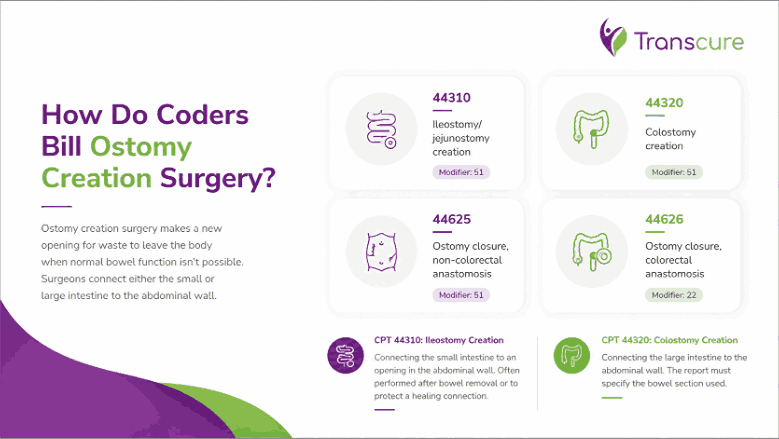
Ostomy creation surgery makes a new opening for waste to leave the body when normal bowel function isn’t possible. Surgeons connect either the small or large intestine to the abdominal wall. Since two separate codes exist for this, matching the code to the correct organ matters most.
| Code | Descriptor | Category | Common Modifier |
|---|---|---|---|
| 44310 | Ileostomy/jejunostomy creation | Ostomy Creation | 51 |
| 44320 | Colostomy creation | Ostomy Creation | 51 |
| 44625 | Ostomy closure, non-colorectal anastomosis | Ostomy Closure | 51 |
| 44626 | Ostomy closure, colorectal anastomosis | Ostomy Closure | 22 |
CPT 44310: Ileostomy Creation
Connecting the small intestine to an opening in the abdominal wall falls under this code. Surgeons often perform this after removing diseased bowel or to protect a healing connection elsewhere. Clinical records should explain why waste diversion was required. This code is typically bundled when performed alongside a larger resection procedure.
CPT 44320: Colostomy Creation
This code applies when the large intestine, rather than the small intestine, is connected to the abdominal wall instead. Coders sometimes struggle to tell this apart from 44310 without clear anatomical detail in the note. The operative report must specify which section of bowel was used. NCCI edits often bundle this into the primary colon procedure performed.
What Anal Fissure Surgery Codes Should Coders Know?
Anal fissure surgery treats small tears in the anal lining that cause pain and bleeding with bowel movements. Surgeons may cut through part of the muscle or open the tract to relieve pressure. Choosing between these codes depends on the exact technique performed.
| Code | Descriptor | Category | Common Modifier |
|---|---|---|---|
| 46200 | Fissurectomy w/sphincterotomy | Anal/Rectal | 51 |
| 46270 | Fistulotomy, subcutaneous | Anal/Rectal | 51 |
| 46275 | Fistulotomy, intersphincteric | Anal/Rectal | 22 |
| 46221 | Hemorrhoidectomy, band ligation | Anal/Rectal | 51 |
| 46255 | Hemorrhoidectomy, simple | Anal/Rectal | 51 |
| 46260 | Hemorrhoidectomy, complex | Anal/Rectal | 22 |
CPT 46200: Fissurectomy w/Sphincterotomy
Removing the fissure tissue while also cutting the sphincter muscle to ease tension falls under this code. Surgeons combine these steps when a fissure fails to heal on its own. The operative note must confirm both parts of the procedure took place. Billing sphincterotomy separately alongside this code would create an unbundling issue.
CPT 46270: Fistulotomy, Subcutaneous
A different problem gets treated here: opening a shallow tunnel that connects skin to the anal canal. Surgeons choose this approach when the fistula tract sits close to the surface. Documentation should describe the tract’s location and depth clearly. Deeper tracts instead require a different code entirely, not this one.
How Are Liver Biopsy and Resection Coded?
Liver surgery here covers taking a small tissue sample or removing a diseased portion of the liver itself. Surgeons choose these procedures for suspected tumors, cirrhosis, or other liver disease needing closer study or treatment. Picking the right code depends heavily on whether tissue was sampled or actually removed.
| Code | Descriptor | Category | Common Modifier |
|---|---|---|---|
| 47100 | Liver wedge biopsy | Liver | 59 |
| 47120 | Partial hepatectomy | Liver | 22 |
| 47350 | Liver laceration repair | Liver | 22 |
| 47384 | Percutaneous liver ablation | Liver | 22 |
CPT 47100: Liver Wedge Biopsy
Taking a small wedge-shaped tissue sample from the liver through an open incision falls under this code. Pathology results and a documented clinical reason for biopsy support billing here. Payers may expect notes showing why a needle biopsy wasn’t sufficient instead. Modifier 59 may apply when billed alongside another abdominal procedure.
CPT 47120: Partial Hepatectomy
Removing an actual diseased section of liver tissue, rather than just sampling it, applies here. Surgeons use this for tumors, damaged tissue, or donor liver procedures requiring true resection. The operative report must clearly state how much liver tissue was removed. Modifier 22 may fit when the resection involves added surgical complexity.
What Codes Apply to Distal Pancreas Removal?
Distal pancreatectomy removes the tail end of the pancreas, usually to treat a tumor, cyst, or chronic pancreatitis. Surgeons sometimes reconnect the remaining pancreas to the intestine afterward, and sometimes they don’t. That single difference decides which of these two codes applies.
| Code | Descriptor | Category | Common Modifier |
|---|---|---|---|
| 48140 | Distal pancreatectomy | Pancreas | 22 |
| 48145 | Distal pancreatectomy w/pancreaticojejunostomy | Pancreas | 22 |
| 48150 | Whipple procedure | Pancreas | 22 |
CPT 48140: Distal Pancreatectomy
Removing the tail portion of the pancreas without creating a new drainage connection falls under this code. Surgeons typically use it when the remaining pancreas doesn’t need rerouting to the bowel. The operative note should confirm no pancreaticojejunostomy was performed. Modifier 22 may apply if the resection required unusual added effort.
CPT 48145: Distal Pancreatectomy w/Pancreaticojejunostomy
This code applies when the surgeon also connects the remaining pancreas to the jejunum after removing the tail section. That extra connection step is what separates this code from 48140, not the splenectomy status. Documentation must clearly describe the pancreaticojejunostomy performed during the same operative session.
Which Codes Cover Full Spleen Removal?
Splenectomy removes the entire spleen, often after trauma, blood disorders, or an enlarged spleen causing symptoms. Surgeons perform this through an open incision, sometimes needing extra work for nearby diseased tissue. The extent of tissue removed decides which of these two codes fits the claim.
| Code | Descriptor | Category | Common Modifier |
|---|---|---|---|
| 38100 | Open total splenectomy | Spleen | 51 |
| 38102 | Total splenectomy, en bloc | Spleen | 22 |
| 38115 | Splenic repair (splenorrhaphy) | Spleen | 22 |
| 38120 | Laparoscopic splenectomy | Spleen | 51 |
CPT 38100: Open Total Splenectomy
Removing the whole spleen through a traditional open incision falls under this standard code. Trauma, cancer, or blood conditions like ITP commonly support the medical need behind this procedure. The operative note should confirm the entire spleen was removed. Modifier 51 may apply when done alongside another abdominal procedure.
CPT 38102: Total Splenectomy, En Bloc
Extensive disease sometimes requires removing the spleen together with nearby diseased tissue in one combined specimen. Coders bill this code as an add-on alongside another primary procedure, never on its own. Documentation must describe the en bloc removal and the adjacent tissue involved. This code cannot stand alone on a claim.
What Sets Unilateral Thyroid Lobectomy Codes Apart?
Thyroid lobectomy removes one side of the thyroid gland, leaving the other lobe intact. Surgeons choose this when disease affects only one side, such as a nodule or small tumor. How much of that one lobe gets removed decides which code applies here.
| Code | Descriptor | Category | Common Modifier |
|---|---|---|---|
| 60210 | Partial unilateral lobectomy | Thyroid | LT/RT |
| 60220 | Total unilateral lobectomy | Thyroid | LT/RT |
| 60225 | Unilateral + contralateral subtotal | Thyroid | 22 |
| 60240 | Total/complete thyroidectomy | Thyroid | 22 |
| 60500 | Parathyroidectomy, single gland | Parathyroid | 22 |
| 60502 | Parathyroidectomy, re-exploration | Parathyroid | 22 |
CPT 60210: Partial Unilateral Lobectomy
Only part of one thyroid lobe gets removed under this code, leaving some gland tissue behind on that side. Surgeons often choose this for smaller nodules not requiring full lobe removal. The operative note should state how much tissue remained after surgery. Modifier LT or RT applies based on which side was treated.
CPT 60220: Total Unilateral Lobectomy
The entire lobe on one side comes out completely under this code, unlike the partial removal described above. This applies to larger nodules, suspicious growths, or confirmed thyroid cancer limited to one side. Documentation must confirm the whole lobe was removed, not just a portion. Confusing this with 60210 misrepresents how much tissue was taken.
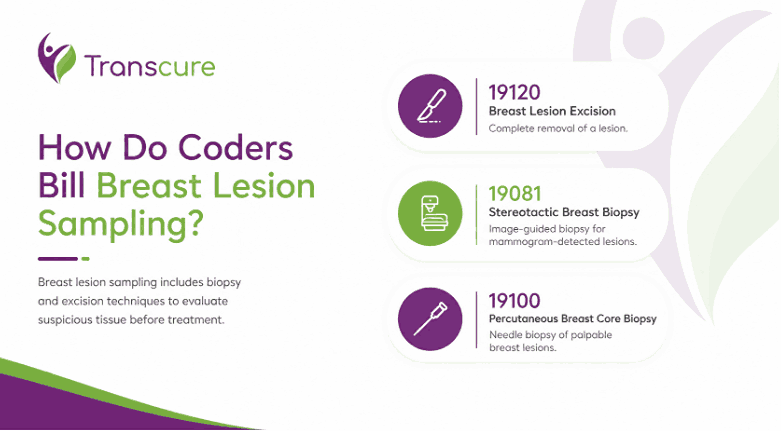
How Do Coders Bill Breast Lesion Sampling?
Breast lesion sampling covers biopsy and excision methods used to check suspicious tissue before deciding on further treatment. Surgeons pick between a needle sample or a full lesion excision depending on what the imaging shows. Three separate codes apply here, each tied to a different technique.
| Code | Descriptor | Category | Common Modifier |
|---|---|---|---|
| 19120 | Breast lesion excision | Breast | 51 |
| 19081 | Stereotactic breast biopsy | Breast | 59 |
| 19100 | Percutaneous breast core biopsy | Breast | 59 |
| 19301 | Partial mastectomy/lumpectomy | Breast | LT/RT |
| 19302 | Partial mastectomy + axillary nodes | Breast | LT/RT |
| 19303 | Total simple mastectomy | Breast | LT/RT |
| 19304 | Subcutaneous mastectomy | Breast | LT/RT |
| 19307 | Modified radical mastectomy | Breast | LT/RT |
CPT 19120: Breast Lesion Excision
Removing an entire cyst, fibroadenoma, or suspicious lump falls under this code, rather than just sampling a piece of it. Surgeons choose this when imaging findings or exam results point to something need full removal. Documentation must describe the lesion size and location clearly. Modifier 51 may apply for multiple lesions removed in one visit.
CPT 19081: Stereotactic Breast Biopsy
Guided imaging technology helps pinpoint the exact tissue location for sampling under this code. Radiologists or surgeons use stereotactic guidance specifically for lesions found on mammograms that aren’t easily felt by hand. The report should confirm imaging guidance was used during the biopsy. This is one of the CPT codes for general surgery tied closely to diagnostic imaging.
CPT 19100: Percutaneous Breast Core Biopsy
A needle removes a small tissue core through the skin without any imaging guidance under this code. Surgeons rely on this method when a lump can be felt directly during physical exam. Clinical notes should state the palpable finding that prompted the biopsy. Billing 19081 instead would misstate the guidance method actually used.
What Codes Apply to Skin and Wound Removal?
Skin lesion excision and wound debridement both involve removing unwanted tissue, but for very different reasons. Surgeons excise skin growths to check or treat them, while debridement clears dead or damaged tissue from a wound. Depth and purpose decide which code fits each case.
| Code | Descriptor | Category | Common Modifier |
|---|---|---|---|
| 11402 | Benign skin lesion excision | Skin/Soft Tissue | 51 |
| 11602 | Malignant skin lesion excision | Skin/Soft Tissue | 51 |
| 11042 | Subcutaneous debridement | Skin/Soft Tissue | 59 |
| 11043 | Muscle/fascia debridement | Skin/Soft Tissue | 59 |
| 11044 | Bone debridement | Skin/Soft Tissue | 59 |
| 10060 | Simple abscess drainage | Skin/Soft Tissue | 59 |
| 10080 | Simple pilonidal drainage | Skin/Soft Tissue | 59 |
| 11770 | Simple pilonidal excision | Skin/Soft Tissue | 51 |
| 11771 | Extensive pilonidal excision | Skin/Soft Tissue | 51 |
| 11772 | Complicated pilonidal excision | Skin/Soft Tissue | 22 |
CPT 11402: Benign Skin Lesion Excision
Removing a non-cancerous skin lesion growth on the trunk, arms, or legs falls under this size-based code. Pathology confirming benign status supports the medical necessity behind billing here. The operative note should record the lesion’s measured size in centimeters. Modifier 51 may apply when multiple lesions are removed in one visit.
CPT 11602: Malignant Skin Lesion Excision
A cancerous skin lesion of similar size in the same body region is billed under this separate code instead. Pathology results confirming malignancy are what distinguish this from the benign version above. Coders should never assume malignancy status without a documented pathology report. This is one of the common general surgery CPT codes tied to skin cancer removal.
CPT 11042: Subcutaneous Debridement
Clearing dead tissue down to the fat layer of a wound, rather than removing a lesion, applies here. Chronic wounds, infections, or pressure injuries commonly support billing this code. Documentation must state the wound’s depth and the total area treated. Frequency limits may apply if debridement is repeated often on the same wound site.
How Is Central Venous Access Coded?
Central venous access places a catheter or port into a large vein for long-term medication, chemotherapy, or nutrition delivery. Surgeons choose between tunneled and non-tunneled devices depending on how long the patient needs access. For a broader overview of surgical coding and billing considerations, see the general surgery billing guide, where duration of use and device type help determine which code applies.
| Code | Descriptor | Category | Common Modifier |
|---|---|---|---|
| 36556 | Non-tunneled central catheter, adult | Vascular Access | 59 |
| 36558 | Tunneled catheter, no port, adult | Vascular Access | 59 |
| 36561 | Tunneled port placement, adult | Vascular Access | 59 |
| 36563 | Tunneled catheter, with pump | Vascular Access | 59 |
| 36569 | PICC line, no port, adult | Vascular Access | 59 |
| 36571 | PICC line, with port, adult | Vascular Access | 59 |
| 36589 | Removal, tunneled catheter | Vascular Access | 59 |
| 36590 | Removal, tunneled port device | Vascular Access | 59 |
CPT 36556: Non-Tunneled Central Catheter, Adult
A temporary catheter placed directly into a central vein without tunneling under the skin falls under this code. Surgeons typically use this for short-term needs like ICU care or urgent medication delivery. Documentation should note the insertion site and clinical reason for placement. This code applies only to patients aged 5 or older.
CPT 36558: Tunneled Catheter, No Port, Adult
Longer-term access needs a tunneled catheter routed under the skin before entering the vein, without an implanted port attached. Surgeons choose this for extended treatment like long-course antibiotics or dialysis access. The note must confirm the tunneling technique used during placement. Skipping this detail could lead to confusion with the non-tunneled code above.
CPT 36561: Tunneled Port Placement, Adult
A fully implanted port beneath the skin, connected to a tunneled catheter, gets billed under this code instead. Cancer patients needing repeated chemotherapy access commonly justify this procedure. Operative notes should describe both the port placement and the tunneled catheter route. This is one of the CPT codes for general surgery entries tied closely to oncology support.
Which Codes Cover Thymus Gland Removal?
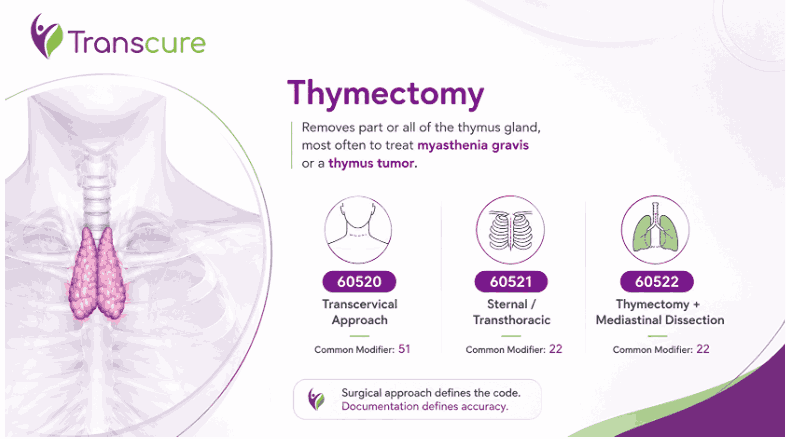
Thymectomy removes part or all of the thymus gland, most often to treat myasthenia gravis or a thymus tumor. Surgeons choose their surgical route based on how much access the case requires. Two of these codes differ mainly by the incision approach used.
| Code | Descriptor | Category | Common Modifier |
|---|---|---|---|
| 60520 | Thymectomy, transcervical approach | Thymus | 51 |
| 60521 | Thymectomy, sternal/transthoracic | Thymus | 22 |
| 60522 | Thymectomy + mediastinal dissection | Thymus | 22 |
CPT 60520: Thymectomy, Transcervical Approach
Removing thymus tissue through a small neck incision, avoiding the chest entirely, falls under this code. Surgeons favor this route for smaller cases needing less invasive access. The operative note should confirm the neck-only surgical field. Recovery details rarely affect coding, but the incision location always must be documented.
CPT 60521: Thymectomy, Sternal/Transthoracic
A larger surgical field through the chest, either by splitting the sternum or entering from the side, applies here. Bigger thymus tumors or cases needing wider visibility often require this approach instead. Documentation must specify which chest access method was used. Choosing 60520 instead would misstate the surgical field actually entered.
How Do Coders Choose Codes For Open Adrenalectomy?
Open adrenalectomy treats adrenal tumors, hormone imbalances, and other gland disease through a traditional surgical incision. Surgeons access the gland via the abdomen, back, or side depending on the case. Whether nearby tissue also needs removal is what separates the two codes below.
| Code | Descriptor | Category | Common Modifier |
|---|---|---|---|
| 60540 | Open adrenalectomy | Adrenal | 51 |
| 60545 | Open adrenalectomy + tumor excision | Adrenal | 22 |
| 60650 | Laparoscopic adrenalectomy | Adrenal | 51 |
CPT 60540: Open Adrenalectomy
Surgeons bill this code for removing part or all of one adrenal gland through an open approach. Hormone-producing tumors and suspicious masses typically justify the procedure on medical necessity grounds. The operative report needs to state the surgical approach and how much gland tissue came out. Modifier 51 may apply during multi-procedure sessions.
CPT 60545: Open Adrenalectomy + Tumor Excision
A tumor spreading into nearby retroperitoneal tissue pushes this case into a different code entirely. That extra tissue removal, beyond the adrenal gland itself, is the deciding factor here. Notes must describe the additional tumor excised alongside the gland. Reporting 60540 in this scenario would understate the actual surgical scope performed.
How Should Coders Differentiate Superficial and Deep Lymph Node Biopsies?
Lymph node biopsy checks whether cancer or infection has spread beyond the original site being treated. Surgeons sample nodes at different depths depending on what imaging or exam findings suggest. Node location and access depth decide which of these two codes applies.
| Code | Descriptor | Category | Common Modifier |
|---|---|---|---|
| 38500 | Superficial lymph node biopsy | Lymph Nodes | 51 |
| 38525 | Deep axillary node biopsy | Lymph Nodes | 51 |
| 38745 | Complete axillary dissection | Lymph Nodes | 51 |
CPT 38500: Superficial Lymph Node Biopsy
Sampling a lymph node sitting close to the skin surface, such as in the neck or groin, falls under this code. Surgeons choose this when the node can be reached without extensive tissue dissection. The operative note should confirm the superficial location and the reason biopsy was needed. Modifier 51 may apply for multi-site sampling.
CPT 38525: Deep Axillary Node Biopsy
Nodes buried deeper in the axilla, past the surface tissue, require a more involved dissection covered by this separate code instead. Surgeons often bill this specifically when a partial mastectomy doesn’t already include full axillary clearance. Documentation must state the depth reached and why deeper sampling was clinically necessary.
Why Do Some Trauma Cases Need a Second Surgery?
Trauma and exploratory surgery covers opening the abdomen to find and control severe injury or unexplained bleeding. Some cases need a planned return trip through the same incision days later. Picking the right code between a first surgery and a repeat one matters for accurate payment.
| Code | Descriptor | Category | Common Modifier |
|---|---|---|---|
| 49000 | Exploratory laparotomy | Trauma/Exploratory | 51 |
| 49002 | Reopening of recent laparotomy | Trauma/Exploratory | 22 |
| 49020 | Peritoneal abscess drainage, open | Trauma/Exploratory | 51 |
CPT 49000: Exploratory Laparotomy
Opening the abdomen to look for the source of injury, bleeding, or unclear symptoms falls under this code. Surgeons use it broadly across trauma cases before deciding on further treatment steps. The operative note should state the reason exploration was clinically necessary. This code often gets bundled into whatever definitive procedure follows.
CPT 49002: Reopening of Recent Laparotomy
Returning through the same recent incision, often for damage-control cases needing a planned second look, applies here instead. Surgeons commonly use this after packing the abdomen to control severe bleeding during the first surgery. Documentation must reference the original operation and the reason for reentry. Modifier 22 may apply for added surgical complexity.
Which Coding Mistakes Cost General Surgery Practices the Most?
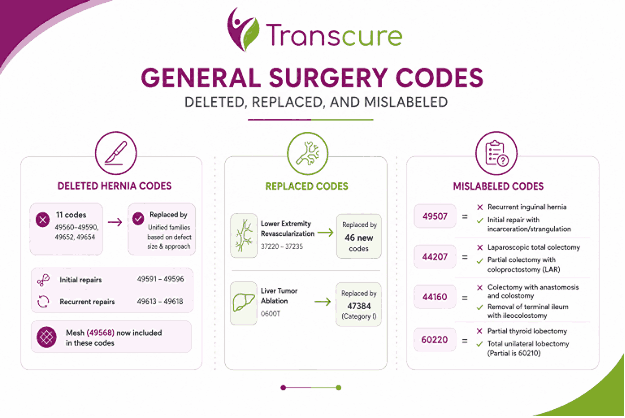
Even experienced coders make consistent mistakes across common general surgery CPT codes. For any general surgeon, a company offering expert medical coding services for general surgery is the best choice to outsource their billing workflow. Below are the errors seen most often across appendectomy, hernia, colorectal, and other categories in this guide, along with the fix for each one.
Recurrent Hernia Miscoded as Initial (or Vice Versa)
Billing 49505 or 49507 for a hernia that’s actually a repeat repair on the same side triggers a mismatch with the patient’s surgical history.
Fix: Confirm prior repair status from the chart before selecting between 49505/49507 (initial) and 49520/49521 (recurrent).
Deleted Hernia Codes Still in Use
Older ventral, umbilical, and incisional hernia codes like 49585 and 49652 were deleted in 2023 and no longer processed correctly.
Fix: Replace them with the current 49591-49596 (initial) or 49613-49618 (recurrent) codes, sized by defect length.
Partial Colectomy Billed as Total (or the Reverse)
Code 44207 covers partial colectomy with low anterior resection, not total colectomy, a mix-up that appears often in coding references.
Fix: Use 44210, 44211, or 44212 for true total colectomy, and reserve 44207 for partial resections with coloproctostomy.
Missing Global Period Modifier
Billing a routine post-op visit separately inside a 10-day or 90-day global window gets denied automatically under Medicare rules.
Fix: Apply modifier 24, 78, or 79 only when the visit is genuinely unrelated, a complication, or a separate procedure.
Modifier 25 Applied Without Distinct Documentation
Appending modifier 25 to an E/M visit that isn’t clearly separate from the same-day procedure is one of the most audited patterns in general surgery.
Fix: Confirm the visit note stands alone with its own history, exam, and decision-making before applying modifier 25.
Wrong Assistant Surgeon Modifier
Using modifier 80 when the case actually involved a PA or NP assistant, rather than a physician, results in incorrect reimbursement.
Fix: Match the modifier to the assistant’s credential: 80/81/82 for physicians, AS for PA or NP.
Unbundled NCCI Code Pairs
Billing two codes that NCCI edits classify as mutually exclusive, such as certain colectomy and lysis-of-adhesions combinations, triggers an automatic denial.
Fix: Run every multi-code claim through an NCCI edit checker before submission, and append modifier 59 only when the services were genuinely distinct.
Incomplete Operative Documentation
A vague operative note missing surgical approach, conversion details, or complications leaves every code tied to that note vulnerable to denial.
Fix: Require surgeons to document approach, findings, and any deviation from the planned procedure before coding begins.
Missing Prior Authorization on Elective Cases
Scheduling bariatric, vascular, or other elective procedures without confirmed payer approval leads to immediate, non-appealable denials.
Fix: Build a hard stop in scheduling workflows that blocks OR booking until authorization is confirmed on file.
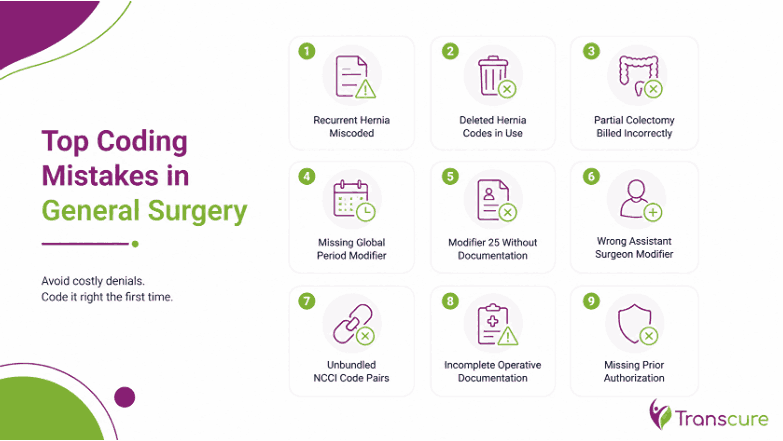
General Surgery Codes That Are Deleted, Replaced, and Mislabeled
Coding guides and billing sheets often carry forward numbers that stopped working years ago. Here is a clear record of what changed, what replaced it, and what commonly gets described wrong.
Deleted Hernia Codes
CPT removed several older hernia repair codes in 2023, though many billing references still list them as active. The affected codes are 49560, 49565, 49570, 49572, 49580, 49582, 49585, 49587, 49590, 49652, and 49654. All of them covered umbilical, ventral, incisional, epigastric, and spigelian hernia repair under separate, technique-specific numbers.
Every one of these now falls under a single unified family based on defect size and approach. Initial repairs use 49591 through 49596. Recurrent repairs use 49613 through 49618. Mesh placement, which used to require its own add-on code (49568), is now built into these same codes rather than billed separately.
Replaced Vascular and Liver Codes
Two other categories saw meaningful replacements heading into 2026. Lower extremity revascularization codes 37220 through 37235 were retired and replaced by a set of 46 new codes covering the same procedures with updated specificity. Liver tumor ablation moved from a temporary Category III code, 0600T, to a permanent Category I code, 47384, giving the procedure standard payer recognition it lacked before.
Mislabeled Codes Still in Circulation
Some codes were never deleted but get described incorrectly often enough to cause real billing errors. Modifier 49507 gets frequently mislabeled as a recurrent inguinal hernia code, when it actually covers an initial repair with incarceration or strangulation. Recurrent inguinal cases belong under 49520 and 49521 instead.
Code 44207 faces a similar problem, regularly described as laparoscopic total colectomy. Its actual scope is partial colectomy with a coloproctostomy connection, commonly known as a low anterior resection. True total colectomy sits under 44210, 44211, or 44212.
Two more codes carry descriptor errors worth flagging. 44160 gets mislabeled as colectomy with anastomosis and colostomy, when its real definition covers removal of the terminal ileum with an ileocolostomy connection. 60220 often gets called a partial thyroid lobectomy, but the code actually applies to a total unilateral lobectomy. The genuine partial version is 60210.
Frequently Asked Questions About General Surgery CPT Codes
What is the CPT code for a general surgery consult?
General surgery consults use standard E/M codes 99242–99245 for outpatient consults, or 99202–99215 for new and established office visits, depending on payer consult code acceptance and visit complexity.
What are the most common general surgery CPT codes?
The most billed codes include 44950 and 44970 for appendectomy, 47562 for laparoscopic cholecystectomy, 49505 for inguinal hernia repair, and 44140 for partial colectomy with anastomosis.
How do I know which billing company handles general surgery coding correctly?
Look for AAPC-certified coders with surgical specialty experience, low denial rates, and transparent reporting, the qualities that separate the best general surgery billing companies from generalist vendors.