The default hypothyroidism ICD-10 code is E03.9, a billable code for unspecified hypothyroidism cases. Parent category E03 sits in Chapter 4 of ICD-10-CM, among endocrine and metabolic diseases. However, the cause matters, because Medicare and commercial payers expect the most specific code.
Hashimoto’s thyroiditis, postprocedural hypothyroidism, and drug-induced cases each carry their own codes beyond E03.9. Relying on unspecified codes at every chronic visit invites audits, record requests, and denials. The official FY 2027 ICD-10-CM Coding Guidelines, effective October 1, 2026, govern code assignment.
Clinicians confirm the diagnosis with elevated TSH levels, as American Thyroid Association guidance describes. This guide explains billable codes, documentation requirements, CPT pairings, and denial patterns coders encounter.
Hypothyroidism ICD-10 Quick Reference Card
This hypothyroidism ICD-10 quick reference card lists the most common billable codes for providers. Use it to match the documented cause with an E03, E06, or E89 code. E03.9 remains the default, but each specific code below reduces audit risk and denials.
| Code | Description | Key Rule |
|---|---|---|
| E03.9 | Hypothyroidism, unspecified | Use when providers document hypothyroidism without any stated cause; avoid it once etiology appears. |
| E03.8 | Other specified hypothyroidism | Use when providers document a specific cause that no other hypothyroidism code fully captures. |
| E03.2 | Hypothyroidism due to medicaments and other exogenous substances | Report for drug-induced cases and add the adverse-effect T-code identifying the drug when applicable. |
| E03.4 | Atrophy of thyroid (acquired) | Use only when providers document acquired thyroid atrophy, never for congenital or unspecified hypothyroidism. |
| E03.5 | Myxedema coma | Reserve for life-threatening decompensated hypothyroidism with altered mental status, never routine chronic management visits. |
| E03.0 / E03.1 | Congenital hypothyroidism with diffuse goiter / without goiter | Report for hypothyroidism present at birth; goiter documentation decides between codes E03.0 and E03.1. |
| E02 | Subclinical iodine-deficiency hypothyroidism | Use only when providers document iodine deficiency as the cause; E03 codes are excluded. |
| E06.3 | Autoimmune thyroiditis | Report for documented Hashimoto’s thyroiditis; add an E03 code only if hypothyroidism is documented. |
| E89.0 | Postprocedural hypothyroidism | Use after thyroidectomy or other thyroid procedures; never report it together with code E03.9. |
What Is the ICD-10 Code for Hypothyroidism?
The ICD-10 code for hypothyroidism is E03.9, a billable code that means hypothyroidism, unspecified. The tabular list places myxedema NOS under E03.9 as an inclusion term for coders. Coders assign it when the chart documents an underactive thyroid without any stated cause.
Where Does E03.9 Sit in ICD-10-CM?
E03.9 sits in Chapter 4 of ICD-10-CM, which covers endocrine, nutritional, and metabolic diseases (E00–E89). Within that chapter, E03.9 falls under the disorders of the thyroid gland block, E00–E07. E03 is the parent category, other hypothyroidism, and holds eight specific billable child codes.
Is E03.9 a Billable ICD-10 Code?
E03.9 is a billable code that providers can submit directly on professional insurance claims. E03 itself is a non-billable parent category, so claims need a specific child code.
How Do ICD-10-CM, WHO ICD-10, and ICD-9 Differ for Hypothyroidism?
The WHO publishes ICD-10 for global statistics, while ICD-10-CM serves United States billing claims. The ICD-9 code for the same diagnosis was 244.9, which ICD-10 replaced in 2015.
CODING RULE: Report E03.9 only when the provider documents hypothyroidism without any stated cause.
Complete Hypothyroidism ICD-10 Code List (E03 Family)
The E03 family holds eight billable hypothyroidism codes, each tied to a documented cause. Coders choose among them by reading the provider’s note for onset, cause, and severity. E02 and E89.0 sit outside E03 because the category carries Excludes1 notes for both.
Which Codes Report Congenital Hypothyroidism (E03.0 and E03.1)?
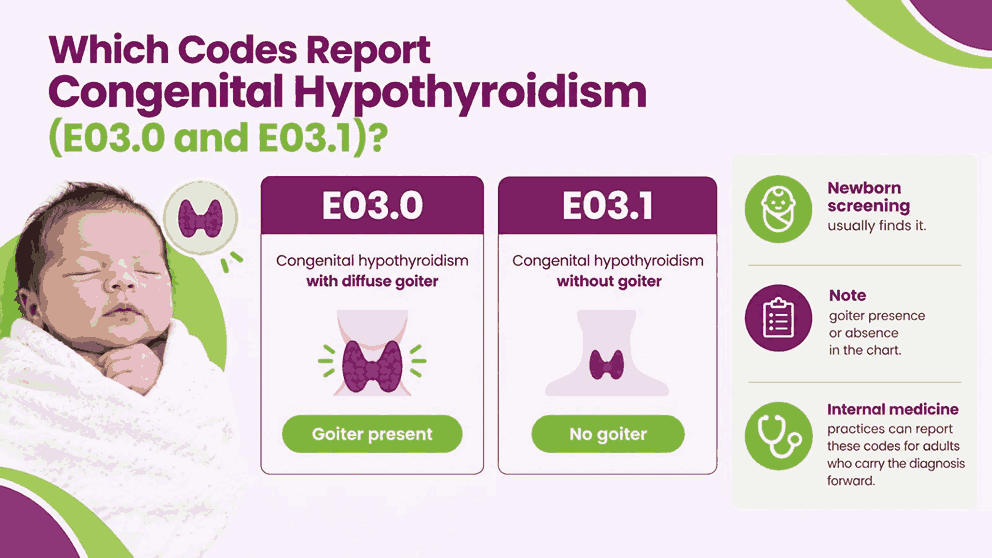
E03.0 reports congenital hypothyroidism with diffuse goiter, while E03.1 reports congenital hypothyroidism without goiter. Newborn screening usually finds it, so the chart should note goiter presence or absence. Internal medicine practices can report these codes for adults who carry the diagnosis forward.
How Is Drug-Induced Hypothyroidism Coded (E03.2)?
E03.2 reports hypothyroidism due to medicaments and other exogenous substances, like amiodarone or lithium. Coders add a matching adverse-effect T-code, when applicable, to identify the specific causative drug. Documentation must link the thyroid problem to the drug, not just list both together.
What Are E03.3 and E03.4 for Postinfectious and Atrophic Cases?
E03.3 reports postinfectious hypothyroidism, which develops after an infection that damages the thyroid gland. E03.4 reports acquired atrophy of the thyroid and never describes congenital or unspecified hypothyroidism. Neither code applies unless the provider documents the infection or the atrophy by name.
When Is Myxedema Coma (E03.5) Reported?
E03.5 reports myxedema coma, a life-threatening form of decompensated hypothyroidism with altered mental status. Providers reserve it for acute crises, never for routine chronic care visits or follow-ups. Hospital records usually support this code, since patients need urgent inpatient treatment and monitoring.
Which Fits Better: E03.8 or E03.9?
E03.8 reports other specified hypothyroidism, including acquired central (secondary) forms the provider clearly names. E03.9 remains the choice when the note says hypothyroidism without any cause or type. Switch to E03.8 once providers document a specified cause that no other E03 code captures.
The table below compares every E03 code by use, exclusions, and required chart documentation.
| Code | When to Use | When to Avoid | Documentation Needed |
|---|---|---|---|
| E03.0 | Congenital hypothyroidism with diffuse goiter | Goiter absent or acquired onset | Newborn screening result, goiter noted |
| E03.1 | Congenital hypothyroidism without goiter | Goiter present or acquired onset | Congenital onset, goiter absence stated |
| E03.2 | Drug-induced hypothyroidism | Cause not linked to a drug | Drug name, documented link, TSH result |
| E03.3 | Hypothyroidism after thyroid infection | No infection documented | Prior infection, thyroid function results |
| E03.4 | Acquired thyroid atrophy | Congenital or unspecified cases | Atrophy named, supporting labs or imaging |
| E03.5 | Myxedema coma crisis | Routine chronic visits | Mental status change, hypothermia, acute treatment |
| E03.8 | Specified cause no other code captures | No cause stated | Named cause, such as central type |
| E03.9 | No cause documented | Any cause appears in the note | Hypothyroidism diagnosis, TSH, current treatment |
Which ICD-10 Code for Hashimoto’s, Post-Thyroidectomy, and Other Causes?
Cause drives code choice once providers document why the thyroid stopped making enough hormone. Four common causes change the coding path, and each one needs its own rule.
What Is the ICD-10 Code for Hashimoto’s Hypothyroidism (E06.3)?
Hashimoto’s thyroiditis is autoimmune thyroiditis, and ICD-10-CM reports it with the specific code E06.3. The Alphabetic Index points Hashimoto’s disease to E06.3, not to any E03 hypothyroidism code. Providers should document TPO antibody results and the hypothyroidism status for every follow-up visit. Report an E03 code beside E06.3 only when the provider also documents the hypothyroidism.
How Is Postprocedural Hypothyroidism Coded (E89.0)?
E89.0 covers postprocedural hypothyroidism after thyroidectomy, radioactive iodine therapy, or any other thyroid procedures. E03 carries an Excludes1 note for E89.0, so the two codes never appear together. Documentation should name the procedure, its date, and the resulting thyroid hormone replacement therapy.
DENIAL SCENARIO: A practice bills E03.9 after a documented thyroidectomy, and payers reject it. The fix is replacing E03.9 with E89.0 and resubmitting with the surgical documentation attached.
How Is Central or Secondary Hypothyroidism Coded?
Acquired central hypothyroidism, also called secondary hypothyroidism, usually falls under code E03.8 in ICD-10-CM. Pituitary failure behind it may add E23.0 for hypopituitarism when the provider documents it. Confirm both codes in the Tabular List and Index before submitting the final claim.
How Is Hypothyroidism in Pregnancy Coded (O99.28-)?
Hypothyroidism in pregnancy starts with an O99.28- code for endocrine disease complicating the pregnancy. A matching E03.x code follows it to identify the specific type of maternal hypothyroidism. Obstetric chapter codes take sequencing priority, so coders list O99.28- first on every claim.

Subclinical Hypothyroidism ICD-10 Code
Subclinical hypothyroidism means elevated TSH with normal free T4, so coding depends on documentation. Coders struggle with subclinical hypothyroidism ICD-10 coding because only iodine-related cases have dedicated codes.
The sections below cover E02, non-iodine cases, and Alphabetic Index verification for accurate claims.
When Does Subclinical Hypothyroidism Use E02?
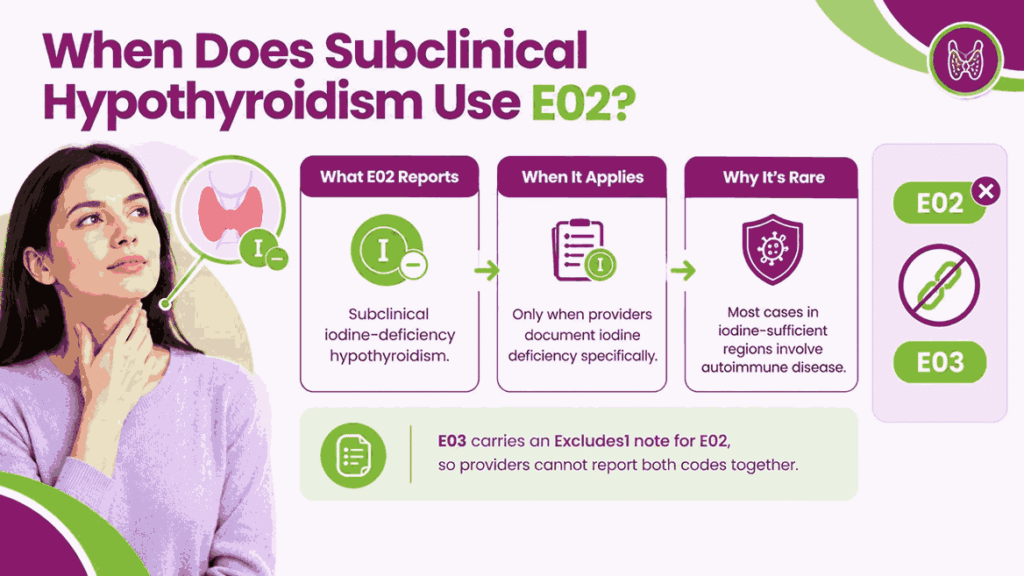
E02 reports subclinical iodine-deficiency hypothyroidism and applies only when providers document iodine deficiency specifically. Most cases in iodine-sufficient regions involve autoimmune disease, so E02 rarely fits routine charts. E03 carries an Excludes1 note for E02, so providers cannot report both codes together.
How Are Non-Iodine Subclinical Cases Coded?
ICD-10-CM has no separate code for subclinical hypothyroidism without a clearly documented iodine-deficiency cause. Many coders report E03.9 when the provider diagnoses subclinical hypothyroidism with an elevated TSH. Without a provider diagnosis, abnormal thyroid function study results may code to R94.6 instead.
Why Verify Subclinical Hypothyroidism Against the Alphabetic Index?
Published sources disagree on subclinical hypothyroidism, so coders should check the Alphabetic Index directly. Payer policies and AHA Coding Clinic advice may change which code a claim uses. Document the TSH value, free T4 result, and symptoms to support the final code.
Excludes1 Notes and Code Sequencing Rules
Excludes1 notes stop coders from reporting two codes that cannot describe one condition together. Sequencing rules then decide which diagnosis appears first on the claim for each visit.
How Do Excludes1 Notes Apply to E03, E00–E02, and E89.0?
Category E03 carries an Excludes1 note for iodine-deficiency related hypothyroidism, codes E00 through E02. The same note excludes postprocedural hypothyroidism, which belongs to E89.0 after any thyroid surgery. Coders therefore never report E03.9 together with E02 or E89.0 for the same condition.
How Is Hypothyroidism Sequenced With Diabetes, CKD, or Obesity?
Many adult internal medicine visits include hypothyroidism besides diabetes, chronic kidney disease, and obesity. Each condition receives its own code when the provider documents that it affects care.
No combination code links hypothyroidism to these conditions, so coders report each one separately. Browse additional ICD-10 codes for internal medicine to code adult comorbid chronic conditions accurately.
The visit’s main reason, such as E11.9 follow-up or E03.9 recheck, sets first-listed status. Add the N18 stage code, plus E11.22 or I12.- when diabetes or hypertension coexist. Report obesity with E66 codes and add the matching Z68 BMI code for severity.
Which Status Code Applies to Long-Term Levothyroxine Use?
Long-term levothyroxine use may add Z79.899, other long-term drug therapy, after coder verification. Status codes show ongoing thyroid hormone replacement but never replace the hypothyroidism diagnosis code.
Documentation Requirements for Hypothyroidism Codes
Clear documentation supports the code, the labs, and the visit level on every claim. Auditors look for MEAT elements showing the provider monitored, evaluated, assessed, or treated hypothyroidism.
What Must the Provider Document in a Hypothyroidism Note?
Every hypothyroidism note needs the provider’s diagnosis, written in plain clinical language without abbreviations. The note should name the etiology, such as Hashimoto’s, thyroidectomy, or a specific medication.
Recent TSH and free T4 results show whether the current therapy controls the hypothyroidism. Current treatment, such as levothyroxine dose and any recent change, belongs in the assessment. The plan should state the next lab date, the dose decision, and follow-up interval.
Which Documentation Checklist Fits Each Code Group?
The table below lists the documentation each code group needs to survive payer review.
| Code Group | Document These Elements |
|---|---|
| E03.9 | Provider diagnosis, TSH, free T4, current treatment, plan |
| E03.0–E03.1 | Congenital onset, newborn screening, goiter status, replacement therapy |
| E03.2 | Named drug, documented link to thyroid function, TSH, drug plan |
| E03.3–E03.4 | Prior infection or atrophy finding, thyroid labs, treatment |
| E03.5 | Altered mental status, hypothermia, acute treatment, inpatient notes |
| E03.8 | Named cause, central or secondary type, pituitary workup if present |
| E06.3 | Hashimoto’s diagnosis, TPO antibody result, TSH, treatment |
| E89.0 | Procedure name and date, postoperative TSH, replacement therapy |
| O99.28- plus E03.x | Pregnancy status, trimester, TSH, dose adjustments |
CPT Codes Commonly Paired with Hypothyroidism ICD-10 Codes
Hypothyroidism is chronic, so paired CPT codes are mostly visits and thyroid lab tests. Explore related CPT codes for internal medicine to pair visits and thyroid labs correctly. The table below lists the CPT codes most often billed with E03 hypothyroidism diagnoses.
| CPT Code | Description | Typical Use With Hypothyroidism |
|---|---|---|
| 99202–99205, 99211–99215 | New and established patient office visits | Evaluation and management of the thyroid condition |
| 84443 | Thyroid-stimulating hormone (TSH) | Diagnosis and levothyroxine dose monitoring |
| 84439 | Thyroxine, free (free T4) | Confirms TSH findings, supports central hypothyroidism workup |
| 84436 | Thyroxine, total (total T4) | Total hormone assessment |
| 84480 | Triiodothyronine, total (T3) | Selected cases needing further thyroid evaluation |
How Do Medical Necessity and Screening Affect Thyroid Test Claims?
Thyroid labs need a diagnosis or symptom that supports medical necessity for each test. Z13.29 reports screening for other suspected endocrine disorders in patients without symptoms or diagnosis. Diagnostic claims should use E03.9 or a specific code instead of the screening code. Medicare and commercial payers may also limit how often TSH testing can be repeated.
When Can CCM (99490) Support Chronic Hypothyroidism Management?
CPT 99490 reports chronic care management for patients with two or more chronic conditions. Hypothyroidism alone cannot qualify, but hypothyroidism plus diabetes or CKD can meet that threshold. Documentation needs patient consent, a comprehensive care plan, and tracked clinical staff time monthly.
Common Denial Patterns in Hypothyroidism Billing
Most hypothyroidism denials trace back to weak documentation, vague codes, or mismatched lab claims. The table below lists five denial types, root causes, and fixes billing teams apply.
| Denial Type | Root Cause | Fix |
|---|---|---|
| Unspecified-Code Overuse | Practices report E03.9 at every visit even after providers document a specific underlying cause. | Update the diagnosis to E06.3, E89.0, or E03.2 once the chart names the cause. |
| Missing Labs | Charts omit recent TSH or free T4 results, so auditors cannot validate the diagnosis. | Attach the latest TSH and free T4 results, and record them in the assessment. |
| Screening Billed as Diagnosis | Billers report Z13.29 on visits where the provider already documented an established hypothyroidism diagnosis. | Report E03.9 or a specific code for diagnostic tests, and reserve Z13.29 for screening. |
| Known Cause Left Uncoded | Coders default to E03.9 although the chart documents thyroidectomy, Hashimoto’s, or a causative drug. | Review the full note, then assign E89.0, E06.3, or E03.2 plus any needed T-code. |
| CPT/ICD Mismatch | Claims pair a thyroid test CPT code with a diagnosis that doesn’t support it. | Link CPT 84443 or 84439 to E03.9 or the specific hypothyroidism code before submission. |
Transcure’s internal medicine billing support audits hypothyroidism claims before submission and fixes coding errors.
Hypothyroidism Coding in Risk Adjustment
Risk adjustment affects Medicare Advantage payments, so accurate hypothyroidism coding matters beyond claim approval.
Does Hypothyroidism Carry HCC Weight in CMS-HCC V28?
E03.9 does not map to a payment HCC in the current CMS-HCC V28 model. This code does map to the Part D RxHCC model for prescription drug plans. E03.8 and E89.0 also appear on RxHCC lists, according to Medicare Advantage plan materials.
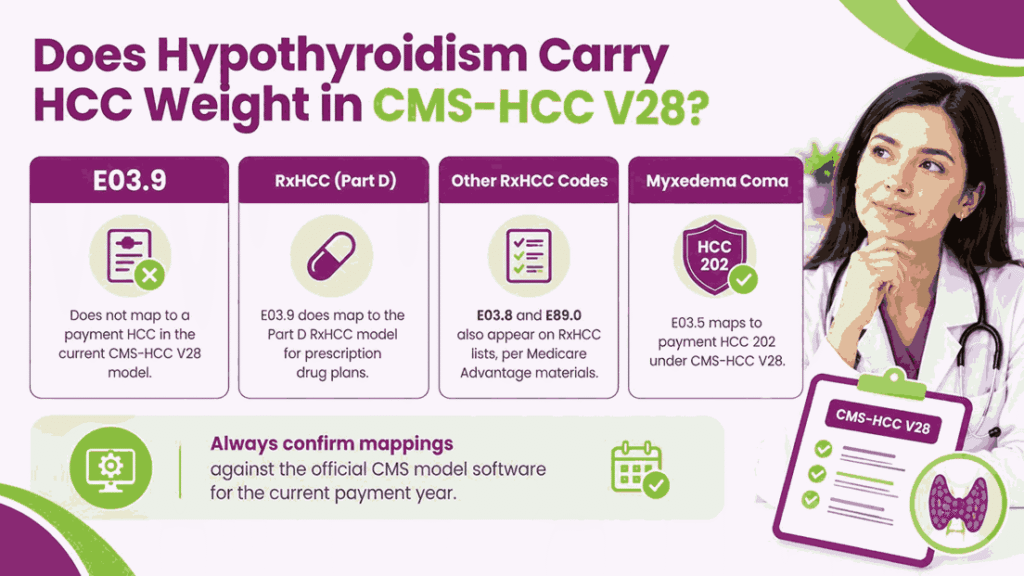
Myxedema coma, E03.5, maps to payment HCC 202 under CMS-HCC V28, so confirm yearly. Always confirm mappings against the official CMS model software for the current payment year.
Why Does Chronic Recapture Still Matter for Hypothyroidism?
Chronic conditions need documentation every calendar year, even when the HCC weight is absent. Annual MEAT documentation keeps the problem list accurate for care coordination and quality reporting. Recapture also protects RxHCC submissions, which depend on diagnoses reported on eligible face-to-face visits.
CODING RULE: Document hypothyroidism using MEAT elements during at least one face-to-face visit yearly. Internal medicine practices should therefore review thyroid problem lists before each annual wellness visit. Thyroid specialists can rely on Transcure’s endocrinology medical billing services for complex hypothyroidism claims.
Frequently Asked Questions
These frequently asked questions answer the most common hypothyroidism ICD-10 coding queries from providers.
What is the ICD-10 Code for Hypothyroidism?
The ICD-10-CM code for hypothyroidism is E03.9, used when providers document no specific cause. Specific documented causes, such as Hashimoto’s or thyroidectomy, require code E06.3 or E89.0 instead.
Is E03.9 Billable?
Yes, E03.9 is a billable ICD-10-CM code that providers can submit directly on claims. The parent category E03 is non-billable, so claims always need a specific child code.
What is the ICD-10 Code for Hashimoto’s Hypothyroidism?
Hashimoto’s thyroiditis is reported with E06.3, the specific ICD-10-CM diagnosis code for autoimmune thyroiditis. Add an E03 code only when the provider also separately documents the hypothyroidism itself.
Can I Code Subclinical Hypothyroidism?
Yes, but E02 applies only when providers document iodine deficiency as the underlying cause. Other subclinical cases need a provider diagnosis and Alphabetic Index confirmation before choosing E03.9.
Can E03.9 and E89.0 be Coded Together?
No, category E03 carries an Excludes1 note that blocks reporting E89.0 together with E03.9. Report E89.0 alone when hypothyroidism follows thyroidectomy, radioactive iodine therapy, or another thyroid procedure.
What is the Code for Hypothyroidism After Thyroidectomy?
The ICD-10-CM code for hypothyroidism after thyroidectomy is E89.0, which reports documented postprocedural hypothyroidism. Document the procedure name, surgery date, and current levothyroxine therapy to support this code.
In addition to the above, visit Transcure’s ICD-10 coding guide for many more specialty code explanations and billing rules.