
Internal medicine practices depend on precise ICD-10-CM diagnosis codes for every single billed patient encounter. The Centers for Medicare and Medicaid Services (CMS) released the 2026 ICD-10-CM diagnosis code files, which contain 487 new codes.
Internists routinely manage complex and overlapping chronic conditions that require accurate diagnosis coding daily. This guide organizes the most common ICD-10 codes for internal medicine by clinical category and condition.

It also walks through real coding examples for hypertension, diabetes, COPD, and chronic kidney disease. You will find denial prevention strategies alongside a practical internal medicine coding audit checklist.
What Are ICD-10-CM Codes for Internal Medicine?
ICD-10-CM is the official diagnostic coding system used across United States healthcare settings nationwide. The Centers for Disease Control and Prevention’s National Center for Health Statistics maintains ICD-10 CM, based on the World Health Organization’s classification.
Internal medicine diagnosis codes identify specific conditions that internists diagnose, treat, and manage very regularly. Common ICD-10 codes for internists cover chronic disease, acute illness, and routine preventive care visits. However, HIPAA regulations legally require these codes on every submitted healthcare insurance claim nationwide.
ICD-10-CM coding for internal medicine often captures several chronic conditions within a single patient visit. Accurate coding directly supports effective internal medicine billing services and significantly affects overall claim reimbursement outcomes. Chronic disease coding in internal medicine therefore demands precision, specificity, and constant regulatory vigilance.
Why ICD-10-CM Coding Matters in Internal Medicine
ICD-10-CM coding directly determines whether an internal medicine practice gets paid accurately and on time. Initial claim denial rates climbed to 11.81% of all claims in 2024, as per Kodiak Solutions revenue cycle data. Our internal medicine medical billing guide explains why accurate coding sits at the center of reversing that trend, and here’s exactly why it matters most:
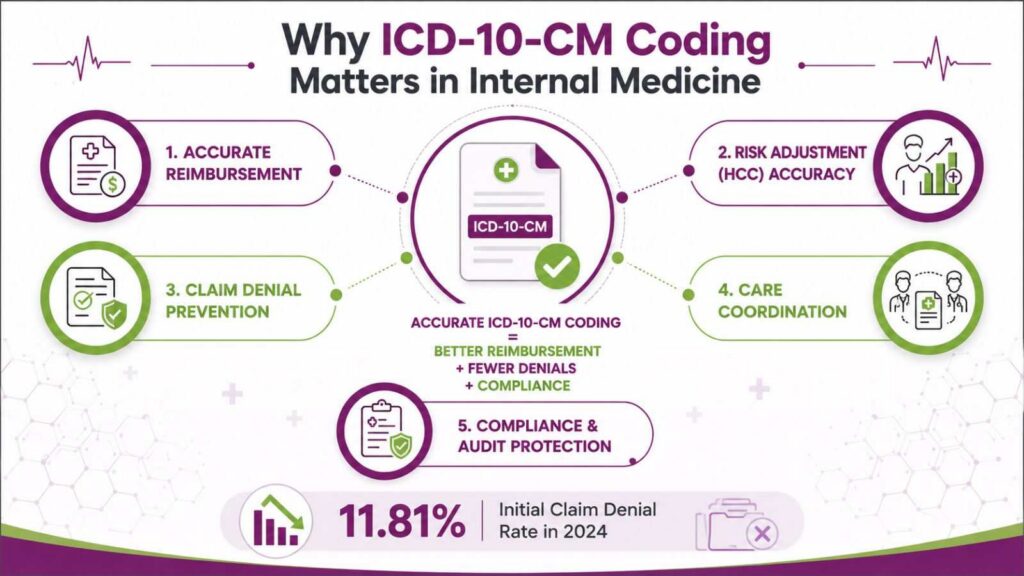
- Accurate Reimbursement: Accurate internal medicine billing codes ensure payers reimburse internists fully and correctly for services rendered.
- Risk Adjustment (HCC) Accuracy: Specific chronic disease coding in internal medicine improves HCC risk-adjustment scores under Medicare Advantage plans.
- Claim Denial Prevention: Precise ICD-10-CM coding for internal medicine directly reduces costly claim denials and resubmission delays significantly.
- Care Coordination Support: Common ICD-10 codes for internists support clear communication between specialists managing shared, chronically complex patients.
- Regulatory Compliance and Audit Protection: HIPAA-mandated internal medicine diagnosis codes protect practices from compliance violations and costly recurring federal audits.
Common ICD-10 Codes Used in Internal Medicine
Internal medicine spans diagnosis codes across nearly every major organ system and medical specialty today. The following categories break down the most common ICD-10 codes internists use clinically every day.
Cardiovascular ICD-10 Codes
Cardiovascular disease remains one of the most frequently coded condition groups in internal medicine practices. Internists must document hypertension, heart failure, and arrhythmia severity precisely to support medical necessity.
| ICD-10 Code | Description |
|---|---|
| I10 | Essential (primary) hypertension |
| I11.0 | Hypertensive heart disease with heart failure |
| I11.9 | Hypertensive heart disease without heart failure |
| I12.9 | Hypertensive chronic kidney disease, stage 1–4, or unspecified |
| I13.10 | Hypertensive heart and CKD without heart failure |
| I13.2 | Hypertensive heart and CKD with heart failure and stage 5 CKD |
| I25.10 | Atherosclerotic heart disease without angina pectoris |
| I48.91 | Unspecified atrial fibrillation |
| I50.9 | Heart failure, unspecified |
| I50.22 | Chronic systolic (congestive) heart failure |
Endocrine ICD-10 Codes
Endocrine coding in internal medicine centers heavily on diabetes management and thyroid function disorders. Documentation must specify diabetes type, complications, and control status for accurate code assignment.
| ICD-10 Code | Description |
|---|---|
| E11.9 | Type 2 diabetes mellitus without complications |
| E11.22 | Type 2 diabetes mellitus with diabetic chronic kidney disease |
| E11.40 | Type 2 diabetes mellitus with diabetic neuropathy, unspecified |
| E11.65 | Type 2 diabetes mellitus with hyperglycemia |
| E11.A | Type 2 diabetes mellitus in remission |
| E10.9 | Type 1 diabetes mellitus without complications |
| R73.03 | Prediabetes |
| E03.9 | Hypothyroidism, unspecified |
| E05.90 | Thyrotoxicosis (hyperthyroidism), unspecified |
Metabolic ICD-10 Codes
Metabolic codes capture lipid disorders, obesity, and electrolyte imbalances that internists routinely monitor. These conditions often drive risk-adjustment scoring and require BMI documentation to support the diagnosis.
| ICD-10 Code | Description |
|---|---|
| E78.5 | Hyperlipidemia, unspecified |
| E78.00 | Pure hypercholesterolemia, unspecified |
| E78.2 | Mixed hyperlipidemia |
| E66.9 | Obesity, unspecified |
| E66.01 | Morbid (severe) obesity due to excess calories |
| Z68.30–Z68.39 | Body mass index (BMI) 30.0–39.9, adult |
| Z68.41–Z68.45 | Body mass index (BMI) 40.0 and above, adult |
| E87.6 | Hypokalemia |
| E86.0 | Dehydration |
Respiratory ICD-10 Codes
Respiratory codes cover COPD, asthma, and acute infections that internists manage across nearly every patient population. Severity and exacerbation status must be documented clearly since they directly affect code specificity.
| ICD-10 Code | Description |
|---|---|
| J44.9 | Chronic obstructive pulmonary disease, unspecified |
| J44.0 | COPD with acute lower respiratory infection |
| J44.1 | COPD with (acute) exacerbation |
| J45.909 | Unspecified asthma, uncomplicated |
| J45.901 | Unspecified asthma with (acute) exacerbation |
| J45.902 | Unspecified asthma with status asthmaticus |
| J20.9 | Acute bronchitis, unspecified |
| J06.9 | Acute upper respiratory infection, unspecified |
| Z87.891 | Personal history of nicotine dependence |
| F17.210 | Nicotine dependence, cigarettes, uncomplicated |
Gastrointestinal ICD-10 Codes
Gastrointestinal complaints make up a large share of internal medicine visits that never require specialty referral. Internists code these conditions based on symptom pattern, chronicity, and any documented complications.
| ICD-10 Code | Description |
|---|---|
| K21.9 | Gastro-esophageal reflux disease without esophagitis |
| K21.0 | Gastro-esophageal reflux disease with esophagitis |
| K58.9 | Irritable bowel syndrome without diarrhea |
| K58.0 | Irritable bowel syndrome with diarrhea |
| K59.00 | Constipation, unspecified |
| K92.2 | Gastrointestinal hemorrhage, unspecified |
| K76.0 | Fatty (change of) liver, not elsewhere classified |
| K29.70 | Gastritis, unspecified, without bleeding |
| R10.9 | Unspecified abdominal pain |
Renal ICD-10 Codes
Renal coding requires internists to document CKD stage precisely since it drives both medical necessity and risk adjustment. Associated conditions like diabetes and hypertension must be linked or sequenced correctly per coding guidelines.
| ICD-10 Code | Description |
|---|---|
| N18.1 | Chronic kidney disease, stage 1 |
| N18.2 | Chronic kidney disease, stage 2 (mild) |
| N18.3 | Chronic kidney disease, stage 3 (moderate) |
| N18.4 | Chronic kidney disease, stage 4 (severe) |
| N18.5 | Chronic kidney disease, stage 5 |
| N18.6 | End-stage renal disease |
| N17.9 | Acute kidney failure, unspecified |
| E11.22 | Type 2 diabetes with diabetic CKD (cross-reference) |
| I12.9 | Hypertensive CKD, stage 1–4 or unspecified (cross-reference) |
Genitourinary ICD-10 Codes
Genitourinary codes cover infections and prostate conditions that internists frequently manage in adult primary care. Documentation should specify site, recurrence, and any complicating factors to support correct code selection.
| ICD-10 Code | Description |
|---|---|
| N39.0 | Urinary tract infection, site not specified |
| N30.00 | Acute cystitis without hematuria |
| N30.01 | Acute cystitis with hematuria |
| N40.0 | Benign prostatic hyperplasia without lower urinary tract symptoms |
| N40.1 | Benign prostatic hyperplasia with lower urinary tract symptoms |
| N41.9 | Inflammatory disease of prostate, unspecified |
| R31.9 | Hematuria, unspecified |
| N28.9 | Disorder of kidney and ureter, unspecified |
| R33.9 | Retention of urine, unspecified |
Neurological ICD-10 Codes
Internists routinely manage common neurological complaints without requiring a specialist neurology referral. Headache, neuropathy, and dizziness codes require documentation of chronicity and any underlying contributing condition.
| ICD-10 Code | Description |
|---|---|
| G43.909 | Migraine, unspecified, not intractable, without status migrainosus |
| R51.9 | Headache, unspecified |
| G62.9 | Polyneuropathy, unspecified |
| E11.40 | Type 2 diabetes with diabetic neuropathy (cross-reference) |
| G47.00 | Insomnia, unspecified |
| R42 | Dizziness and giddiness |
| G20 | Parkinson’s disease |
| G30.9 | Alzheimer’s disease, unspecified |
| R41.9 | Unspecified symptoms and signs involving cognitive functions |
Musculoskeletal ICD-10 Codes
Musculoskeletal codes capture degenerative and structural joint conditions that internists manage alongside chronic disease care. These diagnoses differ from pain-related codes since they describe confirmed structural findings rather than symptoms alone.
| ICD-10 Code | Description |
|---|---|
| M19.90 | Osteoarthritis, unspecified site |
| M17.9 | Osteoarthritis of knee, unspecified |
| M81.0 | Age-related osteoporosis without current pathological fracture |
| M81.8 | Other osteoporosis without current pathological fracture |
| M15.9 | Polyosteoarthritis, unspecified |
| M25.50 | Pain in unspecified joint (cross-reference to Pain-Related) |
| M06.9 | Rheumatoid arthritis, unspecified |
| M79.7 | Fibromyalgia |
Pain-Related ICD-10 Codes
Pain-related codes describe patient-reported symptoms rather than confirmed structural or degenerative diagnoses. Internists must document pain location, duration, and chronicity to select the most specific code available.
| ICD-10 Code | Description |
|---|---|
| M54.50 | Low back pain, unspecified |
| M54.9 | Dorsalgia, unspecified |
| M79.1 | Myalgia |
| M79.18 | Myalgia, other site |
| M25.50 | Pain in unspecified joint |
| M25.561 | Pain in right knee |
| M25.562 | Pain in left knee |
| G89.4 | Chronic pain syndrome |
| G89.29 | Other chronic pain |
| R52 | Pain, unspecified |
Hematology ICD-10 Codes
Hematology codes cover confirmed blood disorders that internists diagnose and monitor through routine lab work. These differ from abnormal findings codes since they represent an established diagnosis, not a pending workup.
| ICD-10 Code | Description |
|---|---|
| D64.9 | Anemia, unspecified |
| D50.9 | Iron deficiency anemia, unspecified |
| D51.0 | Vitamin B12 deficiency anemia due to intrinsic factor deficiency |
| D69.6 | Thrombocytopenia, unspecified |
| D72.829 | Elevated white blood cell count, unspecified |
| D68.9 | Coagulation defect, unspecified |
| D75.9 | Disease of blood and blood-forming organs, unspecified |
Abnormal Laboratory Findings ICD-10 Codes
Abnormal finding codes apply when lab results are outside the normal range but haven’t yet reached a confirmed diagnosis. Internists use these R-chapter codes during workup, before a definitive condition can be coded.
| ICD-10 Code | Description |
|---|---|
| R74.8 | Abnormal levels of other serum enzymes |
| R73.9 | Hyperglycemia, unspecified |
| R79.89 | Other specified abnormal findings of blood chemistry |
| R97.20 | Elevated prostate-specific antigen (PSA) |
| R94.5 | Abnormal results of liver function studies |
| R79.1 | Abnormal coagulation profile |
| R78.81 | Abnormal findings of blood-alcohol level |
| R41.83 | Borderline intellectual functioning |
Infectious Disease ICD-10 Codes
Infectious disease codes cover acute, systemic infections that internists diagnose and treat in outpatient settings. Documentation should specify the organism or site of infection whenever testing confirms a causative agent.
| ICD-10 Code | Description |
|---|---|
| J06.9 | Acute upper respiratory infection, unspecified |
| J18.9 | Pneumonia, unspecified organism |
| N39.0 | Urinary tract infection, site not specified |
| A41.9 | Sepsis, unspecified organism |
| B96.20 | Unspecified E. coli as cause of disease |
| U07.1 | COVID-19 |
| B34.9 | Viral infection, unspecified |
| A09 | Infectious gastroenteritis and colitis, unspecified |
Dermatological ICD-10 Codes
Dermatological codes capture localized skin conditions internists manage without requiring dermatology referral. Cellulitis is coded here rather than under infectious disease since it presents as a localized skin finding.
| ICD-10 Code | Description |
|---|---|
| L03.90 | Cellulitis, unspecified |
| L23.9 | Allergic contact dermatitis, unspecified cause |
| L30.9 | Dermatitis, unspecified |
| L20.9 | Atopic dermatitis, unspecified |
| L40.9 | Psoriasis, unspecified |
| L98.9 | Disorder of the skin and subcutaneous tissue, unspecified |
| L03.116 | Cellulitis of right lower limb |
| L03.115 | Cellulitis of left lower limb |
Preventive Care ICD-10 Codes
Preventive care codes support annual wellness visits and routine health maintenance encounters in internal medicine. These Z-chapter codes justify the visit type itself rather than describing an active medical condition.
| ICD-10 Code | Description |
|---|---|
| Z00.00 | Encounter for general adult medical exam without abnormal findings |
| Z00.01 | Encounter for general adult medical exam with abnormal findings |
| Z00.129 | Encounter for routine child health exam without abnormal findings |
| Z02.9 | Encounter for administrative examination, unspecified |
| Z71.3 | Dietary counseling and surveillance |
| Z71.89 | Other specified counseling |
| Z71.9 | Counseling, unspecified |
Screening ICD-10 Codes
Screening codes justify tests ordered to detect disease before any symptoms or diagnosis are present. Internists use these Z-chapter codes to support medical necessity for routine, guideline-based screening services.
| ICD-10 Code | Description |
|---|---|
| Z12.11 | Encounter for screening for malignant neoplasm of colon |
| Z13.1 | Encounter for screening for diabetes mellitus |
| Z13.220 | Encounter for screening for lipoid disorders |
| Z13.31 | Encounter for screening for depression |
| Z13.6 | Encounter for screening for cardiovascular disorders |
| Z12.31 | Encounter for screening mammogram for malignant neoplasm of breast |
| Z11.59 | Encounter for screening for other viral diseases |
| Z13.89 | Encounter for screening for other disorder |
Encounter and Immunization ICD-10 Codes
Encounter and immunization codes document the reason for a visit when no active illness is present. These codes also support vaccine administration billing, which internists report at wellness and follow-up visits.
| ICD-10 Code | Description |
|---|---|
| Z23 | Encounter for immunization |
| Z00.00 | Encounter for general adult medical exam without abnormal findings |
| Z09 | Encounter for follow-up exam after completed treatment |
| Z76.89 | Persons encountering health services in other specified circumstances |
| Z79.899 | Other long term (current) drug therapy |
| Z79.4 | Long term (current) use of insulin |
| Z87.891 | Personal history of nicotine dependence |
How to Apply ICD-10 Codes for Internal Medicine Conditions
The codes listed above serve mainly as a quick, handy, and categorized ICD-10-CM diagnosis reference list. This section instead shows exactly how coders apply those codes in real, documented encounters daily. The following worked examples walk carefully through hypertension, diabetes, COPD, CKD, and multi-condition visits:
Hypertension Coding Example
Hypertension coding depends entirely on whether other chronic conditions are causally and clinically linked. ICD-10-CM presumes a causal relationship between hypertension and heart involvement and between hypertension and kidney involvement.
| Clinical Scenario | ICD-10-CM Code | Coding Note |
|---|---|---|
| Uncomplicated essential hypertension | I10 | No heart or kidney involvement documented |
| Hypertension with heart disease | I11.0 (with HF) or I11.9 | Causal link assumed unless documented otherwise |
| Hypertension with CKD | I12.0 or I12.9 | Codes from category I12 are assigned when both hypertension and a condition classifiable to category N18 (CKD) are present. |
| Hypertension with heart failure and CKD | I13.0–I13.2 | Use the I13 combination code, not I11 + I12 separately |
| Hypertensive crisis | I16.0 (urgency) / I16.1 (emergency) | Code also the underlying hypertension type |
Diabetes Coding Example
Diabetes coding always starts with correctly identifying the diabetes type before adding specific complication codes. Each documented diabetes complication, from neuropathy to CKD, requires its own unique combination billing code.
| Clinical Scenario | ICD-10-CM Code | Coding Note |
|---|---|---|
| Type 2 diabetes, no complications | E11.9 | Default code when no complication is documented |
| Type 1 diabetes, no complications | E10.9 | Used only when insulin-dependent onset is confirmed |
| Diabetes with hyperglycemia | E11.65 | Documents elevated glucose without a separate complication |
| Diabetes with neuropathy | E11.40 | Add G62.9 if further neuropathy detail is needed |
| Diabetes with CKD | E11.22 | Sequence with N18.x to identify CKD stage |
| Diabetes with retinopathy | E11.319 | Specify laterality and whether macular edema is present |
| Diabetes, long-term insulin use | Z79.4 | Reported as an additional code, not a complication |
COPD and Asthma Coding Example
COPD coding must clearly distinguish between stable disease and acute exacerbation status documented clinically today. Asthma codes similarly separate uncomplicated disease from any documented severe acute exacerbation or status asthmaticus.
| Clinical Scenario | ICD-10-CM Code | Coding Note |
|---|---|---|
| Stable COPD | J44.9 | No acute exacerbation or infection documented |
| COPD with acute exacerbation | J44.1 | Use when symptoms are actively worsening |
| COPD with acute lower respiratory infection | J44.0 | Sequence a secondary code for the infection type |
| Uncomplicated asthma | J45.909 | No exacerbation or status asthmaticus documented |
| Asthma with acute exacerbation | J45.901 | Symptoms worsening but not yet life-threatening |
| Asthma with status asthmaticus | J45.902 | Severe, unresponsive exacerbation requiring urgent care |
Chronic Kidney Disease Coding Example
CKD coding always requires documenting the exact disease stage from recent available laboratory eGFR results. Dialysis dependence, ESRD status, and any concurrent acute kidney injury must always be coded separately.
| Documentation Element | ICD-10-CM Code | Coding Note |
|---|---|---|
| CKD stage 3, moderate | N18.3 | Based on eGFR 30–59 mL/min/1.73m² |
| CKD stage 4, severe | N18.4 | Based on eGFR 15–29 mL/min/1.73m² |
| CKD stage 5 | N18.5 | eGFR below 15, no dialysis yet |
| End-stage renal disease | N18.6 | Use when dialysis dependence is documented |
| Hypertensive CKD | I12.0 or I12.9 | Causal link with hypertension presumed automatically |
| Diabetic CKD | E11.22 | Sequence before the N18.x stage code |
| Acute kidney injury with CKD | N17.9 | Coded in addition to the chronic N18.x code |
Multiple Chronic Conditions During One Visit
Coders should only report specific chronic conditions actively evaluated, monitored, assessed, or treated that day. Passive history-list diagnoses not actually addressed during that specific encounter should never be coded.
| Condition | ICD-10-CM Code | Reported This Visit? |
|---|---|---|
| Hypertension, medication adjusted | I10 | Yes — actively managed |
| Type 2 diabetes, A1C reviewed | E11.9 | Yes — actively managed |
| Hyperlipidemia, statin discussed | E78.5 | Yes — actively managed |
| CKD stage 3, labs reviewed | N18.3 | Yes — actively managed |
ICD-10 Denial Prevention Strategies for Internal Medicine Practices
Denials rarely stem from bad coding alone, as they’re usually a process gap somewhere along the way. CAQH reports that U.S. healthcare avoided an estimated $258 billion in administrative costs in 2024 through automation. The strategies below target the specific gaps that most often cause internal medicine claim denials.
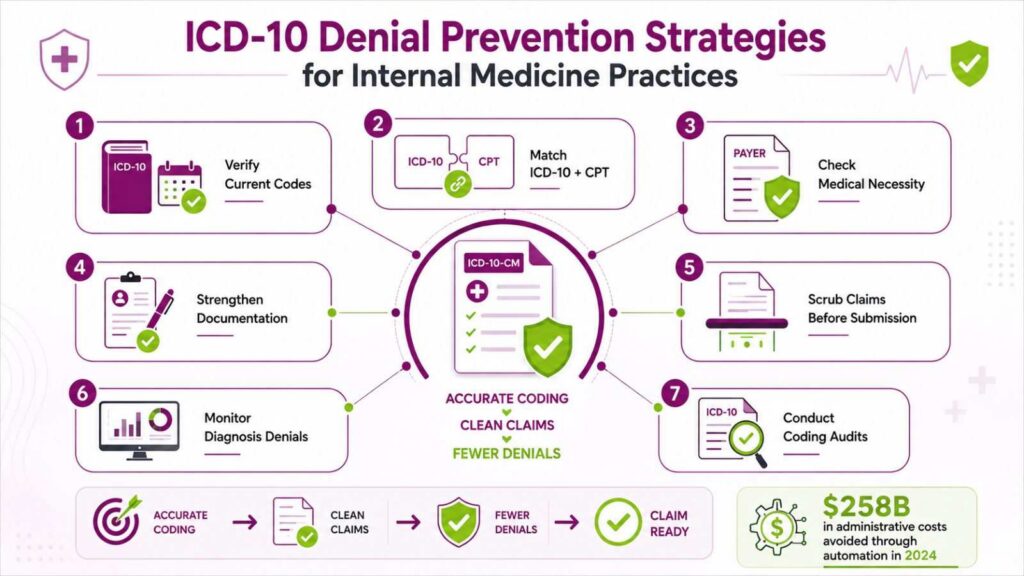
- Verify the Current ICD-10-CM Code Set: CMS retires, revises, and adds new diagnosis codes every single October first, without fail. Practices using medical coding services must confirm the active code set matches the actual date of service used.
- Match Diagnosis Codes With CPT Services: Every diagnosis code must always logically and correctly support the specific CPT services covered in our internal medicine CPT codes guide. Mismatched pairs, like screening codes paired with problem-focused visits, often trigger medical necessity denials.
- Check Payer Medical Necessity Policies: Medicare, Medicare Advantage, and commercial payers each maintain their own distinct necessity policies. Skipping this check remains one of the most preventable causes of internal medicine denials.
- Improve Provider Documentation: Coders can only code conditions that providers actually document with sufficient clinical specificity. Imprecise notes like “diabetes, stable” fail to support the required ICD-10-CM coding specificity level.
- Use Claim Scrubbing Before Submission: Automated scrubbing software catches missing modifiers and invalid code combinations before final submission today. This step catches sequencing errors that manual review frequently overlooks under constant time pressure.
- Monitor Diagnosis-Related Denials: Tracking denials by diagnosis category, not just by payer, consistently reveals recurring coding gaps. This pattern data turns a reactive denial process into a preventive coding practice.
- Conduct Routine Coding Audits: Scheduled internal audits catch coder drift before payers ever flag it through costly denials. This is especially important for high-risk categories like hypertension and diabetes combination coding.
Internal Medicine ICD-10 Coding Audit Checklist
This checklist helps internal medicine practices confirm coding accuracy before every single final claim submission. Internal medicine ICD-10 codes require this extra verification layer given their frequent structural combination-code complexity. Run through each checklist item carefully below before finalizing any internal medicine coding submission:
Confirm the Date-of-Service Code Set
Always match diagnosis codes to the ICD-10-CM code set effective on that exact service date. Codes retired or newly added after October first should never appear on earlier documented encounters.
Verify Diagnosis Specificity
Confirm that every code reflects the highest specificity level the documentation fully and clearly supports. Unspecified codes like E11.9 should only apply when truly no complication is clearly documented anywhere.
Review Diagnosis Sequencing
Sequence the primary reason for the visit first, followed by all relevant supporting diagnoses today. Combination codes like I13 must always be sequenced before their required specific additional stage codes.
Confirm Medical Necessity
Every diagnosis code should clearly and logically justify the specific CPT service billed alongside it. Check payer-specific medical necessity policies carefully before submitting any final diagnosis-driven internal medicine claim.
Check Documentation Consistency
Diagnosis codes, provider notes, and the stated visit reason must all align consistently together today. Inconsistent documentation across different chart sections remains a common, easily overlooked internal medicine denial trigger.
Identify Provider Query Opportunities
Flag any vague documentation for provider clarification before the claim ever reaches final submission. Structured query templates help providers add missing clinical detail quickly without disrupting their daily workflow.
Frequently Asked Questions
What is the Most Commonly Used ICD-10 code in Internal Medicine?
I10, essential hypertension, remains the single most commonly billed internal medicine diagnosis code nationwide today. Diabetes codes like E11.9 and E11.22 also appear extremely frequently across most internal medicine practices.
What’s the Difference Between ICD-10-CM and ICD-10-PCS?
ICD-10-CM codes diagnoses, while ICD-10-PCS codes only inpatient hospital procedures performed during an entire stay. Internal medicine practices almost exclusively use ICD-10-CM codes for outpatient clinical diagnosis and billing purposes.
Do Internists Code “history of” Conditions During Follow-up Visits?
No, coders should only report specific conditions actively evaluated, monitored, or treated at each visit. Passive history-list diagnoses that weren’t specifically addressed at that visit should never be coded.
How often do ICD-10 codes for Internal Medicine Change Each Year?
CMS updates the entire ICD-10-CM code set annually, effective consistently every single October first nationwide. The FY2026 update alone added 487 brand-new diagnosis codes across multiple clinical medical specialties.