The AMA defines CPT code 99212 as an established patient visit needing straightforward decision-making. Providers report this evaluation and management service for minor acute problems and stable follow-ups. Since 2024, selecting 99212 by time requires at least ten total minutes that day.
CMS’s 2026 Physician Fee Schedule final rule sets the national non-facility payment at $59.45. The facility rate is $31.06, reflecting revised indirect practice expense allocation for facility services. Correct reporting also depends on modifier 25, G2211, G0463, and place-of-service rules for telehealth.
Since January 1, 2026, CMS permanently allows audio-video direct supervision for most incident-to services. The CMS Evaluation and Management Services Guide explains documentation principles that support every level. This guide explains the CPT 99212 description, cost, scenarios, and rules so claims get paid.
What Is the Description of CPT Code 99212?
CPT code 99212 is the second-lowest level among established patient office visit E/M codes. The American Medical Association maintains the code and descriptor within the CPT code set. The official descriptor requires a medically appropriate history and/or examination, plus straightforward medical decision-making.
Medicare, Medicaid, and commercial payers recognize it for evaluating minor problems and stable follow-ups. Our guide to CPT codes shows how every evaluation and management level fits together.
What Does Straightforward Medical Decision Making Require for CPT Code 99212?
Straightforward medical decision-making is met when two of three elements reach that level.
- Problems Addressed: The first element is problems addressed, which must be one self-limited or minor problem. An example is an established patient with a common cold managed with over-the-counter medication.
- Data Reviewed: The second element is data, which must be minimal or absent for this level. An example is a visit with no tests ordered and no outside records reviewed.
- Risk of Management: The third element is risk of morbidity from patient management, which must be minimal. An example is advising rest and fluids, then a return visit if symptoms worsen.
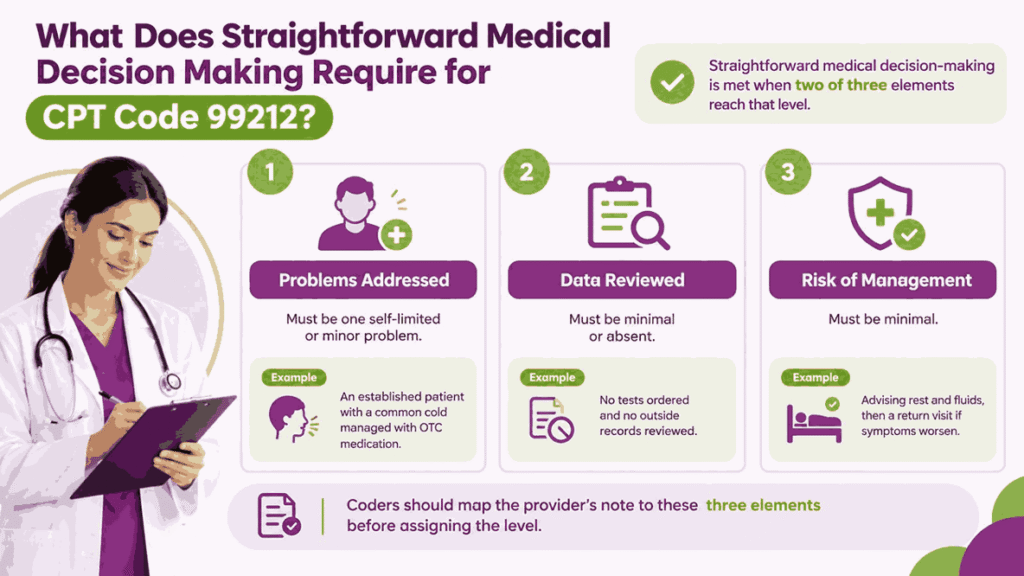
Coders should map the provider’s note to these three elements before assigning the level.
How Is Total Time Counted When Selecting 99212 by Time?
Since CPT 2024, E/M descriptors state one threshold that must be met or exceeded. For 99212, that threshold is ten minutes of total time on the encounter date. Several ranking pages and some official short descriptors still show the older 10-19 range.
Total time counts all practitioner work performed on the date, both face-to-face and non-face-to-face. Examples include reviewing records, examining the patient, counseling, documenting, and ordering medications or tests. Separately reported services and clinical staff time must be excluded from the visit total.
How Does CPT 99212 Differ From 99211 and 99213?
CPT 99211 is the only office E/M code that does not require a practitioner. It is typically a nurse visit under supervision, with no MDM or time threshold. CPT 99213 requires low medical decision-making or at least twenty minutes of time. Therefore, 99212 fits visits that exceed nurse-only care but fall below low-complexity medical management.
Most 99212 errors are undercoding of visits that actually met low medical decision-making. Coders should verify whether documentation supports the higher 99213 level before settling on 99212. Practices can use the CPT coding reference for internists to compare 99211 through 99213.
Who Qualifies as an Established Patient for CPT 99212?
Established patients received professional services from the same practitioner within the past three years. Care from a same-specialty, same-subspecialty physician in the group qualifies a patient as established. Patients without such services within three years are new, so 99202 through 99205 apply. Billing 99212 after a three-year gap is a common denial reason for many payers.
Which ICD-10 Codes Are Commonly Reported With CPT 99212?
Evaluation and management codes are not gated by a covered diagnosis list, unlike procedures. The ICD-10-CM code on the claim must support the problem the practitioner actually addressed.
Symptom codes are appropriate when no definitive diagnosis has been established at the visit. Typical 99212 problems include minor acute conditions, such as rashes, and stable chronic follow-ups.
- J00: J00 reports acute nasopharyngitis, the common cold, for a minor self-limited upper respiratory complaint.
- L30.9: L30.9 reports unspecified dermatitis when a mild rash needs brief evaluation and topical advice.
- I10: I10 reports essential hypertension during a stable follow-up with no medication changes needed today.
- R05.9: R05.9 reports unspecified cough when the practitioner cannot yet assign a definitive diagnosis today.
Always verify code selection against the current ICD-10-CM guidelines published by CDC and CMS. Our ICD-10 coding guide for internists lists more diagnosis codes for common office visits.
Which HCPCS Codes Are Reported in Relation to CPT 99212?
Four HCPCS Level II codes relate directly to CPT 99212 across Medicare billing.
- G2211: G2211 applies when the practitioner serves as the continuing focal point of patient care. It applies when the practitioner manages a single serious or complex condition over time.
- G0463: G0463 is the clinic visit code that the hospital bills for outpatient department services. The practitioner separately bills 99212 with place of service 22 at the facility rate.
- G0438 and G0439: G0438 and G0439 are Annual Wellness Visit codes for initial and subsequent Medicare visits. A problem-oriented 99212 may accompany them when modifier 25 is appended to the E/M.
- Q3014: The originating site facility bills Q3014 when the patient attends telehealth from its location. The distant practitioner bills 99212 separately with the correct telehealth modifier and place-of-service code.
What Are the Modifiers for CPT Code 99212?
Modifiers explain why a 99212 claim differs from the standard single-service office visit scenario. This section covers modifiers 25, 24, 95, 93, and FS, which affect many claims.
Modifier 25: Significant, Separately Identifiable E/M on the Same Day as a Procedure or Preventive Visit
Modifier 25 signals a significant, separately identifiable E/M service performed on the same date. Append it to the 99212 only, never to the procedure or preventive service code. Documentation must show the problem addressed required work beyond the preventive or procedural service.
Since January 1, 2025, G2211 is payable with modifier 25 E/M alongside preventive services. Those include the Annual Wellness Visit, vaccine administration, and Medicare Part B preventive services.
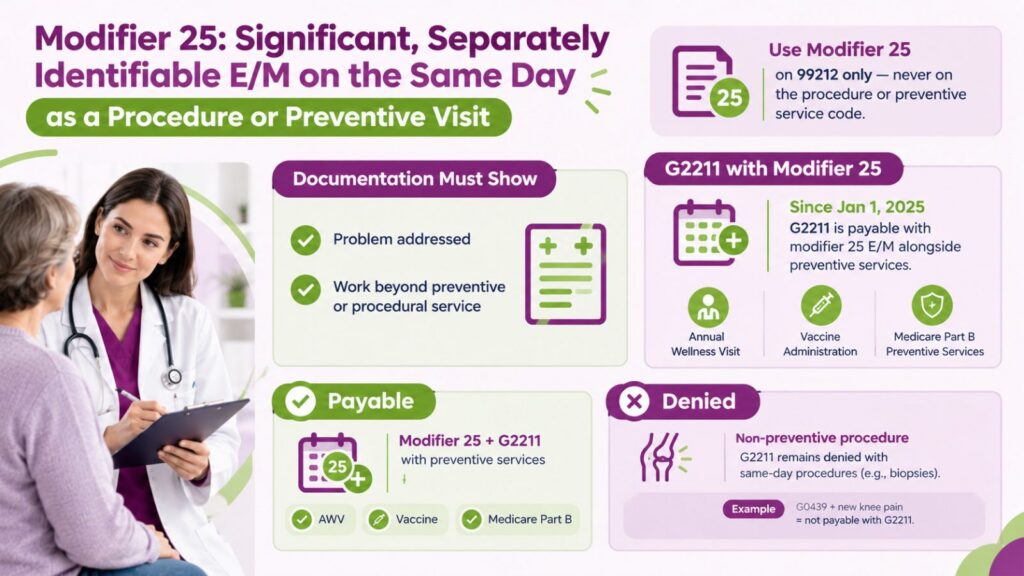
G2211 remains denied when the same-day service is a non-preventive procedure, such as biopsies. For example, a patient receives G0439 and separately raises new knee pain needing evaluation.
Modifier 24: Unrelated E/M During a Postoperative Period
Modifier 24 identifies an unrelated E/M by the same physician during a postoperative period. The global surgical package normally includes routine follow-up care for the procedure performed earlier. Medicare global periods run zero, ten, or ninety days depending on the procedure performed.
Append modifier 24 to 99212 when the visit addresses a problem unrelated to surgery. Documentation should clearly state why the problem is unrelated to the original surgical operation. For example, a hypertension follow-up during knee replacement recovery qualifies when unrelated to surgery.
Modifier 95: Synchronous Audio-Video Telehealth
Modifier 95 identifies a real-time telehealth service delivered through synchronous audio and video technology. Append modifier 95 to 99212 when the payer requires it for live audio-video visits. Pair it with the correct telehealth place of service code for the patient’s location.
Home-based visits use place of service 10 and pay at the higher non-facility rate. Other telehealth visits use place of service 02 and pay the lower facility rate. Payers vary, so verify telehealth policies, because Medicare flexibilities have changed repeatedly over time.
Modifier 93: Audio-Only Telehealth
Modifier 93 identifies telehealth services furnished through real-time, audio-only communication when video is unavailable. Append modifier 93 to 99212 only when the payer accepts audio-only telehealth for E/M.
Documentation should state why audio-only was used, such as the patient lacking video capability. Medicare restricts audio-only telehealth to specific circumstances, so check payer rules before submitting claims.
Modifier FS: Split or Shared Visit in a Facility Setting
Modifier FS identifies split or shared visits furnished by a physician and nurse practitioner. Medicare permits split or shared billing only in facility settings, including hospital outpatient departments.
In the office, the parallel concept is incident-to billing, which follows separate supervision rules. The practitioner performing the substantive portion, over half the total time, bills the visit.
Substantive portion can also mean the substantive part of medical decision-making, instead of time. One practitioner must personally have face-to-face contact with the patient during the shared visit.
Which Documents Are Required For CPT Code 99212?
CPT code 99212 requires documentation that supports the level billed and the medical necessity.
- Patient and Provider Details: Records must show the patient’s name, date of service, and the rendering practitioner’s signature.
- Chief Complaint and History: Document the chief complaint and a brief, medically appropriate history of the present illness.
- Examination: Include a limited, medically appropriate examination relevant to the presenting problem during the visit.
- Assessment and Plan: Record the assessment and the plan, such as over-the-counter treatment, reassurance, or return precautions.
- Time Statement: Document total practitioner time on the date of service when selecting 99212 by time.
- Diagnosis Linkage: Link an ICD-10-CM diagnosis that supports the problem addressed to the 99212 claim line.
- Modifier Support: Keep supporting notes for modifiers 25, 24, 95, 93, or FS whenever they apply.
- Telehealth Records: Telehealth notes should state patient location, modality used, and consent where required by payers.
- Split or Shared Visits: Split or shared visits need documentation of each practitioner’s work and the substantive portion.
- Incident-to Services: Incident-to services need documented supervision, the physician’s initial plan of care, and established-patient status.
What Is the Cost of CPT Code 99212?
The cost of CPT code 99212 depends on the payer, the setting, and geography. Medicare sets the benchmark that many commercial payers and Medicaid programs use for fee schedules.
RVUs and 2026 Medicare Payment for CPT 99212
Medicare payment equals total relative value units multiplied by the conversion factor, adjusted geographically. CPT 99212 carries 1.78 total RVUs in offices and 0.93 total RVUs in facilities. CMS finalized a 2026 non-qualifying APM conversion factor of $33.4009 for physicians and practitioners.
- Non-facility Rate: That produces a national Medicare payment of $59.45 for 99212 in the non-facility setting.
- Facility Rate: The facility setting pays a lower national amount of $31.06 for the same visit.
- Qualifying APM Participants: Qualifying APM participants receive a higher conversion factor of $33.57 under the same rule.
Payment varies by locality through geographic practice cost indices in the Physician Fee Schedule.
Why the Facility Rate Fell in 2026 While the Office Rate Rose
The 2026 facility rate fell about 8.5 percent from 2025, while office payment rose. The office rate rose about 8.1 percent, so the same visit diverged by setting. In CY2026, CMS changed how indirect practice expense is allocated to facility-based physician services.
Specialty society summaries describe a 50 percent cut to facility indirect practice expense RVUs. Practitioners billing 99212 at POS 22 now receive less than they did in 2025. RCM teams should model 99212 revenue separately for office and hospital outpatient department locations.
Commercial Payers
Commercial payers such as UnitedHealthcare, Aetna, Cigna, and Anthem negotiate their own 99212 rates. Many contracts express reimbursement as a percentage of the Medicare Physician Fee Schedule amount. Rates vary by contract, specialty, geography, and whether the practitioner participates in the network.
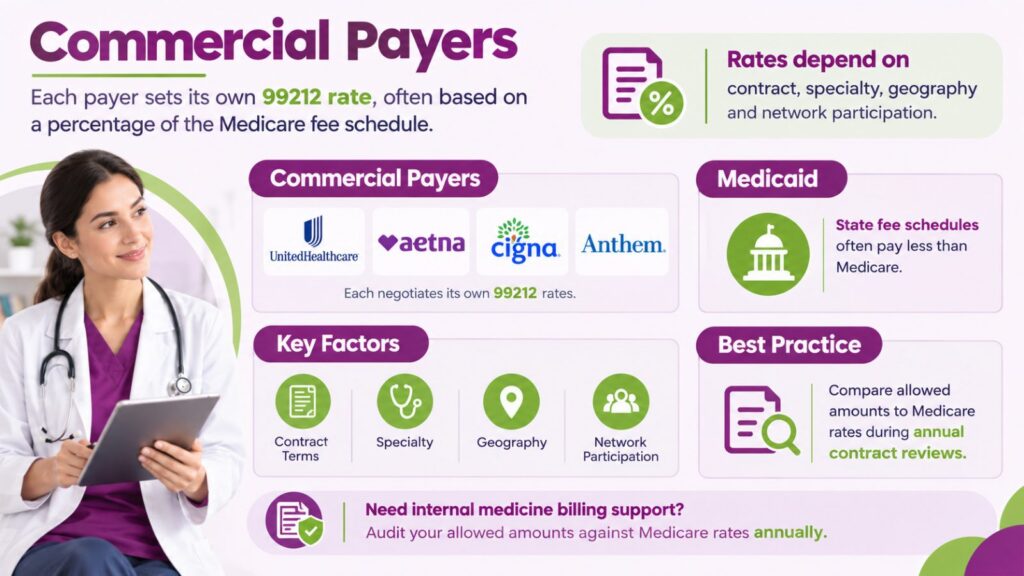
Medicaid programs set separate state fee schedules, which often pay less than Medicare does. Practices should compare contracted allowed amounts against Medicare rates during annual payer contract reviews. Practices needing internal medicine billing support can audit allowed amounts against Medicare rates annually.
Place-of-Service and Telehealth Payment Rules
Place of service codes tell payers where the visit occurred and which rate applies.
- POS 11: Office visits use POS 11 and pay at the national non-facility rate of $59.45.
- POS 22 or 19: Hospital outpatient department visits use POS 22 or 19 and pay the facility rate.
- POS 10: Telehealth with the patient at home uses POS 10 and pays the non-facility rate.
- POS 02: Telehealth from any other location uses POS 02 and pays the lower facility rate.
Pair modifier 95 or 93 with the correct place of service on each claim. Congress extended Medicare telehealth flexibilities through December 2027, so verify payer rules before billing. Q3014 may also apply when the patient attends telehealth from an originating site facility.
What Are Example Clinical Scenarios or Use Cases for CPT Code 99212?
These scenarios show how CPT 99212 applies across office, preventive, and hospital outpatient settings.
Scenario 1: Follow-Up for a Self-Limited Problem Using Straightforward MDM
- Patient: An established patient returns after a week of nasal congestion, sneezing, and sore throat.
- Management: The practitioner confirms a self-limited cold and recommends over-the-counter decongestants with fluids and rest.
- Data and Risk: No tests are ordered, and no outside records are reviewed during the encounter.
- Level Support: Problem, data, and risk all meet straightforward levels, so 99212 is supported by MDM.
- Diagnosis: Report J00 as the diagnosis, linked to the 99212 claim line for medical necessity.
Scenario 2: A Visit Selected by Time at 12 Minutes Total
- Patient: An established patient visits for brief follow-up of a healing, uncomplicated minor wrist sprain.
- Time: The practitioner documents twelve total minutes on the date, including record review and counseling.
- Threshold: Twelve minutes meets the ten-minute threshold, so time alone can support 99212 without MDM.
- Shortfall: Nine minutes would fall below the threshold, so time could not support this level.
- Documentation: Document a clear time statement and exclude separately reported services and clinical staff time.
Scenario 3: A Problem-Oriented Visit Billed With an Annual Wellness Visit
- Patient: A Medicare patient attends a subsequent Annual Wellness Visit and mentions new knee pain.
- Services: The practitioner completes the wellness visit, separately evaluates and counsels on the knee problem.
- Coding: Report G0439 for the wellness visit and 99212 with modifier 25 for the problem.
- Modifier Placement: Modifier 25 attaches only to the 99212 line, never to the preventive code G0439.
- G2211: G2211 is payable with this combination only if the longitudinal relationship requirement is met.
- Documentation: Separate documentation must show the knee problem required work beyond the preventive wellness visit.
Scenario 4: An Established Patient Seen in a Hospital Outpatient Clinic
- Patient: An established patient visits a hospital-based outpatient clinic for a minor, self-limited skin problem.
- Claim Structure: This creates two separate claims, one from the practitioner and one from the hospital.
- Practitioner Claim: The practitioner bills 99212 with place of service 22 at the lower facility rate.
- Hospital Claim: The hospital bills G0463, the outpatient clinic visit code, for its own facility costs.
- 2026 Impact: The CY2026 indirect practice expense change lowers facility practitioner payment compared with 2025 levels.
- Billing Caution: Never bill G0463 yourself as the practitioner, because only the hospital reports that code.
What Are the CPT Code 99212 Rules To Ensure Successful Reimbursement?
Following these rules protects clean claims, accurate payment, and compliance with Medicare and payers.
MDM Versus Time: Choosing the Selection Method That Supports the Level
Practitioners may select the 99212 level using either medical decision-making or total practitioner time. Choose whichever method documents the higher supported level, because the two methods are independent.
- MDM: Use MDM when the note shows a minor problem, minimal data, and minimal risk.
- Time: Use time when the visit lasted ten minutes or more, and notes say so.
- Audit Risk: Auditors compare documented time against note content, so avoid copied or templated time statements.
Same-Day Procedures, Preventive Visits, and Modifier 25
A same-day procedure or preventive visit bundles routine evaluation into that service by default. Report 99212 separately when the problem required significant, separately identifiable work beyond that service.
- Placement: Append modifier 25 to the 99212 line, never to the procedure or preventive code.
- Documentation: Document the separate problem, history, assessment, and plan apart from the procedure note itself.
- G2211 Allowed: G2211 is payable with modifier 25 E/M only alongside preventive services since January 2025.
- G2211 Denied: G2211 stays denied when the same-day service is a non-preventive procedure, such as biopsies.
Incident-To, Split or Shared, and Virtual Direct Supervision Rules in 2026
Incident-to billing lets a physician bill services furnished by auxiliary staff in office settings.
- Incident-to Basics: Incident-to requires an established patient, an existing plan of care, and appropriate physician supervision.
- Virtual Supervision: CMS permanently allows real-time audio-video direct supervision for most incident-to services beginning January 2026.
- Exclusions: Audio-only supervision, plus 010 or 090 global services, stays excluded from the permanent change.
- Facility Only: Split or shared visits remain limited to facility settings, so offices cannot use them.
- Substantive portion: The substantive portion means over half the total time or the substantive MDM part.
- Face-to-face Rule: One practitioner must also have face-to-face contact with the patient during the shared visit.
Why Under-Coding to 99212 Is a Larger Revenue Risk Than Audit Exposure
Under-coding to 99212 can cost practices more revenue than audit exposure from higher levels. Clinicians who default to 99212 for brief visits often leave legitimate low-MDM work unbilled. The payment gap between 99212 and 99213 becomes significant across thousands of annual visits.
- Correct Level: A visit meeting low MDM or twenty minutes belongs at 99213, not at 99212.
- Audit Scope: Compliance audits should review both under-coded and over-coded encounters to protect accurate practice revenue.
- Education: Provider education on MDM elements helps clinicians document the visit complexity they actually manage.
Primary care billing services often catch under-coded 99212 visits before revenue is lost permanently.
Top Reasons For Denials Specific To 99212 & Quick Remedies
- Modifier 25 on the Wrong Line: Claims deny when modifier 25 is appended to the procedure instead of the E/M. Move modifier 25 onto the 99212 line, then resubmit the corrected claim to payers.
- Missing Modifier 25: Billing 99212 beside a same-day procedure without modifier 25 usually triggers payer bundling edits. Review documentation for a separate problem, then add modifier 25 only if clearly supported.
- Time Below Ten Minutes: Selecting 99212 by time fails when documented total time falls below the ten-minute threshold. Support the level through MDM instead, or correct an inaccurate time statement before resubmitting.
- Split or Shared in the Office: Payers often deny split or shared claims billed with modifier FS in office settings. Bill under the rendering practitioner’s own NPI unless every incident-to requirement is fully met.
- G2211 with a Procedure: G2211 denies when billed with a modifier 25 E/M beside a same-day non-preventive procedure. Remove G2211 from the claim unless the same-day service is a Medicare preventive service.
- Telehealth Coding Errors: Telehealth claims often deny when submitted without the correct payer-required modifier and place-of-service code. Apply modifier 95 or 93, then use POS 10 for home or POS 02.
- New Patient Billed as Established: Claims deny when a patient unseen for over three years is billed as established. Verify prior visits first and bill the appropriate new patient code, 99202 through 99205.