CPT code 99211 describes an established patient office visit that needs no physician present. The AMA removed the time threshold in 2021 and the problem-level wording in 2022. Medicare’s national non-facility payment is $24.38 for 2026, which is up $1.74 from 2025.
The facility rate is only $7.68 because hospitals bill G0463 for outpatient clinic visits. CMS permanently allows real-time audio-video direct supervision of incident-to services beginning January 1, 2026. Audio-only supervision does not qualify, so practices must confirm their technology meets that requirement.
Injection-only, vaccine-only, and specimen-collection-only encounters do not support billing this Medicare nurse visit code. Medicare requires an established patient and a practitioner-initiated plan of care for incident-to billing. This guide explains the descriptor, cost, scenarios, modifiers, and rules for successful 99211 reimbursement.
What Is the Description of CPT Code 99211?
CPT code 99211 is the lowest-level office visit code in the established-patient E/M family. The AMA descriptor covers an established patient visit that may not require a physician. Use this internal medicine CPT code reference alongside our guide when reviewing visit codes.
Clinical staff, such as nurses and medical assistants, usually perform this service under supervision. The supervising practitioner’s NPI appears on the claim, making this a Medicare incident-to service.
What Does an E/M Service Without a Practitioner Present Require Under CPT 99211?
CPT 99211 still requires a genuine evaluation and management component, not routine nurse contact. Three elements support a nurse visit under this code, according to Medicare incident-to rules.
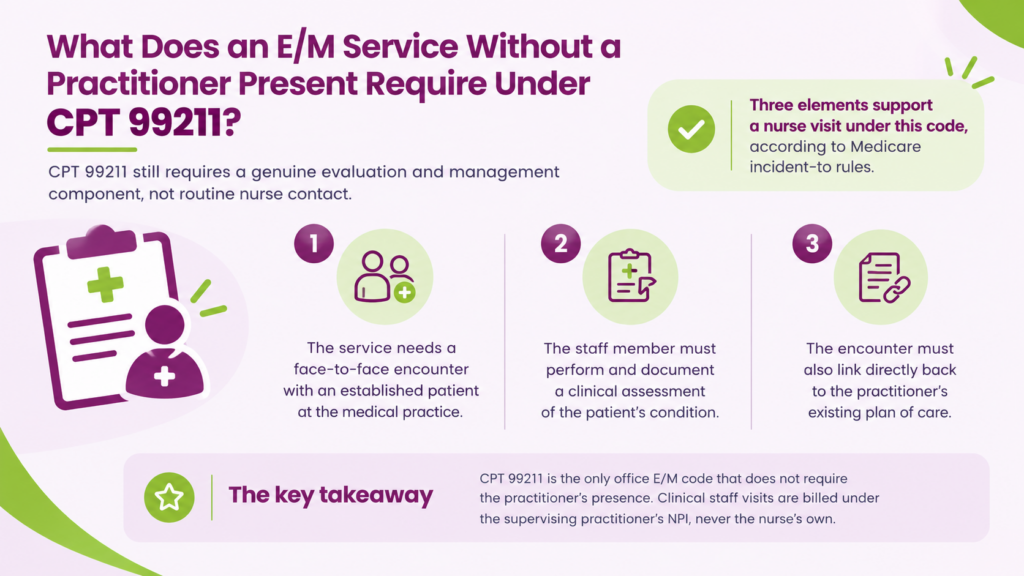
- The service needs a face-to-face encounter with an established patient at the medical practice.
- The staff member must perform and document a clinical assessment of the patient’s condition.
- The encounter must also link directly back to the practitioner’s existing plan of care.
It is the only office E/M code that does not require the practitioner’s presence. Clinical staff visits are billed under the supervising practitioner’s NPI, never the nurse’s own.
Why CPT 99211 Has No Time Threshold or MDM Level
CPT revised its office E/M coding in 2021 and removed time from code 99211. The American Medical Association later removed the minimal-problem wording from the descriptor in 2022. Many websites still list five minutes for 99211, which reflects outdated pre-2021 code descriptors.
Documentation should therefore prove the clinical assessment, not the minutes spent with the patient. Payers evaluate medical necessity through diagnosis linkage and the practitioner’s documented plan of care.
How Does CPT 99211 Differ From CPT 99212?
CPT 99212 requires a physician or qualified health care professional to see the patient. It also requires straightforward medical decision-making or ten minutes of total practitioner time. CPT 99211 is the clinical staff code, with no minimum time or decision-making requirement.
A practitioner who personally sees the patient for a brief problem should report 99212. Reporting 99211 for practitioner-performed visits undervalues the work and creates avoidable Medicare audit risk. A reliable CPT medical coding guide helps coders choose between office visit code levels.
Which Encounters Do Not Qualify for CPT 99211?
Several nurse encounters fail to meet the evaluation and management standard for this code.
- Injection-only visits are billed with CPT 96372 and the drug J-code, without adding 99211.
- Vaccine-only visits use Medicare administration codes such as G0008, G0009, and G0010, without 99211.
- Specimen collection alone, like a blood draw, does not qualify as an E/M service.
- Prescription refill requests and phone or portal results are not valid face-to-face 99211 encounters.
- New patients never qualify because Medicare incident-to billing always requires an established patient relationship.
The Medicare Claims Processing Manual excludes injections furnished without the physician in the office. Billing 99211 for those injection visits is not appropriate either, and claims are often denied.
Which ICD-10 Codes Are Commonly Reported With CPT 99211?
ICD-10 diagnosis codes for CPT 99211 must show why the nurse visit was necessary. Medicare has no covered list, so diagnosis linkage to the plan of care matters. These pairings appear most often on nurse visit claims. Our internal medicine ICD-10 coding guide explains diagnosis selection for chronic conditions like hypertension.
- I10 fits hypertension follow-up visits where nurses recheck blood pressure after a medication change.
- Z79.01 supports long-term anticoagulant use when staff monitor INR and adjust protocol-based warfarin doses.
- Z01.30 and Z01.31 describe encounters for blood pressure examination without or with abnormal findings.
- Z48.0- covers attention to surgical dressings and suture removal after a completed surgical procedure.
Screening-only Z codes do not establish medical necessity for a Medicare problem-oriented nurse visit.
Which HCPCS Codes Are Reported in Relation to CPT 99211?
HCPCS Level II codes relate to CPT 99211 in four distinct, common billing situations.
- G0463 applies when visits occur in a hospital outpatient clinic and the hospital bills.
- Drug J-codes pair with CPT 96372 on injection visits, where 99211 is usually absent.
- G0008, G0009, and G0010 report vaccine administration, standing alone without 99211 on vaccine-only visits.
- G2211 covers office E/M visits but requires the billing practitioner’s longitudinal relationship with patients.
Pairing G2211 with a clinical staff visit invites high payer scrutiny and possible denials.
What Are the Modifiers for CPT Code 99211?
Two modifiers occasionally apply to CPT 99211, and each always demands strong supporting documentation.
Modifier 25: Separately Identifiable 99211 on the Same Day as a Procedure
Modifier 25 marks a separately identifiable service on the same day as a procedure. Medicare NCCI edits pair CPT 99211 with drug administration codes such as CPT 96372. An injection-only encounter is therefore billed as CPT 96372 plus the drug, without 99211.
Modifier 25 is supportable only when staff separately assessed the patient beyond the injection. Documentation must show a distinct problem or symptom review separate from the injection itself.
Modifier 24: Unrelated Visit During a Postoperative Period
Modifier 24 identifies an unrelated evaluation and management service during a global postoperative period. Suture removal for sutures the same practice placed falls inside the surgical global package.
Practices track that included work with CPT 99024 instead of reporting CPT 99211 separately. Modifier 24 applies when the nurse visit addresses a problem unrelated to the surgery. Confirm payer policy first, because modifier 24 on clinical staff visits draws extra scrutiny.
Which Documents Are Required For CPT Code 99211?
Medicare auditors expect documentation that clearly proves a real evaluation and management service occurred.
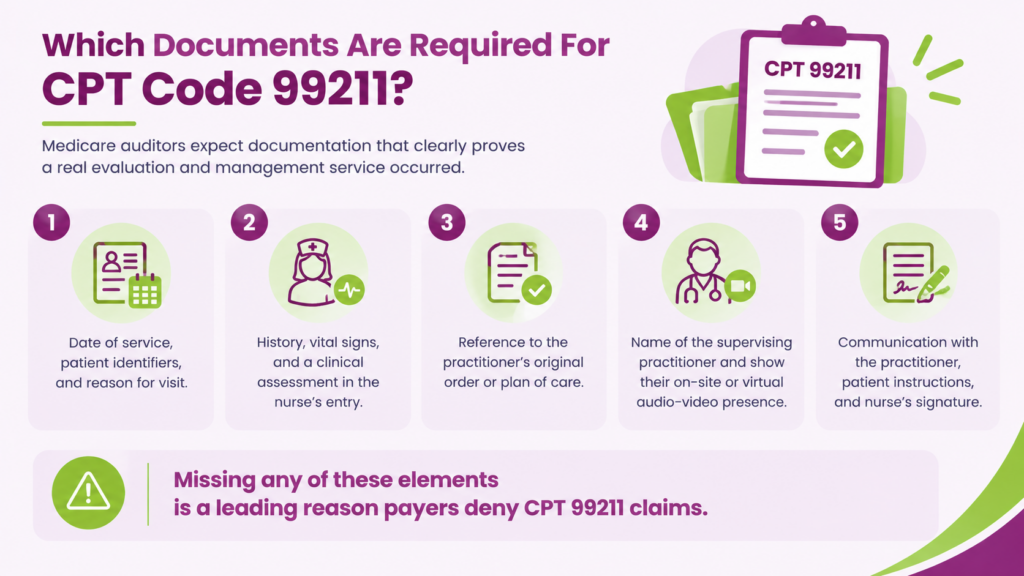
- Notes need the date of service, patient identifiers, and the specific reason for the visit.
- Brief history, vital signs, and a clinical assessment should appear in the nurse’s entry.
- A reference to the practitioner’s original order or plan of care shows incident-to compliance.
- Records should name the supervising practitioner and show their on-site or virtual audio-video presence.
- Documentation should record communication with the practitioner, patient instructions given, and the nurse’s signature.
Missing any of these elements is a leading reason payers deny CPT 99211 claims.

What Is the Cost of CPT Code 99211?
The cost of CPT code 99211 is low because the service requires minimal resources. Medicare payment depends on relative value units, a conversion factor, and the care setting.
RVUs and 2026 Medicare Payment for CPT 99211
CMS lists a work RVU of 0.18 for CPT 99211 during calendar year 2026. The non-facility total RVU is 0.73, which produces a national Medicare payment of $24.38. The payment rises $1.74 from the $22.64 that Medicare paid during calendar year 2025. One cost website lists 0.69 total RVUs, but the arithmetic only works at 0.73.
Why the Facility Rate for 99211 Is Under Eight Dollars
The facility rate comes from 0.23 total RVUs, producing a Medicare payment of $7.68. Hospital outpatient clinic staff are hospital employees, so the hospital bills G0463 for visits. The practitioner’s facility rate for 99211 is therefore minimal by design, not by error. Billing teams should expect low practitioner-side payment when staff sees patients in hospital departments.
Commercial Payers and Nurse Visit Coverage
Commercial payers set their own rules for nurse visit coverage, fee schedules, and reimbursement. Some plans follow CPT guidelines, while others restrict nurse visits or bundle them into services.
Practices should verify each payer’s nurse visit policy and contracted allowable amounts before billing. Some payers also decline 99211 on telehealth claims, so confirm policies before billing virtually. Primary care billing services often track payer nurse visit policies to prevent avoidable underpayments.
What Are Example Clinical Scenarios or Use Cases for CPT Code 99211?
Clinical scenarios show how CPT 99211 works in real nurse visits and common denials. Each example below reflects Medicare incident-to rules and the supervising practitioner’s plan of care.
Scenario 1: Nurse Blood Pressure Recheck After a Medication Change
A hypertensive established patient returns to the clinic after the practitioner changed their medication. The registered nurse measures blood pressure, assesses the patient, and reviews all current symptoms. The nurse then communicates the findings to the practitioner, following the documented plan of care.
This encounter supports CPT 99211 when ICD-10 code I10 serves as the linked diagnosis. Documentation must record each step, including the blood pressure reading and the practitioner communication. This is the canonical 99211 visit because every required element appears in the record.
Scenario 2: A B12 Injection Visit With No Separate Assessment
An established patient arrives for a scheduled vitamin B12 injection ordered by the practitioner. The nurse administers the injection without performing any separate assessment of the patient’s condition. Correct billing uses CPT 96372 plus the cyanocobalamin J-code, such as HCPCS code J3420.
Adding 99211 to an injection visit is a very common nurse visit billing error. Injection-only encounters lack a separately identifiable evaluation, so payers deny the added 99211 line. Modifier 25 helps only when documentation proves an assessment beyond what the injection required.
Scenario 3: Suture Removal Inside Versus Outside a Global Period
Suture removal creates a billing fork depending on who placed the patient’s sutures originally. Removal of sutures the practice placed during a global period is included in surgery. Practices track that included visit with CPT 99024 when they monitor global postoperative care.
Sutures placed elsewhere and removed by clinical staff with an assessment can support 99211. Documentation should name the original surgeon, surgery date, and the wound condition at removal. ICD-10 category Z48.0- links the nurse’s wound assessment directly to the suture removal visit.
Scenario 4: Point-of-Care INR Check With a Protocol-Based Dose Adjustment
A patient on warfarin returns for a point-of-care INR check at the medical practice. The nurse performs the CLIA-waived test, billed as CPT 85610 with a QW modifier. The nurse then assesses the patient and adjusts warfarin under the practitioner’s written protocol.
That assessment supports CPT 99211 alongside the INR test, with linked ICD-10 code Z79.01. A result recorded without assessment or dose decision supports only the billed laboratory test.
What Are the CPT Code 99211 Rules To Ensure Successful Reimbursement?
Following CPT code 99211 rules protects reimbursement because Medicare and payers audit nurse visits. The sections below cover supervision, telehealth limits, same-day billing, documentation, and common denial prevention.
Incident-To Requirements and Virtual Direct Supervision in 2026
Incident-to billing requires direct supervision and a practitioner-initiated plan of care for established patients. Effective January 1, 2026, CMS permanently allows real-time audio-video technology to satisfy direct supervision. Audio-only communication does not meet the standard, so the supervising practitioner needs live video.
Some widely indexed guides call this general supervision, but that mislabels direct supervision requirements. Practices relying on outdated office-suite wording may bill Medicare incorrectly under virtual supervision arrangements.
Why 99211 Cannot Be Billed as a Medicare Telehealth Service by Clinical Staff
Medicare telehealth services must be furnished by a distant-site practitioner, not clinical staff alone. Virtual direct supervision does not convert an incident-to nurse encounter into a telehealth service. A nurse-only CPT 99211 visit therefore cannot be billed as a Medicare telehealth service. Commercial payers set their own telehealth rules, so verify each policy before billing virtually.
Same-Day Combinations: Injections, Vaccines, Labs, and Practitioner Visits
CPT 99211 follows strict same-day billing rules when other services occur during the visit.
- Do not report 99211 with a practitioner E/M for the same patient that date.
- Injection-only encounters use CPT 96372 and the drug J-code, without 99211 added to claims.
- Vaccine-only visits use administration codes G0008, G0009, or G0010 without 99211 on the claim.
- Specimen collection alone, such as a routine blood draw, never supports a 99211 claim.
- A CLIA-waived lab test may accompany 99211 when a separate documented nurse assessment occurs.
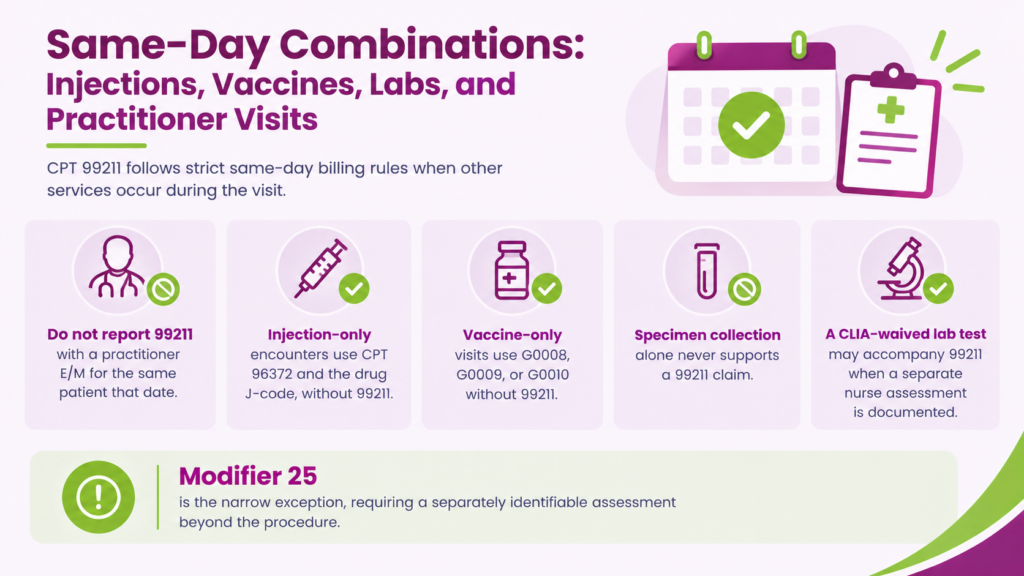
Modifier 25 is the narrow exception, requiring a separately identifiable assessment beyond the procedure.
Documentation That Establishes a Real E/M Component
Documentation must prove that a genuine evaluation and management service happened during the visit.
- Record the reason for visit, brief history, vital signs, and the nurse’s clinical assessment.
- Reference the practitioner’s original order showing the visit belongs to the plan of care.
- Document communication with the practitioner, including findings shared and any instructions the practitioner gave.
- Name the supervising practitioner and record their on-site or real-time audio-video availability that day.
- Add patient education provided, the visit outcome, and the nurse’s signature with credentials included.
Top Reasons For Denials Specific To 99211 & Quick Remedies
- Claims billing 99211 for injection-only or vaccine-only visits are denied; report 96372 or vaccine codes.
- No evidence the practitioner initiated the plan of care; add the original order reference.
- Supervising practitioner neither on site nor connected by audio-video; document supervision for every visit.
- Billed for a new patient; report a practitioner E/M, because 99211 requires established patients.
- Billed beside a same-day practitioner E/M; remove 99211 unless modifier 25 documentation supports it.
- Suture removal inside a global period; report 99024 instead of 99211 for included care.
- Screening Z code listed as the only diagnosis; link a problem-oriented ICD-10 code instead.
Practices can reduce nurse visit claim denials with dedicated internal medicine medical billing services.