
A single diagnosis code decides whether a cataract claim is paid or denied. Moreover, the FY2027 ICD-10-CM update took effect on October 1, 2026. Every claim with a date of service on or after that day follows the new code set. The good news is that the lens disorder codes in H25 through H28 did not change.
However, payers still deny claims for missing laterality, vague unspecified codes, and diagnoses that do not match the procedure modifier. Therefore, coders and billers need a dependable reference for every cataract ICD-10 code, not a half-remembered shortlist.
This guide lists each cataract ICD-10-CM code with a plain-language description, so your team and your ophthalmology billing services partner are working from the same reference. It also explains how the H25 family differs from H26, H27, and H28. Furthermore, it shows how to pair diagnosis codes with CPT 66984 and CPT 66982, and which documentation supports each choice.

What Are Cataract ICD-10 Codes and Why Do They Matter?
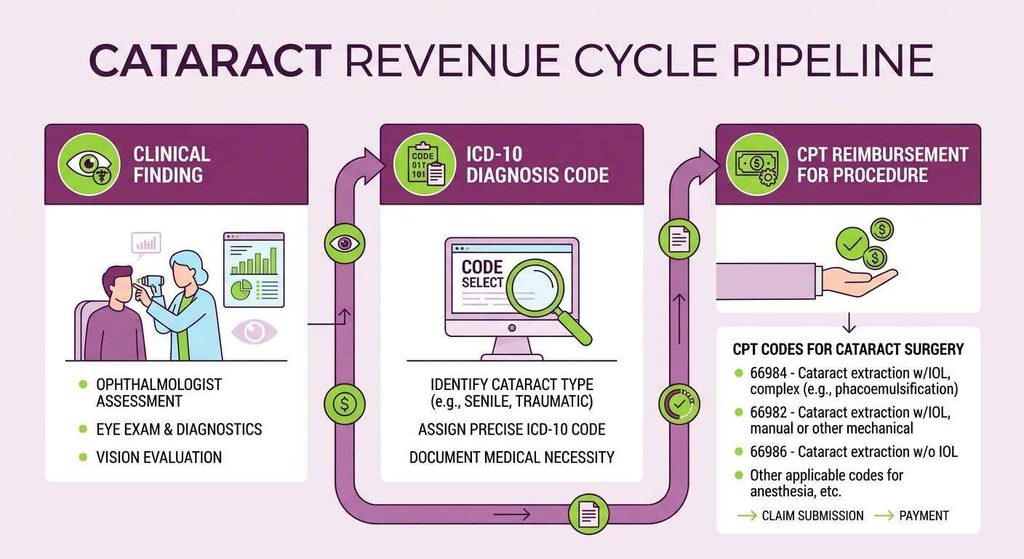
Cataract ICD-10 codes are the diagnosis codes that describe clouding of the eye’s lens. Specifically, the codes tell the payer which type of cataract the patient has and which eye is affected. Consequently, the cataract diagnosis code supports medical necessity for surgery. Without the diagnosis code, the procedure code has nothing to stand on.
Searchers often type cataract icd 10 codes, icd10 cataract, or cataract icd-10 codes and expect one answer. However, ICD-10-CM does not use a single code. Instead, the code set splits cataracts by cause, type, and laterality across several categories. Therefore, the right choice depends on what the ophthalmologist documents in the chart.
Get to know about other codes in the Ophthalmology ICD-10 Codes Guide.
What Changed in the FY2027 ICD-10-CM Update for Cataract Codes?
The FY2027 ICD-10-CM code set applies to dates of service from October 1, 2026 through September 30, 2027. Notably, the cataract codes did not change. The update added 190 new billable codes, yet none of the 190 sit in the lens disorders range.
Therefore, the cataract code icd 10 2026 lists that practices already used remain valid in FY2027. Moreover, the related codes for aphakia, postoperative complications, and cataract extraction status also stayed the same. Claims with earlier dates of service still follow the earlier edition, so the date of service decides which edition applies.
The table below summarizes the FY2027 status of each cataract code family.
| Code Family | Description | FY2027 Status |
|---|---|---|
| H25 | Age-related cataract | No change |
| H26 | Other cataract | No change |
| H27 | Other disorders of lens | No change |
| H28 | Cataract in diseases classified elsewhere | No change |
| H59.0- | Disorders of the eye following cataract surgery | No change |
| Z98.4- | Cataract extraction status | No change |
| Z96.1 | Presence of intraocular lens | No change |
All 7 code families carry the same descriptions and billable status in FY2027 as in FY2026. Consequently, coders can keep existing cataract code libraries and spend audit time on documentation quality instead.
How Are Cataract ICD-10-CM Codes Organized?
Cataract ICD-10-CM codes live in Chapter 7, Diseases of the Eye and Adnexa (H00-H59). Anyone seeking the icd 10 cm code for cataract lands in the lens disorders section, H25 to H28. Therefore, most cataract codes begin with H25 or H26. However, related codes sit elsewhere.
The table below maps each category to its clinical purpose.
| Category | Description | Typical Use |
|---|---|---|
| H25 | Age-related cataract | Cataract linked to aging |
| H26 | Other cataract | Infantile, juvenile, traumatic, complicated, drug-induced, and secondary cataract |
| H27 | Other disorders of lens | Aphakia and lens dislocation |
| H28 | Cataract in diseases classified elsewhere | Cataract caused by a systemic disease coded first |
| E08.36, E09.36, E10.36, E11.36, E13.36 | Diabetes with diabetic cataract | Cataract in a patient with diabetes |
| Q12.0 | Congenital cataract | Cataract present at birth |
| H59.0- | Disorders of the eye following cataract surgery | Complications after surgery |
| Z98.4- | Cataract extraction status | History of cataract surgery |
The map shows 8 groups of codes that touch cataract care. Consequently, a coder who stops at H25 or H26 misses the diabetes, congenital, and postoperative codes that apply to many patients.
What Is the ICD 10 Code for Cataract in Older Adults?
The H25 ICD 10 code family covers age-related cataract. The family holds 30 billable codes, and most of the codes name the affected eye. Therefore, coders select the cataract type first and the eye second.
Notably, H25 carries an Excludes2 note for capsular glaucoma with pseudoexfoliation of lens (H40.1-). Excludes2 means both conditions can be coded together when both are present. A patient with both conditions receives both codes.
What Are the H25 Codes for Incipient Age-Related Cataracts?
Incipient cataracts are early lens opacities that have not matured. ICD-10-CM groups them under H25.0 by the location of the opacity. Specifically, the cortical, anterior subcapsular, posterior subcapsular, and other incipient types each have 4 codes. The table lists all 16 billable codes.
| ICD-10-CM Code | Description |
|---|---|
| H25.011 | Cortical age-related cataract, right eye |
| H25.012 | Cortical age-related cataract, left eye |
| H25.013 | Cortical age-related cataract, bilateral |
| H25.019 | Cortical age-related cataract, unspecified eye |
| H25.031 | Anterior subcapsular polar age-related cataract, right eye |
| H25.032 | Anterior subcapsular polar age-related cataract, left eye |
| H25.033 | Anterior subcapsular polar age-related cataract, bilateral |
| H25.039 | Anterior subcapsular polar age-related cataract, unspecified eye |
| H25.041 | Posterior subcapsular polar age-related cataract, right eye |
| H25.042 | Posterior subcapsular polar age-related cataract, left eye |
| H25.043 | Posterior subcapsular polar age-related cataract, bilateral |
| H25.049 | Posterior subcapsular polar age-related cataract, unspecified eye |
| H25.091 | Other age-related incipient cataract, right eye |
| H25.092 | Other age-related incipient cataract, left eye |
| H25.093 | Other age-related incipient cataract, bilateral |
| H25.099 | Other age-related incipient cataract, unspecified eye |
Moreover, H25.09 lists coronary age-related cataract, punctate age-related cataract, and water clefts as inclusion terms. Therefore, coders report H25.09- when the chart uses any of those 3 terms.
What Are the H25 Codes for Nuclear, Morgagnian, Combined, and Unspecified Cataracts?
The remaining H25 codes describe advanced, mixed, and unspecified cataracts. Nuclear cataract, which ICD-10-CM also calls cataracta brunescens, uses H25.1-. Morgagnian cataract uses H25.2-. Combined forms use H25.81-, while H25.89 and H25.9 cover other and unspecified types. The table lists all 14 billable codes.
| ICD-10-CM Code | Description |
|---|---|
| H25.10 | Age-related nuclear cataract, unspecified eye |
| H25.11 | Age-related nuclear cataract, right eye |
| H25.12 | Age-related nuclear cataract, left eye |
| H25.13 | Age-related nuclear cataract, bilateral |
| H25.20 | Age-related cataract, morgagnian type, unspecified eye |
| H25.21 | Age-related cataract, morgagnian type, right eye |
| H25.22 | Age-related cataract, morgagnian type, left eye |
| H25.23 | Age-related cataract, morgagnian type, bilateral |
| H25.811 | Combined forms of age-related cataract, right eye |
| H25.812 | Combined forms of age-related cataract, left eye |
| H25.813 | Combined forms of age-related cataract, bilateral |
| H25.819 | Combined forms of age-related cataract, unspecified eye |
| H25.89 | Other age-related cataract |
| H25.9 | Unspecified age-related cataract |
The nuclear and Morgagnian codes use a 0, 1, 2, 3 pattern for unspecified, right, left, and bilateral. The combined forms use the 1, 2, 3, 9 pattern instead. Consequently, coders confirm the final digit against the code description rather than assuming one pattern.
When Should You Use H25.9 ICD 10?
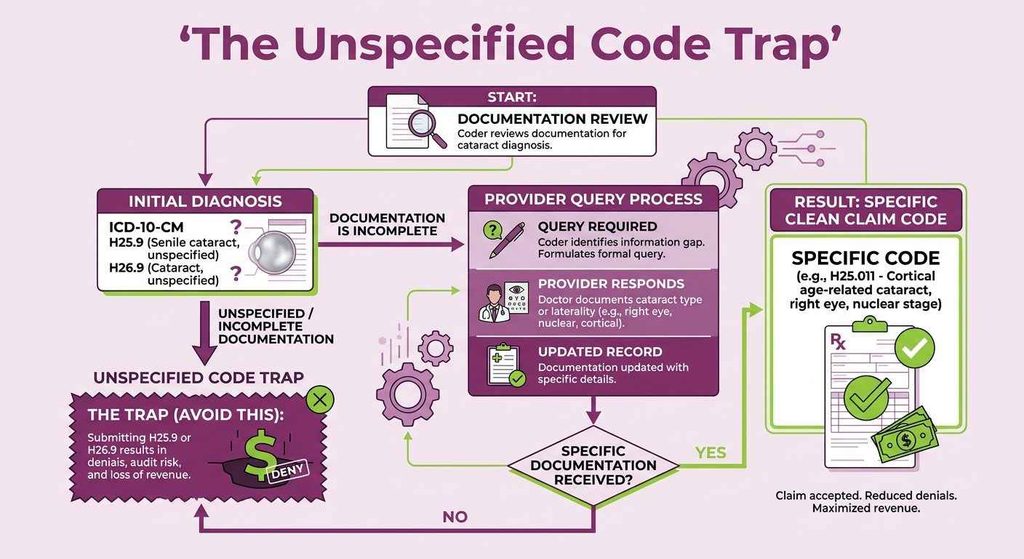
H25.9 means unspecified age-related cataract. The code is billable and carries no laterality. Therefore, H25.9 fits only when the record names neither the cataract type nor the eye. An ophthalmologist’s exam usually documents both, so a specific code is usually available.
Moreover, unspecified codes give payers less to work with. Coders query the provider when the cataract type or the eye is missing. A short query usually produces a more specific cataract icd 10 cm code and a stronger claim.
Which Cataract ICD-10 Codes Cover Causes Other Than Age?
H26 covers every cataract that ICD-10-CM does not classify as age-related. The category includes infantile, juvenile, traumatic, complicated, drug-induced, and secondary cataracts. However, H26 carries an Excludes1 note for congenital cataract (Q12.0). Therefore, a cataract present at birth belongs in Q12.0 and never in H26.
What Are the ICD-10 Codes for Infantile and Juvenile Cataract?
Infantile and juvenile cataracts use H26.0-. The category splits by lens location into cortical, nuclear, anterior subcapsular, and posterior subcapsular types. Additionally, the category offers combined forms and an unspecified option. Each subcategory then adds a digit for the right eye, left eye, bilateral, or unspecified eye. The table lists every code group.
| ICD-10-CM Codes | Description |
|---|---|
| H26.001, H26.002, H26.003, H26.009 | Unspecified infantile and juvenile cataract |
| H26.011, H26.012, H26.013, H26.019 | Infantile and juvenile cortical, lamellar, or zonular cataract |
| H26.031, H26.032, H26.033, H26.039 | Infantile and juvenile nuclear cataract |
| H26.041, H26.042, H26.043, H26.049 | Anterior subcapsular polar infantile and juvenile cataract |
| H26.051, H26.052, H26.053, H26.059 | Posterior subcapsular polar infantile and juvenile cataract |
| H26.061, H26.062, H26.063, H26.069 | Combined forms of infantile and juvenile cataract |
| H26.09 | Other infantile and juvenile cataract |
In each group of 4, the last digit follows the order right eye, left eye, bilateral, and unspecified eye. Therefore, H26.012 reports a cortical, lamellar, or zonular cataract in the left eye.
What Are the ICD-10 Codes for Traumatic and Complicated Cataract?
Traumatic cataract follows an eye injury. The H26.1 note instructs coders to add a Chapter 20 external cause code. Complicated cataract develops because of another eye condition, so H26.2 and its children point back to the underlying disorder. Therefore, coders read the notes under each code before choosing between the two groups.
| ICD-10-CM Codes | Description |
|---|---|
| H26.101, H26.102, H26.103, H26.109 | Unspecified traumatic cataract |
| H26.111, H26.112, H26.113, H26.119 | Localized traumatic opacities |
| H26.121, H26.122, H26.123, H26.129 | Partially resolved traumatic cataract |
| H26.131, H26.132, H26.133, H26.139 | Total traumatic cataract |
| H26.20 | Unspecified complicated cataract |
| H26.211, H26.212, H26.213, H26.219 | Cataract with neovascularization |
| H26.221, H26.222, H26.223, H26.229 | Cataract secondary to ocular disorders (degenerative) (inflammatory) |
| H26.231, H26.232, H26.233, H26.239 | Glaucomatous flecks (subcapsular) |
Three notes shape this table. H26.1 calls for an external cause code. H26.21 calls for the associated condition, such as chronic iridocyclitis (H20.1-), when applicable. H26.23 requires the underlying glaucoma code (H40-H42) first.
What Are the ICD-10 Codes for Drug-Induced, Secondary, and Other Specified Cataract?
Drug-induced cataract, which ICD-10-CM also calls toxic cataract, uses H26.3-. The note adds an adverse effect code from T36-T50, with a fifth or sixth character of 5, when applicable. Secondary cataract uses H26.4-. Meanwhile, H26.8 and H26.9 cover other specified and unspecified cataracts.
| ICD-10-CM Code | Description |
|---|---|
| H26.30 | Drug-induced cataract, unspecified eye |
| H26.31 | Drug-induced cataract, right eye |
| H26.32 | Drug-induced cataract, left eye |
| H26.33 | Drug-induced cataract, bilateral |
| H26.40 | Unspecified secondary cataract |
| H26.411, H26.412, H26.413, H26.419 | Soemmering’s ring |
| H26.491, H26.492, H26.493, H26.499 | Other secondary cataract |
| H26.8 | Other specified cataract |
| H26.9 | Unspecified cataract |
H26.9 gives no cause, type, or eye. Therefore, coders treat H26.9 like H25.9 and report the code only when the documentation offers nothing more specific.
How Do You Code Cataracts in Diseases Classified Elsewhere (H28)?
H28 reports cataract caused by another disease that has its own code. The code is a single billable code with no subcodes, and it follows a code-first rule. Specifically, coders report the underlying disease first. The tabular list names hypoparathyroidism (E20.-), myotonia (G71.1-), myxedema (E03.-), and protein-calorie malnutrition (E40-E46) as examples.
However, diabetes follows a different path. H28 carries an Excludes1 note for cataract in diabetes mellitus. Therefore, a patient with a diabetic cataract receives E08.36, E09.36, E10.36, E11.36, or E13.36 instead of H28. Coders never report the two together.
The table below shows the correct coding approach for common scenarios.
| Scenario | Correct Code Approach |
|---|---|
| Cataract caused by hypoparathyroidism | Report E20.- first, then H28 |
| Cataract caused by myxedema | Report E03.- first, then H28 |
| Cataract caused by protein-calorie malnutrition | Report E40-E46 first, then H28 |
| Cataract with type 1 diabetes | E10.36, Type 1 diabetes mellitus with diabetic cataract |
| Cataract with type 2 diabetes | E11.36, Type 2 diabetes mellitus with diabetic cataract |
| Cataract with diabetes due to an underlying condition | E08.36 |
| Cataract with drug or chemical induced diabetes | E09.36 |
| Cataract with other specified diabetes | E13.36 |
| Cataract present at birth | Q12.0, never H26 |
The table covers 9 scenarios across 3 coding paths: H28 with a code-first disease, the diabetes combination codes, and the congenital code. Moreover, the medical record links the cataract to the underlying disease in every H28 case. When the link is unclear, the coder queries the provider.
Which Diagnosis Codes Apply Before and After Cataract Surgery?
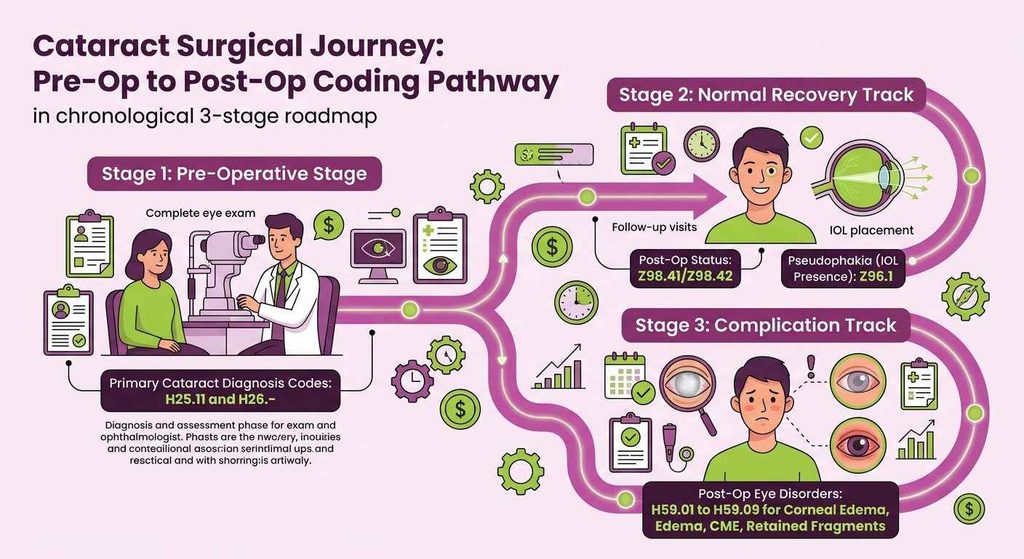
Preoperative claims rely on the cataract codes in H25 and H26. After surgery, however, the diagnosis changes. Postoperative complications use H59.0-, while a patient who has completed surgery is reported with status codes. Therefore, coders separate a complication from a normal recovery.
H59.0- holds 4 subcategories: bullous aphakic keratopathy, retained lens fragments, cystoid macular edema, and other disorders following cataract surgery. Each subcategory offers laterality choices. Notably, H59 carries an Excludes1 note for secondary cataract (H26.4-), pseudophakia (Z96.1), and mechanical complication of an intraocular lens (T85.2). The table lists the postoperative and status codes.
| ICD-10-CM Codes | Description |
|---|---|
| H59.011, H59.012, H59.013, H59.019 | Keratopathy (bullous aphakic) following cataract surgery |
| H59.021, H59.022, H59.023, H59.029 | Cataract (lens) fragments in eye following cataract surgery |
| H59.031, H59.032, H59.033, H59.039 | Cystoid macular edema following cataract surgery |
| H59.091, H59.092, H59.093, H59.099 | Other disorders of the eye following cataract surgery |
| Z98.41 | Cataract extraction status, right eye |
| Z98.42 | Cataract extraction status, left eye |
| Z98.49 | Cataract extraction status, unspecified eye |
| Z96.1 | Presence of intraocular lens |
Moreover, Z98.4 instructs coders to add Z96.1 to identify the intraocular lens implant status. Therefore, a status claim after surgery typically carries both codes.
How Do Cataract ICD-10 Codes Pair With CPT Codes and Modifiers?
Diagnosis codes justify the procedure, so every cataract claim needs a matched pair. CPT 66984 reports routine extracapsular cataract removal with intraocular lens insertion. CPT 66982 reports the complex version. Moreover, complex cataract extraction requires devices or techniques not generally used in routine surgery. Therefore, a difficult case alone does not support 66982, and the operative note must describe the qualifying factor.
The table below lists the 4 core cataract extraction codes and their diagnosis pairing notes.
| CPT Code | Description | Diagnosis Pairing Note |
|---|---|---|
| 66984 | Routine extracapsular cataract removal with intraocular lens insertion, without endoscopic cyclophotocoagulation | Pair with the specific H25 or H26 code for the operated eye |
| 66982 | Complex extracapsular cataract removal with intraocular lens insertion, without endoscopic cyclophotocoagulation | Operative note must name the complicating factor |
| 66988 | Routine extracapsular cataract removal with intraocular lens insertion, with endoscopic cyclophotocoagulation | Pair with the specific cataract code for the operated eye |
| 66987 | Complex extracapsular cataract removal with intraocular lens insertion, with endoscopic cyclophotocoagulation | Operative note must name the complicating factor |
Laterality connects the diagnosis to the procedure. Medicare contractor billing articles for cataract extraction, including the article from NGS Medicare, instruct providers to append LT or RT to the procedure code. Therefore, the eye in the diagnosis must match the modifier. A claim with H25.11 (right eye) and modifier LT contradicts itself.
Additionally, CPT 66984 carries a 90-day global period. Consequently, surgery on the second eye during that window is typically reported with modifier 79 plus the correct laterality modifier. Payer rules vary, so the coder confirms the policy before submission. For more details you can also go through our ophthalmology billing guide.
What Are the Most Common Cataract Coding Mistakes?
Cataract claims are prone to a handful of avoidable errors. Fortunately, each error has a direct fix. The table below lists 8 mistakes and the correction for each.
| Mistake | Why It Causes Problems | Fix |
|---|---|---|
| Reporting H25.9 or H26.9 by default | Gives the payer no type or eye detail | Query the provider for a specific code |
| Mismatching laterality | Diagnosis eye conflicts with the RT or LT modifier | Cross-check the eye on both fields |
| Using H28 for diabetic cataract | H28 Excludes1 forbids the pairing | Report E08.36, E09.36, E10.36, E11.36, or E13.36 |
| Skipping the code-first disease | H28 requires the underlying disease first | Report the underlying disease before H28 |
| Coding aphakia with extraction status | Z98.4 Excludes1 aphakia (H27.0) | Choose H27.0- or Z98.4-, never both |
| Using H26 for congenital cataract | H26 Excludes1 congenital cataract | Report Q12.0 |
| Billing complex surgery without support | 66982 requires documented complexity | Cite the qualifying factor in the operative note |
| Omitting external cause or adverse effect codes | H26.1 and H26.3 add code instructions | Add the Chapter 20 or T36-T50 code |
A pre-submission scrub that checks laterality and Excludes1 pairs catches 5 of these 8 mistakes automatically. The other 3 depend on documentation quality, so provider education closes that gap.
How Can Practices Prepare for the FY2027 Cataract Coding Update?
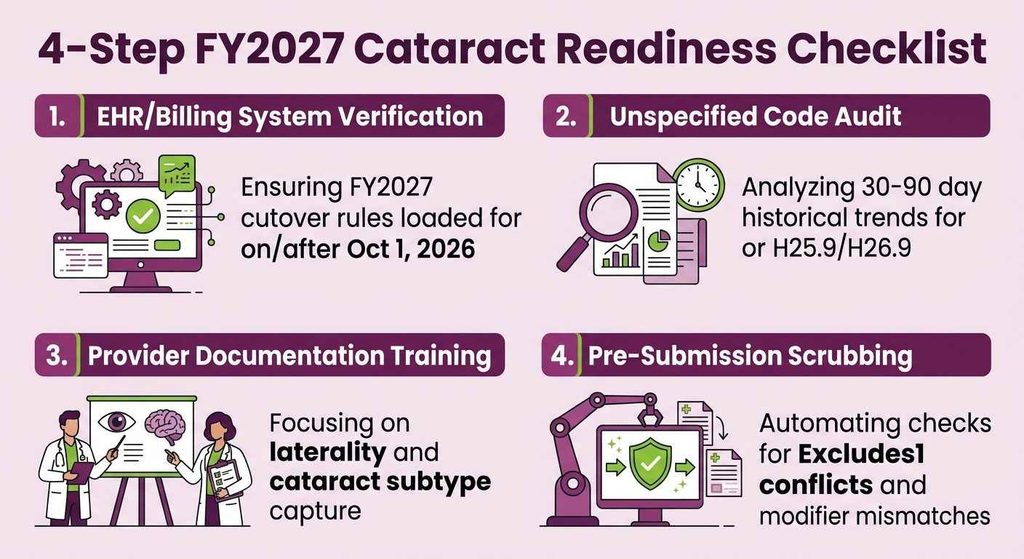
Although the cataract codes did not change, the October 1 cutover still deserves a check. First, confirm that the EHR and billing system load the FY2027 code set for dates of service on or after October 1, 2026. Second, remember that claims with earlier dates of service follow the earlier edition.
Next, audit the most used cataract codes. Pull 30 to 90 days of claims and count how often H25.9, H26.9, and other unspecified codes appear. Then compare diagnosis laterality with procedure modifiers. Finally, train front-end and surgical staff to capture the cataract type and the eye at every visit.
Moreover, outsourcing closes gaps that small teams cannot cover. A specialized billing partner tracks annual code updates, payer policies, and denial patterns. However, any partner must show coding accuracy data before a practice signs.
FAQs About Cataract ICD-10 Codes
What Is the ICD-10 Code for Cataract?
ICD-10-CM has no single cataract code. Age-related cataract uses the H25 family, other cataract types use H26, and unspecified age-related cataract is H25.9. The right ICD-10-CM code for cataract depends on the type, the cause, and the affected eye.
What Does H25.9 Mean?
H25.9 means unspecified age-related cataract. The code is billable and carries no laterality. Coders use H25.9 only when the record names neither the cataract type nor the eye.
Did the FY2027 Update Change Any Cataract ICD-10 Codes?
The FY2027 ICD-10-CM update, effective October 1, 2026, added, deleted, and revised no codes in H25 through H28. Related codes for postoperative complications and extraction status also stayed the same. The cataract code icd 10 2026 lists therefore carry into FY2027 for dates of service on or after October 1, 2026.
What Code Applies to Cataract in a Patient With Diabetes?
Coders report the diabetes combination code with diabetic cataract, such as E11.36 for type 2 diabetes, instead of H28. H28 carries an Excludes1 note for cataract in diabetes mellitus, so the two never appear together.
Which ICD-10 Codes Apply After Cataract Surgery?
Status codes Z98.41, Z98.42, or Z98.49 report cataract extraction status, with Z96.1 added for the intraocular lens. Complications after surgery use the H59.0- codes, such as H59.03- for cystoid macular edema following cataract surgery.
Do Cataract Claims Require RT and LT Modifiers?
Medicare contractor billing articles for cataract extraction instruct providers to append LT or RT to the procedure code. The eye named in the diagnosis code must match the modifier on the claim line.