Illinois medical billing laws stack three layers: federal rules, state statutes, and payer contracts. Illinois Department of Insurance and HFS enforce prompt pay, balance billing, and Medicaid rules. The Workers’ Compensation Commission and Attorney General’s Health Care Bureau add further state oversight.
Illinois prompt pay law, 215 ILCS 5/368a, sets 30 days and 9 percent interest. HFS rejects Medicaid claims received more than 180 days after the date of service. Public Act 102-0901 aligned Illinois balance billing rules with the federal No Surprises Act.

Public Act 103-0648 bars Illinois credit reporting of medical debt beginning January 1, 2025. One missed deadline turns a clean claim into a denial, write-off, or regulator complaint. This article covers prompt pay, balance billing, Medicaid deadlines, collections, and the compliance steps.
What Makes Illinois Medical Billing Law Different From Federal Rules?
Illinois medical billing law differs from federal rules because state statutes add enforceable deadlines. Federal law sets a floor: HIPAA, the No Surprises Act, and Medicare timely filing. Illinois statutes sit above that floor and apply mainly to insured, state-regulated health plans. Illinois Department of Insurance enforces prompt pay and balance billing rules for those plans.
Self-funded ERISA plans fall outside most of those state rules and follow federal law. HFS administers Illinois Medicaid and denies most claims filed beyond 180 days of service. Federal Medicare rules allow 12 months, so billing teams often apply the wrong deadline.
National Government Services, Jurisdiction 6, processes traditional Medicare fee-for-service claims for all Illinois providers. HealthChoice Illinois managed care organizations each set their own filing, authorization, and dispute windows.
Illinois workers’ compensation bills must be paid within 30 days under 820 ILCS 305/8.2. Late payments accrue 1 percent monthly interest, and the Workers’ Compensation Commission sets fees. The table below shows which body, law, and deadline govern each Illinois claim type.
| Payer Category | Governing Body | Controlling Law | Key Deadline |
|---|---|---|---|
| State-regulated Commercial Plans | Illinois Department of Insurance (IDOI) | 215 ILCS 5/368a; 215 ILCS 5/356z.3a | 30 days to pay a clean claim; 9% annual interest |
| Illinois Medicaid fee-for-service | Department of Healthcare and Family Services (HFS) | Public Act 97-0689 | 180 days from date of service; 2 years for Medicare crossover |
| HealthChoice Illinois MCOs | Managed care organizations under HFS contracts | MCO contract and provider manual | Set by each MCO |
| Workers’ Compensation | Illinois Workers’ Compensation Commission (IWCC) | 820 ILCS 305/8.2 | 30 days to pay; 1% monthly interest |
| Traditional Medicare | National Government Services, Jurisdiction 6 | Federal Medicare rules | 12 months from date of service |
| Self-funded Employer Plans | Plan administrator under federal oversight | ERISA; federal No Surprises Act | Plan document terms; federal independent dispute resolution |
What Does Illinois Law Say About Balance Billing and Surprise Bills?
Illinois bars balance billing for emergency care and ancillary services under 215 ILCS 5/356z.3a. Nonparticipating providers may bill patients only in-network cost sharing, calculated on the recognized amount. IDOI enforces the statute, so billing teams should know it beyond federal rules alone.
Which Services Does Illinois Protect From Balance Billing?
Emergency services from nonparticipating providers and facilities are protected regardless of provider network status. Ancillary services at in-network hospitals and ambulatory surgical centers receive this balance billing protection.
Ancillary services include emergency medicine, anesthesiology, pathology, radiology, and neonatology furnished by any provider. Assistant surgeons, hospitalists, intensivists, and diagnostic laboratory and radiology services also qualify as ancillary.
Advanced diagnostic laboratory tests on the federal list are excluded from that ancillary category. Balance billing is also barred when no participating provider can furnish the service there.
How Does Illinois Law Work With the Federal No Surprises Act?
Public Act 102-0901 aligned Illinois law with the federal No Surprises Act in 2022. Most provisions took effect July 1, 2022, while some provisions began January 1, 2023. IDOI can also help patients billed out-of-network after mistakenly using providers they believed participated.
Insurers must apply cost sharing as though a participating provider furnished the emergency services. They must send payment or denial with an explanation of benefits within 30 days. Insurance company must also pay reimbursement directly to the nonparticipating provider instead of the patient.
How Are Out-of-Network Payment Disputes Resolved in Illinois?
Payers and providers get 30 days to negotiate before either side can request arbitration. State-regulated plans use Illinois arbitration, while self-funded plans follow federal independent dispute resolution procedures. Arbitrators endeavor to decide within 45 days after the demand for arbitration is filed.
Interest under Section 368a does not accrue until 30 days after the arbitrator’s decision. That interest delay never extends beyond 150 days from the date the provider billed. Providers should track every out-of-network claim by billing date so negotiation windows never lapse.
Which Plans Fall Outside the Illinois Balance Billing Law?
Self-funded employer plans governed by ERISA fall entirely outside the Illinois balance billing law. Those plans follow the federal No Surprises Act, which also bans most balance billing. Medicare and TRICARE claims follow separate federal rules rather than Illinois Insurance Code provisions.
Verify funding type during every eligibility check, because it decides which dispute process applies. Billing teams should flag out-of-network claims at intake, since federal and Illinois timelines differ.
How Fast Must Illinois Insurers Pay a Clean Claim?
Illinois insurers must pay clean claims within 30 days or owe 9 percent interest. The Illinois Insurance Code, 215 ILCS 5/368a, sets that prompt pay rule for providers.
What Counts as a Clean Claim Under the Illinois Prompt Pay Statute?
A clean claim contains everything the insurer needs to adjudicate payment without further documentation. Insurers must notify the provider within 30 days of receipt when documentation is insufficient.
Once missing documentation completes the claim, the payment clock starts from that receipt date. Late payments accrue 9 percent annual interest from the original due date until paid. Interest under $1 is not owed, and insurers pay other interest within 30 days.
Does Illinois Prompt Pay Law Apply to HMOs, PPOs, and Third-Party Administrators?
The statute covers insurers, HMOs, managed care plans, PPOs, and third-party administrators alike. Independent practice associations and physician hospital organizations must also follow the statute’s notice requirements. Self-funded ERISA plans generally fall outside this statute because state insurance law reaches insurers.
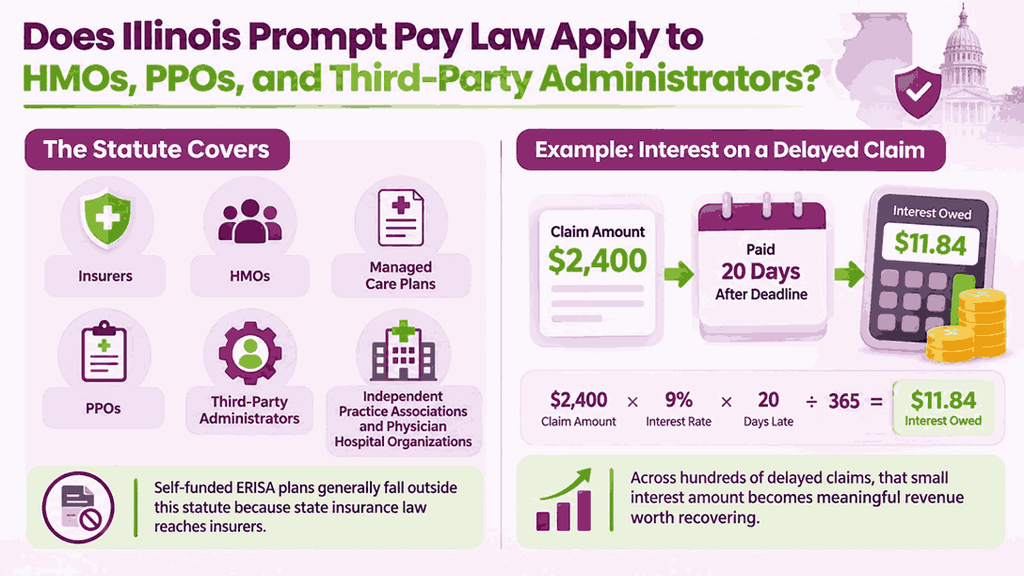
Consider a $2,400 clean claim paid exactly 20 days after its 30-day deadline. Interest equals $2,400 times 9 percent times 20 divided by 365, or about $11.84. Across hundreds of delayed claims, that small interest amount becomes meaningful revenue worth recovering. Track every payer’s payment date against day 30, and bill back any omitted interest.
What Are the Illinois Medicaid Timely Filing Deadlines?
HFS denies non-institutional Medicaid claims received over 180 days after the service date, barring exceptions. That deadline applies to both initial and resubmitted claims, which surprises many billing teams. Hospital inpatient claims run 180 days from discharge, while Medicare crossovers run two years.
The table below lists each Illinois Medicaid timely filing deadline and its starting event.
| Situation | Deadline | Clock Starts |
|---|---|---|
| Standard non-institutional Claim | 180 days | Date of service |
| Hospital Inpatient Claim | 180 days | Date of discharge |
| Medicare Crossover Claim | 2 years | Date of service |
| Medicare Denied Claim | 2 years | Date of service |
| Third-party Liability Claim | 180 days | Primary payer adjudication |
| Split Bill Claim | 180 days | Date on form HFS 2432 |
| Retroactive Eligibility | 180 days | System update viewed in MEDI |
| Provider Enrollment or File Change | 180 days | Change recorded on provider file |
| Local Government Provider over 3 million Population | 12 months | Date of service |
| Replacement or Void Claim | 12 months | Original paid voucher date |
When Does HFS Grant a Timely Filing Override?
Manual timely filing overrides require form HFS 1624 attached to an original paper claim. Hospitals and other institutional providers use form HFS 1624A, the UB-04 override request form. HFS will not override filing deadlines when providers choose to wait for liability settlements.
Document the bill-or-wait choice at registration, because waiting forfeits any timely filing override rights. HFS errors that block adjudication delay the 180-day clock until providers receive notice.
How Do HealthChoice Illinois MCO Deadlines Differ From Fee-for-Service?
HealthChoice Illinois managed care organizations each set their own filing, appeal, and authorization windows. Many MCOs use 180 days, but corrected claims and appeals often follow different clocks.
Maintain a payer matrix and verify each deadline against the current MCO provider manual. Practices lacking capacity can compare top medical billing companies in Illinois that maintain matrices.
Why Does IMPACT Enrollment Affect Billing Deadlines?
Rendering and billing providers must enroll in IMPACT before Illinois Medicaid claims can adjudicate. Enrollment delays can consume the 180-day window before a practice can submit claims. HFS counts 180 days from when enrollment, re-enrollment, or updates reach the provider file.
This exception covers only claims that could not be billed before the file changed. Practices often outsource credentialing support to prevent enrollment gaps from consuming timely filing windows.
How Do Illinois Workers’ Compensation Billing Rules Work?
Illinois workers’ compensation payers must pay undisputed medical bills within 30 days of receipt. Late bills accrue 1 percent monthly interest under 820 ILCS 305/8.2(d), payable to providers. The Workers’ Compensation Commission sets the fee schedule, and employers alone owe late interest.
What Is the Illinois Workers’ Compensation Medical Fee Schedule?
Providers may not charge more than the lesser of actual charges or schedule rates. The Commission publishes the schedule in 50 Ill. Adm. Code 9110, including billing codes. Providers generally cannot balance bill employees for compensable treatment beyond the scheduled payment amounts. If employers deny compensability, providers may seek actual charges from employees under Section 8.2(e).
How Does a Provider Collect Late-Payment Interest?
Employers or insurers must pay required interest within 30 days after paying the bill. Send an interest statement right after payment arrives, because insurers frequently omit required interest.
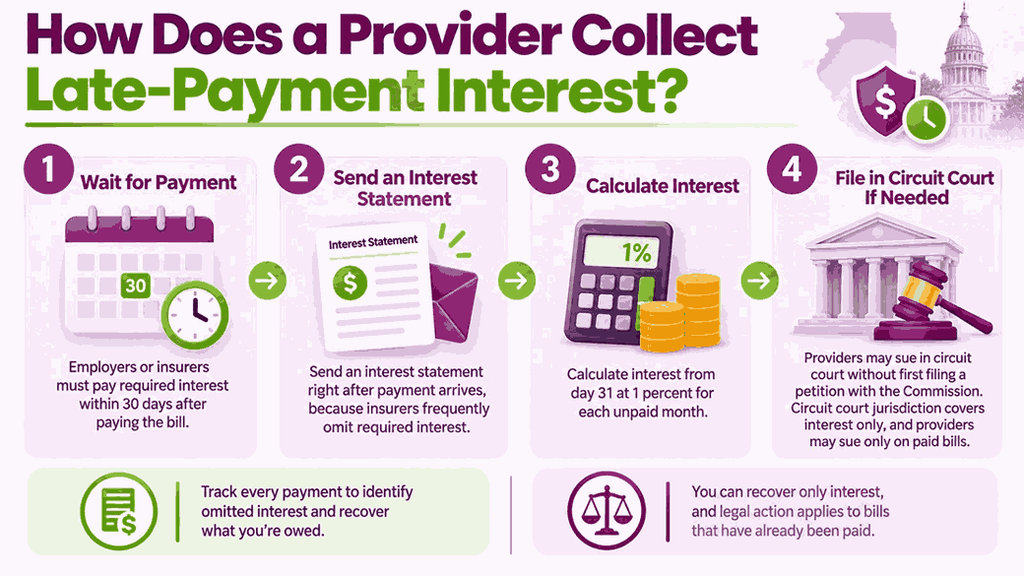
Providers should calculate interest from day 31 at 1 percent for each unpaid month. Providers may sue in circuit court without first filing a petition with the Commission. Circuit court jurisdiction covers interest only, and providers may sue only on paid bills.
Which Illinois Electronic Billing Rules Apply to Workers’ Compensation Claims?
Department of Insurance rules govern both electronic and paper workers’ compensation medical bill formats. Complete electronic bills left unpaid or unobjected after 30 days become subject to interest. Payers must pay uncontested portions of complete bills within 30 days of bill receipt.
Fines for late payment apply only after one month of interest has already accrued. Orthopedic, pain management, and surgical center practices should audit workers’ compensation payments for interest. Specialty practices can hand interest tracking to Illinois billing services that monitor payer deadlines.
How Long Can a Provider Collect an Unpaid Medical Bill in Illinois?
Illinois law sets 10 years for written contracts and 5 years for oral contracts. 735 ILCS 5/13-205 and 5/13-206 create those two limits for unpaid medical bill lawsuits. The table below shows each Illinois limit, its statute, and what restarts the clock.
| Debt Type | Limit | Statute | What Restarts the Clock |
|---|---|---|---|
| Written Contract or Written Evidence of Indebtedness | 10 years | 735 ILCS 5/13-206 | A written payment or new written promise to pay |
| Oral or Implied Contract, including Open Accounts | 5 years | 735 ILCS 5/13-205 | Date the cause of action accrued; confirm restart rules with counsel |
| Court Judgment | 7 years to enforce | 735 ILCS 5/12-108 | Revival proceeding |
Does a Patient Intake Form Create a Written Contract in Illinois?
Courts may treat a contract as written only when essential terms appear in writing. Signed intake forms that lack a price may not qualify for the longer limit. Patients without signed agreements often fall under the five-year limit for implied contracts. Practices should ask counsel to review patient financial responsibility forms for complete essential terms.
Can a Partial Payment Restart the Statute of Limitations?
Under Section 13-206, a written payment or promise restarts the 10-year limitation clock. The action may then be commenced within 10 years from that payment or promise. Practitioners should not assume partial payments restart the five-year limit without legal review. Keep records of every patient payment because those records determine when each limit expires.
What Collection Limits Apply After a Judgment?
Illinois judgments generally cannot be enforced after seven years unless the creditor revives them. 735 ILCS 5/12-108 governs that enforcement window and the revival proceeding for dormant judgments. Illinois wage deductions under 12-803 reach at most 15 percent of gross weekly wages.
A second formula based on 45 times the minimum wage can lower that cap. Consumer debt judgments follow separate revival rules, so confirm current requirements before pursuing accounts. Regular billing audits help identify aging accounts before their limitation periods expire without notice.
Can Illinois Providers Report Medical Debt to Credit Bureaus?
Illinois now bars consumer reporting agencies from reporting medical debt, effective January 1, 2025. Public Act 103-0648 added section 815 ILCS 505/2EEEE to the Illinois Consumer Fraud Act.
The law bars bureaus from maintaining medical debt information in a consumer’s credit file. Reporting a patient balance to bureaus therefore gains providers nothing, and may invite complaints.
What Counts as Medical Debt Under Illinois Law?
Medical debt covers balances arising from health care services, products, or devices patients receive. Collection actions against the consumer to collect medical debt also fall within the protection. Debt charged to a credit card is excluded from the definition of medical debt.
Open-end or closed-end credit from a financial institution is also excluded, with one exception. That exception covers credit a borrower can use solely to purchase health care services. Patients who finance balances through ordinary cards or loans lose the credit reporting protection.
What Should Collection Agency Contracts Say About Credit Reporting?
Review vendor contracts to confirm agencies will not report Illinois medical balances to bureaus. The statute defines collection agencies as entities that purchase or collect medical debt balances. Contracts should prohibit credit bureau reporting and require removal of previously furnished medical tradelines.
Document every account placement, including date, agency, balance, and the written no-reporting instruction sent. A July 2025 federal court vacated the CFPB’s broader medical debt credit reporting rule. Whether federal credit reporting law preempts Illinois’s statute remains unsettled, so monitor court developments. Proposed legislation would extend the restrictions to furnishers, so keep contract language flexible.
What Rules Do Illinois Hospitals Follow for Patient Billing and Charity Care?
Illinois hospitals follow the Fair Patient Billing Act, 210 ILCS 88, before pursuing collections. The Hospital Uninsured Patient Discount Act, 210 ILCS 89, adds discounts for uninsured patients. Both acts apply to licensed hospitals, and the discount excludes separately billed physician services. Ambulatory surgical centers are licensed separately, so these hospital rules do not govern them.
What Does the Fair Patient Billing Act Require?
Hospitals must screen consenting uninsured patients for public insurance eligibility before any collection action. They must also offer financial assistance screening and apply available discounts before referring accounts.
Medical centers must respond to patient billing inquiries within 10 business days under the Act. Hospital bills must meet statutory content requirements and include notice of financial assistance availability. Hospitals may not bill uninsured patients whose income qualifies them for free hospital care.
Billing teams should track screening dates because collection timelines depend on documented screening completion. Hospital revenue cycle teams should embed screening workflows into registration and patient financial services.
Who Qualifies for the Uninsured Patient Discount?
Uninsured patients qualify with family income up to 600 percent of federal poverty guidelines. Rural and critical access hospitals apply a 300 percent federal poverty guideline threshold instead. Most hospitals must provide charity care at or below 200 percent of poverty guidelines.
Discounts apply to medically necessary services exceeding $150 per inpatient admission or outpatient encounter. The uninsured discount factor equals one minus the hospital’s Medicare cost-to-charge ratio times 1.35. That formula caps uninsured charges at cost plus 35 percent, using Medicare cost reports.
Patients may apply within 90 days of discharge, service, screening, or public insurance denial. Hospital obligations cease when patients unreasonably fail to provide requested documentation within 30 days.
How Do Illinois Prior Authorization and Step Therapy Laws Affect Claims?
The Healthcare Protection Act bans step therapy in state-regulated plans from January 1, 2026. HB 5395, Public Act 103-0650, amended the Managed Care Reform and Patient Rights Act. Most provisions took effect January 1, 2025, while several changes began January 1, 2026.
Step therapy requires patients to fail cheaper drugs before insurers approve the prescribed treatment. Denials for step therapy or missing prior authorization deserve careful review against these limits.
Which Plans Does the Healthcare Protection Act Cover?
The Act covers state-regulated plans including individual, small group, and extensive group insured coverage. Medicaid managed care organizations must also follow the step therapy and prior authorization prohibitions. The Healthcare Protection Expansion Act, Public Act 104-0028, also took effect January 1, 2026.
HB 3019 extends some requirements to county, municipal, and school district employee health plans. Self-funded ERISA plans generally fall outside state insurance mandates, so federal rules govern them. Billing teams should confirm funding type before challenging step therapy or prior authorization denials.
What Changed for Behavioral Health Prior Authorization?
Illinois now prohibits prior authorization for inpatient mental health admission to any participating hospital. The ban covers commercial insurers and Medicaid managed care organizations from January 1, 2026. Providers must notify the insurer of the admission and treatment plan within 48 hours.
Insurers must publish a list of services requiring prior authorization on their public websites. Public Act 102-0409, the Prior Authorization Reform Act, separately sets timelines and transparency rules. Document prior authorization numbers, admission notices, and insurer responses so appeals show compliance timelines.
How Does Illinois Enforce Billing Fraud, and What Are the Penalties?
The Illinois False Claims Act, 740 ILCS 175, covers false claims to government programs. The Insurance Claims Fraud Prevention Act, 740 ILCS 92, reaches fraudulent private insurer claims. Both statutes allow whistleblowers to sue on behalf of the State and share recoveries.
What Does the Insurance Claims Fraud Prevention Act Penalize?
Violators face civil penalties of $5,000 to $10,000 per fraudulent claim they participated in. Courts may also assess up to three times the amount of each fraudulent claim. An interested person, including an insurer, may sue for the person and the State.
The Act also reaches kickbacks paid to procure patients for medical services or procedures. Practices must therefore audit marketing arrangements, referral fees, and billing for private payer exposure.
How Does the Illinois False Claims Act Apply to Medicaid Billing?
Knowingly submitting false Medicaid claims creates liability under 740 ILCS 175/3 for billing providers. Liability also reaches false records and statements material to a false or fraudulent claim. Penalties track the federal False Claims Act range, plus three times the State’s damages.
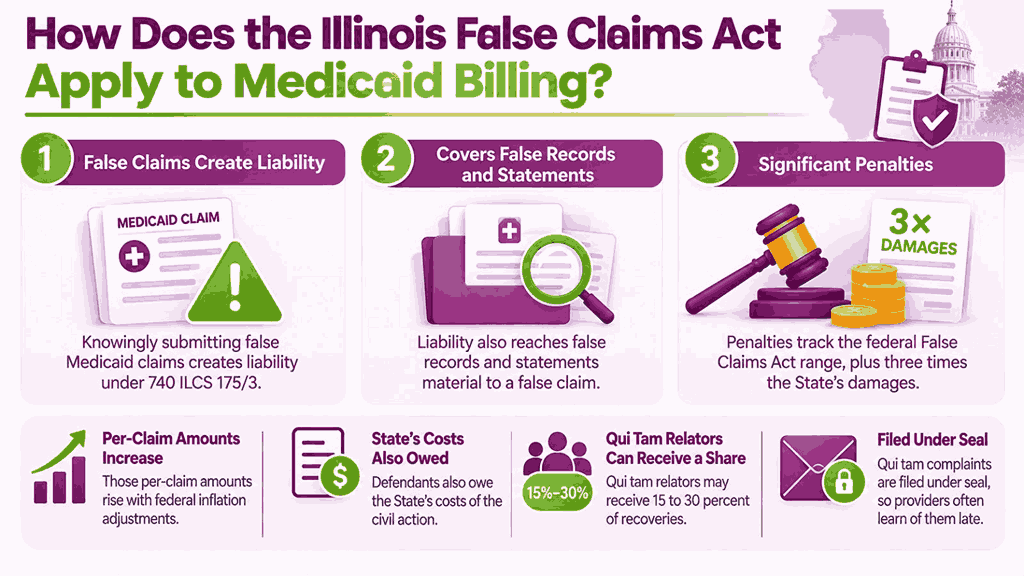
Those per-claim amounts rise with federal inflation adjustments, so verify current figures each year. Defendants also owe the State’s costs of the civil action brought to recover penalties. Qui tam relators may receive 15 to 30 percent of recoveries depending on intervention. Qui tam complaints are filed under seal, so providers often learn of them late.
Which Agencies Audit Illinois Providers?
The HFS Office of Inspector General conducts post-payment audits and recovers improper Medicaid payments. HFS may withhold payments during audits, quality reviews, or credible allegation of fraud investigations.
The Inspector General refers suspected criminal fraud to the state Medicaid Fraud Control Unit. The Attorney General holds subpoena authority to investigate suspected Illinois False Claims Act violations. The Attorney General’s Health Care Bureau also receives patient complaints about provider billing practices.
IDOI investigates private insurance claims fraud and shares evidence with federal agencies when appropriate. Respond to audit requests promptly and retain documentation supporting every claim your practice submits. Practices facing audit pressure often compare the best Illinois billing companies for compliance support.
Which Illinois Privacy Laws Go Beyond HIPAA for Billing Teams?
Four Illinois statutes add to HIPAA: mental health, biometrics, breach notice, and genetic information. HIPAA remains the federal floor, but Illinois adds stricter consent, breach, and biometric rules.
The table below summarizes each statute, its citation, and its effect on billing operations.
| Statute | Citation | Effect on Billing |
|---|---|---|
| Mental Health and Developmental Disabilities Confidentiality Act (MHDDCA) | 740 ILCS 110 | Specific written consent; collection disclosures limited to needed information |
| Personal Information Protection Act (PIPA) | 815 ILCS 530 | Breach notice to residents; Attorney General notice above 500 residents |
| Biometric Information Privacy Act (BIPA) | 740 ILCS 14 | Consent for biometric data; HIPAA treatment, payment, and operations exclusion |
| Genetic Information Privacy Act (GIPA) | 410 ILCS 513 | Confidential genetic information; payment disclosures follow HIPAA minimum necessary standard |
MHDDCA requires specific written consent for mental health records, and blanket consent is invalid. Disclosures to collect balances or obtain third-party payment must include only needed information. Collection agencies receiving mental health data cannot use or redisclose it beyond collection activities.
PIPA requires prompt notice to affected Illinois residents after a breach involving personal information. Breaches affecting more than 500 Illinois residents also require notice to the Attorney General. HIPAA-compliant entities notify the Illinois Attorney General within five business days after notifying HHS.
BIPA excludes information collected for HIPAA treatment, payment, or operations from its biometric identifier definition. That exclusion does not cover employee fingerprint timeclocks or voice data from non-patient callers. BIPA damages run $1,000 for negligent violations and $5,000 for reckless or intentional ones.
A 2024 amendment limits recovery to one award per person for repeated identical collections. GIPA keeps genetic information confidential and allows payment disclosures under HIPAA’s minimum necessary standard. Billing teams should train staff on consent rules before sharing behavioral health records externally.
How Can Illinois Practices Stay Compliant Across Every Deadline?
Practices stay compliant by tracking deadlines by claim type and payer, then auditing quarterly. Illinois deadlines range from 30 days for payment to ten years for collection lawsuits. The Illinois billing deadline matrix below consolidates every deadline discussed throughout this complete guide.
| Claim Type | Deadline | Authority | Consequence |
|---|---|---|---|
| Commercial Clean Claim | Insurer pays within 30 days | 215 ILCS 5/368a | 9 percent annual interest owed on late payment |
| Medicaid fee-for-service Claim | 180 days from date of service | HFS timely filing rules | Denial unless an override is approved |
| Medicare Crossover Claim | 2 years from date of service | HFS timely filing rules | Denial unless an exception applies |
| Workers’ Compensation Bill | Payer pays within 30 days | 820 ILCS 305/8.2(d) | 1 percent monthly interest owed |
| Written Contract Collection Suit | 10 years | 735 ILCS 5/13-206 | Lawsuit becomes time-barred |
| Oral Contract or Open Account Suit | 5 years | 735 ILCS 5/13-205 | Lawsuit becomes time-barred |
| Court Judgment Enforcement | 7 years, then revival | 735 ILCS 5/12-108 | Dormant judgment needs revival |
| Medical Debt Credit Reporting | Barred since January 1, 2025 | Public Act 103-0648 | Bureaus cannot furnish medical debt information |
Which Habits Prevent Most Illinois Billing Denials?
Verify eligibility and plan funding type at every visit before claims leave your system. Funding type decides whether Illinois statutes or federal rules control the claim and deadlines. Submit claims within days of service, never near the 180-day Medicaid filing limit.
Early submission leaves room for corrections, resubmissions, and timely filing overrides if rejections occur. Maintain a payer matrix listing each HealthChoice MCO’s filing, appeal, and prior authorization windows. Update the matrix immediately whenever payer contracts, provider manuals, or Illinois statutes change materially.
Document prior authorization numbers, referral approvals, and notice dates in the patient account record. Complete documentation lets teams challenge step therapy denials and inpatient mental health authorization disputes.
Reconcile payer payments monthly against the 30-day deadlines and bill any missing interest. Quarterly audits then confirm that denials, write-offs, and aging accounts match the deadline matrix.
When Does Outsourcing Make Sense for an Illinois Practice?
Outsourcing makes sense when deadline tracking exceeds what your in-house billing team can manage. Outsourcing does not remove liability, because the practice remains responsible for every submitted claim.
Choose partners that track Illinois deadlines, document claim histories, and support audits and appeals. Practices comparing options can review medical billing services in Illinois before making final outsourcing decisions.
Frequently Asked Questions
Can a Doctor Bill you 6 Months Later in Illinois?
Yes, Illinois generally sets no six-month cutoff for billing patients for care received. Late filing limits in payer contracts and Medicaid often prevent patient billing after denials.
What Happens If You Do Not Pay a Medical Bill in Illinois?
Unpaid bills may go to collections, and providers can sue within the limitation period. Bureaus cannot report medical debt, and hospitals must screen uninsured patients before pursuing collections.
What is the Statute of Limitations for Medical Bills in Illinois?
Illinois generally allows 10 years on written contracts and 5 years on oral contracts. Medical bills without complete signed agreements often fall under the shorter five-year limit.
Is Balance Billing Legal in Illinois?
Illinois bans balance billing for emergency care and certain ancillary services in state-regulated plans. Self-funded plans follow the federal No Surprises Act, which also bans most balance billing.
How Long does an Illinois Insurer have to Pay a Clean Claim?
Illinois insurers must pay clean claims within 30 days of receiving due written proof. Late payments accrue 9 percent interest under 215 ILCS 5/368a until the insurer pays.
What is the Illinois Medicaid Timely Filing Limit?
HFS requires non-institutional Medicaid claims received within 180 days of the date of service. Medicare crossover claims get two years, and exceptions may apply through form HFS 1624.
Can Medical Debt Appear on a Credit Report in Illinois?
No, Illinois bars consumer reporting agencies from reporting medical debt, effective January 1, 2025. Debt charged to credit cards is excluded, and federal preemption questions remain legally unsettled.