Major depressive disorder is coded F32 for a single episode and F33 for recurrent episodes. Severity, remission, and psychotic features set the final characters. Episode and severity documentation decides TMS authorization, Spravato authorization, and risk adjustment outcomes for psychiatry practices.
Major depressive disorder (MDD) is coded in ICD-10-CM under F32 for a single episode and F33 for recurrent episodes. The characters after the decimal report severity, psychotic features, or remission. Psychiatry practices use them on every evaluation, medication visit, and authorization request.
Specificity matters most where reimbursement is at stake. Unspecified codes weaken transcranial magnetic stimulation (TMS) and Spravato authorizations. They also remove diagnoses from Medicare Advantage risk adjustment. Accurate MDD ICD-10 coding starts with documented episode history and severity.
Diagnosis specificity decides whether psychiatry claims and authorizations clear. Transcure’s AAPC-certified billers check episode, severity, and payer criteria before submission.
What Is the ICD-10 Code for Major Depressive Disorder?
The ICD-10-CM code for major depressive disorder is F32.x for a single episode and F33.x for a recurrent episode. The final characters report severity or remission status. The DSM-5-TR uses the same ICD-10-CM codes, so the diagnosis in the chart matches the claim.
The Centers for Medicare & Medicaid Services (CMS) and the National Center for Health Statistics (NCHS) maintain the code set. Every code in the table is billable. The matrix shows how severity and remission map across both MDD categories.
| Severity or Status | F32 (Single Episode) | F33 (Recurrent) |
|---|---|---|
| Mild | F32.0 | F33.0 |
| Moderate | F32.1 | F33.1 |
| Severe without psychotic features | F32.2 | F33.2 |
| Severe with psychotic features | F32.3 | F33.3 |
| In partial remission | F32.4 | F33.41 |
| In full remission | F32.5 | F33.42 |
| In remission, unspecified | Not applicable | F33.40 |
| Unspecified | F32.9 | F33.9 |
Four related codes sit beside the MDD matrix and cause frequent confusion. None of them reports a standard MDD episode by severity.
| Code | Description | Relationship to MDD |
|---|---|---|
| F32.A | Depression, unspecified | Does not establish MDD |
| F32.89 | Other specified depressive episodes | Specified episode outside the standard severity codes |
| F33.8 | Other recurrent depressive disorders | Specified recurrent depression outside the standard codes |
| F34.1 | Dysthymic disorder | Persistent depressive disorder, coded outside F32 and F33 |
Chapter 5 of the ICD-10-CM Official Guidelines sets the reporting rules for mental disorders. Those rules sit inside the wider ICD-10 diagnosis coding rules every coder follows, including coding to the highest documented specificity. Psychiatry practices apply them on every encounter.
Did the MDD Code Set Change for FY2027?
The F32 and F33 categories have no new or deleted codes in the FY2027 ICD-10-CM update, effective October 1, 2026. Psychiatry practices keep the same MDD codes for dates of service through September 30, 2027. Each code still needs checking against the current CMS code set before submission.
How Do You Choose Between F32 and F33 for MDD?
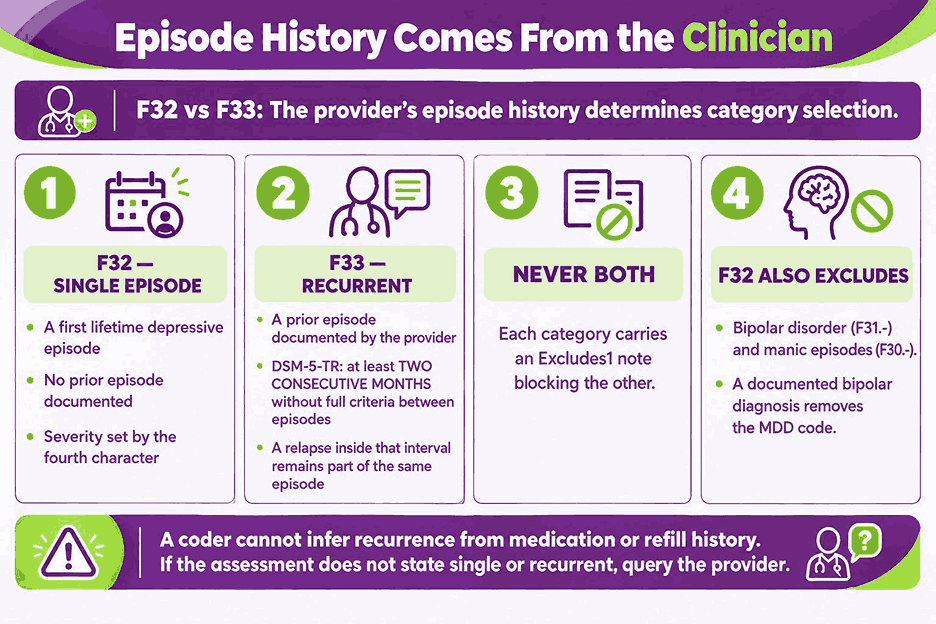
F32 applies to a first lifetime depressive episode, while F33 applies once the provider documents a prior episode. The two categories never describe the same episode. Each carries an Excludes1 note that blocks the other. The choice rests on history, not severity.
Episode history comes from the clinician, not from the claim. A coder cannot infer recurrence from a medication list or refill history. The provider must state single or recurrent in the assessment. Without that statement, specificity is lost.
What Counts as a Recurrent Episode?
The DSM-5-TR requires an interval of at least two consecutive months between episodes in which full criteria are not met. Two episodes separated by that interval qualify as recurrent. A relapse inside the interval counts as part of the same episode.
Can F32 and F33 Be Reported Together?
F32 and F33 cannot be reported together for the same episode. Both categories carry Excludes1 notes that exclude the other. Bipolar disorder (F31.-) and manic episodes (F30.-) sit under the F32 note too, so a bipolar diagnosis removes the MDD code.
What Should a Coder Do When the Chart Does Not State Episode History?
The coder queries the provider before assigning a code. Defaulting to an unspecified code without a query loses specificity and weakens later authorizations. The table shows how chart wording maps to a coding decision.
| Chart Says | Correct Action | Reason |
|---|---|---|
| MDD, recurrent, moderate | Report F33.1 | Episode and severity are documented |
| MDD, moderate, two prior episodes | Report F33.1 | Prior episodes establish recurrence |
| Major depression, moderate, no history stated | Query the provider | Recurrence cannot be assumed |
How Do You Code MDD Severity and Psychotic Features?
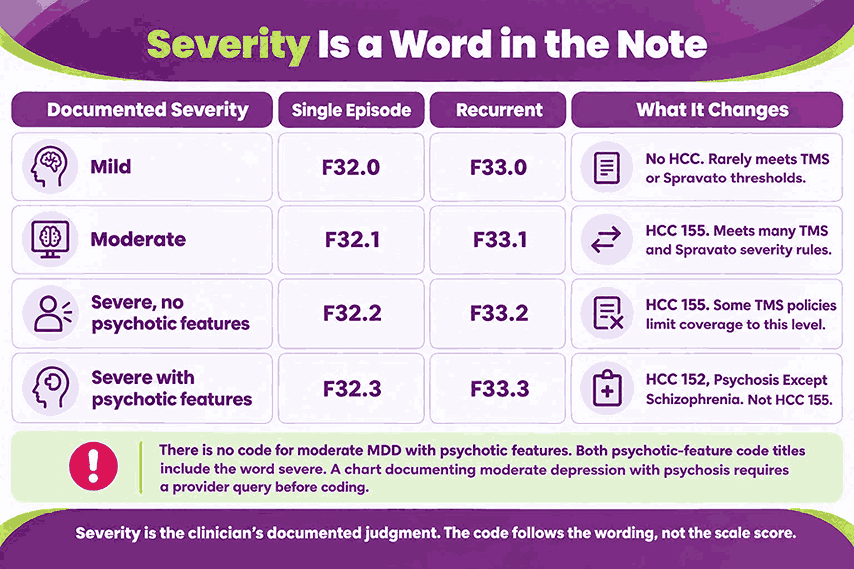
Severity is the clinician’s documented judgment, and the code follows that wording. Mild, moderate, and severe each have separate codes in both F32 and F33. Severe episodes split again by the presence of psychotic features.
Specific severity codes carry the most weight on authorizations and risk adjustment. Moderate and severe codes matter most in TMS requests, Spravato requests, and HCC capture. Each severity level has a distinct code and a distinct payer consequence.
What Is F33.1?
F33.1 is major depressive disorder, recurrent, moderate. The provider documents a prior episode and a current episode of moderate severity. F32.1 is the single-episode equivalent. Both codes map to HCC 155 under CMS-HCC V28, which makes severity documentation a risk adjustment issue.
What Is F33.2?
F33.2 is major depressive disorder, recurrent, severe without psychotic features. F32.2 is the single-episode equivalent. Some payer TMS policies limit coverage to severe depression without psychosis. The chart must state severe and must not document psychosis in the current episode.
What Is the Code for Mild Major Depressive Disorder?
Mild MDD is F32.0 for a single episode and F33.0 for a recurrent episode. Neither code maps to an HCC under V28. Mild episodes rarely meet payer thresholds for TMS or Spravato, so the code seldom changes those authorizations.
How Do You Code MDD With Psychotic Features?
MDD with psychotic features codes to F32.3 for a single episode or F33.3 for a recurrent episode. Both code titles include the word severe. No code exists for moderate MDD with psychotic features. A chart with that wording requires a provider query.
Can a PHQ-9 Score Assign the Severity Code?
A PHQ-9 score cannot assign the severity code on its own. The clinician states severity, and the score supports that statement. The table pairs standard PHQ-9 bands with the ICD-10-CM wording they usually support.
| PHQ-9 Score | Band | Typical ICD-10-CM Wording |
|---|---|---|
| 0 to 4 | Minimal | Does not support an MDD severity code |
| 5 to 9 | Mild | Mild (F32.0 or F33.0) |
| 10 to 14 | Moderate | Moderate (F32.1 or F33.1) |
| 15 to 19 | Moderately severe | Moderate or severe, by clinician judgment |
| 20 to 27 | Severe | Severe (F32.2 or F33.2, or F32.3 or F33.3 with psychosis) |
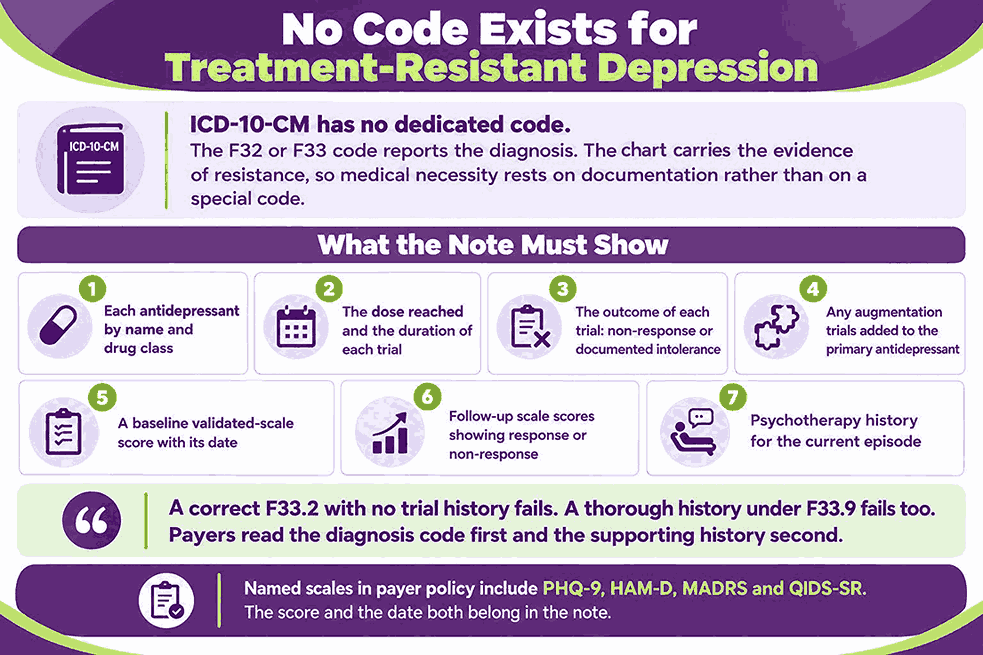
Payer policies name different validated scales, including the Hamilton Depression Rating Scale (HAM-D), the Montgomery-Asberg Depression Rating Scale (MADRS), and the QIDS-SR. The score and the date belong in the note. A baseline score anchors every later response measurement.
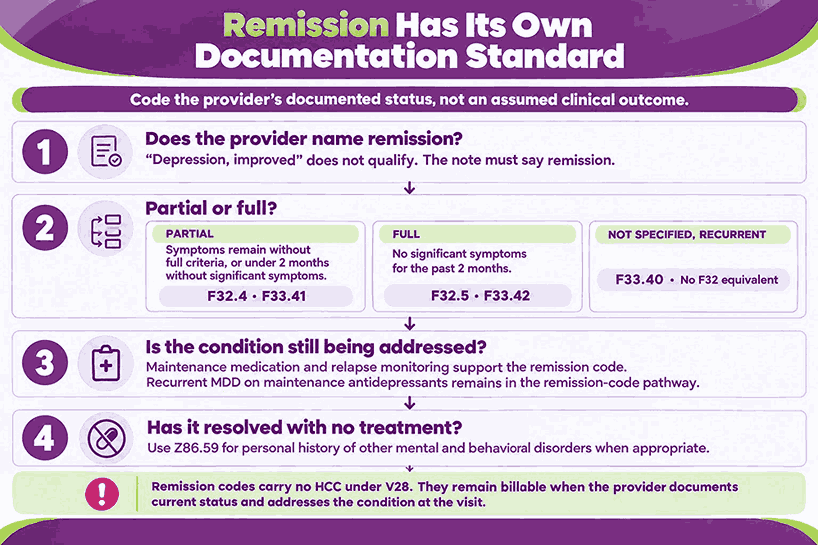
How Do You Code MDD in Remission?
Remission codes apply when the provider documents the episode as in partial or full remission. F32.4 and F32.5 cover a single episode. F33.41 and F33.42 cover recurrent episodes, and F33.40 covers recurrent remission without further specification.
MDD in remission ICD-10 coding depends on the provider’s status statement. A note reading “depression, improved” does not qualify. The provider must name remission and state whether it is partial or full.
| Remission Status | DSM-5-TR Definition | Codes |
|---|---|---|
| Partial | Symptoms present without full criteria, or under two months without significant symptoms | F32.4, F33.41 |
| Full | No significant symptoms for the past two months | F32.5, F33.42 |
| Unspecified | Remission documented without partial or full status | F33.40 |
Is Major Depressive Disorder in Remission Still Billable?
Remission codes are billable when the provider documents current status and addresses the condition at the visit. Maintenance medication and relapse monitoring support the code. Remission codes carry no HCC under V28, which lowers their risk adjustment value.
When Does Remission Become a History Code?
Z86.59, personal history of other mental and behavioral disorders, applies when the condition has resolved and no longer receives treatment. A patient on maintenance antidepressants for recurrent MDD stays in the remission codes. The provider’s documentation decides the boundary.
When Is F32.A, F32.9, or F33.9 the Right Code?
F32.A is the ICD-10 code for depression unspecified, and it does not establish major depressive disorder. F32.9 and F33.9 are MDD codes with unspecified severity. The three codes look similar but carry different meanings on a claim.
F32.A entered ICD-10-CM in fiscal year 2022. It stopped “depression NOS” from defaulting to an MDD code. Providers who document only “depression” now land on F32.A. Providers who document “major depressive disorder” without severity land on F32.9 or F33.9.
| Code | Meaning | Use When | HCC Under V28 |
|---|---|---|---|
| F32.A | Depression, unspecified | Provider documents depression without “major” or severity | No |
| F32.9 | MDD, single episode, unspecified | MDD documented, single episode, severity not stated | No |
| F33.9 | MDD, recurrent, unspecified | MDD documented, recurrent, severity not stated | No |
The costliest error is a moderate or severe episode coded to F33.9 because the note omitted the severity word. The HCC is lost. TMS and Spravato requests also lose their severity support.
Unspecified codes cost the most when the clinical picture is already moderate or severe.
Which Depression Codes Look Like MDD but Are Not?
Several depressive codes resemble MDD but describe different diagnoses, and each follows its own coding rules. The provider’s documented diagnosis decides which code applies. The table separates the codes that most often get mistaken for MDD.
| Code | Diagnosis | Why It Is Not MDD |
|---|---|---|
| F34.1 | Dysthymic disorder | Chronic, lower-grade course coded as persistent depressive disorder |
| F31.- | Bipolar disorder | Excludes1 notes remove F32 and F33 when bipolar disorder is documented |
| F32.81 | Premenstrual dysphoric disorder | Cyclical pattern with its own code |
| F53.0 | Postpartum depression | Perinatal onset with its own code |
| F06.31, F06.32 | Mood disorder due to a known physiological condition | Medical cause with depressive features or a major depressive-like episode |
| F43.21, F43.23 | Adjustment disorder with depressed mood, or mixed anxiety and depressed mood | Stressor-linked reaction below MDD criteria |
| F41.8 | Other specified anxiety disorders | Includes mixed anxiety and depressive disorder |
Notes that say “depression with anxiety” are ambiguous and need a provider query. A psychiatry ICD-10 code reference helps coders match the documented diagnosis to the right category. The query resolves the code before the claim leaves the practice.
How Does MDD Coding Affect TMS and Spravato Medical Necessity?
TMS and Spravato authorizations depend on two chart elements. The MDD code must match the payer’s severity rule, and the note must document failed antidepressant trials. A mismatch on either element is a common reason for denial.
Both treatments serve patients with depression that has not responded to standard care. Payers read the diagnosis code first and the supporting history second. A correct F33.2 with no trial history fails. A thorough history under F33.9 fails too.
Which MDD Codes Do Payers Accept for TMS (CPT 90867 to 90869)?
CPT 90867 reports the initial TMS treatment, including cortical mapping and motor threshold determination. CPT 90868 reports subsequent delivery and management. CPT 90869 reports subsequent treatment with motor threshold re-determination. Payer policies set the diagnosis and history rules for all three.
| Criterion | What Payer Policies Commonly Specify | What to Document |
|---|---|---|
| Severity | Moderate to severe, or severe without psychosis, depending on the policy | Episode, severity, and psychotic status |
| Failed trials | Between one and four antidepressant trials, sometimes from two drug classes | Drug, class, dose, duration, and outcome |
| Validated scale | Baseline and follow-up scores on a named scale | PHQ-9, HAM-D, MADRS, or QIDS-SR score and date |
| Exclusions | Bipolar disorder, psychosis in the current episode, seizure history, implanted magnetic-sensitive devices | Screening for each exclusion |
| Treating provider | Psychiatrist or supervised clinician | Provider credentials and supervision |
What Is the Medicare Coverage Basis for TMS?
Medicare Administrative Contractors (MACs) publish Local Coverage Determinations (LCDs) for TMS. Coverage centers on treatment-resistant major depressive disorder. Criteria differ by jurisdiction, so the practice confirms the LCD for its own MAC region before treatment starts.
Which Diagnosis Codes Support Spravato Administration (G2082 and G2083)?
Esketamine nasal spray (Spravato) is administered under a Risk Evaluation and Mitigation Strategy (REMS) with required post-dose observation. HCPCS G2082 reports administration of up to 56 mg, and G2083 reports more than 56 mg. The FDA label covers treatment-resistant depression in adults and MDD with acute suicidal ideation or behavior.
Payers review the MDD code and the antidepressant history before approving the series. Severity wording and trial documentation carry the same weight as they do for TMS. Interventional psychiatry practices evaluating psychiatry billing companies should check how they track payer-specific Spravato and TMS criteria, since series approvals fail on severity and trial gaps.
Is There an ICD-10 Code for Treatment-Resistant Depression?
ICD-10-CM has no dedicated code for treatment-resistant depression. The F32 or F33 code reports the diagnosis, and the chart carries the evidence of resistance. Medical necessity therefore rests on documentation, not on a special code.
What Documentation Proves Treatment Resistance?
Payers look for a dated, specific trial history. The note should show:
- Each antidepressant by name and drug class.
- The dose reached and the duration of each trial.
- The outcome of each trial, either non-response or documented intolerance.
- Any augmentation trials added to the primary antidepressant.
- A baseline validated scale score with its date.
- Follow-up scale scores that show response or non-response.
- Psychotherapy history for the current episode.
Why Do MDD Codes Matter for Risk Adjustment and Audits?
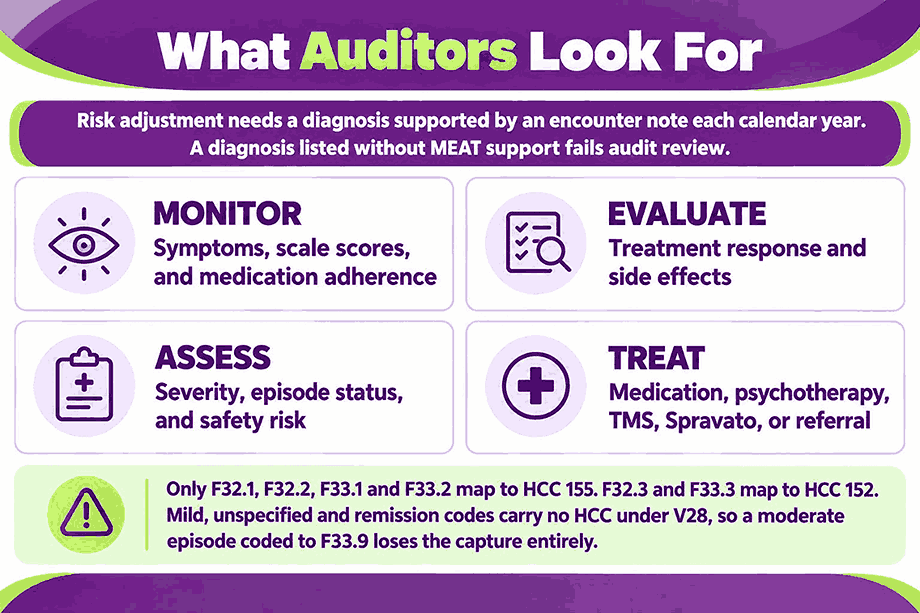
Under CMS-HCC V28, moderate and severe major depression without psychosis map to HCC 155. Mild, unspecified, and remission codes do not map. Medicare Advantage plans and accountable care organizations (ACOs) rely on this mapping to report patient complexity.
Risk adjustment looks for a diagnosis supported by an encounter note each calendar year. The Monitor, Evaluate, Assess, Treat (MEAT) standard shows that the provider addressed the condition. A diagnosis listed without MEAT support fails audit review.
- Monitor: symptoms, scale scores, and medication adherence.
- Evaluate: treatment response and side effects.
- Assess: severity, episode status, and safety risk.
- Treat: medication, psychotherapy, TMS, Spravato, or referral.
| Code Group | Codes | HCC 155 Under V28 |
|---|---|---|
| Moderate | F32.1, F33.1 | Yes |
| Severe without psychotic features | F32.2, F33.2 | Yes |
| Mild | F32.0, F33.0 | No |
| Unspecified | F32.9, F33.9, F32.A | No |
| In remission | F32.4, F32.5, F33.40, F33.41, F33.42 | No |
| Severe with psychotic features | F32.3, F33.3 | Follows separate category rules |
Does F32.9 Map to an HCC?
F32.9 does not map to an HCC under CMS-HCC V28. The same holds for F33.9 and F32.A. When the clinical picture is moderate or severe, the note must say so. The code then follows the documentation.
How Do Audits Treat MDD Diagnoses?
The Office of Inspector General (OIG) has included major depressive disorder among the diagnosis groups reviewed in Medicare Advantage audits. Auditors look for diagnoses that lack severity, treatment, or encounter support. Specific, dated documentation answers each of those findings.
What Documentation Do Payers and Auditors Expect for an MDD Diagnosis?
A payer or auditor expects every MDD diagnosis to show episode, severity, and current status. The note also needs a validated scale score and a treatment plan. Together these elements support the code and the medical necessity argument.
The DSM-5-TR criteria belong in the note as one clause stating that criteria are met. A full symptom inventory is not required. Specific, dated clinical statements carry more weight than long templates.
| Element | Weak Note Language | Strong Note Language |
|---|---|---|
| Episode | Major depression, ongoing | Major depressive disorder, recurrent; prior episodes in 2019 and 2022 |
| Severity | MDD, on medication | MDD, recurrent, moderate; PHQ-9 of 14 |
| Psychosis | Severe depression with paranoia | MDD, recurrent, severe with psychotic features; auditory hallucinations documented |
| Remission | Depression, improved | MDD, recurrent, in partial remission; PHQ-9 of 6 on sertraline |
Dated scale scores also protect the practice during payer review. A baseline score and a follow-up score show response or non-response across treatment. A psychiatry billing guide that covers documentation standards, modifiers, and denial management helps teams apply these note-level rules consistently across providers.
Which CPT and HCPCS Codes Pair With MDD Diagnosis Codes?
MDD diagnosis codes attach to evaluation, psychotherapy, assessment, and interventional psychiatry services. The diagnosis supports medical necessity for each service. The table pairs the most common psychiatry codes with their MDD role.
| Code | Service | MDD Pairing Note |
|---|---|---|
| 90791 | Psychiatric diagnostic evaluation | Establishes the F32 or F33 diagnosis |
| 90792 | Psychiatric diagnostic evaluation with medical services | Supports diagnosis plus medication management |
| 90833, 90834, 90837 | Psychotherapy with or without an E/M add-on | Links to the documented MDD severity |
| 96127 | Brief emotional or behavioral assessment with scoring | Documents the PHQ-9 or similar score |
| G0444 | Annual depression screening for Medicare | Reports screening, not a diagnosis |
| 90867 to 90869 | TMS treatment | Requires the payer’s severity and trial documentation |
| G2082, G2083 | Esketamine administration with observation | Requires the payer’s severity and trial documentation |
Practices that bill TMS and esketamine administration should confirm the psychiatry CPT codes for add-on, modifier, and unit rules before submission. Those rules differ by payer and affect reimbursement as much as the diagnosis does.
What Are the Most Common MDD Coding Errors and Denial Causes?
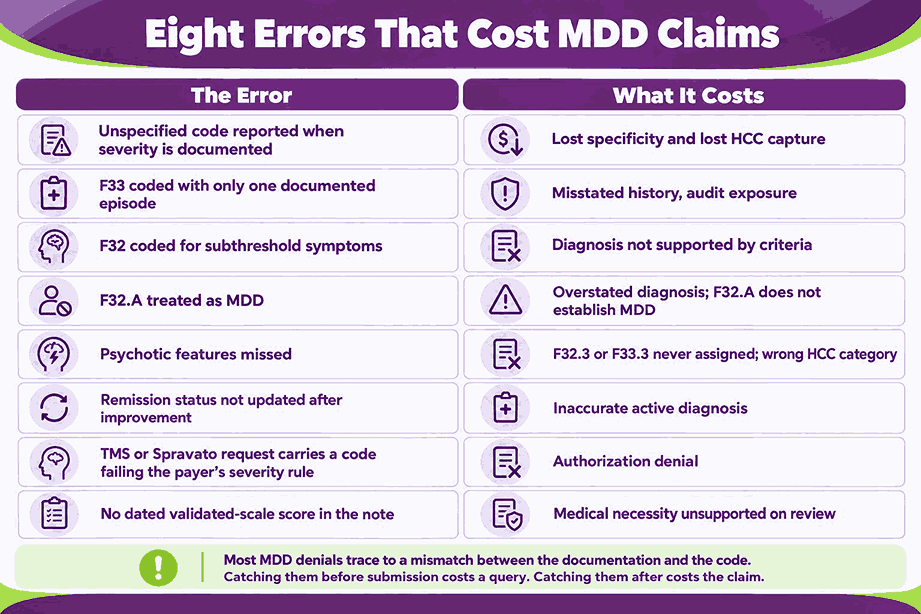
Most MDD denials trace to a mismatch between the documentation and the code. Auditors and payers compare the diagnosis against episode, severity, and treatment history. The errors below appear most often in psychiatry claim review.
- An unspecified code is reported when severity is documented, which loses specificity and HCC capture.
- F33 is coded with only one documented episode, which misstates history.
- F32 is coded for subthreshold symptoms that do not meet MDD criteria.
- F32.A is treated as MDD, which overstates the diagnosis.
- Psychotic features are missed, so F32.3 or F33.3 is never assigned.
- Remission status goes unupdated after the patient improves.
- A TMS or Spravato request carries a code that fails the payer’s severity rule.
- The note lacks a dated validated-scale score.
Psychiatry practices that route claims through psychiatry billing services catch these mismatches before submission. Coders check episode history, severity wording, and payer criteria against the note. They query providers when the chart conflicts.
Frequently Asked Questions About MDD ICD-10 Codes
What is the ICD-10 code for major depressive disorder?
The ICD-10-CM codes for major depressive disorder are F32.0 to F32.5 and F32.9 for a single episode. F33.0 to F33.9 cover recurrent episodes. The provider’s episode and severity documentation selects the exact code.
What is ICD-10 code F33.2?
F33.2 is major depressive disorder, recurrent, severe without psychotic features. It requires a documented prior episode and a current severe episode. Some payer TMS and Spravato criteria reference this severity level.
What is ICD-10 code F33.1?
F33.1 is major depressive disorder, recurrent, moderate. It requires a documented prior episode and a current moderate episode. The code maps to HCC 155 under CMS-HCC V28.
What is the ICD-10 code for mild major depressive disorder?
Mild major depressive disorder is F32.0 for a single episode and F33.0 for a recurrent episode. Neither code maps to an HCC under V28. The provider must document mild severity in the note.
Is F32.A the same as F32.9?
F32.A and F32.9 are different codes. F32.A reports depression unspecified without an MDD diagnosis. F32.9 reports major depressive disorder, single episode, unspecified. Neither code maps to an HCC under V28.
What is the ICD-10 code for major depressive disorder with anxious distress?
ICD-10-CM has no separate code for the anxious distress specifier. The coder reports the MDD code by episode and severity. A separate anxiety code applies only when the provider documents an anxiety disorder.
Can MDD be billed together with an anxiety code?
MDD and an anxiety disorder code can be reported together when the provider documents both diagnoses. Generalized anxiety disorder (F41.1) is a common pairing. Each diagnosis needs its own supporting documentation.
Is there an ICD-10 code for treatment-resistant depression?
ICD-10-CM has no dedicated code for treatment-resistant depression. The F32 or F33 code reports the diagnosis. The chart documents failed antidepressant trials, which supports TMS or Spravato medical necessity.