Colorado Medicaid billing follows the rules in 10 CCR 2505-10 and the procedures in HCPF’s official provider billing manuals. Gainwell Technologies receives claims through the Provider Web Portal, batch EDI, or approved paper. Providers have 365 days from the date of service to submit each Medicaid claim.
After day 365, claims stay timely only when providers resubmit every 60 days with the previous ICN. Health First Colorado always pays last, so commercial insurance and Medicare pay claims first. TPL rules, ColoradoPAR authorizations, and member billing limits shape every Health First Colorado claim.

Noncompliance with billing rules carries consequences including claim denials, overpayment recoupment, and payment suspension. This guide covers Colorado Medicaid billing from eligibility checks to timely filing and denials. Every rule below comes from official HCPF manuals, provider bulletins, and Colorado state regulations.
What Is Colorado Medicaid Billing?
Colorado Medicaid billing is how providers get paid for covered Health First Colorado services. Health First Colorado is Colorado’s Medicaid program, established under Title XIX of federal law. The program pays for medically necessary services after all other healthcare resources are exhausted.
Claims follow two payment methods, fee-for-service and capitation, which determine where providers send claims. Medicaid billing in Colorado runs through the Colorado interChange system and Provider Web Portal.
Who Administers Health First Colorado billing?
Five organizations administer Health First Colorado billing, and each organization controls a separate step. The table below lists each administrator and the specific billing function that administrator performs.
| Administrator | Billing role |
|---|---|
| HCPF | Sets policy, rules, billing manuals, and reimbursement rates |
| Gainwell Technologies | Fiscal agent that enrolls providers and receives claims |
| County departments of human services | Determine member eligibility and issue Medical Identification Cards |
| ColoradoPAR Program (Acentra Health) | Administers prior authorization request reviews |
| DentaQuest | Processes dental claims as the dental administrative services organization |
The fiscal agent processes claims in the Colorado interChange and issues weekly remittance advice. HCPF writes the rules, and Gainwell Technologies applies those rules to submitted fee-for-service claims.
Which Claims Go to fee-for-service and Which Go to RAEs or MCOs?
Claim destination depends on service type and a member’s RAE or MCO enrollment status. Colorado’s ACC Phase III began July 1, 2025, with four RAE regions replacing seven. RAEs reimburse capitated behavioral health services, while HCPF pays fee-for-service physical health claims directly.
Managed care organizations pay claims for their enrolled members under capitated contracts with HCPF. The following table maps five common Health First Colorado claim types to billing destinations.
| Claim type | Billing destination |
|---|---|
| Physical health services for members assigned only to a RAE | HCPF fee-for-service through Gainwell Technologies |
| Capitated behavioral health services | The member’s RAE |
| Fee-for-service behavioral health services | Gainwell Technologies |
| Services for members enrolled in an MCO | The MCO |
| Dental services | DentaQuest |
Gainwell Technologies denies fee-for-service claims for members enrolled in a capitated managed care program. Eligibility verification shows managed care enrollment before service, so providers confirm the correct payer.
Who Can Bill Health First Colorado?
Only providers enrolled with Health First Colorado receive payment for covered Medicaid benefit services. Six enrollment requirements determine which providers can bill and receive Health First Colorado payment.
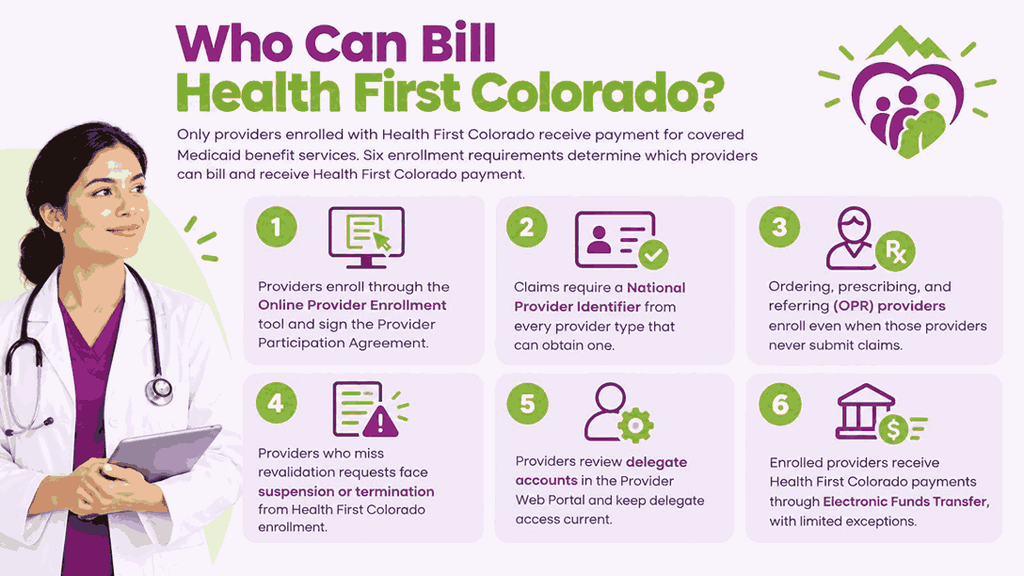
- Providers enroll through the Online Provider Enrollment tool and sign the Provider Participation Agreement.
- Claims require a National Provider Identifier from every provider type that can obtain one.
- Ordering, prescribing, and referring (OPR) providers enroll even when those providers never submit claims.
- Providers who miss revalidation requests face suspension or termination from Health First Colorado enrollment.
- Providers review delegate accounts in the Provider Web Portal and keep delegate access current.
- Enrolled providers receive Health First Colorado payments through Electronic Funds Transfer, with limited exceptions.
Billing companies cannot receive Medicaid payments directly because payments go to the enrolled provider. A separate Colorado Medicaid provider enrollment guide explains each enrollment step in complete detail.
How Do You Verify Eligibility Before Billing?
Providers verify Health First Colorado eligibility on the date of service before rendering services. A Medical Identification Card alone does not verify eligibility, so providers run an inquiry. The Colorado Benefits Management System stores member eligibility records and updates every business day.
Which Methods Verify Health First Colorado Eligibility?
Providers verify eligibility through the Provider Web Portal, IVR system, or batch 270 transactions. The following table compares the three eligibility methods by function and by access requirement.
| Method | Function | Access requirement |
|---|---|---|
| Provider Web Portal | Interactive or batch 270 eligibility inquiry | Provider Web Portal account |
| IVR virtual agent | Voice eligibility, claim status, and warrant information | Call to the Provider Services Call Center |
| Batch 270/271 | HIPAA transaction through an office system or clearinghouse | Signed Trading Partner Agreement |
The IVR virtual agent GABBY also reports claim status and warrant information to callers. Batch 270/271 transactions require a HIPAA-compliant sender, an office system or a clearinghouse. The 270/271 Companion Guide on the EDI Support web page lists exact transaction specifications.
Every eligibility response returns four data points that determine how a claim gets billed.
- Eligibility dates confirm active Medicaid coverage for the exact date of service being billed.
- Co-pay status shows each member’s co-pay liability before the provider collects payment at service.
- Third-party liability details list commercial insurance and Medicare coverage that pays before Medicaid does.
- Managed care enrollment names the RAE or MCO responsible for the member’s covered services.
Providers who verify eligibility on the date of service receive an eligibility guarantee number. The guarantee number exempts the claim from eligibility edits if coverage changes before submission.
Providers retain documentation of each eligibility verification, which supports billing and later audit requests. Third-party liability data is member-reported, so providers also ask every member about other insurance.
How Do You Submit Claims to Health First Colorado?
Providers submit claims through three channels, namely the portal, batch EDI, and approved paper. Electronic submission is the default, and paper claims require advance approval from the Department. The following table compares the three submission channels by claim format and feedback type.
| Channel | Claim format | Feedback |
|---|---|---|
| Provider Web Portal | Interactive 837P and 837I, one claim at a time | Immediate paid, denied, or suspended response |
| Batch EDI | 837P, 837I and 837D files | TA1 and 999 acknowledgments, then remittance advice |
| Paper | CMS-1500, UB-04 and ADA forms | Remittance advice after processing |
Claims from all three channels appear together on the same weekly Remittance Advice document.
How does Provider Web Portal Submission Work?
Interactive portal submission is a real-time exchange between the provider and Health First Colorado. Providers create and transmit 837P professional and 837I institutional claims one at a time. The portal workflow follows five ordered steps from login through the immediate claim response.
- Providers log in to the portal and select a professional or institutional claim type.
- Providers enter member, provider, diagnosis, and service line details using the portal’s required fields.
- The portal edits check format, validity, required fields, and billing policy compliance before claim adjudication.
- The portal returns an immediate response showing the claim as denied, suspended, or paid.
- Suspended claims receive manual review from the fiscal agent and do not need resubmission.
Claim status inquiries on the portal show claim results before the Remittance Advice posts. Providers also adjust, edit, resubmit, and void claims in real time through the portal.
How does Batch EDI Submission Work?
Batch EDI submission sends groups of claims from billing software, a vendor, or a clearinghouse. Batch files follow the X12N standards that Washington Publishing Company publishes in TR3 guides.
Companion Guides on the EDI Support page cover 837P, 837I, and 837D batch transactions. Batch submission requires four setup steps before providers transmit the first production claim file.
- EDI Trading Partner enrollment assigns a Logon Name, Logon ID, and Trading Partner ID.
- Batch software completes testing and vendor certification with the fiscal agent before production submission.
- Submitters transmit 837 files through the SFTP file delivery system or Provider Web Portal.
- Submitters review the TA1 and 999 acknowledgments to confirm each file passed validation successfully.
Two acknowledgment reports identify batch file errors at two different stages of electronic validation.
| Acknowledgement | Validation stage | Error result |
|---|---|---|
| TA1 Interchange Acknowledgment | Interchange header and trailer syntax | Corrupt data or a missing trading partner relationship blocks adjudication |
| 999 Functional Acknowledgment | X12 validation after header and trailer checks | Segments and elements with syntax errors appear in the report |
A TA1 rejection stops claims from adjudication, so submitters correct the error and resend.
When are Paper Claims Allowed?
Paper claims require prior Department approval, because electronic claims are the required billing format. Providers who consistently submit five claims or fewer monthly can request paper billing approval.
Paper claim approval requests go to Gainwell Technologies, P.O. Box 30, Denver, CO 80201-0030. Three paper claim forms apply, and provider type determines which form each provider submits.
| Form | Used for |
|---|---|
| CMS-1500 | Professional claims from practitioners and other professional provider types |
| UB-04 | Institutional claims from hospitals and other facilities |
| ADA Dental Claim form | Dental claims submitted to DentaQuest |
Paper claims reject typed signatures and “Signature on File” but accept holographic signature stamps.
What Is the Colorado Medicaid Timely Filing Limit?
The Colorado Medicaid timely filing limit is 365 days from the date of service. Providers always have 365 days to submit each claim to fiscal agent Gainwell Technologies. HCPF bulletins confirm this deadline under Colorado Medicaid rule 10 CCR 2505-10, section 8.043.
Denied claims still satisfy timely filing, so providers submit every claim before day 365. Correspondence with Gainwell does not prove timely filing, because only a submitted claim counts.
How do You Keep a Claim within Timely Filing?
Resubmitting every 60 days keeps a claim within timely filing after 365 days pass. The Internal Control Number (ICN) is a unique identifier assigned to every processed claim.
- Providers submit the original Medicaid claim within 365 days from the date of service.
- Providers check each weekly Remittance Advice to identify denied claims and returned paper claims.
- Providers correct the error and resubmit within 60 days of the last Remittance Advice.
- Resubmitted claims past 365 days reference the previous ICN from the latest 60-day submission.
- Providers repeat this 60-day cycle after every denial to preserve claim timely filing status.
Claims still inside 365 days do not require 60-day refiling until that deadline passes.
Which Exceptions Extend Timely Filing?
Four documented circumstances extend Health First Colorado timely filing beyond the standard 365-day deadline.
- Medicare crossover claims stay timely within 120 days of the Medicare payment or denial date.
- Retroactive member eligibility extends filing to 60 days after the county load letter date.
- Backdated provider enrollment extends filing to 60 days after the enrollment approval letter date.
- Providers also resubmit within 60 days when Gainwell or Health Management Systems initiates adjustments.
Providers attach the county load letter or enrollment approval letter to each resubmitted claim. Load letter requests require an ICN from a claim submitted within the 365-day window. A Prior Authorization Request (PAR) approval does not waive timely filing requirements for claims.
The following table summarizes six timely filing scenarios with deadlines and required claim actions.
| Scenario | Deadline | Required action |
|---|---|---|
| Original Claim | 365 days from date of service | Submit the claim, even when denial is likely |
| Resubmission After Denial | 60 days from the last Remittance Advice | Enter the previous ICN in the Previous Claim ICN field |
| Medicare as Primary Payer | 365 days, or 120 days from the Medicare Explanation of Benefits date | Submit after receiving the Medicare Explanation of Benefits |
| Retroactive Member Eligibility | 60 days from the county load letter date | Attach the load letter to the claim |
| Backdated Provider Enrollment | 60 days from the enrollment approval letter date | Attach the enrollment approval letter to the claim |
| Gainwell or HMS Adjustment or Recoupment | 60 days from the adjustment or recoupment | Resubmit with the previous ICN |
How Does Third-Party Liability and Medicare Crossover Billing Work?
Health First Colorado is the payer of last resort, so other coverage pays first. Federal regulations require providers to use all available health insurance benefits before billing Medicaid. Third-Party Liability (TPL) covers commercial insurance, Medicare, and other resources that pay before Medicaid. An estimated 10% of Health First Colorado members have other health insurance resources available.
How do Providers Report TPL Payments and Denials?
Providers report TPL payments and denials in designated claim fields on every Medicaid claim.
- With few exceptions, claims for members with known TPL are denied when no insurance payment or denial appears.
- Providers enter the TPL Explanation of Benefits (EOB) date on each Medicaid claim submitted.
- Providers retain the EOB for audit because attaching the EOB to claims is unnecessary.
- Records of TPL payments and denials stay on file for seven years for audits.
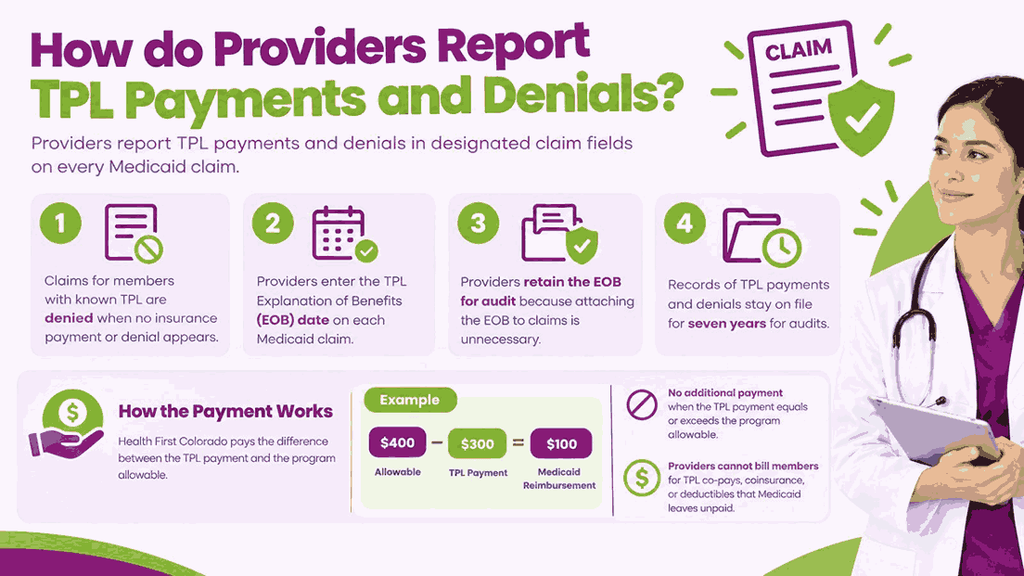
Health First Colorado pays the difference between the TPL payment and the program allowable. A $400 allowable minus a $300 TPL payment leaves a $100 Medicaid reimbursement amount. No additional payment occurs when the TPL payment equals or exceeds the program allowable. Providers cannot bill members for TPL co-pays, coinsurance, or deductibles that Medicaid leaves unpaid.
Which TPL Denial Reasons are Invalid?
Four commercial insurer denial reasons are invalid for submitting a Health First Colorado claim.
| Invalid TPL denial reason | Provider action |
|---|---|
| No Denial Reason Identified | Obtain a valid denial reason from the insurer |
| Duplicate Claim | Pursue the original claim with the insurer |
| Insufficient Information for Processing | Resubmit to the insurer with complete information |
| Claim in Process | Wait for the insurer’s final payment or denial |
Providers pursue every TPL resource completely before submitting any claim to Health First Colorado.
How does Medicare Crossover Billing Work for Dual-eligible and QMB Members?
Dual-eligible members hold both Medicare and Health First Colorado coverage, so Medicare pays first. Providers keep evidence of each Medicare denial for seven years after the denial date. Qualified Medicare Beneficiaries (QMBs) receive Health First Colorado payment of Medicare deductibles and coinsurance.
QMB-Only members receive benefits limited to Medicare coinsurance and deductibles for all Medicare-covered services. Crossover payments for Medicare Part A and Part B follow the same lesser-of formula.
| Scenario | Medicaid payment |
|---|---|
| Medicare payment below the Medicaid allowed amount | Lesser of allowed minus Medicare payment, or deductible and coinsurance |
| Medicare payment equals or exceeds the Medicaid allowed amount | Zero payment on the crossover claim |
Medicare sends eligible claims to Health First Colorado automatically, but crossover is not guaranteed. Providers submit missing crossover claims manually, using the Medicare EOB to keep timely filing.
When Does Colorado Medicaid Require Prior Authorization?
Colorado Medicaid prior authorization applies to selected fee-for-service benefits before providers render those services. A Prior Authorization Request (PAR) asks Health First Colorado to approve services before delivery.
The ColoradoPAR Program, run by Acentra Health, reviews fee-for-service prior authorization requests for HCPF. Notification letters reach the requesting physician, the proposed rendering provider, and the affected member.
Which Services need Fee-for-service Prior Authorization?
Fee-for-service prior authorization targets three categories of services with high cost or utilization risk.
- Expensive services, including transplantation and long-term care, require Health First Colorado prior authorization approval.
- Procedures with inappropriate utilization reported in medical literature also require prior authorization approval first.
- Procedures performed for both medical and cosmetic reasons require prior authorization before the service.
Prior authorization is not required when a member’s primary insurance pays the claim first. Prior authorization becomes required when the primary insurance denies the claim for the service.
How do Fee-for-service and MCO Prior Authorization Rules Differ?
Fee-for-service members follow HCPF prior authorization rules, while MCO members follow their plan’s rules. The following table shows who sets prior authorization rules for each member enrollment type.
| Member enrollment | Prior authorization source |
|---|---|
| Fee-for-service | ColoradoPAR Program reviews requests under HCPF rules |
| Managed Care Organization (MCO) | The MCO sets its own prior authorization requirements |
| Capitated Behavioral Health | The RAE conducts utilization management |
Capitated MCOs may apply different prior authorization requirements than fee-for-service Health First Colorado rules. Providers verify the member’s managed care enrollment before requesting any Medicaid prior authorization approval.
Does a PAR Approval Guarantee Payment?
A PAR approval does not guarantee Health First Colorado payment for the authorized service.
- PAR approval does not serve as a timely filing waiver for the related claim.
- PAR approval does not override benefit eligibility or delivery requirements on the service date.
- Every claim with an approved PAR still requires timely filing, TPL pursuit, and attachments.
The Colorado interChange matches approved PARs to claims for most services, so providers check each billing manual for PAR number requirements. Claims are denied with EOB 0192 when no approved PAR matches the provider, member, and service on the claim. Mismatched service dates, exhausted units, different modifiers, or incomplete approvals explain these PAR denials.
What Are the Member Billing and Co-Pay Rules?
Providers cannot bill a Health First Colorado member for any covered Medicaid benefit service. They always accept Health First Colorado payment as full payment for covered benefit services.
Can You Bill a Medicaid Patient in Colorado?
Colorado law C.R.S. 25.5-4-301 prohibits billing Health First Colorado members for covered benefit services.
- The law applies even when Medicaid denies a claim because of provider billing errors.
- The law applies to non-enrolled providers and even when the member agrees to pay.
- Providers cannot bill members for balances remaining after Medicaid, Medicare, or private insurance payments.
- Providers cannot bill members for missed appointments, telephone calls, claim forms, or refill approvals.
- Providers cannot assert liens, including hospital liens, on member personal injury settlements or judgments.
- Collection agencies cannot submit Health First Colorado claims or collect payment from eligible members.
- The prohibition also extends to billing the estates of deceased Health First Colorado members.
When does a Written Agreement Allow Billing for Non-covered Services?
Providers may bill members only for services that Health First Colorado does not cover. They have the member sign an acknowledgment of financial responsibility before delivering non-covered services. Services denied entirely for failing medical necessity criteria count as non-covered for member billing.
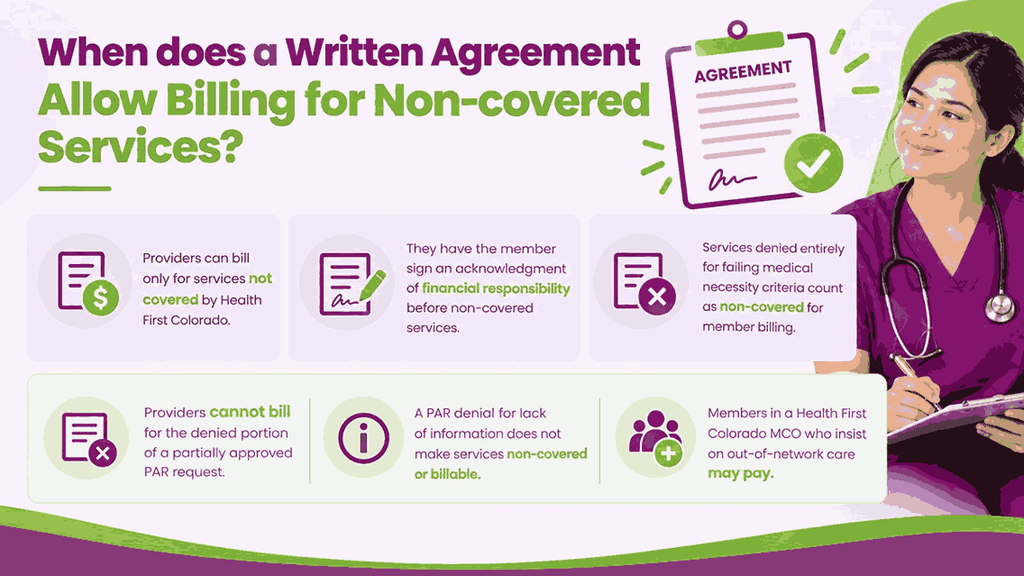
Providers cannot bill members for the denied portion of a partially approved PAR request. A PAR denial for lack of information does not make services non-covered or billable. Members in a Health First Colorado MCO who insist on out-of-network care may pay.
How do Health First Colorado Co-pays and Exemptions Work?
Co-pays apply only to fee-for-service members, and claims processing automatically deducts the co-pay amount. Most listed services carry a $0 co-pay under the schedule effective July 1, 2023. A non-emergent hospital emergency room visit carries an $8.00 co-pay, effective July 1, 2022.
Monthly co-pays stop at 5% of household monthly income, shared across all household members. Providers check the Provider Web Portal eligibility response for each member’s co-pay liability status. Federal rules prohibit providers from refusing services because a member cannot pay a co-pay.
Providers refund collected co-pays that Health First Colorado does not deduct from the payment. The following table lists the main co-pay exemptions and how each exemption is applied.
| Exemption | How it applies |
|---|---|
| Members ages 18 and younger | Shown automatically on eligibility verification |
| Institutionalized members under 21 or over 65 | Claim field completion, such as CMS 1500 field 12 nursing facility |
| Preventive services rated A or B by the U.S. Preventive Services Task Force (USPSTF) | Modifier 33 on the service line |
| Maternity cycle through six weeks postpartum | Pregnancy indicator on the claim |
| Emergency services in any setting | Emergency indicator on the claim |
| Dental, HCBS, home health, RAEs and transportation | Processed automatically |
Modifier 33 bypasses co-pays for preventive services rated A or B by the USPSTF. Modifier 33 on an evaluation and management visit requires prevention as the primary purpose.
How Do You Read a Remittance Advice and Fix Denied Claims?
Health First Colorado posts Remittance Advice reports to the Provider Web Portal every Monday. One Remittance Advice contains claims from paper, batch, and Provider Web Portal submissions together.
Clearinghouses retrieve the X12N 835 Electronic Remittance Advice through the secure file transfer system. The Remittance Advice reports each claim under paid, adjusted, denied, or in process status.
| RA section | What the section shows |
|---|---|
| Claims Paid | Claims paid in full or only on some line items |
| Claim Adjustments | Provider-initiated and system-initiated changes to paid claims |
| Claims Denied | Claims rejected with Explanation of Benefits codes |
| Claims in Process | Suspended claims awaiting review by the fiscal agent |
Remittance Advice Explanation of Benefits (EOB) codes in Appendix R explain each denial reason. The first two ICN digits form a region code showing how Medicaid received claims. Suspended claims await review, appear once on the Remittance Advice, and need no resubmission. Providers call the Provider Services Call Center when suspended claims pass 14 days pending.
What are the most Common Colorado Medicaid Denials?
Six denial reasons recur across Health First Colorado training, billing manuals, and provider bulletins.
| Denial reason | Typical cause | Fix |
|---|---|---|
| Unenrolled or Unrevalidated Provider | Billing, rendering, or ordering NPI lacks active enrollment or has overdue revalidation | Complete enrollment or revalidation, then resubmit the claim |
| Missing TPL Information | Member has commercial coverage, and the claim shows no insurer payment or denial | Bill the insurer first and report the payment or denial |
| Timely Filing | Date of service exceeds 365 days without a valid previous ICN | Resubmit within 60 days with the previous ICN or required letter |
| Member Eligibility | Member lacks eligibility on the date of service | Verify eligibility, confirm the date, and resubmit after eligibility updates |
| Missing OPR NPI | Claim lacks an enrolled ordering, prescribing, or referring provider NPI | Add the enrolled OPR NPI and resubmit |
| Prior Authorization Mismatch | Approved PAR does not match the provider, service, dates, units, or modifiers | Review the PAR, request a revision if needed, and resubmit |
Providers resolve each denial by correcting the cause and submitting a new corrected claim. Unchanged claim resubmissions deny automatically again, and attached notes do not trigger manual review.
When do you Resubmit, Adjust, Void, or Request Reconsideration?
Five actions resolve Health First Colorado claim problems, and claim status decides the action.
| Action | When to use it | Method |
|---|---|---|
| Resubmit | Denied claim | Copy and correct the claim, and for dates of service past 365 days, enter the previous ICN. |
| Adjust | Paid claim that needs correction | Portal Adjust option, batch code 7, or paper box 22 code 7 with the original ICN |
| Void | Paid claim with a wrong member ID, wrong provider ID, or billing error | Portal Void option, batch code 8 or paper box 22 code 8 |
| Reconsideration | Policy-based denial or extenuating timely filing circumstances | Call the Provider Services Call Center and send a written explanation through secure portal correspondence |
| Appeal | Claim unresolved after exhausting fiscal agent channels | Written appeal to the Office of Administrative Courts within 30 days of the last notice |
Providers include all original information on claim adjustments since removed items reduce the payment. Only paid claims can be voided, and voids may create a negative payment balance. Denied claims need no Request for Reconsideration form because providers resubmit corrected claims instead.
Where Do You Find Billing Manuals, Bulletins and Fee Schedules?
Official Colorado Medicaid billing resources live on HCPF web pages and the provider portal. Authorized billing procedure manuals for Health First Colorado come only from HCPF’s Billing Manuals.
Eight HCPF and vendor resources cover most Colorado Medicaid billing questions in one place.
| Resource | What it contains | Where to find it |
|---|---|---|
| Billing Manuals | General manual, appendices, and specialty billing manuals | HCPF Billing Manuals web page |
| General Provider Information Manual | Eligibility, claims, TPL, timely filing, and member billing | HCPF General Provider Information Manual page |
| Appendices | Contact addresses, prior authorization details and Appendix R messages | Appendices drop-down on the Billing Manuals page |
| Provider Bulletins and Provider News | Policy updates and reminders | HCPF Provider Bulletins and Provider News pages |
| Provider Web Portal Quick Guides | Claim entry, delegates and resubmission steps | HCPF Quick Guides page |
| EDI Support | Companion Guides and trading partner enrollment | HCPF EDI Support page |
| DentaQuest Office Reference Manual | Dental claims and billing | DentaQuest Colorado provider page |
| Provider Services Call Center | Billing and claim questions | HCPF Provider Help page |
Where do you find Colorado Medicaid Bulletins and Updates?
Updating portal contact information routes Provider Bulletin links to the correct service location email. Each program manual pairs with an HCPCS procedure code bulletin that replaces earlier versions. Provider News issues regularly repeat timely filing and revalidation reminders between formal Provider Bulletins.
Where do you find Colorado Medicaid Fee Schedules and CPT Codes?
Reimbursement rates and covered CPT codes appear in the full Colorado Medicaid fee schedule. Front-desk and billing staff review relevant fee schedules before rendering services to confirm coverage. Providers bill usual and customary charges because lower-of pricing applies, and the fiscal agent cannot adjust already paid claims to a higher rate.
Where do you find Colorado Medicaid Rules and Regulations?
Regulations appear in 10 CCR 2505-10, also called Volume VIII, the Medical Assistance Manual. Manuals instruct billing procedures, and program rules and regulations set binding Colorado Medicaid policy. Statutes and compliance rules beyond Medicaid appear in Transcure’s guide to medical billing laws in Colorado.
How Does a Medical Billing Company Handle Colorado Medicaid Claims?
Transcure, founded in 2002, manages Colorado Medicaid claims from eligibility checks through denial follow-up. Our team of 1,100+ certified billers and coders works inside the practice’s existing EMR. We handle Medicaid payer rules so practices keep control of their own EFT deposits.
Seven Colorado Medicaid billing tasks sit inside our daily workflow for each client practice.
| Task | How we handle it |
|---|---|
| Eligibility Verification | Provider Web Portal and 270/271 inquiries with TPL and managed care review |
| Claim Submission | 837P and 837I claims through the portal or batch EDI as an enrolled submitter |
| Timely Filing Control | 365-day tracking and 60-day resubmissions with the previous ICN |
| Prior Authorization | ColoradoPAR request tracking for fee-for-service members |
| Denial Management | Remittance Advice review, corrected resubmissions, adjustments and voids |
| Payment Posting | Remittance Advice and 835 reconciliation into the practice’s ledger |
| Accounts Receivable Follow-up | Weekly review of suspended, denied, and unpaid claims |
ELIXA, our AI eligibility agent, confirms Medicaid coverage and payer details before each visit. CLAIR, our AI claim-scrubbing agent, reviews each claim for errors before submission to Gainwell. DEXA, our AI denial agent, flags denial patterns so our team corrects root causes.
First-pass clean claims reach 98% across our client accounts under this front-end scrubbing process. Pricing for Colorado practices stays at 5% of collected revenue with no setup cost. Practices ready to hand off Colorado Medicaid claims can review Transcure’s Colorado billing services.
Frequently Asked Questions
What is the Timely Filing Limit for Colorado Medicaid?
Colorado Medicaid allows 365 days from the date of service to submit each claim. Resubmitting every 60 days after day 365 keeps each claim within Medicaid timely filing.
How do You Submit Colorado Medicaid Claims?
Providers submit Medicaid claims through the Provider Web Portal, batch EDI, or approved paper. Electronic claims are the default format, and paper claims need prior approval from HCPF.
Can Providers Bill a Health First Colorado Member for a Denied Claim?
No, Colorado law prohibits billing members for covered services, even after a claim denial. Providers may bill members only for non-covered services under a signed financial responsibility agreement.
How do You Resubmit a Colorado Medicaid Claim after 365 days?
Providers resubmit within 60 days of the last Remittance Advice with the previous ICN. Load or enrollment letters extend the deadline to 60 days after the letter date.
Does Colorado Medicaid Require Prior Authorization for Every Service?
No, prior authorization applies only to selected benefits such as transplants and long-term care. MCO members follow their plan’s authorization rules, and a PAR approval never guarantees payment.