The correct ICD-10-CM code for epididymitis is N45.1, but picking it correctly takes more than a quick lookup. Urology practices see this diagnosis often, and claims with weak code choices get denied more often than staff expect.
A claim can fail because of a missing fourth character, a mismatched procedure, or thin documentation. Billers, coders, and practice managers need a clear map from diagnosis to payment. This blog post covers the code family, documentation rules, linked CPT codes, and common denials.

What Is Epididymitis?
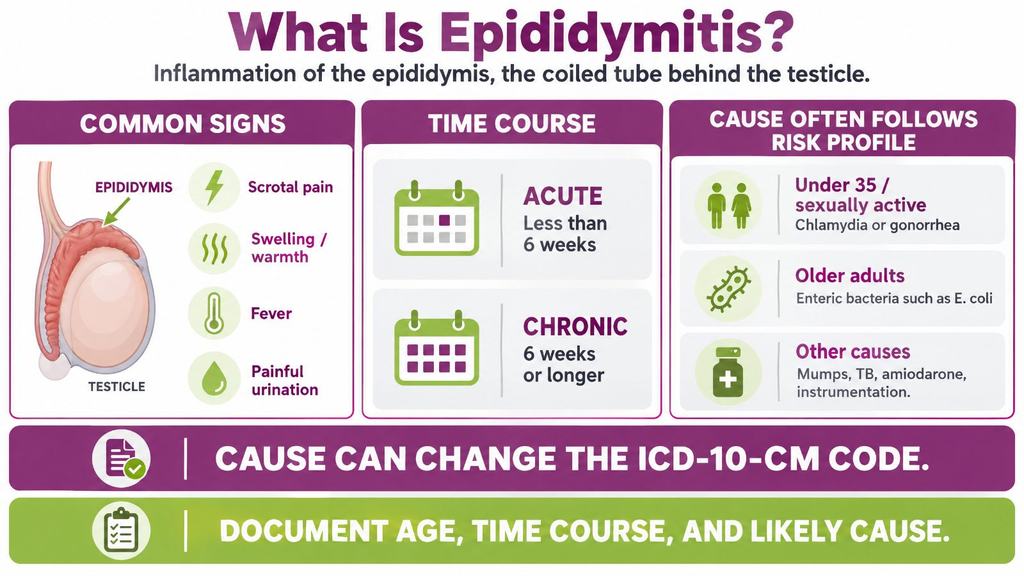
Epididymitis is inflammation of the epididymis, the coiled tube behind each testicle that stores and carries sperm. Patients usually arrive with scrotal pain, swelling, warmth, and sometimes fever or painful urination.
Acute cases last less than six weeks, while chronic cases continue for six weeks or longer. Causes differ by age and risk profile, which affects both treatment and coding.
Common causes
In sexually active men under 35, chlamydia and gonorrhea are the usual causes. In older men, enteric bacteria such as E. coli often cause the infection, sometimes linked to bladder outlet obstruction. Other causes include mumps, tuberculosis, medications such as amiodarone, and urinary tract instrumentation. The cause matters because some infectious causes have their own ICD-10-CM codes.
Epididymitis ICD-10 Code: N45.1
N45.1 is the ICD-10-CM code for epididymitis, and it belongs to category N45, titled orchitis and epididymitis. Category N45 is not billable on its own, so you must report a code with four characters. Office visits for confirmed epididymitis should list N45.1 as the first diagnosis on the claim.
| Code | Description | Use when |
|---|---|---|
| N45.1 | Epididymitis | Inflammation is limited to the epididymis |
| N45.2 | Orchitis | The testicle is inflamed, and the epididymis is not involved |
| N45.3 | Epididymo-orchitis | Both structures are documented as inflamed |
| N45.4 | Abscess of epididymis or testis | An abscess is confirmed by exam, imaging, or drainage |
Add a code for the infectious agent
ICD-10-CM includes an instruction under N45 to use an additional code from B95 through B97 for the infectious agent. For example, B96.20 reports unspecified E. coli as the cause of a disease classified elsewhere. When the organism falls in that range, list that code after N45.1.
Some organisms follow a different path. The ICD-10-CM index directs gonococcal epididymitis to A54.23 and chlamydial epididymitis to A56.19. Tuberculous epididymitis points to A18.15, while mumps orchitis points to B26.0 instead of N45.2. Always check the code set in effect on the date of service, since code descriptions and edits change.
Practices often pair N45.1 with a symptom code or leave out the organism code that the note supports. A scrubber flags some errors, but an experienced Medical Billing Company also reads the note behind the claim. That review catches missing laterality, unsupported codes, and pairing errors before the payer does.
Epididymitis Code Comparison: N45.1, N45.2, N45.3, and N45.4
Choosing between these codes depends on what the provider documents, not on what the coder assumes.
| Code | What the note must show | Typical findings | Billing risk |
|---|---|---|---|
| N45.1 | Epididymal inflammation only | Posterior scrotal pain, tender epididymis | Chosen when orchitis also exists, which understates the condition |
| N45.2 | Testicular inflammation only | Testicular swelling, often viral | Rare as a standalone adult diagnosis |
| N45.3 | Epididymis and testicle both inflamed | Swelling and tenderness across both structures | Requires explicit documentation of both |
| N45.4 | Abscess present | Fluctuant mass, fluid collection on ultrasound | Needs imaging or a procedure note to support |
Coders cannot upgrade N45.1 to N45.3 without provider documentation of testicular involvement.
Documentation Needed to Support N45.1
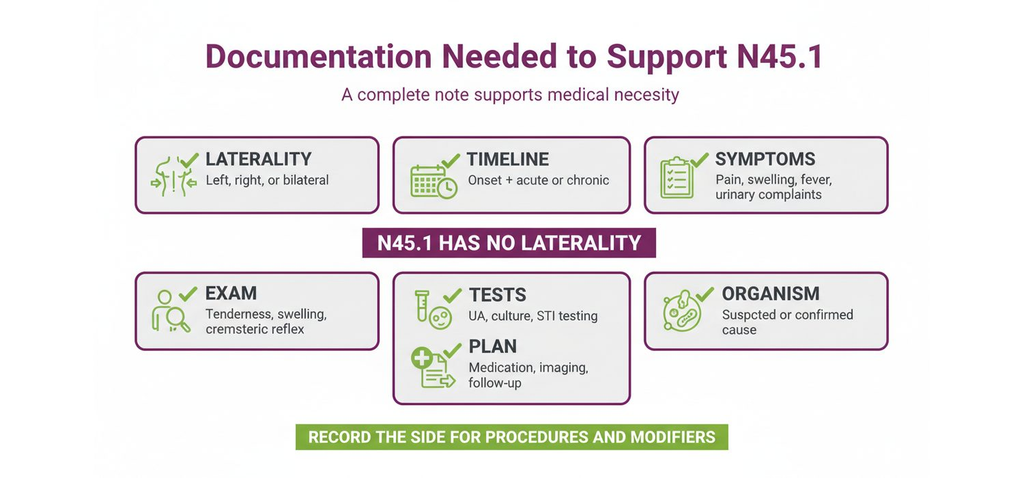
Payers read the note before they pay, so weak documentation leads directly to medical necessity denials. Each visit for epididymitis should include the following elements in the provider note.
- Laterality: left, right, or bilateral
- Timeline: onset date and whether the case is acute or chronic
- Symptoms: pain location, swelling, fever, and urinary complaints
- Exam findings: epididymal tenderness, swelling, and cremasteric reflex status
- Test results: urinalysis, urine culture, and STI testing
- Organism: suspected or confirmed cause
- Plan: medication, imaging, and follow-up
N45.1 does not carry laterality, but procedure codes and modifiers do, so record the side every time.
| Weak note | Strong note | Billing effect |
|---|---|---|
| Scrotal pain, likely infection | Left epididymal tenderness with swelling and fever, urinalysis positive for leukocytes | Supports N45.1 instead of a symptom code |
| Epididymitis | Left epididymitis | Supports modifiers and clean records |
| Ultrasound done | Scrotal ultrasound with Doppler to rule out torsion, findings described | Supports medical necessity for imaging |
| Treated with antibiotics | Ceftriaxone 500 mg IM given, oral antibiotic prescribed | Supports the injection and drug units |
Rule out torsion
Testicular torsion mimics epididymitis and counts as a surgical emergency, so providers must document how they ruled it out. Scrotal ultrasound with Doppler often settles the question, and the report supports the scan claim.
Do not code suspected epididymitis.
In the outpatient setting, do not code epididymitis when the note says probable, suspected, or rule out. Report the confirmed signs or symptoms instead, such as N50.819 or N50.82. Once the provider confirms the diagnosis, N45.1 becomes appropriate on the next claim.
Document the timeline
ICD-10-CM does not split N45.1 into acute and chronic versions. The provider should still state the timeline, because it supports visit frequency and the length of treatment.
Related ICD-10 Codes Billers Should Know
Epididymitis often shows up with other diagnoses, and the second code can change how a claim is read.
| Code | Description | When it applies |
|---|---|---|
| N50.811 | Right testicular pain | Pain is documented, and no confirmed diagnosis exists |
| N50.812 | Left testicular pain | Same as above, left side |
| N50.819 | Testicular pain, unspecified | Side is not documented |
| N50.82 | Scrotal pain | Pain involves the scrotum, not the testicle |
| N49.1 | Inflammatory disorders of spermatic cord, tunica vaginalis, and vas deferens | Inflammation extends beyond the epididymis |
| N43.3 | Hydrocele, unspecified | A hydrocele is documented on exam or imaging |
| N44.00 | Torsion of testis, unspecified | Torsion is confirmed, not just suspected |
| N41.0 | Acute prostatitis | The provider diagnoses prostatitis separately |
| N39.0 | Urinary tract infection, site not specified | A urinary tract infection is separately documented |
Do not report a symptom code when N45.1 already explains the symptom. Pain and swelling are routine parts of epididymitis, so separate symptom codes usually add no value. Report a separate diagnosis, such as prostatitis or a urinary tract infection, only when the provider documents it.
CPT Codes Commonly Billed With Epididymitis
The diagnosis code proves medical necessity, while the CPT code drives the payment amount. Urology CPT codes should be reviewed beside diagnosis codes so mismatches get caught before submission.
| CPT or HCPCS | Service | Common pairing |
|---|---|---|
| 99202 to 99205 | New patient office visit | N45.1 with exam findings |
| 99212 to 99215 | Established patient office visit | N45.1 for follow-up |
| 81001 | Urinalysis, automated, with microscopy | N45.1 with dysuria or fever |
| 87086 | Urine culture, colony count | N45.1 with a suspected urinary source |
| 87491 | Chlamydia, amplified probe | N45.1 in younger patients |
| 87591 | Gonorrhea, amplified probe | N45.1 in younger patients |
| 76870 | Ultrasound of scrotum and contents | N45.1 or N45.4 with torsion ruled out |
| 93975, 93976 | Duplex scan of scrotal contents | Check payer rules before billing with 76870 |
| J0696 | Ceftriaxone injection, per 250 mg | N45.1 with an in-office injection |
| 96372 | Therapeutic injection, intramuscular | Billed with J0696 |
| 54700 | Incision and drainage of epididymis, testis, or scrotal space | N45.4 |
| 54860, 54861 | Epididymectomy, unilateral or bilateral | Chronic or refractory cases |
Modifiers that matter
Modifier 25 applies when a provider performs a significant, separately identifiable E/M service on the same day as a procedure or injection. Use RT or LT modifiers on unilateral procedures, such as epididymectomy, when the payer requires laterality. Code 54860 is unilateral, and 54861 is bilateral, so modifier 50 does not apply to 54861.
Ceftriaxone at 500 mg bills as two units of J0696, since each unit represents 250 mg. Document the dose and route, or the units will not hold up in an audit.
E/M Level for Epididymitis Visits
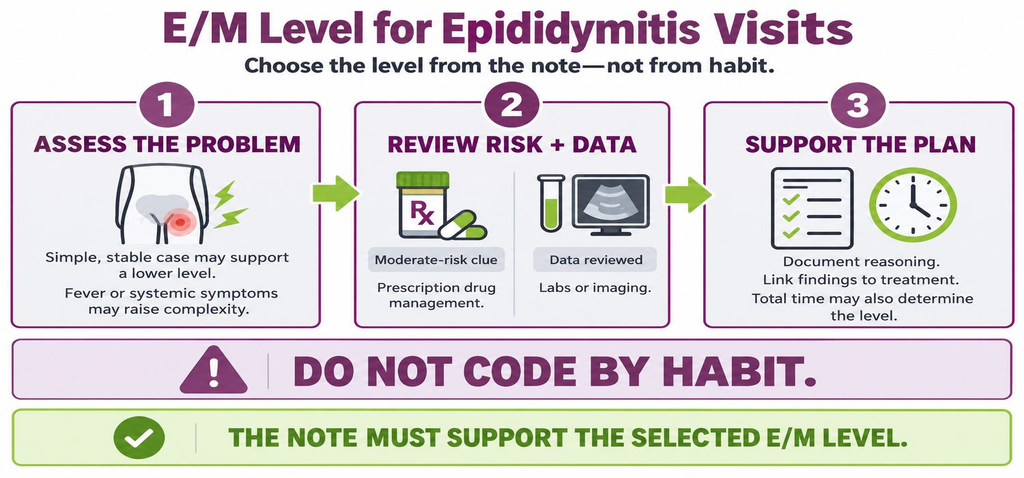
Office visit levels follow medical decision making or total time. Prescription drug management counts as moderate risk under the current AMA table. Fever or other systemic symptoms may support a moderate problem level.
A simple, stable case with a short note may fit a lower level. The provider should document the data reviewed, such as lab results or imaging, and the reasoning behind the plan. Do not choose the level by habit. Choose it from what the note supports.
Example: A Claim That Fails and a Claim That Pays
Consider a patient aged 28 who visits a urology clinic with left scrotal pain and fever. The provider documents tenderness over the epididymis and orders a urinalysis and a scrotal ultrasound. The coder submits N45 without the fourth character, and the payer rejects the claim. The fix takes two minutes, but the resubmission cycle can add weeks to payment.
Now picture the same claim with N45.1, the correct infectious agent code, and a documented ultrasound result. That version is far more likely to pay on the first submission, without a payer request for records.
Common Denials and How to Fix Them
Medicare Administrative Contractors, UnitedHealthcare, Aetna, Cigna, and Blue Cross Blue Shield plans each apply their own edits. Check the policy for each payer before you set a standard workflow.
| Denial reason | Likely cause | Fix |
|---|---|---|
| CO-16, missing or invalid information | N45 submitted without a fourth character | Report a full code such as N45.1 |
| CO-146, diagnosis invalid for date of service | Outdated or retired code used | Verify the code set for the date of service |
| CO-11, diagnosis inconsistent with procedure | N45.1 billed with an incision and drainage code | Use N45.4 when the note documents an abscess |
| CO-50, not medically necessary | Imaging billed without documented exam findings | Add symptoms, exam findings, and the clinical question |
| CO-97, included in payment for another service | Injection or test bundled into the visit | Review NCCI edits and apply modifier 25 when supported |
Practices with steady denial-management support resolve these rejections faster and track payer patterns.
Coding Tips for Urology Billing Teams
Confirm the fourth character before submission
Build a claim scrubber rule that blocks N45 without a fourth character. This single edit prevents a common rejection. It costs almost nothing to set up.
Match the diagnosis to the service.
Specialty edits change often, and a missed update can stall a clean claim. Urology groups that work with medical billing services get current payer rules applied to every N45 claim. Coders then match each CPT line to a supported diagnosis before submission.
Query the provider when notes are unclear.
Many coding errors begin at registration, long before the coder opens the note. RCM Services that connect registration, coding, and payment posting give every team the same denial data. That shared view stops the same mistake from repeating across providers and months.
Audit N45 claims every quarter.
Groups that run urology and digestive care under one roof often share coding habits. Practices that use gi billing services can compare denial trends across both specialties. Shared errors, such as missing laterality or weak notes, then get fixed once instead of twice.
Frequently Asked Questions About Epididymitis ICD-10 Coding
What is the ICD-10 code for epididymitis?
The ICD-10-CM code for epididymitis is N45.1, and it applies when the provider documents epididymal inflammation alone. Add a code from B95 through B97 when the note names the organism.
Can I Report N45 Without a Fourth Character?
No, because N45 is a category heading and payers reject it as an invalid diagnosis code. Report N45.1, N45.2, N45.3, or N45.4, depending on what the provider documents in the note.
What is the ICD-10 Code For Epididymitis With Orchitis?
Use N45.3 when the provider documents inflammation of both the epididymis and the testicle. Do not report N45.1 and N45.2 together for the same encounter when N45.3 describes the condition.
Which Code Reports Epididymitis With an Abscess?
Report N45.4 when the provider documents an abscess of the epididymis or testis. Pair it with CPT 54700 when the provider performs incision and drainage.
Is There a Separate ICD-10 Code For Chronic Epididymitis?
ICD-10-CM does not list separate acute and chronic codes under N45.1, so document the timeline in the note. Chronic scrotal pain without confirmed inflammation may fit N50.82 or N50.81x, depending on the documentation.
Can I Code Epididymitis When the Provider Only Suspects It?
Not in the outpatient setting. Code the confirmed symptoms, such as scrotal pain, until the provider confirms the diagnosis.
Which CPT Codes are Commonly Billed With N45.1?
Common choices include office visit codes, urinalysis, urine culture, STI testing, scrotal ultrasound, and ceftriaxone injection. Payer policy decides which of these services are covered with this diagnosis, so check local rules first.
Does a Ceftriaxone Injection Need Modifier 25 on the Office Visit?
Modifier 25 goes on the E/M code when the visit is significant and separately identifiable from the injection. NCCI edits can bundle injection administration into the visit, so modifier 25 often matters. Some payers require it, so confirm the policy for each plan before submission.