Dermatology medical billing turns skin exams, biopsies, excisions, Mohs surgery, and pathology into paid claims. The hardest parts are the cosmetic coverage line, modifier 25 on same-day procedures, Mohs units, and in-office pathology rules. Each one has its own audit history.
Dermatology medical billing is the process of converting dermatology services into paid insurance claims. It covers E/M visits, biopsies, lesion removals, destructions, Mohs surgery, repairs, and dermatopathology. Every claim must also separate medically necessary care from cosmetic care that Medicare excludes by statute.
The HHS Office of Inspector General (OIG) reviewed Medicare dermatology claims from 2019 and 2020. About 61.5% of paid dermatology E/M claims included a same-day minor procedure by the same dermatologist. The November 2025 OIG audit estimated $62.9 million in overpayments on E/M services that missed Medicare requirements.
Mohs surgery and in-office pathology add two more layers of risk. CMS runs an approved Recovery Audit Contractor (RAC) topic on Mohs units billed. Medicare’s anti-markup rule governs how a practice bills purchased pathology. Each layer carries its own documentation and unit rules.

Practices that code to these rules keep more of what each visit earns. That holds whether coding stays in-house or runs through expert dermatology billing services. The difference shows up in first-pass payment and audit exposure.
What Makes Dermatology Billing Different From Other Specialties?
Dermatology billing differs from other specialties in four ways: same-day procedures, a cosmetic exclusion, Mohs coding, and in-office pathology. Standard medical billing workflows handle none of these by default. A biller trained on primary care E/M leveling still misses most dermatology-specific edits.
The table below compares each factor with its effect on the claim.
| Billing Factor | Dermatology Reality | Billing Consequence |
|---|---|---|
| Same-day Procedures | Biopsies, destructions, and shave removals often happen during the E/M visit | A modifier 25 decision on a large share of visits |
| Cosmetic Exclusion | Social Security Act § 1862(a)(10) excludes cosmetic surgery from Medicare | Coverage depends on documented symptoms, not lesion type |
| Mohs Surgery | Codes depend on body site, stage, and tissue block count | Unit errors fall under CMS RAC topic 0150 |
| In-office Pathology | Many groups prepare or read their own slides | Anti-markup, Stark, and CLIA rules apply to 88305 |
Each factor changes how a dermatology claim is built from the front desk forward. The workflow is where all four first show up.
How Should the Dermatology Billing Workflow Run Before and After the Visit?
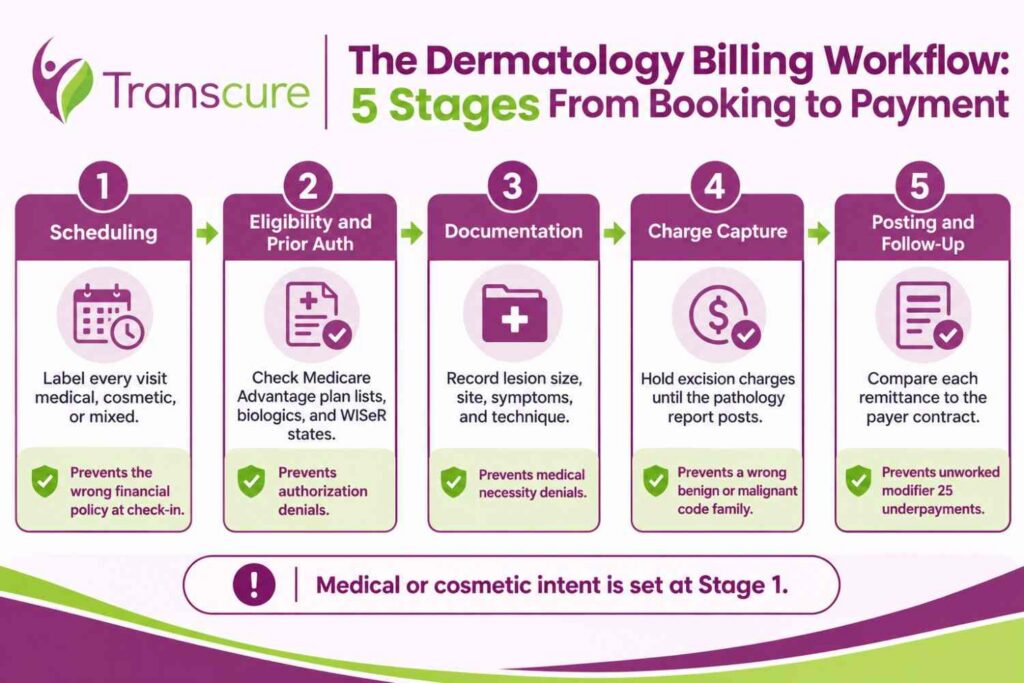
A dermatology billing workflow runs in five stages, and the front desk stage costs the most when it fails. Medical or cosmetic intent is set before the patient reaches the exam room. A wrong label at scheduling follows the claim all the way to the payer.
- Scheduling: Label each visit medical, cosmetic, or mixed, and attach the matching financial policy.
- Eligibility and authorization: Confirm coverage, plan type, and any prior authorization the planned service needs.
- Documentation: Record lesion size, site, symptoms, technique, and the reason for each procedure.
- Charge capture: Hold excision and diagnosis codes until the pathology report posts.
- Payment posting and follow-up: Compare each remittance against the payer contract and work every denial by reason code.
How Should the Front Desk Separate Medical and Cosmetic Visits?
The front desk should label every appointment as medical, cosmetic, or mixed when it is booked. That label sets the consent form, the financial policy, and the payment collected at check-in. A cosmetic visit still produces a medical claim when the provider finds a suspicious lesion.
Cosmetic patients pay out of pocket, so No Surprises Act rules apply to them. Under 45 CFR §149.610, uninsured and self-pay patients must receive a Good Faith Estimate for scheduled services. The estimate becomes part of the medical record, and copies must stay available for six years.
Front-desk staff should confirm four items before a cosmetic or mixed visit:
- The visit label (medical, cosmetic, or mixed) in the scheduling system
- A signed cosmetic financial policy for cash-pay services
- A Good Faith Estimate issued to every self-pay patient
- Payment terms for cosmetic services collected at check-in
What Should Eligibility and Prior Authorization Checks Cover?
Eligibility checks should confirm active coverage, plan type, and specialist cost-sharing before the dermatology visit. Patient eligibility verification matters most for Medicare Advantage members, because each plan sets its own authorization list. A Medicare Advantage card does not follow Original Medicare rules.
Dermatology authorization triggers fall into four groups:
- Biologic drugs: Commercial plans require prior authorization for most biologics used in psoriasis and atopic dermatitis.
- Mohs surgery: Some commercial plans list Mohs codes for review, including Kaiser Permanente Washington.
- Skin substitutes: The CMS WISeR model requires authorization or pre-payment review in six states.
- Plan-specific procedures: Medicare Advantage plans publish their own lists, which change during the year.
WISeR applies to Original Medicare in Arizona, New Jersey, Ohio, Oklahoma, Texas, and Washington from January 1, 2026. It covers lower-extremity skin substitutes where an active LCD exists. CMS adjusted the WISeR service list during 2026, so confirm the current scope before scheduling.
Why Should Dermatology Claims Wait for Pathology Results?
Dermatology claims for excised lesions should wait for the pathology report, because the report sets the code family. Benign excisions (11400 to 11446) and malignant excisions (11600 to 11646) pay at different rates. Coding before the report posts forces a corrected claim when a presumed benign lesion returns malignant.
Outpatient ICD-10-CM guidelines bar coding diagnoses documented as “probable” or “suspected.” The final pathology result sets the diagnosis code, the excision code, and often the repair code. Build a pathology-pending hold into the charge review step, whether the practice runs ModMed EMA billing or a general EHR.
How Should Payment Posting and Denial Follow-Up Work?
Payment posting should compare every dermatology remittance against the payer contract, line by line. Commercial payers have cut payment on E/M services billed with modifier 25 beside minor procedures. The American Academy of Dermatology (AAD) cites a 2021 Blue Cross Blue Shield of Massachusetts policy as one example.
Posting staff should flag four patterns for follow-up:
- E/M lines with modifier 25 paid below contract rate
- Mohs additional-stage lines paid for fewer units than billed
- Pathology lines denied as duplicates of another provider’s claim
- Cosmetic lines denied without a matching patient balance
Each flagged pattern points to a fix at the front desk, in coding, or in payer contracting. Track the pattern by payer, so the fix goes to the right place.
When Is a Dermatology Service Medical and When Is It Cosmetic?
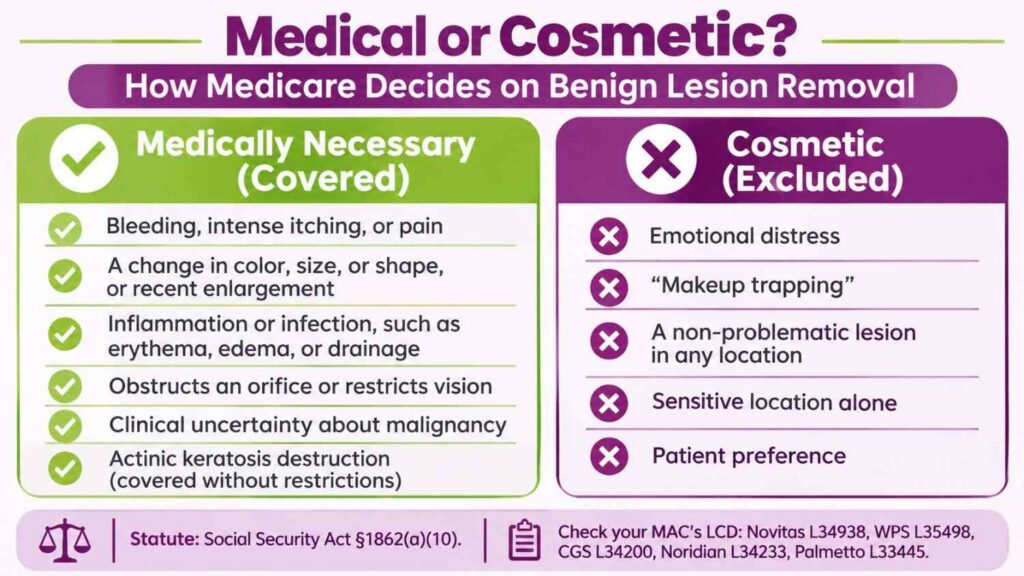
A dermatology service is medical when documentation shows the lesion threatens health or function. Social Security Act §1862(a)(10) excludes cosmetic surgery from Medicare coverage. Removing a benign lesion that poses no threat to health or function is cosmetic. The patient’s reason for wanting it gone does not change that.
What Makes a Benign Lesion Removal Medically Necessary?
Medicare Administrative Contractor (MAC) LCDs list the findings that make benign lesion removal medically necessary. The LCDs differ by MAC: Novitas L34938, WPS L35498, CGS L34200, Noridian L34233, and Palmetto L33445. Check the local LCD before coding, because covered indications and wording vary.
Most of these LCDs accept documented findings such as:
- Bleeding, intense itching, or pain from the lesion
- A change in color, size, or shape, or recent enlargement
- Signs of inflammation or infection, such as erythema, edema, or drainage
- Obstruction of an orifice or clinically restricted vision
- Clinical uncertainty about malignancy
Location alone does not qualify a lesion for coverage. CGS LCD L34200 lists emotional distress, “makeup trapping,” and non-problematic lesions in any location as cosmetic reasons. The note has to describe the symptom, not the patient’s preference.
Can You Bill the E/M When the Removal Turns Out to Be Cosmetic?
The E/M that diagnoses a benign lesion can still be paid when the removal itself is cosmetic. WPS LCD L35498 states this directly. Bill the diagnostic E/M to Medicare and collect the cosmetic removal from the patient under the practice’s financial policy.
Do Cosmetic Services Need an ABN?
Cosmetic services do not need an Advance Beneficiary Notice (ABN), because the denial rests on a statutory exclusion. The patient is liable for an excluded service with or without the notice. Practices can still issue a voluntary ABN to document the patient’s financial agreement.
Four HCPCS modifiers tell Medicare which liability rule applies:
- GY: The item or service is statutorily excluded, such as cosmetic surgery.
- GX: A voluntary ABN was issued for a statutorily excluded service.
- GA: Report modifier GA when a required ABN is on file for a service expected to deny as not reasonable and necessary.
- GZ: A medical necessity denial is expected and no ABN was obtained, so the patient cannot be billed.
Does Medicare Cover Skin Cancer Screening Exams?
Medicare does not cover a screening skin exam for a patient without signs or symptoms. Social Security Act §1862(a)(7) excludes routine physical examinations. A full-body skin exam becomes billable when the patient presents with a problem or a new lesion. A cancer history that requires surveillance also supports it.
Some lesion treatments are covered without the benign lesion restrictions. CGS LCD L34200 states that Medicare covers actinic keratosis destruction without limits based on lesion or patient characteristics. Actinic keratoses are premalignant, so the cosmetic test does not apply to them.
How Does Modifier 25 Work in Dermatology?
Modifier 25 tells the payer that a significant, separately identifiable E/M service happened on the same day as a procedure. In dermatology, the procedure is usually a minor one. The NCCI Policy Manual defines a minor procedure as any code with a 000 or 010 global period.
When Does a Same-Day E/M Qualify for Modifier 25?
A same-day E/M qualifies for modifier 25 when it goes beyond the decision to perform the minor procedure. The NCCI Policy Manual states that the decision to perform a minor procedure is included in its payment. A visit that only evaluates the lesion being removed is part of the procedure.
Three NCCI rules settle most dermatology modifier 25 questions:
- The E/M and the procedure do not need different diagnoses.
- A new patient status alone does not justify a same-day E/M.
- The E/M must address work beyond routine pre-procedure and post-procedure care.
A rash evaluation plus a biopsy of an unrelated lesion supports modifier 25. A biopsy of the lesion the patient came in for, with no other problem addressed, does not. The note should read as a full visit even if the procedure had never happened.
What Did the 2025 OIG Dermatology Audit Find?
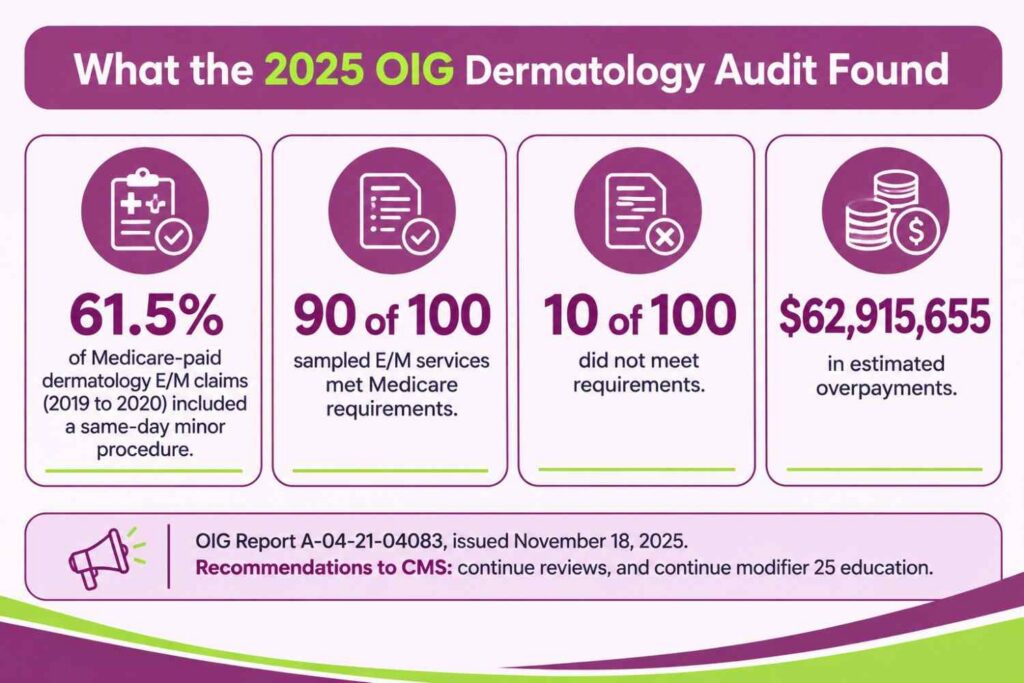
The OIG audit found that dermatologists met Medicare requirements for 90 of 100 sampled same-day E/M services. OIG report A-04-21-04083, issued November 18, 2025, projected $62,915,655 in overpayments from the 10 failed services. Its title states that dermatology providers “generally met” Medicare requirements.
OIG made two recommendations to CMS:
- Continue MAC and contractor reviews of dermatology E/M claims billed with same-day minor procedures.
- Continue educating dermatologists on E/M documentation, E/M levels, and correct modifier 25 use.
CMS did not concur but described steps it had already taken. The review recommendation keeps dermatology modifier 25 claims on MAC review lists. A medical billing audit of your own modifier 25 claims shows where your notes would fail the same test.
When Does Modifier 57 Replace Modifier 25?
Modifier 57 replaces modifier 25 when the same-day E/M leads to a major procedure with a 090 global period. Adjacent tissue transfers in the 14000 series and full-thickness skin grafts carry 090 globals. The E/M that results in the decision for that surgery takes modifier 57.
Can Dermatology Practices Bill G2211?
Dermatology practices can bill G2211 for office E/M visits within ongoing care, such as chronic psoriasis management. CMS does not pay G2211 when the E/M carries modifier 25 for a procedure. A same-day E/M plus biopsy cannot carry G2211.
The CY 2025 exception is narrow. CMS pays G2211 with a modifier 25 E/M only beside three service types. These are an annual wellness visit, vaccine administration, or a Medicare Part B preventive service. Lesion removals and biopsies fall outside that list.
How Do Global Periods Affect Dermatology Claims?
Global periods decide whether a follow-up visit or second procedure is billable or already paid. Dermatology uses all three Medicare global periods: 000, 010, and 090 days. A 010 global covers the day of surgery plus 10 days. A 090 global covers the day before, the day of, and 90 days after.
The table below groups common dermatology code families by global period.
| Global Period | Common Dermatology Code Families | What the Period Includes |
|---|---|---|
| 000 days | Biopsies (11102 to 11107), shave removals (11300 to 11313), simple repairs, Mohs (17311 to 17315) | The procedure day only |
| 010 days | Excisions (11400 to 11646), destructions (17000 to 17286), intermediate and complex repairs | Day of surgery plus 10 days of related follow-up |
| 090 days | Adjacent tissue transfers (14000 to 14350), split- and full-thickness skin grafts | Day before, day of surgery, and 90 days after |
Confirm each code’s global indicator in the Medicare Physician Fee Schedule before billing a follow-up service. The modifier that applies depends on where the new service falls in this window.
Four modifiers handle services that fall inside a global period:
- 24: An unrelated E/M by the same physician during a postoperative period.
- 58: A staged or more extensive related procedure, such as re-excision after positive margins.
- 78: An unplanned return to the operating room for a related complication.
- 79: An unrelated procedure by the same physician during a postoperative period.
How Is Mohs Micrographic Surgery Billed Correctly?
Mohs surgery is billed by body site, stage, and tissue block, and only when one physician performs both roles. CMS billing article A57477 requires that the same physician act as surgeon and pathologist. If another physician reads the slides, the Mohs codes do not apply.
The table below shows how the Mohs code family is structured.
| CPT Code | Body Site | What It Reports |
|---|---|---|
| 17311 | Head, neck, hands, feet, genitalia, or surgery involving muscle, cartilage, bone, tendon, major nerves, or vessels | First stage, up to 5 tissue blocks |
| 17312 | Same sites as 17311 | Each additional stage, up to 5 tissue blocks |
| 17313 | Trunk, arms, or legs | First stage, up to 5 tissue blocks |
| 17314 | Trunk, arms, or legs | Each additional stage, up to 5 tissue blocks |
| 17315 | Any site | Each additional block beyond 5 in any stage |
The units in this table are where Medicare auditors look first. Additional stages are totaled and reported as units on one line.
Why Do Mohs Units Draw Audits?
Mohs units draw audits because CMS has an approved RAC topic on them. RAC topic 0150, “Mohs Micrographic Surgery: Incorrect Coding and Incorrect Units Billed,” was approved March 5, 2019. Reviewers check the units billed for additional stages under 17312 and 17314 against the operative and pathology notes.
The operative note must match the units on the claim. Document each stage, the number of tissue blocks in each stage, and the map of the specimens. A note that lists stages without block counts cannot support 17315.
Can a Biopsy and Frozen Section Be Billed With Mohs?
A same-day biopsy and frozen section can be billed with Mohs when no diagnosis existed before the surgery. CPT Mohs guidelines allow the biopsy and frozen section (88331) with modifier 59 in that case. A biopsy of a lesion already confirmed as cancer is part of the Mohs service.
Repairs after Mohs follow their own codes. Simple, intermediate, and complex repairs, adjacent tissue transfers, and grafts are reported separately from the Mohs codes. A flap repair after Mohs brings a 090 global period with it.
Which Payer Credential Rules Apply to Mohs Codes?
Some commercial payers restrict Mohs codes to specific provider credentials. UnitedHealthcare denies Mohs codes billed by non-MD/DO specialties as incorrect coding. Blue Cross and Blue Shield of Minnesota requires dermatology board certification plus Mohs subspecialty certification for 17311 to 17315.
Payer enrollment records must show those credentials before the first Mohs claim goes out. Provider credentialing services that load board and subspecialty certifications into each payer file prevent credential-based Mohs denials. Check each commercial contract for its Mohs credential clause.
How Does Dermatopathology Billing Work?
Dermatopathology billing splits 88305 into a technical component and a professional component. The technical component (modifier TC) covers slide preparation. The professional component (modifier 26) covers interpretation and the report.
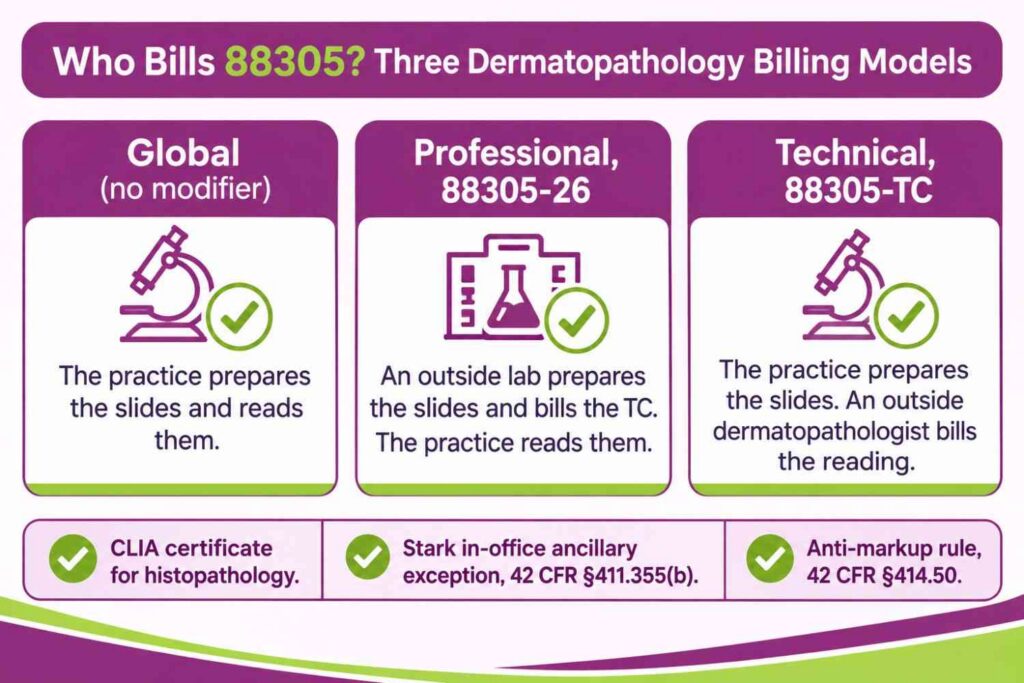
A dermatology practice bills one of three ways, depending on who prepares and reads the slides:
- Global billing (no modifier): The practice prepares the slides in its own lab and reads them.
- Professional component (88305-26): An outside lab prepares the slides and bills the TC, and the practice reads them.
- Technical component (88305-TC): The practice prepares the slides, and an outside dermatopathologist bills the reading.
Which Rules Apply to In-Office Pathology Labs?
Three federal rules apply when a dermatology practice runs its own pathology lab:
- CLIA: The lab needs the right Clinical Laboratory Improvement Amendments certificate for histopathology.
- Stark law: Self-referred lab services must fit the in-office ancillary services exception at 42 CFR §411.355(b).
- Anti-markup rule: Under 42 CFR §414.50, a purchased component is billed at the supplier’s net charge, with no markup.
The anti-markup rule catches practices that buy the TC from an outside lab and bill it as their own. Medicare limits payment to what the practice paid, and the claim must report the purchase. State direct-billing laws add a second layer in some states.
How Do CPT, ICD-10, and HCPCS Codes Work Together on a Dermatology Claim?
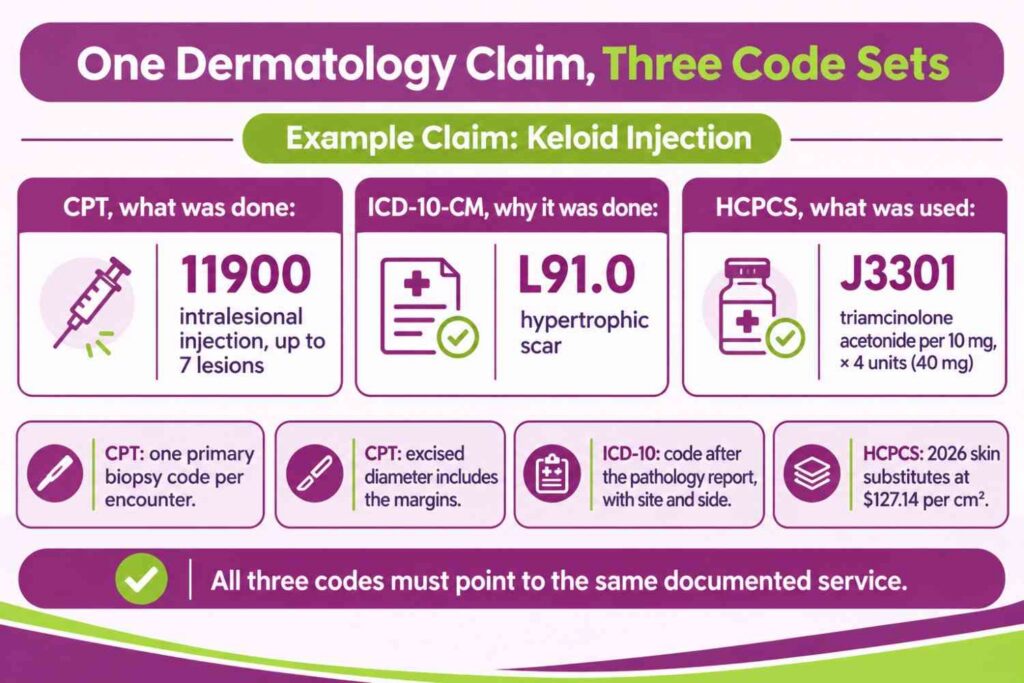
A dermatology claim pairs a CPT procedure code with an ICD-10-CM diagnosis code that supports medical necessity. HCPCS Level II codes then add drugs, supplies, and modifiers. All three code sets must point to the same documented service.
Which CPT Code Families Produce Most Dermatology Revenue?
CPT codes report what the dermatologist did, from E/M visits (99202 to 99215) to Mohs. The highest-volume families are biopsies, shave removals, excisions, repairs, destructions, Mohs, and adjacent tissue transfers. Each family of dermatology CPT codes carries its own sizing, counting, and add-on rules.
Three CPT rules cause most dermatology procedure errors:
- Biopsy hierarchy: Report one primary biopsy code per encounter, ranked incisional, then punch, then tangential, with add-on codes for the rest.
- Excision sizing: Measure the excised diameter, which is the lesion plus the narrowest margins.
- Actinic keratosis units: Report 17000 for the first lesion and 17003 for lesions 2 to 14. Report 17004 alone for 15 or more.
Each rule changes the units or the primary code on the claim. A wrong biopsy order or a missed margin measurement changes payment on every line that follows.
How Specific Must Dermatology ICD-10 Coding Be?
Dermatology ICD-10-CM coding must match the pathology report, the body site, and the laterality. Malignant dermatology ICD-10 codes in the C44 category require the specific site, side, and tumor type. Actinic keratosis (L57.0) and personal history of other skin cancer (Z85.828) support many surveillance and destruction claims.
A benign lesion code alone rarely supports removal. Pair it with the documented symptom code when the MAC’s LCD requires one. Code the diagnosis only after the pathology report confirms it.
Which HCPCS Codes Appear on Dermatology Claims?
HCPCS Level II codes report the drugs and supplies dermatologists use during procedures. Most dermatology HCPCS codes on a claim cover injectables and skin substitutes. J3301 reports triamcinolone acetonide, per 10 mg, for intralesional injections. Skin substitute Q-codes report products applied with the 15271 to 15278 application codes.
Skin substitute payment changed on January 1, 2026. Medicare now pays most skin substitutes that are not Section 351 biologics as incident-to supplies. The national rate is $127.14 per square centimeter before geographic adjustment.
How Are Teledermatology and Virtual Services Billed?
Teledermatology is billed with different codes depending on whether the visit is live, image-based, or portal-based. Store-and-forward image review is common in dermatology, and the code choice depends on who reviews the images. Many billing pages assign the wrong code to dermatologists.
The table below matches each teledermatology service to its code.
| Service | Code | Key Rule |
|---|---|---|
| Live audio-video visit | 99202 to 99215 | Report place of service 02 or 10, and follow each payer’s modifier rules |
| Store-and-forward image review by a physician | G2010 | Established patient, follow-up within 24 business hours |
| Store-and-forward review by a clinician who cannot bill E/M | G2250 | Not for dermatologists who bill E/M |
| Patient portal e-visit | 99421 to 99423 | Established patient, cumulative time over 7 days |
| Medicare audio-only visit | 99202 to 99215 with modifier 93 | Provider has video, but the patient cannot or will not use it |
G2010 and G2250 share the same 7-day and 24-hour exclusion windows. The code cannot relate to an E/M in the previous 7 days or lead to one within 24 hours.
CPT deleted the telephone E/M codes 99441 to 99443 effective January 1, 2025. Medicare does not recognize the new audio-only CPT codes 98008 to 98015. Medicare telehealth eligibility for home-based visits outside behavioral health depends on congressional extensions, so confirm current status before billing.
Which Dermatology Denials Are Most Common and How Do You Prevent Them?
The most common dermatology denials come from modifier 25, cosmetic coverage, bundling, pathology timing, and Mohs units. Each one traces back to a documentation or coding step that can be checked before submission.
The table below pairs each denial pattern with its cause and prevention step.
| Denial Pattern | Root Cause | Prevention Step |
|---|---|---|
| E/M bundled into the procedure | Modifier 25 missing or unsupported | Document a separate problem and its workup before appending 25 |
| Benign lesion removal denied | No LCD indication documented | Record the symptom, size change, or inflammation in the note |
| NCCI bundling edit | Two codes billed that NCCI treats as bundled | Run NCCI edits and apply 59 or X modifiers only when documentation supports them |
| Wrong excision family | Coded before the pathology report | Hold excision charges until the report posts |
| Mohs units reduced | Stage or block count missing from the note | Document stages and blocks for every Mohs case |
| Missing prior authorization | Plan-specific list not checked | Verify authorization at scheduling for biologics, Mohs, and skin substitutes |
Most of these denials are preventable at the front desk or at charge review. The rest come from payer contract terms, which posting staff should flag for renegotiation.
Practices comparing outside partners should test each candidate on these six patterns. The strongest dermatology billing companies show denial data by reason code, not just a total denial rate. Ask for modifier 25 and Mohs unit results specifically.
Which KPIs Should a Dermatology Practice Track?
A dermatology practice should track five revenue KPIs every month. They are clean claim rate, first-pass payment rate, days in A/R, denial rate, and net collection rate. Each KPI shows where revenue stalls. Break each one out by payer and by procedure family.
The table below lists each KPI with its common industry target.
| KPI | What It Measures | Common Industry Target |
|---|---|---|
| Clean claim rate | Claims that pass scrubbing on first submission | 95% or higher |
| First-pass payment rate | Claims paid on the first submission | 90% or higher |
| Days in A/R | Average time from service to payment | Under 40 days |
| Denial rate | Share of claims denied by payers | Under 5% |
| Net collection rate | Share of collectible revenue actually collected | 95% or higher |
Track modifier 25 denial rate and Mohs unit reductions as separate lines. A practice can hit every total target while losing money on those two lines.
How Does Transcure Support Dermatology Billing?
Transcure runs dermatology billing with 1,100+ AAPC-certified billers and seven AI agents for medical billing. The agents are ELIXA, PRIA, CODIN, CLAIR, DEXA, ARIA, and REMITA. Transcure works inside 43+ EHR systems, so the practice keeps its current platform.
Transcure’s results against each KPI:
- 98% first-pass clean claim rate and a 99% clean claim rate on human-reviewed claims
- Under 1% denial rate through pre-submission scrubbing and modifier checks
- 24 days in A/R, against the common under-40-day target
- 80% recovery on denied claims through appeals and resubmission
Transcure charges a flat 5% of collections for end-to-end RCM. Credentialing and old A/R recovery are included at no added charge. Transcure bills dermatology clients, including Dr. Thrower’s Medspa Dermatology and MD Vein & Skin Specialists.
Frequently Asked Questions About Dermatology Medical Billing
How Is a Dermatology Visit Billed When a Biopsy Is Done the Same Day?
A dermatology visit with a same-day biopsy is billed as the biopsy code alone, unless a separate problem was evaluated. When the provider addresses a separate problem, bill the E/M with modifier 25 and the biopsy code. The note must show work beyond the decision to biopsy.
Does Medicare Cover Cosmetic Dermatology Procedures?
Medicare does not cover cosmetic dermatology procedures, because Social Security Act §1862(a)(10) excludes cosmetic surgery. A benign lesion removal becomes covered when the note documents a symptom listed in the MAC’s LCD. The patient pays for cosmetic removals directly.
Can a Dermatologist Bill G2211?
A dermatologist can bill G2211 with an office E/M visit that is part of ongoing care for a condition. Medicare does not pay G2211 when the E/M carries modifier 25 for a biopsy or lesion removal.
Who Can Bill Mohs Surgery Codes?
Mohs surgery codes 17311 to 17315 can be billed only by a physician who acts as both surgeon and pathologist. Some commercial payers add credential rules. UnitedHealthcare requires an MD or DO, and Blue Cross and Blue Shield of Minnesota requires Mohs subspecialty certification.
Does a Dermatologist Need an ABN for Cosmetic Removals?
A dermatologist does not need an ABN for cosmetic removals, because cosmetic surgery is a statutory Medicare exclusion. Append modifier GY to the excluded service. A voluntary ABN, reported with modifier GX, documents the patient’s agreement to pay.
How Much Does It Cost to Outsource Dermatology Billing?
Outsourcing dermatology billing typically costs a percentage of collections. Full-service companies commonly charge 6% to 10% for full RCM. Transcure charges a flat 5% of collections, with credentialing and old A/R recovery included.