Summary: “Dermatology ICD-10 codes by condition, with the neoplasm, biopsy, skin cancer, and lesion removal rules that decide whether a skin claim pays.”
Skin cancer is the most commonly diagnosed cancer in the United States. During 2016 to 2018, more than 6 million adults received skin cancer treatment each year, according to the CDC. Annual treatment costs reached nearly $8.9 billion. Every one of those encounters reaches a payer as a dermatology diagnosis code.
Finding a dermatology code is rarely the hard part. Payment depends on neoplasm behavior, pathology timing, anatomic site, and Medicare coverage policy. A biopsy coded before pathology returns, or a benign removal without documented symptoms, fails on rules a code lookup never shows.
Five rules govern how a skin diagnosis becomes a payable code. Once those rules are set, each condition comes down to its anchor codes, the detail that changes them, and one documentation point payers check. Seven condition categories cover the diagnoses dermatology practices report every day.

What Are Dermatology ICD-10 Codes?
Dermatology ICD-10 codes are ICD-10-CM diagnosis codes that classify skin, hair, nail, and subcutaneous conditions, from atopic dermatitis to melanoma. Payers read these codes to judge medical necessity for biopsies, destructions, excisions, and Mohs surgery. A dermatology procedure without a supporting diagnosis code does not get paid.
Which ICD-10 Chapters Cover Dermatology Diagnoses?
Dermatology diagnoses come from five ICD-10-CM chapters, not only the skin chapter. The table maps each chapter to the dermatology conditions it holds.
| Chapter | Code Range | Dermatology Conditions Covered |
|---|---|---|
| Chapter 12: Diseases of the Skin and Subcutaneous Tissue | L00–L99 | Dermatitis, psoriasis, acne, rosacea, cysts, alopecia, cellulitis, abscess |
| Chapter 2: Neoplasms | C43, C4A, C44, D03, D04, D22, D23, D48.5, D49.2 | Melanoma, Merkel cell carcinoma, basal and squamous cell carcinoma, in situ disease, nevi, benign and uncertain neoplasms |
| Chapter 1: Certain Infectious and Parasitic Diseases | B02, B07, B08.1, B35–B36, B86, B88 | Herpes zoster, warts, molluscum, tinea, scabies, Demodex |
| Chapter 18: Symptoms, Signs, and Abnormal Findings | R21, R23, R61 | Rash, skin changes, generalized hyperhidrosis |
| Chapter 21: Factors Influencing Health Status | Z08, Z09, Z12.83, Z85.82-, Z86.00- | Skin cancer screening, personal history, and surveillance |
The chapter decides which rules apply to a dermatology code. Neoplasm codes follow behavior and pathology rules. Infection codes sit outside the skin chapter. Z codes carry screening and history status. A claim built from the wrong chapter fails before a payer reviews medical necessity.
How Is a Dermatology ICD-10 Code Structured?
A dermatology ICD-10 code is an alphanumeric string of three to seven characters. The first three characters name the category. Later characters add site, tumor type, or side. The same character logic runs through all ICD-10-CM diagnosis codes, but skin codes lean on anatomic site more than most.
Two dermatology codes show the range:
- C44.311 reports basal cell carcinoma of the skin of the nose. C44 names other skin cancer, the 3 marks the face, the next 1 marks basal cell carcinoma, and the final 1 marks the nose.
- L73.2 reports hidradenitis suppurativa. The code is complete at four characters, with no laterality, stage, or severity axis.
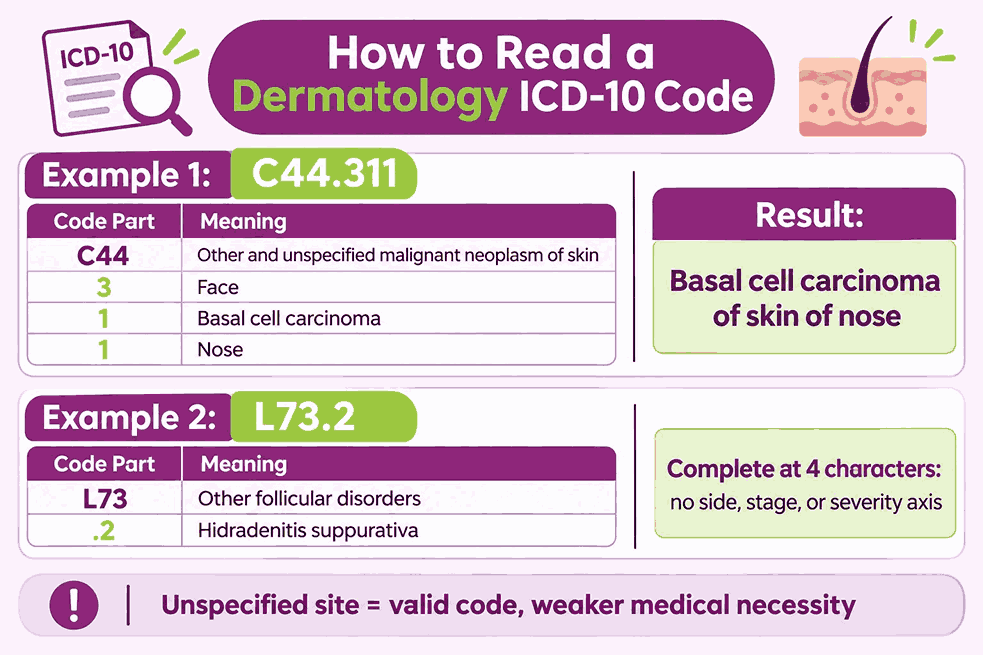
Codes that stop at an unspecified site or type stay valid. An unspecified site still weakens medical necessity for procedures priced by location, such as excision and Mohs surgery.
How Do You Code Dermatology Diagnoses Correctly?
Correct dermatology coding rests on five rules: neoplasm behavior, biopsy timing, skin cancer structure, benign lesion necessity, and screening versus history status. Each rule decides which code reaches the claim. Your practice can pick a valid code and still face a denial when one of these rules is missed.
How Does Neoplasm Behavior Change a Skin Code?
Neoplasm behavior changes the category a skin lesion codes to, even when the site stays the same. ICD-10-CM sorts every neoplasm into five behaviors, and each behavior sits in a different block.
- Malignant: melanoma (C43) and basal or squamous cell carcinoma (C44)
- In situ: melanoma in situ (D03) and squamous cell carcinoma in situ, or Bowen’s disease (D04)
- Benign: melanocytic nevi (D22) and other benign skin neoplasms, such as dermatofibroma (D23)
- Uncertain behavior: D48.5, assigned only when pathology cannot classify the lesion
- Unspecified behavior: D49.2, used when a neoplasm is documented without a known behavior
Coders reach these categories through the ICD-10-CM Neoplasm Table, which lists each site against its behavior columns. The documented diagnosis selects the column. A provider’s visual impression of a lesion does not establish neoplasm behavior.
How Do You Code a Skin Biopsy Before Pathology Returns?
Before pathology returns, a biopsied skin lesion is coded as the provider documents it, not as D48.5. The ICD-10-CM tabular note for categories D37 through D48 limits uncertain behavior to one situation. Histologic examination must fail to confirm whether the neoplasm is malignant or benign.
Three pre-pathology options apply:
- L98.9 when the note documents a skin lesion without further detail
- A morphology code when the note names a finding, such as an epidermal cyst (L72.0) or a seborrheic keratosis (L82.1)
- D49.2 when the provider documents a neoplasm whose behavior is not yet known
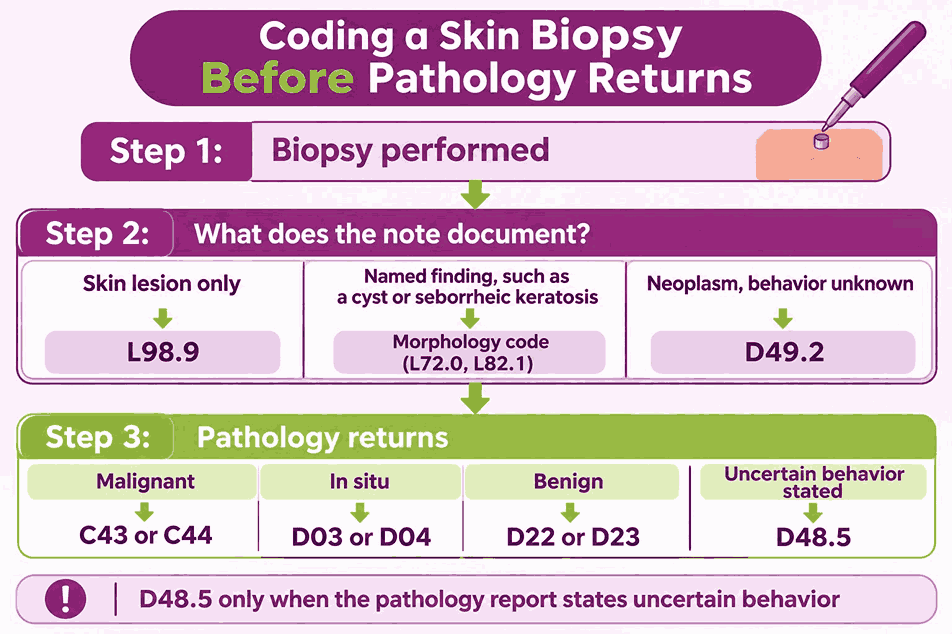
Outpatient coding guidelines direct coders to the confirmed diagnosis when the final report is available at the time of coding. Many dermatology practices hold biopsy claims until pathology returns for that reason. A basal cell carcinoma result then supports the claim with a C44 code instead of a lesion code.
The diagnosis must also match the biopsy technique billed. Tangential, punch, and incisional biopsies carry separate dermatology CPT codes, and each claim line needs a linked diagnosis. D48.5 remains correct when the pathology report states uncertain behavior.
How Do Site, Tumor Type, and Laterality Build a Skin Cancer Code?
Nonmelanoma skin cancer codes in category C44 encode the anatomic site in the 4th character and the tumor type in the 5th. The table shows how the two characters combine.
| Character Value | 4th Character: Anatomic Site | 5th Character: Tumor Type |
|---|---|---|
| 0 | Lip | Unspecified malignant neoplasm |
| 1 | Eyelid, including canthus | Basal cell carcinoma |
| 2 | Ear and external auricular canal | Squamous cell carcinoma |
| 3 | Other and unspecified parts of face | Sebaceous cell carcinoma (eyelid only) |
| 4 | Scalp and neck | None |
| 5 | Trunk | None |
| 6 | Upper limb, including shoulder | None |
| 7 | Lower limb, including hip | None |
| 8 | Overlapping sites | None |
| 9 | Unspecified site | Other specified malignant neoplasm |
Paired sites add laterality after the tumor type. Ears, eyelids, and limbs carry right and left codes. Eyelid codes also split the upper and lower lid. C44.1121, for example, reports basal cell carcinoma of the right upper eyelid.
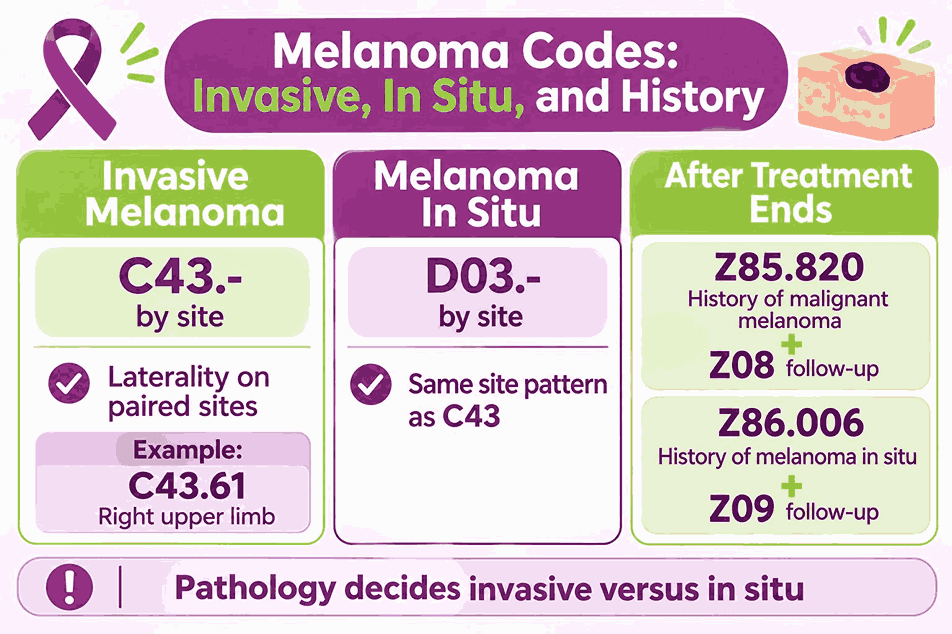
Melanoma follows its own category, C43, with laterality on paired sites. Melanoma in situ codes to D03. Squamous cell carcinoma in situ, also called Bowen’s disease, codes to D04. Merkel cell carcinoma uses C4A.
When Is Benign Lesion Removal Medically Necessary?
Medicare covers benign lesion removal only when the medical record documents a qualifying clinical problem. Removal for appearance alone falls under the Medicare cosmetic exclusion. Medicare Administrative Contractor (MAC) policies list the problems that qualify, and the core indications repeat across contractors.
Qualifying indications in MAC benign lesion policies include:
- Bleeding
- Intense itching
- Pain
- Inflammation, such as edema, erythema, or purulence
- Recent change in appearance, such as enlargement or color change
- Obstruction of vision or a body orifice
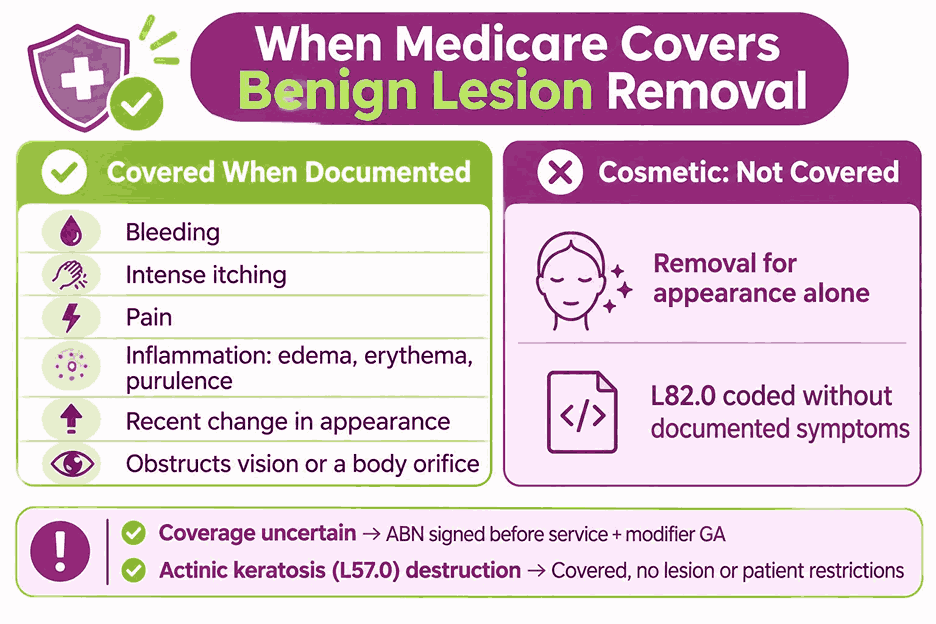
Seborrheic keratosis shows how the code and the chart interact. L82.0 reports an inflamed seborrheic keratosis, and L82.1 reports other seborrheic keratosis. CGS Administrators states that L82.0 alone does not justify removal without documented symptoms and physical findings.
Actinic keratosis is the exception: Medicare covers destruction of L57.0 lesions without restrictions based on lesion or patient characteristics.
Removal that may fall outside coverage needs an Advance Beneficiary Notice signed before the service. The claim then carries modifier GA to show the notice is on file. The evaluation visit that diagnoses a benign lesion stays payable even when the removal is cosmetic.
When Do You Use Skin Cancer Screening and History Codes?
Skin cancer screening codes apply to patients without signs or symptoms. History codes apply once treatment has ended. Z12.83 reports an encounter for skin cancer screening. Medicare has no routine skin cancer screening benefit, so an asymptomatic full-body skin exam is not a covered Medicare service.
Personal history codes split by tumor type:
- Z85.820: personal history of malignant melanoma of skin
- Z85.821: personal history of Merkel cell carcinoma
- Z85.828: personal history of other malignant neoplasm of skin, such as basal or squamous cell carcinoma
- Z86.006: personal history of melanoma in situ
- Z86.007: personal history of in situ neoplasm of skin
Surveillance after completed cancer treatment sequences Z08 ahead of the Z85 history code. In situ history codes in Z86 pair with Z09 instead. A new suspicious lesion found at a surveillance visit takes its own diagnosis code.
Which ICD-10 Codes Cover the Most Common Dermatology Conditions?
Dermatology conditions fall into seven coding categories. They are skin cancer, benign growths, eczema, chronic inflammatory disease, infections, hair and pigment disorders, and skin findings. Each entry names the anchor codes and the detail that moves a claim off an unspecified code.
Which ICD-10 Codes Cover Skin Cancer and Precancer?
Skin cancer and precancer codes span Chapter 2 and Chapter 12. Malignant tumors code to C43, C4A, or C44. In situ disease codes to D03 or D04. Actinic keratosis stays in the skin chapter as a premalignant lesion. Pathology confirms the final category for every biopsied lesion.
Basal Cell Carcinoma ICD-10 Codes
Basal cell carcinoma codes to C44 with a 1 in the tumor-type position. Examples include C44.311 for the nose and C44.41 for the scalp and neck. Site and side complete the code. Excision and Mohs surgery claims depend on that site match. Each site and laterality option appears in the basal cell carcinoma ICD-10 codes.
Squamous Cell Carcinoma ICD-10 Codes
Squamous cell carcinoma of the skin codes to C44 with a 2 in the tumor-type position, such as C44.321 for the nose. Furthermore, squamous cell carcinoma in situ, or Bowen’s disease, moves to D04 by site. Squamous cell carcinoma of internal organs codes elsewhere in Chapter 2. Skin-specific options sit in the squamous cell carcinoma ICD-10 codes.
Melanoma ICD-10 Codes
Melanoma codes to C43 by site, with laterality on paired sites, such as C43.61 for the right upper limb. Moreover, melanoma in situ codes to D03 with the same site pattern. Invasive and in situ melanoma carry different history and follow-up codes. Every melanoma site appears in the melanoma ICD-10 codes.
Actinic Keratosis ICD-10 Codes
Actinic keratosis codes to L57.0, a single code with no site or laterality axis. The code supports destruction of premalignant lesions, and lesion count sets the destruction procedure code. Documentation states the number of lesions treated. The actinic keratosis ICD-10 codes cover the lesion and related sun-damage findings.
Which ICD-10 Codes Cover Benign Growths, Nevi, and Cysts?
Benign growths, nevi, and cysts sit at the center of the cosmetic exclusion. Most code to Chapter 12 or to the benign neoplasm block in Chapter 2. Coverage for removal depends on documented symptoms, not on the diagnosis code alone.
Seborrheic Keratosis ICD-10 Codes
Seborrheic keratosis codes to L82.0 when inflamed and L82.1 for other presentations. The inflamed code requires matching clinical findings in the note, such as erythema or bleeding. Removal of an L82.1 lesion needs a documented symptom to meet Medicare contractor policy. Both forms appear in the seborrheic keratosis ICD-10 codes.
Melanocytic Nevi ICD-10 Codes
Melanocytic nevi code to D22 by site, with laterality on limbs, such as D22.61 for the right upper limb. A dysplastic or atypical nevus diagnosis comes from pathology, not from the visual exam. Nevi removed for suspicion still need the pathology result coded. Each site appears in the melanocytic nevi ICD-10 codes.
Epidermoid and Sebaceous Cyst ICD-10 Codes
Epidermal cysts code to L72.0, and sebaceous cysts code to L72.3. Pilar cysts take L72.11, and trichodermal cysts take L72.12, so cyst type changes the code. Cyst removal follows the same medical necessity rules as other benign lesions. Each cyst type appears in the epidermoid and sebaceous cyst ICD-10 codes.
Skin Tag ICD-10 Codes
Skin tags, or acrochordons, code to L91.8, other hypertrophic disorders of the skin. Medicare treats removal as cosmetic unless the tag bleeds, becomes inflamed, or causes pain. Removal of multiple tags uses a count-based procedure code. The skin tag ICD-10 codes cover single and multiple acrochordons.
Lipoma ICD-10 Codes
Lipomas of the skin and subcutaneous tissue code to D17 by site. D17.0 covers the head, face, and neck, and D17.1 covers the trunk. D17.21 through D17.24 cover the arms and legs by side. Lesion size and depth set the excision code, not the diagnosis. Every site appears in the lipoma ICD-10 codes.
Skin Lesion and Uncertain Behavior ICD-10 Codes
A skin lesion without further detail codes to L98.9, disorder of the skin and subcutaneous tissue, unspecified. D48.5 applies only when pathology reports uncertain behavior. D49.2 applies when a neoplasm is documented without known behavior. Pathology timing decides which of the three reaches the claim. All three sit in the skin lesion ICD-10 codes.
Which ICD-10 Codes Cover Eczema and Dermatitis?
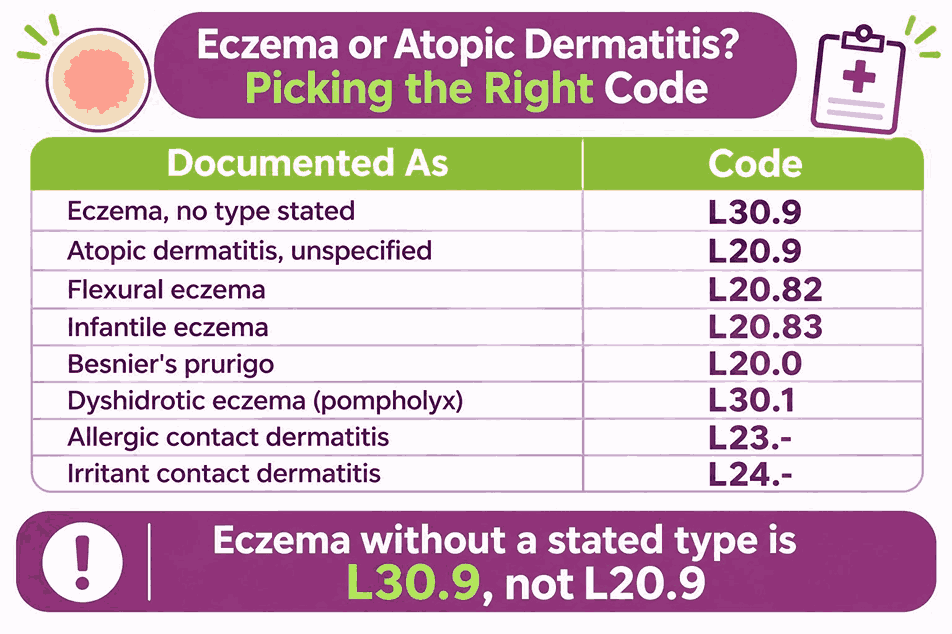
Eczema and dermatitis codes split by cause and type across categories L20 through L30. A frequent error is coding eczema without a stated type to atopic dermatitis. ICD-10-CM indexes unspecified eczema to L30.9, not to L20.9.
Atopic Dermatitis ICD-10 Codes
Atopic dermatitis codes to category L20. L20.9 reports unspecified atopic dermatitis. L20.81 through L20.89 report documented types, such as flexural eczema and infantile eczema. Besnier’s prurigo takes L20.0. Payer prior authorization reviews for biologics check this diagnosis. Each subtype appears in the atopic dermatitis ICD-10 codes.
Eczema and Unspecified Dermatitis ICD-10 Codes
Eczema without a stated type codes to L30.9, dermatitis, unspecified. Dyshidrotic eczema, also called pompholyx, codes to L30.1. Coding unspecified eczema to L20.9 reports atopic disease the provider never documented. The eczema ICD-10 codes separate unspecified, dyshidrotic, and atopic presentations.
Contact Dermatitis ICD-10 Codes
Contact dermatitis splits by mechanism. Allergic contact dermatitis codes to L23, irritant contact dermatitis to L24, and contact dermatitis of unspecified mechanism to L25. The 4th character names the agent, such as metals, cosmetics, or plants. Agent-level detail lives in the contact dermatitis ICD-10 codes.
Seborrheic Dermatitis ICD-10 Codes
Seborrheic dermatitis codes to L21. L21.0 reports seborrhea capitis, or cradle cap, and L21.1 reports infantile seborrheic dermatitis. L21.8 covers other forms, and L21.9 covers unspecified seborrheic dermatitis. Seborrheic dermatitis is a different entity from seborrheic keratosis (L82). Each form appears in the seborrheic dermatitis ICD-10 codes.
Stasis Dermatitis ICD-10 Codes
Stasis dermatitis codes to I87.2, venous insufficiency, in the circulatory chapter. Also, stasis dermatitis with varicose veins moves to I83.1- by side. A coder who searches only the skin chapter for stasis dermatitis selects the wrong code. Both presentations appear in the stasis dermatitis ICD-10 codes.
Which ICD-10 Codes Cover Chronic Inflammatory Skin Disease?
Chronic inflammatory skin diseases often carry long treatment courses, including biologic therapy. Payers review the diagnosis code and its documented type before approving those drugs. Plus, psoriasis, hidradenitis suppurativa, rosacea, acne, and urticaria each follow their own category.
Psoriasis ICD-10 Codes
Psoriasis codes to category L40. Plaque psoriasis, or psoriasis vulgaris, takes L40.0. Guttate psoriasis takes L40.4, and generalized pustular psoriasis takes L40.1. Psoriatic arthritis moves to L40.50 through L40.59, a range shared with rheumatology. L40.9 reports unspecified psoriasis. Every form appears in the psoriasis ICD-10 codes.
Hidradenitis Suppurativa ICD-10 Codes
Hidradenitis suppurativa codes to L73.2, a single code with no severity axis. Hurley stage, lesion count, and treatment history live in the note, not in the code. Biologic requests depend on that documentation. The hidradenitis suppurativa ICD-10 codes show how severity gets documented when the code cannot carry it.
Rosacea ICD-10 Codes
Rosacea codes to L71. L71.0 reports perioral dermatitis, and L71.1 reports rhinophyma. L71.8 covers other rosacea, and L71.9 covers unspecified rosacea. Documented Demodex mite infestation adds B88.01, a code that took effect on October 1, 2025. Each presentation appears in the rosacea ICD-10 codes.
Acne ICD-10 Codes
Acne codes to L70. L70.0 reports acne vulgaris, L70.1 acne conglobata, and L70.9 unspecified acne. Acne scarring moves to L90.5, scar conditions and fibrosis of skin. Many payers treat scar procedures as cosmetic, so the note documents functional impact. The acne ICD-10 codes include each form and the scarring code.
Urticaria ICD-10 Codes
Urticaria codes to L50. L50.0 reports allergic urticaria, and L50.1 reports idiopathic urticaria. L50.8 covers other forms, including chronic urticaria, and L50.9 covers unspecified urticaria. Chronic urticaria treated with biologics needs the chronic form documented. Each type appears in the urticaria ICD-10 codes.
Which ICD-10 Codes Cover Skin Infections and Infestations?
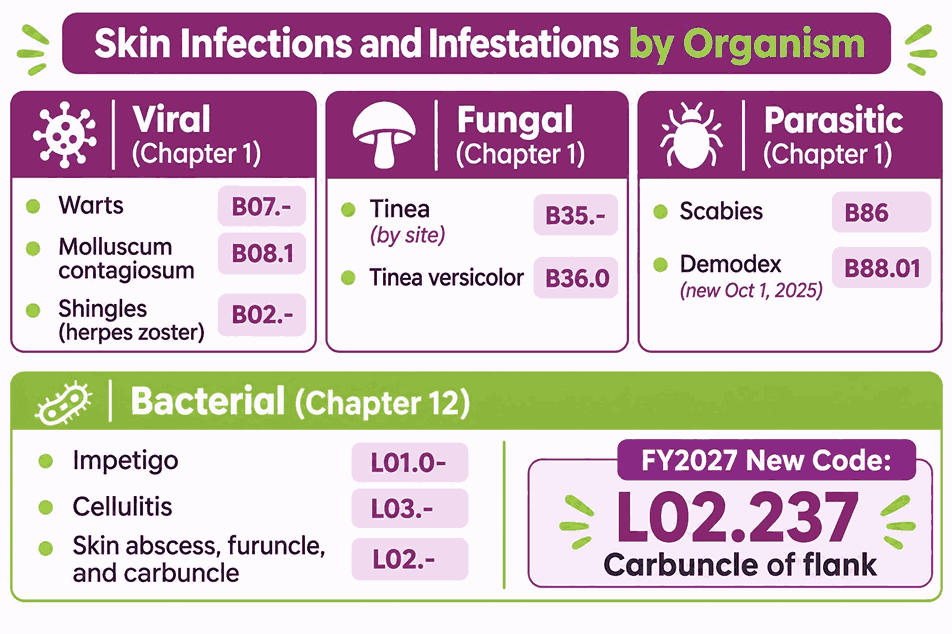
Skin infections and infestations code mostly to Chapter 1, while bacterial skin infections stay in Chapter 12. Viral, fungal, and parasitic conditions each have their own category. The infecting organism and the body site decide the code.
Wart ICD-10 Codes
Viral warts code to B07. Plantar warts take B07.0, other viral warts such as common warts take B07.8, and unspecified warts take B07.9. Anogenital warts move to A63.0 in a separate block. Medicare contractor policies list viral warts among benign lesions with removal criteria. Each type appears in the wart ICD-10 codes.
Molluscum Contagiosum ICD-10 Codes
Molluscum contagiosum codes to B08.1, a single code with no site axis. Removal follows benign lesion criteria under Medicare contractor policies. Lesion count and location belong in the note because the code carries neither. The molluscum contagiosum ICD-10 codes cover diagnosis and treatment visits.
Tinea ICD-10 Codes
Dermatophyte infections code to B35 by site: B35.0 capitis, B35.1 unguium, B35.3 pedis, B35.4 corporis, and B35.6 cruris. Tinea versicolor comes from a different fungus and codes to B36.0. Nail and foot infections overlap with podiatry ICD-10 codes. Every site appears in the tinea ICD-10 codes.
Shingles (Herpes Zoster) ICD-10 Codes
Shingles, or herpes zoster, codes to B02. B02.9 reports zoster without complications. B02.2- covers nervous system involvement, B02.3- eye involvement, and B02.7 disseminated zoster. Postherpetic neuralgia codes to the nervous system subcategory. Each complication appears in the shingles ICD-10 codes, which primary care practices report too.
Impetigo ICD-10 Codes
Impetigo codes to L01.0-. L01.00 reports unspecified impetigo, L01.01 non-bullous impetigo, and L01.02 Bockhart’s impetigo. L01.03 covers bullous impetigo, and L01.09 covers other impetigo. Impetiginization of another skin condition codes to L01.1. Each form appears in the impetigo ICD-10 codes, a set pediatrics shares.
Scabies ICD-10 Codes
Scabies codes to B86, a single code that also covers crusted, or Norwegian, scabies. Exposure to scabies without a confirmed infestation codes to Z20.7 instead. Each treated household contact needs a separately documented diagnosis. Both scenarios appear in the scabies ICD-10 codes.
Demodex ICD-10 Codes
Demodex mite infestation codes to B88.01, and other acariasis codes to B88.09. B88.0 became a non-billable header on October 1, 2025, when both codes took effect. Demodex often accompanies rosacea or blepharitis, and eyelid inflammation takes its own code. The Demodex ICD-10 codes cover each mite infestation.
Cellulitis ICD-10 Codes
Cellulitis codes to L03 by site, with laterality on limbs, such as L03.115 for the right lower limb. The FY2026 update added L03.31A for cellulitis of the flank. The FY2027 update revised L03.312, so back cellulitis excludes the flank. Every site appears in the cellulitis ICD-10 codes.
Skin Abscess, Furuncle, and Carbuncle ICD-10 Codes
Cutaneous abscess, furuncle, and carbuncle share category L02, coded by site. FY2026 added L02.217 for cutaneous abscess of the flank, and FY2027 added L02.237 for carbuncle of the flank. Dental abscesses, such as periapical abscess (K04.7), code to the digestive chapter instead. Each lesion type appears in the skin abscess ICD-10 codes.
Which ICD-10 Codes Cover Hair, Sweat, and Pigment Disorders?
Hair, sweat, and pigment disorders carry high cosmetic-exclusion risk, so the note documents medical impact. Each condition codes to its own Chapter 12 category. Generalized sweating is the exception and codes to Chapter 18.
Alopecia ICD-10 Codes
Alopecia codes split by mechanism. Also, alopecia areata takes L63, androgenic alopecia L64, nonscarring hair loss L65, and scarring or cicatricial alopecia L66. L65.9 reports nonscarring hair loss without a stated type. Medical necessity for treatment depends on a documented cause. Each type appears in the alopecia ICD-10 codes.
Hyperhidrosis ICD-10 Codes
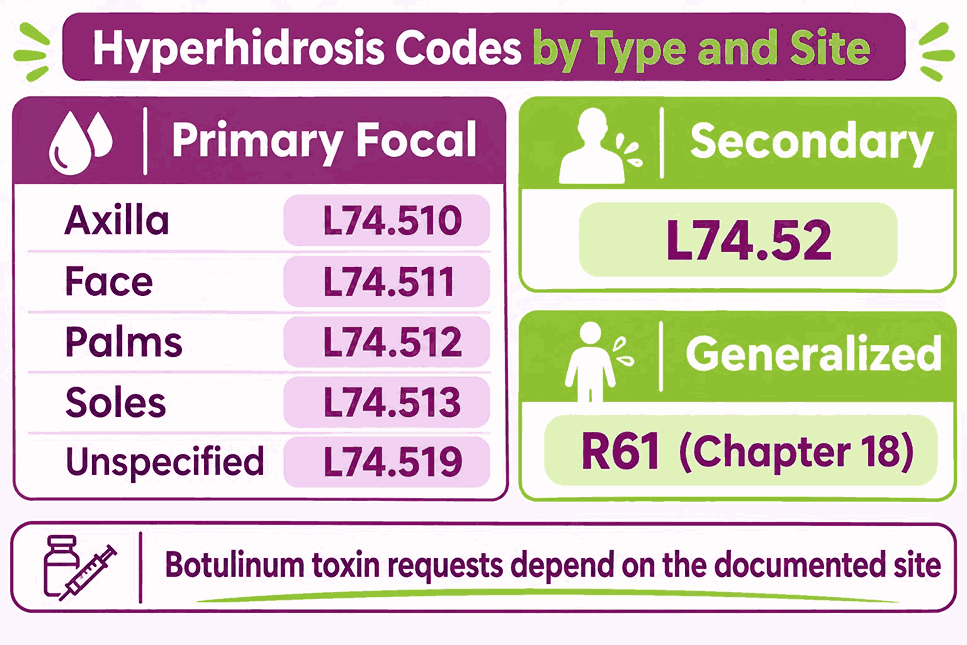
Primary focal hyperhidrosis codes to L74.510 through L74.519 by site, covering the axilla, face, palms, and soles. Secondary focal hyperhidrosis takes L74.52. Generalized hyperhidrosis codes to R61 in Chapter 18. Botulinum toxin requests depend on the documented site. Each form appears in the hyperhidrosis ICD-10 codes.
Vitiligo ICD-10 Codes
Vitiligo codes to L80, a single code with no site or laterality axis. Body surface area and treatment history belong in the note. Phototherapy and topical therapy requests rely on that documentation. The vitiligo ICD-10 codes cover the diagnosis and the documentation payers request.
Which ICD-10 Codes Cover Skin Symptoms and Findings?
Skin symptom and finding codes apply until the provider documents a definitive diagnosis. Payers accept symptom codes for evaluation visits but expect a diagnosis once the workup concludes. Also, rash, pruritus, and skin changes make up this group.
Rash ICD-10 Codes
Rash and other nonspecific skin eruption code to R21. The code fits an evaluation visit before the provider names a cause. Once a diagnosis such as contact dermatitis is documented, the specific code replaces R21. The rash ICD-10 codes, shared with primary care and pediatrics, cover symptom-level coding.
Pruritus ICD-10 Codes
Pruritus codes to L29 by site. L29.0 through L29.3 cover anal, scrotal, vulvar, and anogenital itch. L29.81 reports cholestatic pruritus, L29.89 other pruritus, and L29.9 unspecified pruritus. Itch caused by a documented condition codes to that condition instead. Each site appears in the pruritus ICD-10 codes.
Other Skin Changes ICD-10 Codes
Skin changes without a diagnosis code to R23. The category covers cyanosis (R23.0), pallor (R23.1), flushing (R23.2), spontaneous ecchymoses (R23.3), and changes in skin texture (R23.4). R23.8 and R23.9 cover other and unspecified changes. Each finding appears in the skin changes ICD-10 codes.
Why Do Dermatology Claims Get Denied?
Dermatology claims get denied when the diagnosis does not support the procedure billed. Four recurring errors create those mismatches: behavior coded before pathology, an unspecified site, missing removal indications, and screening billed as a diagnostic visit.
Each error starts in the chart and surfaces at the payer. Practices that route claims through dedicated dermatology billing services catch these mismatches before submission. Transcure holds an under 1% denial rate across the specialties it bills.
Two Transcure AI agents target dermatology coding errors before a claim goes out:
- CODIN reads clinical notes, matches documented diagnoses to ICD-10 and CPT codes, and flags missing documentation.
- CLAIR scrubs each claim line, including codes and modifiers, against payer rules before submission.
What Documentation Supports Dermatology Code Selection?
Dermatology code selection depends on what the note states, not on what the provider observed. Six documentation elements support the diagnosis code:
- Anatomic site, down to the subsite the code requires
- Laterality for ears, eyelids, and limbs
- Lesion morphology and size
- Symptoms that support benign lesion removal
- The pathology result for every biopsied lesion
- Disease type for atopic dermatitis, psoriasis, and urticaria
Lesion size sets the procedure code rather than the diagnosis code. Excision and Mohs surgery claims fail when the site on the procedure line does not match the site on the diagnosis.
How Do Coverage Policies Shape Dermatology Coding?
Coverage policy decides whether a correct dermatology code gets paid. Medicare contractor LCDs set the rules for benign lesion removal. The cosmetic exclusion blocks removal for appearance alone. An Advance Beneficiary Notice protects your practice when coverage is uncertain.
Biologic therapy adds a prior authorization layer. Payers review biologic requests for psoriasis, atopic dermatitis, and hidradenitis suppurativa against the documented diagnosis and its type. The drugs themselves bill under dermatology HCPCS codes, which carry their own documentation demands.
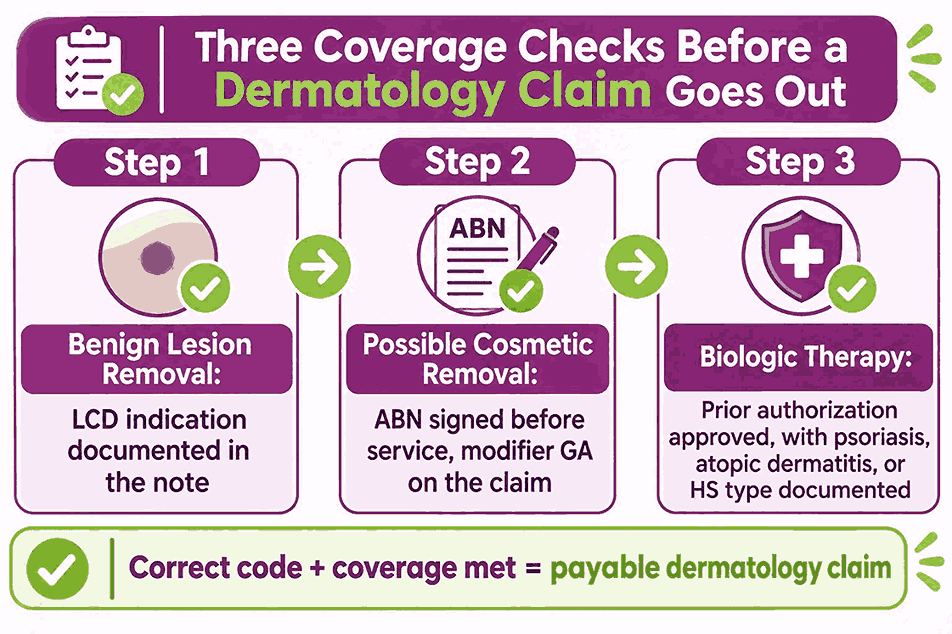
Three coverage checks apply before a dermatology claim goes out:
- Confirm the LCD indication for every benign lesion removal.
- Confirm a signed ABN for every removal that may be cosmetic.
- Confirm prior authorization for every biologic drug, a step Transcure’s PRIA agent automates through submission and payer follow-up.
These checks repeat on every claim, so they belong in a written workflow. A documented dermatology medical billing process sequences eligibility, coding, authorization, and payer follow-up.
How Do You Reduce Dermatology Coding Denials?
Your practice reduces dermatology coding denials with four habits applied before each claim leaves the office:
- Hold biopsy claims until pathology returns, where payer filing limits allow.
- Code site, tumor type, and laterality to the full character the code supports.
- Document the symptom behind every benign lesion removal.
- Separate Z12.83 screening visits from problem-oriented exams.
Practices without in-house coding depth often hand this work to specialists. Experienced dermatology billing companies run these checks on every claim, alongside eligibility verification and prior authorization. When a denial still lands, Transcure’s DEXA agent categorizes the denial and generates the appeal letter.
What Is the Most Common Dermatology ICD-10 Code?
No single dermatology ICD-10 code leads every practice, because code volume follows the patient mix. High-frequency code families include actinic keratosis (L57.0), seborrheic keratosis (L82.-), eczema and atopic dermatitis (L30.9 and L20.-), psoriasis (L40.-), and nonmelanoma skin cancer (C44.-).
What Is the ICD-10 Code for a Skin Check?
The ICD-10 code for a skin check without signs or symptoms is Z12.83, encounter for screening for malignant neoplasm of skin. A skin exam prompted by a new or changing lesion codes the documented finding instead, such as L98.9 or the confirmed diagnosis.
Should a Skin Biopsy Be Coded D48.5 or D49.2?
A skin biopsy is coded D48.5 only when the pathology report states uncertain behavior. Before pathology returns, the lesion is coded as documented, such as L98.9, or as D49.2 when the provider documents a neoplasm without known behavior. Many practices hold the claim until pathology returns.
What Is the ICD-10 Code for Eczema?
The ICD-10 code for eczema without a stated type is L30.9, dermatitis, unspecified. Atopic dermatitis codes to category L20, with L20.9 for the unspecified form. Dyshidrotic eczema codes to L30.1, and contact eczema codes to L23 through L25 by mechanism.
Does Medicare Cover Skin Cancer Screening?
Medicare does not cover routine skin cancer screening for patients without signs or symptoms. An exam prompted by a symptom or a changing lesion is evaluated as a diagnostic service, coded to the documented finding. Commercial plan coverage for Z12.83 screening varies by contract.
How Often Do Dermatology ICD-10 Codes Change?
Dermatology ICD-10 codes update every October 1 with the new fiscal-year code set. The FY2027 update added L02.237 for carbuncle of the flank and revised three back codes to exclude the flank. FY2026 added Demodex infestation (B88.01), flank abscess and cellulitis codes, and more than 100 chronic ulcer codes.