This guide covers how dermatology CPT codes are selected, counted, and sized, the global period behind each high-volume code, and which code families fall inside Medicare’s 2027 same-day payment reduction for E/M visits billed with modifier 25.
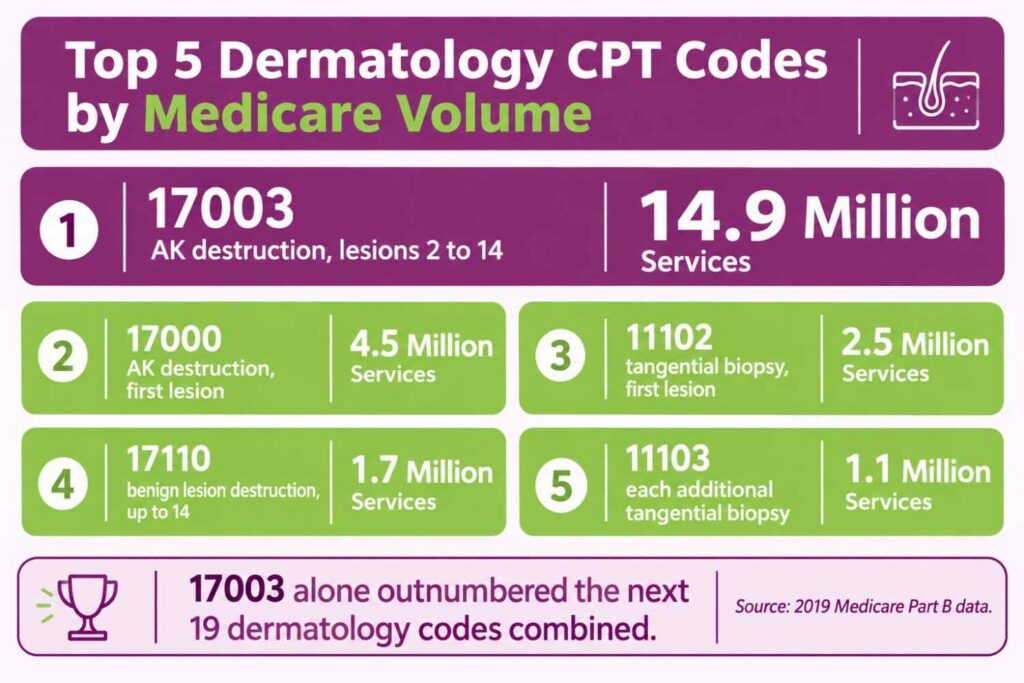
Medicare data shows dermatologists submitted nearly 14.9 million services under CPT 17003 in 2019. That one add-on code for actinic keratosis destruction outnumbered the other 19 most-billed dermatology procedure codes combined, 14.86 million against 13.98 million. Small counting errors on a code that common repeat thousands of times a year.
Dermatology CPT codes split into families by procedure type: biopsy, destruction, shave removal, excision, Mohs surgery, wound repair, tissue transfer, injections, and light-based therapy. Each family has its own counting unit, such as lesions, centimeters, stages, or tissue blocks. Each code also carries a global period that controls same-day and follow-up billing.
That global period matters more from January 1, 2027. Medicare’s 2027 Physician Fee Schedule final rule pays 20% less for the lower-paid service on certain same-day claims. The rule applies when an E/M visit with modifier 25 falls on the same day as a 0-day global procedure. Biopsies, shave removals, Mohs, and simple repairs are all 0-day codes.
Practices that bill these families daily feel the change in every clinic session. Whether coding stays in-house or moves to outsourced dermatology billing services, the same code rules apply. The sections below cover each code family, its counting rules, and the 2026 and 2027 changes.

What Are the Most Billed Dermatology CPT Codes?
The most billed dermatology CPT codes are 17003, 17000, 11102, 17110, and 11103, in that order by 2019 Medicare volume. AK destruction and skin biopsy codes lead the list. Patch testing, phototherapy, wound repair, and lesion excision codes follow behind them.
All of these are Category I codes, the main tier of how CPT codes are organized by the American Medical Association (AMA). The table below lists the core dermatology codes with their global days from the CMS 2026 Physician Fee Schedule. Each code family is covered in detail in its own section further down.
| Code | What It Reports | Family | Global Days | Modifier to Watch |
|---|---|---|---|---|
| 11102 | Tangential biopsy, first lesion | Biopsy | 000 | 25 on a same-day E/M |
| 11103 | Tangential biopsy, each additional lesion | Biopsy | ZZZ | None; follows its primary code |
| 11104 | Punch biopsy, first lesion | Biopsy | 000 | 25 on a same-day E/M |
| 11105 | Punch biopsy, each additional lesion | Biopsy | ZZZ | None; follows its primary code |
| 11106 | Incisional biopsy, first lesion | Biopsy | 000 | 25 on a same-day E/M |
| 11107 | Incisional biopsy, each additional lesion | Biopsy | ZZZ | None; follows its primary code |
| 69100 | Biopsy of external ear | Biopsy | 000 | 25 on a same-day E/M |
| 67810 | Incisional biopsy of eyelid including lid margin | Biopsy | 000 | 25 on a same-day E/M |
| 17000 | Destruction, premalignant lesion, first lesion | AK destruction | 010 | 25 on a same-day E/M |
| 17003 | Destruction, premalignant lesions 2 through 14, each | AK destruction | ZZZ | None; follows 17000 |
| 17004 | Destruction, premalignant lesions, 15 or more | AK destruction | 010 | 25 on a same-day E/M |
| 17110 | Destruction, benign lesions, up to 14 | Benign destruction | 010 | 25 on a same-day E/M |
| 17111 | Destruction, benign lesions, 15 or more | Benign destruction | 010 | 25 on a same-day E/M |
| 17262 | Destruction, malignant lesion, trunk, arms, or legs, 1.1 to 2.0 cm | Malignant destruction | 010 | 25 on a same-day E/M |
| 11200 | Removal of skin tags, up to 15 | Skin tags | 010 | 25 on a same-day E/M |
| 11201 | Removal of skin tags, each additional 10 | Skin tags | ZZZ | None; follows 11200 |
| 11300–11313 | Shave removal by site and lesion diameter | Shave removal | 000 | 25 on a same-day E/M |
| 11301 | Shave removal, trunk, arms, or legs, 0.6 to 1.0 cm | Shave removal | 000 | 25 on a same-day E/M |
| 11400–11446 | Excision of benign lesion by site and excised diameter | Excision | 010 | 25 on a same-day E/M |
| 11600–11646 | Excision of malignant lesion by site and excised diameter | Excision | 010 | 25 on a same-day E/M |
| 11602 | Excision, malignant lesion, trunk, arms, or legs, 1.1 to 2.0 cm | Excision | 010 | 25 on a same-day E/M |
| 17311 | Mohs, first stage, head, neck, hands, feet, genitalia, or deep structures | Mohs | 000 | 59 or XS for a second lesion |
| 17312 | Mohs, each additional stage, same sites as 17311 | Mohs | ZZZ | None; follows 17311 |
| 17313 | Mohs, first stage, trunk, arms, or legs | Mohs | 000 | 59 or XS for a second lesion |
| 17314 | Mohs, each additional stage, trunk, arms, or legs | Mohs | ZZZ | None; follows 17313 |
| 17315 | Mohs, each additional block beyond 5, any stage | Mohs | ZZZ | None; follows its primary code |
| 12001–12018 | Simple repair by site and length | Repair | 000 | 25 on a same-day E/M |
| 12032 | Intermediate repair, scalp, axillae, trunk, or extremities, 2.6 to 7.5 cm | Repair | 010 | 25 on a same-day E/M |
| 13121 | Complex repair, scalp, arms, or legs, 2.6 to 7.5 cm | Repair | 010 | 25 on a same-day E/M |
| 13132 | Complex repair, forehead, cheeks, chin, mouth, neck, axillae, genitalia, hands, or feet, 2.6 to 7.5 cm | Repair | 010 | 25 on a same-day E/M |
| 14040 | Adjacent tissue transfer, forehead, cheeks, chin, mouth, neck, axillae, genitalia, hands, or feet, 10 sq cm or less | Tissue transfer | 090 | 57 on the decision E/M |
| 14060 | Adjacent tissue transfer, eyelids, nose, ears, or lips, 10 sq cm or less | Tissue transfer | 090 | 57 on the decision E/M |
| 11900 | Intralesional injection, up to 7 lesions | Injection | 000 | 25 on a same-day E/M |
| 11901 | Intralesional injection, more than 7 lesions | Injection | 000 | 25 on a same-day E/M |
| 10040 | Extraction of acne lesions | Minor procedure | 010 | 25 on a same-day E/M |
| 10060 | Incision and drainage of abscess, simple or single | Minor procedure | 010 | 25 on a same-day E/M |
| 96900 | Ultraviolet light therapy (actinotherapy) | Phototherapy | XXX | None routinely |
| 96910 | Photochemotherapy with tar or petrolatum and UVB | Phototherapy | XXX | None routinely |
| 96920–96922 | Laser treatment by total area treated | Laser therapy | 000 | 25 on a same-day E/M |
| 96573 | Photodynamic therapy, drug applied by physician or QHP | Photodynamic therapy | 000 | 25 on a same-day E/M |
| 95044 | Patch or application tests, per test | Allergy testing | XXX | None routinely |
| 88305 | Surgical pathology, level IV | Pathology | XXX | 26 or TC when billing is split |
| 99212–99214 | Established patient office visits | E/M | XXX | 25 with a same-day procedure |
The global period column shows what the same-day 2027 payment reduction touches. Codes marked 000 fall inside it when an E/M with modifier 25 is billed the same day. Codes marked 010, 090, and XXX fall outside it. ZZZ add-on codes always ride on the global period of their primary code.
What Are the CPT Codes for a Skin Biopsy?
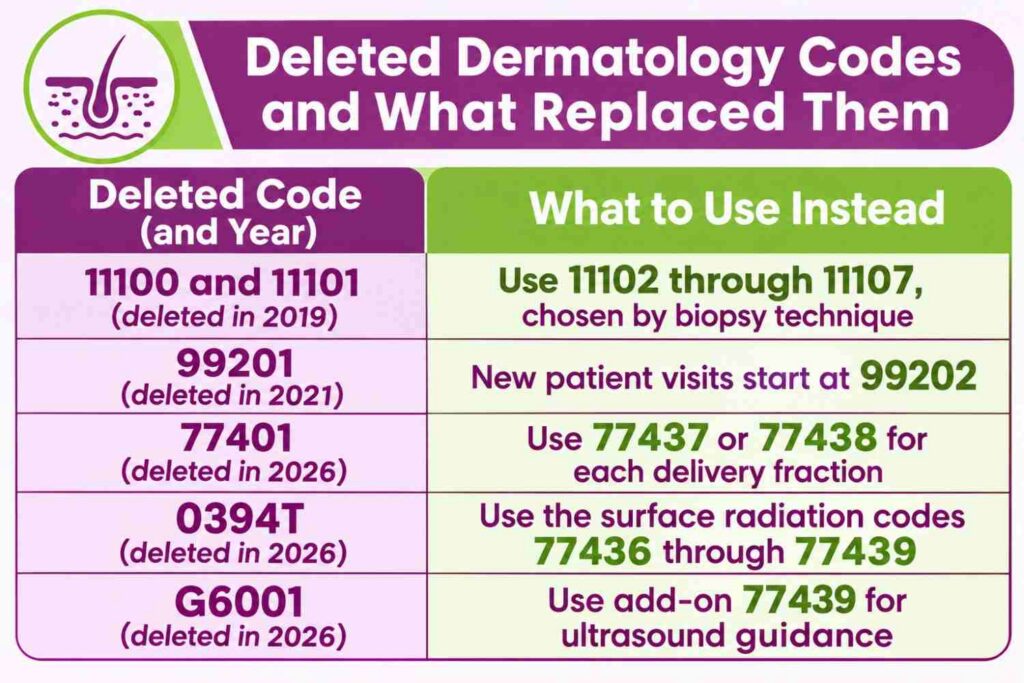
Skin biopsy CPT codes are 11102 through 11107, and the biopsy technique sets the code. Tangential, punch, and incisional techniques each have a primary code and an add-on code. These codes replaced 11100 and 11101 on January 1, 2019. Site-specific codes exist for the ear, lip, and eyelid margin.
CPT allows only one primary biopsy code per encounter, whatever the number of techniques used. Every other biopsy at that visit goes on the add-on code for its own technique. All three primary codes carry a 0-day global period, so they fall inside Medicare’s 2027 same-day reduction.
CPT 11102: Tangential Biopsy of Skin, Single Lesion
CPT 11102 reports a tangential biopsy of a single skin lesion. Tangential techniques include shave, scoop, saucerize, and curette methods. It was the third most-billed dermatology procedure code in 2019 Medicare data, with about 2.5 million services. The code carries a 0-day global period.
CPT 11103: Each Additional Tangential Biopsy
CPT 11103 is the add-on code for each separate or additional lesion sampled by tangential technique. It is reported with a primary biopsy code from the same encounter, never alone. Medicare data shows about 1.1 million services in 2019, the fifth highest dermatology volume.
CPT 11104: Punch Biopsy of Skin, Single Lesion
CPT 11104 reports a punch biopsy of a single lesion, including simple closure when performed. The punch tool removes a full-thickness cylinder of tissue. A simple suture closure of the punch site does not add a repair code. The code carries a 0-day global period.
CPT 11105: Each Additional Punch Biopsy
CPT 11105 is the add-on code for each additional lesion sampled by punch technique. It follows 11104 in a punch-only encounter. In a mixed encounter it follows whichever primary code was reported. Each additional punch biopsy adds one unit.
CPT 11106 and 11107: Incisional Biopsy
CPT 11106 reports an incisional biopsy of a single lesion, such as a wedge biopsy, including simple closure. CPT 11107 is its add-on for each additional lesion. Incisional biopsies sample full-thickness tissue into the subcutaneous fat with a sharp blade. Volume is low compared with tangential and punch methods.
CPT 69100: Biopsy of the External Ear
CPT 69100 reports a biopsy of the external ear, including the helix and lobe. CPT directs ear biopsies to this site-specific code instead of 11102 through 11107. It ranked twentieth among dermatology procedure codes in 2019 Medicare data, with about 119,000 services.
Two other site-specific biopsy codes apply in dermatology:
- 40490 (lip): Used for the vermilion or mucosa of the lip. A biopsy of the skin of the lip uses 11102 through 11107.
- 67810 (eyelid): Used for an incisional biopsy of eyelid skin that includes the lid margin. Eyelid skin alone uses 11102 through 11107.
11102 vs 11104 vs 11106: Which Technique Sets the Primary Code?
The most involved technique performed sets the primary code when biopsy methods are mixed. CPT ranks incisional above punch, and punch above tangential. The remaining biopsies are then reported with the add-on code that matches each one’s technique.
| Biopsies Performed in One Encounter | Codes Reported |
|---|---|
| 3 tangential | 11102 × 1, 11103 × 2 |
| 2 tangential and 1 punch | 11104 × 1, 11103 × 2 |
| 1 punch and 1 incisional | 11106 × 1, 11105 × 1 |
| 1 of each technique | 11106 × 1, 11105 × 1, 11103 × 1 |
Biopsy or Shave Removal: How Does Intent Change the Code?
Intent decides the code. A biopsy samples tissue to reach a diagnosis, while a shave removal takes off the whole lesion. The National Correct Coding Initiative (NCCI) treats a biopsy of a lesion removed in the same session as part of the removal. Two exceptions apply:
- Different lesion: A biopsy of a separate lesion is reportable with an anatomic modifier or modifier 59 or XS.
- Immediate pathology decision: A same-lesion biopsy is reportable only when its immediate pathologic diagnosis leads to the more extensive procedure. Modifier 58 applies in that case.
What Are the CPT Codes for Actinic Keratosis Destruction?
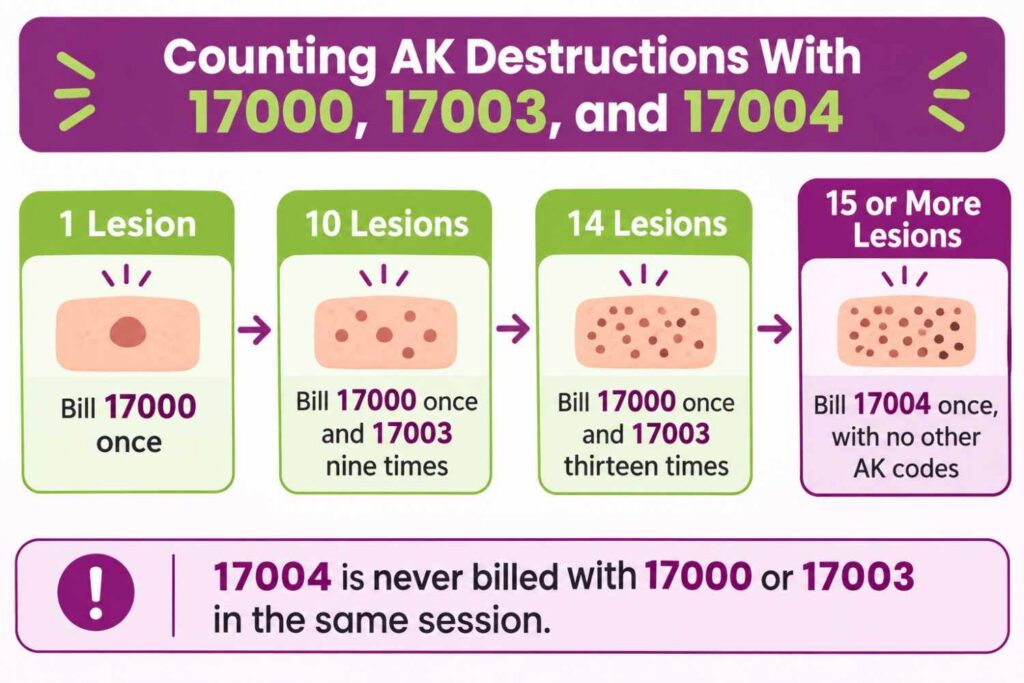
Actinic keratosis (AK) destruction uses three codes: 17000 for the first lesion, 17003 for lesions 2 through 14, and 17004 for 15 or more. Destruction covers laser, electrosurgery, cryosurgery, chemosurgery, and surgical curettement. The method does not change the code; the lesion count does.
CPT 17000 and 17004 carry a 10-day global period, and 17003 is an add-on. Because they are 010 codes, AK destruction falls outside Medicare’s 2027 same-day reduction. Medicare covers AK treatment without the cosmetic restrictions that apply to benign lesion removal.
CPT 17000: Destruction of Premalignant Lesion, First Lesion
CPT 17000 reports destruction of the first premalignant lesion, such as an actinic keratosis. It was the second most-billed dermatology code in 2019 Medicare data, with about 4.5 million services. A single 17000 unit anchors every encounter with 2 to 14 AK lesions.
CPT 17003: Each Additional Premalignant Lesion, 2 Through 14
CPT 17003 reports each premalignant lesion from the second through the fourteenth, one unit per lesion. It was the highest-volume dermatology code in Medicare data, at about 14.9 million services in 2019. It is never reported without 17000 on the same claim.
CPT 17004: Destruction of 15 or More Premalignant Lesions
CPT 17004 reports destruction of 15 or more premalignant lesions in one session as a single unit. It is a standalone code, not an add-on. CPT bars reporting 17004 with 17000 or 17003 for the same session, because 17004 already covers the full count.
How Many Units of 17003 Can One Session Carry?
One session can carry a maximum of 13 units of 17003, covering lesions 2 through 14. At 15 lesions, the claim switches to 17004 alone. Documentation needs the lesion count and the site of each lesion.
What Are the CPT Codes for Benign and Malignant Lesion Destruction?
Benign lesion destruction uses 17110 and 17111, malignant lesion destruction uses 17260 through 17286, and skin tag removal uses 11200 and 11201. Benign codes count lesions. Malignant codes are set by anatomic site and lesion diameter. All base codes in these families carry a 10-day global period.
Medicare covers benign lesion destruction only when the lesion is symptomatic or otherwise medically necessary, not for cosmetic reasons. The diagnosis on the claim carries that proof. Malignant destruction requires a confirmed or clinically documented malignant lesion.
CPT 17110: Destruction of Benign Lesions, Up to 14
CPT 17110 reports destruction of up to 14 benign lesions, such as warts or seborrheic keratoses, as one unit. It excludes skin tags and cutaneous vascular proliferative lesions, which have their own codes. It ranked fourth in 2019 Medicare dermatology volume, at about 1.7 million services.
CPT 17111: Destruction of 15 or More Benign Lesions
CPT 17111 reports destruction of 15 or more benign lesions in one session as one unit. It replaces 17110 at that count; the two are not reported together for one session. The code carries a 10-day global period.
CPT 17262: Destruction of Malignant Lesion, Trunk, Arms, or Legs, 1.1 to 2.0 cm
CPT 17262 reports destruction of a malignant lesion on the trunk, arms, or legs measuring 1.1 to 2.0 cm. It ranked tenth in 2019 Medicare dermatology volume. Each malignant lesion is coded separately by its own site and diameter.
| Lesion Diameter | Trunk, Arms, Legs | Scalp, Neck, Hands, Feet, Genitalia | Face, Ears, Eyelids, Nose, Lips, Mucous Membrane |
|---|---|---|---|
| 0.5 cm or less | 17260 | 17270 | 17280 |
| 0.6 to 1.0 cm | 17261 | 17271 | 17281 |
| 1.1 to 2.0 cm | 17262 | 17272 | 17282 |
| 2.1 to 3.0 cm | 17263 | 17273 | 17283 |
| 3.1 to 4.0 cm | 17264 | 17274 | 17284 |
| Over 4.0 cm | 17266 | 17276 | 17286 |
CPT 11200 and 11201: Removal of Skin Tags
CPT 11200 reports removal of up to 15 skin tags, any area, by any method. CPT 11201 is its add-on for each additional 10 tags or part of 10. A visit removing 30 tags reports 11200 once and 11201 twice.
17110 or 17000: Is the Lesion Benign or Premalignant?
The diagnosis decides between 17110 and 17000, not the destruction method. Cryosurgery on an actinic keratosis (L57.0) is 17000. The same cryosurgery on a wart or seborrheic keratosis is 17110. Common benign diagnoses include:
- L82.0: Inflamed seborrheic keratosis
- L82.1: Other seborrheic keratosis
- B07.0: Plantar wart
- B07.8: Other viral warts
- B07.9: Viral wart, unspecified
Some Medicare contractors accept L82.0 and the B07 codes on their own. L82.1 typically needs a documented symptom, such as bleeding, itching, or irritation, to support medical necessity.
What Are the CPT Codes for Shave Removal and Lesion Excision?
Shave removal uses 11300 through 11313, benign excision uses 11400 through 11446, and malignant excision uses 11600 through 11646. Shave codes are sized by lesion diameter alone. Excision codes are sized by excised diameter, which adds the surgical margins. Anatomic site divides each family into three groups.
Shave removals carry a 0-day global period, so they fall inside the 2027 same-day reduction. Excisions carry a 10-day global period and fall outside it. Every excision code includes simple closure of the wound.
CPT 11301: Shave Removal, Trunk, Arms, or Legs, 0.6 to 1.0 cm
CPT 11301 reports shave removal of a single epidermal or dermal lesion on the trunk, arms, or legs, 0.6 to 1.0 cm. Shave removal takes the lesion off by horizontal slicing, without a full-thickness dermal excision. The code includes control of bleeding and requires no suture closure.
The measurement is the lesion diameter only, because shave removals include no margins. Each lesion is coded separately by its own site and size.
| Lesion Diameter | Trunk, Arms, Legs | Scalp, Neck, Hands, Feet, Genitalia | Face, Ears, Eyelids, Nose, Lips, Mucous Membrane |
|---|---|---|---|
| 0.5 cm or less | 11300 | 11305 | 11310 |
| 0.6 to 1.0 cm | 11301 | 11306 | 11311 |
| 1.1 to 2.0 cm | 11302 | 11307 | 11312 |
| Over 2.0 cm | 11303 | 11308 | 11313 |
A shave removal and a tangential biopsy are never reported for the same lesion. If the whole lesion comes off, the shave removal code applies, whatever the pathology result.
CPT 11400–11446: Excision of Benign Lesions
Benign excision codes report full-thickness removal of a benign lesion, including margins and simple closure. The pathology report must confirm the lesion is benign. These codes exclude skin tags, which use 11200 and 11201.
| Excised Diameter | Trunk, Arms, Legs | Scalp, Neck, Hands, Feet, Genitalia | Face, Ears, Eyelids, Nose, Lips, Mucous Membrane |
|---|---|---|---|
| 0.5 cm or less | 11400 | 11420 | 11440 |
| 0.6 to 1.0 cm | 11401 | 11421 | 11441 |
| 1.1 to 2.0 cm | 11402 | 11422 | 11442 |
| 2.1 to 3.0 cm | 11403 | 11423 | 11443 |
| 3.1 to 4.0 cm | 11404 | 11424 | 11444 |
| Over 4.0 cm | 11406 | 11426 | 11446 |
CPT 11602: Excision of Malignant Lesion, Trunk, Arms, or Legs, 1.1 to 2.0 cm
CPT 11602 reports excision of a malignant lesion on the trunk, arms, or legs with an excised diameter of 1.1 to 2.0 cm. It ranked fifteenth in 2019 Medicare dermatology volume, at about 177,000 services. The malignant family follows the same site and size structure as the benign family.
| Excised Diameter | Trunk, Arms, Legs | Scalp, Neck, Hands, Feet, Genitalia | Face, Ears, Eyelids, Nose, Lips |
|---|---|---|---|
| 0.5 cm or less | 11600 | 11620 | 11640 |
| 0.6 to 1.0 cm | 11601 | 11621 | 11641 |
| 1.1 to 2.0 cm | 11602 | 11622 | 11642 |
| 2.1 to 3.0 cm | 11603 | 11623 | 11643 |
| 3.1 to 4.0 cm | 11604 | 11624 | 11644 |
| Over 4.0 cm | 11606 | 11626 | 11646 |
How Is Excised Diameter Measured?
Excised diameter equals the lesion’s widest diameter plus twice the narrowest margin required to remove it. The surgeon measures it before the excision, not from the final wound or the specimen. A 1.0 cm lesion removed with 0.3 cm margins has an excised diameter of 1.6 cm.
On the trunk, that 1.6 cm excision reports as 11402 if benign or 11602 if malignant. Sizing from the lesion alone would drop it to the 0.6 to 1.0 cm code and underpay the claim.
Why Does the Pathology Report Decide Between 11400 and 11600?
The final pathology report decides whether an excision is benign or malignant, not the clinical impression. A lesion excised as suspicious and returned as basal cell carcinoma is coded from the 11600 family. Holding excision charges until the pathology result posts prevents corrected claims.
What Are the CPT Codes for Mohs Micrographic Surgery?
Mohs micrographic surgery uses five codes, 17311 through 17315, split by anatomic site, stage, and tissue block count. The first-stage codes cover up to 5 tissue blocks. Add-on codes cover each additional stage and each block beyond 5. One physician must act as both the surgeon and the pathologist.
Codes 17311 and 17313 carry a 0-day global period, and the rest are add-ons. Mohs therefore falls inside Medicare’s 2027 same-day reduction when a separate E/M with modifier 25 is billed that day. Repairs after Mohs are reported separately.
CPT 17311: Mohs First Stage, Head, Neck, Hands, Feet, Genitalia, or Deep Structures
CPT 17311 reports the first Mohs stage, up to 5 tissue blocks, on the head, neck, hands, feet, or genitalia. It also covers any site where surgery directly involves muscle, cartilage, bone, tendon, major nerves, or vessels. It includes tumor removal, mapping, color coding, and the surgeon’s microscopic review.
CPT 17312: Each Additional Mohs Stage, Same Sites
CPT 17312 is the add-on for each stage after the first at 17311 sites, up to 5 tissue blocks per stage. It is reported once for each additional stage. A three-stage case on the nose reports 17311 once and 17312 twice.
CPT 17313: Mohs First Stage, Trunk, Arms, or Legs
CPT 17313 reports the first Mohs stage, up to 5 tissue blocks, on the trunk, arms, or legs. It applies only when the surgery does not directly involve muscle, cartilage, bone, tendon, major nerves, or vessels. Deep-structure involvement moves the case to 17311.
CPT 17314: Each Additional Mohs Stage, Trunk, Arms, or Legs
CPT 17314 is the add-on for each stage after the first at 17313 sites, up to 5 tissue blocks per stage. It pairs only with 17313. Mixing 17312 with 17313, or 17314 with 17311, is a site mismatch that denies.
CPT 17315: Each Additional Tissue Block Beyond 5, Any Stage
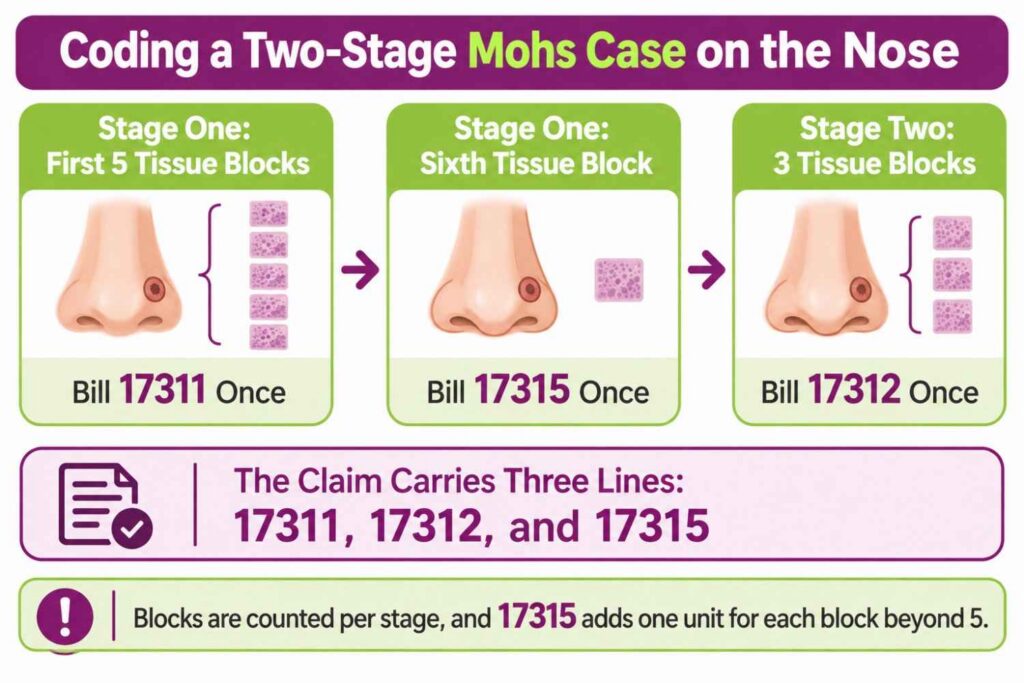
CPT 17315 is the add-on for each tissue block beyond the first 5 in any stage, at any site. Blocks are counted per stage, not across the whole case. A stage with 7 blocks adds 2 units of 17315.
How Are Mohs Stages and Blocks Reported on One Claim?
Mohs claims report one first-stage code, one add-on unit per extra stage, and one 17315 unit per extra block. Consider a basal cell carcinoma on the nose cleared in two stages, with 6 blocks in stage one and 3 blocks in stage two.
The claim reports 17311 once for the first stage, 17312 once for the second stage, and 17315 once for the sixth block in stage one.
A second tumor treated by Mohs on the same day starts its own first-stage code with modifier 59 or XS. A same-day diagnostic biopsy (11102 through 11107) and frozen section (88331) are reportable with modifier 59 only when no prior pathology confirms the diagnosis.
What Are the CPT Codes for Wound Repair After Dermatologic Surgery?
Wound repair codes split into simple (12001 through 12018), intermediate (12031 through 12057), and complex (13100 through 13153) repairs. Each tier is divided by anatomic group and wound length in centimeters. Simple repairs carry a 0-day global period, while intermediate and complex repairs carry 10 days.
Simple repair is included in every excision and biopsy code that lists it. Intermediate and complex repairs bill separately from an excision under CPT. Medicare’s NCCI edits add one exception, covered in the decision block below.
CPT 12032: Intermediate Repair, Scalp, Axillae, Trunk, or Extremities, 2.6 to 7.5 cm
CPT 12032 reports a layered closure of 2.6 to 7.5 cm on the scalp, axillae, trunk, or extremities, excluding hands and feet. Intermediate repair closes one or more deeper layers of subcutaneous tissue and fascia before skin closure. It ranked twelfth in 2019 Medicare dermatology volume.
CPT 13121: Complex Repair, Scalp, Arms, or Legs, 2.6 to 7.5 cm
CPT 13121 reports a complex repair of 2.6 to 7.5 cm on the scalp, arms, or legs. Complex repair requires more than a layered closure, such as scar revision, debridement, extensive undermining, or retention sutures. CPT 13122 is its add-on for each additional 5 cm or less.
CPT 13132: Complex Repair, Forehead, Cheeks, Chin, Mouth, Neck, Axillae, Genitalia, Hands, or Feet, 2.6 to 7.5 cm
CPT 13132 reports a complex repair of 2.6 to 7.5 cm at the forehead, cheeks, chin, mouth, neck, axillae, genitalia, hands, or feet. It ranked ninth in 2019 Medicare dermatology volume, at about 269,000 services. CPT 13133 is its add-on for each additional 5 cm or less.
CPT 12001–12018: Simple Repair
Simple repair codes report single-layer closure of superficial wounds involving the epidermis, dermis, or subcutaneous tissue. They are reported on their own only when the wound is not part of an excision or biopsy that already includes closure.
| Wound Length | Scalp, Neck, Axillae, External Genitalia, Trunk, Extremities | Face, Ears, Eyelids, Nose, Lips, Mucous Membranes |
|---|---|---|
| 2.5 cm or less | 12001 | 12011 |
| 2.6 to 7.5 cm | 12002 | 12013 (2.6 to 5.0 cm) and 12014 (5.1 to 7.5 cm) |
| 7.6 to 12.5 cm | 12004 | 12015 |
| 12.6 to 20.0 cm | 12005 | 12016 |
| 20.1 to 30.0 cm | 12006 | 12017 |
| Over 30.0 cm | 12007 | 12018 |
How Are Repair Lengths Added Across Multiple Wounds?
Repair lengths are added together when the wounds share the same repair tier and the same anatomic group. Each combined total then reports as one code. Wounds in different tiers or different anatomic groups are coded separately.
- Added together: A 3.0 cm intermediate repair on the arm and a 2.0 cm one on the back total 5.0 cm, reported as 12032.
- Coded separately: A 2.0 cm complex repair on the cheek reports on its own complex code, apart from the arm and back repairs.
- Sequenced first: The more complex repair is listed as the primary procedure, with modifier 59 or XS on the other repair codes.
When Is a Repair Billable Separately From an Excision?
An intermediate or complex repair is billable separately from an excision under CPT, while simple repair is always included. Medicare’s NCCI Policy Manual adds a limit for small benign excisions. Codes 11400, 11420, and 11440 (excised diameter 0.5 cm or less) include all repairs, so no repair code is billed with them.
That limit does not reach malignant excisions. An intermediate repair after a 0.5 cm malignant excision (11600) remains separately reportable.
What Are the CPT Codes for Adjacent Tissue Transfer and Grafts?
Adjacent tissue transfer codes 14000 through 14302 report local flaps, such as advancement, rotation, and transposition flaps, by anatomic site and defect size. Defect size counts both the primary defect and the secondary defect the flap creates. All codes in the 14000 through 14061 range carry a 90-day global period.
That 90-day global brings modifier 57 into play on the E/M visit where the decision to operate is made. Flap codes fall outside Medicare’s 2027 same-day reduction, which applies only to 0-day procedures.
CPT 14040: Adjacent Tissue Transfer, Forehead, Cheeks, Chin, Mouth, Neck, Axillae, Genitalia, Hands, or Feet, 10 sq cm or Less
CPT 14040 reports an adjacent tissue transfer or rearrangement of 10 sq cm or less. Its sites are the forehead, cheeks, chin, mouth, neck, axillae, genitalia, hands, or feet. CPT 14041 covers the same sites from 10.1 to 30.0 sq cm. These flaps commonly close defects after Mohs surgery.
CPT 14060: Adjacent Tissue Transfer, Eyelids, Nose, Ears, or Lips, 10 sq cm or Less
CPT 14060 reports an adjacent tissue transfer or rearrangement of 10 sq cm or less on the eyelids, nose, ears, or lips. CPT 14061 covers the same sites from 10.1 to 30.0 sq cm. Nasal and auricular flaps after Mohs make up much of this code’s use.
| Defect Size | Trunk | Scalp, Arms, Legs | Forehead, Cheeks, Chin, Mouth, Neck, Axillae, Genitalia, Hands, Feet | Eyelids, Nose, Ears, Lips |
|---|---|---|---|---|
| 10 sq cm or less | 14000 | 14020 | 14040 | 14060 |
| 10.1 to 30.0 sq cm | 14001 | 14021 | 14041 | 14061 |
| 30.1 to 60.0 sq cm, any area | 14301 | 14301 | 14301 | 14301 |
| Each additional 30.0 sq cm, any area | 14302 | 14302 | 14302 | 14302 |
Why Is the Excision Not Billed With an Adjacent Tissue Transfer?
CPT includes excision of a lesion in the adjacent tissue transfer code when both happen in the same session. Billing 11602 with 14040 for the same lesion unbundles the flap. Mohs surgery is the exception, because Mohs is not an excision code. A flap closing a Mohs defect reports separately alongside the Mohs codes.
What Are the CPT Codes for Injections and Minor Dermatology Procedures?
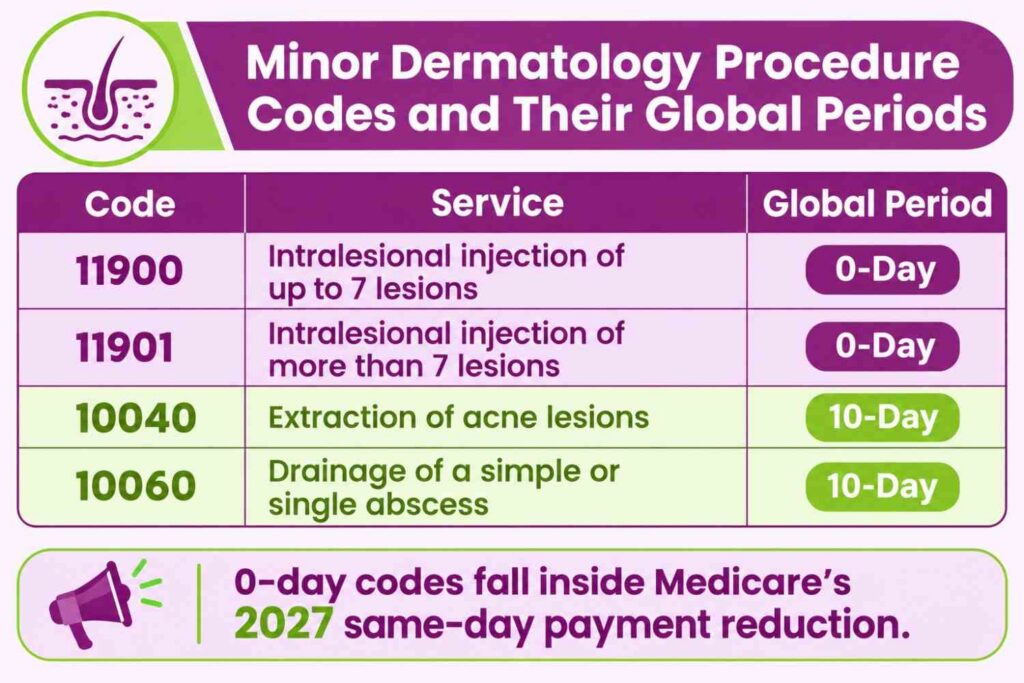
Minor dermatology procedures include intralesional injections (11900, 11901), acne lesion extraction (10040), and incision and drainage of abscesses (10060, 10061). Injection codes carry a 0-day global period. Extraction and drainage codes carry a 10-day global period.
CPT 11900: Intralesional Injection, Up to 7 Lesions
CPT 11900 reports intralesional injection of up to and including 7 lesions, such as keloids, acne cysts, or alopecia areata patches. It is reported once per session, whatever the count up to 7. It ranked thirteenth in 2019 Medicare dermatology volume, at about 194,000 services.
CPT 11901: Intralesional Injection, More Than 7 Lesions
CPT 11901 reports intralesional injection of more than 7 lesions in one session. It replaces 11900 at that count; the two are not reported together. Both carry a 0-day global period, so both fall inside the 2027 same-day reduction.
The injected drug bills separately on a HCPCS Level II J-code with units based on the dose given. Triamcinolone acetonide (J3301, per 10 mg) is the most common pairing, and the full drug list sits among the HCPCS codes used in dermatology.
CPT 10040: Extraction of Acne Lesions
CPT 10040 reports extraction of multiple acne lesions, such as marsupialization, opening or removal of milia, comedones, cysts, or pustules. CPT 2026 revised its descriptor from “acne surgery” to “extraction.” The code carries a 10-day global period.
CPT 10060: Incision and Drainage of Abscess, Simple or Single
CPT 10060 reports incision and drainage of a simple or single abscess, cyst, furuncle, carbuncle, or paronychia. CPT 10061 covers complicated or multiple abscesses. Both carry a 10-day global period.
What Are the CPT Codes for Phototherapy, Photodynamic Therapy, Patch Testing, and Superficial Radiation?
Light-based dermatology treatments use phototherapy codes (96900, 96910, 96912), laser codes (96920 through 96922), and photodynamic therapy codes (96567, 96573, 96574). Patch testing uses 95044. Superficial radiation therapy moved to 77436 through 77439 in 2026.
Global periods split this group. Phototherapy and patch testing codes are XXX, so the 2027 same-day reduction does not reach them. Laser and physician photodynamic therapy codes are 000, which places them inside it.
CPT 96910: Photochemotherapy With UVB
CPT 96910 reports photochemotherapy using tar or petrolatum with ultraviolet B light, including the Goeckerman treatment. It ranked eighth in 2019 Medicare dermatology volume, at about 343,000 services. It is reported once per treatment session.
CPT 96900 and 96912: Ultraviolet Light Therapy and PUVA
CPT 96900 reports actinotherapy with ultraviolet light alone, once per session regardless of the areas treated. CPT 96912 reports photochemotherapy with psoralens and ultraviolet A (PUVA). When tar, petrolatum, or psoralens are added to the light treatment, 96900 no longer applies.
CPT 96920–96922: Laser Treatment for Inflammatory Skin Disease
Laser codes 96920 through 96922 report targeted excimer laser treatment by the total area treated in one session. Each carries a 0-day global period.
| Code | Total Area Treated per Session |
|---|---|
| 96920 | Less than 250 sq cm |
| 96921 | 250 to 500 sq cm |
| 96922 | Over 500 sq cm |
Through 2026 the descriptors limit these codes to psoriasis. CPT 2027 expands them beyond psoriasis to other inflammatory skin diseases from January 1, 2027. Payer coverage for conditions such as vitiligo still follows each payer’s medical policy.
CPT 96573 and 96574: Photodynamic Therapy by Physician
CPT 96573 reports photodynamic therapy (PDT) for premalignant lesions when a physician or other qualified health care professional applies and activates the drug, per day. CPT 96574 adds debridement of hyperkeratotic lesions by targeted curettage or abrasion before the light treatment. CPT 96567 reports PDT when clinical staff apply the drug.
Three rules govern PDT claims:
- One code per area: Only one of 96567, 96573, or 96574 is reported for the same anatomic area on the same day.
- No same-area procedures: Shave, biopsy, excision, or debridement codes are not reported within the treated area on the same day.
- Drug billed separately: Aminolevulinic acid 10% gel bills as J7345, per 10 mg.
CPT 95044: Patch Testing
CPT 95044 reports patch or application tests, with one unit per test applied. A panel of 80 allergens reports 80 units. It ranked sixth in 2019 Medicare dermatology volume, at about 867,000 services, yet many dermatology code lists leave it out.
CPT 77436–77439: Surface Radiation Therapy (Replaced 77401 in 2026)
CPT 2026 deleted 77401, the old superficial and orthovoltage delivery code, along with Category III code 0394T. Four surface radiation therapy codes replaced them, and Medicare also deleted HCPCS G6001 for ultrasound guidance.
| Code | Service |
|---|---|
| 77436 | Treatment planning and simulation-aided field setting, superficial or orthovoltage |
| 77437 | Superficial delivery, 150 kV or less, per fraction |
| 77438 | Orthovoltage delivery, greater than 150 kV up to 500 kV, per fraction |
| 77439 | Ultrasound image guidance for field placement, add-on, once per course |
Surface radiation codes are not reported with megavoltage delivery, planning, simulation, dosimetry, or treatment management codes, such as 77261 through 77263, 77280, and 77300.
Which E/M Codes Do Dermatology Practices Bill Most?
Dermatology practices bill 99213 more than any other evaluation and management (E/M) code, followed by 99214 and 99212. In 2019 Medicare data, 99213 reached about 6.1 million services, 99214 about 2.4 million, and 99212 about 1.5 million. Established patients account for most dermatology visits.
Office E/M levels are chosen by medical decision making (MDM) or by total time on the date of service. Since CPT 2024, each code lists a single time threshold that must be met or exceeded, not a range. The tables below use those thresholds.
CPT 99213
CPT 99213 reports an established patient visit with low MDM, or at least 20 minutes of total time. A typical dermatology example for E/M code 99213 is follow-up of stable acne on a topical regimen, or evaluation of a new, uncomplicated rash. It is the most-billed dermatology E/M code.
CPT 99214
CPT 99214 reports an established patient visit with moderate MDM, or at least 30 minutes of total time. Prescription drug management, such as starting or monitoring isotretinoin or a systemic psoriasis therapy, commonly supports moderate MDM. CPT code 99214 is the second most-billed dermatology E/M code.
CPT 99212
CPT 99212 reports an established patient visit with straightforward MDM, or at least 10 minutes of total time. A brief recheck of a single minor problem fits this level. Dermatology billed about 1.5 million 99212 CPT services in 2019 Medicare data.
CPT 99202–99204: New Patient Visits
New patient office visits follow the same MDM levels with higher time thresholds. A new patient has received no professional services from the physician, or a same-specialty group physician, within the past three years.
| Code | MDM Level | Total Time (Met or Exceeded) |
|---|---|---|
| 99202 | Straightforward | 15 minutes |
| 99203 | Low | 30 minutes |
| 99204 | Moderate | 45 minutes |
| 99205 | High | 60 minutes |
How Does the 2027 Same-Day Payment Cut Change E/M Billing With Minor Procedures?
From January 1, 2027, Medicare pays 20% less for the lower-paid of two same-day services. It applies when an office E/M with modifier 25 meets a 0-day global procedure. The rule applies when the same physician, or a same-specialty physician in the same group, bills both services. The higher-paid service is paid in full.
CMS narrowed the rule between the July 2026 proposal and the final rule released November 4, 2026:
- Reduction: 50% in the proposal, 20% in the final rule.
- Procedures covered: 0-day, 10-day, and 90-day globals in the proposal, 0-day globals only in the final rule.
Consider an illustrative visit billed as 99213-25 with 11102 for a biopsy, using round numbers:
- Biopsy (11102), allowed at $100: The higher-paid service, paid in full at $100.
- E/M (99213-25), allowed at $90: The lower-paid service, paid at 80%, or $72.
- Visit total: $172 instead of $190, an $18 loss on one routine visit.
| Inside the 2027 Reduction (000 Global) | Outside the 2027 Reduction |
|---|---|
| Biopsies 11102, 11104, 11106, 69100 | AK destruction 17000, 17004 (010) |
| Shave removals 11300 through 11313 | Benign destruction 17110, 17111 (010) |
| Mohs 17311, 17313 | Excisions 11400 through 11646 (010) |
| Simple repairs 12001 through 12018 | Intermediate and complex repairs (010) |
| Intralesional injections 11900, 11901 | Adjacent tissue transfer 14000 through 14061 (090) |
| Laser 96920 through 96922, PDT 96573 | Phototherapy, patch testing, pathology (XXX) |
The documentation standard for modifier 25 does not change in 2027. The E/M still has to be significant and separately identifiable from the procedure’s own evaluation work. The modifier 25 documentation rules for dermatology billing set out what that record looks like.
What Replaces G2211 in 2027?
Modifier B1 replaces HCPCS G2211 on January 1, 2027. B1 is appended to the office E/M code and adds 16% to that E/M’s payment. It applies to visits within ongoing longitudinal care, such as long-term management of psoriasis or atopic dermatitis.
CMS kept the same modifier 25 limit that applied to G2211. B1 does not pay when the E/M carries modifier 25 for a same-day procedure, such as a biopsy or AK destruction. The only exceptions are a same-day annual wellness visit, vaccine administration, or other Medicare Part B preventive service.
Which Pathology CPT Code Do Dermatology Practices Use?
Dermatology practices use 88305 for most skin specimens, including biopsies, shave removals, and excisions sent for diagnosis. Practices with in-house dermatopathology bill it themselves. Practices that send specimens out may bill only the professional or technical part.
CPT 88305: Surgical Pathology, Level IV
CPT 88305 reports gross and microscopic examination of a level IV surgical pathology specimen, which includes most skin biopsies and excisions. It is reported once per specimen submitted. Practices split the service with modifier 26 for the reading and TC for slide preparation. The CPT 88305 billing rules cover each billing model.
Which Modifiers Matter Most for Dermatology CPT Codes?
Modifiers 25, 57, 59, and XS appear most often on dermatology claims, followed by global period and liability modifiers. The table below lists each modifier’s role in one line.
| Modifier | When Dermatology Uses It |
|---|---|
| 25 | Significant, separately identifiable E/M on the same day as a 0-day or 10-day procedure |
| 57 | E/M that results in the decision for a 90-day procedure, such as a flap repair |
| 58 | Staged or planned procedure during a global period, such as excision after an immediate pathology diagnosis |
| 59 or XS | Distinct procedure on a separate lesion or anatomic site in the same session |
| 76 | Repeat procedure by the same physician on the same day |
| 79 | Unrelated procedure during another procedure’s global period |
| RT, LT, E1 to E4, FA to F9, TA to T9 | Anatomic site, such as side, eyelid, finger, or toe |
| GA | Required advance beneficiary notice (ABN) on file |
| GX | Voluntary ABN issued for a service Medicare never covers |
| GY | Service statutorily excluded from Medicare, such as cosmetic removal |
| GZ | Expected Medicare denial with no ABN on file |
Benign lesion removal is where the liability modifiers matter most. A signed ABN before a possibly cosmetic removal supports the GA modifier for dermatology claims and shifts payment liability to the patient if Medicare denies.
Which ICD-10 and HCPCS Codes Pair With Dermatology CPT Codes?
Every dermatology CPT code needs an ICD-10-CM diagnosis that supports medical necessity, and some need a HCPCS code for the drug or supply. The diagnosis often decides the CPT code itself, as with benign and premalignant destruction.
Which ICD-10 Codes Support Dermatology Procedures?
The diagnosis code links each procedure to its medical reason, and payers check that link on every line. These pairings cover the most common dermatology procedures, and more detail on diagnosis selection sits with the dermatology ICD-10 codes used for each condition.
| ICD-10-CM Code | Diagnosis | Common CPT Pairing |
|---|---|---|
| L57.0 | Actinic keratosis | 17000, 17003, 17004, 96573 |
| L82.0, L82.1 | Seborrheic keratosis | 17110, 11300 through 11313 |
| B07.x | Viral warts | 17110, 17111 |
| C44.x | Other malignant neoplasm of skin | 11600 through 11646, 17311 through 17315, 17260 through 17286 |
| C43.x | Malignant melanoma of skin | 11600 through 11646 |
| D22.x | Melanocytic nevi | 11102, 11300 through 11313, 11400 through 11446 |
| L40.0 | Psoriasis vulgaris | 96910, 96920 through 96922 |
| L70.0 | Acne vulgaris | 10040, 11900 |
| L91.0 | Hypertrophic scar (keloid) | 11900, 11901 |
| L25.9 | Unspecified contact dermatitis, unspecified cause | 95044 |
| Z85.828 | Personal history of other malignant neoplasm of skin | Surveillance E/M and biopsies |
Which HCPCS Codes Appear With Dermatology CPT Codes?
HCPCS Level II codes report the drugs and supplies used during dermatology procedures. They appear on the same claim line set as the procedure code.
- J3301 (triamcinolone acetonide, per 10 mg): Billed with intralesional injections 11900 and 11901.
- J7345 (aminolevulinic acid 10% gel, per 10 mg): Billed with photodynamic therapy 96573 and 96574.
- Skin substitute Q-codes: Billed with application codes 15271 through 15278.
- Modifier B1: Replaces G2211 on office E/M codes from January 1, 2027.
What Are the Most Common Dermatology CPT Coding Errors?
The most common dermatology CPT errors come from counting units, sizing lesions, and bundling. Each error below is a CPT-level mistake that changes the code or the units on the claim.
- The error: Counting 17003 units from the first lesion, or billing more than 13 units. The fix: The first AK is always 17000. Units of 17003 start at the second lesion and stop at the fourteenth.
- The error: Billing 17004 with 17000 or 17003 in the same session. The fix: At 15 or more AK lesions, report 17004 alone as one unit.
- The error: Reporting two primary biopsy codes in one encounter. The fix: Report one primary code for the most involved technique and add-on codes for the rest.
- The error: Sizing an excision by the lesion alone. The fix: Add twice the narrowest margin to the lesion’s widest diameter before choosing the code.
- The error: Billing each repair separately when wounds share a tier and anatomic group. The fix: Add the lengths together and report one code for the total.
- The error: Billing an excision code with an adjacent tissue transfer for the same lesion. The fix: Report only the tissue transfer code, because it includes the excision.
- The error: Leaving deleted codes on superbills and charge masters. The fix: Remove 11100 and 11101 (deleted 2019), 99201 (deleted 2021), and 77401 and 0394T (deleted 2026).
What Changed in Dermatology CPT Codes for 2026 and 2027?
Dermatology coding changed in both years, with code changes in 2026 and larger payment changes in 2027. CPT code changes apply to every payer on their effective date. The payment changes listed here apply to Medicare claims.
What Changed in 2026?
The 2026 changes were small but affect high-volume superbills:
- 10040 revised: The descriptor changed from “acne surgery” to “extraction.”
- Surface radiation rebuilt: 77401, 0394T, and HCPCS G6001 were deleted, and 77436 through 77439 were added.
- Skin substitutes repriced: Medicare pays skin substitutes as incident-to supplies at $127.14 per sq cm.
- Conversion factor: The 2026 non-APM conversion factor was $33.4009.
What Changes on January 1, 2027?
The CPT 2027 code set adds 299 codes, revises 74, and deletes 80, counting codes released early. Three of its changes and three Medicare payment changes reach dermatology:
| Change | What It Means for Dermatology |
|---|---|
| 96920 through 96922 expanded | Laser codes extend beyond psoriasis to other inflammatory skin diseases |
| 15011 through 15018 deleted | Skin cell suspension autograft moves to new codes 15006 through 15009 |
| Same-day reduction | The lower-paid service is paid at 80% when an E/M with modifier 25 meets a 0-day procedure |
| G2211 becomes B1 | A 16% add-on to the E/M, still blocked by modifier 25 for same-day procedures |
| Conversion factor cut | The non-APM conversion factor falls 2.31%, from $33.40 to $32.63 |
Frequently Asked Questions About Dermatology CPT Codes
What Is the Most Common CPT Code in Dermatology?
CPT 17003 is the most common dermatology procedure code by Medicare volume. It reports each actinic keratosis destroyed from the second through the fourteenth lesion. Dermatologists submitted about 14.9 million 17003 services in 2019. Among E/M codes, 99213 is the most common.
Can 17000 and 17004 Be Billed Together?
CPT 17000 and 17004 cannot be billed together for the same session. CPT 17004 already covers destruction of 15 or more premalignant lesions as one unit. When the count reaches 15, the claim reports 17004 alone, with no 17000 or 17003 lines.
How Many Units of 17003 Can Be Billed?
A single session can carry up to 13 units of 17003. Those units cover lesions 2 through 14, with 17000 covering the first lesion. A session with 15 or more lesions switches to 17004 as a single unit instead.
What Is the CPT Code for a Shave Biopsy?
A shave biopsy is reported with 11102, the tangential biopsy code, for the first lesion. Each additional tangential biopsy adds 11103. A shave that removes the whole lesion is a shave removal instead, coded from 11300 through 11313 by site and size.
Does the 2027 Modifier 25 Payment Cut Apply to AK Destruction?
The 2027 payment cut does not apply to AK destruction. CPT 17000 and 17004 carry a 10-day global period, and the reduction reaches only 0-day procedures. An E/M with modifier 25 billed alongside AK destruction keeps full payment under the final rule.
What Replaced CPT 77401?
Four surface radiation therapy codes replaced 77401 on January 1, 2026. CPT 77436 covers planning, 77437 and 77438 cover delivery per fraction by energy level, and 77439 covers ultrasound guidance once per course.
Is 11100 Still a Valid Biopsy Code?
CPT 11100 is not a valid biopsy code. It was deleted on January 1, 2019, along with 11101. Skin biopsies now use 11102 through 11107, chosen by tangential, punch, or incisional technique.