The D4341 dental code covers periodontal scaling and root planing, the deep cleaning that treats gum disease below the gumline. Dentists use it when four or more teeth in one quadrant need treatment.
Its sister code, D4342, applies when only one to three teeth in a quadrant need the same care. A mixed mouth can need both on one claim.
The American Dental Association (ADA) classifies D4341 as a therapeutic code rather than a preventive one. Payers downgrade the code or deny it when the chart lacks perio charting and a tooth count. Documentation decides if the claim pays or drops.

This guide covers the D4341 descriptor, the cost, real clinical scenarios, and the reimbursement rules. Practices that route periodontal claims through dental billing services catch documentation gaps before submission. The sections below map the full billing picture for D4341.
Quick Reference: D4341 Dental Code
Here is a quick reference for the D4341 dental code, presented in a table.
| Attribute | Detail |
|---|---|
| CDT Code | D4341 |
| Nomenclature | Periodontal scaling and root planing, four or more teeth per quadrant |
| Category | Periodontics (D4000 to D4999), non-surgical periodontal services |
| Common Name | Deep cleaning or SRP, four or more teeth |
| Clinical Gate | Periodontitis diagnosis with pockets of about 4 mm or deeper, attachment loss, or bone loss, and a documented tooth count per quadrant |
| Benefit Class | Basic periodontal services, plan dependent |
| Typical Coverage | About 80% after deductible, some plans pay 50% |
| Frequency Limit | Typically once per quadrant every 24 months, plan dependent |
| National Average Fee (2026) | About $150 to $350 per quadrant |
| Frequent Denial | Missing perio charting or radiographs, tooth count that does not match the code, frequency limit, or downgrade to D1110 |
What Is the Description of Dental Code D4341?
Periodontal scaling and root planing, known as SRP, is what the D4341 dental code reports for four or more teeth in a quadrant. The procedure removes plaque and calculus from root surfaces below the gumline and smooths those surfaces.
Dentists use it to treat periodontitis, not gingivitis. The full ADA nomenclature is periodontal scaling and root planing, four or more teeth per quadrant, and practices bill it once per quadrant treated.
D4341 is defined by the disease and the tooth count, not the appointment length.
How Does D4341 Differ From D4342, D1110, D4346, D4355, and D4910?
Neighboring codes split on the disease treated and the number of teeth involved. The periodontal family of CDT codes covers active therapy, preventive care, gingivitis, exam preparation, and maintenance.
| CDT Code | Procedure | Clinical Trigger |
|---|---|---|
| D4341 | Periodontal scaling and root planing, four or more teeth per quadrant | Periodontitis with pockets and attachment or bone loss in four or more teeth of the quadrant |
| D4342 | Periodontal scaling and root planing, one to three teeth per quadrant | The same disease limited to one to three teeth of the quadrant |
| D1110 | Prophylaxis, adult | Healthy gums or no attachment loss, routine preventive cleaning |
| D4346 | Scaling in the presence of generalized moderate or severe gingival inflammation, full mouth, after oral evaluation | Gingivitis with inflammation but no attachment loss |
| D4355 | Full mouth debridement to enable comprehensive periodontal evaluation and diagnosis on a subsequent visit | Heavy plaque and calculus that block a proper exam |
| D4910 | Periodontal maintenance | Recall visits after active periodontal therapy such as D4341 |
Gingivitis alone never supports D4341. A visit that only clears heavy deposits so an exam can happen is D4355. Once active treatment ends, recall visits move to D4910.
Is D4341 the Same as D4342?
No, D4341 and D4342 differ only by the number of teeth treated in the quadrant. D4341 covers four or more, while D4342 covers one to three.
Both codes share the same clinical steps and documentation. A D4341 claim lists the quadrant treated, while a D4342 claim lists the specific tooth numbers.
Can D4341 Be Billed for Fewer Than Four Teeth?
No, D4341 requires four or more diseased teeth in the same quadrant. One to three teeth in a quadrant are reported as D4342. The count reflects teeth with documented disease, so a quadrant with two diseased teeth is D4342.
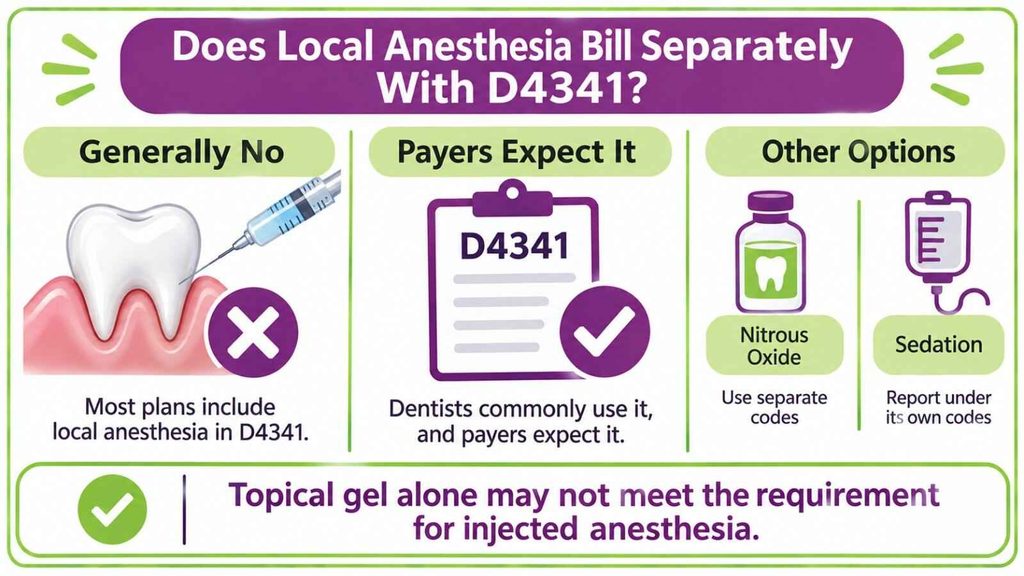
Does Local Anesthesia Bill Separately With D4341?
Generally no, because most plans treat local anesthesia as part of the SRP fee. Dentists routinely use it for D4341, so payers expect it inside the code.
Some carriers also look for injected anesthesia in the chart to support the code, and topical gel alone may not meet that requirement. Nitrous oxide and sedation are reported under their own codes where the plan covers them.
What Clinical Findings Support D4341?
A D4341 claim rests on documented periodontitis in four or more teeth of the quadrant. The findings below are what a payer expects to see in the chart.
- Pocket depths of at least 4 mm on the teeth being treated
- Clinical attachment loss that points to periodontitis instead of gingivitis
- Bleeding on probing at the affected sites
- Radiographic bone loss around the treated teeth
- Calculus on the root surfaces, recorded in the clinical note
- A periodontal diagnosis and a count of diseased teeth in each quadrant
Carriers do not accept pockets under 4 mm, and several now require 5 mm or more. Pockets without radiographic bone loss often fail review.
A comprehensive evaluation under the D0150 dental code often starts the workup that leads to this diagnosis.
What Is the Cost of Dental Code D4341?
The cost of D4341 ranges from about $150 to $350 per quadrant in 2026, and a full mouth of four quadrants runs $600 to $1,400. The negotiated national average sits near $228 per quadrant.
Region, provider type, and the number of quadrants treated move the final number. Medicaid fees sit well below private plan fees, which changes the math for practices that accept it.
Each quadrant bills on its own line, so a full mouth produces four lines on the claim.
| Cost Element | Typical 2026 Amount | Notes |
|---|---|---|
| D4341 office fee | $150 to $350 per quadrant | Four or more teeth per quadrant, negotiated average near $228 |
| D4342 office fee | $100 to $250 per quadrant | One to three teeth per quadrant, billed in place of D4341 |
| Full mouth D4341 | $600 to $1,400 | Four claim lines, often split across two visits |
| D4910 periodontal maintenance | $100 to $250 per visit | Recall visits after active therapy, usually every three to four months |
| D4355 full mouth debridement | $100 to $300 | Billed before the exam when heavy deposits block a diagnosis |
| Local anesthesia | Usually included | Nitrous oxide and sedation billed separately where covered |
The D4341 fee covers the scaling and root planing visit for the quadrant. Exams, radiographs, and added services carry their own codes. Each one needs its own documentation.
How Do Dental Plans Cover D4341?
Most dental plans cover D4341 at 50% to 80%, with frequency limits that typically allow one treatment per quadrant every two years. Many plans file it under basic services and apply the deductible first.
One published Humana benefit table allows one D4341 or D4342 per quadrant every three calendar years. Limits differ by plan, so the history on file matters before treatment starts.
- Annual maximums of $1,000 to $2,000 cap the total plan payment for the year
- Waiting periods can delay periodontal benefits for new enrollees
- Alternate benefit provisions may pay D4341 at the D1110 rate when documentation falls short
- Predetermination often requires the charting and radiographs up front
- Periodontal maintenance (D4910) often pays at 80% instead of the 100% routine cleanings receive
- Coordination of benefits applies when a patient carries dual coverage
State Medicaid schedules pay a fraction of private fees. Maryland’s 2024 schedule lists $90.00 for D4341 and $64.80 for D4342. Original Medicare does not cover routine dental care.
Eligibility checks catch these limits before the patient reaches the chair. Practices that outsource eligibility and benefits verification confirm periodontal benefits, frequency history, and waiting periods ahead of the visit.
What Factors Change the D4341 Fee?
Four factors drive the D4341 fee the most: provider type, geography, case extent, and network status. The same quadrant prices very differently across markets. Published self-pay ranges run from $185 to $444 per quadrant.
- Provider type, because periodontists and general dentists set separate fee schedules
- Geographic market, since metro and rural offices price the same quadrant very differently
- Case extent, such as the number of quadrants and the time each visit takes
- Network status, since contracted write-offs reduce what the practice collects
- Add-on services, since sedation and antimicrobial placement bill separately
What Are Example Clinical Scenarios for Dental Code D4341?
Reporting D4341 correctly depends on matching the disease and the tooth count to each quadrant. The scenarios below show a clean reporting pattern, along with the two situations that most often turn a routine claim into a denial or a downgrade.
Scenario 1: Generalized Periodontitis Across Four Quadrants
Bleeding gums and 5- to 7-mm pockets appear throughout a patient’s mouth, and radiographs show horizontal bone loss in all four quadrants. Each quadrant has at least four affected teeth, so the practice reports D4341 once per quadrant across two visits.
The chart includes six-point charting dated within the plan’s window, a full-mouth series, and a periodontitis diagnosis. Every quadrant meets the tooth count, so the claim clears without a downgrade. After healing, the patient moves to D4910 recall visits.
Scenario 2: Frequency Limit Denial After Prior Treatment
Fourteen months after scaling and root planing at another office, a patient transfers to the practice with fresh pockets in the lower right quadrant. The dentist bills D4341, and the plan denies it because many plans allow one treatment per quadrant every two years.
The denial has nothing to do with the charting or the code choice. It comes down to treatment history, which the new practice never saw. Asking for prior treatment dates during verification would have flagged the limit before the visit.
New charting and radiographs showing progression can support an appeal, though the plan may still hold its limit. A non-covered service agreement lets the practice bill the patient when the plan does not move.
Scenario 3: Gingivitis Case Incorrectly Billed as D4341
Red, bleeding gums and heavy plaque appear in a patient whose pockets stay at 3 mm, with no bone loss on radiographs. The hygienist completes a thorough scaling, and the practice bills D4341 because the visit felt like a deep cleaning.
D4346 is the correct code for generalized moderate or severe gingival inflammation, and D1110 fits mild inflammation. Payer policies reject scaling and root planing for gingivitis without attachment loss, and this chart shows none.
Billing treatment effort as disease is a documentation mismatch that reviewers catch quickly. It invites a downgrade or an audit flag. Knowingly coding gingivitis as periodontitis crosses into improper billing.
What Are the D4341 Rules for Successful Reimbursement?
Successful D4341 reimbursement rests on four things: clean charting, correct tooth counts, verified benefits, and tracked appeals. The rules below reduce downgrades and denials. Each rule targets a known payer behavior.
Why Do Carriers Deny or Downgrade D4341 and How to Prevent It?
Carriers deny or downgrade D4341 for a short, repeating set of reasons. Most trace back to missing periodontal charting or a lack of radiographic proof of bone loss. Fixing the record prevents most of them before submission.
- Chart six points per tooth and date the exam inside the plan’s window
- Record pockets that meet the carrier’s minimum, which can be 4 mm or 5 mm
- Attach radiographs that show bone loss around the treated teeth
- State the diagnosis and the count of diseased teeth in the narrative
- List the quadrant on the claim for every D4341 line
- Check the frequency history before the first visit
Matching each D4341 line to a periodontitis diagnosis from dental ICD-10 codes helps the payer see why treatment was needed.
A downgrade to D1110 is easy to miss because the claim still pays, only at the wrong rate. Never accept a downgrade without reviewing the record first.
Can D4341 Be Billed on the Same Day as D1110?
No, most payers do not pay D1110 on the same day as D4341. The visit already covers deposit removal, so a prophylaxis duplicates the work. One state Medicaid program states the rule outright, barring D1110 on the same day as D4341 through D4910.
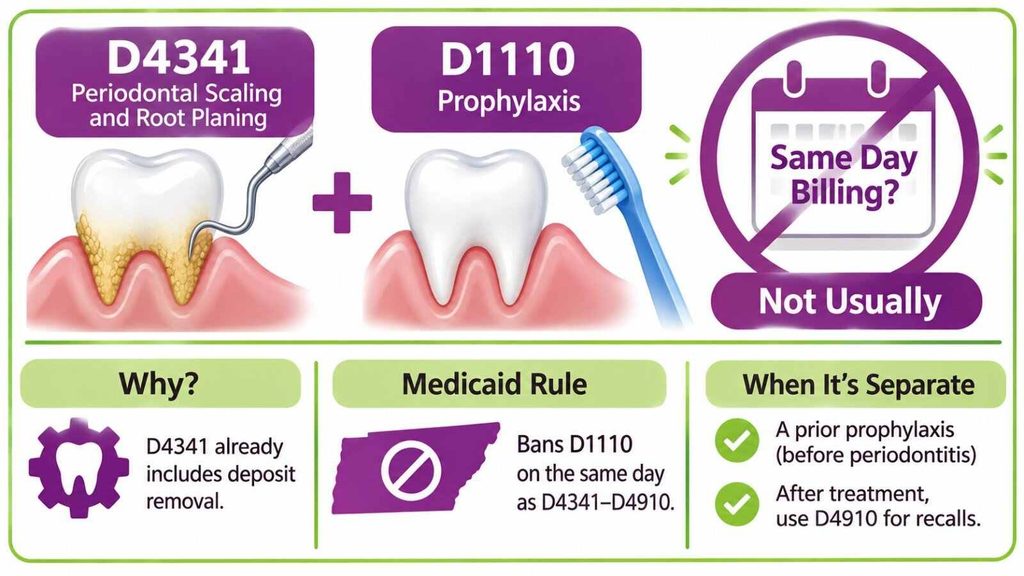
A prophylaxis at a prior visit, before periodontitis was diagnosed, stays a separate service. After active therapy, recall visits move to D4910 instead of D1110.
Can D4341 and D4342 Be Billed in the Same Quadrant?
No, a quadrant uses one code, chosen based on the number of diseased teeth. D4341 applies to four or more, and D4342 applies to one to three. Both codes can appear on one claim when different quadrants have different tooth counts.
Plans count the two codes together. One published benefit table allows a single D4341 or D4342 per quadrant in its limit period.
Is a Predetermination Required Before Billing D4341?
Not always, but it is almost always worth doing. Scaling and root planing is billed by quadrant, and many plans limit how often they pay. A predetermination shows the limit and the documents the plan wants.
Some programs, such as MassHealth, require prior authorization with full periodontal charting, periapical films, and prior treatment records. A predetermination also gives the patient a firm estimate before treatment begins.
How Do Frequency Limits Work for D4341?
Most plans allow one treatment per quadrant every two years, and some stretch the interval. One published Humana table sets it at three calendar years. To avoid frequency denials, follow these steps.
- Ask for the last scaling and root planing date for each quadrant
- Request prior records when a patient transfers from another office
- Remember that D4341 and D4342 share the same quadrant limit
- Document new disease progression with fresh charting and radiographs when early repeat treatment is needed
- Confirm the exact eligibility date with the plan before scheduling
D4910 follows a separate limit, so confirm it before the first recall visit.
What Is Billed After D4341?
Periodontal maintenance under D4910 follows active therapy. It starts after scaling and root planing and repeats every three to four months. Recall visits report D4910 instead of D1110, which fits healthy mouths.
A re-evaluation visit usually happens about four to six weeks after treatment, though payment plans vary. Local antimicrobial placement, billed under D4381, is reported separately when the dentist places it and the plan covers it.
Is It Legal to Balance-Bill When D4341 Is Downgraded?
Often no, though this depends entirely on the contract. When an in-network plan downgrades D4341 to a D1110 allowance, the gap between the fee and the payment is not automatically the patient’s responsibility.
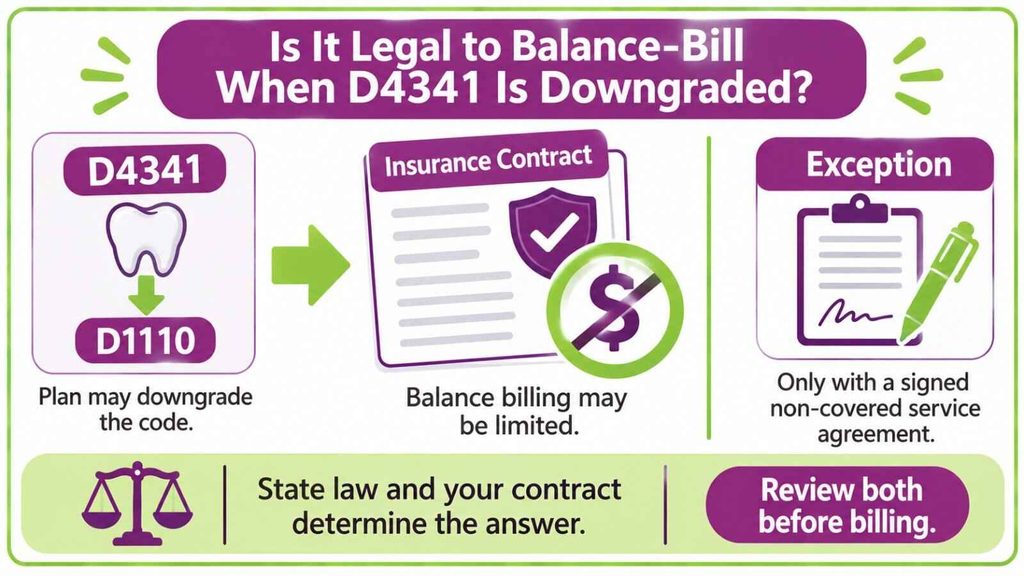
Many PPO agreements limit balance billing beyond the contracted write-off, so the practice may have to absorb the difference. Balance billing is permitted when the patient signed a clear non-covered service agreement before treatment began.
State law and the contract control the answer, so review both before billing the patient.
How to Appeal a Downgraded or Denied D4341 Claim?
An appeal of a downgraded or denied D4341 claim must answer the exact reason the payer gave. Resubmitting the same paperwork rarely changes the outcome. Follow these steps.
- Read the Explanation of Benefits for the exact denial or downgrade reason
- Gather the dated periodontal charting, radiographs, and clinical notes
- Write a narrative that states the diagnosis, the pocket depths, the bone loss, and the tooth count per quadrant
- Submit through the payer’s required channel before the deadline, since provider appeal windows vary by contract
- Request a dental consultant review when the payer upholds the decision
- Track the appeal and escalate at each deadline
Missing the window forfeits the claim, so a tracked workflow protects revenue that silent write-offs lose. That is why many dental billing providers give periodontal claims their own follow-up queue and deadline alerts.