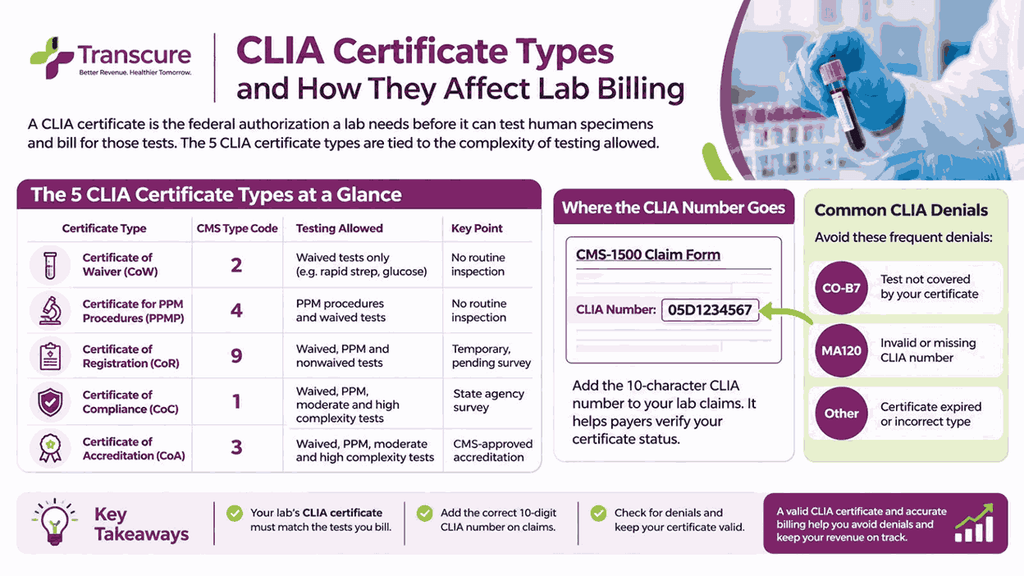
A CLIA certificate is the federal authorization a facility needs before it can test human specimens and bill for those tests. The Clinical Laboratory Improvement Amendments of 1988 (CLIA) program issues five certificate types, each tied to the complexity of testing allowed.
The certificate type directly controls what a lab can bill. Medicare edits laboratory claims against each lab’s certificate, so a test outside the certificate’s scope is denied even when the coding is correct.
This guide covers the five CLIA certificate types and how each one affects claims. It also explains where the CLIA number goes, the most common CLIA denials, and the checks that prevent them.
What Is a CLIA Certificate?
A CLIA certificate confirms that a facility is registered with the Centers for Medicare & Medicaid Services (CMS) to perform laboratory testing on human specimens. The subsections below explain why billing depends on it, how test complexity sets the certificate type, and what the CLIA number contains.
Why CLIA Certification Is Required for Lab Billing
Any facility testing human specimens for diagnosis, prevention, or treatment needs a CLIA certificate. That includes physician offices running a single rapid test. Medicare and Medicaid pay only for tests performed in a facility with a valid, current certificate that covers the test.
How Test Complexity Decides the Certificate Type
The Food and Drug Administration (FDA) categorizes each test system by complexity. The lab’s highest complexity level decides which certificate it needs.
| Test Category | What It Includes | Minimum Certificate |
|---|---|---|
| Waived | Simple tests with low risk of error, such as many rapid strep and glucose meter tests | Certificate of Waiver |
| Provider-Performed Microscopy (PPM) | Defined microscopy procedures performed by a physician, midlevel practitioner, or dentist | Certificate for PPM Procedures |
| Moderate complexity | Most automated chemistry, hematology, and culture testing | Certificate of Registration, then Compliance or Accreditation |
| High complexity | Molecular, cytology, and other tests that need advanced interpretation | Certificate of Registration, then Compliance or Accreditation |
What the 10-Character CLIA Number Means
Every certified site receives a unique 10-character CLIA number. It uses the letter D in the third position, such as 05D1234567. Payers check this number against the CMS certificate file on every lab claim.
The 5 Types of CLIA Certificates at a Glance
CMS issues five certificate types. Each carries a certificate type code that Medicare claim edits read when deciding whether a lab test is payable.
| Certificate | CMS Type Code | Testing Allowed | Oversight |
|---|---|---|---|
| Certificate of Waiver (CoW) | 2 | Waived tests only | No routine inspection |
| Certificate for PPM Procedures (PPMP) | 4 | PPM procedures and waived tests | No routine inspection |
| Certificate of Registration (CoR) | 9 | Waived, PPM, and nonwaived tests until the first survey | Temporary, pending survey |
| Certificate of Compliance (CoC) | 1 | Waived, PPM, moderate, and high complexity tests | State agency survey |
| Certificate of Accreditation (CoA) | 3 | Waived, PPM, moderate, and high complexity tests | CMS-approved accreditation organization |
Billing takeaway: Medicare denies nonwaived test codes billed by labs holding type code 2 or type code 4, or by labs with no valid certificate.
Certificate of Waiver (CoW): What It Allows and How It Affects Billing
Most CLIA-certified sites hold a Certificate of Waiver, and many of them are physician office labs. The subsections below cover its testing scope, its billing rules, and the denials it causes most often.
What a Certificate of Waiver Allows
A CoW lab may perform only tests the FDA categorizes as waived. It must follow the manufacturer’s instructions and pay certificate fees every two years. It does not receive routine inspections, but CMS can still survey a waived lab.
Billing Rules for Waiver Labs
- Report the CoW CLIA number on every claim with a CLIA-covered test.
- Add modifier QW to waived test codes where Medicare requires it.
- Skip QW only on the nine codes CMS recognizes as waived without it: 81002, 81025, 82270, 82272, 82962, 83026, 84830, 85013, and 85651.
- Confirm the exact test kit is waived, because one of the laboratory CPT codes can cover both waived and nonwaived kits.
Common Billing Problems for Waiver Labs
The most frequent problem is billing a nonwaived test under a waiver certificate. A urine culture (87086) billed by a CoW office is a typical example. Medicare denies it because the certificate does not cover moderate complexity testing.

Certificate for Provider-Performed Microscopy Procedures (PPMP)
The PPM certificate sits between waived and nonwaived testing. The subsections below explain who qualifies and how PPM billing works.
Who Qualifies for a PPM Certificate
PPM procedures must be performed by a physician, midlevel practitioner, or dentist during the patient visit. The lab director must hold a qualifying license. The CMS-116 application lists the approved microscopy procedures a PPM lab may perform.
Billing PPM Procedures and Waived Tests
A PPM lab may bill PPM procedures and waived tests under one CLIA number. Common PPM examples include wet mounts (Q0111) and potassium hydroxide preparations (Q0112).
- PPM codes are billed under the PPM certificate without modifier QW.
- Waived codes billed by a PPM lab still need QW where Medicare requires it.
- Any test beyond PPM and waived scope is denied for this certificate type.
Certificate of Registration (CoR): Billing Before the First Survey
A Certificate of Registration is the starting point for every lab that plans nonwaived testing. The subsections below cover what it allows and the billing risks during this temporary stage.
What a Certificate of Registration Allows
CMS issues a CoR to labs applying for a Certificate of Compliance or Accreditation. It allows waived, PPM, and nonwaived testing until the lab is surveyed. A lab pursuing accreditation must show evidence of accreditation, or an application for it, within 11 months.
Billing Risks During the Registration Period
- Testing before the effective date: Tests performed before the CoR takes effect are not payable.
- Missed accreditation deadline: Late evidence of accreditation can stall the move to a final certificate.
- Payer enrollment gaps: Medicare and commercial enrollment must reflect the CLIA number before claims go out.
Certificate of Compliance vs. Certificate of Accreditation
Both certificates allow full nonwaived testing. The subsections below explain how each one is earned and whether the choice changes billing.
Certificate of Compliance (CoC)
A CoC is issued after a state survey agency inspects the lab and finds it compliant with CLIA rules. Surveys repeat on a regular cycle, and the lab pays CMS fees based on test volume and specialties.
Certificate of Accreditation (CoA)
A CoA is issued when a CMS-approved accreditation organization inspects the lab. Approved organizations listed on the CMS-116 include:
- College of American Pathologists (CAP)
- COLA
- The Joint Commission
- Accreditation Commission for Health Care (ACHC)
- AABB, A2LA, and the American Society for Histocompatibility and Immunogenetics (ASHI)
Does the Choice Affect Billing?
| Factor | Certificate of Compliance | Certificate of Accreditation |
|---|---|---|
| Who inspects | State survey agency | Accreditation organization |
| Medicare type code | 1 | 3 |
| Nonwaived test billing | Allowed | Allowed |
| Commercial payer view | Accepted by most payers | Some contracts prefer or require accreditation |
Medicare claim edits treat both the same for nonwaived testing. The difference shows up in payer contracts, survey costs, and inspection standards.
How CLIA Certificates Affect Lab Billing
Certificate type affects billing at three points: the claim edit, the claim form, and the payer’s own rules. The subsections below cover each one.
How Medicare CLIA Edits Work
Medicare edits laboratory claims at the CLIA certificate level. The claim system matches each CLIA-covered code against the certificate type on file for the date of service.
Nonwaived codes require type code 1, 3, or 9. CMS instructs contractors to deny those codes for labs with type code 2, type code 4, or no valid certificate.
Where the CLIA Number Goes on the Claim
| Claim Format | CLIA Number Location |
|---|---|
| Paper CMS-1500 | Item 23 |
| Electronic 837P, claim level | Loop 2300, REF segment with qualifier X4 |
| Electronic 837P, line level | Loop 2400, REF segment with qualifier X4, when lines need different CLIA numbers |
Multiple Sites and Referred Tests
Each testing site generally needs its own CLIA number. A health system with three office labs bills each site’s tests under that site’s certificate. For referred tests billed with modifier 90, Medicare also requires the reference lab’s CLIA number on the claim.
Medicaid and Commercial Payer Rules
Most Medicaid programs and commercial plans follow CMS CLIA rules, and many reject lab claims missing a CLIA number. Some plans add their own edits, such as requiring the number on every office-based lab claim.
Common CLIA Denial Codes and How to Fix Them
CLIA denials usually trace back to a missing number, a scope mismatch, or a lapsed certificate. The table matches each denial to its fix.
Repeated CLIA denials often point to a setup problem rather than a one-off error. A medical billing audit can trace the pattern back to the certificate record or billing rules.
| Denial Code | Meaning | Common Cause | Fix |
|---|---|---|---|
| CO-16 with MA120 | Missing, incomplete, or invalid CLIA number | Blank Item 23 or wrong electronic qualifier | Resubmit with the valid number and qualifier X4 |
| CO-B7 | Provider not certified for this service on this date | Nonwaived test billed under a waiver or PPM certificate | Confirm scope; bill only tests the certificate covers |
| CO-B7 | Provider not certified for this service on this date | Service date outside the certificate’s effective dates | Check effective and expiration dates on the CMS record |
| Waived test denial | Test not recognized as waived | QW missing on a waived code | Add QW and resubmit |
Billing Scenarios by CLIA Certificate Type
The scenarios below show how the same billing question changes with the certificate. Each one lists the biller’s check and the outcome.
| Scenario | Biller Check | Outcome |
|---|---|---|
| A family practice with a CoW runs a rapid strep test | Kit is waived, and the CoW is current | Bill 87880-QW with the CoW number |
| The same practice sends a urine culture through its own lab | 87086 is not waived | Not billable under a CoW; refer the specimen or upgrade the certificate |
| An OB-GYN office with a PPM certificate performs a wet mount and a urine dipstick | Q0111 is a PPM procedure; 81002 is waived without QW | Bill Q0111 and 81002 under the PPM number |
| A new independent lab under a CoR runs chemistry panels | CoR is active for the date of service | Nonwaived tests are billable during registration |
| A lab upgrades from CoW to CoC mid-year | New certificate effective date | Nonwaived tests before that date stay unbillable |
CLIA Certificate Maintenance and Billing Risk
A certificate that was valid at enrollment can still cause denials later. The subsections below cover renewals, changes that need reporting, and state rules.
Renewals and Fees
CLIA certificates are valid for two years. CMS bills fees by certificate type, and Compliance and Accreditation fees also depend on test volume and specialties. As of March 1, 2026, CMS sends fee coupons and certificates by email instead of mail.
Changes That Require an Update
- A new address or testing location
- A new laboratory director
- Adding tests of higher complexity than the certificate allows
- A change of ownership
Update the CLIA record through the state agency, then update payer enrollment and the billing system. A mismatch between these records is a common cause of CO-B7 denials.
State Licensure and CLIA-Exempt States
New York and Washington run CMS-approved state programs that replace federal CLIA certification for labs in those states. Several other states, including California, also require a state lab license on top of CLIA. Billing teams need both records current.
CLIA Billing Compliance Checklist
Run these checks when onboarding a lab client and before each billing cycle:
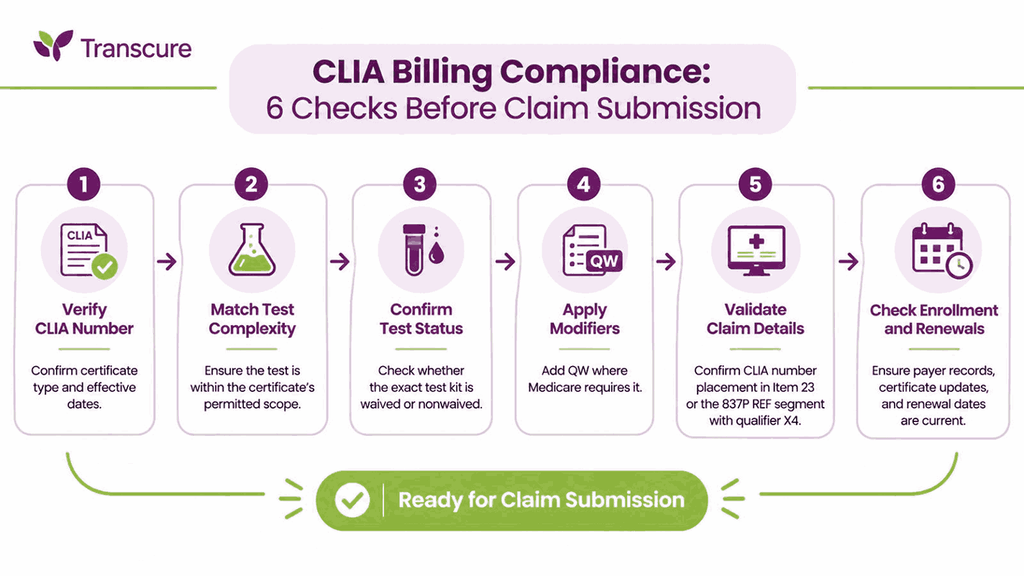
- Confirm the CLIA number, certificate type, and effective dates on the CMS record.
- Match every billed test to the certificate’s complexity scope.
- Confirm the exact test kit’s waived or nonwaived status.
- Apply QW where required, and skip it on the nine exception codes.
- Place the CLIA number in Item 23 or the 837P REF segment with qualifier X4.
- Report the reference lab’s CLIA number on referred tests.
- Track renewal dates and fee payments.
- Update payer enrollment after any certificate change.
How Transcure Supports CLIA-Compliant Lab Billing
CLIA errors are among the easiest lab denials to prevent, because every check happens before the claim leaves. The certificate record, the test scope, and the claim form all need to agree.
Transcure’s laboratory billing services match every claim to the active CLIA number and certificate type. The team also tracks renewal dates and certificate changes for each client site.
Frequently Asked Questions About CLIA Certificates and Lab Billing
These are the questions labs and physician practices ask most often about CLIA certificates and claims.
How Many Types of CLIA Certificates Are There?
There are five: Certificate of Waiver, Certificate for PPM Procedures, Certificate of Registration, Certificate of Compliance, and Certificate of Accreditation.
Can a Lab With a Certificate of Waiver Bill for Nonwaived Tests?
No. Medicare denies nonwaived test codes billed under a Certificate of Waiver. The lab must refer those tests or obtain a higher-level certificate.
Where Does the CLIA Number Go on a Claim?
On paper claims, it goes in Item 23 of the CMS-1500. On electronic 837P claims, it goes in the Loop 2300 or 2400 REF segment with qualifier X4.
What Is the Difference Between a Certificate of Compliance and a Certificate of Accreditation?
A state survey agency inspects Compliance labs, while an approved accreditation organization inspects Accreditation labs. Both allow the same nonwaived testing for Medicare billing.
What Does Denial Code CO-B7 Mean for Lab Claims?
CO-B7 means the provider was not certified for that service on that date. For labs, it usually signals a certificate scope mismatch or a lapsed certificate.
How Do Laboratory Billing Companies Handle CLIA Compliance?
Experienced laboratory billing companies verify each client’s CLIA number and certificate type during onboarding. They then match every claim to that certificate’s test scope before submission.
How Long Is a CLIA Certificate Valid?
CLIA certificates are valid for two years. Labs must pay renewal fees on time to keep the certificate and the billing privileges active.