Michigan medical billing laws set the clock on every claim your practice sends. A health plan owes payment on a clean claim within 45 days, and late payment earns 12% simple interest. Any practice that overlooks either number leaves earned revenue on the table.
Denials add to the pressure. Plan disclosures under CMS rule 0057-F show that Michigan plans denied 13.4% of standard prior authorization requests in 2025. Among plans reporting appeals, only 9% of denials were appealed, and 71% of those appeals were overturned.
This guide explains each one in plain terms, with the deadlines, penalties, and billing steps that matter. Practices, billing teams, and managers can use it to keep Michigan claims compliant and paid in 2027.
Here are the laws to keep in mind when billing in Michigan.
| Law or Rule | What It Covers | Key Rule or Deadline |
|---|---|---|
| Prompt Pay Law (MCL 500.2006) | Payment of clean claims by commercial health plans | 45 days to pay, 12% simple interest when late, and defect notice within 30 days |
| Medicaid Health Plan Prompt Pay Rule (MCL 400.111i) | Payment of clean claims by Medicaid health plans | 45 days to pay, defect notice within 30 days, and 30 days to correct |
| Medicaid Timely Filing Limit | Filing window for fee-for-service Medicaid claims | 12 months from the date of service, with a 120-day re-bill after a plan take-back |
| CHAMPS Enrollment Requirement | Provider enrollment for Medicaid payment | Ordering, referring, and attending providers must be active on the date of service |
| Michigan Surprise Medical Billing Act | Patient protection from out-of-network balance bills | Works alongside the federal No Surprises Act |
| Prior Authorization Reform Law (Public Act 60 of 2022) | Plan rules for prior authorization | Decision deadlines, gold-carding, and appeal rights, with compliance from June 1, 2023 |
| Health Care False Claim Act (Act 323 of 1984) | False claims to private health insurers | Penalties for knowingly submitting false claims |
| Medicaid False Claim Act (Act 72 of 1977) | False claims to Medicaid | Civil penalties and whistleblower suits |
| Telemedicine Coverage Parity Law | Insurer coverage of telemedicine | Covered services cannot be excluded only because they are delivered by telemedicine |
| Medical Records Access Act | Patient access to records and record retention | Patients can request copies, with fee limits and retention periods |
| No-Fault Auto Medical Fee Schedule (MCL 500.3157) | Payment for crash injury care | Charges capped by a schedule tied to Medicare rates, outside the 45-day prompt pay rule |
| Workers’ Disability Compensation Fee Schedule | Payment for work injury care | Carrier fee schedule and documentation rules, outside the 45-day prompt pay rule |
1. Michigan Prompt Pay Law (MCL 500.2006)
Michigan’s prompt pay law sits in section 2006 of the Insurance Code (MCL 500.2006). It sets deadlines for health plans that pay claims from doctors, hospitals, home health providers, and equipment suppliers.
A plan must pay a clean claim within 45 days of receiving it. If it misses that deadline, the claim bears 12% simple interest. The plan also cannot deny a whole claim when some services on it are payable.

The law covers insured plans. It leaves out administrative services-only arrangements, which include many self-funded employer plans, and it steps aside for no-fault auto, workers’ compensation, and Medicaid claims.
Can a Practice Resubmit a Claim Before Day 45?
Not unless certain conditions are met. A provider may not resubmit the same claim until the 45 days have passed or the plan has sent a defect notice. Early resubmission creates duplicate claims and confuses the clock.
A plan has 30 days to tell the provider, in writing or electronically, why a claim is not clean. The provider then has 45 days, plus any extra time the plan allows, to correct those defects.
The 45-day payment clock pauses from the date the provider receives the notice until the plan receives the response. If the fix makes the claim clean, the plan pays within the time left.
If the fix does not work, the plan must send an adverse claim determination with its reasons within that same period.
2. Medicaid Health Plan Prompt Pay Rule
Section 111i of the Social Welfare Act (MCL 400.111i) sets claim rules for Medicaid health plans. It tells the state insurance commissioner to build a timely claims processing and payment procedure for Medicaid services.
A clean claim must be paid within 45 days of receipt, or it bears 12% simple interest. The plan must also pay the payable services on a claim and cannot deny the whole claim over one defective line.
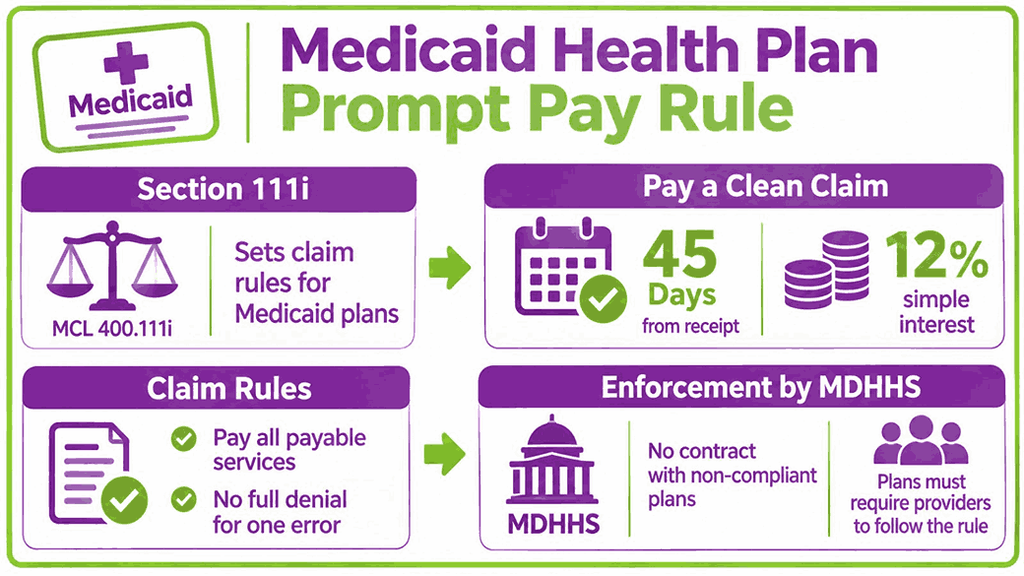
MDHHS enforces the rule through its contracts. It cannot sign or renew a contract with a plan that refuses to follow the procedure. Each plan must also require its contracted providers to follow it.
How Is the Medicaid Health Plan Rule Different From the Commercial Law?
The two rules share the same 45-day payment clock, the same 12% simple interest, and the same 1-year billing limit. They differ in who writes the rule, how quickly providers must fix defects, and what happens when a dispute continues.
Commercial plans follow the Insurance Code, and providers get 45 days to correct a defect. Medicaid plans follow the Social Welfare Act.
The Medicaid plan flags a defect within 30 days. The provider then has 30 days to fix it, and the plan pays within 30 days after the fix.
If a returned claim stays defective, the Medicaid plan must notify the provider and the commissioner. The commercial prompt pay section does not apply to Medicaid claims covered by section 111i.
How Does Medicaid External Review Work?
A provider can ask the state insurance commissioner to review an adverse payment decision. The request must come within 30 days after the provider receives notice that a claim remains defective.
The commissioner completes a preliminary review within 10 days. If the review can go ahead, the plan has 7 business days to send the information it used to make its decision. The commissioner then assigns an independent review organization.
That organization has 30 days to recommend a result, and the commissioner decides within 15 days after receiving it. If the commissioner reverses the plan, the plan must immediately pay the claim and any interest assessed.
3. Michigan Medicaid Timely Filing Limit
Michigan Medicaid limits how long providers have to bill and resolve fee-for-service claims. The Medicaid Provider Manual sets the rule in its General Information for Providers chapter, section 11.3.
Claims must be filed and resolved within 12 months of the date of service. Corrections and additional charges follow the same limit.
Providers must keep records that prove timely filing. Medicaid health plans also expect billing within 1 year under section 111i.
What Exceptions Extend Michigan Medicaid Timely Filing?
MDHHS recognizes several exceptions, each with its own deadline and claim note.
- Retroactive Eligibility: MDHHS accepts a claim up to 6 months after the eligibility decision when that date falls beyond the 12-month limit. The claim note must say timely filing.
- Medicaid Health Plan Take-Backs: The provider re-bills fee-for-service within 120 days of the take-back and uploads the plan’s explanation of benefits.
- Primary Insurer Take-Backs: The provider re-bills or adjusts the claim within 120 days of the take-back and adds a claim note that names the take-back.
An exception only helps when the provider documents it. Keep the eligibility notice or the take-back explanation of benefits on file with the claim.
How Do You Re-Bill After a Medicaid Health Plan Take-Back?
A Medicaid health plan can take back a payment after a patient is retroactively disenrolled. The provider must then re-bill fee-for-service within 120 days of the take-back. The provider uploads the plan’s take-back explanation of benefits to the CHAMPS Document Manager Portal.
Moreover, the claim note must read MHP Take Back EOB in DMP. The 120 days start at the take-back and not at the original service date. Missing that window can turn a recoverable payment into a write-off.
4. CHAMPS Enrollment Requirement
CHAMPS is the Community Health Automated Medicaid Processing System that MDHHS uses for provider enrollment, eligibility checks, and claims. Federal rule 42 CFR 455.410 requires providers who order, refer, prescribe, or attend for Medicaid patients to be enrolled.
Michigan applies that rule through CHAMPS enrollment. A provider must be enrolled and active on the date of service, or the claim can be denied.
Who Has to Enroll in CHAMPS?
Billing providers must enroll in CHAMPS. So must providers who order, refer, prescribe, or attend for Medicaid patients but never bill Medicaid directly.
A specialist who refers a patient falls into this group. So does a physician who orders a sleep study or a lab test. These providers enroll through CHAMPS even though they never bill Medicaid themselves.
Why Do Medicaid Claims Deny for CHAMPS Enrollment?
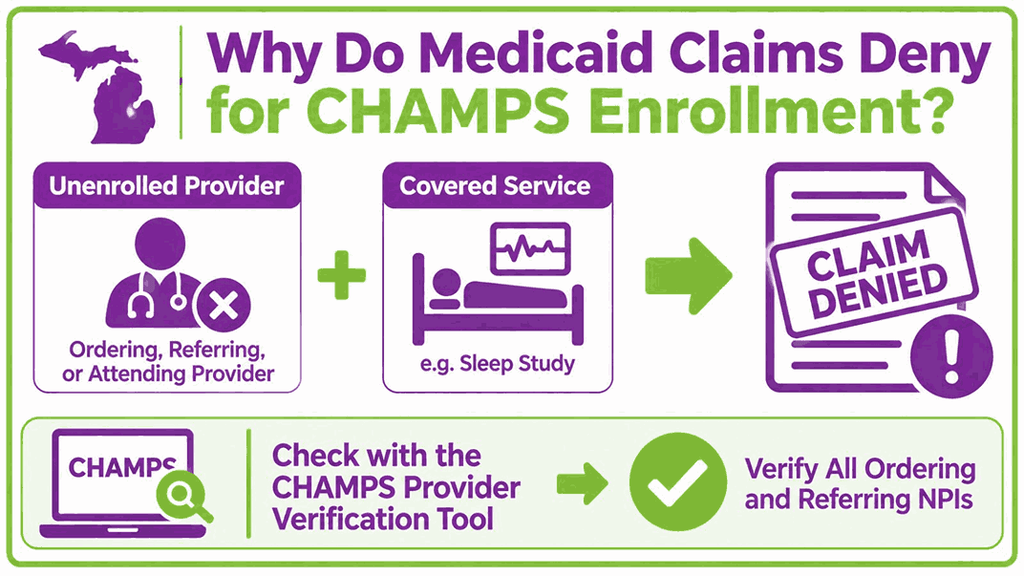
A claim can be denied when it lists an unenrolled provider who ordered, referred, or attended, even for a covered service. Medicaid health plans cannot pay a claim that carries such a provider.
One lapsed enrollment on a sleep study order can therefore sink the whole claim. The billing provider and the patient can both be in good standing, and the claim can still be denied.
MDHHS offers a CHAMPS Provider Verification Tool that shows if a provider is enrolled. Billing teams can run each ordering and referring NPI through it before they submit a claim.
5. Michigan Surprise Medical Billing Act
Michigan’s surprise billing law took effect on October 22, 2020, as Article 18 of the Public Health Code. It limits what out-of-network providers can charge patients in certain situations.
In those cases, the provider bills the insurer, and the patient owes only in-network cost sharing. The law also gives providers a way to dispute the payment amount through DIFS review and arbitration.
The state law applies to insurers regulated by DIFS, such as marketplace plans. It does not reach self-funded employer plans or ground ambulance services.
What Does Michigan’s Surprise Billing Law Cover?
The law protects patients in two main situations.
- Emergency Services: The protection applies to covered emergency care at any facility, in-network or not.
- Non-emergency Services at In-network Facilities: An out-of-network provider cannot balance bill when the patient could not choose the provider or did not receive the required written disclosure.
A patient who receives the disclosure and agrees can waive the protection for some non-emergency services. For other services at in-network facilities, the protection holds even with written consent.
Does the Federal No Surprises Act Apply in Michigan Too?
Yes. The federal No Surprises Act protects patients in self-funded employer plans, which Michigan’s law does not cover. DIFS tells consumers that those plans generally follow the federal protections.
The federal law also adds an independent dispute resolution process for payment disputes between providers and plans.
Which law applies depends on the patient’s plan. Insured plans regulated by DIFS follow the state rules, and self-funded plans follow the federal rules.
6. Michigan Prior Authorization Reform Law (Public Act 60 of 2022)
Public Act 60 of 2022 (SB 247) reformed prior authorization in Michigan, mainly at MCL 500.2212e. It took effect on April 7, 2022, and insurers had to comply operationally by June 1, 2023.
The law requires electronic submission portals and evidence-based review criteria. It sets decision deadlines, and it requires insurers to report denial data to DIFS each year.
If a plan denies a request, it must explain why and how to appeal. A physician in the same or a similar specialty must review the appeal before the plan upholds the denial.
The law covers insured commercial plans, marketplace plans, and state or local government self-funded plans. It excludes Medicaid and Medicare Advantage.
How Fast Must a Michigan Insurer Answer a Prior Authorization Request?
Insurers must decide urgent requests within 72 hours and standard requests within 7 calendar days. The 7-day limit began on June 1, 2024, after a 9-day phase-in.
A request is considered granted when the plan misses the deadline. A plan that needs extra information must ask for it within the deadline. A new clock of the same length starts when the provider responds.
An approval stays valid for at least 60 calendar days, or for a clinically appropriate period when the care needs it.
What Is Gold-Carding in Michigan?
Gold-carding exempts qualifying providers from some prior authorization requirements. Michigan requires each insurer to run a gold card program built with its participating providers.
The program can reward guideline adherence, risk-sharing contracts, or specialty and experience. The law leaves thresholds and application steps to each insurer.
Providers should ask each insurer how its program works, because no single statewide standard exists.
7. Michigan Health Care False Claim Act
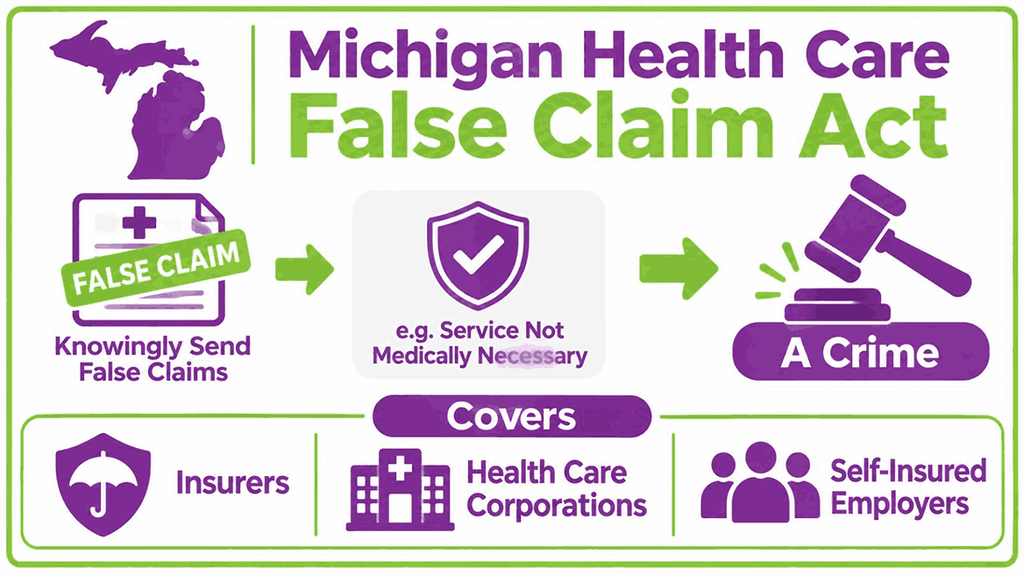
The Health Care False Claim Act makes it a crime to knowingly send false claims to private insurers and health care corporations. Michigan passed it as Act 323 of 1984.
A claim that falsely says a service was medically necessary also counts, and each such claim is a separate offense. The act covers insurers, health care corporations, and self-insured employers that provide health benefits.
Is an Honest Billing Mistake a Crime in Michigan?
Not by itself. The act does not treat an error or mistake as knowing conduct, unless the pattern shows a systematic or persistent tendency toward inaccuracy.
Repeated errors that nobody corrects are the real risk. A practice that finds a coding error and keeps submitting it can cross the line from mistake to violation. The act also builds in two presumptions.
A person is presumed to know about a claim when the person’s signature appears on the claim form. The same applies when the person tells the insurer in writing that they will submit claims electronically. A provider can rebut either presumption.
What Are the Penalties Under the Health Care False Claims Act?
Violations carry criminal and financial penalties.
- False Claims and Statements: A felony with up to 4 years in prison, a fine up to $50,000, or both.
- Kickbacks and Bribes: A felony with the same limits. Taking a rebate for referring a patient counts too.
- Conspiracy to Defraud: A felony with up to 10 years in prison, a fine up to $50,000, or both.
- Repeat Offenses: The penalty can double for any repeat conviction.
- Repayment: The provider owes the insurer the full amount paid, and courts can order restitution.
8. Michigan Medicaid False Claim Act
The Medicaid False Claim Act (Act 72 of 1977) covers false claims, false records, kickbacks, and false medical necessity statements in Michigan’s Medicaid program.
Knowing conduct includes deliberate ignorance and reckless disregard. No proof of intent to defraud is needed, which sets a low bar for providers.
Michigan has two false claim laws. The Health Care False Claim Act covers private insurers, and the Medicaid False Claim Act covers Medicaid.
Can Whistleblowers Sue Under the Medicaid False Claim Act?
Yes, private citizens can sue on the state’s behalf, and the act sets clear rules for how those cases run.
- Filing: Any person can file under seal in the state’s name. The attorney general then has about 90 days to decide if the state will take over the case.
- Reward: A winning whistleblower receives 15% to 25% of the recovery when the attorney general joins and 25% to 30% when the attorney general does not.
- Deadline: The suit must be filed within 6 years of the violation or within 3 years after the state should have known, capped at 10 years.
- Protection: Employers cannot fire, demote, or harass employees who report. A violator owes reinstatement, double back pay, interest, and special damages.
What Penalties Does the Medicaid False Claim Act Carry?
A violator forfeits the full amount received and pays a civil penalty of $5,000 to $10,000 per claim plus 3 times the state’s damages. The state does not need a criminal case to win a civil liability claim.
Criminal violations are felonies. A false claim carries up to 4 years in prison or a fine up to $50,000. A conspiracy carries up to 10 years in prison.
Kickbacks carry up to 4 years in prison or a fine up to $30,000. Each claim that falsely states medical necessity counts as a separate offense.
9. Telemedicine Coverage Parity and Medicaid Telehealth Billing
Michigan regulates telehealth billing through two laws. MCL 500.3476 in the Insurance Code governs private insurers, and MCL 400.105h in the Social Welfare Act governs Medicaid.
Private insurers must cover telemedicine, and Medicaid must pay for it at the in-person rate. MDHHS lists allowable Medicaid services on its telemedicine fee schedules.
Telemedicine includes live audio and video, and private insurers also count store-and-forward messaging.
Does Michigan Require Insurers to Pay the Same for Telehealth?
For coverage, yes. An insurer cannot require face-to-face contact for services appropriately provided through telemedicine, and it must give at least the same coverage as an in-person visit. Copays, coinsurance, and deductibles still apply.
Private insurers have no explicit parity rule, so each contract sets the rate. Check your payer agreements for telemedicine rates before assuming they match in-person pay.
Medicaid works differently. It must pay distant providers the same rate as comparable in-person services, except for providers who offer only telemedicine.
How Do You Bill Michigan Medicaid for Telehealth?
Medicaid telehealth claims follow the rules outlined in the MDHHS Medicaid Provider Manual. Here are the ones to keep in mind:
- Place of Service: Report the place of service you would use for an in-person visit.
- Modifier: Add modifier 95 for audio-video visits or modifier 93 for audio-only visits.
- Consent: Document direct or indirect patient consent in the record.
- Audio-only Visits: Bill only codes on the MDHHS audio-only list, and only when the patient prefers that format.
- Coding: Every part of the billed code must happen during the visit, just as in person.
10. Michigan Medical Records Access Act
The Medical Records Access Act (MCL 333.26261 and following) gives Michigan patients the right to request and receive copies of their records. It also caps what providers can charge for those copies.
HIPAA adds its own access rules. It requires a response within 30 days, with one 30-day extension when the provider explains the delay in writing.
A separate statute, MCL 333.16213, sets how long licensed providers must keep records.
How Much Can a Michigan Provider Charge for Medical Records?
MDHHS adjusts the fee caps each year. The 2026 limits are below.
- Initial Fee: $32.08 per request.
- Pages 1 to 20: $1.60 per page.
- Pages 21 to 50: $0.80 per page.
- Pages 51 and after: $0.32 per page.
HIPAA limits fees for patient requests to reasonable, cost-based amounts, so check which limit fits each request.
How Long Must Michigan Providers Keep Medical Records?
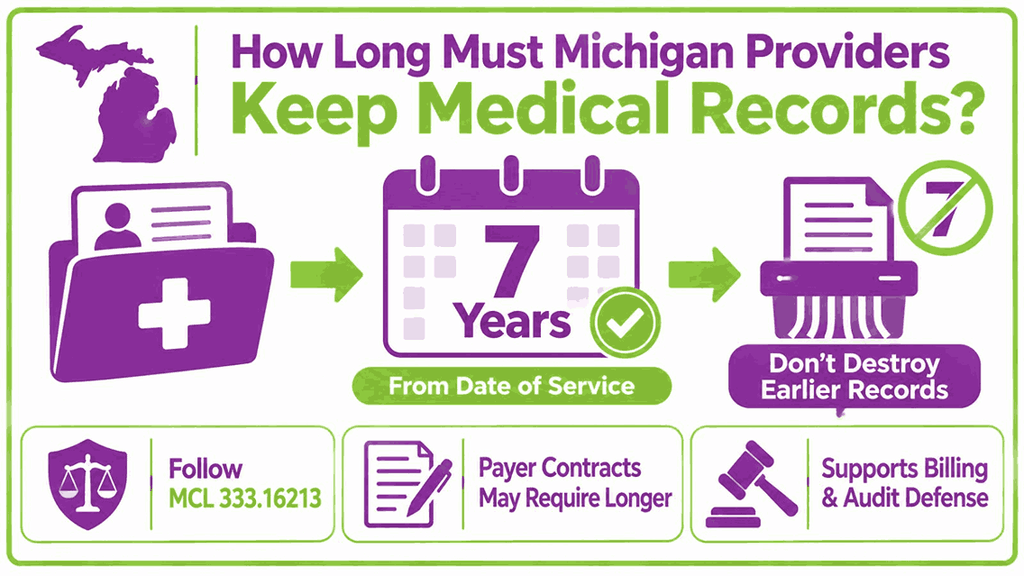
MCL 333.16213 requires licensed providers to keep each record at least 7 years from the date of service. A practice may destroy older records only by following the statute’s destruction rules.
The statute limits when a practice can destroy records that are under 7 years old. Payer contracts can require retention beyond 7 years. Records also support billing disputes and audits. The Medicaid False Claims Act alone allows suits up to 10 years after a violation.
11. No-Fault Auto Medical Fee Schedule (MCL 500.3157)
Michigan’s no-fault law makes auto insurers pay medical costs for crash injuries through personal injury protection, or PIP. The 2019 reform added a medical fee schedule at MCL 500.3157, which took effect on July 2, 2021.
It also let drivers choose their PIP coverage level. The 45-day prompt pay rule does not apply to no-fault claims.
How Much Does Michigan No-Fault Pay for Medical Services?
The fee schedule caps what insurers pay for treatment and training after July 1, 2021. Providers in the general category started at 200% of the Medicare amount. The cap stepped down to 195% in July 2022 and to 190% in July 2023.
Services without a Medicare rate follow a different cap. The insurer pays a share of the provider’s January 1, 2019 charges. The share starts at 55% and settles at 52.5% after 2023. Trauma centers and certain facilities follow different percentages.
These figures are maximums and not guaranteed payments. The Medicare-based amount also cannot exceed the provider’s average charge on January 1, 2019.
Can Providers Sue No-Fault Insurers for Unpaid Bills?
Yes. The 2019 reform gave providers a direct right to sue no-fault insurers for overdue benefits. Benefits are due within 30 days of reasonable proof of the loss, and overdue benefits earn penalty interest.
Insurers also gained utilization review rights over provider care, and providers must submit to those reviews. Family attendant care is capped at 56 hours a week.
12. Workers’ Disability Compensation Medical Fee Schedule
Michigan’s Workers’ Compensation Health Care Services Rules implement section 315 of the Workers’ Disability Compensation Act (MCL 418.315). They set what carriers pay for injured workers’ medical care and how providers must bill.
The rules build maximum payments on the Medicare fee schedule with a Michigan geographic adjustment. The agency multiplies each procedure’s relative value units by a published conversion factor.
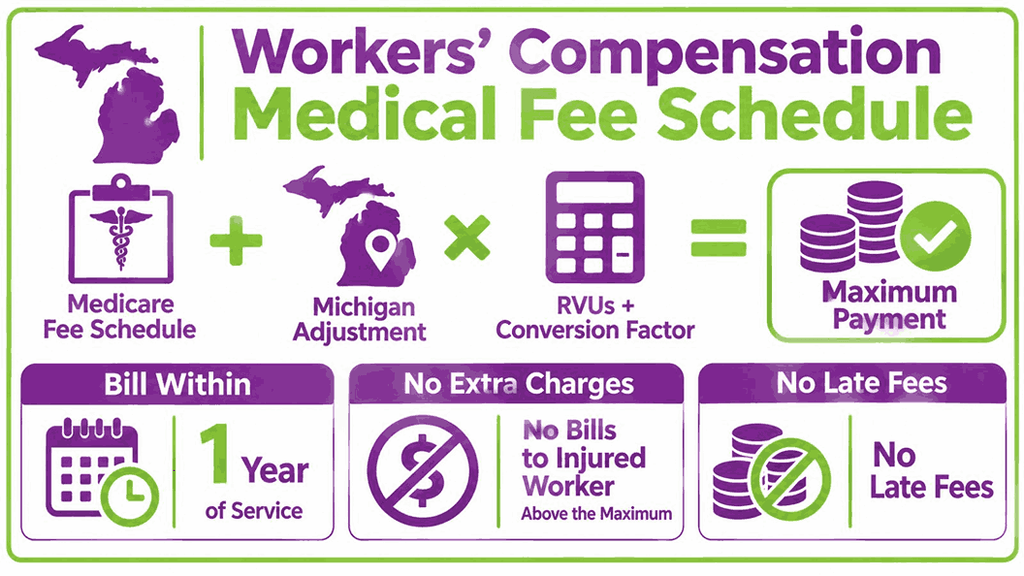
Providers must bill within 1 year of the date of service, with limited exceptions. They cannot bill the injured worker for amounts above the maximum or for late fees.
How Long Does a Michigan Workers’ Comp Carrier Have to Pay a Bill?
Carriers and providers each have deadlines under the rules, and each step carries a form or a fee.
- Carrier Response: A carrier must pay, adjust, or reject a properly submitted bill within 30 days of receiving it. It must give specific reasons when it adjusts or rejects a bill.
- Late Fee and Resubmission: A carrier that pays after 30 days owes a 3% late fee. When 30 days pass without payment, the provider resubmits the bill with the 3% late fee added.
- Escalation: If a second properly submitted bill gets no answer within 60 days of the first, the provider can seek help from the agency. The provider files an Application for Mediation or Hearing.
- Billing the Worker: Providers cannot bill the injured worker for amounts above the maximum or for amounts the carrier disputes through utilization review.
Final Words on Michigan Medical Billing Laws
Michigan’s 12 billing laws and rules cover a lot of ground, but they share one theme. Every payer works on a clock. Commercial and Medicaid plans owe payment on a clean claim within 45 days, and Medicaid fee-for-service claims are due within 12 months.
Prior authorization decisions arrive in 72 hours or 7 days. No-fault and workers’ compensation carriers follow their own 30-day windows. Missing a clock can cost a practice its appeal rights or the payment itself.
Staff who know these rules protect revenue and avoid false claim exposure. Build these habits into daily work, and revisit them when a payer, policy, or deadline changes. Providers who want extra support can review the medical billing providers in Michigan that already handle these rules.