Accounts receivable in healthcare is the money a practice has earned but not yet collected, and that balance sets the pace of the whole practice. Every unpaid claim delays payroll, supply orders, and growth. Yet many providers only review A/R when cash flow tightens. By then, aged claims can pass payer deadlines.
The pressure is rising from several directions at once. Experian Health’s 2026 State of Claims survey found that 40% of providers have at least 10% of claims denied, and 75% say denials are increasing. Meanwhile, patient deductibles keep climbing, payer rules keep changing, and prior authorization keeps consuming staff hours. Therefore, healthcare accounts receivable management now takes more skill than most front offices and small in-house billing teams can supply.
This guide lists the 10 biggest challenges providers face with accounts receivable in healthcare. Each section names the cause, the cost, and the fix. Moreover, the guide shows the benchmarks that reveal whether your own A/R is healthy. Read on to find the leaks that are holding your cash back.

What are Accounts Receivable in Healthcare?
Accounts receivable in healthcare is the total amount owed to a provider for services already delivered. The balance includes unpaid insurance claims and unpaid patient responsibility. Accounts receivable in medical billing tracks every claim from submission to final payment. Therefore, A/R shows how well a revenue cycle converts care into cash.
Medical billing accounts receivable differs from receivables in other industries. A third party, the payer, owes much of the balance. The amount owed also depends on contract rates, coverage rules, and claim accuracy. As a result, a billed charge and a collectible dollar rarely match.
Days in Accounts Receivable in Healthcare | Calculation
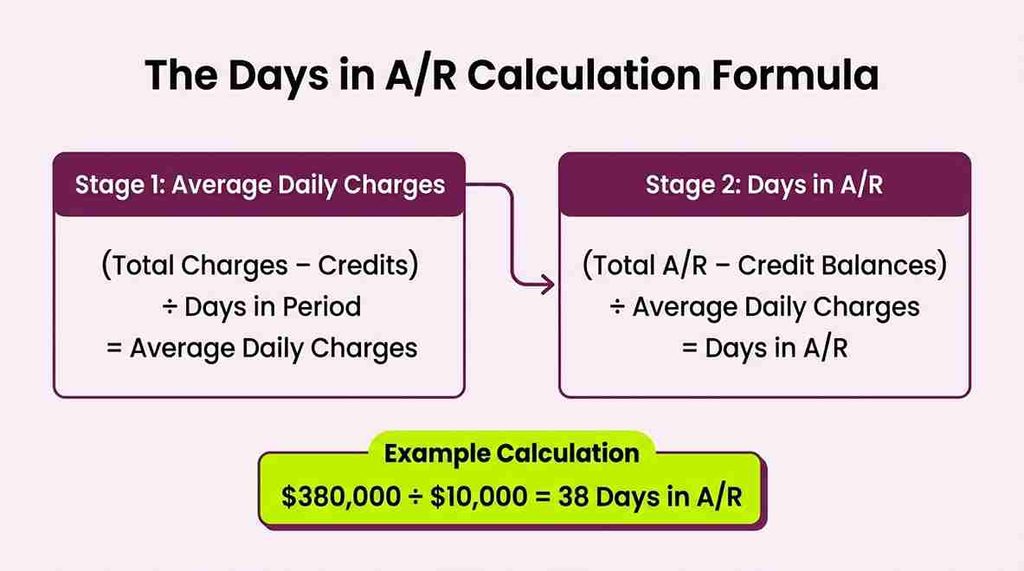
Days in accounts receivable measures the average number of days a practice takes to collect payment. The American Academy of Family Physicians (AAFP) defines the calculation in two stages. First, find average daily charges. Then divide total receivables by that daily figure. A lower number means faster payment.
- Add all charges posted during the period, such as 90 days.
- Subtract credits received from the charge total.
- Divide the result by the number of days in the period to get average daily charges.
- Subtract any credit balances from total A/R, then divide by average daily charges to get days in A/R.
For example, a practice with $900,000 in charges less credits over 90 days has average daily charges of $10,000. A total A/R balance of $380,000, net of credit balances, then produces 38 days in A/R. This is how to calculate AR days in medical billing for any period.
Accounts Receivable Benchmarks in Healthcare
The accounts receivable benchmarks healthcare leaders track start with days in A/R. The AAFP recommends keeping days in A/R below 50 days at minimum, with 30 to 40 days preferred. The table below lists the three AAFP revenue cycle metrics, plus the aged balance measure that averages can hide.
| Metric | What It Measures | Benchmark |
|---|---|---|
| Days in A/R | Average days needed to collect payment | 30 to 40 days preferred; below 50 days at minimum |
| Adjusted collection rate | Payments collected versus the allowed amount | 95% minimum; 95% to 99% average |
| Denial rate | Share of claim dollars denied by payers | 5% to 10% average; below 5% preferred |
| A/R over 120 days | Share of balances in the oldest aging bucket | Tracked separately from average days in A/R |
Days in accounts receivable healthcare practices report can look healthy while old balances grow underneath. The AAFP therefore advises tracking A/R greater than 120 days as its own benchmark. A practice at 38 days overall can still hold a large share of unrecoverable claims in the oldest bucket.
Accounts Receivable Turnover Ratio in Healthcare
The accounts receivable turnover ratio in healthcare equals net patient revenue divided by average accounts receivable. The accounts receivable turnover ratio healthcare CFOs track shows how many times a practice collects its average A/R balance in one year. A higher ratio means faster collection. Dividing 365 by the ratio returns average days in A/R.
The 10 Biggest Accounts Receivable Challenges
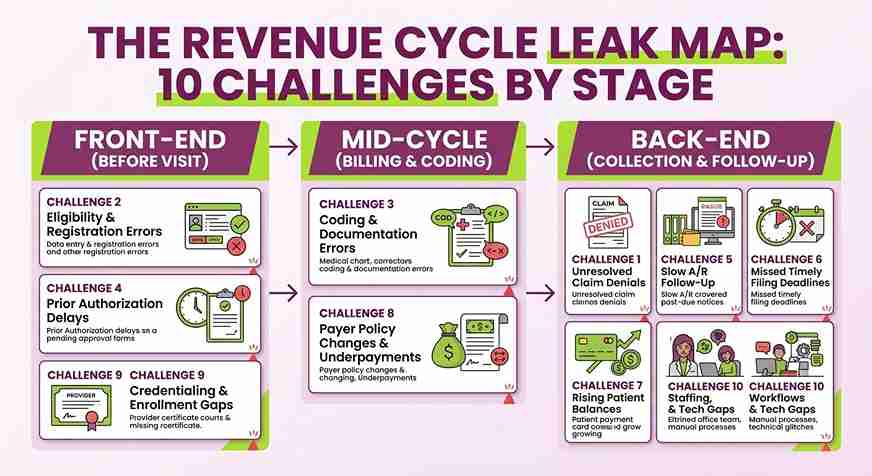
Ten challenges account for most aged balances in the accounts receivable healthcare industry. They sit in three groups. Front-end problems start before the visit, mid-cycle problems appear during coding and claim submission, and back-end problems surface during payment and follow-up. The list below names all 10 challenges:
- Claim denials that stay unresolved: Denied claims sit in A/R until staff correct, appeal, or write them off.
- Eligibility and registration errors: Wrong insurance data at intake becomes a denial weeks later.
- Coding and documentation errors: Codes that miss the clinical record trigger denials and underpayments.
- Prior authorization delays: A missing approval blocks payment for necessary care.
- Slow or inconsistent A/R follow-up: Unpaid claims age because no one works them on a schedule.
- Missed timely filing deadlines: Late claims lose the right to payment.
- Rising patient balances: Higher deductibles shift more dollars to slower-paying patients.
- Payer policy changes and underpayments: Rule changes add denials, and shortfalls go unnoticed.
- Credentialing and enrollment gaps: Unenrolled providers cannot be paid.
- Staffing gaps, manual workflows, and technology disruptions: Too few people and too many manual steps leave aged claims untouched.
Moreover, these challenges compound. A registration error becomes a denial, the denial waits in a work queue, and the delay pushes the claim toward its filing deadline. Therefore, managing accounts receivable in healthcare works best when a practice fixes causes at the front end and not only balances in the oldest bucket.
1. Unresolved Claim Denials
Denied claims remain in accounts receivable until someone corrects, appeals, or writes them off. Experian Health’s 2026 State of Claims survey found that 40% of providers have at least 10% of claims denied. In addition, 75% of respondents said denials are increasing.
The AAFP puts the industry average denial rate at 5% to 10% and calls a rate below 5% preferable. However, a denied claim rarely returns to cash quickly. The Experian survey also found that only 30% of providers recover 80% to 100% of denied revenue, while 52% recover just 50% to 70%.
Common Causes of Claim Denials in Healthcare Billing
Experian’s respondents ranked services not covered as the leading denial reason, with 53% placing it in their top three. Frequently changing payer policies followed at 31%. Code inaccuracy and difficulty obtaining prior authorization each reached 25%. The table below maps common denial causes to their claim adjustment reason codes (CARCs) and the way each ages in A/R.
| Denial Cause | CARC | How It Ages in A/R |
|---|---|---|
| Missing or incorrect claim data | 16 | Waits in a rework queue until a corrected claim goes out |
| Authorization absent | 197 | Waits for retroactive approval or an appeal |
| Medical necessity not met | 50 | Needs a documentation review and a payer appeal |
| Coverage ended before the service | 27 | Moves to the patient or another payer after verification |
| Duplicate claim | 18 | Needs a status check against the original submission |
| Filing deadline missed | 29 | Becomes a write-off unless timely filing is proven |
Each code points to a different owner inside the practice. Front desk staff own coverage errors, coders own data fixes behind CARC 16, and clinical staff own medical necessity documentation. Therefore, a denial report grouped by CARC shows which team creates the most aged balances.
Denial Management Shortens Days in A/R
Denial management turns each denial into a tracked work item with an owner and a deadline. Without that structure, denied claims sit in a shared queue and age past appeal windows. Five habits separate fast recovery from slow write-offs in any practice, whatever its size or specialty:
- Sort every denial by CARC and payer on the day it posts.
- Appeal inside each payer’s window, with medical records attached.
- Correct and resubmit data errors within days, not weeks.
- Track denial rate by payer, provider, and procedure.
- Send root causes back to registration, coding, and clinical teams.
2. Eligibility and Registration Errors
Eligibility and registration errors create unpaid claims because wrong insurance data travels with the claim through every later step. A payer rejects the claim, or denies it weeks later, and the balance ages in A/R. Experian’s 2026 survey found that 43% of providers say inaccurate intake data causes 5% to 15% or more of denials.
In practice, verification catches these errors before the visit. Transcure provides patient benefits and eligibility verification so coverage problems surface before a claim goes out. Moreover, a verified secondary payer prevents coordination of benefits denials, which otherwise stall a claim for weeks.
Front-End Verification Checklist
A complete front-end check covers more than an active policy. The eligibility response also decides what the practice can bill and when. Each unchecked detail becomes a possible denial weeks later. Registration staff can confirm these points at scheduling and again at check-in:
- Active coverage on the date of service
- Subscriber ID, group number, and payer ID
- Patient name and date of birth matching the insurance card
- Primary and secondary insurance order
- Deductible, copay, and coinsurance amounts
- Authorization or referral requirements
3. Coding and Documentation Errors Delay Payment
Coding and documentation errors delay payment because payers deny or reduce claims that do not match the clinical record. An incorrect CPT, ICD-10-CM, or HCPCS code, or a missing modifier, sends the claim back for rework. In Experian’s 2026 survey, 25% of providers named code inaccuracy as a leading denial driver.
Moreover, charge capture gaps add a second problem. A service that never reaches a claim never enters A/R at all, so the revenue disappears without a trace. Transcure’s medical coding services use AAPC-certified coders, and the company reports a 98% first-pass clean claim rate.
Common Coding Errors Behind Aged A/R
Coding rules change every year. ICD-10-CM updates take effect on October 1, and CPT updates take effect on January 1. A practice that misses either date bills with outdated codes, and payers deny those claims. These errors commonly sit behind aged coding denials in practice workflows:
- Unbundled procedures that trigger National Correct Coding Initiative (NCCI) edits
- Missing or incorrect modifiers
- Diagnosis codes that do not support medical necessity for the procedure
- Outdated codes used after an annual update
- Documentation that does not support the level of service billed
4. Prior Authorization Delays Slow Healthcare AR
Prior authorization slows healthcare accounts receivable because a missing approval blocks payment even when the care was medically necessary. The American Medical Association (AMA) 2025 prior authorization survey found that practices complete an average of 40 authorizations per physician per week. Physicians and staff spend 13 hours weekly on them.
In addition, the staffing cost is just as visible. According to the same AMA survey, 40% of physicians employ staff who work only on prior authorization. When a request is late or incomplete, the claim returns with CARC 197, and the balance ages in A/R.
Prior Authorization Metrics That Protect A/R
Prior authorization problems stay hidden until the denials arrive. Authorization sits at the front of the RCM in medical billing workflow, so one missed approval affects every later step. A practice can measure the process earlier with five metrics that show where approvals stall:
- Authorization turnaround time by payer
- Share of scheduled procedures with an approval on file
- Authorization denial rate by CPT code
- Approvals that expire before the service date
- Claims denied with CARC 197
5. Slow A/R Follow-Up Lets Aged Claims Pile Up
Slow A/R follow-up lets aged claims pile up because unpaid claims do not announce themselves. AR follow up in medical billing is the process of tracking each unpaid claim after submission. It includes contacting payers about delays and denials and pursuing patient balances until each account is paid, appealed, or closed.
The accounts receivable aging report healthcare teams run sorts balances into five buckets by age. Buckets run from 0 to 30 days to over 120 days. The AAFP warns that averages hide old balances. The table pairs each bucket with a work priority.
| Aging Bucket | Work Priority |
|---|---|
| 0 to 30 days | Confirm the payer received and accepted each claim |
| 31 to 60 days | Check claim status and correct any rejection |
| 61 to 90 days | Escalate unpaid claims and start appeals |
| 91 to 120 days | Work the highest-value balances first and confirm appeal deadlines |
| Over 120 days | Decide between recovery effort and write-off under practice policy |
The AAFP gives a clear example of payer variation. A practice with an average of 49.94 days in A/R may have Medicaid claims averaging 75 days. Therefore, an aging report split by payer shows slow carriers that a single average hides. Transcure’s medical billing audit reviews 90 days of claims to locate these gaps.
Factors That Distort Days in A/R Calculations
Several accounting choices change the days in A/R figure without changing real performance. Each choice can make a billing office look faster or slower than it is. The AAFP lists the most common ones, and each deserves a separate line in the monthly report:
- Credits left in the receivable balance, which create an overly positive picture
- Accounts sent to collections, which leave the current receivable balance
- Patient payment plans, which extend payment time and raise the average
- Overall averages that mask balances older than 90 or 120 days
6. Missed Timely Filing Deadlines
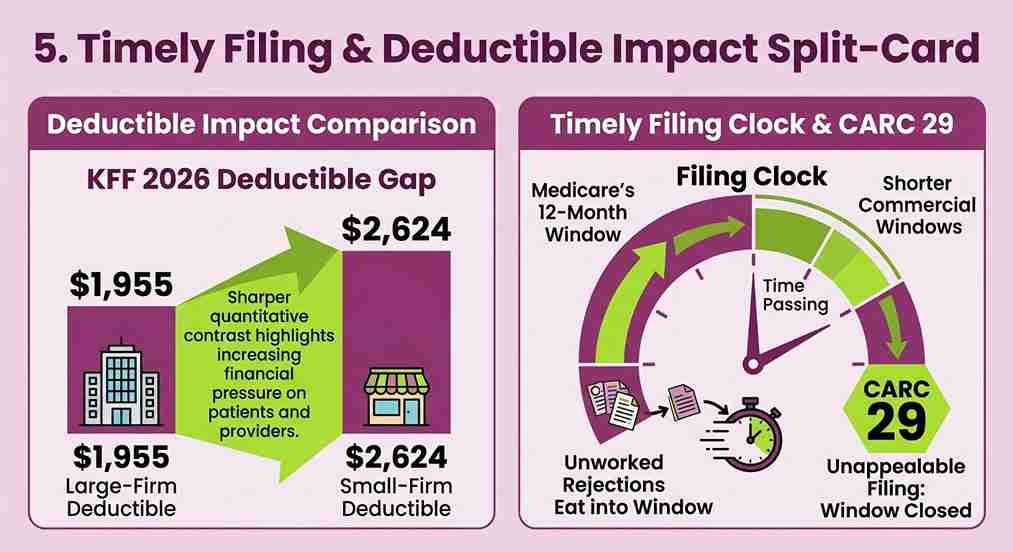
Timely filing limits turn aged A/R into write-offs because a late claim loses its right to payment. Medicare requires claims within 12 months of the date of service under 42 CFR 424.44. CMS allows only limited exceptions, such as administrative error. Commercial payers set their own, often shorter, limits by contract.
A missed deadline returns to the practice as CARC 29, and the claim rarely has an appeal path on its merits. Rejected claims still count against the filing clock. Therefore, a rejection left unworked can use up the entire window. Innovative Pain Care Center faced this pattern at scale.
Controls That Protect Filing Deadlines
Deadline protection depends on tracking, not memory. Staff turnover, backlogs, and payer rejections all push claims toward the limit without anyone noticing. A practice can keep every claim inside its window with a few fixed controls that run on a schedule:
- Record the filing limit for each payer contract in one reference sheet
- Enter charges within one business day of the visit
- Rework rejections the same week they appear
- Flag any claim that reaches half of its filing window unpaid
- Keep proof of timely submission for every claim
7. Rising Patient Balances Strain Healthcare Accounts Receivable
Rising patient balances strain healthcare accounts receivable because each deductible dollar moves from a payer to a patient who needs separate billing. The KFF 2026 Employer Health Benefits Survey found an average single-coverage deductible of $1,955. Workers at firms with fewer than 200 employees average $2,624.
A practice therefore carries more patient-owed A/R as deductibles rise. Each patient balance needs its own statement, reminder, and follow-up call. Payment plans add to the effect, because the AAFP notes that plans extend payment time and raise days in A/R. Transcure’s medical billing services include patient statements and collections.
Practices That Improve Patient Collections
Patient collections improve when the practice sets expectations before the visit. Patients who see a cost estimate in advance and receive a clear statement afterward tend to pay faster. Small changes at scheduling, check-in, and billing add up over a year. These steps support faster patient payment:
- Give a cost estimate at scheduling
- Collect copays and known deductibles at check-in
- Send statements that state the amount owed and the reason
- Offer online payment options
- Track payment plan accounts separately from payer A/R
The Health Insurance Portability and Accountability Act (HIPAA) also applies to patient billing. Any outside partner that handles patient statements and payment calls needs a signed business associate agreement. Transcure signs a business associate agreement with every client, and the agreement defines how protected health information is used and safeguarded.
8. Payer Policy Changes & Underpayments
Payer policy changes and underpayments slow collections because each change creates new denial triggers and each underpayment leaves money unclaimed. Experian’s 2026 survey found that 78% of providers say payer policies change more frequently, up from 67% in 2022. In addition, 64% report longer reimbursement timelines.
However, underpayments are harder to see than denials. A payer pays a claim, but at less than the contracted rate, and the practice writes off the difference as a contractual adjustment. The AAFP advises keeping fee schedules on hand to avoid inappropriate write-offs. Transcure’s revenue cycle management services include payment posting and payer reconciliation.
Checks That Catch Underpayments
Underpayment detection needs a comparison between what the payer paid and what the contract allows. Many practices post the payment and move on, so the shortfall never reaches a work queue. Experian’s 2026 survey found that 79% of providers say reimbursement is harder to secure. These four checks expose variances during monthly review:
- Compare each remittance line to the contracted fee schedule
- Review every contractual adjustment above an agreed dollar threshold
- Track the adjusted collection rate by payer each month
- Challenge payments that fall below the contract rate
9. Credentialing and Enrollment Gaps
Credentialing and enrollment gaps block reimbursement because a payer pays only for providers it has approved. A new physician cannot bill a payer until credentialing and enrollment finish. A lapsed Council for Affordable Quality Healthcare (CAQH) attestation or an outdated Medicare enrollment record produces the same result.
In addition, Medicare enrollment runs through the Provider Enrollment, Chain, and Ownership System (PECOS). Commercial payers each run their own approval process. A claim from an unenrolled provider cannot be paid, so the balance sits in A/R with no route to payment. Transcure’s provider credentialing services cover CAQH, PECOS, and payer enrollment.
Credentialing Tasks That Affect A/R
Credentialing is an ongoing task, not a one-time event. Payers revalidate providers on set cycles, and a missed date can interrupt payment. Four tasks protect claim payment after a provider joins a practice, and each task needs an owner and a calendar date:
- Complete payer enrollment before the first billed visit
- Attest to the CAQH profile on schedule
- Update PECOS when a location or ownership detail changes
- Track payer revalidation dates for every provider
10. Staffing Gaps, Manual Workflows, & Technology Disruptions
Staffing gaps, manual workflows, and technology disruptions hurt A/R because every aged claim needs a person’s time. Experian’s 2025 survey found that 43% of providers were understaffed. The same survey found that 90% of denial rework involved at least some human review.
Similarly, technology failures hit cash flow just as hard. The 2024 Change Healthcare cyberattack interrupted claims processing across the industry. An American Hospital Association survey found that 94% of hospitals reported a financial impact and 74% reported a direct effect on patient care. In addition, 33% said more than half of their revenue was disrupted.
AI Accounts Receivable Automation in Healthcare
AI accounts receivable healthcare tools take over repetitive follow-up work. Healthcare accounts receivable automation tracks claim status and drafts appeals. Accounts receivable automation healthcare teams adopt also ranks accounts by recovery probability. Staff then work the highest-value claims first, which shortens days in A/R.
Transcure’s AI agents for accounts receivable follow-up include ARIA, which tracks outstanding claims, scores recovery probability, and drafts appeals using payer-specific rules. Healthcare accounts receivable software also gives managers visibility. Transcure’s Master Command Dashboard shows days in A/R, denial trends, and collections live.
Overcoming Accounts Receivable Challenges in Healthcare
Providers overcome accounts receivable challenges by fixing front-end errors, working denials fast, and tracking aged balances weekly. The same habits show how to reduce AR days in medical billing. Accounts receivable management healthcare organizations rely on comes down to eight practices, and they apply to any practice size or specialty:
- Verify eligibility and benefits before every visit.
- Submit clean claims with accurate codes within one business day.
- Secure prior authorization before scheduled procedures.
- Work denials by CARC and payer within days of posting.
- Review the A/R aging report weekly, split by payer.
- Track every payer’s filing deadline.
- Collect patient balances at check-in and send clear statements.
- Report days in A/R, denial rate, and adjusted collection rate monthly.
Healthcare accounts receivable recovery starts with the highest-value claims still inside a payer’s appeal window. Weekly escalation of claims over 90 days belongs in any accounts receivable recovery healthcare teams run. Appeal windows differ by payer, so each claim needs its own deadline.
Healthcare accounts receivable financing advances cash against unpaid claims, and healthcare accounts receivable factoring sells those claims at a discount. However, neither option fixes the causes of aged balances, so the same denial, eligibility, and follow-up problems return after each advance.
Outsourcing Accounts Receivable Management in Healthcare
Outsourcing accounts receivable management in healthcare makes sense when aged balances grow faster than the internal team can work them. Signs include days in A/R above 50, rising denial rates, and staff turnover in the billing office. Healthcare accounts receivable outsourcing moves follow-up, appeals, and statements to a dedicated team.
Healthcare accounts receivable services typically cover claim status checks, denial appeals, payment posting, and patient statements. Transcure’s outsourced accounts receivable management runs inside the practice’s existing system. The company reports a reduction of more than 30% in A/R during the first few months.
Criteria for Choosing an A/R Partner
A strong A/R partner shows its work. Accounts receivable services in healthcare come with clear reporting, defined appeal ownership, and a signed business associate agreement. Practices comparing vendors can request sample reports before signing. Five questions separate capable partners from weak ones:
- Does the partner report days in A/R, denial rate, and aging by payer?
- Does a signed business associate agreement cover all patient data?
- Who owns appeals, and what is the turnaround time?
- Does the partner hold security certifications such as ISO 27001?
- Do payer payments deposit into the practice’s own account?
Frequently Asked Questions
These five answers address common questions about accounts receivable in healthcare. Each answer gives a direct number or step. Therefore, a practice can apply the guidance to a live aging report right away and compare its own figures with the benchmarks above.
What Is a Good Day in A/R Number for a Medical Practice?
A good day’s A/R number for a medical practice falls between 30 and 40 days. The AAFP sets 50 days as the minimum standard. A practice above 50 days has a billing or follow-up problem. Balances in the 91 to 120 day and over 120 day buckets need immediate review.
How Do You Calculate A/R Days in Medical Billing?
Calculate A/R days by dividing total receivables by average daily charges. Find average daily charges by adding charges for a period, subtracting credits, and dividing by the number of days in that period. For example, $380,000 in A/R divided by $10,000 in daily charges equals 38 days.
What Causes High Accounts Receivable in Healthcare?
High accounts receivable in healthcare comes from claim denials, eligibility errors, coding mistakes, prior authorization gaps, slow follow-up, and missed filing deadlines. Rising patient deductibles add to the balance. In Experian’s 2026 survey, 40% of providers had at least 10% of claims denied.
How Can Providers Reduce Accounts Receivable Days?
Providers reduce A/R days by verifying eligibility before visits, submitting clean claims quickly, and working denials within days. Weekly aging reviews split by payer catch slow carriers early. Collecting patient balances at check-in also lowers the total. Automation of claim status checks frees staff for appeals.
Does Outsourcing A/R Management Affect HIPAA Compliance?
Outsourcing A/R management does not break HIPAA compliance when a signed business associate agreement is in place. The agreement binds the partner to safeguard protected health information. Practices also confirm security controls, such as ISO 27001 certification, and confirm that payer payments deposit into the practice’s own account.