Summary: “Dermatology HCPCS codes report the drug, biologic, or supply behind a procedure. These claims fail on unit math, JW/JZ modifiers, and benefit routing rather than clinical coding. This guide covers PDT agents, intralesional drugs, Part B biologics, and 2026 skin substitute rates.”
The HHS Office of Inspector General reviewed how Medicare set the Part B payment amount for Tremfya, billed as J1628. Self-administered versions of the drug were inside the calculation. That raised the payment amount between 2 and 7 percent per quarter.
Tremfya generated $32 million in Part B spending in 2025, according to OIG report OEI-BL-26-00200. The code was right, and the drug was right. The payment was still off, because one HCPCS code covered a clinic-administered product and a self-injected one.
That is how dermatology medical billing breaks on the drug line. The procedure code describes the injection, the illumination, or the graft. The HCPCS code describes the product, and it answers to unit definitions, container labels, and benefit rules the procedure never touches.

What Are Dermatology HCPCS Codes?
Dermatology HCPCS codes are the Level II alphanumeric codes for the drugs, biologics, skin substitutes, and supplies a dermatology practice furnishes. They also cover a few Medicare-specific services. The Centers for Medicare and Medicaid Services maintains HCPCS Level II, and the American Medical Association maintains CPT.
The split decides which rulebook a line follows. CPT lines answer to the physician fee schedule and NCCI. HCPCS drug lines answer to average sales price pricing, descriptor units, and discarded-drug modifiers.
Which HCPCS Code Ranges Do Dermatology Practices Bill?
Five ranges carry nearly all dermatology volume. Each range follows a different payment route, and the route decides the rules before coverage is reached.
| Range | What It Reports | Dermatology Example | Payment Route |
|---|---|---|---|
| J | Drugs and biologicals | J3301, triamcinolone acetonide | Average sales price, Part B |
| Q | Skin substitutes, biosimilars | Q5100, ustekinumab-kfce | Flat incident-to rate or average sales price |
| A | Surgical dressings | A6196, alginate dressing | Surgical dressings benefit |
| G | Medicare-specific services | G0168, tissue adhesive closure | Physician fee schedule |
| E | Durable medical equipment | E0691, UV light therapy system | DME benefit |
The J and Q rows carry most of the dollar exposure. A single Ameluz tube or biologic dose can outweigh the procedure it accompanies. The A row matters less in the office, because dressings applied during a visit are not separately payable.
How Do HCPCS Codes Differ From CPT Codes in Dermatology?
CPT reports the work, and HCPCS reports the product. Most dermatology drug encounters produce one line of each, and the two must agree on the date of service and diagnosis.
- Intralesional injection: CPT 11900 plus J3301 for the triamcinolone
- Photodynamic therapy: CPT 96574 plus J7345 for the Ameluz gel
- Hyperhidrosis: CPT 64650 plus J0585 for the onabotulinumtoxinA
- Graft reconstruction: CPT 15271 plus the skin substitute product code
The procedure side, including lesion counts and PDT debridement rules, sits with the dermatology CPT codes that pair with every line in this guide.
How Do Units Work on Dermatology Drug Claims?
Units come from the HCPCS descriptor, never from the vial, tube, or syringe. The claim reports the administered amount divided by the amount the descriptor defines as one unit.
Why Does the Descriptor Set the Unit and Not the Package?
The package describes what the manufacturer shipped. The descriptor describes what Medicare prices. A coder who counts vials or tubes reports the wrong quantity on almost every dermatology drug.
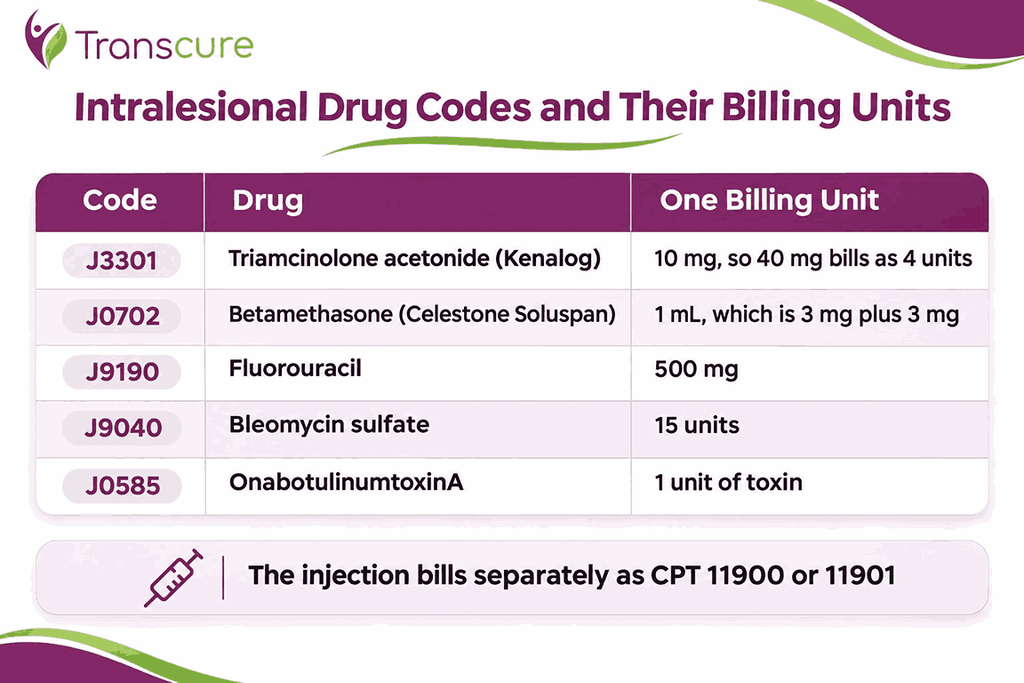
- J3301: one unit is 10 mg, so a 40 mg Kenalog dose bills as 4 units
- J0702: one unit is 3 mg betamethasone acetate plus 3 mg betamethasone sodium phosphate, which is 1 mL of Celestone Soluspan
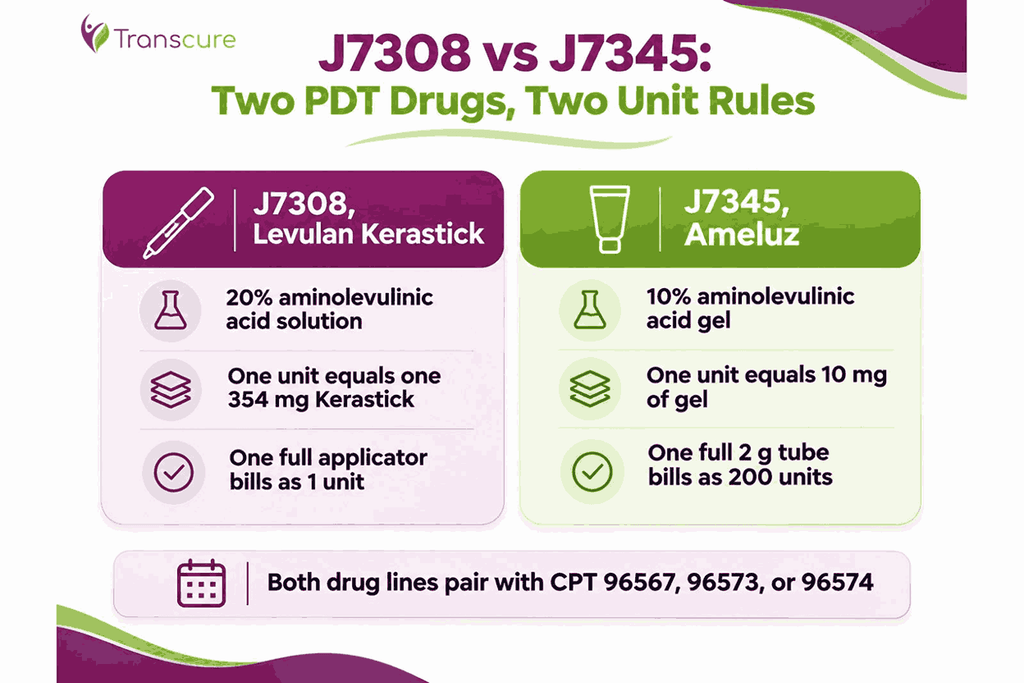
- J7308: one unit is a single 354 mg Kerastick
- J7345: one unit is 10 mg of gel, so a full 2 g Ameluz tube bills as 200 units
- J0585: one unit is one unit of onabotulinumtoxinA
Do Dermatology Drug Claims Need an NDC?
Yes, Part B drug lines carry the National Drug Code, and most commercial payers require it as well. Payers match the HCPCS units against the NDC quantity, so a mismatch between the two flags the line.
The NDC bills in the 11-digit 5-4-2 format. Labels printed in a 5-3-2 format take a padding zero in the product segment. The NDC also identifies the container type, which decides the modifier question below.
When Do JW and JZ Apply to Dermatology Drugs?
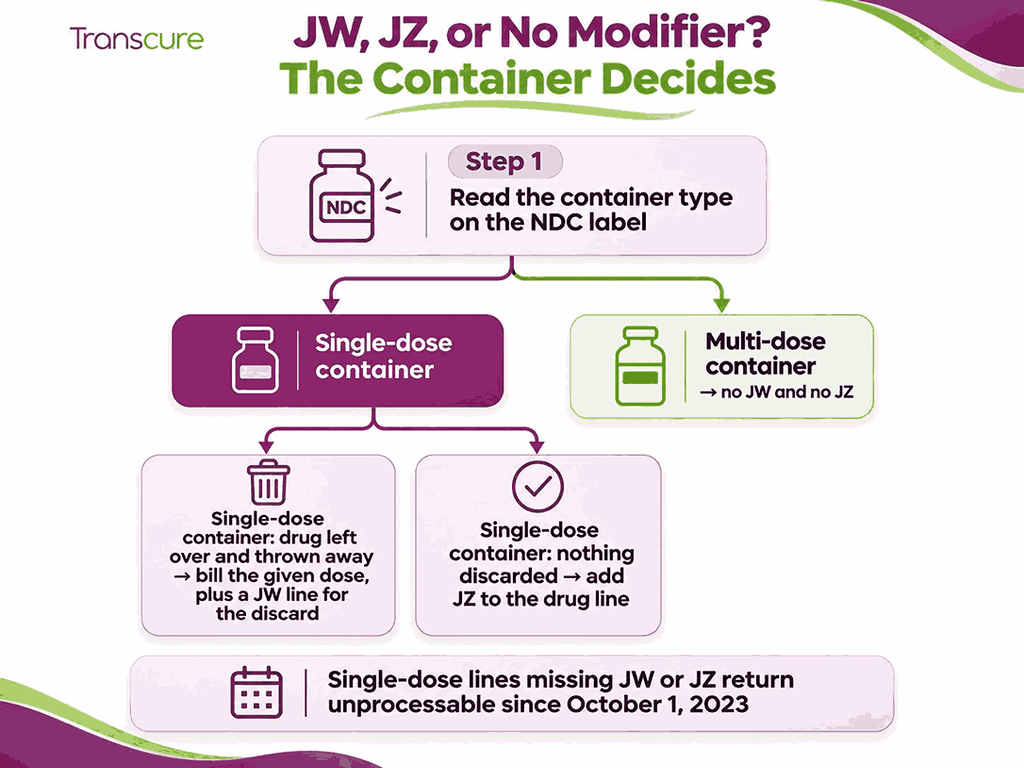
The container label decides, not the HCPCS code. JW reports a discarded amount from a single-dose container and has applied since January 1, 2017. JZ attests that nothing was discarded and has applied since July 1, 2023.
Multi-dose containers take neither modifier. The rule follows FDA labeling for the specific NDC on the claim.
Why Does the Same J-Code Need JW on One Claim and Nothing on Another?
Kenalog shows the split clearly. Triamcinolone ships in single-dose and multi-dose vials, and both bill under J3301.
The American Academy of Ophthalmology publishes worked examples of the rule, and the same logic carries to other dermatology drugs:
- Kenalog, single-dose 40 mg vial, 2 mg injected: J3301 for 1 unit, plus J3301-JW for 3 units
- Kenalog, multi-dose vial, 2 mg injected: J3301 for 1 unit, no modifier
- Celestone Soluspan, 5 mL multi-dose vial: J0702 with neither modifier
- Ilumya, single-dose prefilled syringe, full 100 mg: J3245-JZ, because nothing remains to discard
What Happens When JW or JZ Is Missing?
CMS has returned single-dose drug lines without the required modifier as unprocessable since October 1, 2023. An unprocessable line is not a denial. It carries no appeal rights and never appears on a standard denial report.
The practice sees a short payment and no reason code that explains it. The fix is a resubmission with the modifier, which means the line must be found first.
Can Leftover Botox From a Cosmetic Case Be Billed as Waste?
No, leftover toxin used for a cosmetic purpose cannot be billed to Medicare as waste. MAC billing guidance for botulinum toxin, published in article A59809, states that cosmetic use is statutorily non-covered.
The same guidance bars JW or JZ billing when the unused toxin goes to a cosmetic patient. A 100-unit vial split between a covered hyperhidrosis case and a cosmetic case breaks the waste claim. Bill the covered dose, and bill waste only when it is truly discarded.
Which HCPCS Codes Cover Photodynamic Therapy Drugs?
Photodynamic therapy bills on two lines. CPT 96567, 96573, or 96574 reports the application and illumination work. A J-code reports the photosensitizing drug, and the two products on the market carry different codes and units.
J7308: Aminolevulinic Acid HCl, 20%, 354 mg (Levulan Kerastick)
There is no CPT J7308. J7308 is a HCPCS Level II code for aminolevulinic acid HCl for topical administration, 20%, single unit dosage form (354 mg). That product is the Levulan Kerastick.
One Kerastick equals one unit. The Kerastick is a single-use applicator, so any unused solution is a JW question for that NDC rather than a second unit.
J7345: Aminolevulinic Acid HCl, 10% Gel, 10 mg (Ameluz)
J7345 reports aminolevulinic acid HCl for topical administration, 10% gel, 10 mg. The 10 mg refers to the gel, and an Ameluz tube holds 2 g. A full tube therefore bills as 200 units, and partial tubes bill by the amount actually used.
Coders reading “10 mg” as the drug content report 20 units. Coders counting tubes report one. Both underpay the claim by most of its value. Ameluz does not appear on CMS’s list of single-dose-only codes, so check the NDC’s labeling before adding JW or JZ.
J7308 or J7345: Which PDT Drug Code Applies?
The agent applied decides the code. Levulan is a 20% solution in a single applicator, and Ameluz is a 10% gel in a tube. The two codes are not interchangeable, and their unit bases differ by a factor that turns one tube into 200 units.
J7309 still exists for methyl aminolevulinate, but that product left the US market. A current PDT claim reports J7308 or J7345.
Which HCPCS Codes Cover Intralesional and Injectable Drugs?
Intralesional injections bill CPT 11900 for up to seven lesions or 11901 for more than seven, plus the drug’s J-code. Lesion count drives the CPT line, and milligrams drive the HCPCS line. The diagnosis on both lines, drawn from dermatology ICD-10 codes, decides whether the drug pays.
J3301: Triamcinolone Acetonide, Not Otherwise Specified, 10 mg
There is no CPT J3301, and searching for a J3301 CPT code description leads to the wrong code set. J3301 is the HCPCS Level II code for Kenalog injection, covering triamcinolone acetonide, not otherwise specified, per 10 mg.
Kenalog-10 and Kenalog-40 both bill here. J3301 billing units equal the milligrams injected divided by 10. A 40 mg dose is 4 units, and a 20 mg keloid injection is 2 units.
Whether J3301 needs a modifier depends on the vial. Single-dose vials take JW or JZ, and multi-dose vials take neither. The NDC on the line tells the payer which one was used.
J0702: Betamethasone Acetate 3 mg and Betamethasone Sodium Phosphate 3 mg
J0702 reports Celestone Soluspan and its generic equivalents. Each milliliter contains 3 mg of each salt, and the CMS crosswalk treats that combined 6 mg as one unit. A 1 mL injection bills as 1 unit.
The product ships as a 5 mL multi-dose vial, so JW and JZ do not apply. Coders searching for a J0702 CPT code description are looking at HCPCS Level II, not CPT.
J9190: Fluorouracil, 500 mg
J9190 reports fluorouracil per 500 mg. Dermatology uses it intralesionally for keloids and select squamous cell carcinomas. Intralesional doses rarely reach one full unit, so rounding follows payer policy.
A single-dose 500 mg vial with no discard bills J9190-JZ for 1 unit. Document the administered amount so the rounding decision can be defended on review.
J9040: Bleomycin Sulfate, 15 Units
J9040 reports bleomycin sulfate per 15 units. Some dermatologists inject it intralesionally for recalcitrant warts, which is an off-label use. Payer policy decides coverage, so confirm it before the drug is purchased for that purpose.
J0585: OnabotulinumtoxinA, 1 Unit
There is no CPT J0585. J0585 is the HCPCS Level II code for onabotulinumtoxinA per unit, and dermatology bills it mainly for hyperhidrosis. CPT 64650 covers both axillae, and 64653 covers other areas such as the scalp, face, or neck.
The FDA approved onabotulinumtoxinA for severe primary axillary hyperhidrosis inadequately managed with topical agents. Bill the exact units injected. Report discarded units from the single-dose vial on a separate J0585-JW line.
J3301 or J0702: Which Steroid Code Applies?
The product injected decides the code. Triamcinolone bills J3301 in 10 mg units, and betamethasone bills J0702 in 1 mL units. Carrying a unit habit from one product to the other misreports the claim.
Dexamethasone bills J1100 at 1 mg per unit. It appears far more often on orthopedic claims than dermatology claims.
Which HCPCS Codes Cover Topical and Rare-Disease Drugs?
A small group of office-administered topical products carry their own J-codes. Two of them are gene therapies for dystrophic epidermolysis bullosa, and one became effective in 2026.
J7354: Cantharidin 0.7%, Single Unit Dose Applicator (3.2 mg)
J7354 reports Ycanth, the cantharidin product approved for molluscum contagiosum. CMS made the code permanent effective April 1, 2024. One single-use applicator equals one unit.
J3401: Beremagene Geperpavec-svdt, Topical, per 0.1 mL
J3401 reports Vyjuvek, a topical gene therapy for wounds in dystrophic epidermolysis bullosa. Units follow the 0.1 mL descriptor, so the claim reports the volume applied rather than the number of containers.
J3389: Prademagene Zamikeracel, Topical, per Treatment
J3389 reports Zevaskyn, an autologous cell-sheet gene therapy for recessive dystrophic epidermolysis bullosa. The code took effect January 1, 2026, replacing J3590 billing.
One unit equals one treatment of up to 12 cell sheets. Payer policies bar same-wound use alongside Vyjuvek or Filsuvez, so the treatment record should identify each wound treated.
Which Biologics Can a Dermatology Practice Bill to Part B?
Most psoriasis and eczema biologics never reach the medical claim. Patients self-inject them through the pharmacy benefit, and Medicare’s self-administered drug exclusion keeps them off Part B.
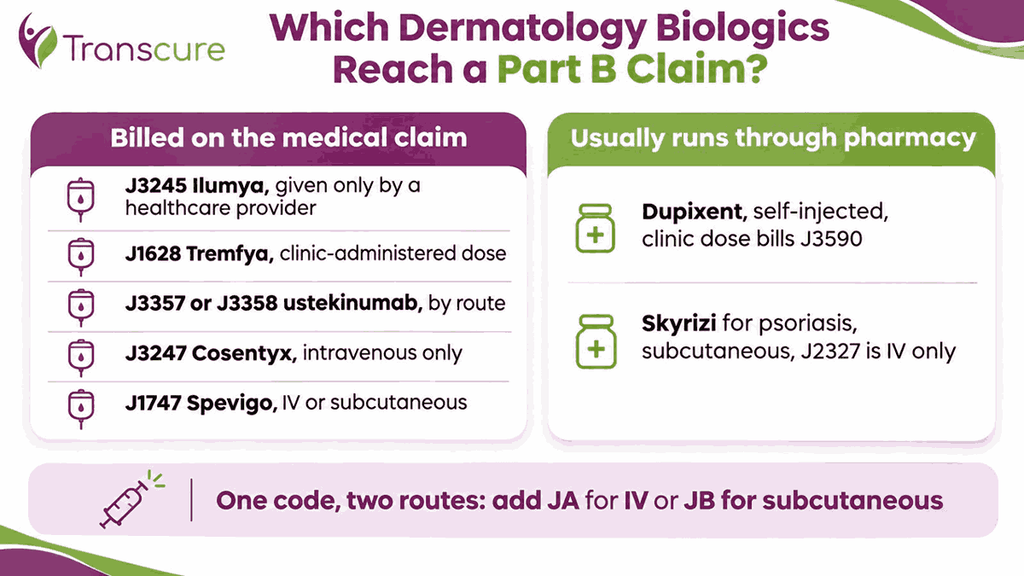
Where one HCPCS code covers two routes, the route modifier carries the difference. MAC self-administered drug article A52527 requires JA for intravenous use and JB for subcutaneous use.
Why Do Most Psoriasis and Eczema Biologics Leave the Medical Claim?
The test is whether the drug is usually self-administered. Drugs meeting that test go on each MAC’s self-administered drug exclusion list and are not covered under Part B. Check the MAC’s current list before buying a biologic to bill under the medical benefit.
A few biologics pass the test because the label requires clinic administration or the drug is infused. Those are the codes that follow.
J3245: Tildrakizumab, 1 mg (Ilumya)
J3245 reports Ilumya, and its label states that only a healthcare provider should administer it. That makes it the psoriasis biologic most naturally billed by a dermatology office under Part B.
Each dose is 100 mg from a single-dose prefilled syringe, which bills as 100 units. A full injection takes JZ, because the syringe is single-dose and nothing is discarded.
J1628: Guselkumab, 1 mg (Tremfya)
J1628 is the Tremfya J-code, billed per 1 mg. Tremfya exists in intravenous and subcutaneous forms, and patients can self-inject the subcutaneous pen after training.
Office administration bills J1628 with the NDC. A self-injected pen runs through pharmacy. OIG’s finding about self-administered versions inside this code’s payment amount is the clearest example of why the route matters.
J3357 and J3358: Ustekinumab, Subcutaneous and Intravenous, 1 mg
The Stelara J-code depends on route. J3357 reports ustekinumab for subcutaneous injection, and J3358 reports ustekinumab for intravenous injection, both per 1 mg. Intravenous induction is the Crohn’s disease and ulcerative colitis regimen, while psoriasis dosing is subcutaneous.
Biosimilars carry their own Q-codes, billed per 1 mg:
- Q5098: ustekinumab-srlf (Imuldosa)
- Q5099: ustekinumab-stba (Steqeyma)
- Q5100: ustekinumab-kfce (Yesintek)
- Q5137 and Q5138: ustekinumab-auub (Wezlana), subcutaneous and intravenous
- Q9997: ustekinumab-ttwe (Pyzchiva), intravenous
- Q9998: ustekinumab-aekn (Selarsdi)
- Q9999: ustekinumab-aauz (Otulfi)
Q-codes without a route in the descriptor need JA or JB on the line.
J3247: Secukinumab, Intravenous, 1 mg
The Cosentyx J-code covers only the intravenous form. J3247 reports secukinumab, intravenous, per 1 mg. Subcutaneous Cosentyx is self-administered and runs through pharmacy, so it has no place on a Part B claim under this code.
J1747: Spesolimab-sbzo, 1 mg
J1747 reports Spevigo for generalized pustular psoriasis. One code covers the intravenous flare dose and the subcutaneous maintenance dose. JA or JB therefore tells the payer which route was used.
CMS lists J1747 as a single-dose-only code, so every line also carries JW or JZ.
What Is the J-Code for Dupixent?
Dupixent has no permanent J-code. When a clinic administers it, the line bills J3590 for an unclassified biologic, with the NDC, dose, and drug name on the claim. Self-injected doses run through the pharmacy benefit and never reach a medical claim.
What Is the J-Code for Skyrizi?
Skyrizi’s only J-code is J2327, risankizumab-rzaa, intravenous, 1 mg. That code covers intravenous induction for Crohn’s disease and ulcerative colitis. Psoriasis dosing is subcutaneous and runs through pharmacy, so a dermatology practice rarely bills J2327.
Which HCPCS Codes Cover Skin Substitutes and Wound Supplies?
Graft reconstruction after Mohs surgery or excision bills two lines. CPT 15271 through 15278 reports the application, and a HCPCS product code reports the skin substitute itself. The product line changed more in 2026 than any other dermatology HCPCS family.
How Did the 2026 Rule Change Skin Substitute Payment?
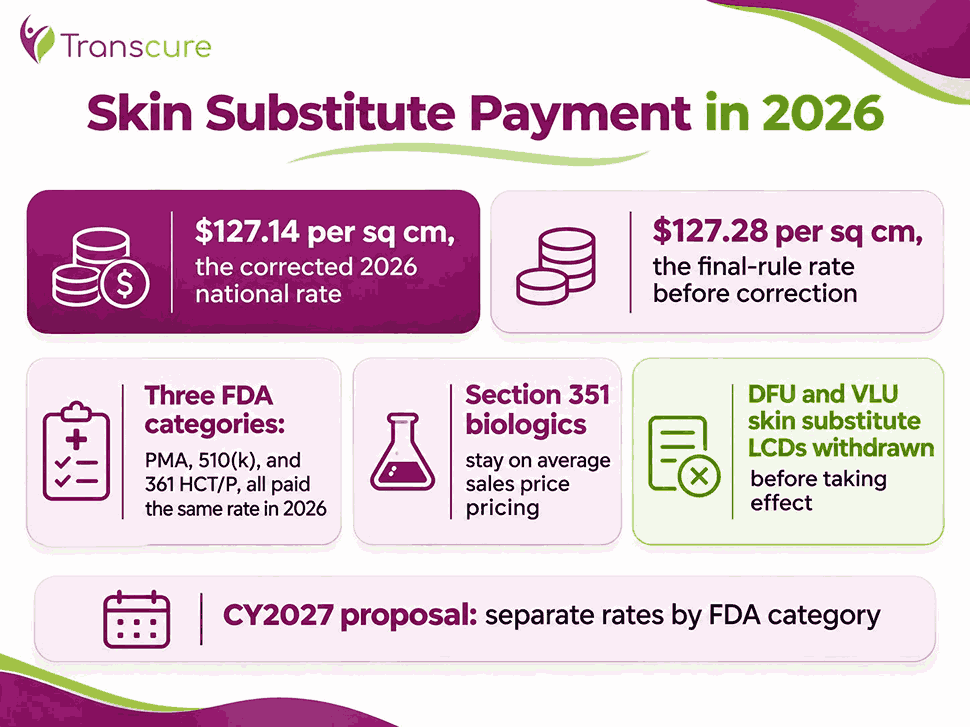
Effective January 1, 2026, CMS reclassified most skin substitutes as incident-to supplies. Products now group by FDA regulatory pathway: premarket approval, 510(k) clearance, and Section 361 human cell and tissue products.
All three categories pay one national rate. The final rule set it at $127.28 per square centimeter. CMS then issued correction notices to both the physician fee schedule and outpatient rules, revising the rate to $127.14.
Biologics licensed under Section 351 of the Public Health Service Act keep average sales price pricing. The same flat rate reshaped wound care in other specialties, and the podiatry HCPCS codes guide covers its effect on diabetic foot ulcer programs.
Did Skin Substitute Coverage Rules Change Too?
Coverage did not tighten alongside payment. The A/B MACs withdrew their final skin substitute LCDs for diabetic foot ulcers and venous leg ulcers before the policies took effect. Several MACs still apply their own skin substitute policies, so coverage varies by contractor.
CMS’s CY2027 physician fee schedule proposal goes further on payment:
- Non-sheet skin substitutes billed under G0681 through G0684 would pay at the same per-square-centimeter rate
- Separate rates for the three FDA categories are intended in future years
- Both remain proposals until the final rule
A6196: Alginate or Other Fiber Gelling Dressing, 16 sq in or Less
HCPCS code A6196 reports a sterile alginate or fiber gelling wound cover with a pad of 16 square inches or less. It bills under the surgical dressings benefit only on a qualifying wound, meaning one created or treated surgically, or debrided.
Dressings applied during the office procedure are incident to the professional service and are not separately payable. A6196 bills only when the patient goes home with dressing supplies for continued care.
Which G-Codes and E-Codes Do Dermatology Practices Use?
Two G-codes and one E-code family come up regularly in dermatology. Each carries a payer or coverage rule that differs from the CPT side.
G0168: Wound Closure Utilizing Tissue Adhesive(s) Only
G0168 reports wound closure with tissue adhesive alone, such as Dermabond. It is a Medicare code. Commercial payers expect CPT simple repair codes 12001 through 12018 for the same closure.
G0168 bundles with repair codes 12001 through 13160. When sutures or staples are placed in the same wound, only the repair code is reported.
G2010: Remote Evaluation of Recorded Video and/or Images
G2010 reports store-and-forward teledermatology for an established patient. The practitioner reviews images the patient submitted and follows up within 24 business hours. The code remains active on the 2026 physician fee schedule.
E0691 to E0694: Ultraviolet Light Therapy Systems
Home phototherapy units bill as durable medical equipment. The codes split by panel size:
- E0691: treatment area of 2 square feet or less
- E0692: 4-foot panel
- E0693: 6-foot panel
- E0694: multidirectional 6-foot cabinet
- A4633: replacement bulb or lamp
Commercial payers generally cover home UVB units and not UVA. Medicare’s psoriasis guidance sits in National Coverage Determination 250.1, so confirm the MAC’s position before dispensing.
What Never Bills Separately on a Dermatology Claim?
Two items appear on dermatology claims that should never be there. Both deny on rules the payer applies automatically.
Can Lidocaine Used for Local Anesthesia Be Billed?
No, local anesthesia given by the physician performing the procedure is part of the procedure. The NCCI policy manual’s integumentary chapter states that local infiltration and regional blocks are not separately reportable.
J2001 describes lidocaine for intravenous infusion, not local injection. NCCI bundles it into hundreds of procedure codes, including dermatology procedures.
Which Modifier Reports a Cosmetic Service?
Cosmetic services are statutorily excluded from Medicare and take the GY modifier when a claim must be sent. Statutory exclusion means no Advance Beneficiary Notice is required. Cosmetic botulinum toxin follows the same rule, and its leftover units cannot be billed as waste.
Front-end review costs minutes, while an unprocessable line can sit unnoticed for months. Practices running drug claims through dermatology billing services move the unit, modifier, and route check to charge entry.
Why Do Dermatology HCPCS Claims Get Denied?
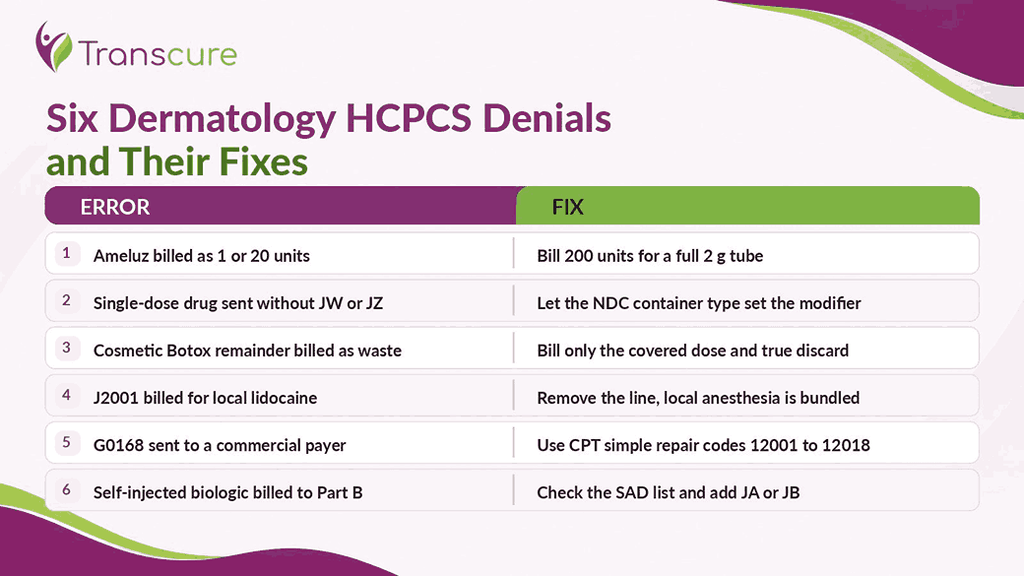
Dermatology HCPCS denials cluster around six failures, and none of them is a clinical coding error. The procedure is usually right. The drug line fails on units, modifiers, payer, or route.
Why Does an Ameluz Claim Underpay by Hundreds of Dollars?
Error. J7345 goes out as 1 unit or 20 units for a full tube. The claim pays a fraction of the drug’s cost.
Fix. Bill 200 units for a full 2 g tube, because one unit is 10 mg of gel. Bill partial tubes by the amount documented as used.
Why Does a Drug Line Come Back Unprocessable?
Error. A single-dose container drug bills without JW or JZ. The line returns unprocessable and never shows as a denial.
Fix. Read the NDC’s container type at charge entry. Single-dose containers take JW for discard or JZ for none, and multi-dose containers take neither.
Why Can’t Leftover Botox Be Billed as Waste?
Error. Unused toxin from a covered hyperhidrosis case goes to a cosmetic patient, and the remainder bills as JW.
Fix. Bill only covered units and waste that was discarded. Cosmetic use of the remainder removes it from the Medicare claim entirely.
Why Does Lidocaine Deny on Every Procedure Claim?
Error. J2001 bills for lidocaine injected before a biopsy or excision.
Fix. Remove the line. Local anesthesia is bundled into the procedure, and J2001 describes intravenous lidocaine only.
Why Does a Dermabond Closure Deny at a Commercial Payer?
Error. G0168 goes to a commercial payer, or bills alongside a repair code for the same wound.
Fix. Use G0168 for Medicare only. Bill CPT simple repair codes to commercial payers, and never pair G0168 with 12001 through 13160 on the same wound.
Why Does a Biologic Claim Deny Even With the Right J-Code?
Error. A self-administered biologic bills to Part B, or a dual-route code goes out without JA or JB.
Fix. Check the MAC’s self-administered drug exclusion list before buy-and-bill. Add the route modifier whenever one code covers both intravenous and subcutaneous use.
Drug-line errors like these rarely show up in procedure-focused audits. Many practices compare dermatology billing companies on whether they review J-code units and modifiers before submission.
What Changed for Dermatology HCPCS Codes in 2026?
Two changes moved money in 2026, and one new code arrived. An OIG finding also changed how one dermatology biologic is priced.
How Much Does Medicare Pay for Skin Substitutes in 2026?
Medicare pays $127.14 per square centimeter for most skin substitutes in 2026, after CMS corrected the $127.28 rate in the final rule. The DFU and VLU skin substitute LCDs were withdrawn before taking effect.
Which New HCPCS Code Took Effect for Dermatology in 2026?
J3389 for Zevaskyn took effect January 1, 2026. It replaced J3590 billing for the first autologous cell-sheet gene therapy for recessive dystrophic epidermolysis bullosa.
What Did OIG Find About Self-Administered Biologics?
OIG report OEI-BL-26-00200 found that self-administered versions of Tremfya were included in J1628’s payment amount. That raised the amount between 2 and 7 percent per quarter.
What Is CMS Proposing for 2027?
CMS proposed paying non-sheet skin substitutes at the same per-square-centimeter rate as sheet products. It also intends to set separate rates for the three FDA categories. Both remain proposals until the CY2027 final rule.
Dermatology HCPCS Codes: Frequently Asked Questions
Is J3301 a CPT Code?
J3301 is not a CPT code. It is a HCPCS Level II code for triamcinolone acetonide, not otherwise specified, per 10 mg. The injection itself bills separately with a CPT code such as 11900 for intralesional injection.
How Many Units of J3301 Are Billed for a 40 mg Kenalog Injection?
A 40 mg Kenalog injection bills as 4 units of J3301. One unit equals 10 mg of triamcinolone acetonide. A 10 mg dose bills 1 unit, and a 20 mg dose bills 2 units.
Does J3301 Need a JW or JZ Modifier?
J3301 needs JW or JZ only when the drug comes from a single-dose vial. Report JW for any discarded amount, or JZ when nothing was discarded. Multi-dose vials take neither modifier.
What Is the J-Code for Dupixent?
Dupixent has no permanent J-code. Clinic-administered doses bill under J3590 for an unclassified biologic, with the NDC, dose, and drug name on the claim. Self-injected doses run through the pharmacy benefit.
What Is the J-Code for Skyrizi?
Skyrizi’s only J-code is J2327, risankizumab-rzaa, intravenous, 1 mg. It covers intravenous induction for Crohn’s disease and ulcerative colitis. Subcutaneous psoriasis dosing runs through the pharmacy benefit.
How Many Units of J7345 Are in One Ameluz Tube?
One full Ameluz tube bills as 200 units of J7345. The code defines one unit as 10 mg of the 10% gel, and each tube holds 2 g. Partial tubes bill by the amount used.
Can G0168 Be Billed to Commercial Insurance?
G0168 is a Medicare code, and most commercial payers do not accept it. For commercial claims, report tissue adhesive closure with CPT simple repair codes 12001 through 12018, based on wound size and location.