Initial claim denials hit 11.8% in 2024, up from 10.2% just a few years earlier, according to multiple national datasets. Hospitals lost an estimated $25 billion to denials in 2025, with each denied claim costing roughly $118 to rework.
Traditional billing teams cannot keep pace with rising payer scrutiny, prior authorization volume, and coding complexity. The result is slower cash, higher A/R days, and shrinking margins for practices already under pressure.
RCM automation has now become a necessity. AI medical billing platforms now handle eligibility, coding, claim scrubbing, denials, AR follow-up, and payment posting with minimal human input. Early adopters report a 10 to 15% revenue lift within months.
This guide breaks down what AI in medical billing does, the workflows it automates, and the AI billing agents that run the work. It will also discuss the risks practices need to manage, and how to deploy AI agents for medical billing without breaking your current operations.

What Is AI-Powered Medical Billing?
AI-powered medical billing is the use of machine learning, natural language processing, and intelligent workflow orchestration to run revenue cycle tasks that once required manual labor. It is different from traditional automation. Rules-based automation follows fixed scripts. AI in medical billing learns from past claims, payer responses, and coding patterns. It reads clinical documentation, scores denial risk, and adapts workflows in real time. The system gets sharper with every claim it processes.
What Are AI Billing Agents?
AI billing agents are autonomous software workers built to run specific RCM tasks end-to-end. Each agent owns one stage of the revenue cycle. One handles eligibility while another handles prior auth. Others cover coding, scrubbing, denials, AR follow-up, and posting.
Unlike bots that follow fixed scripts, agents make decisions, learn from outcomes, and adapt to payer behavior. Certified billers and coders supervise edge cases, while routine work moves through agents at machine speed. This human-plus-AI split is the operating model behind every modern AI-powered medical billing company.
Core Technologies Behind AI Medical Billing
Five technologies are the foundation of modern AI medical billing software:
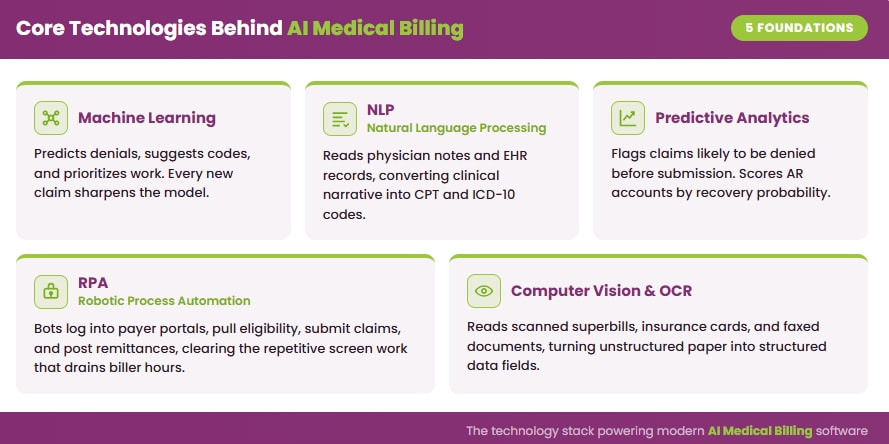
- Machine Learning: Models learn from historical claim outcomes to predict denials, suggest codes, and prioritize work. Each new claim sharpens the model.
- Natural Language Processing (NLP): NLP reads physician notes, op reports, and EHR records. It converts clinical narrative into billable CPT and ICD-10 codes.
- Predictive Analytics: Predictive models flag claims likely to be denied before submission. They also score AR accounts by recovery probability.
- Robotic Process Automation (RPA): RPA bots log into payer portals, pull eligibility data, submit claims, and post remittances. They handle the repetitive screen work that drains biller hours.
- Computer Vision and OCR: OCR reads scanned superbills, insurance cards, and faxed documents. Computer vision turns unstructured paper into structured data fields.
Why Traditional Medical Billing Workflows Are Failing?
Manual workflows were built for a slower, less scrutinized billing environment. That environment no longer exists. The pressure points below explain why most practices are losing revenue they should be collecting.
Increasing Claim Denials
Denial rates have climbed as payer rules multiply. By one estimate, U.S. providers lose over $262 billion annually to RCM inefficiencies (denials, undercoding, omissions). Each rejected claim ties up staff time in appeals and resubmission, delaying cash flow.
Staffing Shortages in Healthcare Billing
A 2026 survey found that 75% of health systems struggle to hire and retain qualified billers/coders. This is because manual billing is tedious and requires hours on data entry and follow-ups, so turnover is high. With labor in short supply, many organizations have unfilled billing positions.
Manual Data Entry Bottlenecks
Eligibility verification, demographic capture, and superbill entry still run by hand at most practices. Front-desk teams spend hours retyping insurance data instead of working with patients. A single typo on the front end produces a denial 20 days later. Manual entry remains the largest preventable source of clean-claim failure.
Payer Rule Complexity
The 48 largest payers each publish their own edit rules, modifier requirements, and authorization triggers. Rules now change monthly, not annually. Practices using static PA checklists generate denials on services they have billed for years, because the requirement changed around them. No human team can track every rule across every payer in real time.
Prior Authorization Delays
According to industry surveys, providers and staff spend nearly two business days per week handling prior authorizations alone. That process slows scheduling, delays treatment, and increases claim denials when authorization details are missed or entered incorrectly. As payers expand authorization requirements across more services, manual workflows cannot keep pace with the growing administrative burden.
Rising Administrative Costs
The U.S. healthcare system spends $60 billion per year on administrative tasks tied to billing. Hospitals spent roughly $19.7 billion in 2024 trying to overturn denied claims. Administrative drag is now the largest non-clinical expense for most practices.
How AI Is Transforming the Revenue Cycle Management Process?
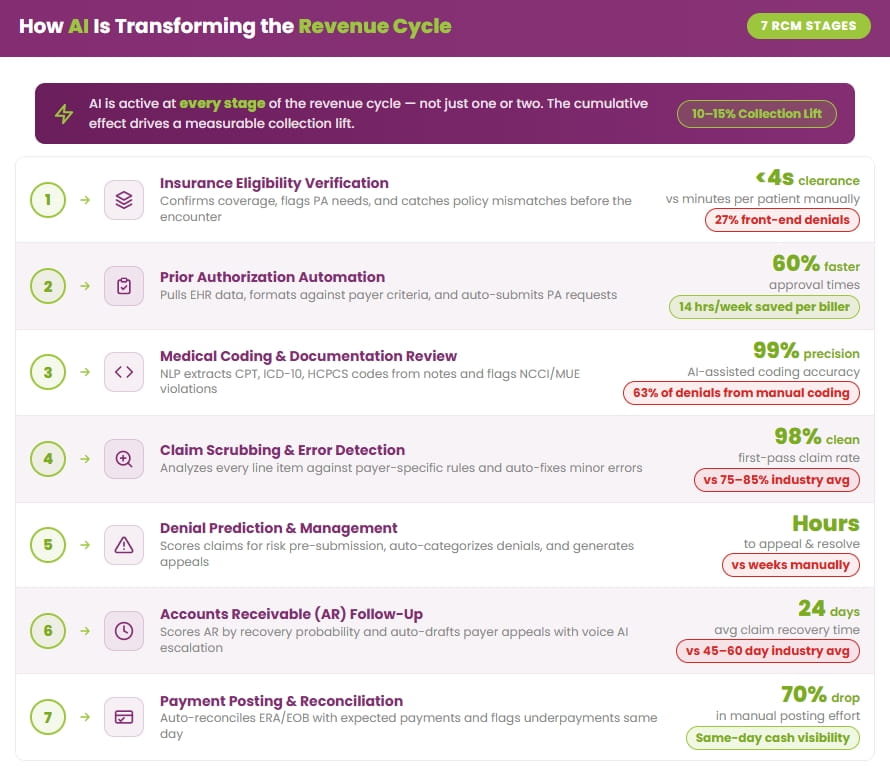
AI is now active at every step of RCM, not just one or two. Each stage of the cycle has a different automation pattern, and the cumulative effect is what drives the 10 to 15% collection lift practices report.
AI for Insurance Eligibility Verification
AI eligibility tools connect to payer systems through EDI, APIs, and AI-driven calls to confirm coverage in real time. They flag mismatched policies, identify secondary coverage, and surface PA requirements before the encounter. Eligibility errors cause around 27% of front-end denials. Using AI with your existing medical billing services can clear eligibility in under 4 seconds, versus minutes per patient manually.
AI-Powered Prior Authorization Automation
AI PA agents pull clinical data from the EHR, format it against payer criteria, and submit requests automatically. Some agents make AI-driven phone calls to payers for verbal PAs. Practices using AI for prior auth report 60% faster approval times and a 14-hour weekly time saving per biller. Predictive heatmaps flag high-risk denials before submission.
AI Medical Coding and Documentation Review
AI medical billing and coding tools read clinical notes with NLP, extract diagnoses and procedures, and assign correct CPT, ICD-10, and HCPCS codes. They flag NCCI and MUE edit violations in real time. Manual coding causes 63% of denials. AI-assisted coding raises precision to 99% and supports audit defense with documentation links for every code.
AI Claim Scrubbing and Error Detection
AI scrubbing engines analyze every claim line item against payer-specific rules before submission. They detect missing modifiers, code mismatches, eligibility gaps, and provider info errors. Some engines auto-fix minor issues using trained models. Practices using AI scrubbing reach 98% first-pass clean claim rates versus the 75 to 85% industry average.
AI Denial Prediction and Denial Management
AI denial models score every claim for denial risk before submission, then route high-risk claims for human review. After denial, AI agents auto-categorize the root cause, generate appeal letters, and pull supporting documentation from the EHR. AI cuts the time to appeal from weeks to hours.
AI Accounts Receivable (AR) Follow-Up
AI AR agents track outstanding claims, score them by recovery probability, and prioritize the highest-value accounts. They auto-draft payer appeals using payer-specific rules and make voice AI calls for status updates. Most appeal and escalation work is now fully automated. Practices using AI for AR follow-up recover claims in roughly 24 days versus the 45 to 60-day industry standard.
AI Payment Posting and Reconciliation
AI posting agents auto-reconcile ERA and EOB data with expected payments and post to patient and insurance accounts in real time. They flag exceptions such as underpayments, missing remits, or contractual variance. Manual posting effort drops by 70% or more. Cash visibility improves because every dollar is matched the day it arrives.
The Biggest Benefits of AI-Powered Medical Billing
The benefits below are reported across deployments of AI medical billing software. Each is linked to a measurable financial or operational outcome.
Faster Claims Processing
AI submits claims in minutes, not days. Eligibility, coding, scrubbing, and submission run in one connected workflow. Practices cut their claim-to-submission cycle from 3 to 5 days down to under 24 hours. Faster submission directly shortens the cash cycle and shrinks A/R aging.
Reduced Claim Denials
AI scrubbing and predictive denial models block claims that would otherwise be rejected. First-pass clean claim rates climb from 75 to 85% to over 98%. Denial volume drops 30 to 50% within six months of full deployment. Lower denials mean less rework, faster cash, and recovered margin.
Improved Coding Accuracy
AI coding tools assign CPT and ICD-10 codes at 99% precision, with full documentation links for audit defense. They catch unbundling, upcoding, and missing modifiers before submission. Coding-related denials drop sharply, and audit risk falls. Certified coders shift from data entry to review and exception handling.
Lower Administrative Costs
RCM automation cuts manual labor by up to 70% across eligibility, coding, posting, and AR. Practices reduce dependence on offshore teams and overtime hours. The $118 per-denial cost of rework also drops as denial volume falls. Total cost-to-collect can fall by 25 to 40%.
Faster Reimbursements
Clean claims lead to faster payments from insurers. Practices on Medicare see clean claims paid in 10 to 14 days versus 30 to 45 days for unclean submissions. Combined with same-day eligibility and faster PA, AI medical billing services shorten time-to-cash by two to four weeks for most practices.
Reduced AR Days
AR days drop because claims are cleaner, denials are worked faster, and follow-ups happen automatically. Top-performing AI deployments hit 24 days in A/R compared to the 40 to 55-day industry average. Lower AR means more predictable cash flow and less working capital pressure.
Better Revenue Visibility
Master dashboards show clean claim rate, denial rate, PA approval rate, AR days, and AI auto-resolution rate in real time. Teams can further visualize billing performance, claim trends, and revenue metrics with a chart maker, making it easier to interpret complex data and support informed decision-making. Finance teams can then leverage these clear visual insights to spot revenue trends, catch denial spikes, and identify underpayments early.
Improved Staff Productivity
Billers and coders stop doing data entry and start doing judgment work. Each FTE handles 2 to 3x more claims after AI rollout. Burnout drops because repetitive work moves to agents. Productivity gains usually pay back the AI investment within 6 to 9 months.
Scalable Billing Operations
AI billing agents handle volume spikes without new hires. Acquisitions, new specialties, and new locations are on board in days rather than weeks. Practices can grow patient volume 20 to 30% without proportional staff increases. AI medical billing software is the only model that scales without linear cost growth.
Better Patient Financial Experience
AI handles eligibility, benefits estimation, and patient cost discussion before the visit. Patients get accurate cost estimates and clean statements. Voice AI agents handle payment plan calls and outstanding balance reminders. Patient collection rates rise while complaint volume falls.
Comparison: AI Medical Billing vs Traditional Medical Billing
The two models differ on workflow, accuracy, staffing, scale, denial prevention, decision speed, and cost. The comparison below summarizes the core gaps practices weigh when choosing an AI-powered medical billing company.
| Dimension | Traditional Medical Billing | AI Medical Billing |
|---|---|---|
| Workflow | Sequential, manual handoffs across teams | Connected pipeline with agents running parallel tasks |
| Accuracy | 75 to 85% first-pass clean claim rate | 98 to 99.99% first-pass clean claim rate |
| Staffing | Linear headcount growth with volume | Fixed core team plus agents that scale with volume |
| Scalability | Adding specialties or locations requires hiring | New specialties and locations on board in days |
| Denial Prevention | Reactive: denials worked after rejection | Predictive: high-risk claims flagged before submission |
| Real-Time Decisions | Decisions made hours or days after the event | Decisions made in seconds with payer rule context |
| Cost Efficiency | High cost-to-collect, 6 to 10% of net revenue | Cost-to-collect drops 25 to 40% after rollout |
What are the Common Use Cases for AI in Medical Billing?
AI medical billing is now active across most specialty types. The use cases below show where adoption has moved fastest in 2025 and 2026.
Specialty Practices
Specialty practices use AI medical billing to handle complex coding rules unique to their field. AI tools apply specialty-trained models for cardiology, oncology, ortho, and pain management without retraining the human team.
Multi-Location Provider Groups
Multi-location groups use AI to standardize billing across sites. Agents apply the same coding rules, payer logic, and KPI tracking across every location. Group finance gets one consolidated view.
Behavioral Health Billing
Behavioral health practices use AI to handle session-based billing, parity rules, and prior authorization for long-term care. Agents track auth limits and trigger renewals before sessions are denied.
Nephrology Billing
Nephrology groups use AI for dialysis billing, monthly capitation tracking, and ESRD-specific code rules. Agents handle the 30-day dialysis episode billing window automatically.
Cardiology Billing
Cardiology billing teams use AI to code cath, EP, and device procedures with correct CPT and HCPCS combinations. AI catches modifier errors on procedures like 93015 and device implants before submission.
Urgent Care Billing
Urgent care uses AI to handle high-volume, low-dollar visits with same-day claim submission. Agents clear eligibility, code visits, and submit claims within hours of the patient leaving.
Dental and DSO Billing
Dental practices and DSOs use AI for CDT code accuracy, predetermination tracking, and dual coverage coordination. Agents handle the unique dental claim format and ADA-specific rules.
Hospital Revenue Cycle Operations
Hospital RCM teams use AI for inpatient DRG validation, charge capture audits, and high-dollar denial management. Predictive models flag DRG downgrades before the claim drops.
What are the Challenges and Risks of AI-Powered Medical Billing?
AI medical billing is not risk-free. The challenges below need direct planning before rollout. Practices that skip them see slower ROI and avoidable compliance exposure.
- HIPAA Compliance and Data Security: AI tools handle PHI at scale. Any AI medical billing software needs a HIPAA-compliant infrastructure, end-to-end encryption, and clear BAA terms. SOC 2 Type II and ISO 27001 certifications are now table stakes.
- AI Accuracy and Hallucination Risks: AI coding tools can suggest codes that look right but are not. Without human review on high-dollar or complex cases, hallucinations create compliance and audit exposure. Confidence scoring and human-in-the-loop checks are required.
- EHR Integration Challenges: Many AI tools claim integration, but only support 5 or 6 EHRs in production. Practices on legacy or niche EHRs may need custom connectors. Real integration depth matters more than the EHR list on a vendor’s website.
- Payer Rule Variability: Payer rules change monthly. AI models must be retrained or fed updated rule sets continuously. A static AI tool degrades fast. Ask vendors how often their payer rule libraries update.
- Human Oversight Requirements: AI is not autonomous on high-risk claims. Certified coders must review complex cases, audit AI decisions, and own payer escalations. Practices that treat AI as a full replacement see compliance issues within 6 to 12 months.
- Staff Training and Adoption: Billers and coders need training to work alongside agents. The role shifts from data entry to exception handling. Practices that skip training see staff reverting to manual workflows and underusing the AI.
- Implementation Costs: Upfront cost includes platform licensing, EHR connector work, training, and parallel operations during cutover. Most practices see payback in 6 to 9 months.
- Ethical Concerns Around Healthcare AI: Patient-facing AI in billing raises questions about consent, transparency, and bias. Practices need clear policies on how AI is used, when patients are notified, and how decisions can be reviewed by a human.
Is AI Replacing Medical Billers?
No, AI is not replacing medical billers in 2026. AI medical billing tools are replacing the manual, repetitive work that billers and coders never wanted to do. Eligibility checks, basic code lookups, claim submission, and posting now run on AI. What remains for human billers is the work that needs judgment.
Complex coding cases, payer disputes, audit defense, contract analysis, and patient financial counseling all require certified human expertise. The role is shifting from data entry to exception management and payer strategy. The question “Will AI take over medical billing and coding?” assumes a binary outcome.
The real outcome is a hybrid model where one biller plus AI agents do the work of three traditional billers, with higher accuracy and lower burnout. Practices that retrain their teams for this model keep their best people and raise margin at the same time.
Why Human Expertise Still Matters?
Certified coders bring clinical reasoning, payer history, and audit defense skills that AI cannot replicate. Complex op reports, surgical bundling, and multi-procedure coding still need a human review. AI handles volume. Humans handle nuance.
AI as a Billing Assistant, Not a Replacement
AI medical billing software is positioned as a force multiplier. It handles the 80% of work that is repetitive and rule-based, freeing billers for the 20% that drives the biggest revenue impact. Practices that frame AI this way see faster adoption and stronger results.
Human Oversight in High-Risk Claims
High-dollar inpatient claims, complex surgical cases, and contested PA denials all require human review. AI flags the case, pulls the documentation, and drafts the response. A certified coder signs off before submission. This split limits compliance exposure.
Certified Coders + AI Collaboration
The strongest billing operations pair certified CPC and CCS coders with AI agents. The AI handles speed, the coder handles judgment. Coding-related denials drop 60 to 80% under this model, and audit risk falls because every decision is documented.
The Future Role of Medical Billers
The biller of 2026 is part data analyst, part payer strategist, part AI supervisor. Routine billing tasks are now AI work. Strategic work, like payer contract analysis, denial trend review, and revenue recovery, is the new core job. Practices that invest in upskilling keep their best people.
How Transcure Uses AI Agents to Automate Medical Billing?
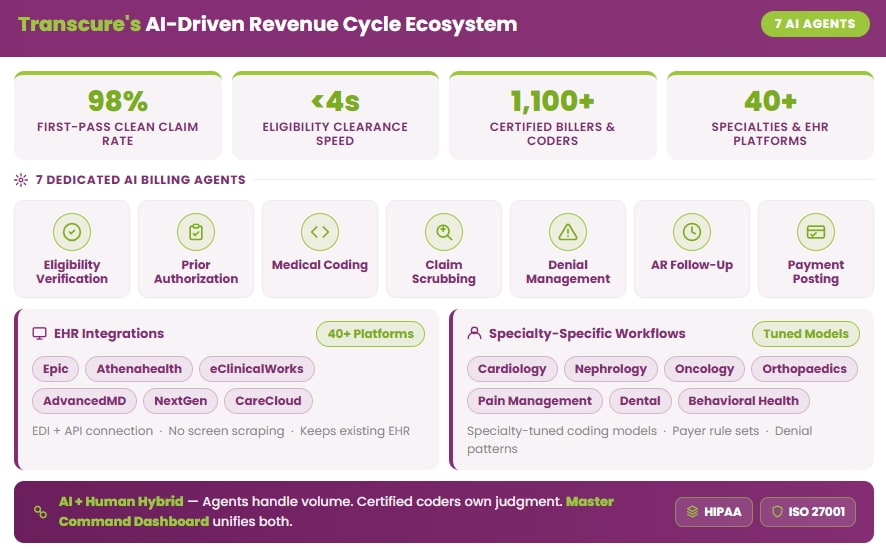
Experienced medical billing companies like Transcure are already running AI agents inside live revenue cycle operations. Transcure has built seven dedicated AI billing agents that handle the core RCM steps. The agents work alongside 1,100+ certified billers and coders across 40+ specialties.
Transcure’s AI-Driven Revenue Cycle Ecosystem
Transcure’s ecosystem covers eligibility, prior auth, coding, scrubbing, denials, AR, and posting under one Master Command Dashboard. Each agent reports clean claim rate, denial rate, and recovery metrics in real time. The system runs HIPAA-compliant and ISO 27001 certified.
AI + Human Hybrid Billing Model
Transcure runs a hybrid model where AI agents handle high-volume routine work and certified coders own judgment cases. The split lifts first-pass clean claim rates to 98% while keeping audit defense strong. Practices get speed without giving up coder oversight.
Real-Time Workflow Automation
The Transcure platform processes eligibility in 4 seconds and submits clean claims within hours of the encounter. Predictive denial scoring flags risky claims before submission. AR follow-up runs automatically based on payer-specific aging rules. Real-time means same-day, not next-day.
AI Agents Built for End-to-End RCM
Each of Transcure’s seven agents owns one RCM stage from end to end. There is no shared logic spread across one general AI layer. Modular ownership creates cleaner SLAs, easier debugging, and faster fixes when payer rules change.
EMR-Integrated AI Billing Operations
Transcure’s agents connect to 40+ EHR platforms, including Epic, Athenahealth, eClinicalWorks, AdvancedMD, NextGen, and CareCloud. The connection uses EDI and API rather than screen scraping. Practices keep their existing EHR and add AI on top.
Specialty-Specific AI Billing Workflows
Each specialty gets its own coding models, payer rule sets, and denial patterns. Cardiology, nephrology, oncology, ortho, pain management, dental, and behavioral health each have tuned workflows. Specialty-specific tuning is what produces 98% clean claim rates instead of generic AI averages.
Meet Transcure’s AI Billing Agents
Transcure has built seven AI RCM agents. Each one runs a specific stage of the medical billing process. The breakdown below covers what each agent does and the performance numbers behind it.
ELIXA — AI Eligibility Verification Agent
ELIXA verifies patient eligibility and insurance coverage in real time through EDI, API, and AI-driven payer calls. It clears eligibility in 4 seconds versus minutes per patient manually. The dashboard shows live AI activity, prior auth flags, and verification trends. ELIXA cuts front-end denials caused by coverage errors.
PRIA — AI Prior Authorization Agent
PRIA automates prior auth submission and payer follow-up with over 97% accuracy. Predictive Risk Heatmaps flag high-risk denials before they happen. The AI Call Center handles payer phone time for status updates and verbal PAs. PRIA shortens approval times by 60% and frees 14 hours per biller per week.
CODIN — AI Medical Coding Agent
CODIN reads clinical notes with NLP, extracts diagnoses and procedures, and matches them to correct CPT and ICD-10 codes. OCR pulls data from scanned documents. CODIN audits every claim for NCCI and MUE edits, flags missing documentation, and raises coding precision to 99% versus the 63% manual coding denial baseline.
CLAIR — AI Claim Scrubbing Agent
CLAIR analyzes every claim line item, including codes, modifiers, coverage, and provider info, against payer rules before submission. It auto-fixes minor errors using trained models and compares each claim against historical denial patterns. CLAIR delivers 98% first-pass clean claim rates with live denial trend tracking on its dashboard.
DEXA — AI Denial Management Agent
DEXA detects, analyzes, and resolves denials in real time. It auto-categorizes critical denials, generates appeal letters from payer feedback, and calls payers to verify claim status. DEXA updates claim states in the EHR or billing software automatically. The agent learns from every denial to lift future appeal success rates.
ARIA — AI AR Follow-Up Agent
ARIA tracks outstanding claims and auto-drafts appeals using payer-specific rules. The predictive engine scores recovery probability and prioritizes the highest-value accounts. Voice AI handles patient payment calls. ARIA gives real-time payer performance insights and pulls A/R recovery cycles down to roughly 24 days for most practices.
REMITA — AI Payment Posting Agent
REMITA auto-reconciles ERA and EOB data with expected payments and posts to patient and insurance accounts. It flags exceptions such as underpayments, denials, and missing remits. REMITA learns payer patterns continuously, cutting manual posting effort by 70% or more. Cash visibility improves because every dollar gets matched the day it arrives.
How to Implement AI-Powered Medical Billing in Your Practice?
Successfully implementing AI-powered medical billing requires a structured rollout that aligns automation with clinical workflows, payer requirements, and revenue cycle goals. The six steps below show how leading practices deploy AI-driven billing systems.
Evaluate Current Billing Bottlenecks
Pull six months of denial reports, A/R aging, and clean claim rate data first. Find the two or three workflows costing the most revenue. Those are your AI rollout priorities. Without a baseline, you cannot measure ROI.
Identify High-Volume Manual Tasks
Map the work your billers do hour by hour for two weeks. Eligibility checks, PA submission, posting, and payer phone time usually top the list. These are the tasks where AI medical billing software produces the fastest payback.
Choose the Right AI Billing Partner
Pick an AI-powered medical billing company that owns its agents end-to-end, not a vendor reselling a third-party platform. Ask for live KPI numbers, not pilot numbers. Confirm SOC 2 Type II, HIPAA, and ISO 27001 certifications. Validate EHR integration depth with a reference call.
Ensure EHR Compatibility
Real integration is API and EDI, not screen scraping. Confirm the AI platform supports your EHR in production, not just on its marketing page. Test a sandbox connection before signing. Integration depth determines how much manual workaround your team will still need.
Build Human Oversight Processes
Define which claim types go straight to AI and which need a certified coder review. High-dollar, complex surgical, and contested PA cases all need human sign-off. Build a clear escalation path. Document everything for audit defense.
Track KPIs After Implementation
Track first-pass clean claim rate, denial rate, A/R days, AI auto-resolution rate, and cost-to-collect monthly. Compare to your pre-AI baseline. Most practices see clean claim rates rise within 60 days and full ROI within 6 to 9 months. KPIs are how you protect the investment and prove the case for expansion.