Summary: “The ICD-10 code for gastritis is the K29.x series, which covers gastritis, duodenitis, and gastroduodenitis. K29 sits within Diseases of the Digestive System (K00-K95). The fourth character defines the gastritis type, and the fifth character defines bleeding status. Both characters are required for a billable claim. The series contains 18 billable codes across 9 condition families, with no K29.1 code existing in ICD-10-CM. H. pylori gastritis uses the matching K29 code plus B96.81 as a secondary code.”
The ICD-10 code for gastritis is the K29.x series, which covers gastritis, duodenitis, and gastroduodenitis. K29 sits within Diseases of the Digestive System (K00-K95). The fourth character defines the gastritis type. The fifth character defines bleeding status. Both characters are required for a billable claim.
This guide maps every active K29.x code for FY2026, the fifth-character bleeding rule that drives most gastritis denials, and the coding logic for Helicobacter pylori involvement. All codes are verified against the CMS ICD-10-CM FY2026 Tabular List, effective October 1, 2025.

Quick Reference: K29.x Gastritis and Duodenitis Codes
The following table lists every billable K29.x code and its non-billable parent. Header codes (K29, K29.0, K29.2 through K29.9) carry no fifth character and reject on claims.
| Code | Description | Billable |
|---|---|---|
| K29.00 | Acute gastritis without bleeding | Yes |
| K29.01 | Acute gastritis with bleeding | Yes |
| K29.20 | Alcoholic gastritis without bleeding | Yes |
| K29.21 | Alcoholic gastritis with bleeding | Yes |
| K29.30 | Chronic superficial gastritis without bleeding | Yes |
| K29.31 | Chronic superficial gastritis with bleeding | Yes |
| K29.40 | Chronic atrophic gastritis without bleeding | Yes |
| K29.41 | Chronic atrophic gastritis with bleeding | Yes |
| K29.50 | Unspecified chronic gastritis without bleeding | Yes |
| K29.51 | Unspecified chronic gastritis with bleeding | Yes |
| K29.60 | Other gastritis without bleeding | Yes |
| K29.61 | Other gastritis with bleeding | Yes |
| K29.70 | Gastritis, unspecified, without bleeding | Yes |
| K29.71 | Gastritis, unspecified, with bleeding | Yes |
| K29.80 | Duodenitis without bleeding | Yes |
| K29.81 | Duodenitis with bleeding | Yes |
| K29.90 | Gastroduodenitis, unspecified, without bleeding | Yes |
| K29.91 | Gastroduodenitis, unspecified, with bleeding | Yes |
The K29.x series contains 18 billable codes across 9 condition families. No K29.1 code exists in the ICD-10-CM system.
How is the K29?x Series Structured?
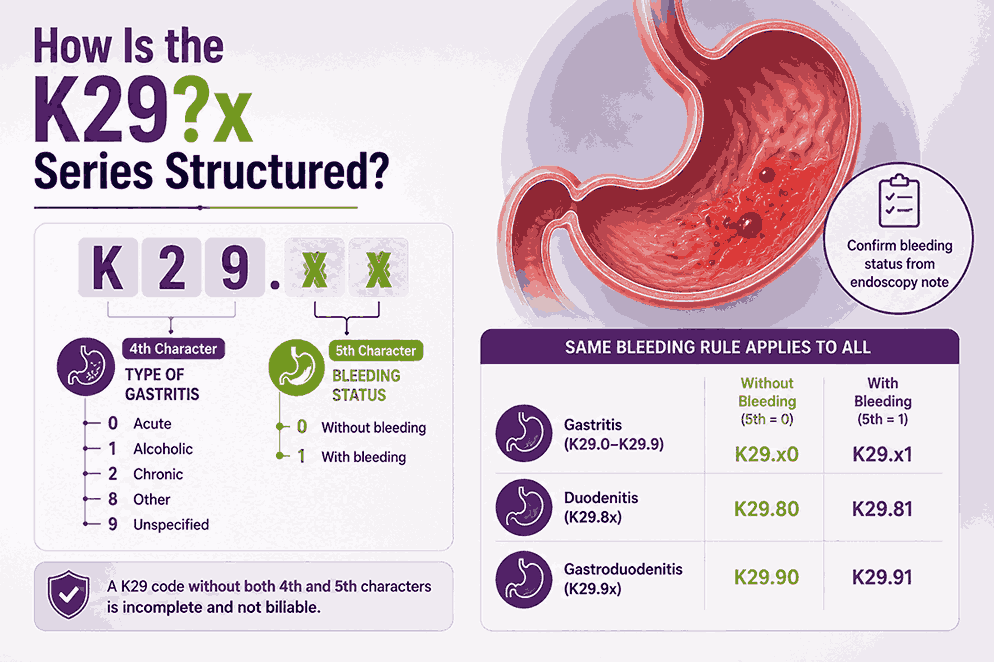
The K29.x series uses a fixed two-position structure after the K29 stem. Position four sets the clinical type. Position five sets the bleeding status. A K29 code without both positions is incomplete and not billable.
The fifth character follows one rule across every gastritis family:
- 0 reports the condition without bleeding
- 1 reports the condition with bleeding
This rule applies identically to acute, alcoholic, chronic, other, and unspecified gastritis. The same rule governs duodenitis (K29.8) and gastroduodenitis (K29.9). Coders confirm bleeding status from the operative or endoscopy note before final code selection.
What is the K29.x Gastritis Codes?
The K29.x series classifies 7 gastritis families: acute, alcoholic, chronic superficial, chronic atrophic, unspecified chronic, other, and unspecified. Each family splits into a “without bleeding” and a “with bleeding” code. Code selection starts with the gastritis type, then resolves the bleeding status from the chart.
K29.0: Acute Gastritis (K29.00 and K29.01)
Acute gastritis is sudden-onset inflammation of the gastric mucosa, often linked to NSAIDs, alcohol, or acute infection. K29.00 reports acute gastritis without bleeding. K29.01 reports acute gastritis with bleeding. K29.0 alone is a non-billable header code. Documentation of hematemesis, melena, or active mucosal bleeding supports K29.01 over K29.00.
K29.2: Alcoholic Gastritis (K29.20 and K29.21)
Alcoholic gastritis is gastric inflammation attributed to alcohol use. K29.20 reports alcoholic gastritis without bleeding. K29.21 reports alcoholic gastritis with bleeding. The K29.2 family requires provider documentation linking the gastritis to alcohol. Coders add a relevant alcohol-use code from the F10 series when the record supports a coexisting alcohol-use disorder.
K29.3: Chronic Superficial Gastritis (K29.30 and K29.31)
Chronic superficial gastritis is long-standing inflammation limited to the superficial gastric mucosal layer. K29.30 reports chronic superficial gastritis without bleeding. K29.31 reports chronic superficial gastritis with bleeding. Biopsy findings and the term “superficial” in the pathology report distinguish K29.3 from the deeper atrophic form coded under K29.4.
K29.4: Chronic Atrophic Gastritis (K29.40 and K29.41)
Chronic atrophic gastritis is chronic inflammation with loss of gastric glandular cells and mucosal thinning. K29.40 reports chronic atrophic gastritis without bleeding. K29.41 reports chronic atrophic gastritis with bleeding. Atrophic gastritis carries higher clinical significance because of its association with B12 deficiency and gastric cancer risk. Pathology confirming glandular atrophy supports the K29.4 family over K29.3.
K29.5: Unspecified Chronic Gastritis (K29.50 and K29.51)
Unspecified chronic gastritis reports documented chronic gastritis without a stated superficial or atrophic subtype. K29.50 reports unspecified chronic gastritis without bleeding. K29.51 reports unspecified chronic gastritis with bleeding. Coders assign K29.5 when the provider documents “chronic gastritis” with no further specification. A pathology report that names the subtype moves the claim to K29.3 or K29.4.
K29.6: Other Gastritis (K29.60 and K29.61)
Other gastritis reports specified gastritis types that fall outside the named K29 families, including giant hypertrophic gastritis and granulomatous gastritis. K29.60 reports other gastritis without bleeding. K29.61 reports other gastritis with bleeding. K29.6 also captures iron-related and reactive chemical gastritis when a poisoning or adverse-effect code from the T-series accompanies the diagnosis.
K29.7: Gastritis, Unspecified (K29.70 and K29.71)
Gastritis, unspecified, reports gastritis with no documented acuity, chronicity, or cause. K29.70 reports unspecified gastritis without bleeding. K29.71 reports unspecified gastritis with bleeding. K29.70 ranks among the most frequently assigned gastritis codes, which makes it a common target for specificity-based payer review. Stronger documentation of type and cause supports a more specific K29 code.
What is the K29.x Duodenitis and Gastroduodenitis Codes?
The K29.x series also classifies duodenitis (K29.8) and gastroduodenitis (K29.9). Both follow the same fifth-character bleeding rule used across the gastritis families. Duodenitis is inflammation of the duodenum. Gastroduodenitis is the combined inflammation of the stomach and duodenum.
K29.8: Duodenitis (K29.80 and K29.81)
Duodenitis is inflammation of the duodenal mucosa, the first segment of the small intestine. K29.80 reports duodenitis without bleeding. K29.81 reports duodenitis with bleeding. Coders apply K29.8 when inflammation is documented in the duodenum without concurrent gastric involvement. Concurrent stomach and duodenum inflammation moves the claim to the K29.9 gastroduodenitis family.
K29.9: Gastroduodenitis (K29.90 and K29.91)
Gastroduodenitis is the combined inflammation of the stomach and duodenum. K29.90 reports unspecified gastroduodenitis without bleeding. K29.91 reports unspecified gastroduodenitis with bleeding. K29.9 applies when documentation supports inflammation in both sites. A single-site diagnosis routes to either the gastritis families (K29.0 through K29.7) or duodenitis (K29.8). Diagnoses outside the stomach and duodenum route to other K-series families mapped in the gastroenterology ICD-10 codes reference.
Is There a K29.1 Code for Gastritis?
No K29.1 code exists in the ICD-10-CM system. The K29.x series skips from K29.0 (acute gastritis) directly to K29.2 (alcoholic gastritis). Claims submitted with K29.1 are rejected as invalid codes. Coders confirm the correct family by matching the documented gastritis type to the active K29 subcategories: 0, 2, 3, 4, 5, 6, 7, 8, and 9.
Why Does the Fifth Character Matter for Gastritis Coding?
The fifth character matters because it converts a non-billable K29 header into a payable claim and records clinical severity. A K29 code submitted at the four-character level (for example, K29.0 or K29.7) rejects on every payer. The fifth character also separates bleeding from non-bleeding presentations, which affects medical-necessity review and the gastroenterology CPT codes selected for the same encounter.
Three fifth-character patterns drive gastritis denials:
- Truncated codes: submitting K29.7 instead of K29.70 or K29.71
- Default to non-bleeding: coding K29.x0 when the note documents active bleeding
- Specificity gaps: defaulting to K29.70 when the chart supports a typed code
Bleeding status pulls directly from the operative, endoscopy, or pathology report. Coders verify the documented finding before assigning the fifth character.
How Do You Code Helicobacter Pylori Gastritis?
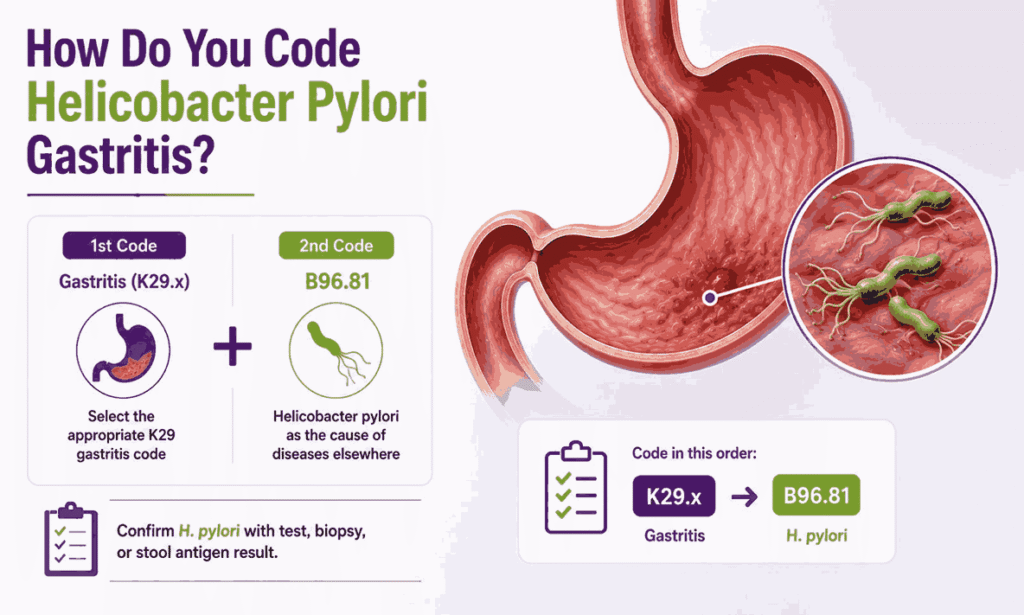
Helicobacter pylori gastritis is coded with the matching K29 gastritis code plus B96.81 as an additional code. B96.81 reports Helicobacter pylori as the cause of diseases classified elsewhere. ICD-10-CM sequencing places the K29 gastritis code first and B96.81 second.
The K29 series carries no single combination code for H. pylori gastritis. Documentation of a positive H. pylori test, biopsy, or stool antigen result supports adding B96.81. A patient with chronic gastritis and confirmed H. pylori is coded K29.50 (or the documented subtype) plus B96.81. Omitting B96.81 understates the clinical picture and weakens medical-necessity support for eradication therapy.
Which Conditions Are Excluded From the K29.x Series?
The K29 category carries Excludes notes that block specific conditions from K29.x assignment. Two conditions sit under a Type 1 Excludes, which means they are never coded alongside K29:
- Eosinophilic gastritis or gastroenteritis (K52.81): eosinophil-driven inflammation coded to the K52 noninfective enteritis family
- Zollinger-Ellison syndrome (E16.4): gastrin-secreting tumor syndrome coded to the endocrine chapter
A Type 1 Excludes note signals that the excluded condition and K29 represent distinct clinical entities. Coders confirm the documented diagnosis matches gastritis or duodenitis, not eosinophilic disease or a gastrin-driven syndrome, before applying K29.x.
What are the Most Common K29 x Coding Errors?
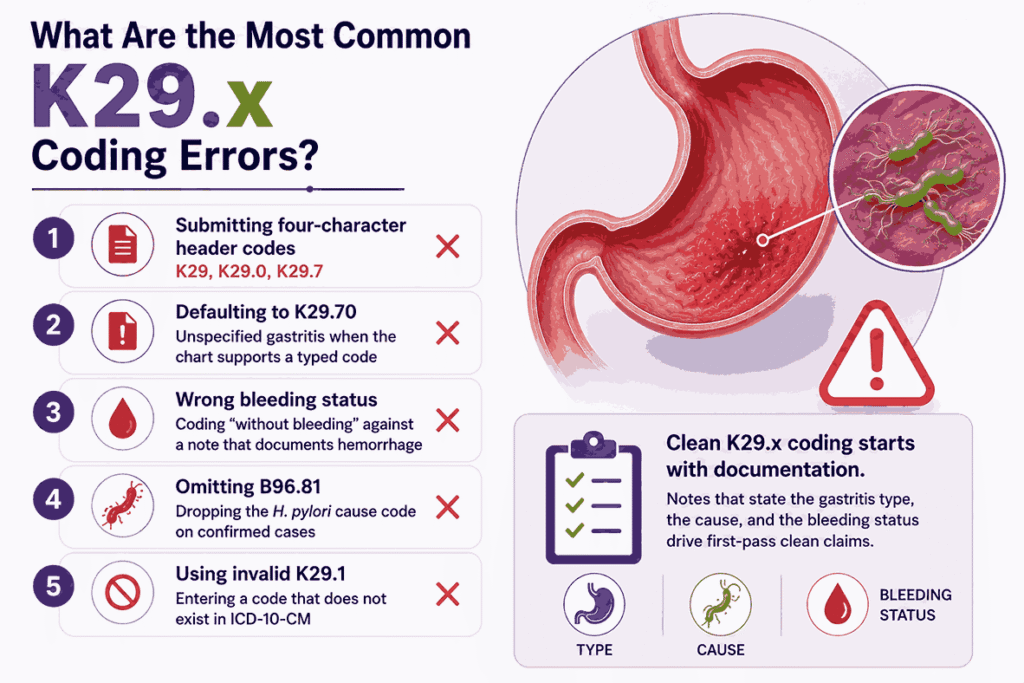
The 5 most common K29.x errors center on incomplete specificity and unsupported defaults. Each error produces a denial, a rework cycle, or an underpayment.
- Submitting four-character header codes: K29, K29.0, and K29.7 reject as non-billable
- Defaulting to K29.70: assigning unspecified gastritis when the chart supports a typed code
- Wrong bleeding status: coding “without bleeding” against a note that documents hemorrhage
- Omitting B96.81: dropping the H. pylori cause code on confirmed cases
- Using invalid K29.1: entering a code that does not exist in ICD-10-CM
Clean K29.x coding starts at the documentation layer. Provider notes that state the gastritis type, the cause, and the bleeding status give coders the detail required for a first-pass clean claim. The gastroenterology medical billing guide details the documentation and denial-management workflow that closes these gaps before claims leave the practice.
How Does Accurate Gastritis Coding Affect Reimbursement?
Accurate K29.x coding raises first-pass clean claim rates and shortens accounts receivable cycles for gastroenterology practices. Truncated codes, unspecified defaults, and missing cause codes generate the denials that stall GI revenue. Specificity at the fifth character protects both payment and audit defensibility.
Transcure pairs AAPC-certified GI coders with AI-driven claim scrubbing that flags truncated codes, bleeding-status mismatches, and missing H. pylori cause codes before submission. The gastroenterology billing services team manages K29.x accuracy at scale across high-volume endoscopy practices.
Frequently Asked Questions About ICD-10 for Gastritis
Is K29.70 a billable code?
Yes, K29.70 is a billable ICD-10-CM code that reports gastritis, unspecified, without bleeding. K29.70 carries the required fifth character and accepts on payer claims. The four-character parent K29.7 is not billable.
What is the difference between K29.00 and K29.01?
K29.00 reports acute gastritis without bleeding, and K29.01 reports acute gastritis with bleeding. The fifth character is the only difference. Coders select between the two codes using documented bleeding status from the chart.
What ICD-10 code is used for H. pylori gastritis?
H. pylori gastritis uses the documented K29 gastritis code plus B96.81 as a secondary code. B96.81 identifies Helicobacter pylori as the cause. The K29 code sequences first, and the B96.81 sequences second.
Is K29.5 the same as K29.50?
No, K29.5 is a non-billable header code, and K29.50 is the billable code for unspecified chronic gastritis without bleeding. Claims require the five-character K29.50 or K29.51. K29.5 rejects without the fifth character.
How many codes are in the K29.x gastritis series?
The K29.x series contains 18 billable five-character codes across 9 condition families, spanning gastritis, duodenitis, and gastroduodenitis. The series includes no K29.1 code.
Accurate K29.x gastritis coding depends on three documented data points: the gastritis type, the cause, and the bleeding status. Coders who confirm all three at the fifth character protect first-pass payment and audit defensibility across every gastroenterology claim.