Roughly one in five fully insured commercial claims was denied in Massachusetts in 2024, and most denials came from administrative issues, not clinical ones. Three shifts raise the stakes for 2026 and 2027: payer and ACO changes, prior authorization reform, and MassHealth eligibility changes. Practices that treat medical billing in Massachusetts as a front-end discipline will protect revenue.
This guide covers the main Massachusetts medical billing challenges: high administrative claim denials, shifting payer and ACO networks, uneven prior authorization rollout, MassHealth eligibility churn, payer enrollment gaps, and state law exposure. It closes with practical steps practices can take to reduce them.

What Are the Biggest Medical Billing Challenges in Massachusetts?
Five problems drive most lost revenue: high administrative denials, a changing payer and ACO map, uneven prior authorization rollout, MassHealth eligibility churn, and payer enrollment gaps.
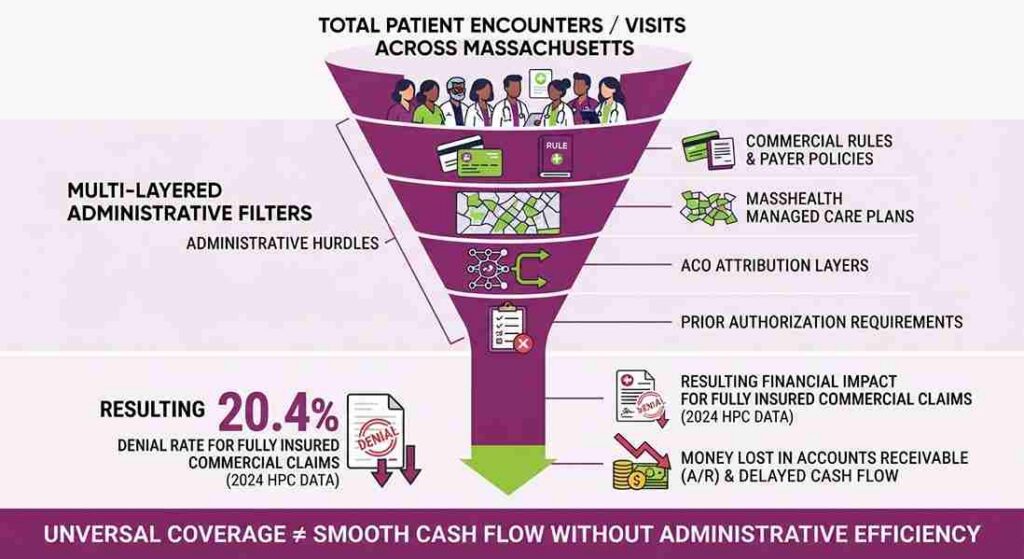
Massachusetts has near-universal health coverage, so the problem is not access to insurance. It is the number of rules, plans, and changes a claim must pass through before it is paid. A single visit can involve a commercial carrier, a MassHealth managed care plan, an ACO attribution, and a prior authorization rule, and each layer can change within a year. The table below summarizes the five challenges.
| Challenge | What Drives It | Data Point to Cite |
|---|---|---|
| Claim denials | Administrative errors, not clinical disputes | 20.4% of fully insured commercial claims denied in 2024 |
| Payer and ACO changes | Plan discontinuations and provider moves | Tufts Health Together MCO ended January 1, 2026 |
| Prior authorization shifts | Amended 211 CMR 52.00, staggered carrier rollout | Effective June 5, 2026 |
| MassHealth eligibility churn | Work requirements, six-month renewals, limited retroactive coverage | Starts January 1, 2027 |
| Payer enrollment gaps | Network and ACO attribution changes | 30 providers moved ACOs on January 1, 2026 |
Challenge 1: High Claim Denial Rates
Denials are the largest and most measurable drain on revenue for Massachusetts practices. The Health Policy Commission found that 20.4% of fully insured commercial claims were denied in 2024, and clinical disputes made up at most 1% of denials for any insurer. Most denials trace back to administrative causes such as timely filing, missing documentation, separate-billing rules, coding errors, and duplicate submissions. That is good news, because administrative problems can be fixed before a claim leaves the office.
Challenge 2: A Changing Payer and ACO Map
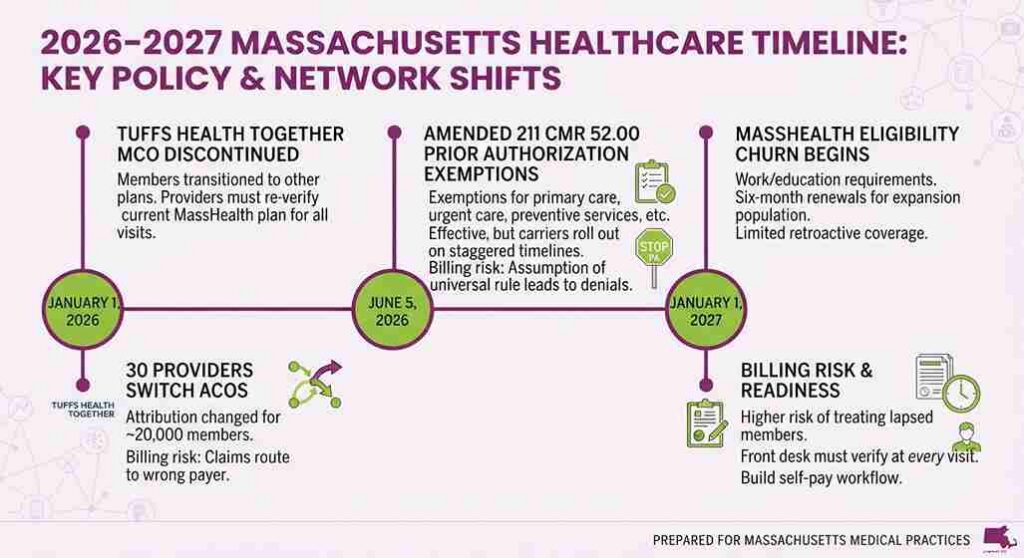
Massachusetts payers and networks do not stay still from one year to the next. Tufts Health Together MCO was discontinued on January 1, 2026, and its MassHealth members transitioned to other plans. The same day, 30 providers moved ACOs, which changed attribution for about 20,000 members. Each change alters who pays a claim, which portal to use, and which rules apply. A practice that relies on last year’s payer list can send claims to the wrong plan, then wait weeks to learn they were rejected.
Challenge 3: Uneven Prior Authorization Rollout
Amended 211 CMR 52.00 removed prior authorization for many services on June 5, 2026, including emergency and urgent care, primary care, preventive services, maternity care, outpatient substance use disorder treatment, and physical and occupational therapy. The reform is real, but carriers are putting it into practice on their own timelines and file their implementation materials separately. A service exempt at one carrier may still be checked at another, and the regulation covers fully insured plans only. Billing teams that assume the rule applies everywhere risk avoidable denials.
Challenge 4: MassHealth Eligibility Churn
Starting January 1, 2027, some MassHealth adults aged 19 to 64 will face work or education requirements, six-month renewals for the expansion population, and limits on retroactive coverage. Members are not affected until their first renewal in 2027, so the impact will build gradually through the year. The billing risk is simple: a patient can lose coverage between visits, often because of missed renewal paperwork rather than a change in circumstances. Without a fresh eligibility check, a practice may deliver care and then bill a lapsed member.
Challenge 5: Payer Enrollment Gaps
Payer enrollment gaps appear when a practice’s network status no longer matches the plans its patients actually use. Plan discontinuations and ACO attribution changes, such as the 2026 events, can leave a provider in network with a plan that no longer pays MassHealth claims for a given member. Claims are then denied for network reasons even though the data on them is correct. These gaps are easy to miss because nothing looks wrong until payments slow down. Reviewing participation with every affected payer after each plan or ACO change, and keeping enrollment records current, closes the gap before it becomes aged accounts receivable.
Why Are Claim Denial Rates So High in Massachusetts?
About one in five fully insured commercial claims was denied in 2024, and clinical disputes made up at most 1% of denials for any insurer.
What Does the Health Policy Commission Data Show?
The Massachusetts Health Policy Commission (HPC) reviewed 45.9 million claims and found that 20.4% were denied in 2024. That is a very large number of claims returned to billing teams for rework, appeal, or write-off. One scope note matters: the figures cover fully insured commercial plans only. Self-funded employer plans and MassHealth are not included, so a practice’s own denial rate may differ depending on its payer mix.
Which Payers Deny the Most Claims?
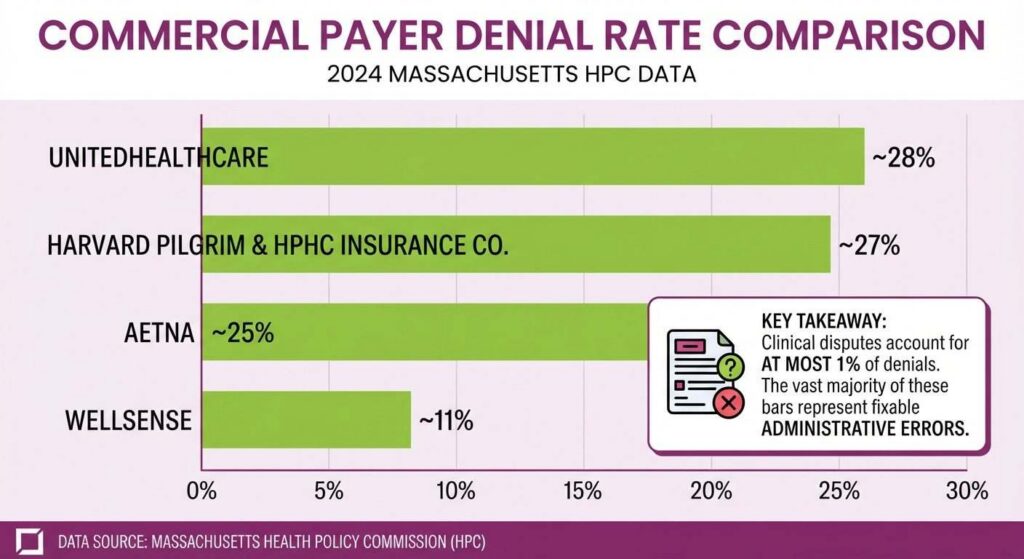
Denial rates varied widely by insurer in 2024. UnitedHealthcare denied about 28% of claims, Harvard Pilgrim and HPHC Insurance Co. about 27%, and Aetna about 25%. WellSense was far lower at roughly 11%. This is best read as a spread of payer behavior, not a ranking of quality. Different insurers apply different edits, documentation rules, and filing limits, which is why denial tracking by payer is the right starting point for any practice.
Why Do Administrative Errors Drive Most Denials?
Clinical disputes are rare. Administrative problems are not. About 11.7% of claims were denied for other administrative reasons, such as timely filing, missing documentation, and separate-billing rules. Another 4.9% were denied as incomplete, coding errors, or duplicates. Combined, that is over 16% of all claims, far more than any clinical disagreement. For practices, this is the key operational point: these denials are fixable at the front end of the claim, through cleaner data capture, better claim scrubbing, and tighter filing discipline, before a payer ever sees the claim.
Do Denial Patterns Differ by Claim Type?
Yes. Institutional outpatient claims were denied at about 23%, while professional mental health claims were denied at about 10%. The administrative share also differed by claim type, at roughly 80% in one group compared with 67% in another. In every case, administrative causes made up the majority of denials. A one-size-fits-all denial workflow therefore misses the specific patterns of each service line.
The Massachusetts Health and Hospital Association has reported that 80% of initial denials are eventually overturned, a figure drawn from a 2023 report. That recovery comes at the cost of staff time and delayed cash flow.
How Is MassHealth Complexity Slowing Reimbursement?
MassHealth members move between managed care plans and ACOs, and each move changes who pays the claim.
What Changed for MassHealth Plans in 2026?
Tufts Health Together MCO was discontinued on January 1, 2026, and its members transitioned to other MassHealth plans. For billing teams, that means a member who was covered by one plan in 2025 may now belong to a different plan with its own claim submission rules, portals, and contacts. Claims submitted to the discontinued plan, or verified against outdated eligibility records, are likely to be rejected or delayed.
How Do ACO Provider Moves Affect Billing?
On January 1, 2026, 30 providers moved between ACOs, affecting about 20,000 members. The billing consequence is direct: a claim sent to the plan on file last year can route to the wrong payer. The claim then bounces, ages in accounts receivable, and may miss a filing deadline before anyone notices the attribution changed. Verifying the current plan and ACO at each visit, not once a year, is the practical safeguard.
Practices should also understand how filing windows work for these members, which our guide on MassHealth filing deadline rules explains.
What Do the 2026 Prior Authorization Changes Mean for Billing Teams?
Amended 211 CMR 52.00 removed prior authorization for many services on June 5, 2026, but carriers are implementing it on their own timelines.
Which Services Lost Prior Authorization Requirements?
The amended regulation removed prior authorization requirements for several categories of care. These include emergency and urgent care, primary care, preventive services, maternity care, outpatient substance use disorder treatment, and physical and occupational therapy. For billing teams, this reduces the number of services that need an authorization on file. However, old workflows and payer-specific habits often outlast a regulation, so staff need updated guidance on which services no longer require approval.
What New Timing and Transparency Rules Apply?
The amended rules add timing and transparency requirements for carriers. Urgent prior authorization requests must receive a response within 24 hours. Carriers must publicly post their prior authorization requirements, and they must give advance notice when those requirements change. These rules give billing teams a reliable place to check requirements and more warning before changes take effect, which makes a documented, regularly updated reference for each carrier far more practical to maintain.
Why Does Uneven Rollout Still Cause Denials?
Carriers file their implementation materials separately, as described in Filing Guidance Notice 2026-I, so a service exempt at one carrier may still be checked at another. That gap between the regulation and each carrier’s actual process is where denials appear. One scope point should be stated plainly: the regulation applies to fully insured plans only. Self-funded plans are outside it, so a patient’s plan type determines which prior authorization rules apply.
How Will the 2027 MassHealth Eligibility Changes Affect Collections?
From January 1, 2027, some MassHealth adults face work or education requirements, more frequent renewals, and shorter retroactive coverage, which raises the risk of billing a lapsed member.
Who Is Affected by the New Requirements?
The requirements apply to MassHealth adults aged 19 to 64 who do not have young children or a disability. Affected members generally need to show 80 hours per month of work, education, or qualifying activity, or monthly income of $580. Members are not affected until their first renewal in 2027, so the impact will arrive in waves through the year. Practices should expect coverage status to change for some patients without any change in their care.
What Changes for Retroactive Coverage and Renewals?
Retroactive coverage is being limited, which narrows the window in which a practice can bill MassHealth for care delivered before a member’s approval date. Renewals also become more frequent, with six-month redeterminations for the expansion population. More renewal points mean more chances for coverage to lapse because of missed paperwork, not changed circumstances. Together, these changes increase the risk of unpaid claims for services delivered to members whose coverage ended.
What Should Front Desks and Billers Change Now?
Start by verifying eligibility at every visit instead of only at enrollment, since coverage can end between appointments. Next, create a self-pay conversion path for patients whose coverage has lapsed, with clear steps for estimates, payment plans, and financial assistance screening. Finally, prepare patient communication scripts that explain renewal requirements in plain language, so patients understand why coverage status matters before the visit, not after the bill arrives.
Publishing note: Re-check the MassHealth federal changes page on the day of publishing and update any detail MassHealth has revised.
Why Does Payer Enrollment Keep Changing for Massachusetts Practices?
Plan discontinuations and ACO moves force practices to re-confirm network status and enrollment with each affected payer.
The verified 2026 events show why. When Tufts Health Together MCO ended on January 1, 2026, members moved to other plans, and when 30 providers changed ACOs the same day, attribution shifted for about 20,000 members. A provider can therefore be in network with a plan that no longer pays MassHealth claims for a given member. A practice that does not re-confirm its status with the plans its patients now use can submit clean claims to the wrong payer, or see them denied for network reasons. Reviewing payer participation after every plan or ACO change prevents that.
Practices that need help keeping network participation current can rely on a team that handles provider credentialing and payer enrollment across Massachusetts plans.
Which Massachusetts Billing Challenges Come From State Law?
Prompt pay deadlines, MassHealth filing limits, surprise billing rules, the proposed medical debt reporting ban, and False Claims exposure are legal challenges covered in a separate guide.
These five legal topics overlap with the operational problems above because deadlines, eligibility, and documentation errors are often what trigger them. A late claim is both a denial and a compliance question. For the full detail on each, see our guide to Massachusetts medical billing laws and challenges.
How Can Practices Reduce Billing Challenges in Massachusetts?
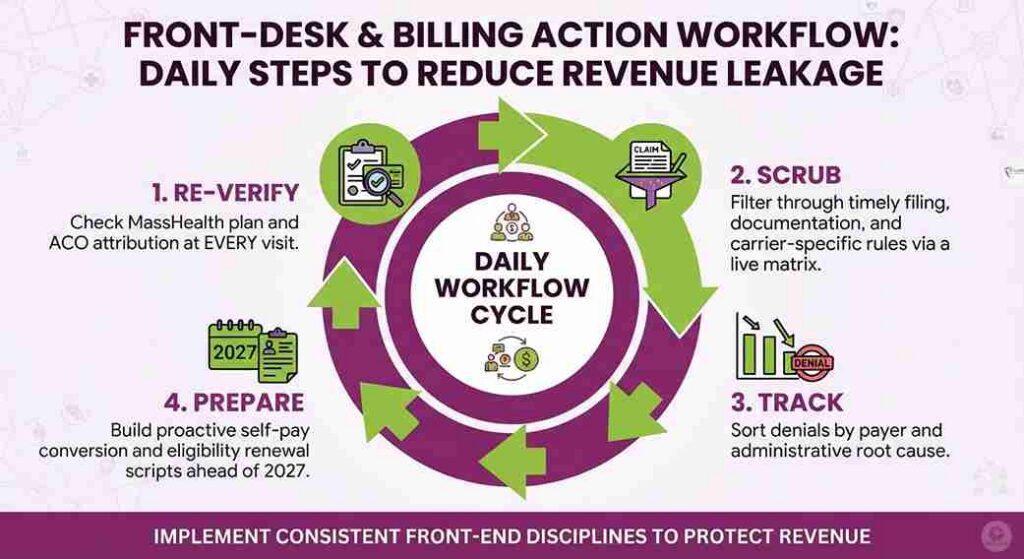
Start with the denial categories that are administrative, because they are the largest share and the easiest to prevent. Once those are under control, tackle the changes arriving in 2026 and 2027 with simple, repeatable workflows that front desk and billing staff can follow.
- Denials: sort by payer and by administrative reason, then fix the top two causes first
- Claim scrubbing: check timely filing, documentation, and separate-billing rules before submission
- Plan changes: re-verify MassHealth plan and ACO on every visit
- Prior authorization: keep a carrier-by-carrier matrix and update it as carriers publish changes
- 2027 readiness: build an eligibility and self-pay workflow before January
If you are not sure where your revenue is leaking, a medical billing audit from reputable medical billing companies in the USA can show which denial categories and payer patterns cost your practice the most.
Frequently Asked Questions
What percentage of medical claims are denied in Massachusetts?
About 20.4% of fully insured commercial claims were denied in 2024, based on 45.9 million claims reviewed by the Health Policy Commission. That is roughly one in five. The figure excludes self-funded plans and MassHealth, so an individual practice’s rate can differ.
Which insurers deny the most claims in Massachusetts?
In 2024, UnitedHealthcare denied about 28% of fully insured commercial claims, Harvard Pilgrim and HPHC Insurance Co. about 27%, and Aetna about 25%. WellSense was lowest at roughly 11%. These figures show a spread in payer behavior, not a ranking of insurer quality.
Are most Massachusetts claim denials clinical or administrative?
Most are administrative. Clinical disputes made up at most 1% of denials for any insurer. Timely filing, documentation, separate-billing rules, incomplete claims, coding errors, and duplicates drive the majority, which makes them largely preventable through better claim preparation and scrubbing before submission.
Did Massachusetts eliminate prior authorization in 2026?
No. Amended 211 CMR 52.00 removed prior authorization for many services on June 5, 2026, including emergency care, primary care, and preventive services. Other requirements remain, carriers are implementing the changes on separate timelines, and the regulation covers fully insured plans only, not self-funded plans.
How will MassHealth changes in 2027 affect providers?
From January 1, 2027, some adults aged 19 to 64 face work or education requirements, six-month renewals, and shorter retroactive coverage. Providers face a higher risk of treating patients whose coverage has lapsed, so eligibility checks at every visit and a self-pay workflow become essential.
What happened to the Tufts Health Together MassHealth plan?
Tufts Health Together MCO was discontinued on January 1, 2026, and its members transitioned to other MassHealth plans. Practices should confirm each patient’s current plan before billing, since claims sent to the discontinued plan or checked against outdated records may be rejected or delayed.