The D0120 dental code reports a periodic oral evaluation for an established patient. The dentist checks for changes since the last exam. It sits in the Diagnostic category of the CDT code set.
The American Dental Association (ADA) defines D0120 for a patient of record on a recall visit. The code covers the routine six-month check that most plans schedule. It differs from the full baseline exam a new patient receives.
This guide covers the D0120 descriptor, the cost, real clinical scenarios, and the reimbursement rules. Practices that route diagnostic claims through specialist dental billing services keep recall exams clean and paid. The sections below map the full billing picture for D0120.
Quick Reference: D0120 Dental Code
The table below summarizes the core attributes of the D0120 dental code for fast lookup.
| Attribute | Detail |
|---|---|
| CDT Code | D0120 |
| Nomenclature | Periodic oral evaluation, established patient |
| Category | Diagnostic (D0100 to D0999) |
| Purpose | Detect changes since a prior comprehensive or periodic evaluation |
| Patient Type | Established patient of record |
| Must Include | Oral cancer (soft tissue) screening, periodontal screening where indicated |
| Typical Frequency | Twice per benefit year for most plans |
| Benefit Class | Diagnostic, often covered at 100% |
| National Average Fee (2026) | About $50 to $75 |
Reference values follow the ADA CDT 2026 code set and the 2026 ADA Survey of Dental Fees.
What Is the Description of Dental Code D0120?
The D0120 dental code describes a periodic oral evaluation for an established patient. The exam determines changes in dental and medical status since a prior evaluation. It applies to a patient of record on a recall visit.
A periodic evaluation includes a soft tissue oral cancer screening. It includes a periodontal screening where the clinical picture indicates one. It may include interpretation of radiographs and other diagnostic information.
D0120 is the routine recall exam for a patient the dentist already knows.
The exam builds on a baseline from a prior comprehensive evaluation. The dentist looks for new caries, periodontal change, and soft tissue findings. The visit updates the record rather than establishing it.
How Does D0120 Differ From D0150, D0180, and D0140?
D0120 differs from its neighbors by patient status and by depth of the exam. A new patient or a major change routes to the full baseline code. A specific complaint routes to the limited code. The table maps each option.
| CDT Code | Evaluation | When It Applies |
|---|---|---|
| D0120 | Periodic oral evaluation, established patient | Routine recall for a patient of record |
| D0150 | Comprehensive oral evaluation, new or established patient | New patient, significant change, or absence of 3 or more years |
| D0180 | Comprehensive periodontal evaluation | Patient with signs or risk factors for periodontal disease |
| D0140 | Limited oral evaluation, problem-focused | Specific complaint, emergency, trauma, or acute infection |
| D0145 | Oral evaluation for a patient under three years of age | Young child exam with a caregiver counseling component |
A routine recall is D0120. A new-patient baseline is D0150. A problem-focused emergency visit is D0140. Matching the code to the visit type prevents frequency and definition denials.
What Is the Difference Between D0120 and D0150?
The difference is patient status and depth. D0120 is the recall exam for an established patient, while D0150 is the full baseline for a new patient. D0150 also applies after a three-year absence or a major health change.
Can a Hygienist Perform a D0120?
A dental hygienist collects data, but the dentist performs and interprets the D0120 evaluation. Scope of practice rules vary by state. The evaluation and diagnosis remain the dentist’s responsibility on the claim.
What Elements Does a D0120 Evaluation Include?
A D0120 evaluation covers the parts that make it a recall exam rather than a cleaning. The record documents each element performed. The core elements appear below.
- Review of the medical and dental history for updates
- A soft tissue oral cancer screening
- A periodontal screening where the findings indicate one
- A caries and existing restoration check
- Interpretation of radiographs taken at the visit
The soft tissue screening is a required element, not an optional add-on. A recall exam without a documented screening reads as incomplete. The note lists the elements the dentist performed.
Which Records Support a D0120 Claim?
Documentation for D0120 shows an established patient received a recall evaluation. The record ties the exam to the patient’s history. The items below support the claim.
- The patient-of-record status and last evaluation date
- Clinical notes listing the exam elements performed
- The oral cancer screening result
- Any radiograph interpretation noted at the visit
- The date of service for frequency tracking
Frequency tracking is the quiet driver of D0120 denials, so the last evaluation date matters on every recall.
Practices with large recall schedules centralize eligibility checks through outsourced dental billing and coding support. Verified frequency at the source prevents the common every-other-visit denial.
What Is the Cost of Dental Code D0120?
The cost of D0120 ranges from about $35 to $80 in 2026. The national average office fee sits near $50 to $75. The recall exam prices well below the full baseline exam.
The exam often bundles into a recall visit with a cleaning and radiographs. Each service carries its own code and fee. The plan pays for the exam on its own line.
| Cost Element | Typical 2026 Amount | Notes |
|---|---|---|
| D0120 office fee | $35 to $80 | Per recall evaluation |
| National average (ADA survey) | About $50 to $75 | Single evaluation |
| Adult prophylaxis (D1110) | $95 to $130 | Common same-visit cleaning |
| Bitewing radiographs (D0274) | $65 to $95 | Common same-visit imaging |
A recall visit estimate often shows the exam, cleaning, and radiographs together. The plan adjudicates each code separately. Diagnostic and preventive services usually carry the highest coverage.
How Do Dental Plans Cover D0120?
Most dental plans cover D0120 at 100% as a diagnostic benefit. Plans limit the exam to a set frequency, usually twice per benefit year. A third exam in the same year often falls to the patient.
- Most plans pay two D0120 evaluations per benefit year
- Some plans allow only one evaluation per calendar year
- Some plans count D0120 and D0150 exams against one shared limit
- Coordination of benefits applies for patients with dual coverage
A plan that counts D0120 and D0150 together limits total exams per year. A comprehensive exam early in the year can consume a recall slot. Verify how the plan pools evaluation frequency.
What Factors Change the D0120 Fee?
Regional market and practice setting move the D0120 fee the most. The exam remains a low-cost diagnostic service across markets. Bundled recall services drive the larger visit total.
- Regional market, since metro fees exceed rural fees
- Practice setting, such as a specialty office versus a general one
- Same-visit services, including cleaning and radiographs
- Plan fee schedules for in-network providers
What Are Example Clinical Scenarios for Dental Code D0120?
D0120 applies when an established patient returns for a routine evaluation. The scenarios below show clean reporting patterns. Each pairs the visit type with the coding decision.
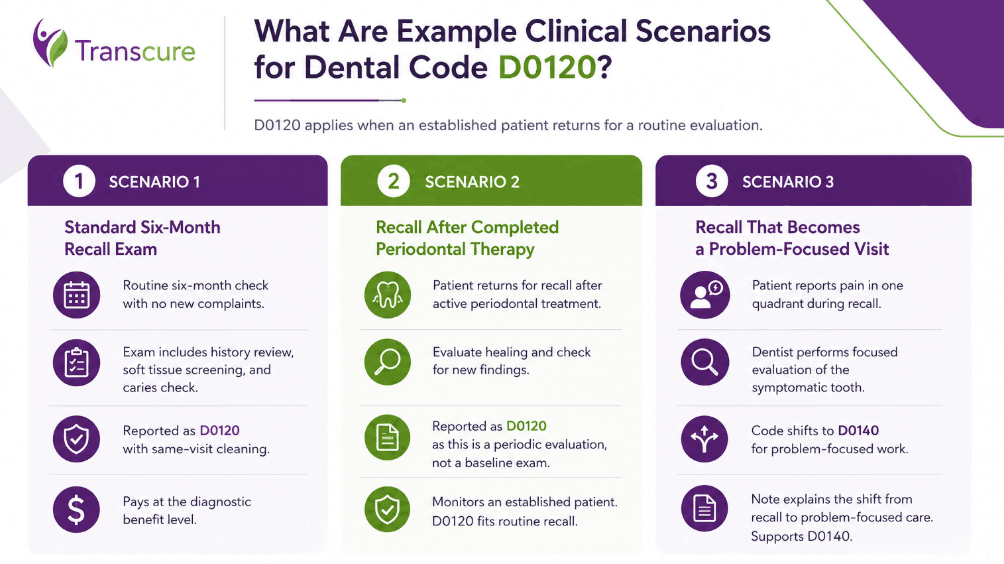
Scenario 1: Standard Six-Month Recall Exam
An established patient returns for a routine six-month check with no new complaints. The dentist reviews history, screens soft tissue, and checks for caries. The practice reports D0120 with a same-visit cleaning.
The note lists the exam elements and the oral cancer screening. The last evaluation date confirms the patient is within frequency. The exam pays at the diagnostic benefit level.
Scenario 2: Recall After Completed Periodontal Therapy
A patient of record returns for a recall after finishing active periodontal treatment. The dentist evaluates healing and checks for new findings. The practice reports D0120, since the visit is a periodic evaluation.
The note records the periodontal status and any change since treatment. The visit monitors an established patient rather than establishing a baseline. D0120 fits a routine recall better than a comprehensive code.
Scenario 3: Recall That Becomes a Problem-Focused Visit
An established patient arrives for a recall but reports pain in one quadrant. The dentist performs a focused evaluation of the symptomatic tooth. The correct code shifts toward D0140 for the problem-focused work.
A routine recall that turns into a specific problem may support D0140 instead. The additional diagnostic time and focus define that code. The note explains the shift from recall to problem-focused care.
What Are the D0120 Rules for Successful Reimbursement?
Successful D0120 reimbursement rests on frequency, patient status, and correct code selection. The rules below reduce denials. Each rule targets a known payer behavior.
How Frequency Limits Drive D0120 Denials
Frequency limits cause most D0120 denials. Plans pay a set number of evaluations per year and reject the rest. Eligibility checks at intake prevent the write-off.
- Confirm remaining exam benefits before the visit
- Track D0120 and D0150 exams against a shared limit
- Space recall exams to match the plan frequency
- Bill the patient only after a verified benefit exhaustion
A third exam in a two-exam plan falls to the patient. A verified estimate sets that expectation early. Frequency discipline keeps recall claims clean.
When to Use D0120 Versus D0150 on an Established Patient
Use D0120 for a routine recall on an established patient. Use D0150 only after a three-year absence or a major health change. Billing D0150 at every recall draws utilization review.
- Confirm the patient is established and within the recall pattern
- Check the last comprehensive evaluation date
- Use D0120 for routine change detection
- Reserve D0150 for the three-year or significant-change pathway
A D0150 code on every recall is a flagged pattern. The plan expects the periodic code for routine visits. Correct selection protects both codes across the patient’s history.
Can D0120 Be Billed with a Cleaning and Radiographs?
Yes. D0120 is billed with a prophylaxis and radiographs on the same visit. Each service reports on its own line with its own documentation. The plan adjudicates the exam, the cleaning, and the imaging separately.
How to Keep D0120 Documentation Audit Ready
Audit-ready D0120 notes list every exam element and the screening result. Carriers request notes when frequency or definition is in question. Consistent notes clear those requests fast.
- List the exam elements performed at each recall
- Record the oral cancer screening result
- Note the last evaluation date for frequency
- Keep radiograph interpretations with the exam record
Practices with heavy recall volume often compare vendors before outsourcing. A review of a detailed CDT codes guide can help weigh diagnostic accuracy, eligibility workflows, and turnaround. Documentation quality at the source still drives the D0120 outcome.
What Is the Key Takeaway for D0120 Billing?
The D0120 dental code pays when an established patient receives a routine evaluation within the prescribed frequency. The oral cancer screening, the exam elements, and the last evaluation date carry the claim. Correct use of D0120 keeps recall revenue clean and predictable.