Neurosurgery ICD-10 codes document diagnoses for brain, spine, and peripheral nerve surgery patients each year. The Centers for Medicare and Medicaid Services released the FY2027 ICD-10-CM update in June 2026. This update added 190 new billable codes, effective nationwide for encounters starting October 1, 2026.
The 2026 HHS risk-adjustment model assigns severe brain cancers a high coefficient of 12.533 nationally. Meanwhile, the American Association of Neurological Surgeons also publishes dedicated ICD-10 and CPT guidance for practices.
Unspecified or outdated diagnosis codes remain a leading cause of neurosurgery claim denials nationwide today. This guide breaks down the codes coders need for accurate, denial-free neurosurgical claims every time.

How Neurosurgery ICD-10 Codes Are Structured
Most medical specialties typically pull diagnosis codes from just one or two ICD-10-CM billing chapters. Neurosurgical claims can draw diagnosis codes from multiple ICD-10-CM chapters depending on documented conditions. A single patient’s neurosurgical treatment can span disease, injury, tumor, and musculoskeletal categories all at once.
A patient with degenerative disc disease may later herniate that disc after a sudden fall. This single case touches a musculoskeletal code, a trauma code, and possibly a nervous-system code. Missing this range is often a common reason neurosurgery coders under-code an entire patient chart.
| ICD-10-CM Chapter/Category | Code Range | What It Covers | Common Neurosurgery Examples |
|---|---|---|---|
| Diseases of the Nervous System | G00–G99 | Disorders of the brain, spinal cord, cranial nerves, peripheral nerves, and related structures | Hydrocephalus (G91), trigeminal neuralgia (G50.0), spinal cord disorders (G95) |
| Diseases of the Circulatory System | I00–I99 | Cerebrovascular and vascular conditions affecting the nervous system | Subarachnoid hemorrhage (I60), intracerebral hemorrhage (I61), cerebral aneurysm (I67.1), moyamoya disease (I67.5) |
| Diseases of the Musculoskeletal System | M00–M99 | Disorders involving vertebrae, intervertebral discs, spinal alignment, and connective tissues | Spinal stenosis (M48.-), disc disorders (M50–M51), spondylolisthesis (M43.1) |
| Injury, Poisoning, and Certain Other Consequences of External Causes | S00–T88 | Traumatic injuries and complications involving the head, spine, nerves, and other structures | Traumatic brain injury (S06), spinal cord injury (S14/S24/S34), skull fracture (S02) |
| Neoplasms | C00–D49 | Malignant, benign, and uncertain-behavior tumors | Brain cancer (C71), meningioma (D32), pituitary tumor (D35.2), brain metastasis (C79.31) |
| Congenital Malformations, Deformations and Chromosomal Abnormalities | Q00–Q99 | Congenital neurological and craniofacial conditions | Spina bifida (Q05), craniosynostosis (Q75.0), other congenital nervous-system disorders |
| Symptoms, Signs and Abnormal Clinical Findings | R00–R99 | Symptoms documented when a definitive diagnosis has not yet been established | Headache (R51.9), paresthesia (R20.2), difficulty walking (R26.2) |
| Factors Influencing Health Status and Contact With Health Services | Z00–Z99 | Aftercare, status, follow-up, and other healthcare encounters | Nervous-system surgical aftercare (Z48.811), shunt status (Z98.2) |
G codes, M codes, and S codes are not interchangeable in actual daily coding practice. A G-code documents an ongoing, chronic neurological disease process inside a patient’s own nervous system. An M-code documents a structural surgical problem affecting the spine, joint, or connective tissue region.
An S-code documents one discrete traumatic event and its own distinct healing timeline before surgery. Coding a post-traumatic disc herniation with only an M-code often loses that crucial connection entirely. Missing the S-code that links the accident to surgery also risks losing full reimbursement value.
How an Individual Code Is Built
Each ICD-10-CM character can add a different layer of clinical or encounter-specific information. Traumatic brain injury codes are a useful example because they can require documentation of injury type, loss of consciousness, and encounter status.
Consider S06.5X9A, which identifies a traumatic subdural hemorrhage with loss of consciousness of unspecified duration, initial encounter.
- S06 — traumatic intracranial injury category
- .5 — traumatic subdural hemorrhage
- X — placeholder character required to reach the required character position
- 9 — loss of consciousness of unspecified duration
- A — initial encounter for active treatment
The sixth character in this code family describes the patient’s loss-of-consciousness status or duration. It is not a laterality character. Depending on the documented circumstances, the sixth character can indicate no loss of consciousness, a specified duration of loss of consciousness, death associated with the brain injury, or unspecified duration/status.
For traumatic subdural hemorrhage, the loss-of-consciousness characters include:
| Character | Meaning |
|---|---|
| 0 | Without loss of consciousness |
| 1 | Loss of consciousness of 30 minutes or less |
| 2 | Loss of consciousness of 31–59 minutes |
| 3 | Loss of consciousness of 1–5 hours 59 minutes |
| 4 | Loss of consciousness of 6–24 hours |
| 5 | Loss of consciousness greater than 24 hours with return to pre-existing conscious level |
| 6 | Loss of consciousness greater than 24 hours without return to pre-existing conscious level, patient surviving |
| 7 | Loss of consciousness of any duration with death due to brain injury before regaining consciousness |
| 8 | Loss of consciousness of any duration with death due to another cause before regaining consciousness |
| 9 | Loss of consciousness of unspecified duration |
| A | Loss-of-consciousness status unknown |
The seventh character then identifies the encounter phase. A represents active treatment, D represents a subsequent encounter during routine healing or recovery, and S represents a sequela or late effect of the injury.
Laterality should be reported only when the applicable ICD-10-CM code specifically requires it. Neurosurgery coders should never assume that every additional character represents laterality; the meaning depends on the individual code family.
Nervous System ICD-10 Codes for Neurosurgery
Nervous system codes identify neurological disorders affecting the brain, spinal cord, and peripheral nerves during neurosurgical care. The following sections organize common neurosurgery diagnosis codes by neurological condition and anatomical structure:
Hydrocephalus ICD-10 Codes
Hydrocephalus codes identify abnormal cerebrospinal fluid accumulation caused by impaired circulation or absorption. Neurosurgeons commonly encounter communicating, obstructive, and normal-pressure hydrocephalus during evaluation and surgical treatment. Accurate documentation should identify the hydrocephalus ICD-10 code type before selecting the most specific one.
| ICD-10-CM Code | Description |
|---|---|
| G91.0 | Hydrocephalus with communicating pathways |
| G91.1 | Hydrocephalus caused by obstruction |
| G91.2 | Normal-pressure hydrocephalus |
| G91.8 | Other hydrocephalus |
| G91.9 | Hydrocephalus, unspecified |
Cranial Nerve ICD-10 Codes
Cranial nerve codes describe disorders involving nerves responsible for facial movement, sensation, and specialized neurological functions. Common neurosurgical conditions include trigeminal neuralgia, facial nerve paralysis, and other cranial nerve disorders. The clinical documentation should identify the affected nerve and confirmed diagnosis before assigning neurosurgery ICD-10 codes.
| ICD-10-CM Code | Description |
|---|---|
| G50.0 | Trigeminal neuralgia |
| G50.8 | Other trigeminal nerve disorders |
| G51.0 | Bell’s palsy |
| G51.8 | Other facial nerve disorders |
| G52.8 | Other specified cranial nerve disorders |
Peripheral Nerve ICD-10 Codes
Peripheral nerve codes identify disorders affecting nerves outside the brain and spinal cord. Neurosurgical billing frequently involves carpal tunnel syndrome, nerve compression, and documented peripheral neuropathies. Laterality and anatomical location should remain consistent between clinical documentation, diagnosis codes, and procedural claims.
| ICD-10-CM Code | Description |
|---|---|
| G56.00 | Carpal tunnel syndrome, unspecified upper limb |
| G56.01 | Carpal tunnel syndrome, right upper limb |
| G56.02 | Carpal tunnel syndrome, left upper limb |
| G56.8 | Other mononeuropathies of upper limb |
| G62.9 | Polyneuropathy, unspecified |
Spinal Cord ICD-10 Codes
Spinal cord codes describe neurological disorders involving compression, disease, or other documented spinal cord abnormalities. These codes may support procedures addressing spinal cord compression when documentation establishes the underlying neurological condition. Coders should distinguish neurological spinal cord disorders from musculoskeletal spine conditions before selecting diagnosis codes.
| ICD-10-CM Code | Description |
|---|---|
| G95.20 | Unspecified cord compression, unspecified spinal cord level |
| G95.29 | Other cord compression |
| G95.9 | Disease of spinal cord, unspecified |
| G95.89 | Other specified diseases of spinal cord |
Musculoskeletal ICD-10 Codes for Neurosurgery
Musculoskeletal codes describe structural disorders affecting vertebrae, discs, spinal alignment, and supporting tissues. The following sections organize ICD-10 codes for brain and spine surgery around common spinal diagnoses.
Cervical Disc ICD-10 Codes
Cervical disc codes identify disorders involving intervertebral discs within the cervical spine. Common diagnoses include cervical disc displacement, degeneration, and other documented cervical disc abnormalities. The selected code should reflect the provider’s documented condition, anatomical level, and available clinical specificity.
| ICD-10-CM Code | Description |
|---|---|
| M50.20 | Other cervical disc displacement, unspecified cervical region |
| M50.21 | Other cervical disc displacement, high cervical region |
| M50.22 | Other cervical disc displacement, mid-cervical region |
| M50.23 | Other cervical disc displacement, cervicothoracic region |
| M50.30 | Other cervical disc degeneration, unspecified cervical region |
Lumbar Disc ICD-10 Codes
Lumbar disc codes identify degenerative, displaced, or other pathological conditions affecting lumbar intervertebral discs. These diagnoses frequently support evaluation for discectomy, decompression, or other spine procedures. Documentation should distinguish disc displacement from degeneration when assigning the appropriate ICD-10-CM diagnosis code.
| ICD-10-CM Code | Description | Billable? |
|---|---|---|
| M51.26 | Intervertebral disc displacement, lumbar region | Yes |
| M51.360 | Intervertebral disc degeneration, lumbar region, without discogenic back pain | Yes |
| M51.361 | Intervertebral disc degeneration, lumbar region, with discogenic back pain | Yes |
| M51.16 | Intervertebral disc disorders with radiculopathy, lumbar region | Yes |
| M51.17 | Intervertebral disc disorders with radiculopathy, lumbosacral region | Yes |
Spinal Stenosis ICD-10 Codes
Spinal stenosis codes identify narrowing of the spinal canal or neural structures and are selected according to the affected spinal region and documented clinical features. For lumbar stenosis, the current billable codes distinguish whether neurogenic claudication is documented.
| ICD-10-CM Code | Description |
|---|---|
| M48.02 | Spinal stenosis, cervical region |
| M48.061 | Spinal stenosis, lumbar region without neurogenic claudication |
| M48.062 | Spinal stenosis, lumbar region with neurogenic claudication |
| M48.07 | Spinal stenosis, lumbosacral region |
Avoid using the legacy/non-billable M48.06 category as a final claim diagnosis. For lumbar spinal stenosis, documentation should support selection of M48.061 or M48.062, depending on whether neurogenic claudication is documented.
Spondylolisthesis ICD-10 Codes
Spondylolisthesis codes identify vertebral displacement involving specific spinal regions. Neurosurgery practices commonly encounter cervical, lumbar, and lumbosacral spondylolisthesis during surgical spine evaluations. Accurate anatomical documentation helps distinguish cervical versus lumbar spine ICD-10 codes during claim submission.
| ICD-10-CM Code | Description |
|---|---|
| M43.12 | Spondylolisthesis, cervical region |
| M43.14 | Spondylolisthesis, thoracic region |
| M43.16 | Spondylolisthesis, lumbar region |
| M43.17 | Spondylolisthesis, lumbosacral region |
Radiculopathy ICD-10 Codes
Radiculopathy codes describe nerve-root disorders producing symptoms within specific spinal regions. Neurosurgery practices most often report cervical, thoracic, lumbar, and lumbosacral radiculopathy when a patient has pain, numbness, or weakness that follows a nerve-root pattern. The selected code should match the documented exam findings, imaging results, and the exact spinal level affected.
When a disc disorder causes the radiculopathy, coders should use the combination disc codes (M50.1- or M51.1-) instead of adding M54.1- on the same claim. For a deeper breakdown of each code and its documentation requirements, see our radiculopathy ICD codes guide.
| ICD-10-CM Code | Description |
|---|---|
| M54.12 | Radiculopathy, cervical region |
| M54.14 | Radiculopathy, thoracic region |
| M54.16 | Radiculopathy, lumbar region |
| M54.17 | Radiculopathy, lumbosacral region |
Injury and Trauma ICD-10 Codes for Neurosurgery
Injury codes document traumatic conditions involving the brain, spinal cord, and other anatomical structures. The following sections explain traumatic diagnosis categories and seventh-character requirements for accurate neurosurgical coding.
Traumatic Brain Injury ICD-10 Codes
Traumatic brain injury codes identify injuries caused by external trauma affecting the brain or intracranial structures. The S06 category includes traumatic brain injuries requiring detailed documentation regarding injury type and associated findings. Coders should verify loss of consciousness, duration, encounter status, and other required details before finalizing codes.
| ICD-10-CM Code | Description |
|---|---|
| S06.- | Traumatic intracranial injury |
| S06.1- | Traumatic cerebral edema |
| S06.5- | Traumatic subdural hemorrhage |
| S06.6- | Traumatic subarachnoid hemorrhage |
| S06.9- | Unspecified intracranial injury |
Spinal Cord Injury ICD-10 Codes
Spinal cord injury codes identify traumatic damage involving cervical, thoracic, or lumbar spinal cord regions. These diagnoses differ from degenerative spinal cord disorders because trauma determines the injury-code family. Documentation should establish anatomical level, neurological findings, encounter status, and other required injury-specific details.
| ICD-10-CM Code | Description |
|---|---|
| S14.- | Injury of nerves and spinal cord at neck level |
| S24.- | Injury of nerves and spinal cord at thorax level |
| S34.- | Injury of nerves and spinal cord at lumbar and sacral level |
Understanding the Seventh Character
Seventh characters provide encounter information required by many injury and trauma diagnosis codes. The commonly used characters distinguish active treatment, subsequent healing care, and treatment for resulting sequelae. Correct seventh-character assignment helps prevent errors involving the 7th character ICD-10 neurosurgery requirements.
| Seventh Character | Description |
|---|---|
| A | Initial encounter for active treatment |
| D | Subsequent encounter during routine healing or recovery |
| S | Sequela representing a late effect of an earlier injury |
The Centers for Medicare & Medicaid Services (CMS) publishes current ICD-10-CM files alongside official annual coding updates. Meanwhile, the CDC’s National Center for Health Statistics (NCHS) maintains ICD-10-CM with CMS for United States healthcare coding.
Neoplasm ICD-10 Codes for Neurosurgery
Neoplasm codes classify tumors according to anatomical site, behavior, and documented pathological characteristics. The following sections separate malignant, benign, and uncertain-behavior tumors commonly encountered during neurosurgical treatment.
Malignant Brain Tumor ICD-10 Codes
Malignant brain tumor codes identify cancerous neoplasms arising within specified brain regions. The C71 category contains malignant neoplasms of brain locations, including unspecified brain sites. Accurate tumor location supports appropriate neurosurgery diagnosis codes and strengthens documentation for medical necessity.
| ICD-10-CM Code | Description |
|---|---|
| C71.0 | Malignant neoplasm of cerebrum, except lobes and ventricles |
| C71.1 | Malignant neoplasm of frontal lobe |
| C71.2 | Malignant neoplasm of temporal lobe |
| C71.9 | Malignant neoplasm of brain, unspecified |
Benign Brain Tumor ICD-10 Codes
Benign brain tumor codes identify nonmalignant neoplasms involving specified brain regions. Meningioma commonly appears in neurosurgical records and uses dedicated codes within the D32 category. The documented tumor location should guide selection rather than relying on a generalized brain tumor description.
| ICD-10-CM Code | Description |
|---|---|
| D32.0 | Benign neoplasm of cerebral meninges |
| D32.1 | Benign neoplasm of spinal meninges |
| D32.9 | Benign neoplasm of meninges, unspecified |
| D33.0 | Benign neoplasm of brain, supratentorial |
| D33.2 | Benign neoplasm of brain, unspecified |
Neoplasm of Uncertain Behavior Codes
Uncertain-behavior codes identify neoplasms whose biological behavior cannot be classified as benign or malignant. These diagnoses differ from confirmed malignant tumors and should reflect the provider’s documented pathology. Neoplasm coding therefore requires careful review of pathology reports, anatomical location, and clinical documentation.
| ICD-10-CM Code | Description |
|---|---|
| D42.0 | Neoplasm of uncertain behavior of cerebral meninges |
| D42.1 | Neoplasm of uncertain behavior of spinal meninges |
| D42.9 | Neoplasm of uncertain behavior of meninges, unspecified |
| D43.0 | Neoplasm of uncertain behavior of brain, supratentorial |
| D43.2 | Neoplasm of uncertain behavior of brain, unspecified |
The American Hospital Association (AHA) Coding Clinic provides official coding advice supporting complex ICD-10-CM interpretation. ICD-10-CM diagnosis coding differs from ICD-10-PCS procedure coding, which applies primarily to inpatient procedures.
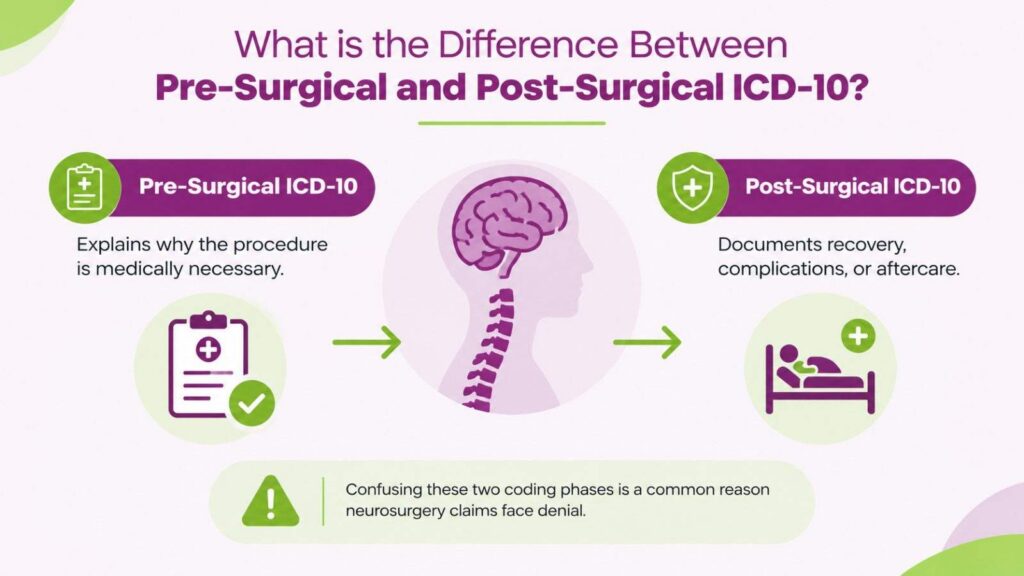
What is the Difference Between Pre-Surgical and Post-Surgical ICD-10?
Pre-surgical codes establish why a neurosurgical procedure is medically necessary in the first place. Post-surgical codes instead document recovery, complications, or aftercare following the actual procedure performed. Confusing these two coding phases is a common reason neurosurgery claims face denial.
What Diagnosis Codes Justify a Neurosurgical Procedure?
Medical necessity depends on the primary diagnosis code that drives the surgical decision itself. A lumbar spinal stenosis code like M48.06 justifies a decompression or laminectomy procedure directly. A malignant brain tumor code like C71.9 justifies craniotomy for tumor resection surgery.
Payers expect this diagnosis to appear as primary, not secondary, on every claim. Symptom codes alone, like unspecified back pain, rarely justify surgery without imaging-confirmed structural findings. The pre-operative diagnosis must match the surgical CPT code’s stated medical necessity requirements exactly.
How Do Post-Operative Codes Differ From Pre-Operative Codes?
Post-operative coding shifts entirely from the original condition to the surgical outcome itself. Postlaminectomy syndrome, coded M96.1, documents ongoing pain following spinal decompression or fusion surgery.
This code applies only after surgery, never as a justification for the procedure. Surgical complication codes under T81 document unexpected events like infection, bleeding, or dehiscence. These T81 codes always require a seventh character marking the specific encounter type.
Aftercare following neurosurgery uses Z48.81, documenting routine follow-up rather than any complication. For a broader look at the complete revenue cycle, see our neurosurgery medical billing guide covering coding, claims, prior authorization, denials, and collections.
Symptom Codes vs. Diagnosis Codes in Neurosurgery
Symptom codes describe what a patient reports feeling before any imaging confirms the cause. Diagnosis codes describe the actual structural problem once testing identifies a clear surgical target. Billing a symptom code alone rarely supports medical necessity for a neurosurgical procedure. The table below maps common neurosurgery symptoms to their eventual surgical diagnosis codes.
| Presenting Symptom | Symptom Code | Likely Surgical Diagnosis | Diagnosis Code |
|---|---|---|---|
| Chronic Low Back Pain | M54.50 | Herniated lumbar disc | M51.26 |
| Persistent Headache | R51.9 | Brain tumor | C71.9 |
| Numbness in Hand | R20.0 | Carpal tunnel syndrome | G56.01 |
| Facial Pain | G50.1 | Trigeminal neuralgia | G50.0 |
| Difficulty Walking, Gait Changes | R26.2 | Spinal stenosis | M48.062 |
A patient presenting with chronic back pain often receives an initial symptom code first. Imaging then confirms whether a herniated disc or stenosis is the actual cause. Coders should update the claim once the definitive diagnosis code becomes clearly available.
Persistent headache alone never justifies a craniotomy without imaging showing a specific mass. Payers routinely deny claims where only the symptom code appears, never the underlying diagnosis.
Once a diagnosis is confirmed, the symptom code should stop appearing as primary. This distinction protects both medical necessity and long-term reimbursement accuracy for practices.
Why Are CPT-to-ICD-10 Linkage Errors Common?
CPT codes describe the surgical procedure performed, while ICD-10 codes describe the reason why. Payers require these two code sets to logically connect before approving any neurosurgery claim. A linkage error happens whenever the diagnosis code cannot medically justify the procedure billed.
Medical necessity mismatches remain the single most frequent cause of these linkage errors. Billing a craniotomy CPT code against a vague headache diagnosis code creates an obvious mismatch. Payers see this pairing as insufficient proof that surgery was truly necessary here. The diagnosis code must specifically support the exact procedure described by the CPT code.
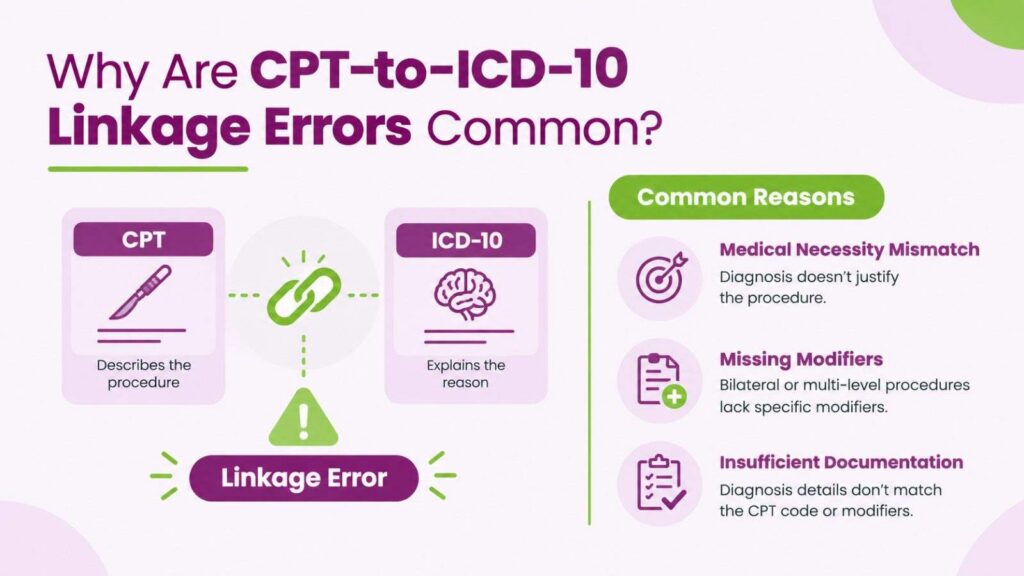
Missing modifiers compound this problem further, especially on bilateral or multi-level spine procedures. A lumbar fusion CPT code without a level-specific modifier leaves the claim under-documented. Modifier 50 for bilateral procedures must match a diagnosis code confirming bilateral involvement too.
Without that match, payers cannot confirm both sides genuinely required the surgical intervention performed. Modifier 59 for distinct procedures needs equally specific diagnosis documentation supporting each separate procedure billed. Our neurosurgery CPT code guide explains procedure coding, modifiers, documentation, and diagnosis linkage requirements.
How Do Neurosurgery Coding Errors Lead to Denials?
Unspecified codes remain the most frequent reason neurosurgery claims come back denied entirely. A code ending in .9, like G91.9 for unspecified hydrocephalus, lacks required clinical detail. Payers expect the most specific code available, not a generic placeholder diagnosis instead.
Laterality omission causes similar denials, especially for paired structures like discs and nerves. Carpal tunnel syndrome billed without specifying right or left side often gets rejected outright. Cervical disc displacement also requires laterality whenever the ICD-10-CM code structure allows that distinction.
Sequencing errors happen when a secondary diagnosis gets listed ahead of the true primary one. A symptom code sequenced before its confirmed diagnosis code weakens the entire claim’s necessity. Payers read the first-listed code as the main reason surgery was performed.
Outdated codes create denials too, particularly after CMS retires or revises a code annually. Coders should verify every code against the current FY2027 ICD-10-CM file before submission. Yet, specialized neurosurgery billing services help practices manage coding, claims, denials, payments, and reimbursement requirements.
Frequently Asked Questions
What is the ICD-10 Code for a Brain Tumor?
The code depends on tumor behavior, location, and documentation, with malignant brain tumors commonly reported using C71 categories. For unspecified malignant brain neoplasm, C71.9 is a billable ICD-10-CM code used when documentation lacks a specific location.
Does Spine Surgery use a G-code or M-code?
Spine surgery commonly uses M-codes for structural musculoskeletal conditions such as stenosis, degeneration, and spondylolisthesis. G-codes may apply when documentation identifies neurological disorders, including spinal cord or nerve-related conditions.
Is M48.06 a Billable ICD-10 Code for Lumbar Spinal Stenosis?
M48.06 identifies lumbar spinal stenosis but is currently a non-billable category requiring additional specificity. Claims should use M48.061 or M48.062 according to documented neurogenic claudication status and applicable coding guidelines.
When Should Neurosurgery Practices Start Using FY2027 ICD-10 codes?
FY2027 ICD-10-CM codes apply to patient encounters beginning October 1, 2026, replacing the applicable FY2026 release. Practices should update coding systems and claim workflows before that effective date to prevent outdated-code submissions.