
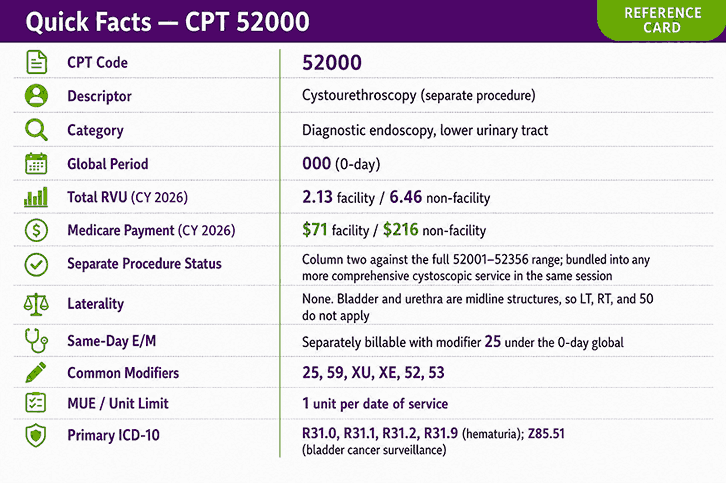
CPT code 52000 reports diagnostic cystourethroscopy. It describes endoscopic inspection of the urethra and bladder using a rigid or flexible cystoscope. Nothing is biopsied, removed, dilated, or treated during the service.
The American Medical Association (AMA) attaches a “separate procedure” designation to 52000. That label is a bundling instruction, not billing permission. On the Medicare Physician Fee Schedule (MPFS), the code carries a 0-day global period.
This article covers CPT 52000, its related codes, ICD-10 and documentation requirements, 2026 Medicare and commercial payments, and key clinical, NCCI, MUE, global-period, and denial rules.
What Is the Description of CPT Code 52000?
52000 CPT code description as defined by the American Medical Association as: “Cystourethroscopy (separate procedure).”
It covers a complete endoscopic examination of the urethra and bladder without any additional therapeutic or diagnostic interventions. The parenthetical designation “(separate procedure)” is a CPT editorial note that governs when this code may be independently reported.
What Does the Cystourethroscopy Procedure Include for CPT Code 52000?
The prefix tells you the anatomy. “Cysto-” refers to the bladder and “-urethroscopy” refers to the urethra. Both structures must be examined for the code to apply.
A complete diagnostic cystourethroscopy inspects the following structures in sequence:
- Urethra, from meatus through the full length of the channel
- Prostatic urethra in male patients, including lobe configuration
- Bladder neck and trigone
- Ureteral orifices, with efflux observed when clinically relevant
- Bladder mucosa, inspected across all walls and the dome
The service includes scope insertion, irrigation to distend the bladder, systematic inspection, and withdrawal. Local anesthetic gel is part of the procedure. Fluoroscopy performed during the exam is integral and never reported separately.
What Does “Separate Procedure” Designation Mean for CPT Code 52000?
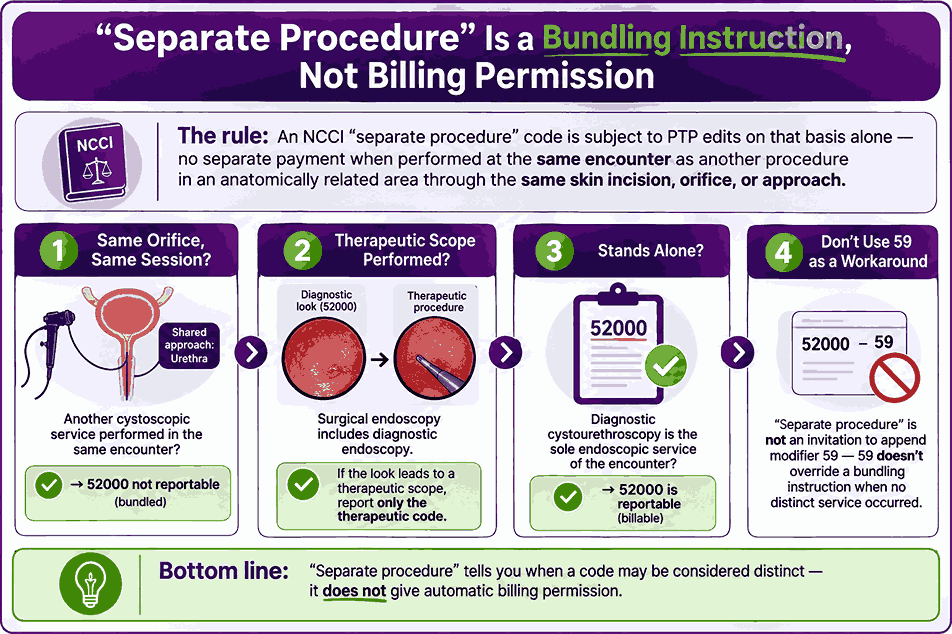
The designation means the opposite of what it sounds like. Per the CMS National Correct Coding Initiative (NCCI) Policy Manual, a code descriptor containing “separate procedure” is subject to NCCI Procedure-to-Procedure (PTP) edits on that basis alone.
CMS does not allow separate payment for a separate-procedure code performed at the same patient encounter as another procedure in an anatomically related area through the same skin incision, orifice, or surgical approach.
Applied to 52000, that means three things:
- Same orifice, same session, another cystoscopic service means 52000 is not reportable. The urethra is the shared approach.
- Surgical endoscopy includes diagnostic endoscopy. If the diagnostic look leads to a therapeutic scope procedure in the same session, only the therapeutic code is reported.
- 52000 stands alone only when it stands alone. It is billable when diagnostic cystourethroscopy is the sole endoscopic service of the encounter.
A common mistake here is treating “separate procedure” as an invitation to append modifier 59. Modifier 59 does not override a bundling instruction when no distinct service occurred.
How Does CPT Code 52000 Differ From CPT 52001, 52005, 52204, 52310, and 52332?
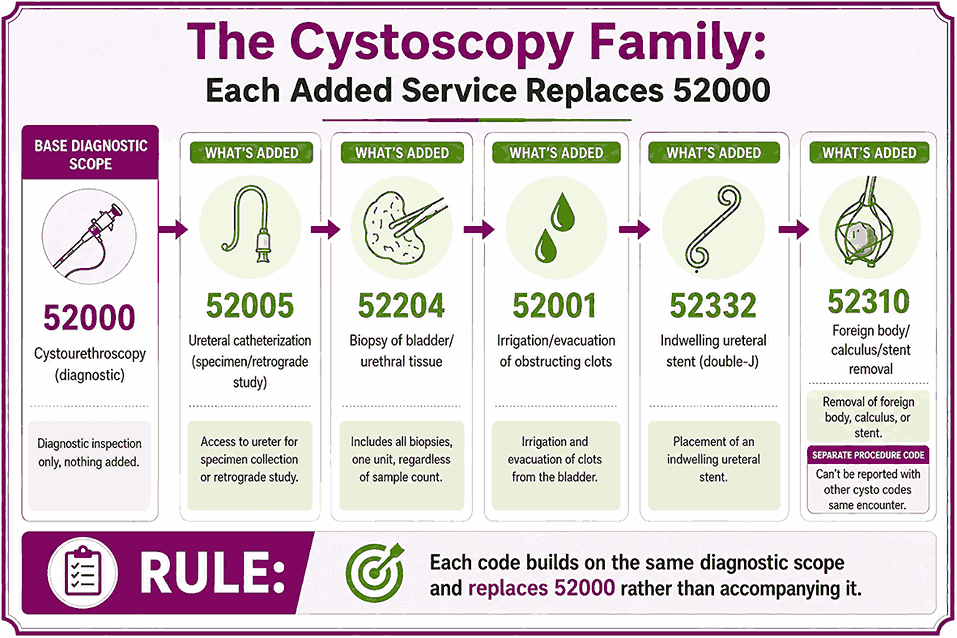
Every code below builds on the same diagnostic scope. Each adds a defined service, and each replaces 52000 rather than accompanying it. Payment rates are CY 2026 Medicare national averages.
| CPT Code | What It Adds Beyond 52000 | 2026 Facility Rate | 2026 Office Rate |
|---|---|---|---|
| 52000 | Nothing. Diagnostic inspection only | $71 | $216 |
| 52001 | Irrigation and evacuation of multiple obstructing clots | $253 | $420 |
| 52005 | Ureteral catheterization, with or without irrigation, instillation, or ureteropyelography | $120 | $281 |
| 52204 | Biopsy or biopsies of bladder or urethral tissue | $127 | $355 |
| 52310 | Removal of foreign body, calculus, or ureteral stent; simple. Also a separate procedure code | $135 | $299 |
| 52332 | Insertion of an indwelling ureteral stent, such as a double-J | $140 | $373 |
Three distinctions drive most miscoding in this family:
- 52005 versus 52000: Ureteral catheterization is not part of 52000. The moment a ureteral catheter goes up for a specimen or retrograde study, the code becomes 52005.
- 52204 versus 52000: Per NCCI, 52204 includes all biopsies taken during the session and is reported with one unit, regardless of how many samples are obtained.
- 52310 versus 52000: Both carry the separate procedure label. Per CMS payment policy, 52310 and 52315 cannot be reported with other cystourethroscopy codes for the same encounter.
What ICD-10 Codes and Medical Necessity Criteria Support CPT Code 52000?
Medical necessity for diagnostic cystoscopy rests on a documented indication, not on the procedure itself. Payers audit whether the linked ICD-10 code plausibly justifies direct visual inspection of the lower urinary tract.
The diagnosis codes below appear most often on clean 52000 claims. Code to the highest available specificity and link the pointer to the line item that matches.
| ICD-10-CM Code | Description | Typical 52000 Context |
|---|---|---|
| R31.0 | Gross hematuria | Highest-yield indication; cystoscopy is standard |
| R31.21 | Asymptomatic microscopic hematuria | Requires risk stratification support |
| R31.29 | Other microscopic hematuria | Requires risk stratification support |
| R31.9 | Hematuria, unspecified | Use only when documentation lacks detail |
| C67.0 to C67.9 | Malignant neoplasm of bladder, by site | Active disease surveillance |
| D09.0 | Carcinoma in situ of bladder | Post-treatment surveillance |
| Z85.51 | Personal history of malignant neoplasm of bladder | Surveillance after cure; never a principal diagnosis |
| N39.0 | Urinary tract infection, site not specified | Recurrent or atypical infection workup |
| N30.10 | Interstitial cystitis without hematuria | Bladder pain evaluation |
| N32.81 | Overactive bladder | Refractory symptoms before therapy escalation |
| N35.911 / N35.919 | Urethral stricture, unspecified, male / unspecified | Stricture assessment |
| N40.1 | Benign prostatic hyperplasia with lower urinary tract symptoms | Pre-surgical anatomic assessment |
| R33.8 | Other retention of urine | Obstructive workup |
| N21.0 | Calculus in bladder | Stone assessment before intervention |
Sequencing warning: Z85.51 is unacceptable as a principal diagnosis. On a surveillance claim, pair it with an active finding or with Z08 (encounter for follow-up examination after completed treatment for malignant neoplasm) sequenced per official guidelines.
Guideline Support Payers Actually Cite
The 2025 AUA/SUFU microhematuria amendment changed which patients qualify for cystoscopy, and payer policy is catching up. Barocas and colleagues published the update in the Journal of Urology in 2025.
Under the amended risk stratification:
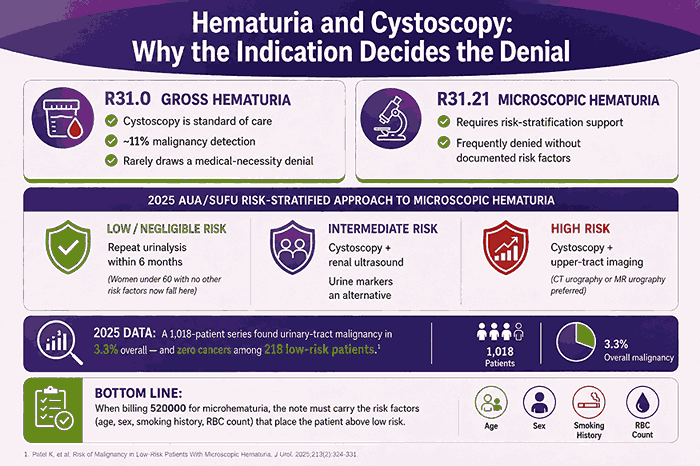
- Low or negligible risk: repeat urinalysis within six months instead of immediate cystoscopy or imaging
- Intermediate risk: offer cystoscopy plus renal ultrasound, with urine-based tumor markers as an alternative pathway
- High risk: cystoscopy plus upper tract imaging
- Women under 60 with no other risk factors now fall in the low or negligible group
The underlying malignancy data explains the payer position. A retrospective series of 1,018 microhematuria patients found urinary tract malignancy in 3.3% overall, with zero cancers detected among 218 low-risk patients. Cancer detection reaches roughly 11% in gross hematuria.
That gap is why R31.0 rarely draws a medical necessity denial, and R31.21 frequently does. When you bill 52000 for microhematuria, the note must carry the risk factors that place the patient above low risk.
What Are the Modifiers for CPT Code 52000?
Most clean 52000 claims carry no modifier at all. When diagnostic cystoscopy is the only service of the encounter, adding a modifier invites scrutiny without adding payment.
The six modifiers below cover the situations where one is genuinely required.
Modifier 25: Significant, Separately Identifiable E/M on the Same Day
CPT 52000 is a minor surgical procedure with a 0-day global period. Under Medicare global surgery rules, the E/M work of deciding to perform a minor procedure is included in the procedure payment.
Modifier 25 applies only when the E/M service is significant, separately identifiable, and unrelated to the decision to scope. Per NCCI Chapter VII, the E/M service and the minor procedure do not require different diagnoses.
Two facts coders get wrong here:
- A patient being new to the practice does not by itself justify a same-day E/M
- The pre-procedure history and exam that support the cystoscopy are not separately billable E/M work
Modifier 59: Distinct Procedural Service
Modifier 59 identifies a service distinct from another procedure performed the same day. For 52000, its legitimate use is narrow.
It does not break a PTP edit where the correct coding modifier indicator is 0. It does not convert a bundled intraoperative look into a payable line. It applies when the diagnostic cystoscopy occurred at a genuinely separate encounter, session, or anatomic site.
CMS prefers the X{EPSU} subset over 59 where a subset fits. Use the specific modifier when one applies.
Modifier XU: Unusual Non-Overlapping Service
Modifier XU identifies a service that does not overlap the usual components of the primary service. For 52000, this is the correct choice when the diagnostic exam served a purpose outside the scope of the main procedure.
An example: a patient undergoes a planned non-urologic pelvic procedure, and a documented new complaint prompts a full diagnostic bladder survey with its own indication. The exam is not confirmatory. It answers a different clinical question.
Modifier XE: Separate Encounter
Modifier XE marks a service distinct because it occurred during a separate encounter on the same date. The documentation burden is timing, not anatomy.
Support XE with:
- Separate start and stop times for each service
- A distinct indication for the second encounter
- A separate note, not an addendum to the first
Modifier 52: Reduced Services for an Incomplete Examination
Modifier 52 applies when the provider intentionally performed less than the full described service. For 52000, the classic case is an exam limited by stricture, patient intolerance, or poor visualization from active bleeding.
The note must state what was examined, what was not, and why the exam stopped short. Medicare pays modifier 52 claims at a reduced amount determined by the MAC, so submit a concise operative narrative with the claim.
Modifier 53: Discontinued Procedure
Modifier 53 applies when the physician terminates the procedure after it begins because of risk to the patient. Hemodynamic instability, an adverse anesthesia reaction, or acute urethral injury are typical triggers.
Modifier 53 is not for elective cancellation before the procedure starts. Facilities do not use it at all for outpatient cases.
| Setting | Discontinued Before Anesthesia | Discontinued After Anesthesia |
|---|---|---|
| Physician claim | Not reported | Modifier 53 |
| Hospital outpatient or ASC claim | Modifier 73 | Modifier 74 |
Which Documents Are Required For CPT Code 52000?
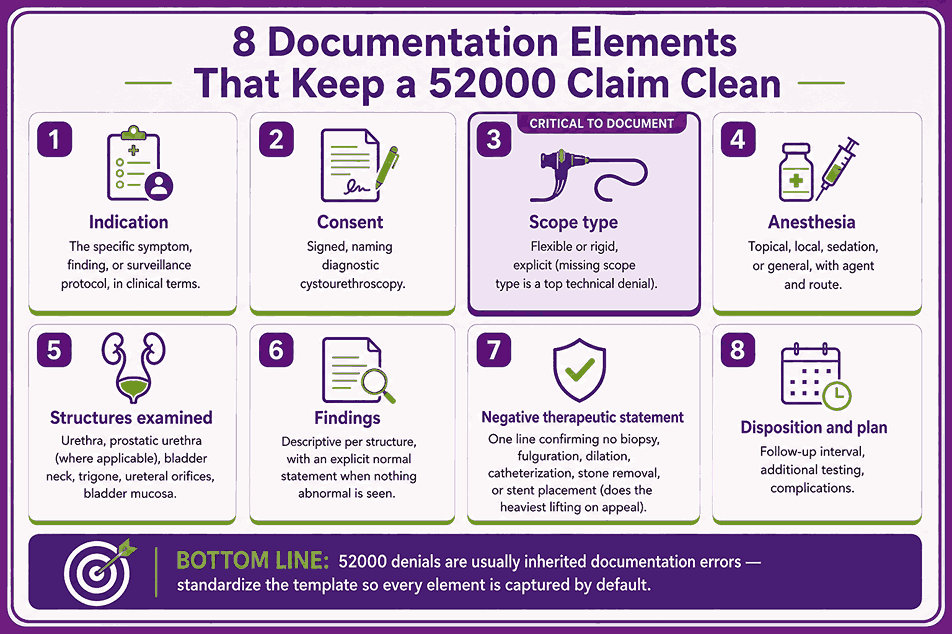
Denials on 52000 are rarely coding errors. They are documentation errors that a coder inherited. Standardize the operative template so every element below is captured by default.
- Indication: The specific symptom, finding, or surveillance protocol driving the exam, stated in clinical terms rather than as a diagnosis code.
- Consent: Signed procedural consent naming diagnostic cystourethroscopy.
- Scope type: Flexible or rigid, documented explicitly. Missing scope type is one of the most common technical denials on this code.
- Anesthesia: Topical, local, sedation, or general, with agent and route.
- Structures examined: Urethra, prostatic urethra where applicable, bladder neck, trigone, ureteral orifices, and bladder mucosa.
- Findings: Descriptive findings for each structure, including an explicit normal statement when nothing abnormal is seen.
- Negative therapeutic statement: A direct sentence confirming no biopsy, fulguration, dilation, catheterization, stone removal, or stent placement was performed.
- Disposition and plan: Follow-up interval, additional testing ordered, and complications if any.
What is the Cost of CPT Code 52000?
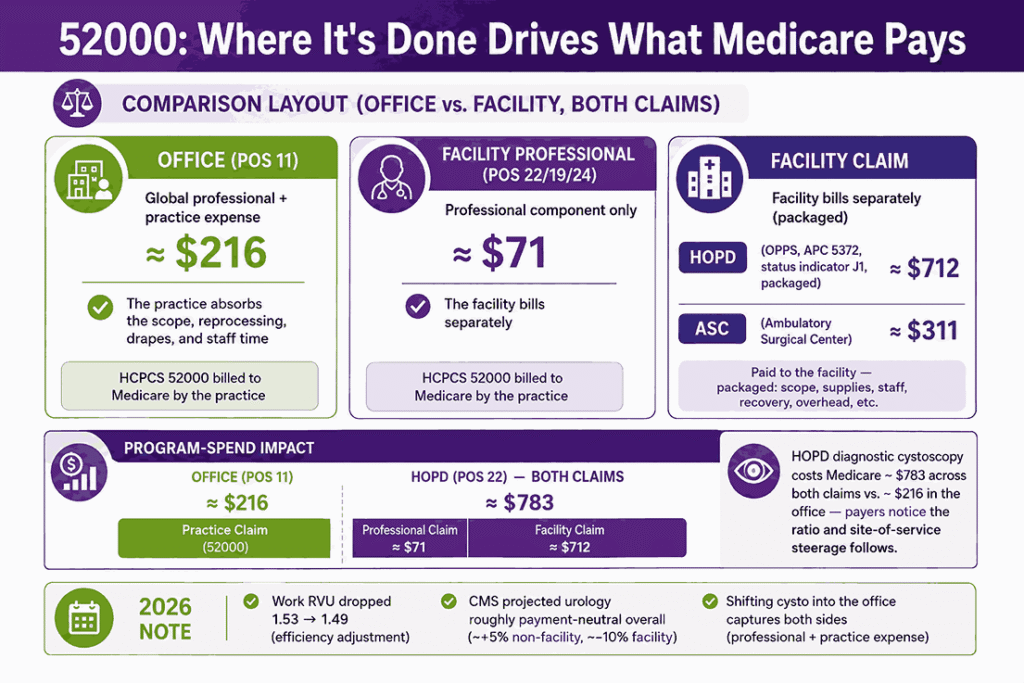
Payment for 52000 varies more by place of service than by payer. The 2026 Medicare spread between office and facility professional payment is roughly three to one.
CY 2026 introduced two structural changes that hit this code directly. CMS applied a negative 2.5% efficiency adjustment to work RVUs for most non-time-based services, and reduced the indirect practice expense allocated to facility-based services.
RVUs & Medicare Payment
The 2026 Medicare Physician Fee Schedule assigns 52000 a work RVU of 1.49, down from 1.53 after the CMS efficiency adjustment. Total RVUs and national allowed amounts follow.
| Component | Facility Setting | Non-Facility (Office) Setting |
|---|---|---|
| Work RVU | 1.49 | 1.49 |
| Total RVUs | 2.13 | 6.46 |
| 2026 conversion factor (non-APM) | $33.4009 | $33.4009 |
| National allowed amount | $71 | $216 |
CY 2026 is the first year with two conversion factors. Practitioners qualifying as advanced Alternative Payment Model participants use $33.5675. Everyone else uses $33.4009, a 3.26% increase over the 2025 factor of $32.3465.
The 4.33 RVU gap between settings is entirely practice expense. In the office, the practice absorbs the scope, the reprocessing, the drape and visit packs, and the clinical staff time. In a facility, those costs sit on the facility claim.
Specialty-level context: CMS projected the 2026 rule to be roughly payment-neutral for urology overall, with about a 5% increase for non-facility services and about a 10% decrease for facility-based services. Practices shifting diagnostic cystoscopy into the office capture both sides of that swing, which is why fee schedule rebuilds and POS logic are the first thing competent urology billing services address after a rule change.
Facility Payment Under OPPS and the ASC Fee Schedule
When 52000 is performed in a hospital outpatient department or ambulatory surgery center, the facility bills its own claim under a separate payment system. The physician still bills the facility professional rate. That split-claim structure, such as a technical component on one claim and a professional component on the other, is the core reconciliation problem in ASC billing services, and it is where most missed revenue on cystoscopy hides.
| Payment System | Assignment | 2026 National Rate |
|---|---|---|
| Hospital Outpatient (OPPS) | APC 5372, Level 2 Urology and Related Services, status indicator J1 | $712 |
| Ambulatory Surgery Center (ASC) | ASC covered procedure | $311 |
| Physician, facility setting (MPFS) | Professional component only | $71 |
| Physician, office setting (MPFS) | Global, professional plus practice expense | $216 |
Status indicator J1 means the facility payment is packaged. Adjunctive items and services on the same claim are folded into a single payment for the encounter rather than paid line by line.
The economics are worth modeling. Total Medicare spend for an HOPD diagnostic cystoscopy runs roughly $783 across both claims. The same exam in a urology office costs the program $216. Payers notice that ratio, and site-of-service steerage policies follow it.
Commercial Payers
Commercial rates for 52000 are contract-driven and rarely match Medicare. In-network urology contracts commonly land between 110% and 135% of the Medicare allowable, though ranges vary widely by market and network leverage.
Three commercial variables matter more than the headline multiplier:
- Prior authorization: Several national plans require authorization for cystoscopy tied to non-hematuria indications such as overactive bladder or chronic pelvic pain.
- Medical policy criteria: Plan policies name qualifying indications explicitly. Suspected fistula, suspected iatrogenic injury, and stricture evaluation are commonly listed as covered.
- Site-of-service policy: Many plans deny facility-setting cystoscopy outright when the exam could be performed in an office.
Published price transparency data shows how wide the spread runs. One analysis of hospital-disclosed prices for cystourethroscopy found a median commercial price of $1,179 against a median Medicare price of $572, with commercial interquartile range spanning $766 to $1,728.
Place-of-Service & Geographic Adjustments
Two variables move the number after the code is correct. Place of service selects which practice expense RVU applies. Geographic Practice Cost Indices (GPCIs) then adjust each component for locality.
The MPFS formula works like this:
Payment = [(Work RVU × Work GPCI) + (PE RVU × PE GPCI) + (MP RVU × MP GPCI)] × Conversion Factor
Practical rules for getting the place-of-service field right:
- POS 11 (office) triggers the non-facility rate of roughly $216
- POS 22 (on-campus outpatient hospital) and POS 19 (off-campus outpatient hospital) trigger the facility rate of roughly $71
- POS 24 (ambulatory surgical center) triggers the facility rate on the professional claim, with the ASC billing separately. 52000 appears on the ASC covered procedures list, and like most ASC CPT codes, it is paid under the ASC fee schedule on a claim the facility submits separately.
- A mismatch between POS and the rendering location is a recoupment finding in post-payment review, not a soft error
Locality swings are material. High-cost metropolitan localities can exceed the national average by double digits, while rural localities fall below it. Build fee schedules from your MAC’s locality file rather than from national averages.
What Are Example Clinical Scenarios or Use Cases for CPT Code 52000?
The five scenarios below cover the encounters where 52000 is most often billed and most often denied. Each pairs the clinical picture with the coding decision it produces.
Scenario 1: Gross Hematuria Evaluation With No Identified Lesion
A 68-year-old man with a 30 pack-year smoking history presents with painless visible blood in his urine. The urologist performs office flexible cystoscopy under topical lidocaine.
The urethra, prostatic urethra, bladder neck, trigone, and bladder mucosa are inspected. Both ureteral orifices efflux clear urine. No lesion, stone, or mucosal abnormality is identified.
Coding: 52000, POS 11, linked to R31.0. A negative exam does not reduce payment or medical necessity. The indication justified the procedure, and gross hematuria carries a malignancy detection rate near 11%.
Scenario 2: Bladder Cancer Surveillance Cystoscopy in a Non-Muscle-Invasive Patient
A patient treated for low-grade Ta urothelial carcinoma returns for scheduled surveillance. The AUA/SUO non-muscle-invasive bladder cancer guideline sets the intervals below for patients whose first surveillance cystoscopy is negative.
| Risk Group | Surveillance Cystoscopy Interval |
|---|---|
| Low risk | Next exam at 6 to 9 months, then annually |
| Intermediate risk | Every 3 to 6 months for 2 years, then 6 to 12 months for years 3 and 4, then annually |
| High risk | Every 3 to 4 months for 2 years, then every 6 months for years 3 and 4, then annually |
Coding: 52000 alone when the exam is purely visual. Sequence the diagnosis carefully. If disease is active, use the C67 code. If the patient is disease-free and under surveillance, Z85.51 supports the encounter but cannot stand as the principal diagnosis.
If a recurrent tumor is fulgurated during the same session, 52000 disappears from the claim and the resection code by tumor size takes its place.
Scenario 3: Recurrent Urinary Tract Infections Requiring Bladder Inspection
A 54-year-old woman has four culture-proven urinary tract infections in twelve months. Imaging is unremarkable. Moreover, the urologist performs diagnostic cystoscopy to rule out a bladder diverticulum, retained foreign body, or fistula.
The exam identifies mild trigonitis and no structural cause. No intervention is performed.
Coding: 52000 linked to N39.0, with the recurrence pattern documented in the indication. Payers deny this scenario when the note reads “recurrent UTI” without the count, the culture results, or the negative imaging that preceded the exam.
Practical tip: put the infection count and the ruled-out differential in the indication line, not buried in the history. Reviewers read the indication first.
Scenario 4: Same-Day Office Evaluation and Diagnostic Cystoscopy
An established patient presents for a scheduled cystoscopy for stricture surveillance. During the visit, he reports new-onset flank pain and fevers. The urologist performs a separate problem-focused evaluation, orders imaging and labs, then proceeds with the planned cystoscopy.
Coding: the appropriate office E/M code with modifier 25, plus 52000. The E/M addressed a problem unrelated to the decision to scope, and the work is documented separately.
What would fail: performing the history and exam that support the cystoscopy, then billing an E/M with modifier 25. That work is already inside the 52000 payment.
Scenario 5: Intraoperative Cystoscopy to Confirm Ureteral Integrity
A gynecologic surgeon completes a laparoscopic hysterectomy. Near the end of the case, cystoscopy is performed to confirm bilateral ureteral efflux and rule out bladder injury.
Coding: 52000 is not separately reportable. NCCI Chapter VII states directly that a cystourethroscopy performed near the termination of an intra-abdominal, intra-pelvic, or retroperitoneal surgical procedure to confirm there was no intraoperative injury to the ureters or bladder is not separately reportable with that surgical procedure.
This is the single most misreported scenario in the 52000 family. Multiple published coding guides recommend appending modifier 59 or 51 here. That guidance conflicts with CMS policy and produces recoupments in post-payment review.
The exam becomes reportable only when it is not confirmatory. If a new intraoperative finding prompts a diagnostic survey with its own documented indication and its own findings, 52000 with modifier XU may apply. Confirming your own surgical work never qualifies.
What Are the CPT Code 52000 Rules To Ensure Successful Reimbursement?
Reimbursement on 52000 turns on four rule sets: NCCI bundling, unit limits, global period logic, and diagnosis linkage. Each fails in a predictable way, and each has a fix that lives in documentation rather than in modifier selection.
Bundling / NCCI / Same-Day Procedure Rules
CPT 52000 functions as the Column Two code against therapeutic cystoscopy codes. When both appear on a claim for the same session, the edit drops 52000 before any human reviews the note.
The governing NCCI principles for this code family:
- Surgical endoscopy includes diagnostic endoscopy. If a diagnostic scope leads to a surgical scope in the same encounter, only the surgical code is reported.
- Endoscopic procedures include all minor related functions. Transurethral resection of the prostate, for example, includes meatotomy, urethral calibration or dilation, urethroscopy, and cystoscopy. None are separately reportable.
- Most extensive code wins. When several endoscopic procedures occur in one session, report the most extensive code that accurately describes the work.
- Fluoroscopy is integral. CPT 76000 and 77002 are never reported alongside a cystourethroscopy code.
- Bladder catheterization is bundled. CPT 51701 through 51703 are not reportable with any procedure carrying a 000, 010, or 090-day global period.
Check the correct coding modifier indicator before reaching for a modifier. An indicator of 0 means the pair can never be unbundled. The 52000 and 57288 pair, cystoscopy with a sling operation for stress incontinence, carries a 0 indicator.
Units, MUEs & Frequency Rules
CPT 52000 is a single-unit code. The Medically Unlikely Edit (MUE) for practitioner services allows one unit per beneficiary per date of service.
The bladder is a single organ examined through a single orifice. There is no laterality, no second site, and no clinical basis for a second unit on the same date.
- Never append modifier 50 to 52000. The procedure is not bilateral.
- Never split 52000 across two claim lines to bypass the unit cap. CMS names this pattern as a coding error, not a workaround.
- Never move a second exam to a different date solely to avoid an MUE or PTP edit. NCCI policy prohibits scheduling around edits.
- Do verify the current MUE value and adjudication indicator in the quarterly CMS Practitioner Services MUE file before building claim edits.
Frequency limits are set by medical necessity, not by the code. Surveillance cystoscopy at guideline intervals is defensible. Cystoscopy every eight weeks on a low-risk surveillance patient invites a utilization review.
0-Day Global Period and Same-Day E/M Billing
A 0-day global period means no bundled postoperative days. Follow-up care on a later date is separately reportable when medically necessary and documented.
Same-day E/M is where the money is won or lost. The rules that decide it:
| Situation | Reportable? | Modifier |
|---|---|---|
| Pre-procedure history and exam supporting the cystoscopy | No | None |
| Decision to perform the cystoscopy | No | None |
| New patient status alone | No | None |
| Significant E/M unrelated to the decision to scope | Yes | 25 on the E/M code |
| E/M addressing the same diagnosis but distinct work | Yes | 25 on the E/M code |
| Post-procedure visit on a later date, related to recovery | Yes | None |
The fifth row surprises people. Per NCCI Chapter VII, the E/M service and the minor surgical procedure do not require different diagnoses. The test is whether the E/M work is significant and separately identifiable, not whether the diagnosis differs.
When CPT 52000 Cannot Be Billed Separately and What to Use Instead
The table below maps the situations where 52000 is not reportable to the code that replaces it.
| Clinical Situation | Do Not Bill | Bill Instead |
|---|---|---|
| Bladder or urethral tissue sampled | 52000 + 52204 | 52204 only, one unit |
| Ureteral catheter placed for specimen or retrograde study | 52000 + 52005 | 52005 only |
| Obstructing clots irrigated and evacuated | 52000 + 52001 | 52001 only |
| Indwelling ureteral stent inserted | 52000 + 52332 | 52332 only |
| Bladder tumor fulgurated or resected | 52000 + 52234-52240 | Resection code by tumor size |
| Ureteroscopy performed in the same session | 52000 + 52351-52356 | Ureteroscopy code only |
| Sling operation for stress incontinence | 52000 + 57288 | 57288 only; indicator 0, never unbundle |
| Confirmatory scope at the end of pelvic surgery | 52000 + surgical code | Surgical code only |
| Endoscopic approach converted to open | 52000 + open code | Open code only |
| Botulinum toxin injected into the bladder | 52000 + 52287 | 52287 plus the drug HCPCS |
| Transurethral bulking agent injected | 52000 or 52287 | 51715 plus the agent HCPCS |
Top Reasons For Denials Specific To 52000 & Quick Remedies
The table below highlights the most common CPT 52000 denial reasons and the quick remedies to address them.
| Denial Driver | What Triggers It | Fix |
|---|---|---|
| NCCI unbundling | 52000 submitted alongside a therapeutic cystoscopy code | Report only the therapeutic code; do not force it with modifier 59 |
| Missing scope type | Note omits flexible versus rigid | Add a required scope-type field to the operative template |
| Weak medical necessity | Vague indication or an unspecified diagnosis such as R31.9 | Document the specific finding and code to the highest specificity |
| Microhematuria risk gap | R31.21 billed without risk factors supporting cystoscopy | Record age, sex, smoking history, and RBC count in the indication |
| Modifier 59 misuse | 59 appended without a distinct service | Reserve 59 and the X modifiers for genuinely separate encounters or sites |
| Same-day E/M bundling | E/M billed for the work that supports the scope | Bill E/M only for significant, separately identifiable work |
| Place-of-service mismatch | POS 11 billed for a service rendered in an HOPD | Reconcile POS against the rendering location before submission |
| Z85.51 as principal | Surveillance claim led with a history code | Sequence an active finding or Z08 per official guidelines |
| Unit excess | More than one unit of 52000 on a date of service | Correct to one unit; never use modifier 50 |
| Intraoperative confirmation | 52000 billed for verifying ureteral integrity | Remove the line; the exam is bundled into the surgical procedure |
Does the “Separate Procedure” Designation Apply Beyond CPT 52000?
The designation appears across hundreds of CPT codes and behaves the same way everywhere. Any descriptor containing the phrase is subject to NCCI PTP edits on that basis
Within the urinary and genital chapter, several codes carry it:
- 52310 and 52315, cystourethroscopy with removal of foreign body, calculus, or ureteral stent. Per CMS policy, these cannot be reported with other cystourethroscopy codes for the same encounter.
- 50650, ureterectomy with bladder cuff. CMS does not allow additional payment when it is performed with other procedures in an anatomically related area.
- 49400, injection of air or contrast into the peritoneal cavity, which is integral to many laparoscopic procedures.
The governing test is consistent across all of them. A separate-procedure code is not payable when performed at the same encounter as another procedure in an anatomically related area through the same skin incision, orifice, or surgical approach.
Read the phrase as a warning rather than an allowance. Every time it appears in a descriptor, the code is a candidate for bundling before it is a candidate for payment.