
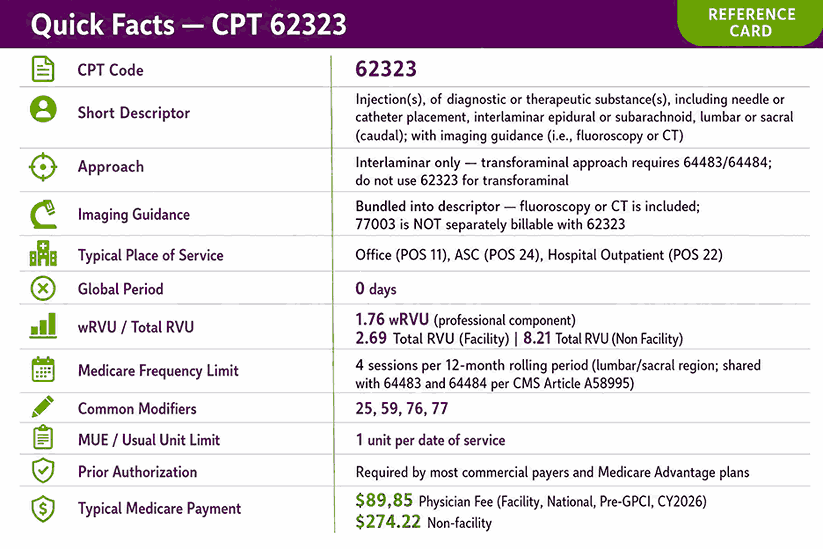
CPT code 62323 reports an interlaminar epidural or subarachnoid injection in the lumbar or sacral spine. The procedure uses imaging guidance, either fluoroscopy or CT. Physicians inject steroids, anesthetics, or other therapeutic substances near the spinal nerves.
The code belongs to a four-code interlaminar family maintained by the American Medical Association (AMA). Its siblings cover the cervical/thoracic region and the non-imaging versions of each injection. Correct selection depends on anatomy, technique, and whether imaging was used.
Epidural steroid injections rank among the highest-volume pain management procedures billed in the United States. CPT 62323 also generates a heavy share of denials. Wrong approach codes, missing imaging notes, and frequency errors drive most of those rejections.
Approach selection, bundled imaging, and frequency caps make this a high-denial code, which is why many practices route injections through expert pain management billing. This article covers the full 62323 description, its cost and RVUs, real clinical scenarios, and the reimbursement rules that protect payment.
What Is the Description of CPT Code 62323?
CPT 62323 describes a single-region, single-level interlaminar epidural injection in the lower spine performed under imaging. The official AMA descriptor reads: injection(s) of diagnostic or therapeutic substance(s), not including neurolytic substances, including needle or catheter placement, interlaminar epidural or subarachnoid, lumbar or sacral (caudal); with imaging guidance (fluoroscopy or CT).
The code applies only when imaging confirms needle position during the procedure. The interlaminar route delivers medication into the general epidural space between adjacent laminae.
What Does the Interlaminar Lumbar/Sacral Epidural Injection With Imaging Guidance Include for CPT Code 62323?
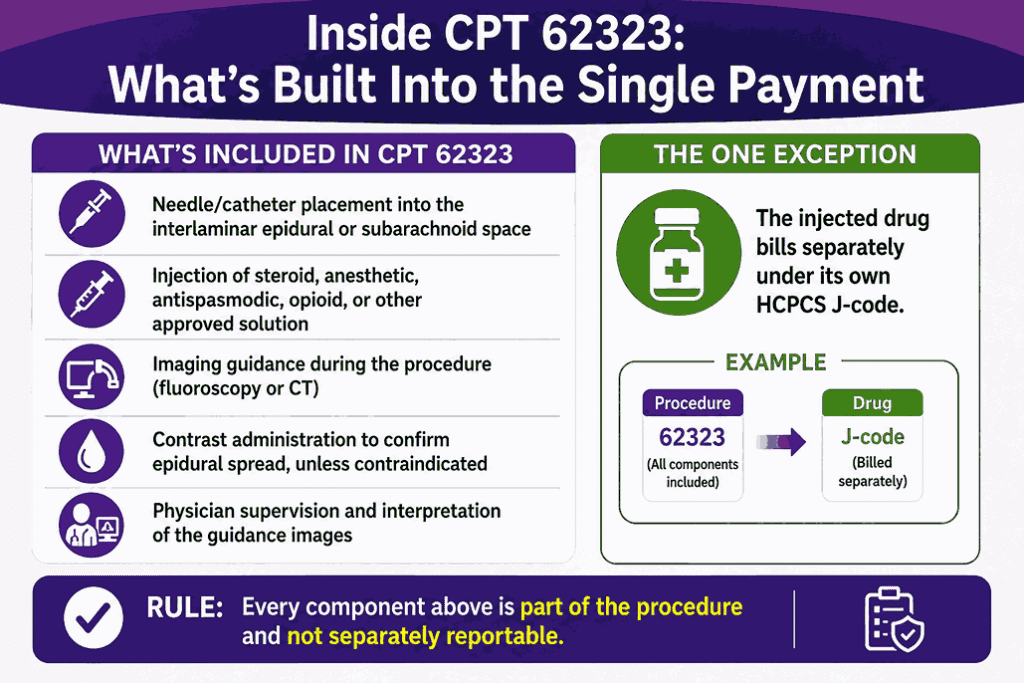
The 62323 service bundles several components into one billable unit. Each element below is part of the procedure and not separately reportable.
- Needle or catheter placement into the interlaminar epidural or subarachnoid space
- Injection of steroid, anesthetic, antispasmodic, opioid, or other approved solution
- Imaging guidance during the procedure, either fluoroscopy or CT
- Contrast administration to confirm epidural spread, unless contraindicated
- Physician supervision and interpretation of the guidance images
The injected medication itself is the one item billed separately. That drug reports under its own HCPCS J-code, which we cover below.
Why CPT 62323 Is for the Interlaminar Approach Only and When 64483/64484 Must Be Used Instead
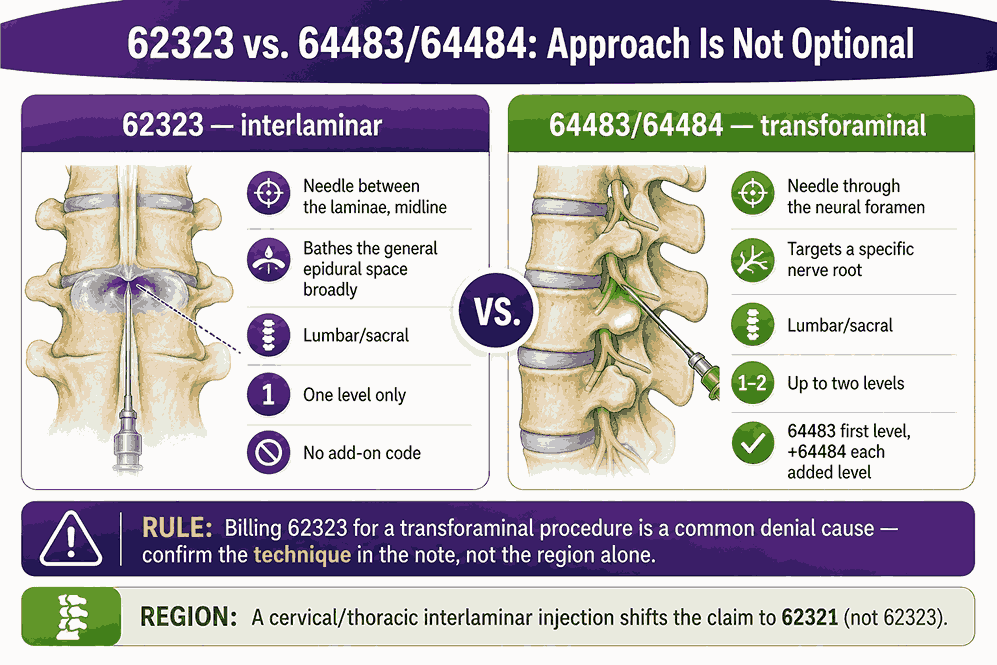
The interlaminar approach places the needle between the laminae into the midline epidural space. It bathes the region broadly rather than targeting one nerve root. CPT 62323 is correct only for this technique in the lumbar or sacral spine.
The transforaminal approach is a different procedure with different codes. The needle passes through the neural foramen to reach a specific nerve root.
| Feature | CPT 62323 (Interlaminar) | CPT 64483 / 64484 (Transforaminal) |
|---|---|---|
| Approach | Between laminae, midline | Through the neural foramen |
| Target | General epidural space | Specific nerve root |
| Region | Lumbar or sacral | Lumbar or sacral |
| Levels per session | One level only | Up to two levels |
| Primary code | 62323 | 64483 (first level) |
| Add-on code | None | 64484 (each added level) |
Approach and level drive selection throughout the pain management procedure codes, where technique separates otherwise similar injections. Use 64483 for a single-level lumbar or sacral transforaminal injection under imaging. Add 64484 for each additional level. Billing 62323 for a transforaminal procedure is a common denial cause.
Why Imaging Guidance (77003, 77012, 76942) Cannot Be Separately Billed With CPT Code 62323
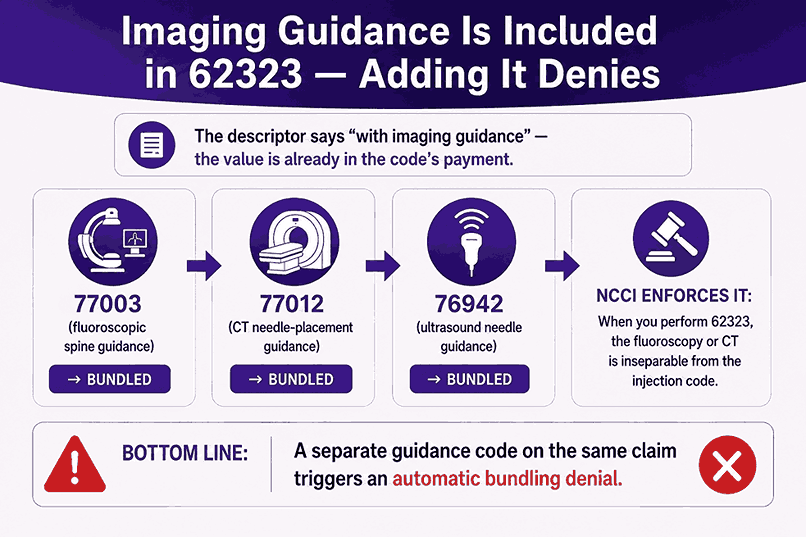
Imaging is written into the 62323 descriptor with the phrase “with imaging guidance.” The value of that guidance is already built into the code’s payment. Billing a separate guidance code triggers an automatic bundling denial.
The guidance codes below are packaged into 62323 and should not appear on the same claim for the same procedure.
- 77003: Fluoroscopic guidance for spine injection procedures
- 77012: CT guidance for needle placement
- 76942: Ultrasound guidance for needle placement
The National Correct Coding Initiative (NCCI) enforces these bundles. When you perform 62323, the fluoroscopy or CT is inseparable from the injection code itself.
How Does CPT Code 62323 Differ From CPT 62321 (Cervical/Thoracic, With Imaging)?
Both codes report interlaminar epidural injections performed under imaging guidance. The only difference is the spinal region treated. Region selection is not optional and drives medical necessity review.
| Attribute | CPT 62321 | CPT 62323 |
|---|---|---|
| Region | Cervical or thoracic | Lumbar or sacral (caudal) |
| Approach | Interlaminar | Interlaminar |
| Imaging | Included (fluoroscopy or CT) | Included (fluoroscopy or CT) |
| Levels per session | One level | One level |
| Bilateral billing | Not appropriate | Not appropriate |
Document the exact region and level in the operative note. Notation such as “L4-L5 interlaminar epidural injection” supports 62323. A cervical or thoracic level shifts the claim to 62321.
How Is the Steroid Medication (J-Code) Billed Separately From CPT Code 62323
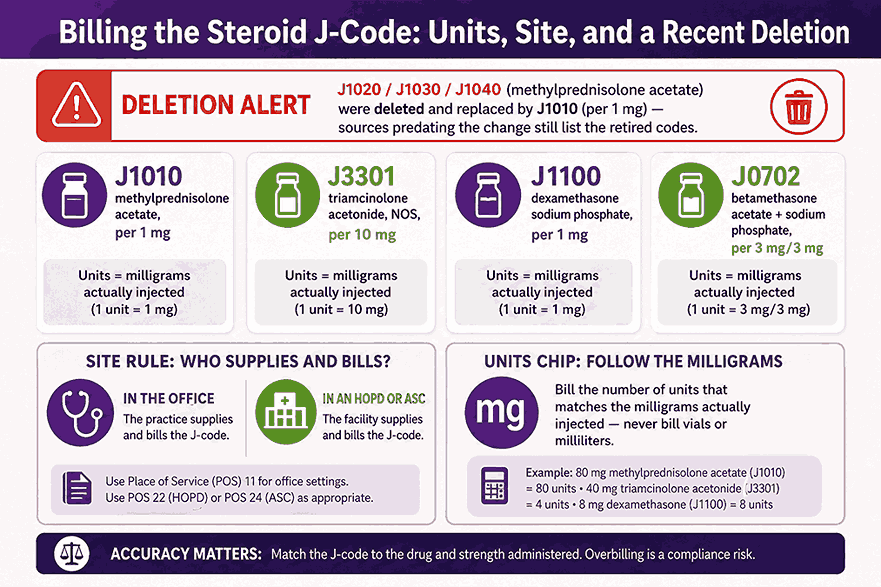
The 62323 code pays for the procedure, not the drug. The corticosteroid or anesthetic reports under a separate HCPCS Level II J-code. Units follow the milligrams actually injected.
Note a recent change. The older methylprednisolone acetate codes J1020, J1030, and J1040 were deleted and replaced by J1010 (per 1 mg). Sources published before that change still list the retired codes.
| J-Code | Drug | Billing Unit |
|---|---|---|
| J1010 | Methylprednisolone acetate | Per 1 mg (replaced J1020/J1030/J1040) |
| J3301 | Triamcinolone acetonide, NOS | Per 10 mg |
| J1100 | Dexamethasone sodium phosphate | Per 1 mg |
| J0702 | Betamethasone acetate + sodium phosphate | Per 3 mg / 3 mg |
Who bills the drug depends on the site of service. In an office, the practice supplies the drug and bills the J-code. In a hospital outpatient department or ASC, the facility supplies and bills it. Confirm J-code separability with each payer before submission.
What ICD-10 Codes and Medical Necessity Criteria Support CPT Code 62323?
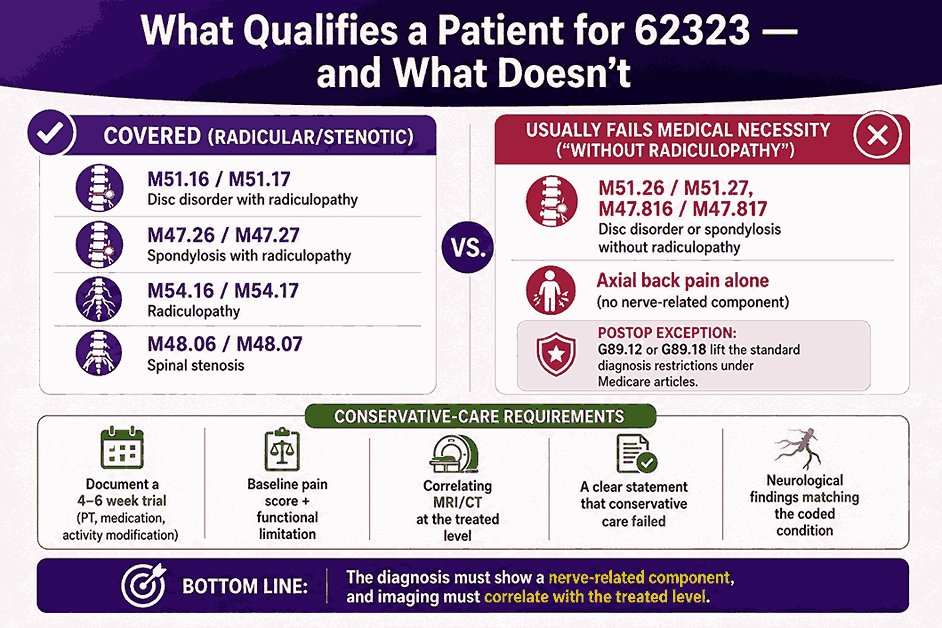
Payers cover 62323 only for a documented radicular or stenotic condition of the lower spine. The diagnosis must show a nerve-related component, not axial back pain alone. Imaging findings should correlate with the treated level.
| ICD-10 Code | Description |
|---|---|
| M51.16 | Intervertebral disc disorder with radiculopathy, lumbar region |
| M51.17 | Intervertebral disc disorder with radiculopathy, lumbosacral region |
| M47.26 | Other spondylosis with radiculopathy, lumbar region |
| M47.27 | Other spondylosis with radiculopathy, lumbosacral region |
| M54.16 | Radiculopathy, lumbar region |
| M54.17 | Radiculopathy, lumbosacral region |
| M48.06 | Spinal stenosis, lumbar region |
| M48.07 | Spinal stenosis, lumbosacral region |
The “without radiculopathy” codes usually fail medical necessity for epidural injections. Examples include M51.26, M51.27, M47.816, and M47.817. For postoperative pain, G89.12 or G89.18 lift the standard diagnosis restrictions under Medicare articles.
What Are the Conservative Treatment Failure Documentation Requirements Before CPT 62323 Can Be Authorized?
Most payers require documented failure of conservative care before approving an epidural injection. The record must show a real trial, not a single office note. This is a frequent audit target for pain management practices.
The chart should establish each of the following before the injection date:
- A conservative care trial, commonly four to six weeks, of physical therapy, medication, or activity modification
- A baseline pain score and a documented functional limitation from the radicular condition
- Imaging (MRI or CT) that correlates with the clinical level being treated
- A clear statement that conservative measures failed to control symptoms
- Neurological findings consistent with the coded radiculopathy or stenosis
Missing or vague conservative care notes are one of the top reasons 62323 prior authorizations are denied. Build a template that captures these fields at intake.
What are the Modifiers for CPT Code 62323?
Modifiers tell the payer why an extra service on the same day is valid. The four below appear most often with 62323. Note that modifier 50 does not apply, since interlaminar epidurals are not bilateral procedures.
Modifier 25: Significant, Separately Identifiable E/M on Same Day as Injection
Append modifier 25 to the E/M code when a distinct evaluation happens on the injection day. The visit must go beyond the routine pre-procedure assessment. Document a separate history, exam, and decision-making for the E/M service.
Use this when a new problem or a change in status prompts a full evaluation. Without modifier 25, the payer bundles the E/M into the procedure.
Modifier 59: Distinct Procedural Service When Combined With Another Spine Procedure Same Day
Modifier 59 identifies a procedure that is separate from another service performed the same day. It applies when two distinct procedures at different sites are clinically appropriate. Payers scrutinize modifier 59 closely, so documentation must support true separateness.
Many payers now prefer the more specific X modifiers, such as XS for a separate structure. Check each payer’s policy before choosing 59 or an X modifier.
Modifier 76: Repeat Procedure by Same Physician
Modifier 76 reports a repeat of the same procedure by the same physician. It signals that the second service was a true repeat, not a duplicate claim. Same-day repeats at 62323 are rare and draw review, so document the clinical reason.
Modifier 77: Repeat Procedure by Another Physician
Modifier 77 reports the same procedure repeated by a different physician. The clinical justification for a second provider must appear in the record. Use it only when the repeat is medically warranted.
Which Documents Are Required For CPT Code 62323?
Clean 62323 claims rest on a specific documentation set. Missing any item invites a denial or an audit finding. Assemble these before the claim leaves the practice.
- Physician order and signed procedure note describing region, level, and laterality
- Explicit statement that fluoroscopy or CT guidance was used
- Confirmation of contrast spread or a documented contraindication
- Drug name, dosage, and volume injected for the J-code
- Correlating imaging report (MRI or CT) at the treated level
- Baseline pain score and documented conservative care failure
- A covered ICD-10 diagnosis linked to the procedure
What is the Cost of CPT Code 62323?
The cost of 62323 depends on setting, geography, and payer. Medicare pays far more in the office than in a facility. That gap exists because the office fee includes the imaging and equipment overhead.
Commercial rates often track a multiple of the Medicare allowable. The examples below use verified national figures as an anchor.
RVUs & Medicare Payment
Medicare pays 62323 using relative value units (RVUs) multiplied by the annual conversion factor. In 2025, the national non-facility figures were verified as follows.
| Component | 2025 Value (Non-Facility) |
|---|---|
| Work RVU | 1.80 |
| Practice Expense RVU | 5.66 |
| Malpractice RVU | 0.17 |
| Total RVU | 7.63 |
| National payment | About $246.80 at the $32.35 conversion factor |
For 2026, CMS set the non-qualifying-APM conversion factor at $33.40. A negative 2.5% efficiency adjustment applies to the work RVUs of non-time-based codes like this one. Practices should pull the current MPFS Addendum B for the exact 2026 value, which lands near $250 in the office setting.
Commercial Payers
Commercial contracts do not follow one formula. Many set 62323 at a percentage of the Medicare allowable, often between 120% and 200%. Others use proprietary fee schedules negotiated by specialty and region.
Three factors shape a commercial 62323 rate in practice:
- The negotiated multiple of the Medicare fee schedule in your contract
- Whether the plan bundles or separately pays the drug J-code
- Prior authorization and site-of-service policies that steer procedures to lower-cost settings
Always verify the specific plan’s allowable and its drug policy before quoting a rate to patients.
Place-of-Service & Geographic Adjustments
Site of service changes the payment sharply. The office (place of service 11) earns the full non-facility fee, which includes imaging overhead. A hospital outpatient department or ASC earns only the professional component, and the facility bills its own fee.
Geography then adjusts the payment through the Geographic Practice Cost Index (GPCI). CMS applies a separate GPCI to the work, practice expense, and malpractice components.
| Setting | What 62323 Pays | Why |
|---|---|---|
| Office (POS 11) | Full non-facility fee | Practice carries imaging and equipment cost |
| Hospital outpatient (POS 22) | Professional component only | Facility bills the technical portion |
| ASC (POS 24) | Professional component only | ASC bills its own facility fee |
Splitting the professional and facility components correctly at each site is routine work for ambulatory surgery center billing, where the technical portion never rides the physician claim.
What Are Example Clinical Scenarios or Use Cases for CPT Code 62323?
The scenarios below show how 62323 applies in daily pain management practice. Each pairs the clinical picture with the coding decision. All three assume documented conservative care failure and correlating imaging.
Scenario 1: Lumbar Radiculopathy With L4-L5 Disc Herniation Causing Unilateral Leg Pain Refractory to Conservative Treatment
A 45-year-old patient reports months of left leg pain radiating below the knee. MRI confirms an L4-L5 disc herniation contacting the exiting nerve root. Six weeks of physical therapy and medication brought no lasting relief.
The physician performs an interlaminar lumbar epidural injection at L4-L5 under fluoroscopy. Contrast confirms epidural spread before the steroid is injected.
- Procedure code: 62323 (imaging included, one level)
- Diagnosis: M51.16, intervertebral disc disorder with radiculopathy, lumbar region
- Drug: appropriate steroid J-code for the agent and dose used
Scenario 2: Lumbar Spinal Stenosis With Bilateral Lower Extremity Neurogenic Claudication
A 68-year-old patient has bilateral leg heaviness that worsens with walking and eases with sitting. MRI shows moderate central canal stenosis at L4-L5. The clinical picture fits neurogenic claudication from lumbar stenosis.
The interlaminar route suits this case because it spreads medication across the midline space. That single midline injection can reach both sides without bilateral billing.
- Procedure code: 62323, reported once, not billed bilaterally
- Diagnosis: M48.06, spinal stenosis, lumbar region
- Coding note: interlaminar epidurals are not bilateral procedures, so modifier 50 does not apply
Scenario 3: Failed Back Surgery Syndrome With Persistent Axial and Radicular Pain After Prior Laminectomy
A 55-year-old patient has ongoing leg and back pain two years after an L5 laminectomy. Imaging shows postsurgical changes with residual nerve root irritation. Conservative care again failed to control the radicular component.
Prior surgery alters the interlaminar anatomy, so the physician plans the level and approach carefully. Some clinicians favor a transforaminal or caudal route in this setting, which changes the code.
- Procedure code: 62323 when the interlaminar approach is used and documented
- Diagnosis: M96.1, postlaminectomy syndrome, plus the applicable radiculopathy code
- Coding note: if the approach becomes transforaminal, report 64483 and 64484 instead
What Are the CPT Code 62323 Rules To Ensure Successful Reimbursement?
Payment for 62323 turns on a tight set of coding and coverage rules. Most denials trace back to a rule broken at the point of service. The sections below map the rules that matter most.
Bundling / NCCI / Same-Day Procedure Rules
The NCCI edits control what you can report alongside 62323. Imaging guidance is bundled into the code and never billed separately. Same-region procedures often conflict on the same date.
- Do not bill 77003, 77012, or 76942 with 62323, since guidance is included
- Do not report a non-imaging epidural code (62322) for the same service
- Only one spinal region may be treated per session per Medicare articles
- Use modifier 59 or an X modifier only when a truly distinct procedure is documented
Same-session bundling questions like these recur across the procedures performed in ASCs, where one region per date is the usual constraint.
Units, MUEs & Per-Region Epidural Frequency Limits
CPT 62323 is a one-level, one-region service, so its Medically Unlikely Edit (MUE) is one unit per date of service. Reporting more than one unit invites an automatic reduction. Frequency limits then cap how often the injection repeats.
| Rule | Standard |
|---|---|
| Levels per session | One level only for 62323 |
| Regions per session | One spinal region per date of service |
| MUE (practitioner) | One unit per date of service |
| Rolling 12-month cap | No more than four epidural sessions per anatomic region under current Medicare articles |
Unit limits sit outside the descriptor itself, a distinction that runs through the whole CPT code structure rather than any single code. Payers vary on frequency. Some commercial plans allow an initial diagnostic and therapeutic series, then a maintenance limit. Verify the exact cap in the governing LCD, MAC article, or commercial policy.
Drug Billing Rules: When J-Codes Are Separately Reportable and When They Are Not
The injected drug is separately reportable in most office settings, subject to payer rules. The practice bills the J-code only when it incurs the drug cost. In a facility, the facility bills the drug, not the physician.
- Report the J-code with units matching the milligrams injected
- Bill the drug from the office (POS 11) when the practice supplies it
- Do not bill the drug when a hospital or ASC supplied it
- Confirm each payer’s stance, since Medicare and commercial rules differ
Prior Authorization and Step-Therapy Documentation Requirements
Most plans require prior authorization for 62323 and proof of step therapy. Step therapy means conservative care was tried first and failed. The authorization file must show that trial in the record.
The strongest authorization packages include these elements:
- Documented conservative care trial with dates and outcomes
- Correlating MRI or CT at the treated level
- Baseline pain score and functional impact
- A covered ICD-10 code with a radicular or stenotic component
Top Reasons For Denials Specific To 62323 & Quick Remedies
Denials on 62323 cluster around a short list of avoidable errors. Fixing the intake and coding workflow removes most of them. The table below pairs each denial with a direct remedy.
| Denial Reason | Quick Fix |
|---|---|
| Wrong approach code (transforaminal billed as 62323) | Confirm technique; use 64483/64484 for transforaminal |
| Imaging billed separately | Remove 77003, 77012, or 76942 from the claim |
| Missing conservative care documentation | Attach the failed conservative trial and dates |
| Frequency limit exceeded | Track sessions per region against the 12-month cap |
| No imaging or contrast note | Document fluoroscopy or CT and contrast spread |
| Bilateral billing attempted | Report 62323 once; do not append modifier 50 |
| Same-day E/M denied | Append modifier 25 with a separate, documented visit |
| Non-covered diagnosis | Use a covered radiculopathy or stenosis ICD-10 code |
Accurate 62323 billing rests on three habits: pick the right approach code, keep imaging bundled, and document conservative care and medical necessity. Practices that build these checks into intake see fewer denials and faster payment. Verify current RVUs, MUE values, and MAC frequency limits each year, since CMS updates them annually.