
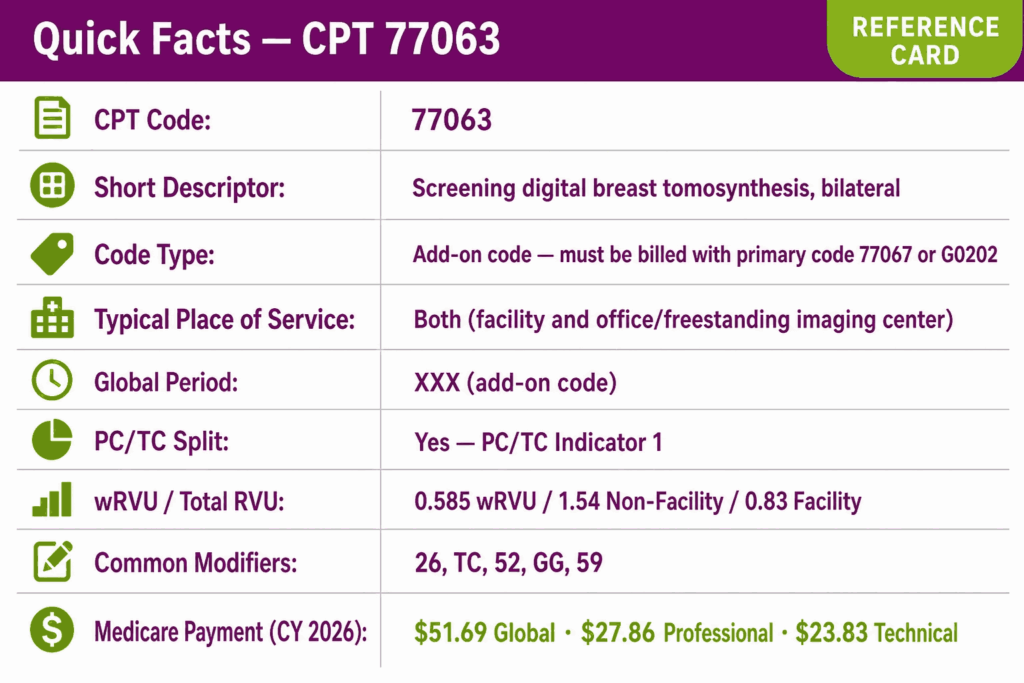
CPT code 77063 is a bilateral add-on code used to report screening digital breast tomosynthesis (3D mammography) performed in conjunction with standard 2D screening mammography. Procedure code 77063 captures the additional imaging work involved when tomosynthesis is used to generate multi-angle, three-dimensional breast images alongside the primary two-dimensional screening study. Code 77063 CPT is designated a preventive service under Medicare and is exempt from beneficiary coinsurance and deductible when billed with the primary screening mammography code 77067.
What Is the Description of CPT Code 77063?
77063 CPT code description as defined by the AMA is: “Screening digital breast tomosynthesis, bilateral (list separately in addition to code for primary procedure).”
77063 is classified as an add-on code, denoted by the “+” symbol in the CPT code set, and may only be reported alongside a primary screening mammography code. CPT code 77063 covers bilateral tomosynthesis only. Unilateral tomosynthesis is reported using modifier 52.
What Does Screening Digital Breast Tomosynthesis Include for CPT Code 77063?
The procedure reported under procedure code 77063 involves acquisition of multiple low-dose X-ray exposures of each breast from varying angles. These are then reconstructed into thin-slice, three-dimensional images on a computer workstation. These images allow the radiologist to scroll through breast tissue layer by layer, improving detection of early-stage cancers and reducing false-positive call-back rates compared to standard two-dimensional mammography.
The two-dimensional images required by the FDA to accompany digital breast tomosynthesis may be either acquired directly or synthesized from the tomosynthesis data. Either approach supports reporting of the CPT 77063 code without changing the code selected. Interpretation and reporting of the tomosynthesis images is included in code 77063 CPT.
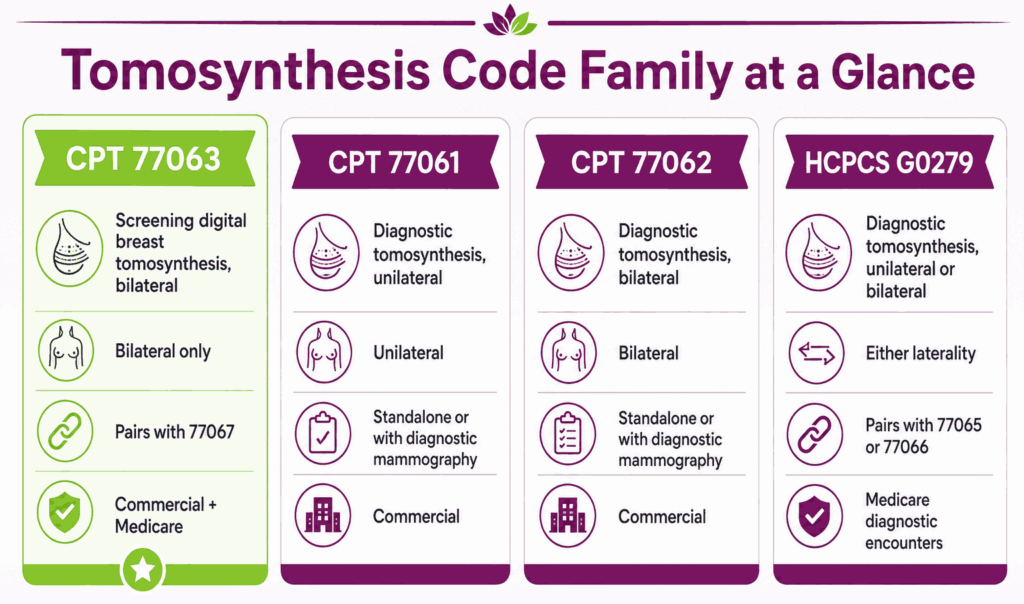
How Does CPT Code 77063 Differ From CPT 77061, 77062, and Diagnostic Add-on Code G0279?
These codes cover distinct tomosynthesis applications and must not be used interchangeably with procedure code 77063:
- CPT 77061: Diagnostic digital breast tomosynthesis, unilateral. Covers a one-sided diagnostic tomosynthesis study; may be reported standalone or alongside a diagnostic mammography code for commercial payers
- CPT 77062: Diagnostic digital breast tomosynthesis, bilateral. Same as 77061 but bilateral; used in a diagnostic rather than screening context
- HCPCS G0279: Diagnostic digital breast tomosynthesis, unilateral or bilateral (list separately in addition to 77065 or 77066). Created by CMS specifically for use with diagnostic mammography codes for Medicare patients. G0279 is the diagnostic counterpart to CPT code 77063 and must not be confused with it
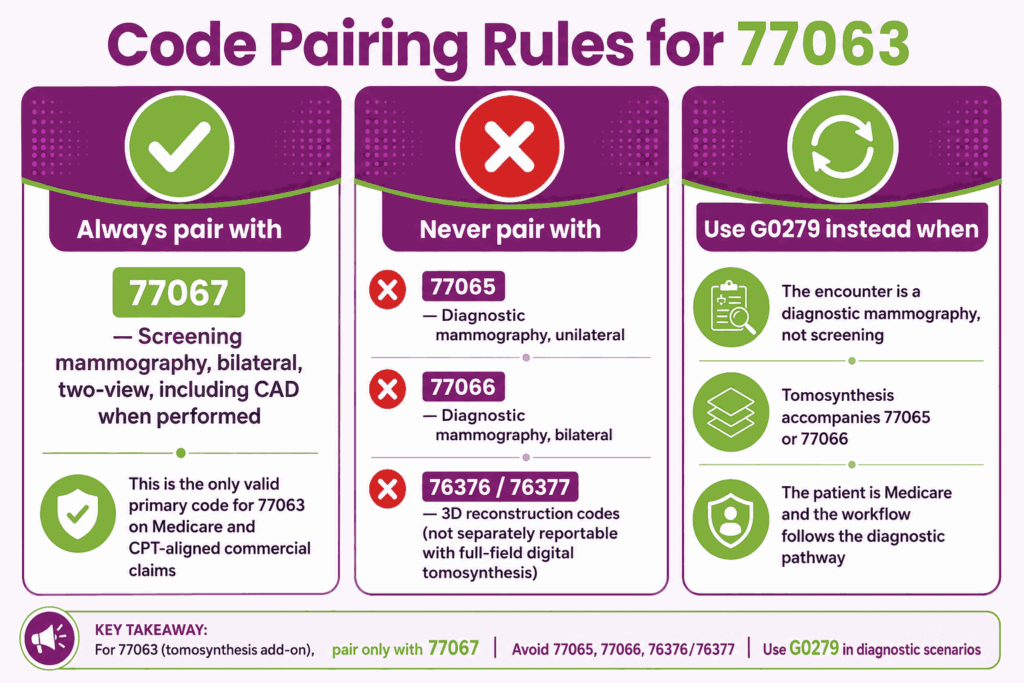
CPT 77063 code applies exclusively to the screening context and is the only tomosynthesis add-on code paired with the primary screening mammography code 77067. When tomosynthesis is performed during a diagnostic mammography encounter, G0279, not CPT code 77063, is the correct add-on code.
Why Must CPT 77063 Always Be Reported With a Primary Mammography Code?
Procedure code 77063 is designated an add-on code by both the AMA and CMS. Per official CMS Transmittal R3160CP, claims containing CPT 77063 that do not also contain the primary screening mammography code are returned or denied by Medicare claims processing contractors.
The FDA requires a standard 2D mammogram to accompany digital breast tomosynthesis when used for screening. The add-on code structure reflects this clinical and regulatory requirement. For Medicare, the required primary code is 77067 (screening mammography, bilateral, two-view study of each breast, including CAD when performed). For commercial payers following CPT guidelines, 77067 is also the correct primary code. CPT code 77063 cannot generate a payable claim when submitted alone.
What Are the Modifiers for CPT Code 77063?
CPT 77063 code is a radiology add-on code with PC/TC Indicator 1, supporting separate professional and technical component billing depending on the practice arrangement.
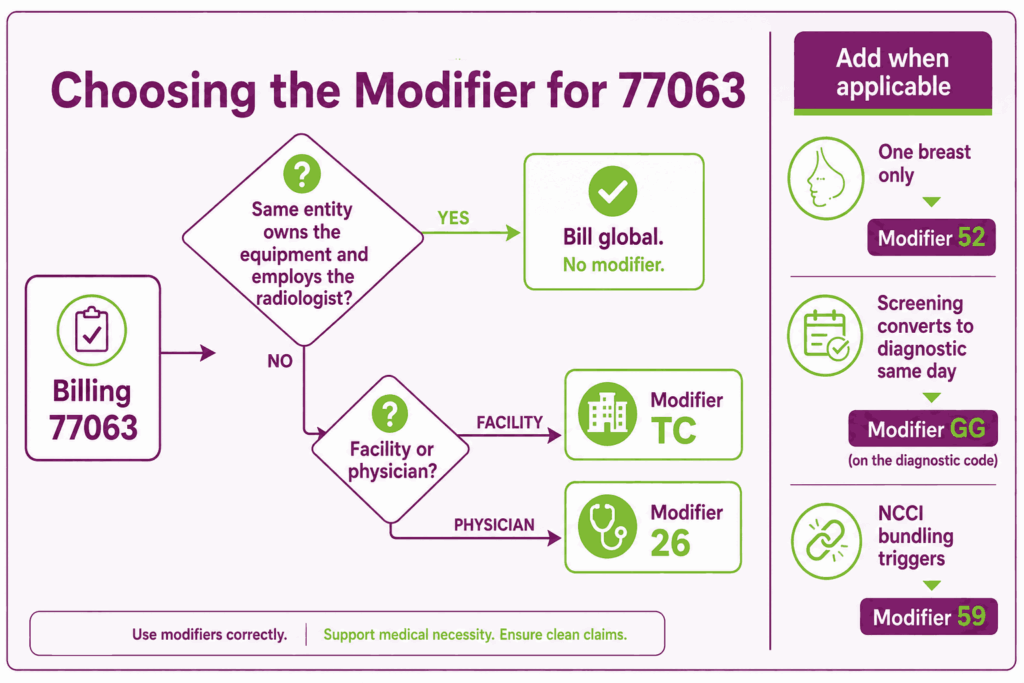
Modifier 26: Professional Component Only
Modifier 26 is appended when the interpreting radiologist bills only for reading the tomosynthesis images and generating the report, and the technical component is billed separately by the facility or imaging center. Append modifier 26 to CPT code 77063 on the physician’s claim when the physician does not own or operate the imaging equipment.
Modifier TC: Technical Component Only
Modifier TC is appended by the facility billing for the tomosynthesis equipment, technologist, and overhead. The physician interpretation is not included. Append modifier TC to procedure code 77063 on the facility claim when the interpreting radiologist bills separately with modifier 26.
Modifier 52: Reduced Services (Unilateral Tomosynthesis)
Modifier 52 is used when digital breast tomosynthesis is performed on only one breast rather than bilaterally. Since CPT 77063 is defined as a bilateral code, unilateral performance requires modifier 52 to indicate a reduced service. Document the clinical reason for unilateral tomosynthesis in the procedure or radiology report.
Modifier GG: Screening Mammogram and Diagnostic Mammogram Performed Same Day, Same Patient
Modifier GG is used when a screening mammography encounter converts to a diagnostic mammography on the same day for the same patient. For example, when a finding on the screening study requires immediate diagnostic evaluation. Per CMS IOM guidance and Transmittal R3160CP, modifier GG is appended to the diagnostic mammography code (not to CPT code 77063) and signals to the contractor that both the screening and diagnostic studies are separately payable on the same date.
Modifier GG is for tracking purposes. Medicare pays for both the screening and diagnostic mammography when this modifier is present.
Modifier 59: Distinct Procedural Service
Modifier 59 is used when CPT code 77063 is performed as a separately identifiable service from another imaging procedure on the same date, and an NCCI edit would otherwise bundle the services. Append modifier 59 only when documentation clearly supports the distinct service, and verify payer-specific instructions before applying.
When Should CPT 77063 Be Billed Globally vs. With Modifier 26 or TC?
- Global billing (no modifier): Used when the same entity, typically a freestanding breast imaging center employing its radiologists, performs both the tomosynthesis acquisition and the professional interpretation
- Modifier 26 (professional only): Used by the interpreting radiologist when the technical component is billed separately by a hospital or imaging facility
- Modifier TC (technical only): Used by the facility that owns the tomosynthesis equipment when the reading physician bills the professional component separately
The same PC/TC split rules that apply to 77067 apply to CPT code 77063. So, ensure both entities are not billing the global code simultaneously, as this creates a duplicate payment denial.
Which Documents Are Required For CPT Code 77063?
Documentation for procedure code 77063 must support the screening indication, the bilateral tomosynthesis acquisition, and the clinical appropriateness of the service.
Required documents checklist:
- Physician order for bilateral screening mammography with tomosynthesis
- Radiology report documenting bilateral tomosynthesis acquisition and interpretation
- Patient age and date of last screening mammography (payers apply annual frequency limitations)
- Clinical indication for screening (age-appropriate screening, family history, dense breast tissue history, etc.)
- Documentation that the 2D images were either acquired or synthesized from tomosynthesis data per FDA requirements
- Primary screening mammography report (77067) filed on the same claim as CPT code 77063
- Facility certification under the Mammography Quality Standards Act (MQSA) confirming the equipment and facility are FDA-certified for tomosynthesis
What is the Cost of CPT Code 77063?
The cost of CPT code 77063 varies by billing component (global, professional, or technical), place of service, payer, and geographic location. As an add-on code, reimbursement is always incremental to the primary 77067 payment.
RVUs & Medicare Payment
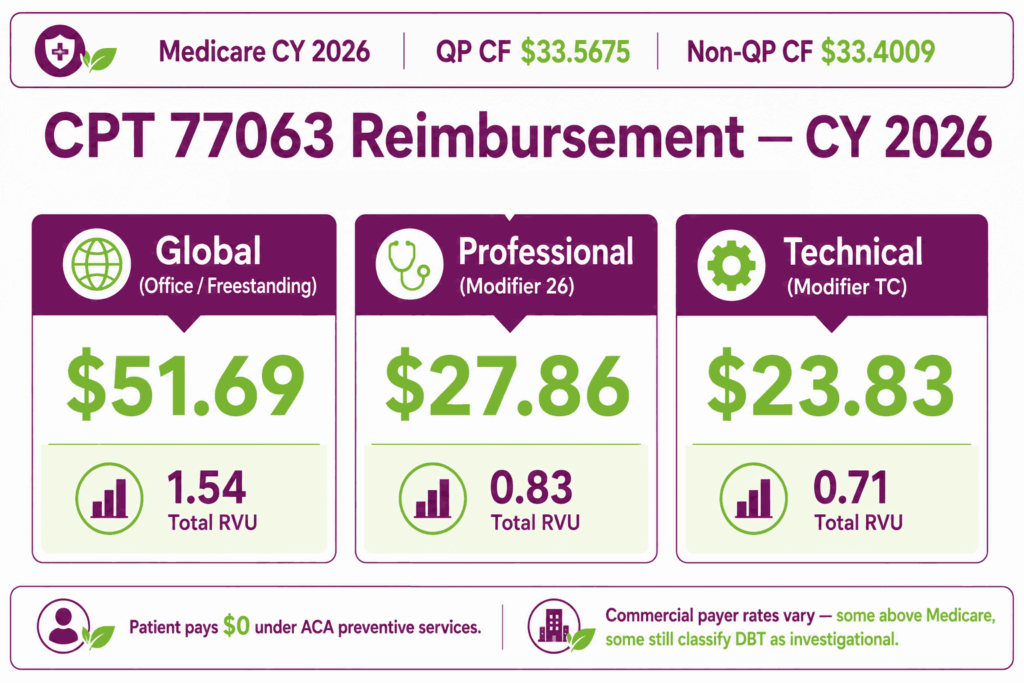
CPT 77063 code carries the following CY 2026 Medicare national average payment rates, sourced directly from Hologic’s 2026 Mammography Coding Guide citing the CMS RVU26A National PFS Relative Value File January Release:
| Component | Total RVU | Medicare Rate (QP CF $33.5675) |
|---|---|---|
| Global (Office/Freestanding) | 1.54 | $51.69 |
| Professional (Facility/Non-Facility) | 0.83 | $27.86 |
| Technical (Facility) | 0.71 | $23.83 |
Providers using the non-QP conversion factor of $33.4009 will receive slightly lower payments. CPT code 77063, when billed as a screening preventive service with 77067, is exempt from Medicare beneficiary coinsurance and deductible per the Affordable Care Act preventive services provisions and CMS Transmittal R3160CP.
Commercial Payers
Commercial payers vary significantly in their coverage and reimbursement of procedure code 77063. Some payers reimburse at rates exceeding Medicare. Others have historically considered digital breast tomosynthesis investigational and may not cover it. Several states have enacted mandates requiring coverage of DBT, which affects commercial payer obligations within those states.
Place-of-Service & Geographic Adjustments
CPT code 77063 carries separate facility and non-facility payment rates. The non-facility (global) rate of $51.69 applies in freestanding imaging centers and office-based settings. When performed in a hospital outpatient department or ASC, the facility bills separately under OPPS or the ASC fee schedule, and the physician bills the professional component only with modifier 26.
GPCIs adjust all RVU components by locality. Per CMS’s CY 2026 final rule (CMS-1832-F), PE RVUs for the professional component (modifier 26) are the same in both facility and non-facility settings.
What Are Example Clinical Scenarios or Use Cases for CPT Code 77063?
CPT 77063 code applies when bilateral screening digital breast tomosynthesis is performed alongside standard two-dimensional screening mammography for a patient without current breast symptoms or known breast pathology requiring diagnostic evaluation.
Scenario 1: Routine Annual Screening in an Average-Risk Patient With No Prior Abnormalities
ICD-10: Z12.31 (Encounter for screening mammogram for malignant neoplasm of breast)
A 52-year-old female with no personal history of breast cancer and no elevated risk factors presents for her annual screening mammogram. The radiologist performs bilateral digital screening mammography with tomosynthesis. CPT code 77067 is reported as the primary code, and CPT code 77063 is reported as the add-on code on the same claim.
Scenario 2: Earlier-Than-Standard Screening in a Patient With Strong Family History of Breast Cancer
ICD-10: Z15.01 (Genetic susceptibility to malignant neoplasm of breast)
A 38-year-old female with a first-degree relative diagnosed with breast cancer at age 43 is referred for earlier screening initiation. The ordering physician documents the elevated familial risk. Bilateral screening mammography with tomosynthesis is performed. CPT code 77067 is reported as the primary code, and procedure code 77063 is reported as the add-on code.
Scenario 3: Annual Screening in a Patient With Confirmed Dense Breast Tissue on Prior 2D Mammogram
ICD-10: Z12.31 (Encounter for screening mammogram for malignant neoplasm of breast)
A 58-year-old female patient was identified as having heterogeneously dense breast tissue (BIRADS C) on her prior year mammogram report. The referring physician orders tomosynthesis for the current year’s screening to improve tissue visualization and reduce false-negative findings associated with dense tissue. Bilateral screening mammography with tomosynthesis is performed. CPT 77063 code is reported as the add-on to 77067.
What Are the CPT Code 77063 Rules To Ensure Successful Reimbursement?
Follow CMS, payer, and MQSA rules for add-on code pairing, frequency, component billing, and documentation. Meeting these rules reduces denials and ensures correct payment.
Bundling / NCCI / Same-Day Procedure Rules
CPT code 77063 must always be reported on the same claim as the primary screening mammography code 77067. Per CMS Transmittal R3160CP and Noridian MAC guidance, Medicare claims processing contractors will return or deny claims for procedure code 77063 when submitted without 77067. Do not report code 77063 CPT alongside diagnostic mammography codes 77065 or 77066.
When tomosynthesis accompanies a diagnostic mammography, G0279 is the correct add-on code, not CPT 77063. Do not report a 3D reconstruction code (76376 or 76377) in conjunction with CPT code 77063 for the same breast study. These codes are not separately reportable with full-field digital mammography tomosynthesis.
Units, MUEs & Add-On Code Pairing Requirements
CPT code 77063 is billed as one unit per screening encounter.
- CPT 77063 code cannot be reported more than once per date of service. If only one breast is imaged, append modifier 52, not a second unit
- Medicare applies annual frequency limitations to screening mammography. When 77067 fails the age and frequency edits, CPT code 77063 also fails, and both will be rejected by CWF when the primary code does not meet frequency criteria
- CPT code 77063 carries a 0-day global period as an add-on code. Follow-up services are billed separately
- When a screening mammography converts to a diagnostic mammography on the same day, append modifier GG to the diagnostic code. Medicare pays both the screening and diagnostic studies under these circumstances, and CPT code 77063 remains reportable.
Medicare vs. Commercial Payer Reporting Differences for CPT 77063
The reporting pathway for procedure code 77063 differs between Medicare and commercial payers:
Medicare: CPT code 77063 must be billed with 77067 as the primary code (effective January 1, 2018, when CMS transitioned from G-codes to CPT codes for mammography). Prior to 2018, the primary code was G0202. Mixing the pre-2018 G-code system with post-2018 CPT codes will result in claim rejection.
Commercial payers following CPT guidelines: CPT code 77063 is reported with 77067 as the primary code. Some commercial payers have not adopted CPT 77063 and may require a different code pairing.
Coverage variability: Some commercial payers still consider DBT investigational in specific clinical contexts and may not cover CPT code 77063 regardless of state mandate. Providers in mandate states should be familiar with state-specific DBT coverage requirements to appeal denials on this basis.
Top Reasons For Denials Specific To 77063 & Quick Remedies
- Submitted Without Primary Code 77067: Prevent by confirming 77067 is on the same claim as CPT code 77063 before submission. Per CMS Transmittal R3160CP, MAC contractors are instructed to deny or return procedure code 77063 when the primary code is absent.
- Paired With Wrong Primary Code (77065 or 77066): Prevent by confirming the mammography type before selecting the add-on code. Diagnostic mammography encounters use G0279, not CPT 77063 code.
- Frequency Edit Failure Cascading to 77063: Prevent by verifying the patient’s last screening mammography date before scheduling; when the primary 77067 fails frequency edits, code 77063 CPT is also rejected.
- Missing MQSA Facility Certification for Tomosynthesis: Prevent by confirming the facility’s FDA certification covers digital breast tomosynthesis before billing; claims from non-certified facilities are denied.
Is CPT 77063 Classified as a Screening or Diagnostic Procedure Code?
77063 is classified as a screening procedure code, not diagnostic. The screening designation places 77063 within a specific group of CPT code types reserved for preventive services performed on asymptomatic patients. This is why it’s required to be paired with 77067.