
ICD-10-CM classifies peptic ulcers under three primary categories: K25 for gastric ulcer, K26 for duodenal ulcer, and K27 for peptic ulcer of unspecified site. Each category divides into nine billable codes. The fourth character captures both acuity and complexity. Accurate selection depends on three documented variables: ulcer location, acute or chronic status, and the presence of hemorrhage or perforation.
Peptic ulcer disease affects an estimated 5 to 10 percent of adults during their lifetime. Gastroenterology practices submit these diagnoses across endoscopy, infusion, and evaluation encounters. Denials follow when coders default to unspecified codes or omit the causative organism. This guide maps every K25-K27 code, the supporting secondary codes, and the documentation drivers that protect first-pass payment.
What Do K25, K26, and K27 Cover in ICD-10?
K25, K26, and K27 cover the three anatomical presentations of peptic ulcer within Chapter 11, Diseases of the Digestive System. K25 identifies ulcers on the stomach lining. K26 identifies ulcers in the duodenum, the first segment of the small intestine. K27 applies when documentation confirms a peptic ulcer but omits the specific site.
All three categories sit in the K20-K31 block, covering diseases of the esophagus, stomach, and duodenum. The 2026 edition of these codes took effect on October 1, 2025. None of the three-character parent codes bill independently. Payers reject K25, K26, or K27 submitted without a fourth character.
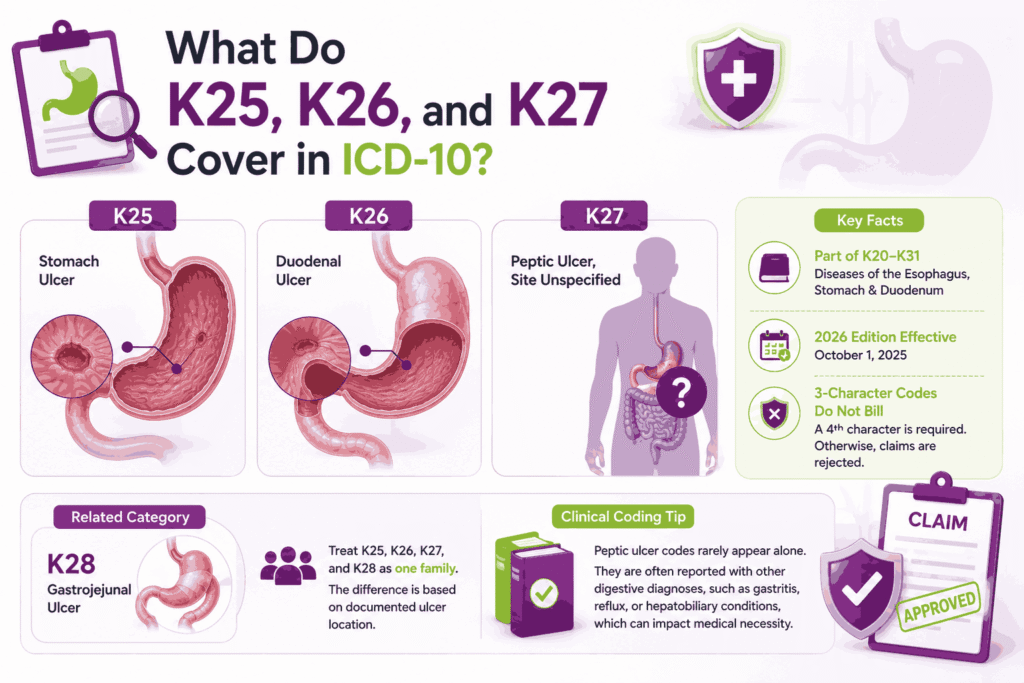
A fourth category, K28, captures gastrojejunal ulcer. K28 falls outside this K25-K27 guide but shares the identical complication structure. Coders working peptic ulcer denials benefit from treating all four categories as one logical family. The distinction between them rests entirely on documented ulcer location.
Practices building out their diagnosis libraries often pair this reference with a broader inventory of gastroenterology ICD-10 codes spanning gastritis, reflux, and hepatobiliary conditions. Peptic ulcer codes rarely appear in isolation on a claim. Comorbid digestive diagnoses frequently accompany them and affect medical necessity review.
How Is the Peptic Ulcer Code Structure Organized?
The K25-K27 code structure organizes each category by two variables encoded in the fourth character: acuity and complication. Acuity splits into acute, chronic, or unspecified. Complication splits into hemorrhage, perforation, both, or neither. These two axes generate a repeating nine-code pattern identical across K25, K26, and K27.
The pattern follows a fixed logic. Codes ending in 0 through 3 describe acute ulcers. Codes ending in 4 through 7 describe chronic or unspecified ulcers. The code ending in 9 covers ulcers with no documented acuity and no complication. Learning this grid once decodes all three categories.
The following table shows the shared fourth-character logic that governs every peptic ulcer category:
| Fourth Character | Acuity | Complication |
|---|---|---|
| .0 | Acute | With hemorrhage |
| .1 | Acute | With perforation |
| .2 | Acute | With both hemorrhage and perforation |
| .3 | Acute | Without hemorrhage or perforation |
| .4 | Chronic or unspecified | With hemorrhage |
| .5 | Chronic or unspecified | With perforation |
| .6 | Chronic or unspecified | With both hemorrhage and perforation |
| .7 | Chronic | Without hemorrhage or perforation |
| .9 | Unspecified acuity | Without hemorrhage or perforation |
One structural detail drives correct selection. The .4, .5, and .6 codes bundle chronic and unspecified acuity into a single value. The .7 code isolates chronic ulcers without complication. This asymmetry causes frequent errors when documentation states chronicity but no bleeding or perforation.
What Are the Complete K25 Gastric Ulcer Codes?
K25 codes classify ulcers located on the stomach lining, also documented as gastric or stomach ulcers. The category contains nine billable codes spanning acute and chronic presentations. Gastric ulcers frequently link to Helicobacter pylori infection and nonsteroidal anti-inflammatory drug use. Both associations require a secondary code when documented.
The table below lists every valid K25 gastric ulcer code and its clinical scenario:
| Code | Description |
|---|---|
| K25.0 | Acute gastric ulcer with hemorrhage |
| K25.1 | Acute gastric ulcer with perforation |
| K25.2 | Acute gastric ulcer with both hemorrhage and perforation |
| K25.3 | Acute gastric ulcer without hemorrhage or perforation |
| K25.4 | Chronic or unspecified gastric ulcer with hemorrhage |
| K25.5 | Chronic or unspecified gastric ulcer with perforation |
| K25.6 | Chronic or unspecified gastric ulcer with both hemorrhage and perforation |
| K25.7 | Chronic gastric ulcer without hemorrhage or perforation |
| K25.9 | Gastric ulcer, unspecified as acute or chronic, without hemorrhage or perforation |
K25.9 functions as the default when documentation lacks acuity and complication detail. Coders should treat K25.9 as a last resort. Endoscopy reports usually specify bleeding status and often specify chronicity. Extracting those details from the operative note upgrades the claim to a more specific and defensible code.
What Are the Complete K26 Duodenal Ulcer Codes?
K26 codes classify ulcers located in the duodenum, the first segment of the small intestine immediately beyond the stomach. Duodenal ulcers occur more frequently than gastric ulcers in most adult populations. The category mirrors K25 exactly, dividing nine codes across acute and chronic presentations with the same complication axis.
The following table presents every valid K26 duodenal ulcer code:
| Code | Description |
|---|---|
| K26.0 | Acute duodenal ulcer with hemorrhage |
| K26.1 | Acute duodenal ulcer with perforation |
| K26.2 | Acute duodenal ulcer with both hemorrhage and perforation |
| K26.3 | Acute duodenal ulcer without hemorrhage or perforation |
| K26.4 | Chronic or unspecified duodenal ulcer with hemorrhage |
| K26.5 | Chronic or unspecified duodenal ulcer with perforation |
| K26.6 | Chronic or unspecified duodenal ulcer with both hemorrhage and perforation |
| K26.7 | Chronic duodenal ulcer without hemorrhage or perforation |
| K26.9 | Duodenal ulcer, unspecified as acute or chronic, without hemorrhage or perforation |
Location distinguishes K26 from K25. A single operative note sometimes documents both a gastric and a duodenal ulcer. Coders assign separate codes from each category in that scenario. The two ulcers represent distinct anatomical sites, and both contribute to the medical necessity narrative for the encounter.
What Are the Complete K27 Peptic Ulcer Codes?
K27 codes classify peptic ulcers when documentation confirms an ulcer but omits its specific anatomical site. K27 applies only when the provider cannot or does not localize the ulcer to the stomach or duodenum. The category holds nine codes following the shared complication and acuity structure.
The table below lists every valid K27 peptic ulcer code for unspecified sites:
| Code | Description |
|---|---|
| K27.0 | Acute peptic ulcer, site unspecified, with hemorrhage |
| K27.1 | Acute peptic ulcer, site unspecified, with perforation |
| K27.2 | Acute peptic ulcer, site unspecified, with both hemorrhage and perforation |
| K27.3 | Acute peptic ulcer, site unspecified, without hemorrhage or perforation |
| K27.4 | Chronic or unspecified peptic ulcer, site unspecified, with hemorrhage |
| K27.5 | Chronic or unspecified peptic ulcer, site unspecified, with perforation |
| K27.6 | Chronic or unspecified peptic ulcer, site unspecified, with both hemorrhage and perforation |
| K27.7 | Chronic peptic ulcer, site unspecified, without hemorrhage or perforation |
| K27.9 | Peptic ulcer, site unspecified, unspecified as acute or chronic, without hemorrhage or perforation |
K27 carries audit risk. Endoscopic and surgical documentation almost always identifies ulcer location. A K27 code on a claim with an attached EGD report invites payer scrutiny. Coders should query the provider before defaulting to K27 whenever a procedure report exists in the record.
Which Additional Codes Support Peptic Ulcer Claims?
Three secondary code groups support peptic ulcer claims: B96.81 for Helicobacter pylori, F10 codes for alcohol involvement, and T36-T50 codes for drug-induced ulcers. ICD-10-CM guidelines direct coders to sequence the ulcer code first, then append the causative or contributing code. Omitting these secondary codes weakens medical necessity.
B96.81 identifies Helicobacter pylori as the cause of diseases classified elsewhere. Coders append B96.81 to a K25, K26, or K27 code when a breath test, stool antigen test, or biopsy confirms infection. The peptic ulcer code sequences first as the primary diagnosis. B96.81 follows as the causative agent.
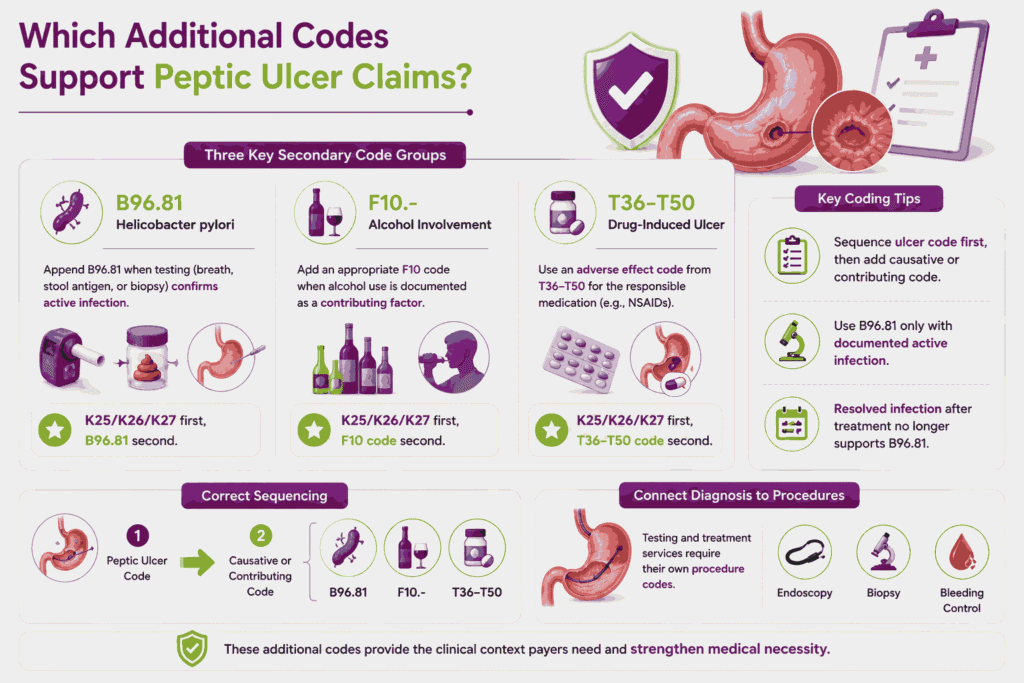
Drug-induced ulcers require an adverse effect code from the T36-T50 range. Nonsteroidal anti-inflammatory drug ulcers represent the most common example in gastroenterology. The adverse effect code identifies the responsible medication. Alcohol use documented as a contributing factor adds an appropriate code from the F10 category for alcohol-related disorders.
Confirmation timing matters for these secondary codes. Coders append B96.81 only when a test result documents active infection during the encounter period. A resolved infection cleared by prior therapy no longer supports the causative code. Test-of-cure results after treatment carry their own coding implications and require review against the current clinical status.
These sequencing rules connect diagnosis coding to procedure coding on the same claim. Testing and treatment services carry their own procedure codes. A practice managing high peptic ulcer volume benefits from aligning diagnosis and procedure coding. A matched gastroenterology CPT code guide covers endoscopy, biopsy, and bleeding control services used across these encounters.
How Do You Document Peptic Ulcers for Clean Claims?
Clean peptic ulcer claims require documentation of three variables in every encounter note: ulcer site, acuity, and complication status. Providers who record all three variables enable code specificity to the fourth character. Missing any variable forces a coder toward an unspecified value and reduces claim defensibility during payer review.
Site documentation determines category selection between K25, K26, and K27. Operative and endoscopy reports typically state the exact location. Providers document the stomach for K25 and the duodenum for K26. Explicit site language eliminates K27 in nearly all endoscopic encounters and strengthens the diagnostic record.
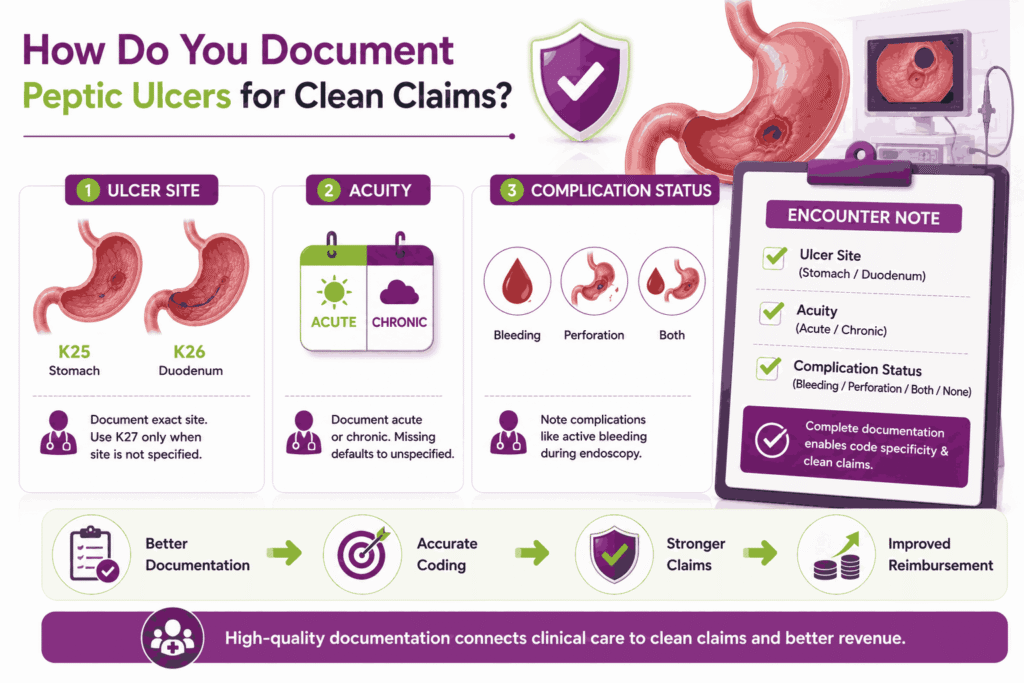
Acuity documentation determines the acute versus chronic split within each category. Providers record the term acute or chronic directly in the assessment. Absent acuity language defaults the code to unspecified values ending in 9. Complication documentation captures active bleeding, perforation, or both. Endoscopists commonly note active hemorrhage during the procedure.
The complexity of digestive procurement and payer rules makes documentation quality a revenue issue, not a clerical one. Practices addressing recurring peptic ulcer denials often audit provider notes at the source. Dedicated gastroenterology billing services connect clinical documentation improvement to claim outcomes and denial recovery across payer types.
What Are the Most Common Peptic Ulcer Coding Errors?
The most common peptic ulcer coding errors fall into five categories: unspecified overuse, acuity confusion, omitted causative codes, complication mismatches, and site defaulting. Each error pattern maps to a recoverable denial. Gastroenterology billing teams that track these five patterns reduce peptic ulcer denial rates measurably across payer mixes.
Unspecified overuse tops the list. Coders assign K25.9, K26.9, or K27.9 when the operative note contains enough detail for a specific code. Payers flag high volumes of unspecified digestive codes during audits. Acuity confusion follows, particularly the misuse of the .4 through .6 codes when documentation states chronic without complication.
The .7 code error deserves attention. Providers document a chronic ulcer without bleeding or perforation. Coders incorrectly select a .4 or default to a .9 code instead of the .7 code. The .7 value is the only code isolating chronic ulcers without complication. Missing it understates the clinical picture.
Omitted causative codes create the third error group. Coders assign the ulcer code but drop B96.81 despite documented Helicobacter pylori infection. This omission weakens the medical necessity link for antibiotic therapy and follow-up testing. Site defaulting to K27 rounds out the pattern when a localized ulcer belongs under K25 or K26.
How Does Peptic Ulcer Coding Affect Reimbursement?
Peptic ulcer coding affects reimbursement through three mechanisms: MS-DRG assignment for inpatient stays, medical necessity validation for procedures, and complication severity weighting. Codes with hemorrhage or perforation carry higher severity and map to different diagnosis-related groups. Specificity directly influences payment for both facility and professional claims.
Complication codes change inpatient grouping. A gastric ulcer with hemorrhage groups differently from an uncomplicated ulcer. The bleeding or perforation status shifts the case into a higher-weighted diagnosis-related group. This shift reflects the greater resource intensity of managing a complicated peptic ulcer during an admission.
Diagnosis specificity also validates procedure claims. An endoscopy with biopsy submitted against a vague ulcer code faces medical necessity questions. A specific K25 or K26 code with the correct complication status supports the procedure and the pathology services. The diagnosis code carries the clinical justification for every service on the claim.
Professional and facility claims respond differently to the same diagnosis. Facility claims tie complication codes to diagnosis-related group weighting and inpatient severity. Professional claims tie the diagnosis to procedure medical necessity and evaluation levels. A gastroenterologist billing an inpatient bleeding control service depends on the hemorrhage code to justify the intensity of the encounter and the follow-up.
Denial recovery and prevention define the financial stakes. Teams that pair accurate diagnosis coding with disciplined claim scrubbing protect first-pass payment on peptic ulcer encounters. A structured gastroenterology billing guide built around specialty denial patterns turns individual code accuracy into sustained revenue performance across the practice.
Frequently Asked Questions
What is the ICD-10 code for peptic ulcer?
The ICD-10 code for peptic ulcer depends on site and complication. K25 codes cover gastric ulcers, K26 codes cover duodenal ulcers, and K27 codes cover ulcers of unspecified site. K27.9 applies when documentation confirms a peptic ulcer without acuity, site, or complication detail.
What is the difference between K25 and K26?
K25 and K26 differ by ulcer location. K25 classifies gastric ulcers found on the stomach lining. K26 classifies duodenal ulcers found in the first segment of the small intestine. Both categories share an identical nine-code structure for acuity and complication.
Do you code H. pylori separately from a peptic ulcer?
Yes, Helicobacter pylori codes separately from a peptic ulcer. Coders sequence the peptic ulcer code first as the primary diagnosis. B96.81 follows as a secondary code identifying Helicobacter pylori as the causative organism. Confirmation requires a breath test, stool antigen test, or biopsy.
When should you use K27 instead of K25 or K26?
K27 applies only when documentation confirms a peptic ulcer but omits the specific anatomical site. Endoscopic and surgical reports almost always localize the ulcer. Coders should query the provider before assigning K27 whenever a procedure report exists in the medical record.
Is K25.9 a billable ICD-10 code?
Yes, K25.9 is a billable ICD-10-CM code valid for the current fiscal year. K25.9 identifies a gastric ulcer of unspecified acuity without hemorrhage or perforation. Coders should reserve K25.9 for encounters where documentation lacks the detail needed for a more specific code.
Can a gastric and duodenal ulcer be coded on the same claim?
Yes, a gastric ulcer and a duodenal ulcer code together on the same claim when documentation confirms both. Coders assign a K25 code and a K26 code as distinct diagnoses. Each ulcer represents a separate anatomical site, and each supports the medical necessity of the encounter.
Which peptic ulcer codes indicate the highest severity?
The codes ending in 2 and 6 indicate the highest severity within each category. These values capture ulcers with both hemorrhage and perforation. K25.2, K26.2, and K27.2 describe acute presentations. K25.6, K26.6, and K27.6 describe chronic or unspecified presentations with both complications documented.