
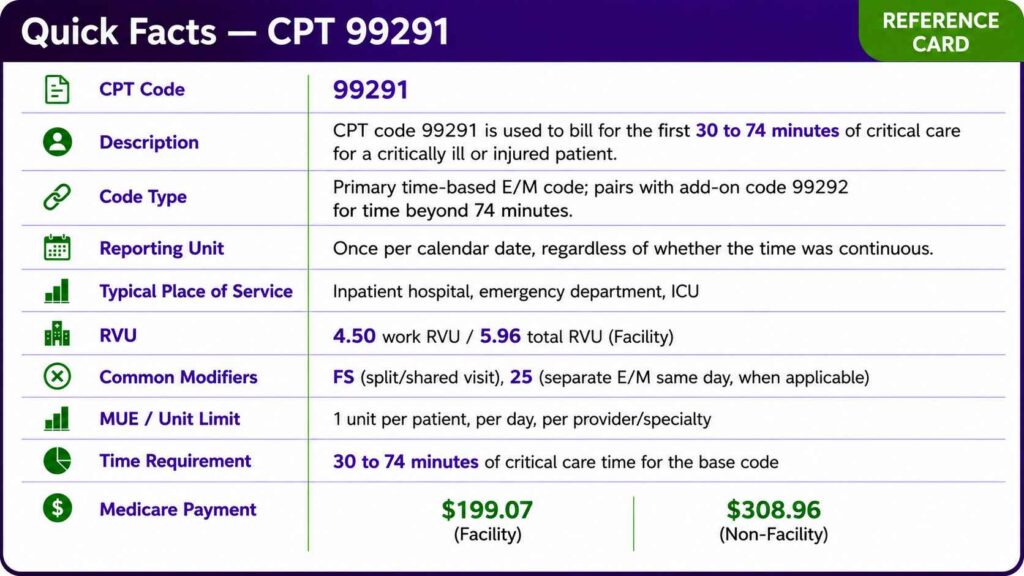
CPT code 99291 is used to bill for the first 30 to 74 minutes of critical care for a critically ill or injured patient. It carries a work RVU of 4.50. In a facility setting, it carries a total RVU of 5.96 and pays a national Medicare average of $199.07 (or $308.96 in a non-facility setting).
Most of the risk with 99291 is the clock. Medicare requires a full 104 minutes of total time before 99292 becomes billable, making the wrong time threshold a common audit trigger.
Time-based critical care coding is one of the most unforgiving areas of pulmonology billing. It’s because documentation has to meet a minute-by-minute standard that most other E/M codes never face.
In the section ahead, we cover the description, full cost breakdown, real billing scenarios, and the key rules that determine if a critical care claim gets paid or denied.
What is the Description of CPT Code 99291?
CPT code 99291 is the code doctors use to bill for critical care, meaning care given to a patient whose life is at risk. The full descriptor reads “critical care, evaluation and management of the critically ill or critically injured patient, first 30 to 74 minutes.”
99291 is the base code, and it always gets billed first. Once a doctor spends more than 74 minutes with the patient on the same day, a second code, 99292, is added to cover the extra time.
Both codes sit alongside PFT, bronchoscopy, and sleep study codes in our pulmonology CPT codes guide, though critical care follows a stricter, time-based standard.
This code is most commonly seen in the ICU, the emergency department, and inpatient hospital floors. It carries a work RVU of 4.50, a measure of physician effort that runs noticeably higher than most regular office visits.
Is 99291 Time-Based or MDM-Based?
99291 CPT code is entirely time-based. In 2023, CPT changed the rules for most hospital E/M codes, allowing doctors to choose between time spent and the complexity of their decision-making to select a code level.
Critical care codes were intentionally left out of that change. No matter how complex the medical decision-making was, 99291 comes down to the total minutes spent providing critical care that day.
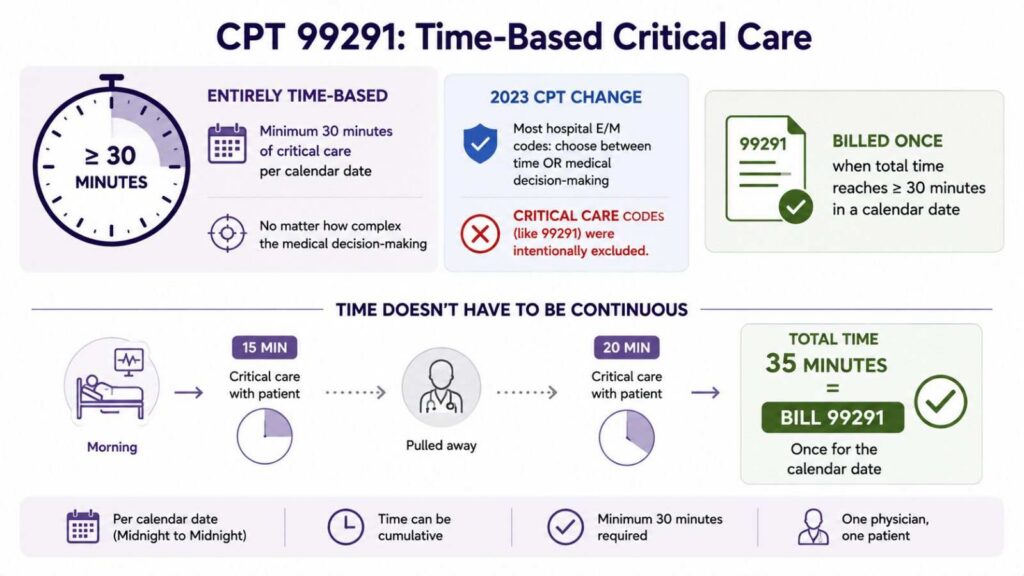
The best part is that the time doesn’t need to be one continuous block. A doctor can spend 15 minutes with the patient in the morning, get pulled away, then come back for another 20 minutes later that day. As long as the total reaches at least 30 minutes, 99291 gets billed once for that calendar date.
However, it comes with one strict rule. While a doctor is counting down the minutes to critical care, they can’t treat any other patient at the same time. Critical care time means the doctor’s full attention is on that one patient.
What Counts as “Critical Illness or Injury” for 99291?
One or more vital organ systems have to be at risk of failing, and there has to be a real chance the patient gets dramatically worse or dies without fast treatment. This is often described as a high probability of imminent, life-threatening deterioration.
Common examples include acute respiratory failure, septic shock, a major heart rhythm problem, or a severe overdose. In each case, an organ system is close to shutting down without immediate intervention.
For 99291, organ system risk establishes medical necessity and not the diagnosis code alone. Documentation should name the specific organ system involved and describe how it’s at risk.
When Was 99291 Last Revised, and What Changed?
The last major change to 99291 happened in 2022. Before that year, services performed while treating a critical patient, such as reading a chest X-ray or interpreting blood gas results, could be billed separately from the critical care code.
Starting in 2022, CPT bundled a list of these services into critical care itself. The full list appears further down. If a bundled service occurs while the doctor is providing critical care, it’s already covered by the 99291 payment and can’t be billed separately.
How Does 99291 Differ From High-Level E/M Codes Like 99205 or 99215?
99205 and 99215 are high-level office visit codes used for long or complex visits. Neither requires the patient to be in danger of dying. A patient with several chronic conditions can justify a 99215 CPT code while staying completely stable.
99291 requires a documented, active threat to the patient’s life. That’s the dividing line: not visit length or the number of problems addressed, but organ-system risk.
A chart can show real critical care work, but if the documentation doesn’t clearly establish that the patient was critically ill, a payer may pay the claim as a high-level E/M visit instead, that too at a lower rate.
Does 99291 Split Into Professional and Technical Components?
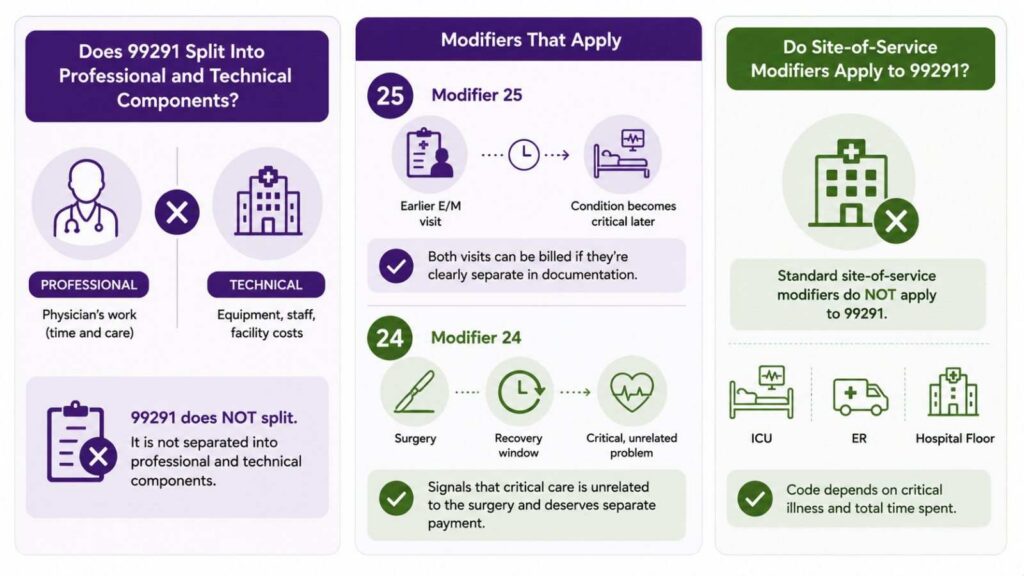
99291 does not split into a professional and technical component. Diagnostic codes, like imaging codes, are often split into a technical part, covering equipment and staff time, and a professional part, covering interpretation.
Although three modifiers still apply to CPT code 99291, each covers a specific situation.
Modifier 25
Modifier 25 applies when a patient is seen for a regular visit earlier in the day and, later that same day, their condition becomes critical. Both visits can be billed if they’re clearly separate in the documentation.
Modifier 24
Modifier 24 applies when a patient is within the recovery window after surgery but develops a critical, unrelated problem, allowing the critical care bill to be billed separately from the global surgical package.
Payers scrutinize “unrelated” closely, and this is one of the most commonly denied modifier applications for that reason.
A patient who develops pneumonia unrelated to a hip replacement supports the use of modifier 24. Sepsis from a surgical site infection does not, since it traces back to the original procedure. The documentation needs to state plainly why the illness is unrelated.
Do Site-of-Service Modifiers Apply to 99291?
Standard site-of-service modifiers don’t apply to 99291. Critical care can happen in the ICU, the emergency department, or a regular hospital floor. The code depends on whether the patient met the critical illness threshold and how much time was spent.
How Do Non-Physician Practitioners Bill 99291 Under Split/Shared Rules?
When a physician and an NPP both provide critical care to the same patient on the same day, this counts as a split or shared visit.
The two providers’ total time gets added together. Whoever contributed more than half of that combined time bills the code, and the claim carries modifier FS. This rule has applied since January 1, 2022.
When multiple providers from the same specialty deliver critical care to the same patient on the same date, their time gets combined the same way, and only one of them can report the code. This ties to the MUE limit for 99291: one unit per patient, per day, per provider.
What Services Are Bundled Into 99291 and Can’t Be Billed Separately?
The bundled list includes interpretation of cardiac output measurements, chest X-ray readings, gastric tube placement, temporary pacing, and vascular access procedures such as arterial line placement.
This list was established in 2022, and billing any of them separately, alongside 99291, can result in claim denials.
Is Ventilator Management Included in Critical Care Time?
Ventilator management is bundled into 99291. Adjusting ventilator settings, checking pressures, or managing breathing support as part of critical care is already counted inside the critical care time.
Are Pulse Oximetry and ABG Interpretation Bundled Into 99291?
Both pulse oximetry readings and arterial blood gas interpretation are bundled into 99291. Billing these separately alongside 99291 results in rejection, since their payment already falls under the critical care code.
How Does Add-On Code 99292 Work with 99291?
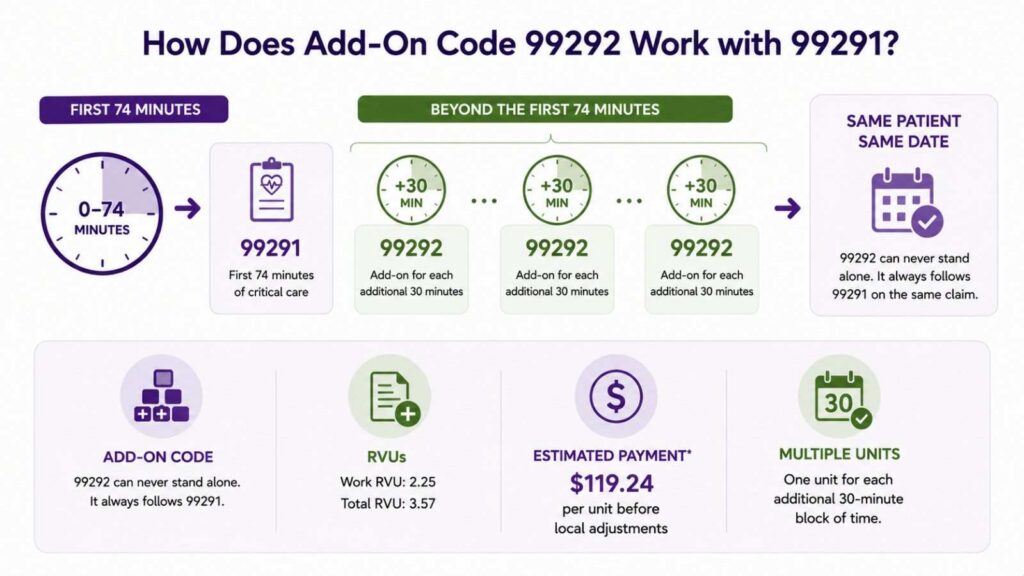
CPT code 99292 covers each additional 30 minutes of critical care beyond the first 74 minutes billed under 99291. It’s an add-on code, meaning it can never stand alone on a claim. It always follows 99291 for the same patient on the same date.
99292 carries a work RVU of 2.25 and a total RVU of 3.57, with an estimated national Medicare payment of ~$108.22 (or ~$119.24 for non-facility) per unit before local adjustments. Multiple units can be applied to the same claim, one for each additional 30-minute block of time.
This is the kind of thing a pulmonology billing service provider can help you keep track of, since a missed or miscounted block is money left on the table.
What’s the Time Threshold for Billing 99292?
CPT and Medicare use different thresholds for this code, and mixing them up can cause denials. Under CPT’s own rule, 99292 becomes billable once the midpoint of the next 30-minute block is reached, at 75 total minutes.
Medicare doesn’t follow that rule. CMS requires a total of 104 minutes before 99292 can be billed at all, calculated as the 74-minute cap on 99291 plus a full additional 30-minute block. Billing 99292 for 75 or 90 minutes on a Medicare claim is rejected, even though CPT guidelines allow it.
Is There a Limit to How Many Units of 99292 You Can Bill?
There’s no fixed cap on the total number of units, but each unit requires an additional full 30 minutes of documented time. The table below shows the total critical time with codes billed to make the concept easier.
| Total Critical Care Time | Codes Billed |
|---|---|
| 30–74 minutes | 99291 x1 |
| 75–103 minutes | 99291 x1 (no 99292 yet under Medicare rules) |
| 104–133 minutes | 99291 x1 + 99292 x1 |
| 134–163 minutes | 99291 x1 + 99292 x2 |
| 164–193 minutes | 99291 x1 + 99292 x3 |
| 194–223 minutes | 99291 x1 + 99292 x4 |
Each row adds one more 30-minute block. A unit without the full 30 minutes, even by a few minutes, doesn’t meet the requirement for that unit.
What Happens If Total Time Lands Between Two Thresholds (e.g., 100 Minutes)?
Under Medicare’s rule, 100 minutes doesn’t reach the 104-minute threshold required for even one unit of 99292. In that case, only 99291 gets billed, and the extra 26 minutes beyond 74 aren’t separately payable.
This is a common documentation gap. A provider may assume any time past 74 minutes automatically qualifies for 99292, but Medicare requires the full 30-minute block to be complete before the add-on code can be reported.
What Does CPT Code 99291 Cost, and Who Pays for It?
99291 pays a national non-facility rate of $308.96 before geographic adjustments. Both Medicare and commercial payers cover it when the documentation supports a critical care diagnosis. The exact amount a practice collects depends on location, payer, and whether the time documentation supports every unit billed.
Does Medicare cover CPT 99291?
Yes, Medicare covers 99291 when documentation supports a critical illness or injury and the 30-minute time threshold is met.
For standard facility settings (ICUs and Emergency Departments), the national Medicare payment sits around $199.07 (5.96 total RVUs). In the rare instance it is performed in a non-facility setting, payment sits around $308.96 (9.25 total RVUs).
Actual payment varies by locality. Medicare applies a Geographic Practice Cost Index, or GPCI, to adjust for regional differences in labor, rent, and malpractice costs, so the same code is paid differently in a high-cost city than in a rural area.
Is CPT 99291 Covered by Commercial Insurance?
Most commercial payers cover 99291 under the same CPT definition and time thresholds as Medicare. Payment rates vary by payer, and commercial rates commonly run higher than Medicare’s, often in the range of 120 to 200 percent of the Medicare rate.
Some commercial payers follow CPT’s midpoint rule for 99292 rather than Medicare’s 104-minute threshold, so it’s worth confirming which rule a specific payer follows before submitting a claim with add-on units.
Does the Patient Owe Any Coinsurance or Deductible?
Yes, critical care billed under 99291 and 99292 is subject to standard Medicare Part B cost-sharing.
This means the patient owes coinsurance after their deductible is met, as with most other physician services. Commercial plans apply their own deductible and coinsurance structure, which varies by plan.
How Much Can Local Reimbursement Differ From the National Average for 99291?
Local reimbursement can differ significantly from the national average once GPCI adjustments apply. For instance, with a Geographic Adjustment Factor around 1.271, facility-based 99291 in Alaska pays closer to $253.00 (compared to the $199.07 national baseline).
Lower-cost states move in the opposite direction. Mississippi’s Practice Expense GPCI runs about 15 percent below the national average. In rural localities, reimbursement tends to fall below average when all three GPCI components are combined.
The exact figure for any location depends on how work, practice expense, and malpractice interact in that locality.

The exact figure for any location depends on how work, practice expense, and malpractice interact in that locality.
What Are Some Real-World Billing Scenarios for CPT 99291 and 99292?
The coding rules for 99291 only mean something once they’re applied to an actual bedside encounter. Here are four scenarios that billers often encounter, along with their CPT codes, ICD-10 codes for pulmonology, and documentation requirements.
Scenario 1: A Single Critical Care Encounter Lasting 45 Minutes
A 68-year-old with a COPD exacerbation is admitted with acute respiratory failure. The physician spends 45 continuous minutes managing oxygenation, adjusting bronchodilator therapy, and reassessing the patient before stabilizing them enough to step down from critical care.
- CPT Codes: 99291 only, since 45 minutes falls within the 30–74 minute range and no add-on applies
- ICD-10 Codes: J44.1 (COPD with acute exacerbation) + J96.01 (acute respiratory failure with hypoxia)
- Modifiers: None required, unless a separately identifiable E/M service was also performed that day, in which case modifier 25 goes on that E/M code
- Documentation Required: Total time stated explicitly, the organ system at risk, and the specific interventions performed
Scenario 2: Critical Care Time That Exceeds Two Hours
A patient in septic shock requires ongoing critical care across 145 total minutes. The total time was split between an initial stabilization period and a later reassessment after a change in vital signs.
- CPT Codes: 99291 x1 (first 74 minutes) + 99292 x2 (covers the next 71 minutes, landing in the 134–163 minute bracket)
- ICD-10 Codes: A41.9 (sepsis, unspecified organism) + R65.21 (severe sepsis with septic shock)
- Modifiers: None required
- Documentation Required: Cumulative time for the full day, not just each individual block, along with what critical care activities occurred during each stretch of time
Scenario 3: Critical Care Time Spent With Family Instead of the Patient
A patient is sedated and on a ventilator, unable to participate in any discussion. The physician spends 20 minutes with the patient’s spouse, reviewing the prognosis and discussing treatment options, since the patient can’t participate in the conversation directly.
- CPT Codes: This time can count toward 99291 only because the patient was medically unable to participate and the discussion was necessary for determining treatment
- ICD-10 Codes: Whatever diagnosis reflects the organ system failure driving the sedation and ventilator support
- Modifiers: None required
- Documentation Required: A clear statement that the patient was unable to participate, and that the family discussion was directly tied to a treatment decision. Time spent comforting family without a treatment decision attached doesn’t count toward critical care time.
Scenario 4: A Case Where CPT 99291 Should Not Be Used
An ED physician sees a patient with chest pain and mildly elevated blood pressure. The workup is unremarkable, the patient stabilizes quickly, and total physician time spent is 20 minutes.
- CPT Codes: A standard E/M code, such as 99284, applies instead of 99291, since total time didn’t reach 30 minutes and the patient never showed a real risk of organ system failure
- ICD-10 Codes: A code reflecting the actual finding, such as R07.9 (chest pain, unspecified)
- Modifiers: None relevant here
- Documentation Required: None specific to critical care, since the encounter doesn’t meet the threshold. Documentation should support the chosen E/M level instead, based on the actual complexity of the visit.
What Are the Coding Rules for CPT 99291?
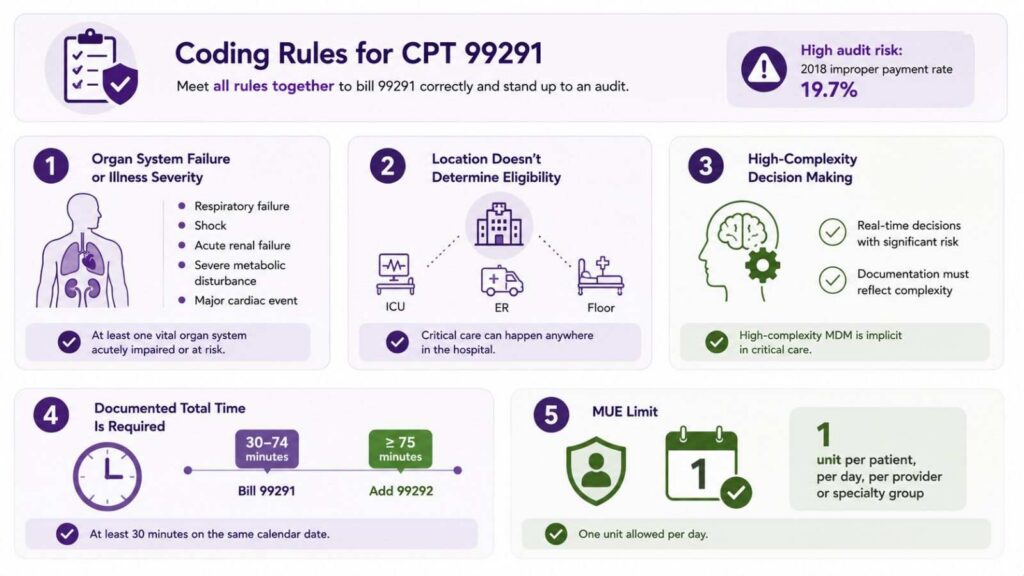
Critical care billing draws more audit attention than almost any other E/M code, and for good reason: Medicare’s own 2018 improper payment rate for critical care services was already 19.7% (about $198 million).
In a 2022 OIG compliance audit of Lahey Clinic, a provider flagged through Medicare data mining, reviewers examined 92 critical care services. They found 56 (61%) were improper, including 41 services that should have been billed as routine subsequent hospital care.
That single number explains why the rules below matter more here than for most codes. Getting 99291 paid, and keeping it paid after an audit, comes down to meeting every one of these criteria at once.
What Organ System Failure or Illness Severity Is Required for 99291?
At least one vital organ system has to be acutely impaired or at risk of failing. This includes conditions like acute respiratory failure, shock, acute renal failure, severe metabolic disturbance, or a major cardiac event such as an arrhythmia causing hemodynamic instability. A stable chronic condition, even a serious one, doesn’t meet this bar on its own.
Does Critical Care Have to Happen in an ICU?
No, critical care can happen in the ICU, the emergency department, or a regular inpatient floor. Location doesn’t determine eligibility. A patient on a general medical floor who suddenly develops septic shock qualifies for critical care billing right there, without being physically moved to the ICU first.
Is High-Complexity Decision Making Required for 99291?
Yes, the physician has to make high-complexity decisions in real time, weighing multiple treatment options, each with significant risk. This is implicit in critical care rather than separately scored the way regular E/M codes score MDM.
However, the documentation still needs to reflect that level of decision-making, not routine, low-risk management.
Is Documented Total Time Required for Every Claim?
99291 covers 30 to 74 minutes of critical care time on a single calendar date. At exactly 30 minutes, the code becomes billable. At 75 minutes, the claim moves into add-on territory and 99292 comes into play alongside it, following the thresholds covered in the earlier 99292 section.
What Is the MUE Limit for CPT 99291?
The Medically Unlikely Edit for 99291 is one unit per patient, per day, per provider or specialty group.
This limit exists because 99291 already covers the full first block of critical care time in a single unit, so a second unit on the same date for the same patient and provider doesn’t make sense to code.
Any additional time beyond 74 minutes is coded by using CPT 99292 rather than a second unit of 99291.
Do Local Coverage Determinations (LCDs) Restrict the Accepted Diagnoses Under 99291?
Some Medicare Administrative Contractors maintain LCDs that list specific diagnosis codes considered medically necessary for critical care billing in their jurisdiction.
These lists vary by MAC and by region, so a diagnosis accepted without issue in one state might trigger additional scrutiny in another. Checking the applicable LCD before submitting a claim, particularly for less common critical illnesses, helps avoid an otherwise preventable denial.
What Happens If Documented Time Falls Under 30 Minutes?
If the total critical care time is less than 30 minutes, 99291 can’t be billed at all, regardless of how sick the patient was.
In that situation, the encounter should be billed as a standard E/M visit instead, at whatever level the documented complexity supports. Time is a hard floor for this code, not a flexible guideline.
What’s the Fastest Way to Audit a 99291 Claim Before Submission?
Four things need to be in place before the claim goes out. The note should include a stated total time, a named organ system at risk, and language that clearly establishes a real threat of rapid deterioration.
The fourth check is different from the other three. It’s about confirming that no other provider in the same specialty and group has already billed critical care for that patient on the same date.
Why Do CPT 99291 Claims Get Denied?
Most 99291 denials trace back to a small, recurring set of causes, not just random errors. The table below covers the most common ones, along with what each looks like on a claim and how to fix it before resubmitting.
| Denial Cause | What It Looks Like | How to Fix It |
|---|---|---|
| Time Under 30 Minutes | Note states a total time below 30 minutes, or no time is stated at all | Bill a standard E/M code instead, based on the documented complexity |
| Missing Organ System Risk | Note describes sick, complex care but never names the organ system at risk | Add an addendum stating the specific organ system and how it’s at risk, then resubmit |
| No Imminent Deterioration Language | Documentation shows treatment but doesn’t state the patient could rapidly worsen without it | Revise the note to state the specific risk of deterioration, not just the treatment given |
| Duplicate Same-Specialty Billing | Two providers from the same specialty and group both bill 99291 for the same patient, same day | Combine total time and have only the provider who spent more than half of it submit the claim |
| Modifier 25 on the Wrong Line | Modifier 25 appended to 99291 instead of the earlier E/M code | Move modifier 25 to the E/M code and resubmit |
| 99292 Billed Too Early | 99292 submitted before 104 total minutes under Medicare’s threshold | Confirm cumulative time meets 104 minutes, or drop 99292 and bill 99291 alone |
| Bundled Service Billed Separately | A code like ventilator management or ABG interpretation billed alongside 99291 | Remove the separate line item, since it’s already included in the 99291 payment |
Final Thoughts on CPT Code 99291
99291 rewards precision more than almost any other E/M code. The clinical work and the paperwork have to match exactly: a stated time, a named organ system at risk, and language that shows a real risk of deterioration.
Getting comfortable with this type of CPT code isn’t about memorizing every rule at once. It’s about building the habit of documenting time and risk the same way, every time, so the note tells the same story the claim is trying to tell.