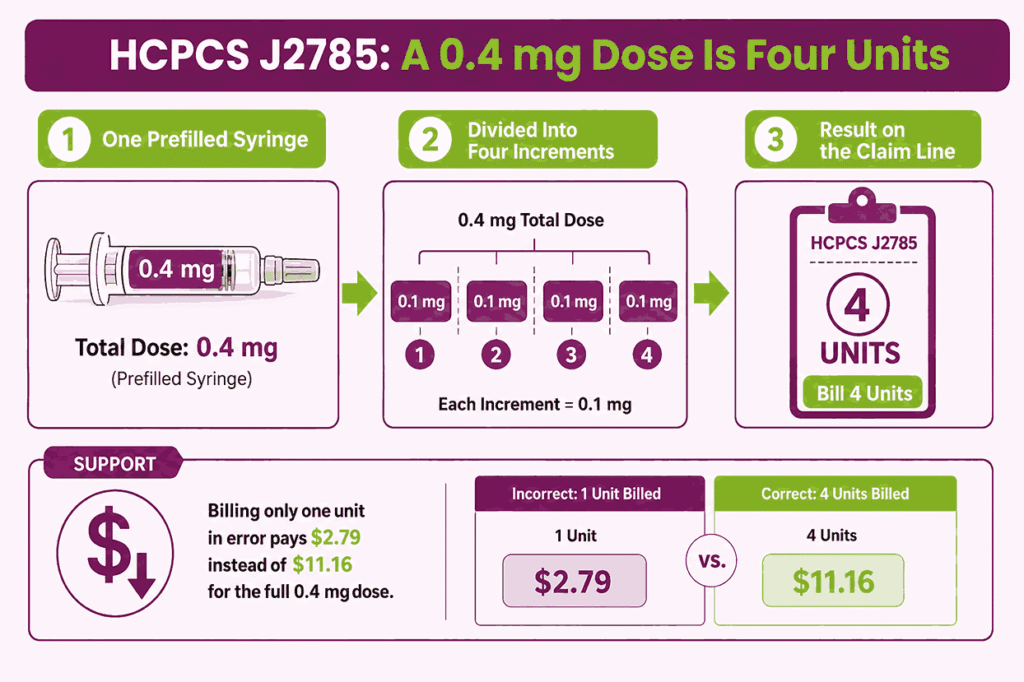
HCPCS code J2785 reports injectable regadenoson in 0.1 mg increments. Because the standard dose is 0.4 mg supplied as a single prefilled syringe, the correct claim carries four units, not one.
J2785 is a pharmacologic stress agent used for myocardial perfusion imaging in patients who cannot exercise adequately. The drug is never a standalone service, and the imaging study it supports is what establishes its medical necessity.
Two errors drive most revenue loss on this code: billing a single unit for the full dose, and treating the injection as separately payable administration. Many cardiology and nuclear imaging practices route these claims through dedicated cardiology billing providers to keep the four-line claim intact.
What Is the Description of HCPCS Code J2785?
The J2785 HCPCS code descriptor as defined by CMS is: “Injection, regadenoson, 0.1 mg.”
This code reports the drug regadenoson, marketed as Lexiscan, used to induce coronary vasodilation during myocardial perfusion imaging. HCPCS code J2785 covers the drug product only, and the imaging study, the stress test, and the radiopharmaceutical each carry their own codes.
The unit basis is where the money is won or lost. J2785 bills in 0.1 mg increments against a 0.4 mg labeled dose, so the arithmetic on the claim line determines whether the practice collects the full drug payment.
What Drug and Unit Basis Does HCPCS Code J2785 Represent?
HCPCS code J2785 represents regadenoson at one unit per 0.1 mg. The product is supplied as a single-dose prefilled syringe containing exactly the 0.4 mg labeled dose in 5 mL.
The unit math works as follows:
- One unit equals 0.1 mg of regadenoson
- The standard adult dose is 0.4 mg, given as a rapid intravenous injection over roughly 10 seconds
- A 0.4 mg dose therefore equals four units of J2785 on the claim line
- The manufacturer’s own reimbursement guidance instructs billing four units for the standard dose
The syringe contains the full labeled dose and nothing more. That design is why four units is the near-universal correct quantity and why discarded drug is rare on this code.
Why Regadenoson Is a Pharmacologic Stress Agent and Not a Radiopharmaceutical
Regadenoson is a vasodilator stress agent, not a radiopharmaceutical. Some coding references describe it as a diagnostic radiopharmaceutical, and that error produces both clinical confusion and broken claims.
The distinction works as follows:
- J2785 is a drug that dilates the coronary arteries to simulate the effect of exercise on blood flow
- The radiopharmaceutical is the radioactive tracer that makes perfusion visible on the scan, reported separately with a code such as A9500
- The two serve different functions and appear on separate claim lines in the same study
- Conflating them leads practices to omit one line entirely, forfeiting real payment
Regadenoson is a selective A2A adenosine receptor agonist that increases coronary blood flow several-fold. The tracer distributes according to that flow, so the drug creates the physiologic condition, and the radiopharmaceutical records it.
How Does J2785 Differ From Adenosine, Dipyridamole (J1245), and Dobutamine (J1250)?
Four agents can produce pharmacologic stress, and they differ by mechanism, dosing burden, and contraindication profile. Agent selection drives which J code appears on the claim.
The pharmacologic stress agents compare as follows:
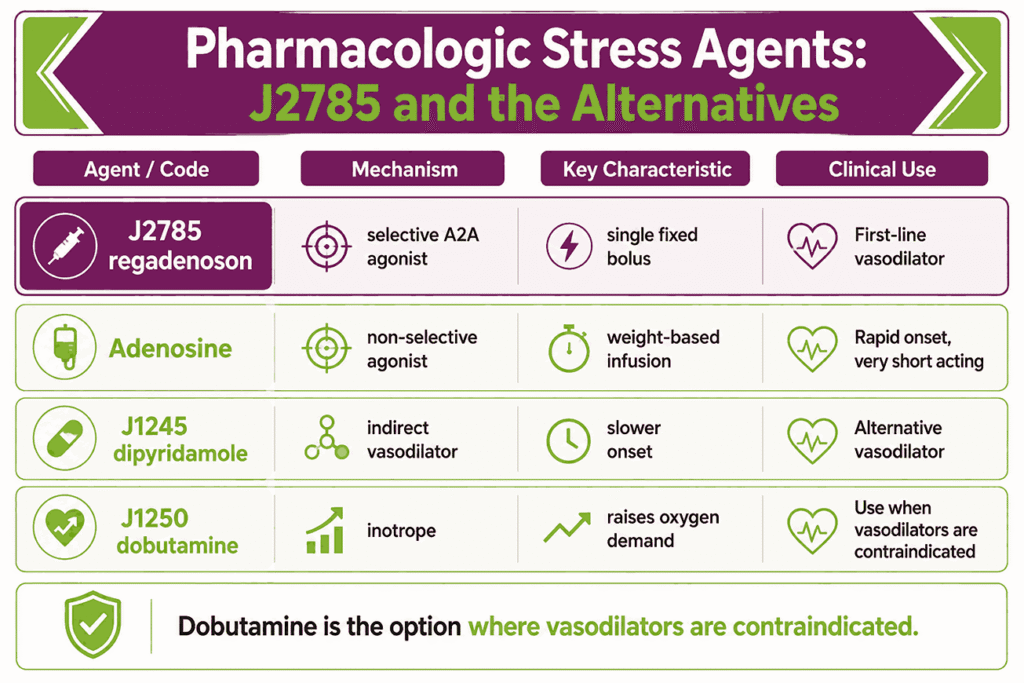
- J2785 regadenoson: a selective A2A agonist given as a single fixed bolus with a short half-life, which simplifies both administration and billing
- Adenosine: a non-selective agonist requiring weight-based infusion, with more systemic side effects and a different code and unit basis
- J1245 dipyridamole: an indirect vasodilator with a slower onset and longer duration of effect
- J1250 dobutamine: an inotrope that raises myocardial oxygen demand rather than dilating vessels
Single-bolus dosing and the shorter half-life drive the preference for regadenoson in most practices. Dobutamine remains the option where vasodilators are contraindicated, such as in patients with significant bronchospastic disease or conduction abnormalities. Agent selection maps directly to code selection across the cardiac drug and supply HCPCS codes, where each J code carries its own unit basis.
Which Codes Are Billed Alongside J2785, and Which Are Not Separately Payable?
A nuclear stress study generates several distinct billable services, and HCPCS code J2785 is only one line among them. The drug administration itself is not one of those lines.
The Standard Nuclear Stress Claim: Imaging, Stress Test, Radiopharmaceutical, and Drug
A complete office-based SPECT study typically carries four components. Each represents a separate service with its own code.
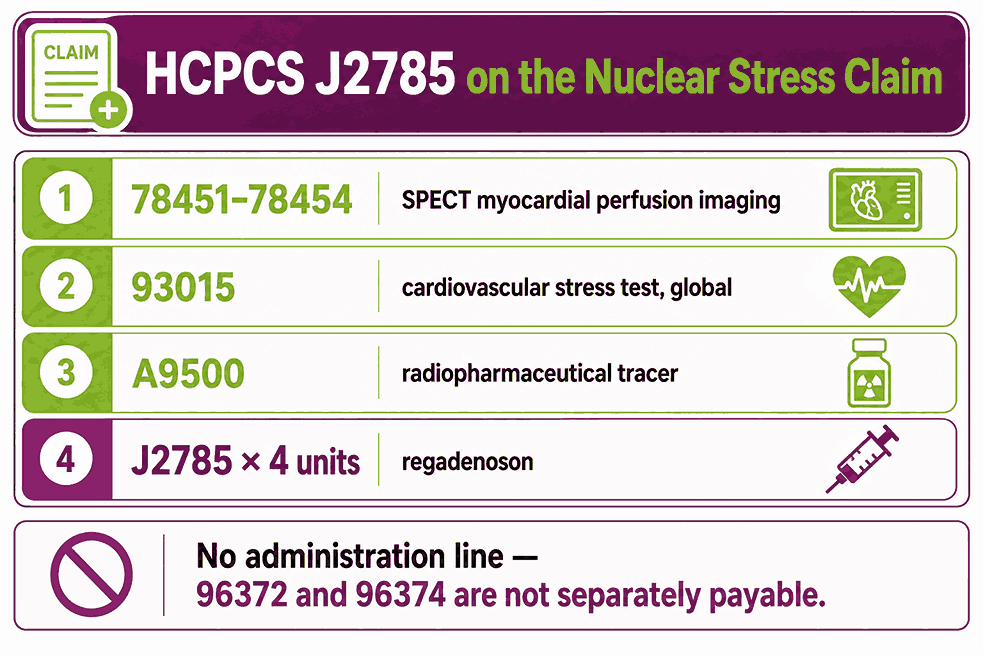
The standard claim construction is:
- 78451 through 78454 for SPECT myocardial perfusion imaging, selected by single or multiple study and by the presence of wall motion or ejection fraction
- 93015 for the global cardiovascular stress test, or the split codes 93016 for supervision, 93017 for tracing only, and 93018 for interpretation and report
- A9500 for the radiopharmaceutical tracer
- J2785 for the regadenoson, at four units for the standard 0.4 mg dose
The professional and technical split matters when different physicians supervise and interpret. A common arrangement bills the technical imaging component, 93016, 93017, A9500, and J2785 under the physician supervising the stress portion, with the imaging professional component and 93018 billed under the interpreting physician. Imaging, stress testing, and supervision each carry their own line among the cardiac diagnostic procedure codes, split further when different physicians supervise and interpret.
Why IV Push Administration (96372, 96374) Cannot Be Billed With J2785
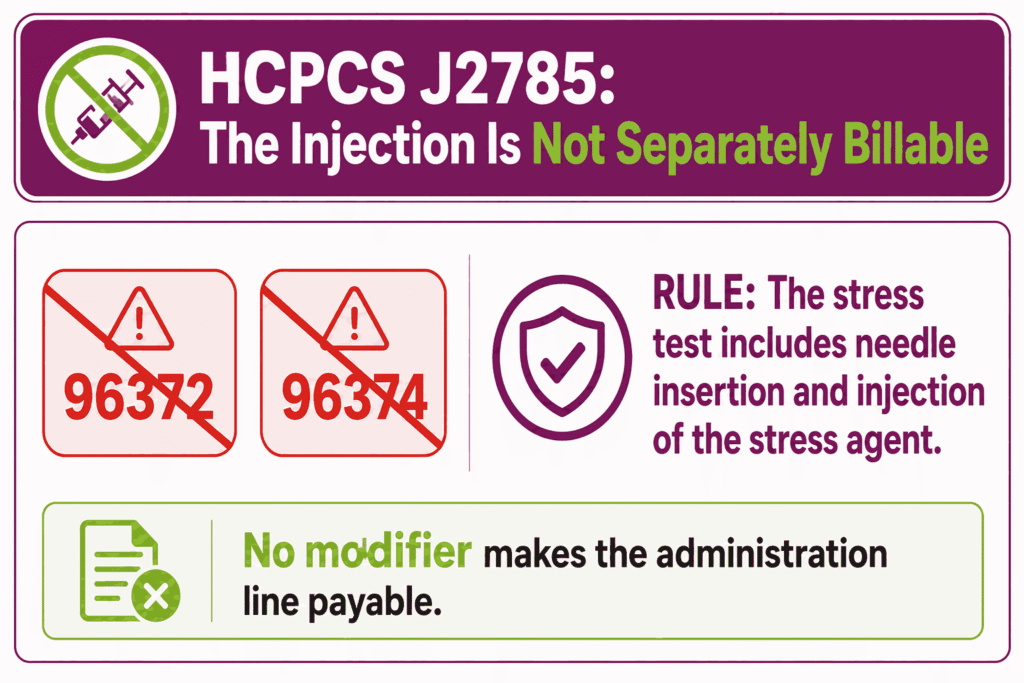
Administration codes 96372 and 96374 are not separately reportable with HCPCS code J2785. The administration of a drug integral to a procedure is incidental to that procedure.
The bundling rule works as follows:
- The NCCI Policy Manual states that cardiovascular stress tests include insertion of the needle or catheter and the injection of the pharmacologic stress agent
- The regadenoson injection exists only to perform the stress test, so it cannot qualify as a separate and unrelated administration
- A modifier does not rescue the administration line, because the service is not distinct from the procedure
- This inverts the familiar pattern from therapeutic J-codes, where an administration code is normally billed alongside the drug
The drug remains separately payable in the office setting even though its administration is not. Practices accustomed to therapeutic infusion billing add the administration line by habit, and it denies every time.
What ICD-10 Codes and Medical Necessity Criteria Support HCPCS Code J2785?
The coverage gate for HCPCS code J2785 is the label indication itself. Regadenoson is indicated for radionuclide myocardial perfusion imaging in patients unable to undergo adequate exercise stress.
The medical necessity elements are:
- A cardiac indication supporting the perfusion study, such as R07.9 for chest pain, I25.10 for atherosclerotic heart disease of native coronary artery without angina, or I20.9 for angina pectoris
- Documentation of why the patient cannot undergo adequate exercise stress
- Common exercise-limiting reasons include severe deconditioning, orthopedic or mobility limitation, neurologic impairment, morbid obesity, or an inability to reach target heart rate
- The study itself must be ordered and performed, since the drug is not payable on its own
The diagnosis supports the study, and the exercise-inability rationale supports the agent. A claim carrying a strong cardiac diagnosis but no recorded reason the patient could not exercise leaves the pharmacologic component unsupported. Selecting between chest pain, angina, and atherosclerotic disease codes follows the usual cardiac condition coding logic, with the study carrying the necessity.
What Are the Modifiers for HCPCS Code J2785?
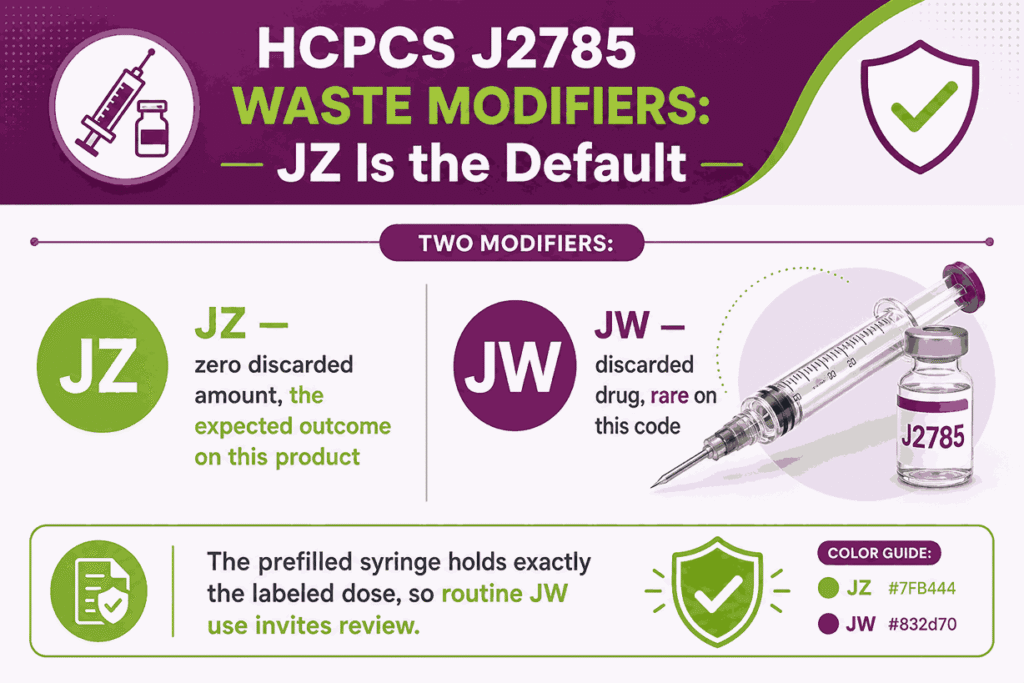
HCPCS code J2785 uses the drug waste modifiers, and the prefilled syringe makes one of them almost universal on this code.
Modifier JZ: Zero Discarded Amount
Modifier JZ attests that no drug was discarded. Append JZ to J2785 in the ordinary case, because the single-dose prefilled syringe contains exactly the 0.4 mg labeled dose and the full contents are administered. Zero waste is the expected outcome on this product.
Modifier JW: Discarded Drug
Modifier JW reports the amount of drug discarded from a single-dose container. Also, modifier JW is rare on HCPCS code J2785, since the syringe holds precisely the labeled dose. Routine JW use on this code signals a documentation error or a product-selection problem rather than genuine waste, and it invites review.
Which Documents Are Required For HCPCS Code J2785?
Documentation for HCPCS code J2785 must support the units billed, the choice of pharmacologic stress, and the safety screening performed. The exercise-inability rationale is the element most often missing.
The required documentation includes:
- The NDC for the product administered, reported on the drug line
- The milligrams administered, supporting the four units billed
- The rationale for pharmacologic rather than exercise stress
- Contraindication screening for AV block and sinus node dysfunction
- Confirmation of methylxanthine and caffeine avoidance instructions given before the test
- The linked imaging study and stress test performed
- The ordering provider and the interpreting physician for each component billed
What Is the Cost of HCPCS Code J2785?
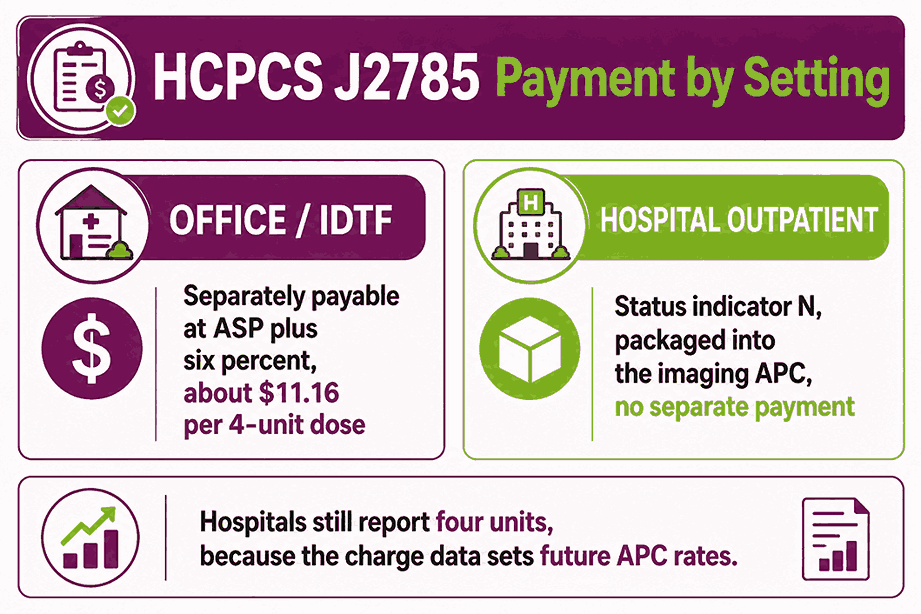
The cost of HCPCS code J2785 depends entirely on the setting. The same drug is separately payable in the office and pays nothing separately in the hospital outpatient department.
ASP Plus Six Percent Payment in the Office and IDTF Setting
In the office and independent diagnostic testing facility setting, HCPCS code J2785 is separately payable under the average sales price methodology at ASP plus six percent. CMS republishes the payment limit each quarter.
| Quarter (2026) | Payment limit per unit | Standard 4-unit dose |
|---|---|---|
| Q2 (April) | $2.902 | $11.61 |
| Q3 (July) | $2.790 | $11.16 |
At the current limit, a standard 0.4 mg dose pays roughly $11.16. The figure moves every quarter, so fee schedules and charge masters need a quarterly refresh rather than an annual one. Quarterly ASP republication sets these limits, a pricing path unique to drug codes within the HCPCS Level II system.
The unit math has direct revenue consequences:
- Four units at $2.790 collects about $11.16 for the dose
- One unit billed in error collects $2.79 and forfeits about $8.37 on that study
- A practice performing several pharmacologic stress studies per week loses meaningful revenue from a single template error
Why J2785 Is Packaged Into the APC Rate in the Hospital Outpatient Setting
In the hospital outpatient setting, J2785 carries status indicator N for CY 2026, unchanged from the prior year. Payment is packaged into the imaging APC, so the drug generates no separate payment.
The operational instruction that follows is counterintuitive:
- Status indicator N means the cost is bundled into the APC payment for the imaging service
- Hospitals should still report HCPCS code J2785 with the correct four units even though the line pays nothing separately
- Reported charges feed the claims data CMS uses to set future APC rates
- Suppressing the drug line understates the true cost of the service and depresses the rate in later years
Omitting the line saves no work and costs the hospital future revenue. The correct practice is to report the drug accurately and let the packaging happen at adjudication.
Commercial Payers and Prior Authorization Variability
Commercial coverage of HCPCS code J2785 varies more by authorization requirement than by rate. Many plans require prior authorization for advanced cardiac imaging, which sweeps in the pharmacologic stress agent.
Coverage considerations include:
- Prior authorization requirements for nuclear stress imaging differ significantly across commercial plans
- Radiology benefit managers may apply appropriateness criteria before approving the study
- The authorization typically covers the imaging study, and the drug follows the approved study rather than being authorized separately
- Verify whether the plan pays the drug separately in the office setting or packages it as Medicare does in the hospital
How Generic Regadenoson Entry Has Moved the ASP Benchmark
Generic competition has pulled the regadenoson benchmark downward, and the quarterly ASP files show the movement directly. The payment limit fell from $2.902 per unit in the second quarter of 2026 to $2.790 in the third quarter.
The ASP mechanism explains the trend:
- ASP is a rolling market-based average of manufacturer sales, so new competitors lower it with a lag
- Multiple regadenoson products now carry the same J2785 code, and the payment limit reflects the blended market
- The single code applies regardless of which manufacturer’s product is administered, so acquisition cost management drives margin
- Practices should compare their acquisition price against the current quarterly limit rather than an older benchmark
Margin on this drug is thin and narrowing. A practice buying above the ASP-based limit loses money on every dose, which makes purchasing review as important as billing accuracy.
What Are Example Clinical Scenarios or Use Cases for HCPCS Code J2785?
HCPCS code J2785 appears in office studies, packaged hospital claims, multi-day protocols, and agent-selection decisions. The scenarios below show each.
Scenario 1: Office-Based SPECT Myocardial Perfusion Study in a Patient Unable to Exercise
ICD-10: R07.9 (Chest pain, unspecified)
A patient with chest pain and severe knee osteoarthritis cannot achieve adequate exercise stress on a treadmill. The cardiologist orders a SPECT myocardial perfusion study with pharmacologic stress. The practice bills the imaging code from the 78451 through 78454 family, 93015 for the global stress test, A9500 for the tracer, and HCPCS code J2785 at four units with modifier JZ. No administration code is added, and the note records the orthopedic limitation preventing exercise.
Scenario 2: Hospital Outpatient Stress Study Where J2785 Is Packaged Into the APC
ICD-10: I25.10 (Atherosclerotic heart disease of native coronary artery without angina pectoris)
The same clinical service is performed in a hospital outpatient department. The hospital reports the imaging, the stress test, the radiopharmaceutical, and J2785 at four units. Because the drug carries status indicator N, the line is packaged into the APC and generates no separate payment. The hospital still reports it with correct units, since the charge data feeds future rate-setting for the imaging APC.
Scenario 3: Two-Day Rest and Stress Protocol Billed Across Separate Dates of Service
ICD-10: I20.9 (Angina pectoris, unspecified)
A patient undergoes a two-day protocol with the rest study on the first date and the stress study a week later. The rest day carries the imaging code and the radiopharmaceutical, with no stress agent. The stress day carries the imaging code, the radiopharmaceutical, the stress test, and HCPCS code J2785 at four units. The drug appears only on the date it was administered, and each date of service is billed independently.
Scenario 4: Second-Degree AV Block Contraindicating Regadenoson and Driving Dobutamine Selection
ICD-10: I44.1 (Atrioventricular block, second degree)
A patient referred for perfusion imaging has second-degree AV block and no functioning pacemaker. Regadenoson is contraindicated in second- or third-degree AV block absent a pacemaker, so the cardiologist selects dobutamine instead. The claim reports J1250 for dobutamine rather than HCPCS code J2785. The contraindication screening documented before the test is what supports the agent substitution.
What Are the HCPCS Code J2785 Rules To Ensure Successful Reimbursement?
Follow the four-unit math, link the drug to the imaging study, document the exercise limitation, and complete the safety screening. Meeting these rules protects HCPCS code J2785 claims from denial and underpayment.
Units, MUEs, and the Four-Unit Billing Math
Units equal milligrams divided by 0.1, so the standard 0.4 mg dose is four units. Billing one unit for a full dose surrenders three quarters of the drug payment and is the most common error on this code.
The unit rules are:
- Calculate units as the milligrams administered divided by 0.1
- A 0.4 mg prefilled syringe fully administered is four units, never one
- Underbilling is not rejected by the payer, so the loss is silent and repeats until someone audits the template
- MUE values are published quarterly and some remain confidential, so verify the current value through the CMS MUE files before submitting quantities above the standard dose
Underbilling is the failure mode here rather than overbilling. A claim for one unit pays cleanly at one unit, which is exactly why the error survives so long in a charge template.
Why J2785 Must Be Linked to the Imaging Study on the Claim
HCPCS code J2785 is not payable as a standalone service. The diagnostic study establishes the medical necessity of the stress agent, so the drug must appear alongside it.
The linkage rules are:
- Report the drug on the same claim as the perfusion imaging and stress test codes
- A drug line submitted without a linked imaging code has no supporting service and denies
- The diagnosis on the drug line must match the cardiac indication supporting the study
- The drug is never billed for a study that was ordered but not performed
Documentation That Establishes Inability to Perform Exercise Stress
The label indication limits regadenoson to patients unable to undergo adequate exercise stress, so the record must show why exercise was not an option. A generic statement that pharmacologic stress was performed does not meet the standard.
The documentation should capture:
- The specific physical, functional, or clinical limitation preventing adequate exercise
- Examples include orthopedic or mobility limitations, severe deconditioning, neurologic impairment, or a prior inability to reach target heart rate
- The clinical reasoning connecting that limitation to the choice of a pharmacologic agent
- Where a patient attempted exercise and failed to reach an adequate workload, the recorded result of that attempt
Pre-Test Preparation and Contraindication Screening Requirements
Safety screening for HCPCS code J2785 protects the patient and supports the claim. The contraindications are specific and appear in the product labeling.
The preparation and screening requirements are:
- Instruct the patient to avoid methylxanthines and caffeine for at least 12 hours before the test, since they blunt the vasodilator response
- Screen for second- or third-degree AV block and sinus node dysfunction, which contraindicate regadenoson absent a functioning pacemaker
- Avoid use in patients with signs or symptoms of acute myocardial ischemia, such as unstable angina or cardiovascular instability
- Ensure cardiac resuscitation equipment and trained staff are available before administration
- Keep aminophylline available as the reversal agent, noting that it is not used in patients with regadenoson-associated seizures
Top Reasons For Denials Specific To J2785 & Quick Remedies
- One Unit Billed Instead of Four: Prevent by calculating units as milligrams divided by 0.1 and auditing the charge template, since a 0.4 mg dose is four units and the underpayment is silent.
- Drug Billed Without a Linked Imaging Code: Prevent by reporting HCPCS code J2785 on the same claim as the perfusion study and stress test, since the drug is not payable alone.
- Missing Exercise-Inability Documentation: Prevent by recording the specific limitation that made adequate exercise stress impossible for this patient.
- Administration Code Billed Alongside the Stress Procedure: Prevent by removing 96372 and 96374, since the injection is integral to the cardiovascular stress test and no modifier makes it payable.
- JW Appended Where No Waste Occurred: Prevent by using JZ as the default, since the prefilled syringe contains exactly the labeled dose and routine JW use signals a documentation problem.
- Separate Payment Expected on a Hospital Outpatient Claim: Prevent by treating status indicator N as packaged, reporting the correct units for rate-setting purposes rather than for separate payment.