The HHS Office of Inspector General reviewed 6,558 Medicare claims for cardiac device replacement. Dates of service ran from January 2015 through June 2017. Hospitals omitted required condition and value codes on 3,233 of them.
That is close to half. Medicare requires those codes whenever a manufacturer issues a device credit. OIG report A-01-18-00502 placed the exposure above $33 million across 911 hospitals.
Cardiology billing fails on the HCPCS side for a reason that has nothing to do with clinical coding skill. The procedure code describes what the physician did. The HCPCS code describes what was implanted, infused, or dispensed, and it answers to a different rulebook.

What Are Cardiology HCPCS Codes?
Cardiology HCPCS codes are the Level II alphanumeric codes that report cardiac devices, drugs, supplies, and screening services. They cover what CPT does not. A pacemaker implant carries a CPT code for the procedure and a C-code for the generator.
The split matters because the two halves are paid by different systems. CPT codes run through the physician fee schedule or an APC. HCPCS Level II codes run through OPPS packaging, average sales price pricing, or the durable medical equipment benefit.
Which HCPCS Code Ranges Do Cardiology Practices Bill?
Six ranges carry almost all cardiology volume. Each range answers to a different payment route. The route decides the rule set before medical necessity is reached.
| Range | What It Reports | Cardiology Example | Payment Route |
|---|---|---|---|
| C | Devices in hospital outpatient settings | C1785, dual chamber pacemaker | OPPS, usually packaged |
| J | Drugs and biologicals | J2785, regadenoson | Average sales price |
| G | Medicare-specific services | G0249, home INR test materials | Physician fee schedule |
| K | Temporary DMEPOS codes | K0606, wearable defibrillator | DME benefit |
| A | Supplies and non-covered items | A4556, electrodes | DME benefit or denial |
| E | Durable medical equipment | E0616, cardiac event recorder | DME benefit |
The C range is the one that generates audit findings. C-codes carry a reporting obligation even when they carry no separate payment. That gap is where the OIG findings live.
HCPCS codes represent only one portion of the coding process. For physician-reported procedures, this complete CPT codes list for cardiology provides the procedural coding guidance that complements the HCPCS device and drug codes discussed here.
Why Does a Cardiology Item Leave the Physician Fee Schedule?
An item leaves the physician fee schedule when it belongs to a different Medicare benefit category. Benefit category is decided before coverage, before medical necessity, and before any payer policy applies.
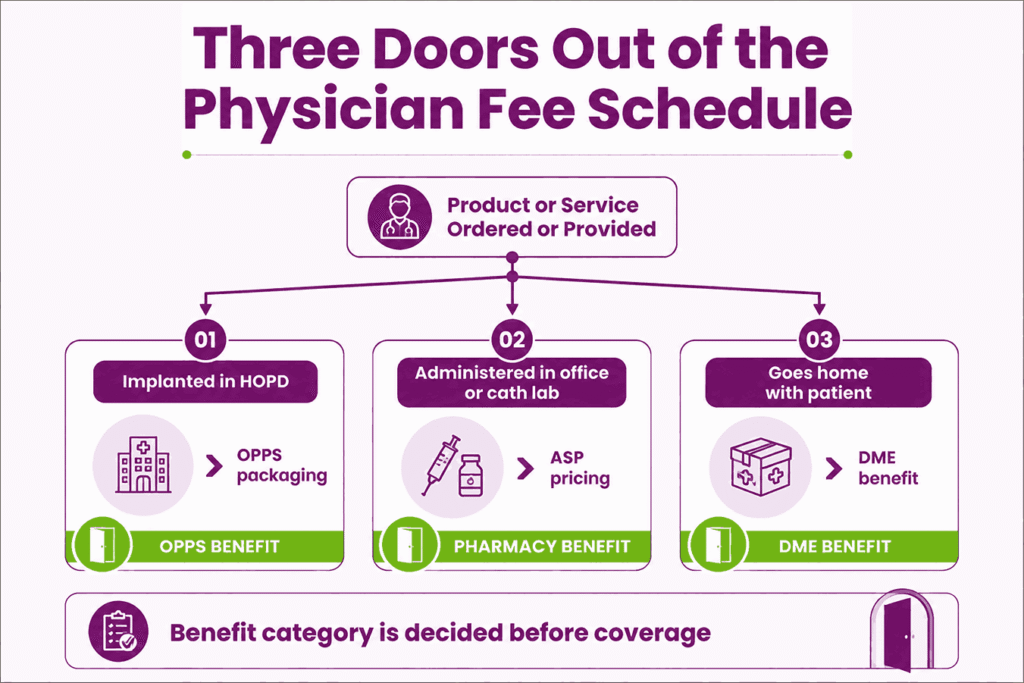
Cardiology items exit through three doors. Implanted devices used in hospital outpatient departments exit into OPPS. Drugs administered in the office or the cath lab exit into average sales price pricing. Equipment the patient takes home exits into the durable medical equipment benefit.
Each door has its own contractor, its own documentation standard, and its own denial pattern. A wearable defibrillator and a pacemaker generator are both cardiac rhythm devices. They share almost no billing rules, because one goes home with the patient and one does not.
How Does OPPS Device Reporting Govern Cardiology C-Codes?
OPPS device reporting governs C-codes through three mechanisms: device-intensive designation, status indicator packaging, and device edits. None of them pay the C-code separately in most cases. All of them can stop the claim.
This is the layer cardiology billers most often skip. A C-code that returns no separate payment looks optional on a remittance. It is not optional, and the Outpatient Code Editor treats its absence as a reason to return the claim.
What Makes a Cardiology Procedure Device-Intensive?
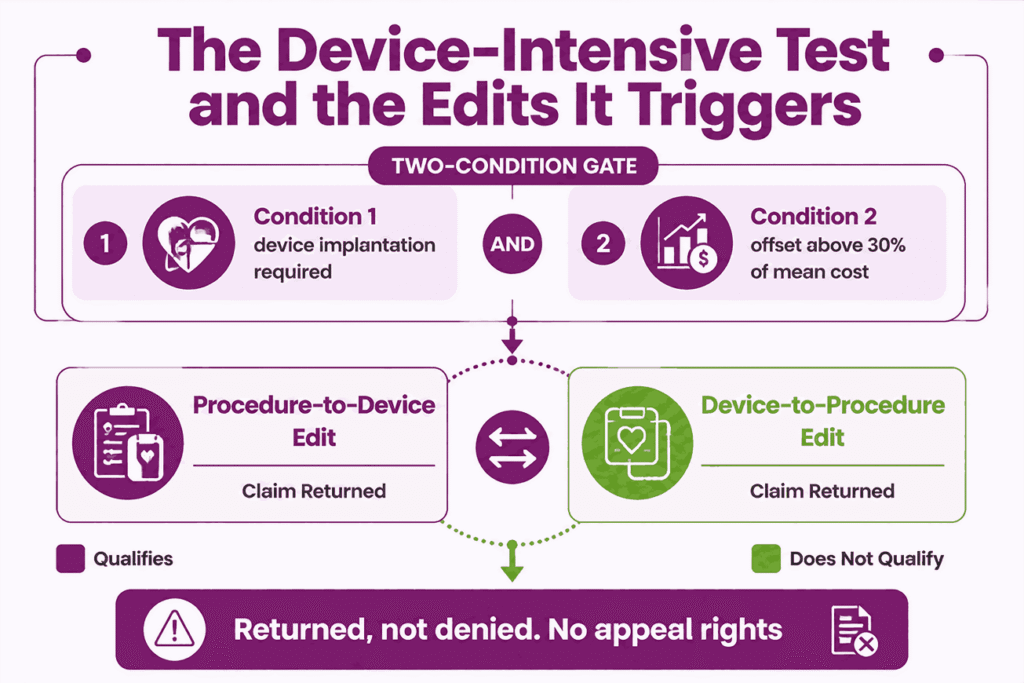
A procedure is device-intensive on two conditions. It requires device implantation, and the device offset exceeds 30 percent of procedure mean cost. CMS assigns that designation at the HCPCS code level, not at the APC level.
The 30 percent figure is current and worth stating precisely. CMS Transmittal R4191CP lowered the threshold from above 40 percent to above 30 percent. The CY2026 OPPS final rule continues it. CMS Transmittal R4191CP made the change effective January 1, 2019. Guidance still citing 40 percent describes a retired rule.
Two further points govern cardiology directly. CMS adopted permanent designation in the CY2025 OPPS final rule, and CY2026 continues it. New codes without claims data receive a default offset of the greater of 31 percent or the APC offset.
Addendum P of each year’s final rule carries the device-intensive list and the per-code offset amounts. That addendum, not a vendor crosswalk, is the authority for whether a given cardiac implant procedure is device-intensive this year.
What Does an OPPS Status Indicator Tell You About a Cardiology Claim?
A status indicator tells you how OPPS will treat the line before it tells you anything about payment. CMS assigns one to every HCPCS code payable under OPPS, per Medicare Claims Processing Manual Pub 100-04, chapter 4.
Status indicator J1 is the one cardiology encounters most. J1 marks a C-APC primary service. That packaging rolls adjunctive items and services into one claim-level payment. When a pacemaker implant carries J1, the generator C-code reported alongside it is absorbed into that payment.
Billers read the zero-dollar line and conclude the C-code was unnecessary. The opposite is true. Packaging is the payment methodology. CMS uses the C-code data to set next year’s offset for the procedure.
Why Does a Device Edit Reject a Cardiology Claim?
A device edit rejects the claim when a device-intensive procedure appears without a device code on the same claim. The edit is a procedure-to-device pairing check run by the Outpatient Code Editor before adjudication.
CMS states the consequence plainly in its January 2014 device edit instruction. Failure to pass these edits returns the claim to the provider. The line is not denied and does not enter appeal. It comes back.
The CY2025 OPPS final rule reinstated these edits for procedures device-intensive since January 1, 2017. CY2026 continues that policy without modification. A cardiac ablation or generator change coded with only the CPT code will not adjudicate.
When Must a Hospital Report a Cardiac Device Credit?
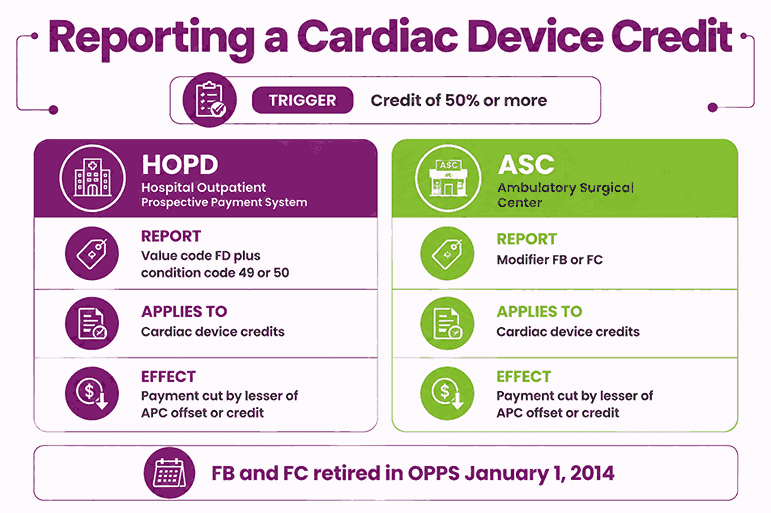
A hospital reports a cardiac device credit at the 50 percent threshold. That means a manufacturer credit worth half the replacement device cost or more. The obligation sits at 42 CFR 419.45 for outpatient claims and 42 CFR 412.89 for inpatient claims.
Warranty replacements and recalls trigger this constantly in cardiology. Generators fail before end of service. Leads get recalled. Manufacturers issue prorated credits as a matter of routine practice, and every one of those credits is reportable.
The payment consequence is the same calculation either way. Under 42 CFR 419.45(b)(1) and (b)(2), CMS reduces payment by the lesser of two amounts. Those are the APC device offset and the credit. Full credits, no-cost devices, and partial credits all run through that single rule.
Condition Code 49 or 50: Which One Reports the Credit?
Condition code 49 reports a product replacement within the product lifecycle. As for condition code 50, this code reports a product replacement for a known recall. CMS created both for institutional use effective April 1, 2006.
The distinction is the reason for the replacement, not the size of the credit. A generator swapped early because it failed under warranty is a 49. The same generator swapped under a manufacturer recall notice is a 50.
Condition code 53 covers a third case cardiology sees in trials. It reports initial placement of a device supplied as a clinical trial item or free sample. No replacement occurred.
Hospital Outpatient or ASC: Which Device Credit Format Applies?
Hospital outpatient departments report the credit amount in value code FD. Ambulatory surgery centers append modifier FB or FC to the procedure code. The two settings have not used the same format since 2014.
CMS Transmittal R2845CP is explicit. Effective January 1, 2014, OPPS no longer recognizes the FB or FC modifiers. That applies to any device furnished at no cost or with a credit. Hospitals report value code FD, described as credit received from the manufacturer for a replaced medical device.
ASCs kept the modifiers. Modifier FB applies when the device arrives without cost or with full credit. Modifier FC applies to a partial credit of 50 percent or more, and a single procedure code never carries both.
The OPPS deduction is capped. CMS limits it to the lesser of two figures. Those are the credit amount in the FD field and the APC device offset.
Guidance instructing a hospital outpatient department to append FB or FC describes a rule that ended twelve years ago. That is a common enough error that it accounts for a share of the reporting failures OIG found.
Which Cardiology Items Pay Under the DME Benefit?
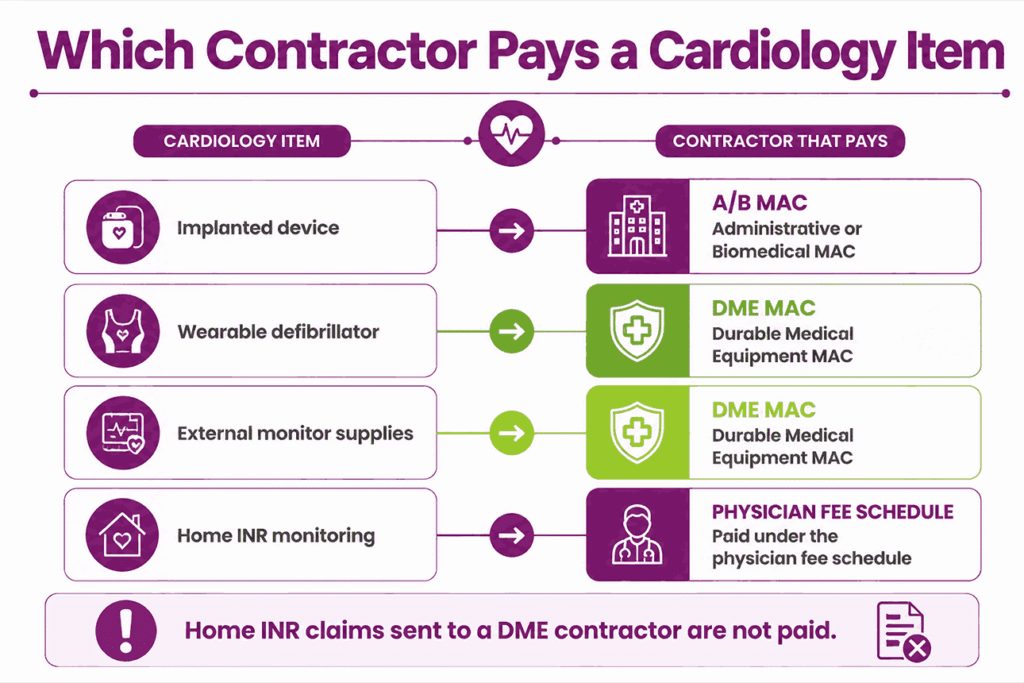
Cardiology items pay under the DME benefit when the patient takes the equipment home. The benefit category follows the patient, not the physician. A monitor worn outside the facility answers to a DME MAC, not the A/B MAC.
Medicare Claims Processing Manual chapter 1 draws the line precisely. Implanted durable medical equipment and implanted prosthetic devices go to the A/B MAC. Other DMEPOS goes to the DME MAC, and CMS maintains a jurisdiction list showing which codes fall where.
Which Cardiac Devices Route to the DME MAC?
Two cardiac device groups route to the DME MAC. Wearable cardioverter defibrillators and ambulatory event recorders leave the building with the patient and bill through DMEPOS.
Home INR monitoring is the exception that catches people. The equipment goes home, but CMS states in Transmittal R1562CP that claims submitted to DME contractors will not be paid. That benefit sits under the physician fee schedule instead.
Supplier standards govern every one of those claims. Enrollment, the standard written order, proof of delivery, and continued need documentation apply identically across DMEPOS categories. The orthopedic HCPCS reference covers that framework in full, and none of it is specialty-specific.
What is specialty-specific is the failure pattern. Cardiology practices rarely hold DMEPOS supplier numbers. The device is usually furnished by a third-party supplier. The practice documents medical necessity but never sees the denial. This lack of visibility is one reason many practices rely on dedicated cardiology billing support to monitor denials, coordinate with suppliers, and prevent recurring reimbursement issues.
How Does Rental Billing Change a Cardiac Monitoring Claim?
Rental billing changes the claim by making it recur. A purchased brace bills once. A rented cardiac monitor bills every month, and every month carries its own documentation exposure.
Three modifiers carry the distinction. NU reports new equipment purchase. RR reports rental. UE reports purchased used equipment, which appears rarely in cardiac monitoring.
The wearable defibrillator behaves unlike any orthopedic item because its rental period tracks a clinical decision window. Coverage runs while the patient waits for implant eligibility or recovery of ejection fraction. When that window closes, the rental stops being payable.
Which HCPCS Codes Report Cardiac Rhythm Device Implants?
Cardiac rhythm device implants generate the largest C-code family in cardiology. Generators, leads, adaptors, and resynchronization devices each carry a separate code. The implant claim needs the right one on the procedure line.
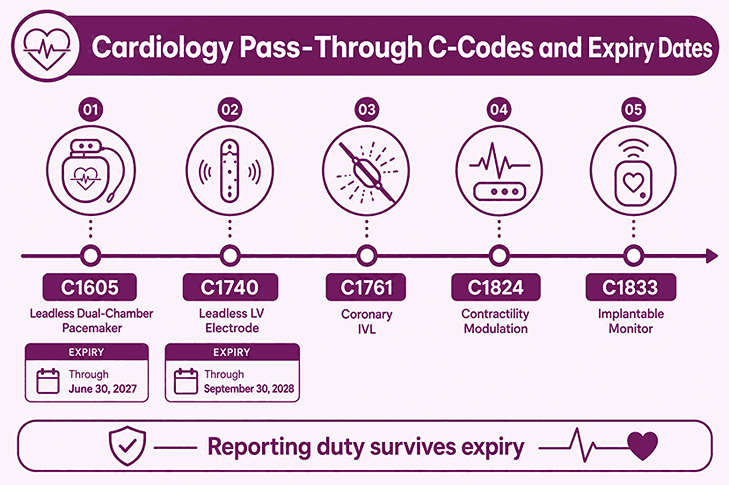
CMS confirms the reporting duty survives pass-through expiration. Almost every cardiac C-code lost pass-through status on December 31, 2002. Hospitals still report them on OPPS claims, per the CY2005 OPPS final rule at 69 FR 65762.
Which C-Codes Report Pacemaker Generators?
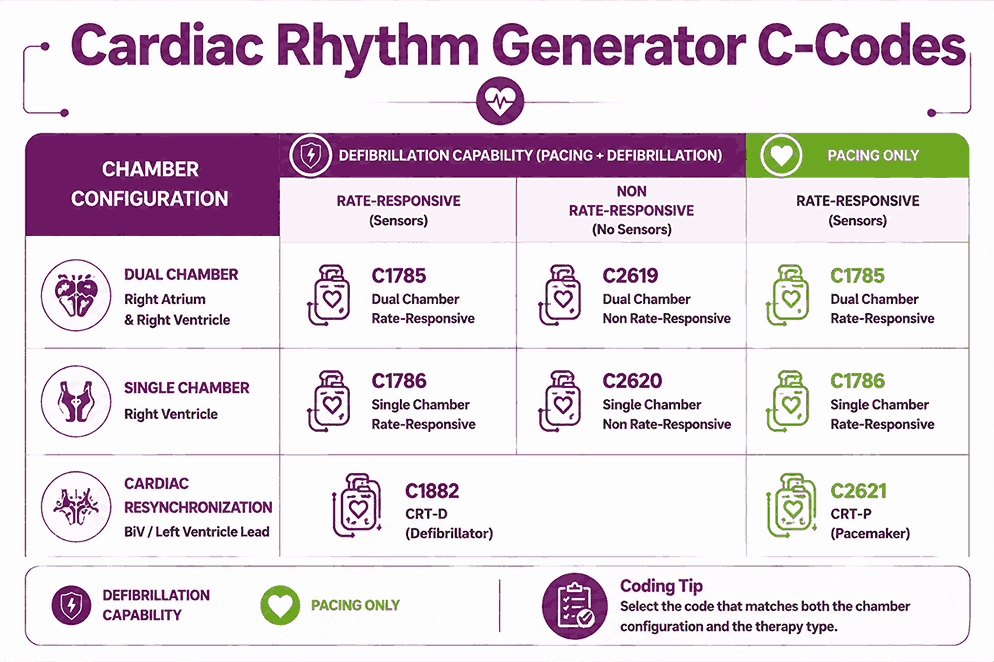
Four codes report pacemaker generators, split on two axes: chamber count and rate response. Reading only the chamber count produces the wrong code half the time.
C1785
Rate response is what this code is built around. C1785 reports a dual chamber pacemaker that is rate-responsive and implantable. The sensor-driven rate adjustment, not the second lead, is what separates it from the non-rate-responsive dual chamber code.
C1786
A single chamber generator with rate response bills as C1786. One lead, one chamber, sensor-driven rate adjustment. The descriptor pairs directly against C1785 on chamber count while holding rate response constant.
C2619 and C2620
Pacemakers without rate response kept their own codes. C2619 covers dual chamber non rate-responsive and C2620 covers single chamber non rate-responsive. Both remain active reporting codes despite pass-through expiring on December 31, 2002.
Rate-Responsive or Not: Which Pacemaker C-Code Applies?
The device label answers this, not the operative note. Rate-responsive generators carry a sensor that modulates pacing rate against physiologic demand, and the manufacturer specification states it plainly.
Chamber count and rate response are independent variables. Dual chamber splits into C1785 and C2619. Single chamber splits into C1786 and C2620. Coders who treat dual chamber as automatically C1785 misreport every non-rate-responsive implant.
Which C-Codes Report Defibrillator and Resynchronization Generators?
Defibrillator generators split three ways, and the third way is the one most often missed. Resynchronization devices do not have their own descriptor. CMS folds them into the other-than-single-or-dual-chamber categories.
C1721
C1721 reports an implantable dual chamber cardioverter-defibrillator. Atrial and ventricular sensing with defibrillation capability defines the category. It is the ICD counterpart to the C1785 pacemaker code, and the two are frequently transposed on generator change claims.
C1722
A patient receiving a single-chamber ICD generates C1722. Ventricular lead only, defibrillation capability present. The single-versus-dual distinction here tracks lead count in the same way it does on the pacemaker side.
C1882
Biventricular capability moves the claim out of both chamber-count codes. C1882 reports a cardioverter-defibrillator other than single or dual chamber. The CMS category definition states that it includes cardiac resynchronization devices. Every CRT-D generator reports here.
C2621
C2621 is the pacing-only mirror of C1882. The CMS definition covers pacemakers other than single or dual-chamber and expressly includes cardiac resynchronization devices. A CRT-P generator without defibrillation capability belongs on this code.
C1882 or C2621: Which Resynchronization Code Applies?
Defibrillation capability decides it. Both codes cover cardiac resynchronization devices under the CMS category definitions, and neither descriptor names resynchronization on its face.
A CRT-D device paces three chambers and can defibrillate, so it reports C1882. A CRT-P device paces three chambers and cannot defibrillate, so it reports C2621. Searching the descriptors for the word resynchronization returns nothing, which is why this pair gets miscoded.
Which C-Codes Report Pacing and Defibrillator Leads?
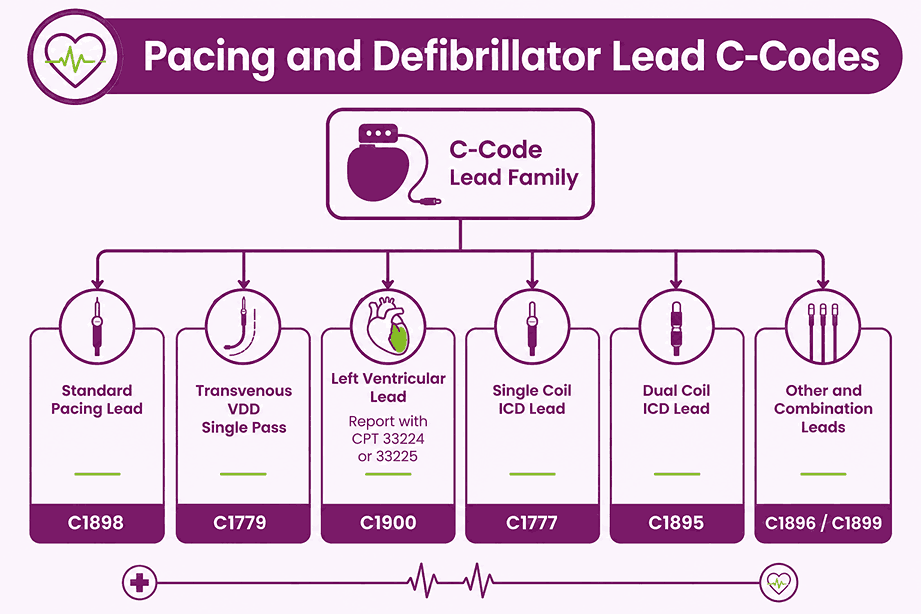
Lead codes outnumber generator codes and carry finer distinctions. Coil count, placement route, and whether the lead serves a pacemaker, a defibrillator, or both all change the code.
C1898
C1898 covers a pacemaker lead other than a transvenous VDD single-pass lead. It is the default pacing lead code and absorbs most standard atrial and ventricular leads. Its counterpart, C1779, exists only for the single-pass VDD design.
C1900
Heart failure resynchronization brought this code into existence. C1900 reports a lead for the left ventricular coronary venous system, placed in a cardiac vein through the coronary sinus. CMS instructs that it be reported with CPT 33224 or 33225.
C1777
Coil count is the whole distinction on defibrillator leads. C1777 reports an endocardial single coil implantable cardioverter-defibrillator lead. A second shocking coil moves the claim to C1895, which reports the endocardial dual coil version.
C1896 and C1899
Two lead codes catch what the endocardial categories do not. C1896 reports a defibrillator lead other than endocardial single or dual coil, covering epicardial and subcutaneous designs. C1899 reports a combination pacemaker and cardioverter-defibrillator lead.
C1779 and C1883
A VDD single-pass lead paces and senses in the ventricle while sensing in the atrium, and reports as C1779. Generator changes sometimes need C1883, an adaptor or extension for a pacing lead. CMS defines the adaptor as the connector that lets an existing lead mate with a new generator receptacle.
Single Coil or Dual Coil: Which Defibrillator Lead Code Applies?
Count the shocking coils on the lead body. One coil reports C1777. Two coils report C1895. Neither descriptor mentions a manufacturer or a model, so the implant log entry is the source document.
Leads falling outside both designs report C1896. That category exists for epicardial and subcutaneous defibrillator leads, which have no endocardial coil configuration at all.
Which HCPCS Codes Report Cath Lab Devices and Supplies?
Cath lab C-codes cover stents, catheters, guidewires, sheaths, and closure devices. Most carry small individual search volume and large collective claim impact. A single intervention can consume six or seven of them.
CMS runs the edits in both directions here. Procedure-to-device edits return the claim when the dominant device is missing. Device-to-procedure edits took effect January 1, 2007. They return the claim when the procedure is missing.
Which C-Codes Report Coronary and Non-Coronary Stents?
Stent codes split on two questions: surface treatment and delivery system. CMS treats a stent packaged with its delivery system as one billable unit. Components inside that package never bill separately.
C1874
C1874 reports a coated or covered stent supplied with a delivery system. CMS writes the category as one definition rather than two, describing a stent bonded with drugs, layered with biocompatible substances, or layered with silicone or a silicone derivative such as PTFE. Coated and covered are not a choice the coder makes.
C1876
Delivery system present, coating absent, and the code becomes C1876. It reports a non-coated and non-covered stent with a delivery system. Bare metal coronary stents land here, and the package includes the mounting catheter, introducer, and sheath.
C2617
Temporary non-coronary stents have their own pair. C2617 reports a temporary non-coronary stent without a delivery system. CMS describes a plastic or non-absorbable design placed for under one year. Peripheral and structural cases reach for it more often than coronary cases do.
C1875, C1877, and C2625
Three codes complete the stent set by removing or restoring the delivery system. C1875 is the coated or covered stent without delivery. C1877 is the non-coated stent without delivery. C2625 is the temporary non-coronary stent with delivery.
Which C-Codes Report Angioplasty and Guiding Catheters?
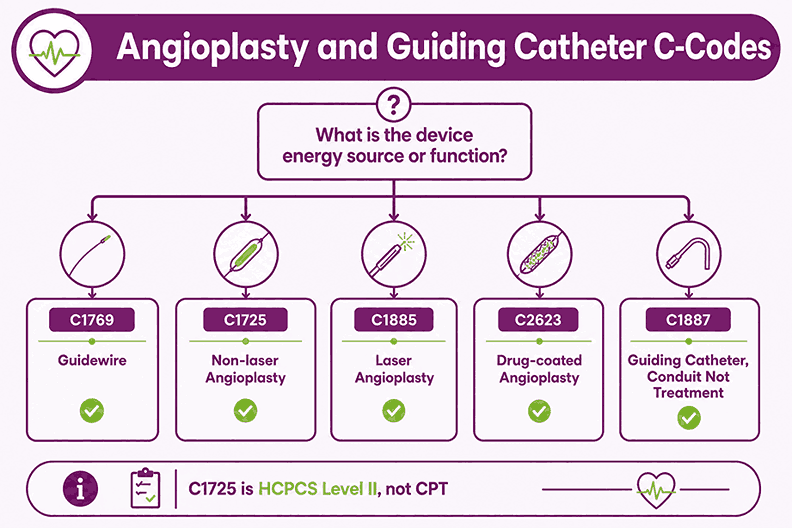
Angioplasty and guiding catheters are the highest-volume cath lab codes and the most frequently confused. Two of them differ only by energy source. Another is a CPT code in every search query and a HCPCS code on every claim.
C1769
C1769 reports a guide wire, and it appears on nearly every interventional claim. Ubiquity is exactly why it goes missing. A biller who assumes the wire was packaged drops the one line the device edit checks for.
C1725
Anyone hunting a C1725 CPT code description is in the wrong code set. C1725 is HCPCS Level II, not CPT, and it reports a non-laser transluminal angioplasty catheter. CMS defines the category as a device designed to dilate stenotic arteries and veins.
C1887
Conduit rather than treatment is what this code describes. C1887 reports a guiding catheter. CMS defines it as a device for introducing interventional or diagnostic tools into coronary or peripheral vessels. It can also inject contrast and measure arterial pressure.
C1885 and C2623
Two variants sit alongside the standard angioplasty catheter. C1885 reports the laser transluminal angioplasty catheter. C2623 reports the drug-coated non-laser version, which is how a drug-coated balloon reaches the claim.
Which C-Codes Report Electrophysiology Catheters?
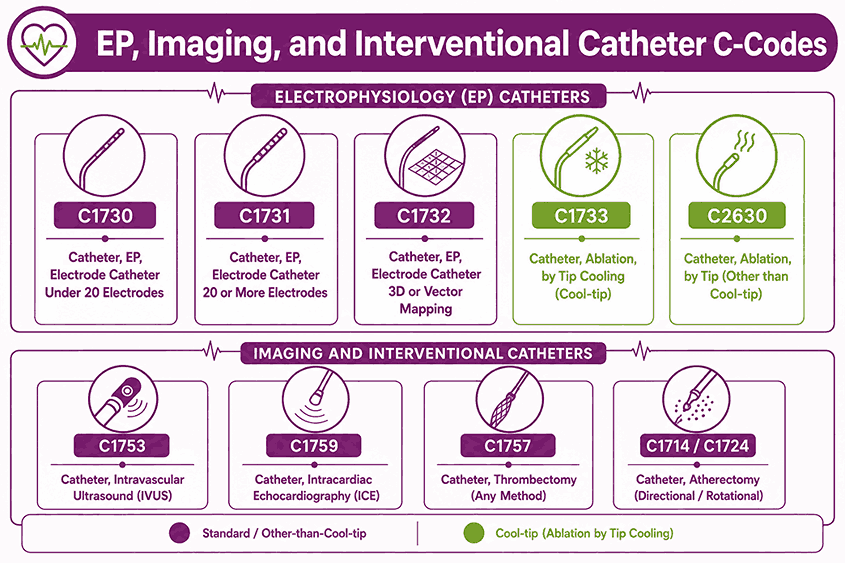
Electrophysiology catheter codes turn on two variables: electrode count and mapping capability. CMS groups these codes two ways. Diagnostic catheters map, pace, or record. Ablation catheters do that and treat.
C1733
C1733 reports an electrophysiology diagnostic or ablation catheter that is neither 3D nor vector mapping and is other than cool-tip. CMS describes the other-than-cool-tip design as a thermistor tip catheter measuring temperature at the tissue interface.
C1730
Nineteen electrodes or fewer, no 3D mapping, and the code is C1730. It reports a diagnostic electrophysiology catheter used for mapping, pacing, or recording. Ablation capability is absent by definition, which distinguishes it from the C1732 and C1733 group.
C1732
Mapping capability moves the claim here. C1732 reports a diagnostic or ablation electrophysiology catheter with 3D or vector mapping. CMS defines vector mapping as an in-plane orthogonal electrode array used to locate a focal arrhythmia source.
C1731
Crossing twenty electrodes changes the code even when nothing else changes. C1731 reports a diagnostic electrophysiology catheter with twenty or more electrodes and no 3D mapping. Electrode count alone separates it from C1730.
Cool-Tip or Not: Which EP Ablation Catheter Code Applies?
Cooling mechanism decides it. CMS defines a cool-tip catheter as one whose tip is cooled by infused or circulating saline. It also carries temperature sensing capability.
Cool-tip ablation catheters report C2630. Everything else in that mapping category reports C1733. The two descriptors are otherwise word-for-word identical, so the device packaging is the only reliable source.
Which C-Codes Report Imaging and Interventional Catheters?
Imaging and thrombectomy catheters sit outside the angioplasty and electrophysiology families. Each answers a diagnostic or mechanical question rather than a dilation question.
C1757
C1757 reports a thrombectomy or embolectomy catheter. Mechanical clot removal in acute coronary and peripheral cases drives its use. It is a separate reporting category from the atherectomy codes despite the clinical overlap.
C1753
Intravascular ultrasound generates C1753. The catheter images the vessel wall from inside the lumen during an intervention. Its code stands apart from the intracardiac echocardiography catheter, which images the heart chambers instead.
C1759
Chamber imaging during structural and electrophysiology work reports C1759, the intracardiac echocardiography catheter. Transseptal punctures, septal defect closures, and ablations all lean on it. Reporting it as an ultrasound supply rather than a device C-code is a common cath lab error.
C1714, C1724, and C1886
Plaque and tissue removal codes complete this group. C1714 reports a directional transluminal atherectomy catheter, and C1724 reports the rotational version. C1886 reports an extravascular tissue ablation catheter of any modality.
Which C-Codes Report Sheaths, Grafts, and Closure Devices?
Access and hemostasis devices bracket every cath lab case. The sheath goes in first, and the closure device goes in last. Both carry reporting obligations the interventional team rarely sees.
C1894
C1894 reports a non-laser introducer or sheath that is neither guiding nor intracardiac electrophysiological. It is the default access sheath code for interventional cardiology. Its laser counterpart is C2629, which shares the descriptor except for the energy source.
C1760
Hemostasis at the arterial puncture site is what this code buys. C1760 reports an implantable or insertable vascular closure device. CMS defines it as achieving hemostasis using biologic substances such as collagen or suture placed through the tissue tract.
C1768
Vascular grafts report C1768 regardless of material or configuration. The category takes no position on synthetic versus biologic construction. Endovascular and open surgical grafts both land on this single code.
C1892, C1893, and C1766
Guiding electrophysiology sheaths split three ways on curve and removal design. C1892 is fixed-curve and peel-away, which CMS defines as separating into two pieces for removal after lead positioning. C1893 is fixed-curve non-peel-away, and C1766 is steerable non-peel-away.
C2628, C1817, C1880, C1884, and C1773
Five occlusion and retrieval codes close out the family. C2628 reports an occlusion catheter, and C1880 reports a vena cava filter. C1817 reports an intracardiac septal defect implant system, which CMS states already includes the delivery catheter. C1884 reports an embolization protective system, and C1773 reports an insertable retrieval device.
Which Cardiology C-Codes Currently Hold Pass-Through Status?
Pass-through status pays a device separately for a limited term instead of packaging it. Several cardiology categories hold it right now, and each expires on its own date.
C1605 and C1740
Leadless pacing moved fast enough to earn its own categories. C1605 reports a leadless dual-chamber pacemaker and holds pass-through status through June 30, 2027. C1740 reports a leadless left ventricular pacing electrode and runs through September 30, 2028.
C1761 and C1824
Two newer therapy categories sit alongside them. C1761 reports a coronary intravascular lithotripsy catheter, used to modify calcified lesions before stenting. C1824 reports a cardiac contractility modulation generator for heart failure patients outside resynchronization criteria.
C1833 and C9610
Monitoring and drug delivery close the group. C1833 reports an implantable cardiac monitor. C9610 reports a coronary drug delivery catheter. Its C9 prefix marks a new-technology code rather than a device category code.
Why Does Pass-Through Status Change the Claim?
Separate payment ends on a published date, and the reporting duty does not end with it. A device that paid separately last quarter may package this quarter while still requiring the same C-code on the claim.
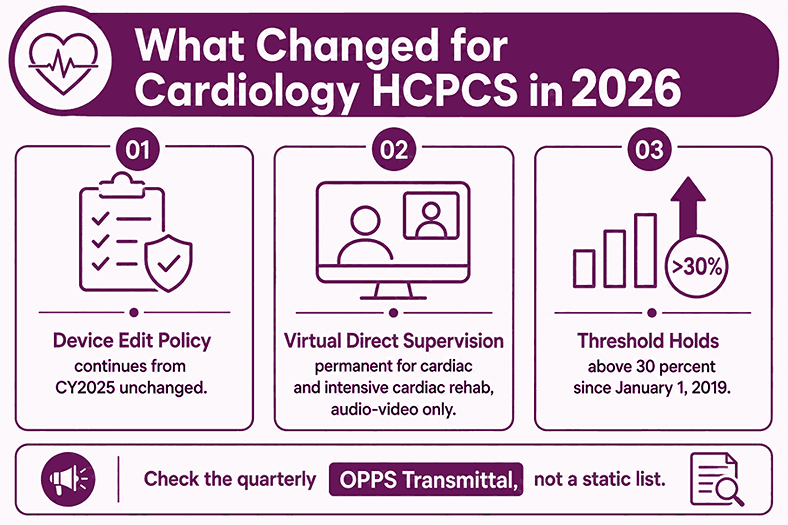
Check the quarterly OPPS update transmittal rather than a static list. CMS publishes additions, expirations, and category changes each quarter. A device category file more than a quarter old misstates current status.
Which C-Code Reports a Cardiac Device With No Specific Category?
C1889 reports an implantable or insertable device that is not otherwise classified. It is the fallback every cardiology coder eventually reaches, and the one most often reached too early.
Its function is to satisfy the device edit when no specific category fits. A device-intensive procedure returns to the provider without a device code on the claim. A novel cardiac implant leaves the coder with nothing else to report.
Using it carelessly carries its own risk. C1889 exists for genuine gaps, not for cases where the coder did not locate the specific category. The device category list published with each OPPS update is the place to check before defaulting here.
Which HCPCS Codes Report Cardiology Drugs?
Cardiology drug codes cover pharmacologic stress agents, procedural anticoagulation, and cath lab infusions. Each one bills in units defined by the descriptor, not by the vial.
Unit math, NDC reporting, and the JW and JZ discarded drug rules apply identically across every Part B drug family. The neurology HCPCS codes reference covers that framework in full. What follows is what changes when the drug is cardiac.
Which J-Codes Report Pharmacologic Stress Agents?
Three agents cover patients who cannot exercise. All three bill alongside the stress imaging study rather than as standalone services. All three carry unit definitions that do not match the vial.
J2785
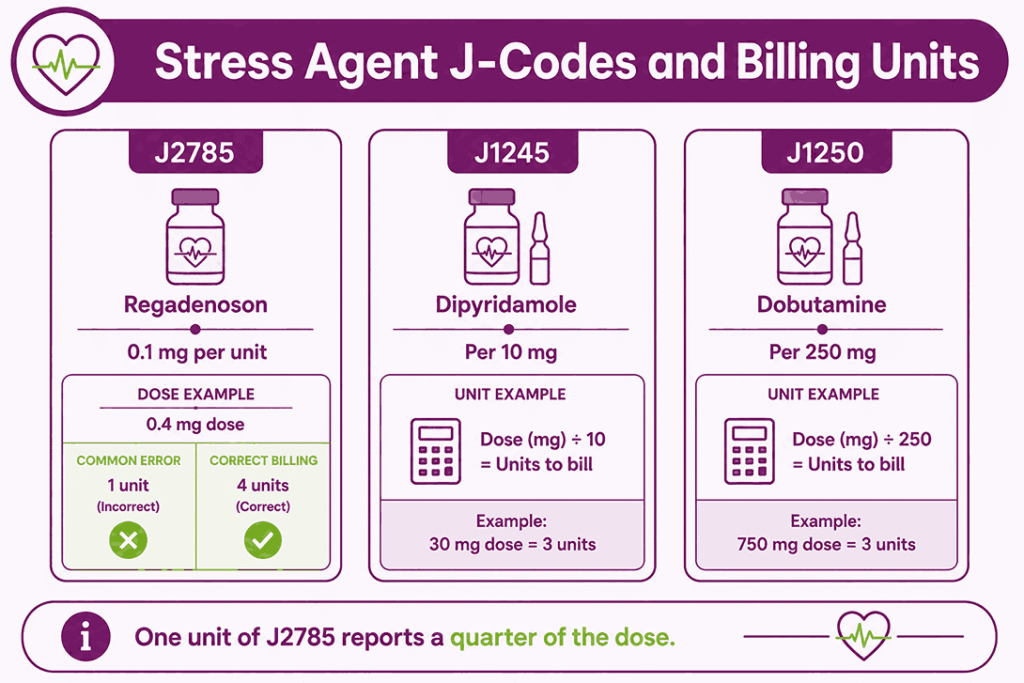
HCPCS code J2785 is for a patient who cannot walk a treadmill and receives a pharmacologic agent; regadenoson is the usual choice. J2785 code reports injection, regadenoson, 0.1 mg. The standard Lexiscan dose is 0.4 mg, which bills as four units. Reporting a single unit understates the claim by seventy-five percent.
J1250
J1250 reports injection, dobutamine hydrochloride, per 250 mg. Dobutamine drives a stress response through inotropic stimulation rather than coronary vasodilation. That mechanism makes it the agent of choice for stress echocardiography rather than nuclear perfusion imaging.
J1245
Dipyridamole predates both other agents and still appears on perfusion studies. J1245 reports injection, dipyridamole, per 10 mg. The per-10-mg unit definition differs from the per-0.1-mg definition on J2785. A coder moving between agents cannot carry the unit habit across.
J2785 or J1245: Which Stress Agent Code Applies?
The agent administered decides the code, and the two are not interchangeable on a claim. Regadenoson is a selective A2A receptor agonist given as a fixed dose. Dipyridamole is weight-based and infused over minutes.
Unit exposure differs sharply. A 0.4 mg regadenoson dose bills as four units of J2785. A dipyridamole dose bills in 10 mg increments under J1245. Documentation must record the administered amount, because neither code carries a default quantity.
Which J-Codes Report Cath Lab and Procedural Drugs?
Procedural drugs reach the claim through the facility side more often than the professional side. Their codes are short, their unit definitions are precise, and their denial pattern is almost entirely arithmetic.
J1644
J1644 reports injection, heparin sodium, per 1000 units. A 5,000 unit bolus therefore bills as five units of the code. Sheath flushes and procedural anticoagulation both draw on it during interventional cases.
J1643
One heparin product sits outside J1644 entirely. J1643 reports heparin sodium from Pfizer, described in the descriptor as not therapeutically equivalent to J1644, per 1000 units. Substituting one code for the other on a claim misidentifies the product.
J0153
Adenosine bills at a finer granularity than the other agents. J0153 reports injection, adenosine, 1 mg. It appears as a stress agent and as a diagnostic bolus during electrophysiology work. The unit count follows the milligram total either way.
J7030
J7030 reports infusion of normal saline solution, 1000 cc. Pre-procedure hydration before contrast exposure puts it on cath lab claims regularly. It belongs to no single specialty, and the dedicated code guide covers its unit and packaging rules.
Which HCPCS Codes Report Cardiac Monitoring, Rehab, and Anticoagulation?
Monitoring and anticoagulation codes cover the cardiology work that happens after the patient leaves. Each family answers to a different payment route, and none of them behaves like the device codes above.
Three routes operate here. Wearable defibrillators and external monitors bill through DMEPOS. Home INR monitoring bills through the physician fee schedule. Implanted recorders bill as OPPS device C-codes.
Which HCPCS Codes Report a Wearable Cardioverter Defibrillator?
Four codes cover the wearable cardioverter defibrillator. One reports the device, and three report the consumables that keep it running.
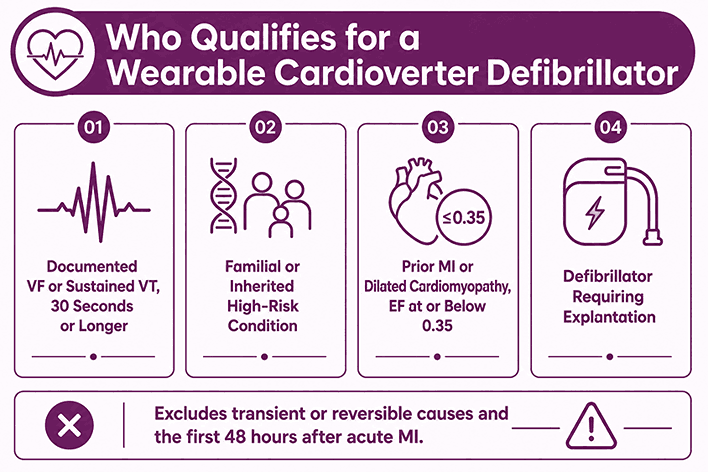
Coverage runs through LCD L33690 and its companion Policy Article A52458. A beneficiary qualifies on any one of four criteria. CMS expects the treating practitioner to be experienced in managing sudden cardiac death risk.
K0606
There is no CPT K0606. K0606 is HCPCS Level II, and it reports an automatic external defibrillator with built-in electrocardiogram analysis, garment type. It sits in the temporary DMEPOS K range, which is why it never appears in a CPT book.
K0607, K0608, and K0609
Consumables bill separately from the base device. K0607 reports a replacement battery, K0608 a replacement garment, and K0609 replacement electrodes, each billed individually. Policy Article A52458 restricts all three to use with K0606.
Why Does Every Wearable Defibrillator Line Need the KF Modifier?
The FDA classifies these devices as Class III. Policy Article A52458 requires modifier KF on every claim line for E0617, K0606, K0607, K0608, and K0609. Lines submitted without it are rejected as missing information rather than denied, so they never reach appeal.
Which Four Criteria Qualify a Patient for K0606?
Any single criterion is enough. LCD L33690 lists a documented episode of ventricular fibrillation or sustained ventricular tachyarrhythmia. The episode must last 30 seconds or longer, spontaneous or induced. It must not stem from a transient or reversible cause. It must also fall outside the first 48 hours of an acute myocardial infarction.
The remaining three cover different clinical routes. Familial or inherited conditions carrying high arrhythmia risk qualify, including long QT syndrome and hypertrophic cardiomyopathy. So does documented prior myocardial infarction or dilated cardiomyopathy with ejection fraction at or below 0.35. So does a previously implanted defibrillator now requiring explantation.
Which G-Codes Report Home INR Monitoring?
Three G-codes report home INR monitoring, and none of them bills through DMEPOS. CMS states in Transmittal R1562CP that claims sent to DME contractors will not be paid. The benefit sits under the physician fee schedule.
National coverage determination 190.11 governs the whole family. Coverage began with mechanical heart valve patients on warfarin. CMS expanded it effective March 19, 2008, to add chronic atrial fibrillation and venous thromboembolism.
Two conditions gate every claim. The patient must have been anticoagulated for at least three months before using the home device. The patient must also complete an educational program on anticoagulation management and monitor use.
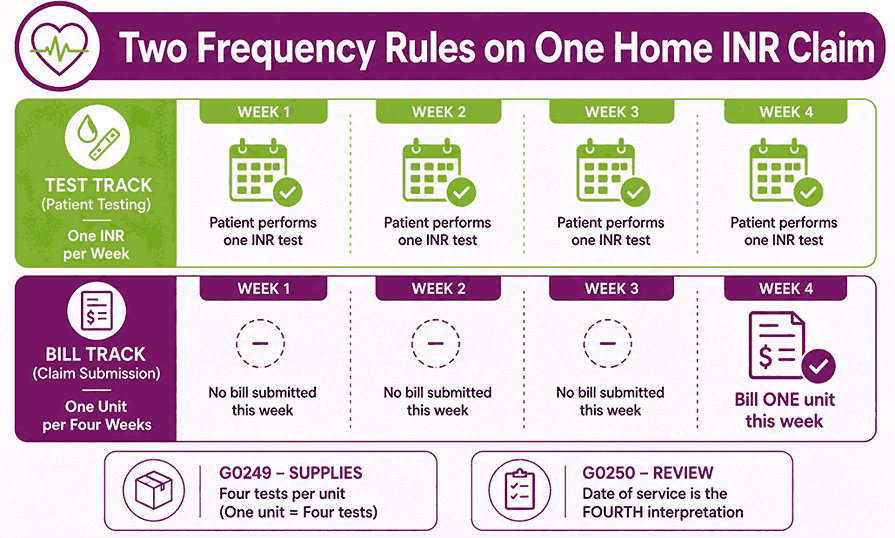
G0249
G0249 reports provision of test materials and equipment for home INR monitoring. For HCPCS code G0249, one billing unit covers four tests, and the descriptor caps testing at once per week. CMS states the device and supply cost is included in this payment and is never billed separately.
G0248
Training comes first and bills once. G0248 reports the face-to-face demonstration given before monitoring begins. The descriptor requires use and care instruction and at least one blood sample drawn. It also requires reporting instructions and documentation that the patient can perform the test.
G0250
Physician work carries its own code on a four-week cycle. G0250 reports review, interpretation, and patient management of home INR results. It also bills per four tests and no more often than once every four weeks. The date of service is the fourth interpretation.
Weekly or Monthly: Which Home INR Frequency Rule Applies?
Both rules run at once, and confusing them drives the denials. Testing happens no more than weekly. Billing happens no more than every fourth week.
G0249 and G0250 each bundle four tests into a single unit of service. A practice submitting weekly units of either code is billing four times the covered frequency. Porcine valve patients fall outside NCD 190.11 entirely, so eligibility fails before frequency is ever reached.
Which HCPCS Codes Report Cardiac Event and Loop Monitoring?
Monitoring codes split by whether the device sits under the skin or on it. Implantable recorders carry C-codes and answer to OPPS. External monitors and their supplies carry A codes, while implanted recorders carry C and E codes.
A4556
A4556 reports electrodes supplied per pair. Holter and ambulatory event monitoring consume them continuously. The pair, not the individual electrode, is the billing unit.
C1764
Implanted loop recorders leave the DMEPOS world entirely. C1764 reports a cardiac event recorder described by CMS as implantable, and it accompanies CPT 33285 on the facility claim. Reporting it as a supply rather than a device C-code is a routine cath lab error.
C2624
Heart failure hemodynamic monitoring has its own device code. C2624 reports an implantable wireless pulmonary artery pressure sensor with delivery catheter, including all system components. The CardioMEMS system bills here and pairs with CPT 33289 and 93264.
A4557, E0616, E0619, and G2066
Three codes finish the monitoring set. A4557 reports lead wires per pair. E0616 reports an implantable cardiac event recorder and E0619 an apnea monitor. G2066 no longer belongs on a current claim, because CMS deleted it effective January 1, 2024.
Which G-Codes Report Cardiac Rehabilitation?
Two G-codes report intensive cardiac rehabilitation, separated by whether the session includes exercise. G0422 covers the with-exercise session, and G0423 covers the without-exercise session.
The CY2026 OPPS final rule changed how these are supervised. CMS permanently adopted virtual direct supervision for cardiac rehabilitation and intensive cardiac rehabilitation. The supervising practitioner may be immediately available by real-time audio and video, though audio-only does not satisfy the standard.
Which G-Codes Report a Screening EKG?
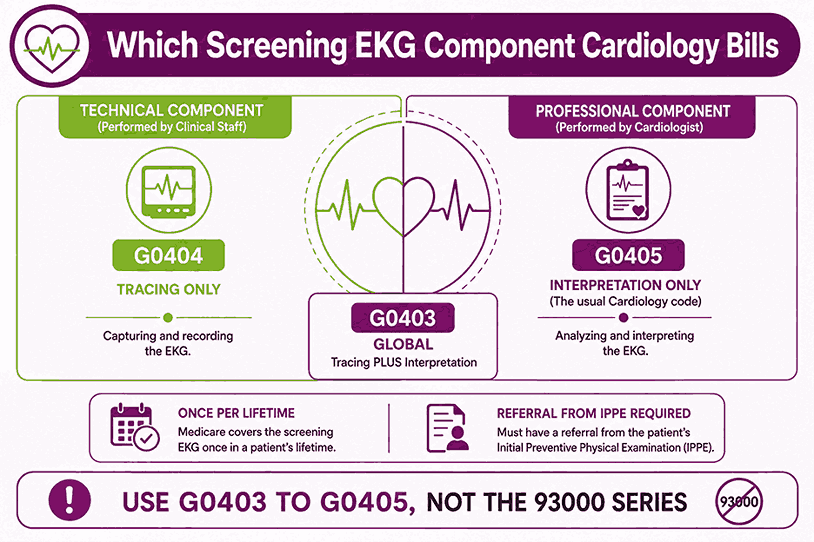
The screening electrocardiogram attached to the Initial Preventive Physical Examination carries three G-codes. All three describe a routine 12-lead ECG and split only on which component the biller performed.
Two rules bracket the whole family. The screening EKG is covered once per beneficiary lifetime, and it requires a referral from the IPPE. CMS made the EKG optional rather than required in 2009.
G0403
G0403 reports the complete screening EKG, meaning tracing, interpretation, and report performed by the same entity. It is the global service. Anyone searching a G0402 CPT code description is looking at the IPPE visit itself, which is a separate code billed by the primary care practitioner.
G0404
Splitting the service splits the code. G0404 reports the tracing only, without interpretation and report. A facility that runs the ECG and sends it elsewhere for reading bills this half.
G0405
G0405 reports interpretation and report only, without the tracing. This is the code cardiology bills most often, because the reading frequently lands with a cardiologist rather than the referring practitioner.
G0403, G0404, or G0405: Which Component Does a Cardiologist Bill?
Whoever performs the work bills the matching component, and cardiology usually performs only the read. A cardiologist interpreting an IPPE tracing captured elsewhere bills G0405, not G0403.
Substituting a CPT code is the common failure. CMS directs that screening EKGs referred from an IPPE use the G0403 to G0405 range. The 93000 series does not apply. A separately medically necessary EKG on the same day is reported with a 93000-series code and modifier 59.
Cost sharing differs from the visit. Medicare waives the deductible and coinsurance for the IPPE itself. Neither is waived for the screening EKG.
Which HCPCS Code Reports a Non-Covered Cardiac Item?
A9270 reports a non-covered item or service. It exists for statutorily excluded items where no specific code and no not-otherwise-classified code applies.
Cardiology reaches it through a route CMS names directly. Policy Article A52458 splits defibrillators three ways. Wearable garment-type units with built-in electrocardiogram analysis take K0606. Non-wearable automatic units with that analysis take E0617. Every other type takes A9270.
Jurisdiction is what trips practices up. Medicare Claims Processing Manual chapter 23 directs suppliers to use A9270 when billing DME MACs. Chapter 1 sends implanted durable medical equipment and implanted prosthetic devices to the A/B MAC instead. The contractor depends on whether the item is implanted.
The liability modifier decides what happens next. Since July 1, 2011, A/B MACs automatically deny lines carrying GZ and run no complex medical review on them. GY lines may be auto-denied at contractor discretion.
Why Do Cardiology HCPCS Claims Get Denied?
Cardiology HCPCS denials cluster around six failures, and none of them is a clinical coding error. The procedure code is usually right. What fails is a reporting obligation attached to the device, the drug, or the frequency rule. These challenges are one reason many cardiology billing companies invest heavily in specialty-specific coding expertise and claim review workflows to reduce preventable denials.
Why Does an Unreported Device Credit Create an Overpayment?
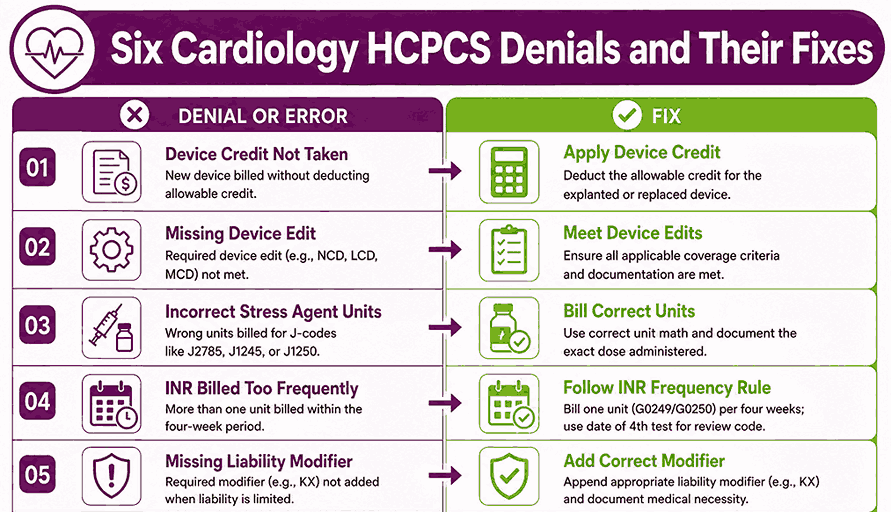
Error. The manufacturer issues a warranty or recall credit worth 50 percent or more of the replacement device, and the claim goes out unchanged. Payment arrives in full, which makes the problem invisible until an audit finds it.
Fix. Report the credit. Hospital outpatient departments enter the amount in value code FD and append condition code 49 for a lifecycle replacement or 50 for a recall. Ambulatory surgery centers use modifier FB or FC instead.
The exposure is not theoretical. OIG report A-01-18-00502 found more than $33 million in potential overpayments across 911 hospitals from exactly this failure.
Why Does a Device Edit Reject a Clean Cardiology Claim?
Error. A device-intensive procedure reaches the payer without a device code on the same claim. Nothing about the coding is clinically wrong, and the claim still comes back.
Fix. Pair the codes before submission. Procedure-to-device edits return the claim when the dominant device is missing, and device-to-procedure edits do the reverse. Check Addendum P for the current year to confirm which cardiac procedures hold the designation.
Why Does a Stress Agent Deny on Units Rather Than Coverage?
Error. Regadenoson bills as one unit. The standard Lexiscan dose is 0.4 mg, and J2785 is defined as 0.1 mg, so a single unit reports one quarter of what was given.
Fix. Bill four units for a standard dose. Then check the neighboring agents, because the unit basis changes underneath you. J1245 runs per 10 mg, and J0153 runs per 1 mg.
Why Does a Home INR Claim Deny on Frequency?
Error. The practice bills G0249 or G0250 weekly because testing happens weekly. Three of every four claims fail.
Fix. Bill every fourth week. Both codes bundle four tests into one unit of service, and the date of service for G0250 is the fourth interpretation. Weekly testing and monthly billing are two separate rules operating at the same time.
Why Does a Non-Covered Cardiac Item Return as Unprocessable?
Error. A statutorily excluded item goes out with no liability modifier attached. The line does not become a denial and never reaches appeal.
Fix. Attach the modifier that states who owes the money. Since July 1, 2011, A/B MACs automatically deny lines carrying GZ and perform no complex review on them. GY lines may be auto-denied at contractor discretion.
Why Does a Resynchronization Device Get Coded as a Dual Chamber Generator?
Error. The coder searches the descriptors for the word resynchronization and finds nothing, then defaults to the dual chamber code. CRT devices pace three chambers and belong nowhere near C1785 or C1721.
Fix. Read the CMS category definitions rather than the descriptors. Both C1882 and C2621 are defined as including cardiac resynchronization devices. Defibrillation capability decides which of the two applies.
What Changed for Cardiology HCPCS Codes in 2026?
Two changes matter for cardiology in 2026. Device policy held steady while supervision rules moved. The final rule left the device framework largely intact and changed the supervision rules around cardiac rehabilitation. Reporting obligations tightened rather than loosened.
What Did the CY2026 Rule Change for Device-Intensive Procedures?
Very little, and that is the point. CMS continues the CY2025 device edit policy without modification. Designation stays permanent once a procedure receives it in any given year.
Two details carry forward from CY2025, where both were adopted. CMS reinstated the edit policy for procedures holding device-intensive status since January 1, 2017. New codes lacking claims data receive a default offset of the greater of 31 percent or the APC offset.
The threshold itself has not moved. A procedure qualifies at a device offset above 30 percent of mean cost. CMS Transmittal R4191CP set that figure, lowering it from 40 percent.
Which Cardiac Services Gained Virtual Direct Supervision?
Cardiac rehabilitation, intensive cardiac rehabilitation, and most diagnostic services did. CMS permanently adopted a new definition of direct supervision. The supervising practitioner may be immediately available through real-time audio and video.
Audio-only does not qualify. The flexibility permits virtual presence rather than requiring it. CMS states that clinical judgment governs the choice case by case.
How Often Do Cardiology HCPCS Codes Update?
Quarterly for HCPCS Level II additions and deletions, annually for OPPS payment policy. The device category list, Addendum B status indicators, and Addendum P device-intensive designations all reset with each final rule.
Pass-through expiration does not retire a C-code. Almost every cardiac C-code lost pass-through status on December 31, 2002. Every one of them remains a required report on OPPS claims.
HCPCS coding is only one part of claim accuracy. Equally important is selecting diagnosis codes that support medical necessity. Our cardiac ICD-10 codes guide covers the most commonly reported cardiovascular diagnoses and their coding guidelines.
Cardiology HCPCS Codes: Frequently Asked Questions
Are Cardiology HCPCS Codes the Same as CPT Codes?
No, CPT codes report the procedure the physician performed. Cardiology HCPCS Level II codes report the device implanted, the drug administered, or the equipment supplied. A pacemaker implant generates both, and the claim needs each one on the correct line.
What Is the HCPCS Code for a Pacemaker?
It depends on chamber count and rate response. C1785 reports a dual chamber rate-responsive pacemaker and C1786 reports the single chamber version. Non-rate-responsive generators use C2619 and C2620. Resynchronization pacemakers report C2621. The device label states rate response, not the operative note.
Is K0606 a CPT Code?
No, there is no CPT K0606. It is a HCPCS Level II code for a wearable cardioverter defibrillator. The code sits in the temporary DMEPOS K range. The confusion is common because HCPCS Level II and CPT codes share the same claim form.
Can a Cardiology Practice Bill C-Codes?
Generally no, as C-codes are hospital outpatient reporting codes under OPPS. The facility reports the device, and the physician practice reports the procedure. A practice submitting a C-code on a professional claim is billing in the wrong setting. Hospital outpatient departments report them.
Do Hospitals Still Report C-Codes After Pass-Through Expires?
Yes, CMS addressed this in the CY2005 OPPS final rule at 69 FR 65762. Hospitals must report device category codes when those devices accompany OPPS procedures. Pass-through payment ended for most cardiac C-codes in 2002. The reporting duty did not.
How Many Units of J2785 Should Be Billed?
Four units for a standard dose. J2785 is defined as injection, regadenoson, 0.1 mg, and the recommended Lexiscan dose is 0.4 mg. Reporting one unit is the most common arithmetic error on pharmacologic stress claims. Document the administered dose so the unit count is auditable.
Who Qualifies for Home INR Monitoring Under Medicare?
Patients with mechanical heart valves, chronic atrial fibrillation, or venous thromboembolism, under NCD 190.11. The patient must have been anticoagulated for at least three months and completed an education program. A treating physician must prescribe the monitor. Porcine valve patients are excluded from the determination.