Radiculopathy ICD-10 codes identify nerve root irritation or compression by spinal region under subcategory M54.1. The subcategory holds 9 billable codes, from site unspecified (M54.10) to sacral (M54.18). Lumbar radiculopathy codes to M54.16. Cervical radiculopathy codes to M54.12.
M54.1x is a symptom-level code with a strict boundary. The ICD-10-CM tabular list excludes M54.1 when radiculopathy occurs with a disc disorder or spondylosis. Each of those conditions has its own combination code. Reporting the combination code beside M54.1x creates an Excludes1 conflict that payer edits reject.
The FY2027 ICD-10-CM update takes effect for encounters on or after October 1, 2026. The update adds 190 new billable codes. None of those additions touch the M54.1, M50.1, M51.1, or M47.2 families. Region selection, combination-code logic, and exam documentation decide whether your practice gets paid on radiculopathy claims.

What Is the ICD-10 Code for Radiculopathy?
The ICD-10 code for radiculopathy is M54.1, a non-billable subcategory that requires a fifth character for spinal region. Radiculopathy sits inside category M54 (Dorsalgia) in Chapter 13 of ICD-10-CM. The fifth character assigns the region, from the occipito-atlanto-axial junction down to the sacrococcygeal region.
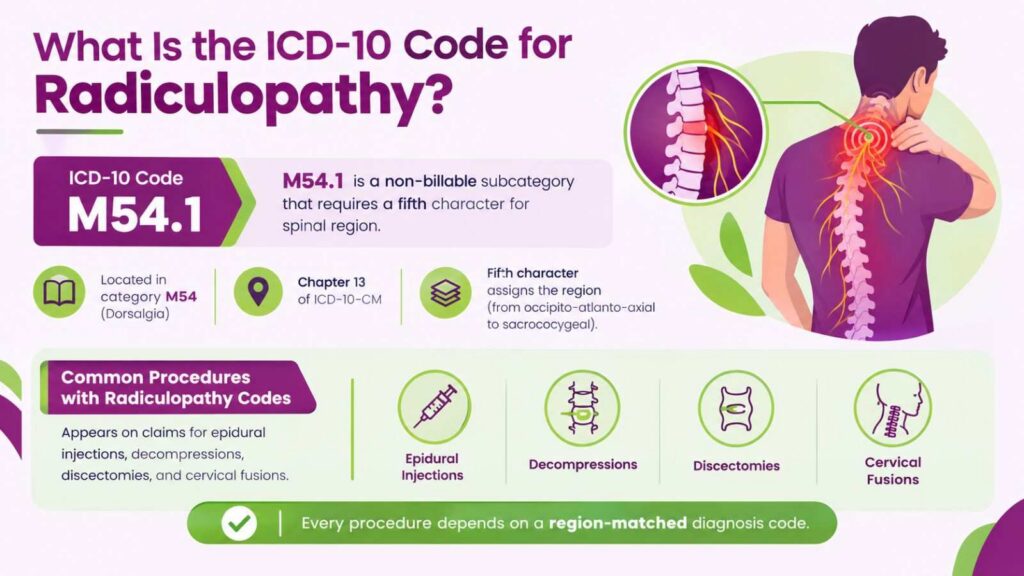
Radiculopathy sits beside stenosis, disc disorders, and cord compression in the neurosurgery ICD-10 code set. The code appears on claims for epidural injections, decompressions, discectomies, and cervical fusions. Every one of those procedures depends on a region-matched diagnosis code.
Is M54.1 a Billable ICD-10 Code?
No, M54.1 is a category header and never appears on a claim by itself. Section I.B.2 of the ICD-10-CM Official Guidelines requires coding to the highest number of characters available. A claim carrying M54.1 alone fails as an invalid diagnosis code. Your practice selects one of the 9 regional codes below instead.
Which Radiculopathy Codes Are Billable?
The M54.1 subcategory contains 9 billable codes, one per spinal region. The table lists each code with its official tabular list description and the chart wording that usually routes to it.
| ICD-10-CM Code | Official Description | Chart Wording That Routes Here |
|---|---|---|
| M54.10 | Radiculopathy, site unspecified | Radiculopathy with no region documented |
| M54.11 | Radiculopathy, occipito-atlanto-axial region | Upper cervical nerve root symptoms at the skull base |
| M54.12 | Radiculopathy, cervical region | Cervical radiculopathy, arm radicular pain |
| M54.13 | Radiculopathy, cervicothoracic region | Brachial radiculitis NOS, cervicothoracic junction symptoms |
| M54.14 | Radiculopathy, thoracic region | Thoracic radiculopathy, band-like chest wall pain |
| M54.15 | Radiculopathy, thoracolumbar region | Thoracolumbar junction nerve root symptoms |
| M54.16 | Radiculopathy, lumbar region | Lumbar radiculopathy, leg radicular pain |
| M54.17 | Radiculopathy, lumbosacral region | Lumbosacral radiculopathy, L5-S1 symptoms |
| M54.18 | Radiculopathy, sacral and sacrococcygeal region | Sacral nerve root symptoms |
M54.10 is the only code in the subcategory without a region. M54.10 fails the region match on any region-specific procedure claim.
What Conditions Does M54.1 Include?
The M54.1 subcategory includes 5 inclusion terms listed under Applicable To in the Tabular List. Each term codes to M54.1x by region:
- Brachial neuritis or radiculitis NOS
- Lumbar neuritis or radiculitis NOS
- Lumbosacral neuritis or radiculitis NOS
- Thoracic neuritis or radiculitis NOS
- Radiculitis NOS
Brachial radiculitis NOS carries a specific Tabular List route. The M50.1 family carries an Excludes2 note for brachial radiculitis NOS (M54.13).
When the documentation supports brachial radiculitis NOS, M54.13 is the appropriate radiculitis code rather than a cervical-region radiculopathy code. Coders who default brachial radiculitis to M54.12 report the wrong region.
Did the FY2027 Update Change Radiculopathy Codes?
No, the FY2027 ICD-10-CM update left every radiculopathy code unchanged. Chapter 13 received 33 new codes for encounters on or after October 1, 2026. Those additions cover VEXAS syndrome (M04.3), plantar fasciitis (M67.A-), plantar fascial fibromatosis (M72.2-), and site-specific osteomyelitis (M86.8X-).
The M54.1, M50.1, M51.1, and M47.2 families keep their FY2026 codes in FY2027. Every descriptor stays the same. Region rules that apply across the full ICD-10 diagnosis code system remain the same for radiculopathy claims after the cutover.
What Is the ICD-10 Code for Lumbar Radiculopathy (M54.16)?
The ICD-10 code for lumbar radiculopathy is M54.16, Radiculopathy, lumbar region. M54.16 applies when the provider documents lumbar nerve root symptoms without linking them to a disc disorder or spondylosis. The code covers the lumbar region above the lumbosacral junction.
What Is M54.16?
M54.16 is a billable ICD-10-CM code for nerve root irritation or compression in the lumbar spine. The documented pattern is leg pain, numbness, or weakness in a lumbar dermatomal distribution. The code describes the symptom pattern, not the structural cause behind the nerve root involvement.
M54.16 stays on the claim until imaging or the provider names the cause. Once the chart links the lumbar radiculopathy to a disc disorder, M51.16 replaces M54.16. Once the chart links it to spondylosis, M47.26 replaces it.
What Separates M54.16 From M54.17?
M54.16 and M54.17 split at the lumbosacral junction. The table compares the two lumbar-region radiculopathy codes.
| Attribute | M54.16 | M54.17 |
|---|---|---|
| Official Description | Radiculopathy, lumbar region | Radiculopathy, lumbosacral region |
| Anatomic Region | Lumbar spine above the lumbosacral junction | Lumbosacral junction (L5-S1) |
| Disc Combination Code | M51.16 | M51.17 |
| Spondylosis Combination Code | M47.26 | M47.27 |
The documented level decides the code. A provider note that names L5-S1 routes to M54.17, even when the note also says “low back.”
How Do You Code Low Back Pain With Radiculopathy?
Low back pain with radiculopathy codes to M54.16 for the radicular component. M54.5x joins the claim only when axial back pain is documented separately. The M54.5 Excludes1 note lists M51.360, M51.370, S39.012, M51.2-, and M54.4-. The note does not list M54.1-, so the Tabular List does not bar the pairing.
Three nearby code families cover overlapping presentations. The distinction rests on what the provider documents:
| Documented Presentation | Code Family | Key Rule |
|---|---|---|
| Radicular Leg Symptoms in a Lumbar Dermatome | M54.16 | No laterality; one code covers either side |
| Low Back Pain Radiating as Sciatica | M54.40-M54.42 | Carries laterality; excludes lumbago with sciatica due to disc disorder (M51.1-) |
| Axial Low Back Pain with no Radicular Features | M54.50, M54.51, M54.59 | Excludes1 against lumbago with sciatica (M54.4-) |
The M51.1 Excludes1 note adds one more boundary. M51.1 excludes lumbar radiculitis NOS (M54.16) and sciatica NOS (M54.3).
How Do You Code Bilateral Lower Extremity Radiculopathy?
Bilateral lower extremity radiculopathy codes to a single M54.16 or M54.17 code. The M54.1x codes carry no laterality character. One code covers right, left, or bilateral symptoms at the same region. The side still belongs in the provider note because the procedure claim often reports laterality separately.
What Is the ICD-10 Code for Cervical Radiculopathy (M54.12)?
The ICD-10 code for cervical radiculopathy is M54.12, Radiculopathy, cervical region. M54.12 applies when the provider documents cervical nerve root symptoms without linking them to a cervical disc disorder or spondylosis. The code covers the cervical spine between its two junction codes.
What Is M54.12?
M54.12 is a billable ICD-10-CM code for nerve root irritation or compression in the cervical spine. The documented pattern is neck pain radiating into the shoulder, arm, or hand in a cervical dermatome. Exam findings usually include a positive Spurling test, reflex changes, or grip weakness.
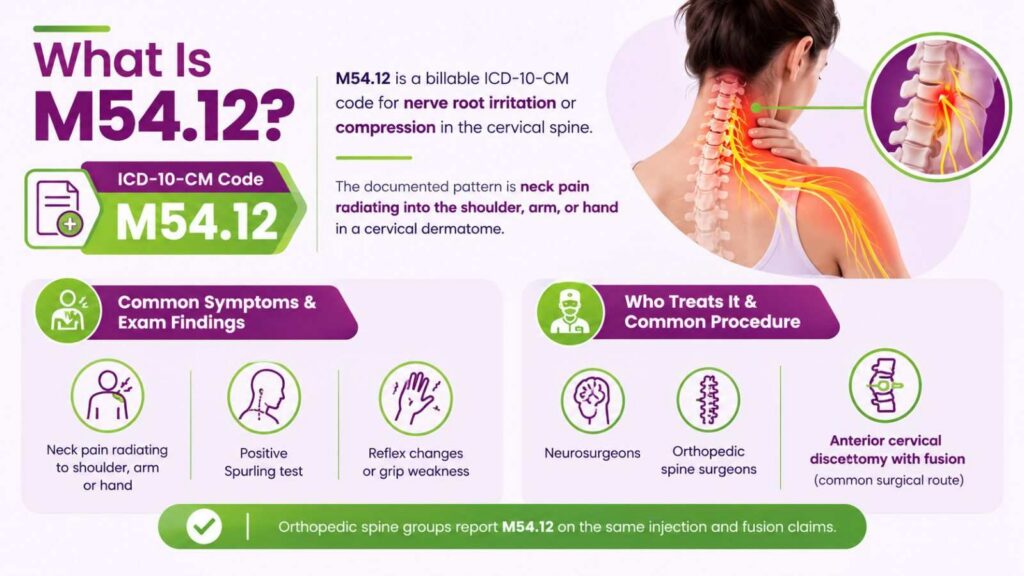
Orthopedic spine surgeons and neurosurgeons both treat cervical radiculopathy. Anterior cervical discectomy with fusion is a common surgical route. Orthopedic spine groups report M54.12 on the same injection and fusion claims.
How Do M54.11, M54.12, and M54.13 Differ?
Three codes cover the cervical spine and its junctions. The table separates them by region.
| ICD-10-CM Code | Official Description | When It Applies |
|---|---|---|
| M54.11 | Radiculopathy, occipito-atlanto-axial region | Nerve root symptoms at the skull base and upper cervical junction |
| M54.12 | Radiculopathy, cervical region | Nerve root symptoms in the cervical spine |
| M54.13 | Radiculopathy, cervicothoracic region | Nerve root symptoms at the cervicothoracic junction, or brachial radiculitis NOS |
M54.12 covers most cervical claims. M54.13 applies whenever the chart documents brachial radiculitis NOS, because the Tabular List routes that term to the cervicothoracic code.
How Do You Code Neck Pain With Radiculopathy?
Neck pain with radiculopathy codes to M54.12, not M54.2. M54.2 (Cervicalgia) describes axial neck pain without nerve root involvement. Once the provider documents radiating arm symptoms, M54.12 captures the presentation. M54.2 stays off the claim unless axial neck pain is documented as a separate problem.
Which Codes Cover Thoracic, Thoracolumbar, Sacral, and Unspecified Radiculopathy?
Four lower-volume codes cover the remaining regions: M54.14, M54.15, M54.18, and M54.10. These codes appear less often on claims. They still follow the same region rules as the lumbar codes. The combination-code rules apply to them as well.
| ICD-10-CM Code | Official Description | Disc Combination Code | Spondylosis Combination Code |
|---|---|---|---|
| M54.14 | Radiculopathy, thoracic region | M51.14 | M47.24 |
| M54.15 | Radiculopathy, thoracolumbar region | M51.15 | M47.25 |
| M54.18 | Radiculopathy, sacral and sacrococcygeal region | None in M51.1 | M47.28 |
| M54.10 | Radiculopathy, site unspecified | None | M47.20 |
M51.1 covers thoracic, thoracolumbar, lumbar, and lumbosacral disc disorders only. Sacral radiculopathy has no M51.1 combination code. M54.18 stays on the claim unless spondylosis replaces it with M47.28.
Why Is M54.10 a Denial Risk?
M54.10 is a denial risk because every spinal procedure code is region-specific. An interlaminar epidural or a laminotomy names its spinal region in the CPT descriptor. A site-unspecified diagnosis cannot support a region-specific service. Your practice queries the provider for the region before submission instead of sending M54.10.
When Does a Combination Code Replace M54.1x?
A combination code replaces M54.1x whenever the chart links radiculopathy to a disc disorder or spondylosis. Section I.B.9 of the ICD-10-CM Official Guidelines bars multiple coding when a combination code classifies both conditions. The M54.1 Excludes1 note names the exact conflicts.
What Does the M54.1 Excludes1 Note Prohibit?
The M54.1 Excludes1 note lists 4 conditions that never appear on a claim with M54.1x:
- Neuralgia and neuritis NOS (M79.2)
- Radiculopathy with cervical disc disorder (M50.1)
- Radiculopathy with lumbar and other intervertebral disc disorder (M51.1-)
- Radiculopathy with spondylosis (M47.2-)
An Excludes1 note means “not coded here.” The excluded code and the code above the note never appear together on the same claim.
Which Combination Codes Replace M54.1x?
Three combination code families replace M54.1x by documented cause. The table maps each cause to its billable codes.
| Documented Cause | Combination Codes | Regional Coverage |
|---|---|---|
| Cervical Disc Disorder with Radiculopathy | M50.10, M50.11, M50.120-M50.123, M50.13 | Unspecified, high cervical, mid-cervical by level, cervicothoracic |
| Thoracic, Thoracolumbar, or Lumbosacral Disc Disorder with Radiculopathy | M51.14, M51.15, M51.16, M51.17 | Thoracic, thoracolumbar, lumbar, lumbosacral |
| Spondylosis with Radiculopathy | M47.20-M47.28 | Site unspecified through sacral and sacrococcygeal |
Each combination code reports the radiculopathy and its cause in one code. Adding M54.1x to any row in this table double-reports the nerve root involvement.
Why Is M50.12 No Longer Reportable?
M50.12 stopped being reportable in the FY2020 ICD-10-CM update. That update expanded mid-cervical radiculopathy by disc level. M50.12 became a header over 4 billable codes:
- M50.120: Mid-cervical disc disorder, unspecified level
- M50.121: Cervical disc disorder at C4-C5 level with radiculopathy
- M50.122: Cervical disc disorder at C5-C6 level with radiculopathy
- M50.123: Cervical disc disorder at C6-C7 level with radiculopathy
Legacy templates that still carry M50.12 produce invalid-code rejections. The same FY2020 update split M50.22 (displacement) and M50.32 (degeneration) into level-specific codes.
Can M51.16 and M54.16 Be Billed Together?
No, M51.16 and M54.16 never appear on the same claim. M51.16 (Intervertebral disc disorders with radiculopathy, lumbar region) already contains the radiculopathy. The same rule blocks M51.17 with M54.17. It also blocks any M50.1- code with M54.12.
How Does the “With” Convention Apply to Radiculopathy?
Section I.A.15 of the ICD-10-CM Official Guidelines presumes a causal link between conditions joined by “with” in the classification. The combination code titles for disc disorders and spondylosis use “with radiculopathy.” The coder assigns the combination code when both conditions are documented at the same region.
The presumption has one exception. The combination code does not apply when the provider documents the radiculopathy as unrelated to that condition. In that case, M54.1x and the separate structural code both report.
How Do You Code Spinal Stenosis or Spondylolisthesis With Radiculopathy?
Spinal stenosis and spondylolisthesis have no radiculopathy combination code, so M54.1x reports beside them. The M54.1 Excludes1 note does not list M48.0- (spinal stenosis) or M43.1- (spondylolisthesis). AHA Coding Clinic, Third Quarter 2018, confirms the two-code approach for both conditions.
Coding Clinic assigned M43.16 with M54.16 for lumbar spondylolisthesis with radiculopathy. M51.16 does not apply, because spondylolisthesis is not a disc disorder. For cervical stenosis with root and cord compression, Coding Clinic assigned M48.02, M54.12, and G99.2 (Myelopathy in diseases classified elsewhere).
Which Stenosis Code Pairs With M54.1x?
Lumbar stenosis reports as M48.061 or M48.062 beside M54.16, based on neurogenic claudication. The parent code M48.06 is not billable. Stenosis selection by region and claudication status sits in the spinal stenosis ICD-10 code guide.
How Does Radiculopathy Differ From Radiculitis, Sciatica, and Myelopathy?
Radiculopathy, radiculitis, sciatica, and myelopathy describe 4 different nerve findings with 4 different code routes. Chart wording drifts between these terms. The code follows the documented finding, not the label the provider happened to use.
| Term | Clinical Meaning | ICD-10-CM Route |
|---|---|---|
| Radiculopathy | Nerve root dysfunction with radicular symptoms by spinal region | M54.10-M54.18, or a combination code when the cause is linked |
| Radiculitis | Nerve root inflammation producing radicular pain without objective neurological findings | M54.1x by region (Radiculitis NOS is an M54.1 inclusion term) |
| Sciatica | Pain along the sciatic nerve distribution | M54.30-M54.32, or M54.40-M54.42 with low back pain |
| Myelopathy | Spinal cord compression, not nerve root compression | M50.0-, M51.0-, or M47.1- by cause; G99.2 with spinal stenosis |
| Neuralgia or neuritis NOS | Nerve pain without spinal root attribution | M79.2, excluded from M54.1 |
The radiculitis definition comes from the Medicare Epidural Steroid Injections for Pain Management LCDs. Medicare Administrative Contractors use that definition when reviewing radicular pain claims.
Why Does Myelopathy Change the Code Family?
Myelopathy changes the code family because cord compression and root compression sit in separate subcategories. Myelopathy presents with gait disturbance, hyperreflexia, or bowel and bladder changes. Radiculopathy presents with dermatomal pain, sensory loss, and diminished reflexes.
Coding myelopathy without cord-level exam findings invites audit review. The disc, spondylosis, and dorsopathy families that border radiculopathy also appear across the orthopedic ICD-10 diagnosis codes. The same region logic applies in both specialties.
What Documentation Supports a Radiculopathy Code?
A radiculopathy code needs 6 documented elements in the provider note. Missing any one of them weakens the code or the procedure claim it supports:
- Region and Level: Name the spinal region, plus the disc level for cervical disc disorders.
- Dermatomal Pattern: Describe where the pain, numbness, or weakness travels.
- Objective Exam Findings: Record reflex, motor, and sensory results, plus straight leg raise or Spurling test.
- Imaging Concordance: State whether MRI or CT findings match the symptomatic level.
- Duration and Conservative Care: Record symptom duration plus every treatment already tried.
- Cause Statement: Name the disc disorder, spondylosis, or stenosis when imaging confirms it.
The cause statement decides between M54.1x and a combination code. A note that documents a herniated disc at the symptomatic level moves the claim to M50.1- or M51.1-.
Covered Medicare epidural claims may involve radiculopathy, radicular pain, neurogenic claudication, post-laminectomy syndrome, or acute herpes zoster-associated pain, subject to the LCD requirements.
How Do Radiculopathy Codes Support CPT Medical Necessity?
Radiculopathy codes support medical necessity by matching the procedure’s spinal region and documented indication. Epidural steroid injections depend on radiculopathy or radicular pain directly. Decompression and fusion claims depend on the structural combination code that names the cause.
Which Radiculopathy Rules Apply to Epidural Steroid Injections?
Under Noridian LCD L39240, Medicare epidural steroid injection coverage requires three documented medical-necessity requirements. Contractor LCDs, including Noridian’s LCD L39240, set the same 3 requirements:
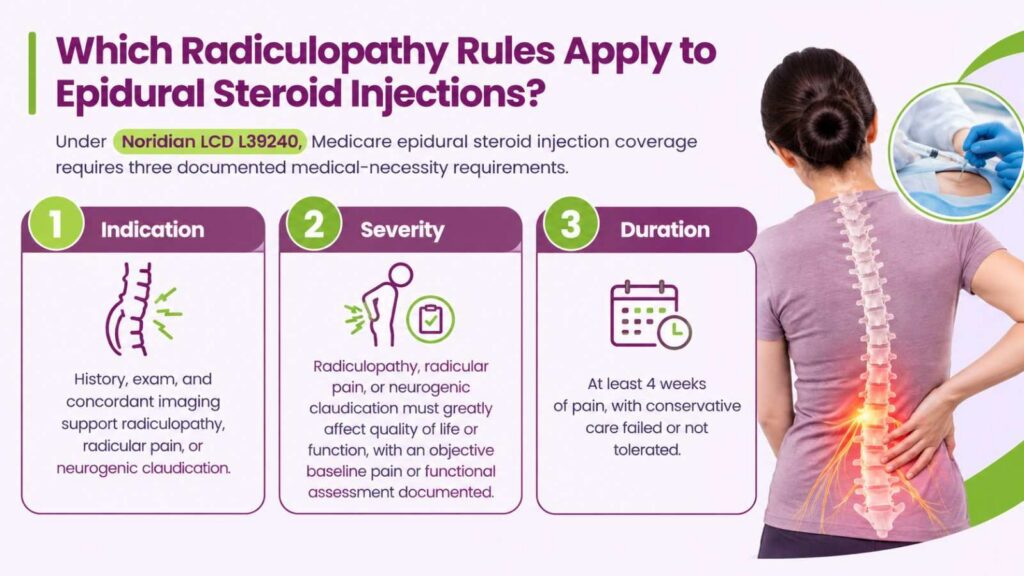
- Indication: History, exam, and concordant imaging support radiculopathy, radicular pain, or neurogenic claudication.
- Severity: Radiculopathy, radicular pain, or neurogenic claudication must greatly affect quality of life or function, with an objective baseline pain or functional assessment documented.
- Duration: At least 4 weeks of pain, with conservative care failed or not tolerated.
Billing and coding article A56681 defines 2 anatomic regions for epidurals. The CPT code region must match the radiculopathy code region.
| Epidural Region | CPT Codes | Matching Radiculopathy Codes |
|---|---|---|
| Cervical or thoracic | 62321, 64479, 64480 | M54.11-M54.14, M50.1-, M51.14 |
| Lumbar or sacral | 62323, 64483, 64484 | M54.16-M54.18, M51.16, M51.17 |
A region mismatch can create a diagnosis-to-procedure inconsistency and may trigger claim edits or medical-necessity review. A cervical radiculopathy code on a lumbar epidural claim is a clear example of a regional diagnosis-to-procedure mismatch. The lumbar interlaminar approach carries its own imaging-guidance descriptor and payer policies.
Cervical and thoracic interlaminar injections share one code. The region split for CPT 62321 cervical and thoracic epidural injection sits at the lumbar boundary. The neck and mid-back share one code.
Which Diagnosis Codes Support Spine Surgery for Radiculopathy?
Spine surgery for radiculopathy relies on the combination code that names the structural cause. M54.1x documents the symptom pattern. A decompression or fusion claim needs the disc disorder or spondylosis that the surgeon treated.
| CPT Code | Procedure | Diagnosis That Names the Cause |
|---|---|---|
| 63030 | Lumbar laminotomy with nerve root decompression or disc excision, 1 interspace | M51.16, M51.17 |
| 63020 | Cervical laminotomy with nerve root decompression or disc excision, 1 interspace | M50.10, M50.11, M50.120-M50.123, M50.13 |
| 63047 | Lumbar laminectomy, facetectomy, and foraminotomy, single segment | M48.061, M48.062, M47.26, M47.27 |
| 22551 | Anterior cervical interbody fusion with discectomy and decompression, below C2 | M50.10, M50.11, M50.120-M50.123, M50.13, M47.22 |
Each row pairs the surgical CPT code with a diagnosis that shows why the nerve root needed decompression. M54.1x alone describes the symptom without the structural target of the surgery.
Level coding, add-on codes, and modifier rules for these procedures follow the neurosurgery CPT coding guide. The diagnosis codes above carry the medical necessity side of each claim.
What Are the Most Common Radiculopathy Coding Denials?
The most common radiculopathy denials come from 6 repeat coding errors. Each error has a known trigger and a known fix.
| Denial Trigger | Why the Claim Fails | Fix |
|---|---|---|
| M54.1 Submitted Without a Fifth Character | Invalid diagnosis code under Section I.B.2 | Report the regional code, M54.10-M54.18 |
| M54.10 on a Region-specific Procedure | Site-unspecified code cannot support a region-specific CPT code | Query the provider for the region |
| M54.1x with M50.1-, M51.1-, or M47.2- | Excludes1 conflict | Report the combination code alone |
| M50.12 on the Claim | Header code since FY2020 | Report M50.120-M50.123 by level |
| Cervical Code on a Lumbar Epidural Claim | Diagnosis and CPT regions do not match | Match the code region to article A56681 |
| Epidural Claim Without Concordant Imaging or 4 Weeks of Pain | Fails LCD L39240 coverage requirements | Document history, exam, imaging, and conservative care |
These errors span code selection, diagnosis-to-procedure matching, Excludes1 rules, and documentation requirements. Neurosurgery practices can encounter these errors across epidural, decompression, and fusion claims.
A pre-submission coding review can check regional specificity, combination-code rules, and applicable LCD documentation. Neurosurgery billing and coding services check region, combination codes, and LCD documentation before submission. That check keeps those claims out of rework.
Frequently Asked Questions
What Is M54.16?
M54.16 is the ICD-10-CM code for radiculopathy, lumbar region. The code applies when the provider documents lumbar nerve root symptoms without linking them to a disc disorder or spondylosis.
What Is M54.12?
M54.12 is the ICD-10-CM code for radiculopathy, cervical region. The code applies to cervical nerve root symptoms, such as arm radicular pain, without a documented disc or spondylosis cause.
What Is M54.17?
M54.17 is the ICD-10-CM code for radiculopathy, lumbosacral region. The code applies when the documented level is the lumbosacral junction at L5-S1.
Is M54.1 a Billable Code?
No, M54.1 is a non-billable subcategory header. Claims require one of the 9 regional codes, M54.10 through M54.18.
What Is the ICD-10 Code for Lumbar Spondylosis With Radiculopathy?
Lumbar spondylosis with radiculopathy codes to M47.26 for the lumbar region or M47.27 for the lumbosacral region. M54.16 and M54.17 do not appear with these codes because of the M54.1 Excludes1 note.
What Is the ICD-10 Code for Cervical Spondylosis With Radiculopathy?
Cervical spondylosis with radiculopathy codes to M47.22, Other spondylosis with radiculopathy, cervical region. M54.12 stays off the claim.
What Is the ICD-10 Code for Lumbar Disc Herniation With Radiculopathy?
Lumbar disc herniation with radiculopathy codes to M51.16 for the lumbar region or M51.17 for the lumbosacral region. The combination code replaces M54.16 or M54.17.
What Is the ICD-10 Code for Lumbar Stenosis With Radiculopathy?
Lumbar stenosis codes to M48.061 or M48.062, based on neurogenic claudication. No combination code exists, so M54.16 reports the radiculopathy beside the stenosis code, per AHA Coding Clinic, Third Quarter 2018.
Can M54.16 and M51.16 Be Billed Together?
No, M54.16 and M51.16 never appear on the same claim. M51.16 already includes the radiculopathy, so the Excludes1 note blocks the pairing.
Is There a Laterality Code for Radiculopathy?
No, radiculopathy codes carry no laterality. One M54.1x code covers right, left, or bilateral symptoms at the same spinal region.
Did FY2027 Change the Radiculopathy ICD-10 Codes?
No, the FY2027 update effective October 1, 2026, did not change M54.1x, M50.1x, M51.1x, or M47.2x. The same radiculopathy codes apply before and after the cutover.