
General surgery billing is one of the most difficult types of medical billing. It uses more codes and more rules than most other specialties. make claims harder to manage every year. Data from KFF shows some insurers turn down more than 12% of prior authorization requests for planned surgeries. Bariatric surgery denials go above 20% at some payers.
This pushes practices to aim for an 80% approval rate on prior authorization. CMS added a new rule in January 2025. Every claim now needs modifier -54 when the surgeon does not handle the patient’s care after surgery. General surgery coding stays hard to get right.
Wrong modifiers, missed global period rules, and new NCCI edits each year can cause a denial from just one bad code. Practices without the right general surgery services can lose significant revenue each year through claim denials, coding errors, missed charges, and payment leakage.
This guide walks through the full billing process, the codes, the modifiers, and the best ways to protect your revenue.

What Is General Surgery Medical Billing?
General surgery medical billing is a complex process that turns a surgeon’s operative report into standard codes, like CPT and ICD-10. These codes go into a claim sent to insurance. This process ensures practices are paid for surgeries such as hernia repairs, appendectomies, and colectomies.
General surgery medical billing is harder than most medical billing. It spans many body parts, not just one. A surgeon may use an open, laparoscopic, or robotic approach, each needing its own code. Most major surgeries carry a 90-day global period bundling follow-up care.
Multi-surgeon cases need modifiers like 80, 81, 82, or AS, and small procedures often bundle into larger ones. Billing teams must track which codes pair correctly. As per AAPC, denied claims can cost medical practices upwards of $200,000 annually in lost revenue.
What Makes General Surgery Billing Different from Other Specialties?
General surgery billing is harder than billing for most other specialties. Three things make it different: long global periods, sessions with many procedures, and claims with more than one surgeon.
| Area | What It Means in Practice |
|---|---|
| Global Surgery Periods | CMS bundles most major surgeries into a 90-day global period. This period covers the surgery and the follow-up care after it. Billing a separate office visit inside that window breaks Medicare’s rules. This is one of the most common mistakes in general surgery billing. |
| Multi-Procedure Sessions | One surgery visit can create 3 to 5 CPT codes. For example, a surgeon may do an appendectomy, a hernia repair, and a bowel resection in one session. Each code needs the right order, the right modifier, and a check against NCCI bundling rules. |
| Assistant and Co-Surgeon Billing | Cases with more than one surgeon need modifiers 80, 81, 82, or 62. The choice depends on each surgeon’s role. Notes must show why each surgeon was needed. Billing staff must check that each surgeon’s specialty matches the modifier rules before sending the claim. |
High-Risk Areas to Prioritize
- Modifier Misuse: Modifiers 51, 59, 62, and 80 get audited often. One wrong or missing modifier can change how much a claim pays.
- Prior Authorization Failures: Bariatric and vascular surgeries get denied more than 20% of the time at some big payers. Every unresolved denial slows down payment and delays patient care.
- Documentation Gaps: If the surgeon’s notes miss key details, like the surgical approach, blood vessel count, or complications, every code tied to that note is at risk. This is true even if the surgery itself went well.
How Does the General Surgery Billing and Coding Process Work?
Outsourced general surgery billing runs through a structured revenue cycle built around surgical claim complexity. The workflow starts before the patient reaches the operating room and continues until every dollar owed has been collected or appealed. Below is how each phase protects reimbursement at a surgical practice.
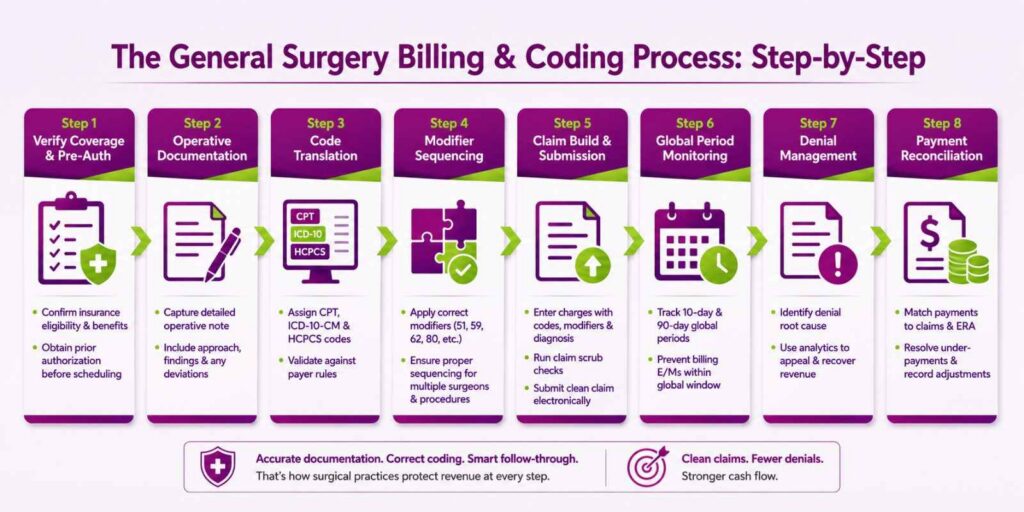
Step 1: Verifying Coverage Before the Procedure Is Scheduled
Billing starts at the front desk. Staff writes down the patient’s name, insurance card, and the reason for the visit. ELIXA checks the insurance right away. It makes sure the plan is still active and shows how much the patient still owes.
Next, the team asks the insurance company for approval. Most surgeries need approval first. For example, a hernia repair often needs approval five to seven days before surgery. PRIA sends this request and tracks the answer. Skipping this step can cost the whole payment.
Step 2: Capturing What Happened in the Operating Room
The surgeon writes notes about the surgery. This is called the operative note. It must say what was done, what the surgeon saw, and if anything changed. For example, if a gallbladder surgery starts small but turns into open surgery, the note must say that.
A short or unclear note causes big problems later. No biller can fix it after the fact. Surgeons who write clear details, like mesh type or vessel count, help coders pick the right code. This makes the whole claim faster and stronger.
Step 3: Translating the Operative Note Into Billable Codes
Once the note is done, CODIN reads it closely. CODIN picks the right CPT, ICD-10, and HCPCS codes. For example, an appendectomy uses code 44950 if done the open way. It uses code 44970 instead if done with small cuts.
Coders then check the code against payer rules. A correct code can still fail if it does not match the diagnosis code. For example, code 47562 for gallbladder surgery needs a matching reason, like gallstones. This step catches mistakes early.
Step 4: Sequencing Modifiers for Multi-Procedure and Multi-Surgeon Cases
Surgery claims often need more than one code. Modifier 51 shows the payer which surgery is the main one. This happens when a surgeon does two surgeries at once, like an appendectomy plus a hernia repair in one visit.
Modifier 62 is used when two surgeons share one surgery. Each surgeon must come from a different specialty area. Getting the order of codes wrong can lower payment on the whole claim, not just one small part of it.
Step 5: Building and Releasing the Claim
After coding, staff enter each charge into the claim. Every code and modifier must line up with the surgery. Staff also check insurance one more time here. A patient’s plan can change between the first visit and surgery day.
CLAIR then scans the whole claim for mistakes. It looks for wrong codes or missing modifiers. For example, catching a missing modifier 59 now saves real time. Fixing it later, after the payer says no, takes much more work.
Step 6: Watching the Clock on Global Periods
Big surgeries come with a set time window, called a global period. It can last 10 or 90 days. This time already includes payment for follow-up visits. For example, removing stitches after a colon surgery is part of that window.
Billing a follow-up visit again inside that window gets denied fast. Doing this too often can also trigger a payer review. That is why billing teams track each surgery’s window closely and carefully. This protects both the claim and future payments.
Step 7: Turning Denials Into Recovered Revenue
A denied claim is not the end. It starts a new step. DEXA looks for patterns in denied claims. For example, it may spot many denials all tied to modifier 22. Finding the pattern helps fix the real problem.
Not all denials need the same fix. A denial from a missing approval needs different steps than one caused by a wrong modifier. Sorting each denial by its real cause first makes the whole appeal faster and much stronger.
Step 8: Closing the Loop on Payment
Once the payer sends money, staff check every line closely. They match the payment to the original claim right away. For example, if a bariatric surgery claim pays only 90% of what was expected, staff flag it and dig in.
Staff write down why each payment was off, not just that it was off. Over time, this shows clear patterns. For example, one payer may often underpay hernia claims. Spotting this early helps fix future claims before they go out.
Coding General Surgery Procedures: CPT, ICD-10, and HCPCS
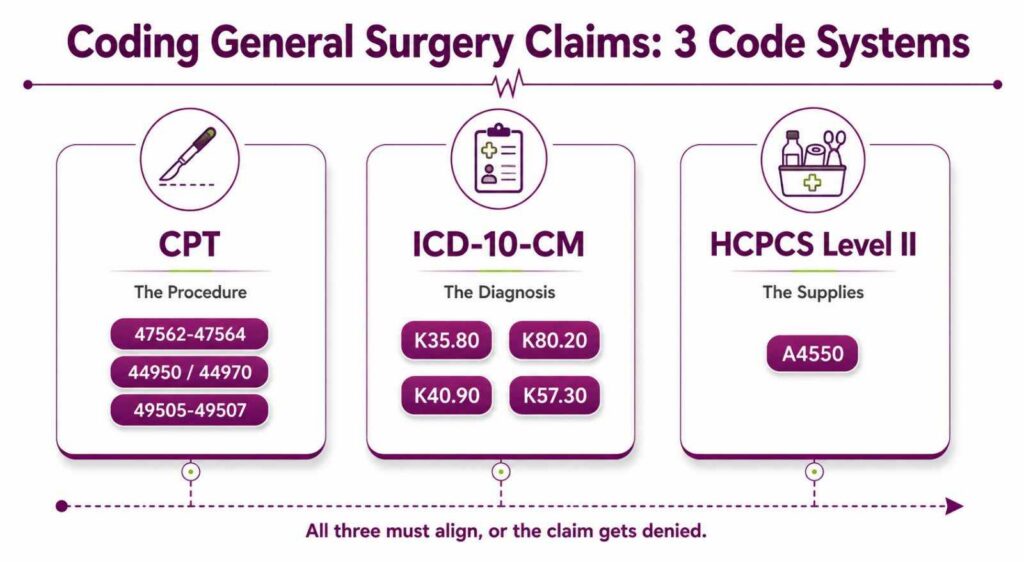
Every general surgery claim runs through three code systems working together. CPT reports the procedure performed, ICD-10-CM reports the diagnosis justifying it, and HCPCS Level II reports supplies used. Getting any single system wrong flags the entire claim for review.
| Code System | Example Codes | What It Reports |
|---|---|---|
| CPT | 47562-47564 (cholecystectomy), 44950/44970 (appendectomy), 49505-49507 (hernia), 44140-44160/44204-44213 (colectomy) | The surgical procedure, approach, and complexity |
| ICD-10-CM | K35.80 (appendicitis), K80.20 (gallstones), K40.90 (hernia), K57.30 (diverticulitis) | The diagnosis proving medical necessity |
| HCPCS Level II | A4550 (surgical tray) | Supplies used during the procedure |
CPT codes split by approach and complexity. Laparoscopic and open cholecystectomy carry different codes, and colectomy splits the same way across open (44140-44160) and laparoscopic (44204-44213) ranges. The operative note determines which code applies.
No CPT code pays without a matching ICD-10-CM diagnosis behind it. A code pair that doesn’t logically connect triggers a medical necessity denial regardless of surgical outcome. CODIN cross-references all three code systems before a claim leaves the practice.
How Do You Apply Modifiers Correctly in General Surgery Claims?
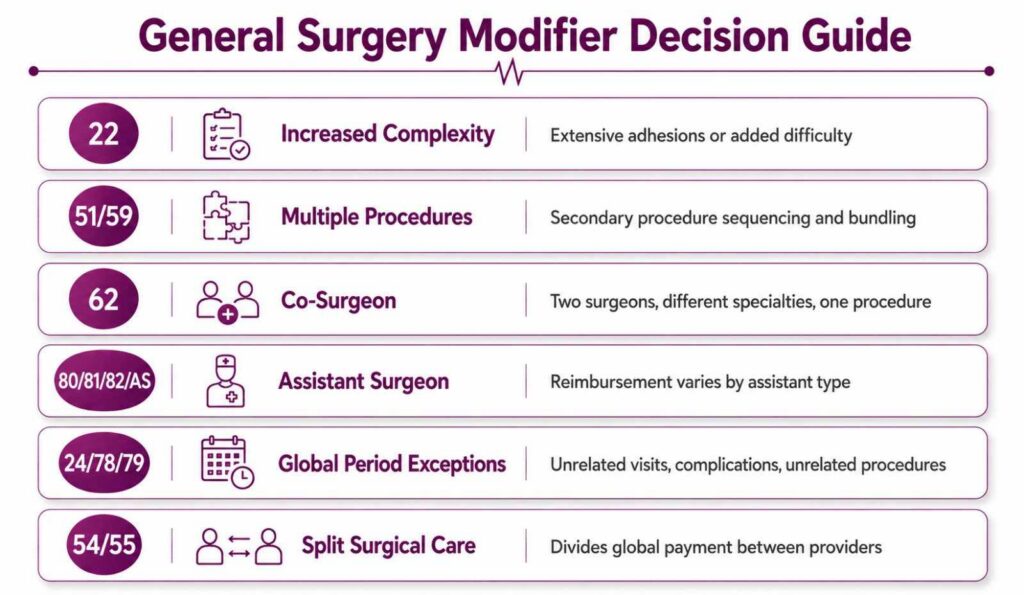
Modifiers tell the payer how to interpret a claim, not just what happened during surgery. In general surgery, where sessions often involve multiple procedures and sometimes multiple surgeons, modifier accuracy determines whether the claim pays in full or gets reduced automatically.
Modifier Decision Guide
Modifier 22: Increased Procedural Service
Use when the operative note documents substantially more work than the code typically describes, such as extensive adhesions or excessive blood loss. Documentation must quantify the added difficulty, not just state the case was “complex.”
Modifier 51 vs. 59 vs. X-Modifiers
Append 51 to secondary procedures when multiple surgeries occur in one session; the primary procedure pays at 100%, secondary procedures at reduced rates. Use 59 only when no more specific modifier applies, and prefer XE, XS, XP, or XU when the situation matches one of those definitions exactly.
Modifier 62: Co-Surgeon
Applies when two surgeons of different specialties each perform a distinct part of the same procedure. Medicare’s Claims Processing Manual bars same-specialty co-surgeons from billing 62 jointly, and violating this triggers automatic rejection.
Modifiers 80/81/82/AS: Assistant Surgeon
Use 80 for a fully participating assistant surgeon, 81 for minimal assistance, 82 when no qualified resident was available, and AS for a non-physician assistant. Reimbursement rates differ by modifier, so selecting the wrong one under- or overpays the claim.
Modifiers 24/78/79: Global Period Exceptions
Use 24 for an unrelated E/M visit during the global period, 78 for an unplanned return to the OR for a complication, and 79 for an unrelated procedure by the same surgeon. Each requires documentation proving the service falls outside the original surgery’s scope.
Modifiers -54/-55: Split Surgical Care
CMS requires -54 whenever the operating surgeon will not personally provide postoperative care, splitting the global package between the surgeon and the provider who takes over follow-up, billed with -55.
What Are the Global Surgical Package Rules for Postoperative Billing?
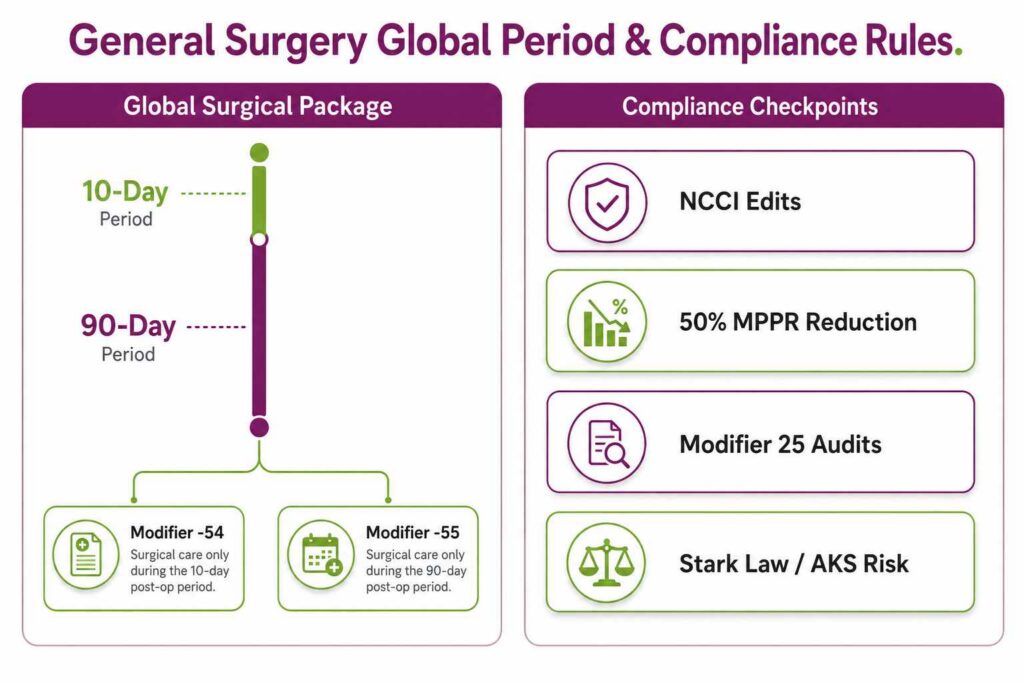
CMS bundles most major general surgery procedures into a 90-day global period covering the surgery and all directly related follow-up care. Minor procedures carry 10 days instead. Billing a bundled visit separately violates Medicare rules and triggers overpayment recoupment.
What Falls Inside vs. Outside the Global Period
| Inside the Global Period (Bundled) | Outside the Global Period (Separately Billable) |
|---|---|
| Routine post-op E/M visits | Unrelated new diagnosis (modifier 24) |
| Suture or drain removal | Complication requiring return to OR (modifier 78) |
| Dressing changes tied to the surgery | Unrelated procedure by the same surgeon (modifier 79) |
| Pain management directly from the procedure | Split care when the surgeon doesn’t provide follow-up (modifiers 54/55) |
Since January 2025, CMS requires modifier -54 on every claim where the operating surgeon will not personally provide postoperative care. The provider who takes over follow-up bills modifier -55 for their portion of the global package. Missing modifier -54 misroutes payment for the entire 90-day period.
CMS also tracks postoperative visit volume using CPT code 99024, and HCPCS code G0559 for split-care claims. Underreporting these codes skews the data CMS uses to set future global period valuations. Transcure’s reporting workflow submits both codes accurately for every applicable surgical encounter.
Compliance and Regulatory Requirements in General Surgery Billing
General surgery sits under heavier CMS and payer scrutiny than most outpatient specialties, given the procedure volume and modifier complexity involved. Meeting these requirements protects both reimbursement and the practice’s standing with federal auditors.
NCCI Edits and Bundling Rules
National Correct Coding Initiative edits bundle related procedure pairs unless a valid modifier documents separate, distinct services. Unmodified bundled pairs deny automatically without manual payer review, so claims should run through an NCCI edit checker before submission.
Multiple Procedure Payment Reduction
Medicare reduces payment by 50% for the second and subsequent surgical procedures performed in one operative session. Incorrect sequencing shifts which procedure absorbs the reduction, so coders rank procedures by relative value before submission.
OIG Audit Focus on Modifier 25
The HHS Office of Inspector General flags modifier 25 among its most frequently audited codes. Appending it to unrelated E/M visits during a global period without distinct documentation risks denial and repayment demands.
Stark Law and Anti-Kickback Risk
The OIG’s Special Fraud Alert flags physician-owned distributorships selling surgical implants as a referral risk under Stark Law and the Anti-Kickback Statute. Surgeons with financial ties to implant vendors face heightened audit scrutiny.
HIPAA and Business Associate Agreements
Surgical billing workflows handle operative reports, device records, and imaging across EHRs, clearinghouses, and payer portals. Every touchpoint is a HIPAA exposure point, so billing partners must operate under a signed BAA with PHI encrypted in transit and at rest.
What Are the Payer-Specific Billing Rules for General Surgery Practices?
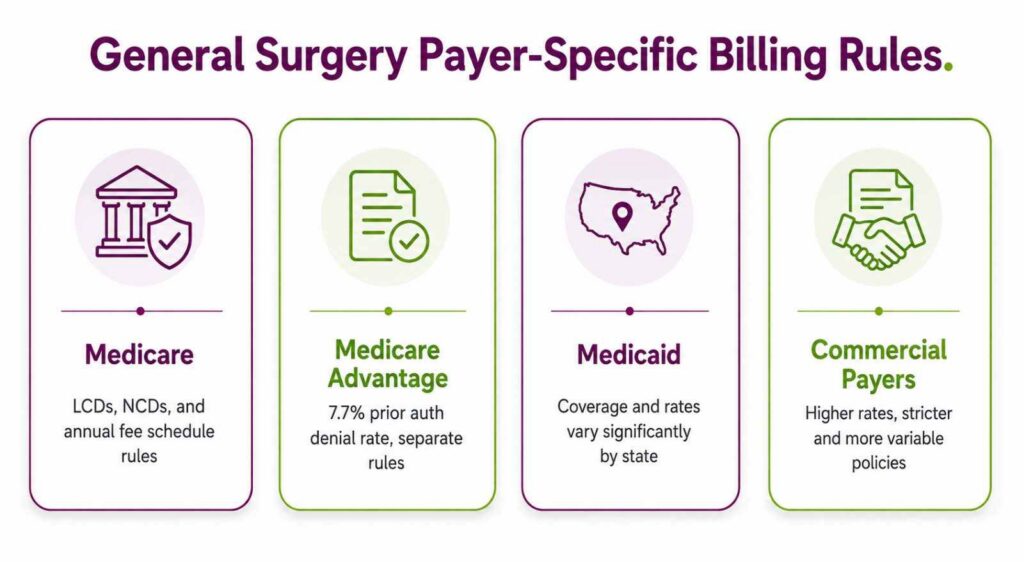
General surgery billing doesn’t operate under one universal rulebook. Medicare, Medicaid, and commercial payers each apply different coverage policies, prior auth thresholds, and reimbursement structures. Billing teams that treat every payer the same will consistently run into avoidable denials.
Medicare Billing Rules for General Surgery
Medicare coverage runs on LCDs, NCDs, and the annual Physician Fee Schedule, all of which directly affect what gets paid and at what rate. Global surgery periods, NCCI edits, and the CY 2026 conversion factors ($33.57 and $33.40) all fall under this same framework.
Medicare Advantage Prior Auth Differences
Medicare Advantage plans follow their own prior authorization rules, not traditional Medicare’s. Per KFF, MA insurers received nearly 53 million prior authorization requests in 2024 and denied about 4.1 million of them, a 7.7% denial rate. A bariatric or vascular procedure that skips pre-auth under fee-for-service Medicare may still require it under a patient’s MA plan.
Medicaid Reimbursement and State-Level Variation
Medicaid reimbursement for general surgery varies significantly by state, both in covered procedures and payment rates. Some states layer managed Medicaid plans on top of state policy, each with separate prior auth rules. Verify coverage and authorization requirements at the plan level before scheduling high-cost surgical cases.
Commercial Payer Guidelines and Contracting
Commercial payers generally reimburse general surgery procedures at higher rates than Medicare, but apply stricter and more variable coverage policies. Some major commercial insurers deny more than 12% of prior authorization requests for planned procedures such as bariatric surgery. Payer mix directly affects net collections, making it essential context for any general surgery RCM strategy.
Credentialing and Provider Enrollment for Surgeons
Credentialing is a prerequisite to billing, not a formality that runs alongside it. An unenrolled or lapsed surgeon means clean claims that still don’t pay. It’s one of the most operationally overlooked revenue risks in general surgery practices.
Why Credentialing Directly Affects Billing Revenue
Every surgeon must be credentialed and enrolled with each payer before claims are reimbursed under their NPI. If a surgeon operates while credentialing is pending, that revenue gets written off or requires retroactive billing, which most payers limit or deny outright.
For group practices, this compounds quickly. A new surgeon who starts operating before enrollment completes can generate weeks of unbillable claims. The revenue loss isn’t always visible in real time, since it surfaces later as denials or zero-pay EOBs that are difficult to recover.
Common Credentialing Errors and How to Avoid Them
- Billing Under the Wrong NPI: Individual vs. group NPI mismatches are a common and easily avoidable denial trigger.
- Outdated CAQH Profiles: Payers pull CAQH data during credentialing; expired licenses or missing documents stall the process.
- Missing Taxonomy Codes: General surgery has specific taxonomy codes that must match across the claim, enrollment record, and payer contract.
- No Tracking System for Credentialing Timelines: Without proactive monitoring, expiration dates slip and surgeons unknowingly fall out of network.
Re-Credentialing, Revalidation, and In-Network Maintenance
Credentialing isn’t one-and-done. Most payers require re-credentialing every two to three years, and Medicare mandates revalidation on a rolling cycle. Letting either lapse drops the surgeon from the network mid-cycle, with claims denied retroactively to the lapse date in some cases.
Maintain a credentialing calendar with expiration dates for every surgeon across every payer. Treat re-credentialing deadlines the same way as prior auth deadlines, since missing them carries a direct, quantifiable revenue impact.
What Are Common General Surgery Billing Errors, and How Can You Avoid Them?
Even small mistakes cost real money in general surgery billing. Below are the most frequent problems and their fixes, so claims get paid on time instead of stacking in your AR.
Incomplete or Inaccurate Operative Documentation
Without detailed operative notes, procedures look medically unnecessary to a payer. Any insurer will reject a claim that fails to justify the surgery performed.
Solution: Train surgeons to document surgical approach, anatomical findings, and any deviation from the planned procedure. Use templates that prompt for case-specific details rather than relying on macros.
Incorrect or Unbundled Global Period Billing
Billing a routine post-op visit separately during the 10-day or 90-day global period violates Medicare rules and triggers overpayment recoupment.
Solution: Track global periods by procedure and confirm modifier -24, -78, or -79 applies before billing anything separately within the window.
Missing Prior Authorization
Billing before securing insurer approval results in immediate denial, and retroactive authorization is rarely granted, particularly for bariatric and vascular procedures.
Solution: Build a pre-procedure authorization workflow. Every scheduled surgery should have a confirmed authorization on file before the OR date is booked.
Incorrect Modifier Usage
Modifier errors are among the most consistent and preventable denial triggers in general surgery, given the specialty’s reliance on multi-procedure sessions and multi-surgeon claims.
Solution: Build modifier logic into the claim scrubbing workflow. Every modifier applied should map to a specific, documentable clinical reason rather than default habit.
Unbundled NCCI Code Pairs
Billing two procedure codes that NCCI edits define as mutually exclusive triggers an automatic denial regardless of documentation quality.
Solution: Run every claim through an NCCI edit checker before submission, catching bundling conflicts pre-claim rather than working denials post-payment.
Failure to Verify Patient Eligibility
Claiming a service that isn’t covered under the patient’s current plan means an automatic write-off.
Solution: Verify insurance eligibility at every visit, not just at initial registration, since coverage can change between scheduling and the surgery date.
Which RCM Performance Metrics Should Every General Surgery Practice Track?
You can’t improve what you don’t measure. These KPIs give general surgery practices a quantifiable read on billing performance, and a clear signal of where revenue is leaking.
Denial Rate
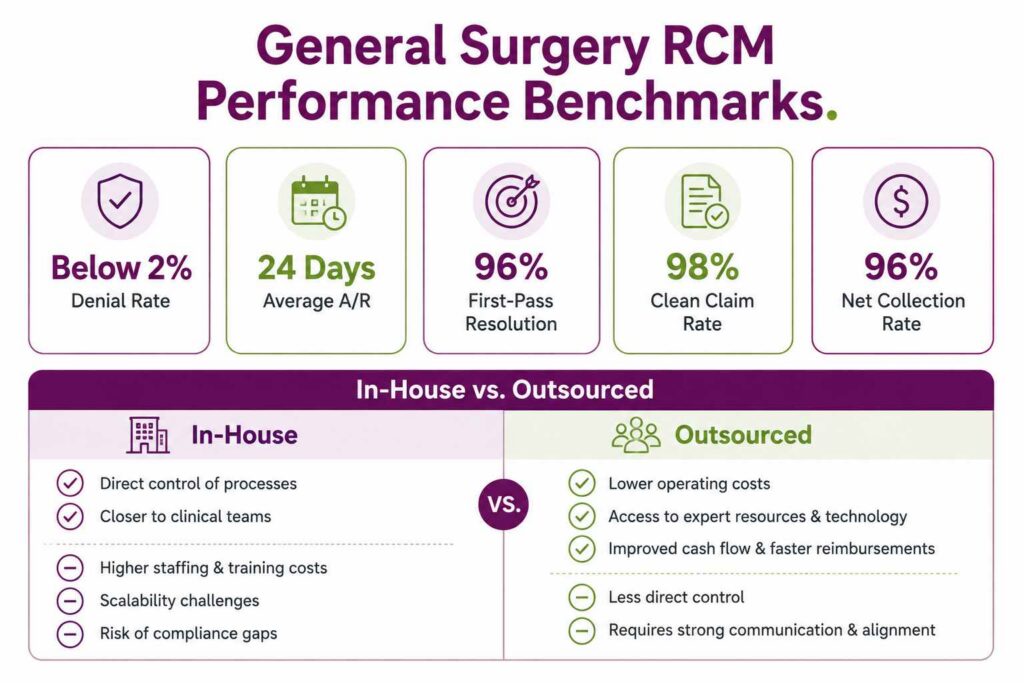
Industry benchmark sits under 5%. General surgery practices often run higher due to modifier complexity and global period violations. Track denial rate by payer and reason code, since patterns at that level show exactly where the process breaks down. Transcure’s general surgery billing operations run at a denial rate below 2%, achieved through pre-claim scrubbing and modifier validation.
Days in Accounts Receivable (A/R)
Measures how long it takes to collect payment after claim submission. Target is under 40 days for general surgery. High A/R days typically signal slow follow-up on outstanding claims or unresolved denials requiring rework. Transcure averages 24 A/R days across surgical clients, well below the specialty benchmark.
First-Pass Resolution Rate (FPRR)
The percentage of claims paid on first submission without rejection. Target is above 95%. Low FPRR points to upstream problems, eligibility gaps, coding errors, or missing authorization. Transcure maintains a 96% FPRR across general surgery billing operations.
Clean Claim Rate
Measured at submission, before payer adjudication. A rate below 98% means claims go out with known errors. Transcure’s clean claim rate holds at 98%, driven by automated scrubbing and pre-submission QA checks.
Net Collections Rate
The percentage of contractually allowed revenue actually collected. Healthy practices target 95% or higher. Transcure delivers a 96% average collection rate across surgical clients.
How Do You Decide Between In-House and Outsourced General Surgery Billing?
The right choice depends on your practice’s size, volume, and internal capacity. In-house billing gives direct control but requires sustained investment in staff training, technology, and compliance infrastructure. Outsourcing to a general surgery billing partner like Transcure transfers that operational burden to a specialized team.
Signs Your Practice Should Consider Outsourcing
- Denial rate consistently above 5% with no clear improvement trend
- A/R days exceeding 45 with a growing 90+ day bucket
- Staff turnover disrupting billing continuity
- No internal capacity to keep up with annual CPT and modifier updates
- Surgeons spending time on billing escalations instead of patients
- Revenue declining despite stable or growing case volume
What to Look for in a General Surgery Billing Partner
Specialty experience is non-negotiable. A generalist billing company without surgical modifier expertise will cost more in denials than it saves in fees. Evaluate transparency, real-time reporting, and whether the partner operates under a signed BAA for HIPAA compliance. Ask for surgery-specific benchmarks, denial rate, clean claim rate, and A/R days before committing.
Frequently Asked Questions
Can You Bill an E/M Visit on the Same Day as a Minor Surgical Procedure?
Yes, but only if the E/M represents a significant, separately identifiable service beyond the usual pre- and post-procedure assessment. Append modifier -25 to the E/M code, not the procedure code. The documentation must stand on its own, distinct from the procedure note.
How Much Does It Cost to Outsource General Surgery Billing?
Most practices pay between 3% and 10% of monthly collections for full-service general surgery billing. Rates vary by claim volume, payer mix, and procedure complexity. General surgery billing providers like Transcure charge in that same range, with no setup fees or long-term contracts.
What’s the Difference Between Modifier 62 and Modifier 80 in General Surgery?
Modifier 62 applies when two surgeons of different specialties each perform a distinct part of the same procedure, splitting reimbursement between them. Modifier 80 applies to a fully participating assistant surgeon who supports the primary surgeon rather than performing a separate portion of the work.
What Should a Practice Do When a High-Value Surgical Claim Gets Denied?
Start by identifying whether the denial is clinical, technical, or administrative before deciding how to respond. For high-value procedures like colectomy, bariatric surgery, or vascular repair, appeal as the default unless the service was genuinely uncovered or past the timely filing limit. Build appeal templates by denial reason so the process repeats efficiently rather than getting rebuilt each time.
How Long Does the Global Surgery Period Last After a Major Procedure?
Most major general surgery procedures carry a 90-day global period, while minor procedures carry 10 days. Related follow-up care within that window is bundled into the original payment and cannot be billed separately unless a modifier documents an unrelated service or complication.