
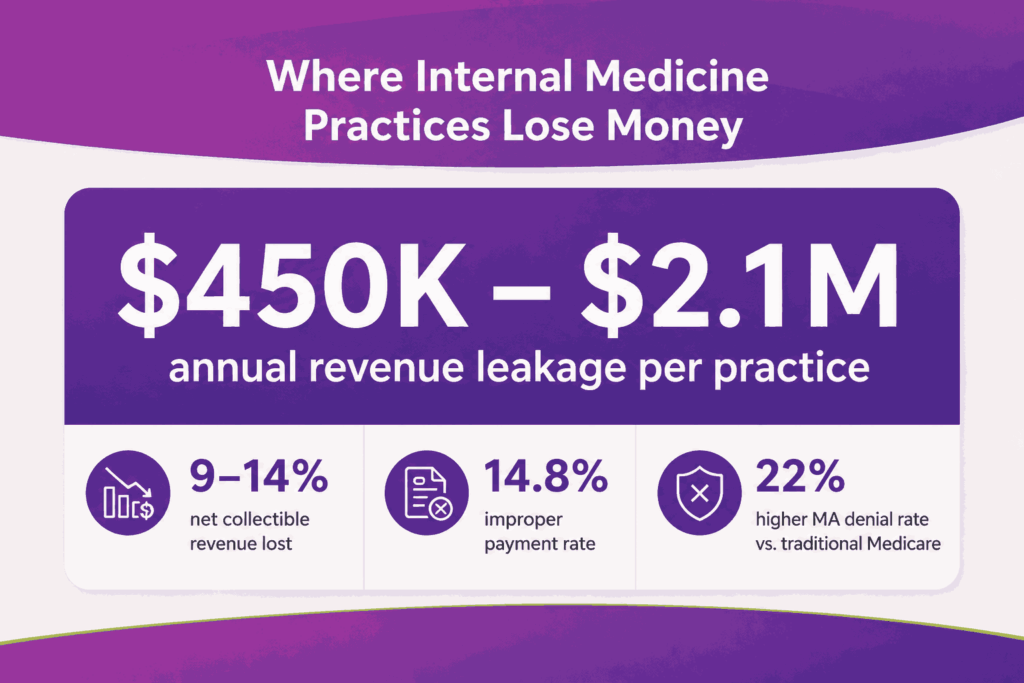
Internal medicine practices lose 9 to 14 percent of net collectible revenue every year to billing process failures, not coding errors. A study of internal medicine visits found 14.8 percent had improper payments, the highest rate in adult primary care. Industry data quantifies the leakage at $450,000 to $2.1 million per practice per year, scaled to patient volume.
The Medical Group Management Association attributes 5 to 10 percent of physician revenue loss to coding errors and lost charges. Internal medicine sits at the top of the 5 to 10 percent loss range.
Three changes in 2026 could increase the cost of process failure. CMS finalized separate 2026 conversion factors for APM and non-APM clinicians, both higher than 2025 levels. Medicare Advantage denial rates for medically necessary services run 22 percent higher than traditional Medicare. Internal medicine evaluation and management visits take the heaviest hit.
This guide covers internal medicine medical billing operations, including workflow, payer behavior, documentation, denials, A/R, compliance, technology stack, and outsourcing.

What Is Internal Medicine Medical Billing?
Internal medicine medical billing is the full revenue cycle process for services provided by internists. It covers everything from patient scheduling and insurance verification to claim submission, payment posting, and patient collections.
The scope goes far beyond basic claim filing. Internal medicine practices bill for outpatient office visits, inpatient rounding, chronic care management, annual wellness visits, telehealth, remote patient monitoring, and diagnostic services. Each service category comes with its own documentation standards, payer requirements, and denial risks.
Internal medicine billing also differs from general primary care billing in several operational areas. Practices typically manage a heavier Medicare and Medicare Advantage patient mix, often representing 40–60% of total volume. Encounters also involve higher chronic disease complexity, which increases documentation requirements and coding scrutiny.
This guide focuses on the operational and revenue cycle side of internal medicine billing. For CPT codes, modifiers, and ICD-10 specificity, see the companion internal medicine coding guide.
How Internal Medicine Billing Differs From Family Practice Billing
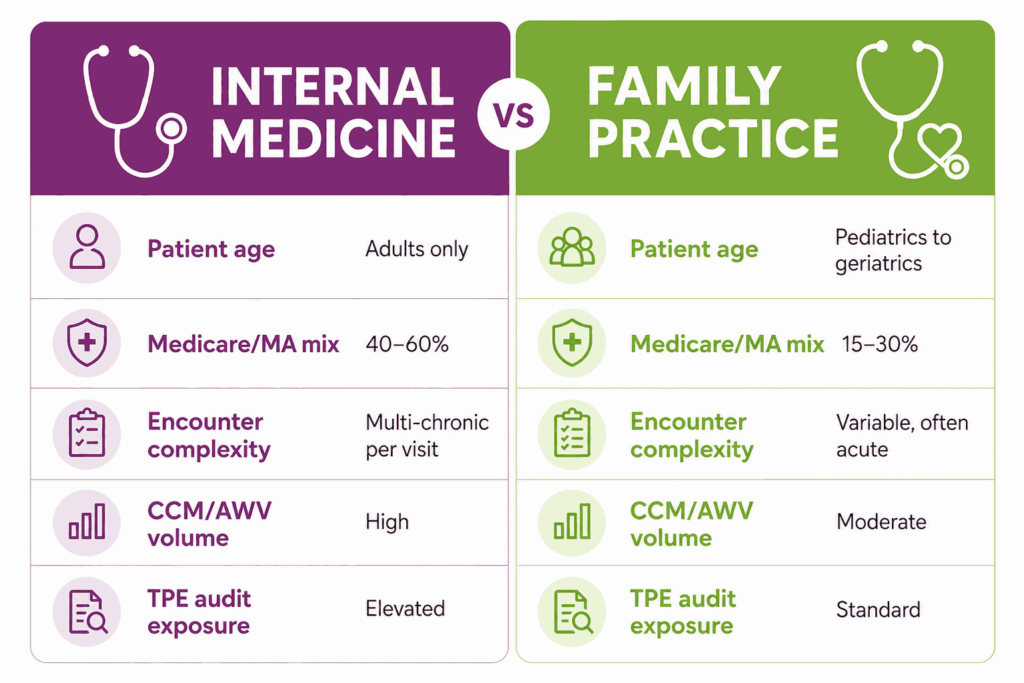
Family practice billing covers a broader age range, from pediatrics through geriatrics, while internal medicine billing focuses exclusively on adult patients. Because of this, internal medicine practices typically carry a much heavier Medicare and Medicare Advantage patient mix.
Encounter complexity is also higher in internal medicine. Internists often manage multiple chronic conditions during a single visit, which increases documentation requirements, coding specificity, and medical necessity scrutiny compared to many family practice encounters.
Internal medicine practices bill larger volumes of Chronic Care Management (CCM) services and Annual Wellness Visits (AWVs), both of which receive significant CMS oversight. This makes internal medicine practices more vulnerable to CMS Targeted Probe and Educate (TPE) audits and other documentation-focused reviews.
The Internal Medicine Billing Process: End-to-End Workflow
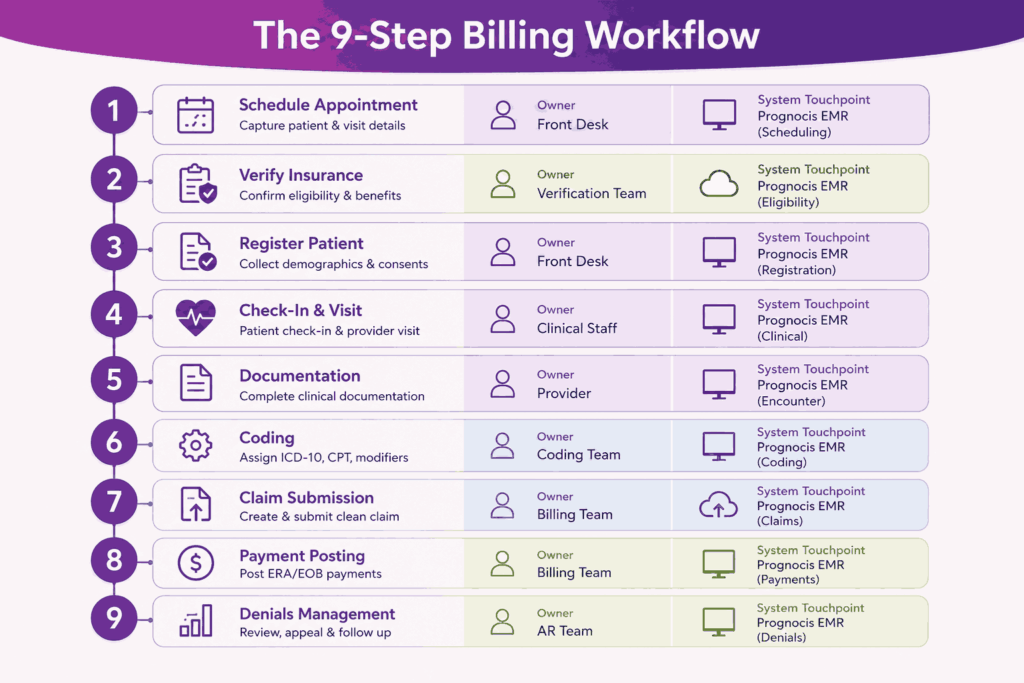
This workflow is the operational core of internal medicine medical billing. The process runs through nine connected steps, each with its own staff responsibilities, system touchpoints, and revenue risks when errors are missed.
High-performing practices usually follow a structured workflow like the one below. Smaller practices may combine responsibilities across fewer staff members, while larger organizations often divide each stage into dedicated teams and work queues.
Step 1: Patient Scheduling and Pre-Registration
Pre-registration starts before the patient arrives. Staff collects demographics, insurance information, primary care designation, and the reason for the visit. The new versus established patient determination also happens during this stage.
Many downstream denials originate here. Incorrect subscriber IDs, inactive insurance, or wrong payer selection during scheduling often surface weeks later as denied claims that appear to be billing issues, even though the root cause started at intake.
Step 2: Insurance Eligibility and Benefits Verification
Eligibility checks run 48 to 72 hours before every visit. Real-time EDI 270/271 transactions confirm active coverage, plan type, deductible status, copay, and any service-specific carve-outs that apply.
Internal medicine teams must verify these items every time:
- Annual Wellness Visit eligibility for Medicare patients
- Chronic Care Management enrollment status
- Deductible met versus remaining for the calendar year
- Secondary and tertiary coverage if Medicare crossover applies
- Referral requirements from HMO plans
Step 3: Prior Authorization Management
Internal medicine carries one of the highest prior auth volumes in primary care. MRI orders, sleep studies, biologics, specialist referrals, and high-cost infusions all need payer approval before the service runs.
The prior authorization workflow usually follows four stages: reviewing payer policy requirements, submitting the authorization request with supporting clinical notes, tracking authorization status daily, and escalating stalled requests around the 5-day mark before the scheduled patient appointment.
Step 4: Patient Check-In and Point-of-Service Collections
Front-desk staff verify patient identity, confirm insurance coverage at check-in, and collect copays or known deductible balances. Patients also sign Assignment of Benefits and financial responsibility forms during this stage.
Point-of-service collections have a major impact on overall patient revenue. Practices collecting 85% or more upfront typically carry fewer aging patient balances and lower collection risk later in the revenue cycle.
Step 5: Clinical Encounter and Documentation Capture
Providers document the encounter during or immediately after the visit. Documentation must support medical necessity, capture all evaluated conditions, and record total time when billing is time-based.
For chronic care visits, documentation should clearly state whether each active condition is stable, worsening, or improving. This supports accurate risk adjustment and higher-acuity billing when clinically justified.
Step 6: Charge Capture and Claim Scrub
Charges move from the EHR into the practice management system for claim generation. Pre-submission scrubbing reviews claims for missing modifiers, payer-specific edits, NCCI conflicts, and other claim quality issues before transmission.
A strong scrub process catches most preventable rejections before the payer sees the claim. Weak scrubbing shifts those issues into denials, which take substantially more time and cost to correct.
Step 7: Claim Submission via Clearinghouse
Claims move from the practice management system to the clearinghouse and then to the payer. The clearinghouse applies another layer of edits and usually returns rejections within hours instead of days.
Daily claim submission is considered standard practice. Delaying claims into weekly batches slows reimbursement and increases the number of accounts aging into older A/R categories without operational benefit.
Step 8: Payment Posting and Reconciliation
Electronic remittance advice (ERA) files automate most payment posting through 835 transactions. Manual posting is still used for paper checks, patient payments, and payers that continue mailing explanation of benefits documents.
The real value of payment posting is variance detection. Underpayments against contracted fee schedules are often identified here, and many billing teams miss them entirely unless automated variance tracking is in place.
Step 9: A/R Follow-Up, Denials, and Appeals
Accounts move through aging buckets at 30, 60, and 90 days. Each bucket has its own work queue, escalation rule, and write-off threshold. Patient balances follow a parallel statement and collections workflow.
The full workflow looks like this when laid out side by side.
| Step | Owner | System | Common Failure Point |
|---|---|---|---|
| Scheduling | Front desk | Practice management | Wrong payer entry |
| Eligibility | Verification team | Clearinghouse | Outdated coverage |
| Prior auth | Auth coordinator | Payer portal | Late submission |
| Check-in | Front desk | PM system | Skipped POS collection |
| Documentation | Provider | EHR | Missing time stamps |
| Charge capture | Coder or biller | EHR to PM | Missed services |
| Submission | Biller | Clearinghouse | Rejection backlog |
| Payment posting | Posting team | PM system | Underpayment misses |
| A/R follow-up | A/R team | PM system | Aged accounts ignored |
Insurance and Payer Mix for Internal Medicine
Payer mix influences nearly every operational and billing decision in an internal medicine practice. A typical internist sees a patient mix of roughly 40–60% Medicare, 20–30% commercial insurance, with the remainder split across Medicaid, Medicare Advantage, and self-pay accounts.
Traditional Medicare fee-for-service follows relatively predictable reimbursement rules and fee schedules. Medicare Advantage plans are more complex and operate closer to commercial insurance, with prior authorization requirements, network limitations, and HCC risk adjustment documentation standards that increase billing and documentation workload.
Payer Behavior to Expect
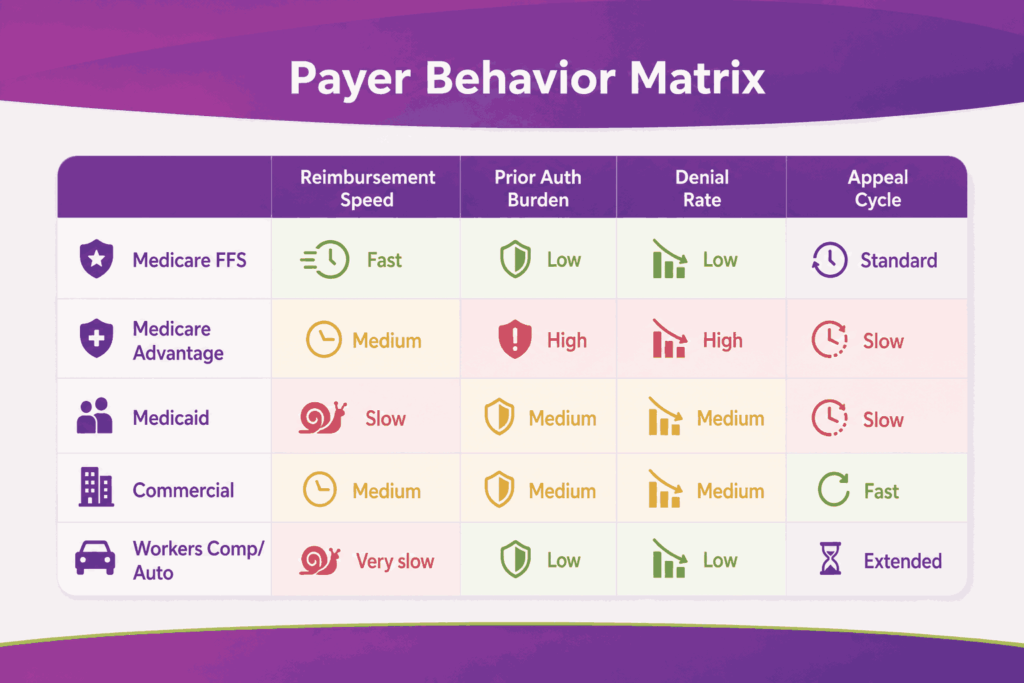
Each payer category behaves differently. Understanding those patterns helps billing teams anticipate denials, manage follow-up more efficiently, and route appeals correctly.
- Medicare FFS: Predictable reimbursement, strict documentation audits, higher TPE audit exposure
- Medicare Advantage: Plan-specific prior auth rules, HCC chart reviews, slower appeal cycles
- Medicaid: State-dependent rules, lower reimbursement, frequent eligibility changes
- Commercial payers (BCBS, UHC, Aetna, Cigna): Variable fee schedules, payer-specific edits, faster appeals
- Workers’ comp and auto: Out-of-network billing issues, attorney involvement, extended payment timelines
Payer Contracts: What to Negotiate
Many internal medicine practices sign payer contracts and rarely revisit them, which gradually reduces reimbursement strength over time. Without active contract management, fee schedules can fall below competitive Medicare-based benchmarks.
Key contract terms to negotiate during renewals include:
- Fee schedules tied to a Medicare multiplier benchmark
- Separate reimbursement carve-outs for Chronic Care Management (CCM) and Remote Patient Monitoring (RPM)
- Timely filing limits of at least 90 days
- Clear appeal timelines and medical necessity standards
- Annual reimbursement rate review clauses built into the agreement
What Are Documentation Standards For Internal Medicine
Documentation is more than a clinical record. It serves as the audit trail that supports every billed service by proving medical necessity, encounter complexity, and time spent when applicable.
Internal medicine has a heavier documentation burden than many outpatient specialties because providers manage multiple chronic conditions, time-based services, and ongoing care plan updates. Each of these areas carries specific documentation requirements that directly affect reimbursement and audit risk.
Internist-Specific Documentation Requirements
These documentation elements appear repeatedly in payer audits and denial reviews. Building them into provider templates helps maintain compliance without significantly slowing documentation workflow.
- Current status of chronic conditions: active, stable, worsening, or improving
- Care plan updates for Chronic Care Management (CCM) patients
- Total documented time for time-based visits
- Clear medical necessity justification for higher-acuity encounters
- Review of systems and exam findings tied directly to the assessment
Documentation Gaps That Trigger Denials
Most documentation-related denials come from a small number of recurring issues. In many practices, provider education, template optimization, and pre-visit planning correct these gaps within a few months.
The most common problems include missing time documentation, vague chief complaints, and chronic conditions listed without updated status details. To prevent these diagnosis-driven rejections, clinicians should refer to a dedicated internal medicine ICD-10 codes guide to ensure maximum code specificity. Copy-forward documentation that does not accurately reflect the current visit is another major audit trigger.
Provider Templates and EHR Macros
Templates improve documentation speed but can create compliance risk when overused. Notes that appear identical across visits are often flagged by auditors as cloned documentation.
The safest approach is structured templates and EHR macros that still require provider input for visit-specific details. Condition status, current treatment plans, and total time spent should always be documented fresh for each encounter.
Denial Management for Internal Medicine Practices
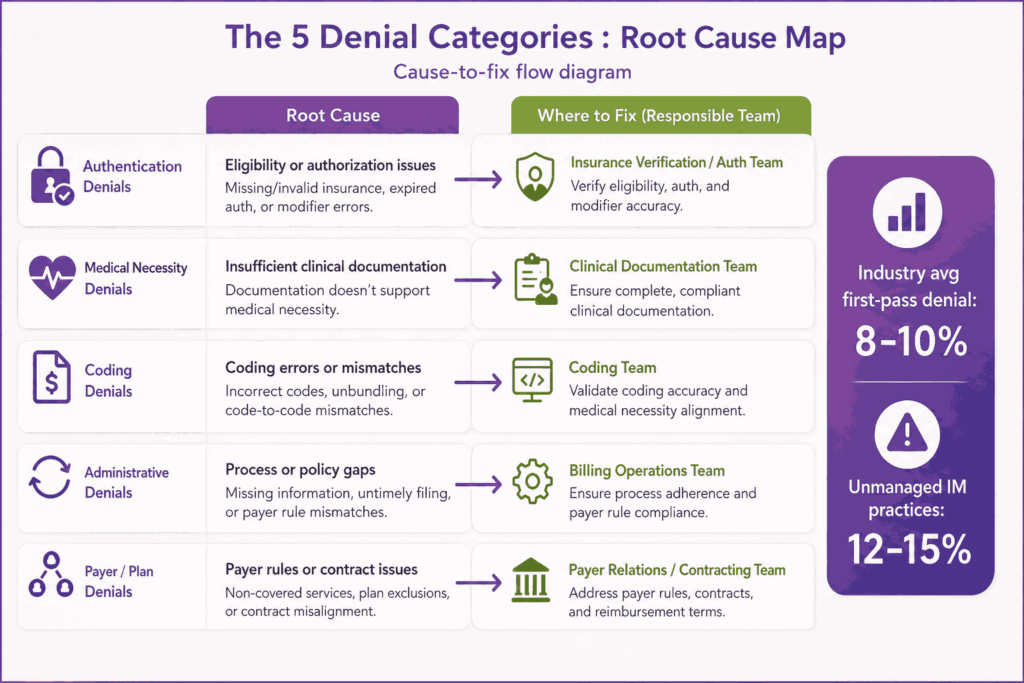
The industry-average first-pass denial rate sits around 8 to 10 percent. Internal medicine practices without active denial management often run 12 to 15 percent, which translates to weeks of additional A/R aging.
Active denial management treats denials as a system problem, not a one-off rework task. Root-cause categorization and trending against payer and provider tell you where to fix the upstream workflow.
The Five Denial Categories You Track
Every denial falls into one of five buckets. Tracking by code is not enough. Tracking by root cause shows the billing team where to act.
| Category | Root Cause | Where to Fix |
|---|---|---|
| Eligibility and registration | Bad payer data | Front desk |
| Authorization | Missing or late PA | Auth coordinator |
| Medical necessity | Documentation gap | Provider workflow |
| Coding and billing | Wrong code or modifier | Coding team |
| Timely filing | Late submission | Billing operations |
Denial Workflow
A functional denial workflow operates on strict timing and accountability. Each denied claim is reviewed within 24 hours of receipt, and an appeal decision is made within five business days based on reimbursement potential and likelihood of success.
The appeal versus write-off decision is guided by a cost-to-collect threshold. If the effort required to pursue an appeal exceeds the expected recovery, the claim is moved to a monitored write-off bucket. Even in write-off status, denial trends are still tracked for reporting and process improvement.
Top Five Avoidable Denials in Internal Medicine
These five categories account for most preventable denials in internal medicine. Each has a clear upstream cause and can be reduced through process fixes and workflow controls.
- Eligibility issues identified after the visit
- Missing prior authorization for imaging or specialty referrals
- Late filing beyond payer timely filing limits
- Documentation gaps in chronic care or higher-acuity visits
- Coordination of benefits errors on Medicare crossover claims
Appeals Framework for Medical Necessity Denials
Medical necessity denials are among the most recoverable when appealed correctly. Effective appeals must clearly connect payer policy requirements with clinical documentation and decision-making.
A strong appeal typically includes a one-page cover letter, the original claim, and the supporting clinical note. When needed, additional materials such as prior labs, imaging results, and relevant payer policy excerpts are included to strengthen the case for reimbursement.
A/R Management and Revenue Cycle KPIs
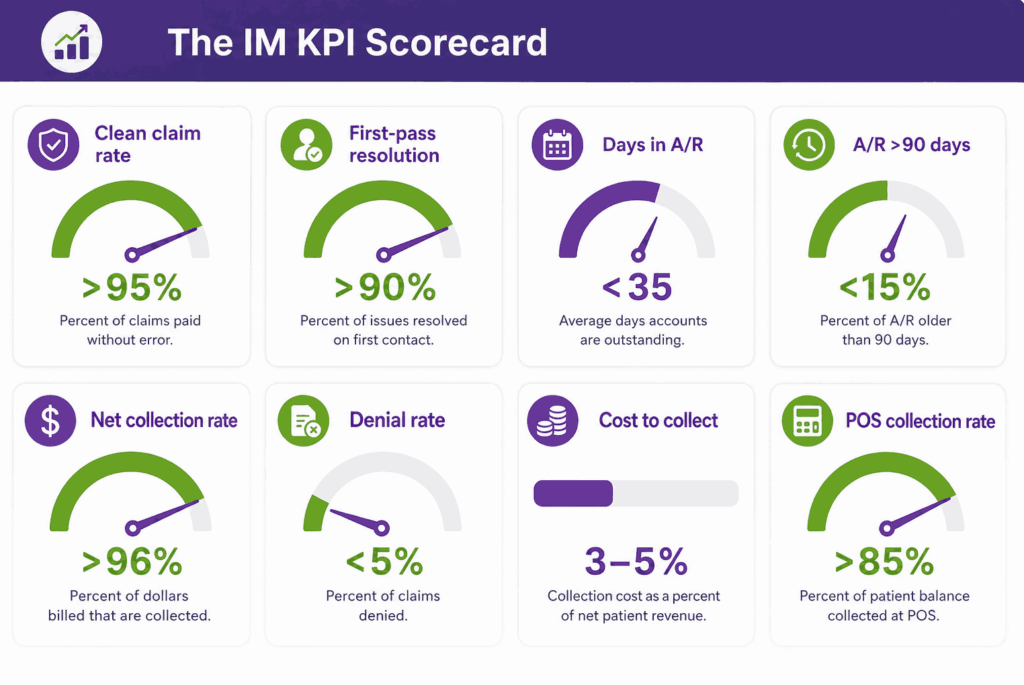
This is the core dashboard for tracking performance across the revenue cycle. Without KPI monitoring, billing teams cannot prove improvement, identify leakage early, or justify staffing and process changes that impact long-term A/R health.
The benchmarks below reflect performance levels seen in high-performing internal medicine practices. Smaller practices may fall short on several metrics initially. The focus is steady quarterly improvement rather than immediate perfection.
Core KPIs Every Internal Medicine Practice Should Track
| KPI | Target | What It Tells You |
|---|---|---|
| Clean claim rate | Above 95 percent | Scrub and submission quality |
| First-pass resolution rate | Above 90 percent | End-to-end billing health |
| Days in A/R | Below 35 | Cash flow speed |
| A/R over 90 days | Below 15 percent | Aging discipline |
| Net collection rate | Above 96 percent | Real revenue capture |
| Denial rate | Below 5 percent | Process upstream quality |
| Cost to collect | 3 to 5 percent | Billing operation cost discipline |
| POS collection rate | Above 85 percent | Front-desk discipline |
A/R Aging Workflow
Each aging bucket operates as a separate queue with its own follow-up rules, escalation path, and write-off authority. Treating all A/R as a single queue or skipping bucket discipline is one of the fastest ways to push claims beyond timely filing limits.
- 0–30 days: Light follow-up, payer status checks only
- 31–60 days: Active follow-up, denial triage, and payer outreach
- 61–90 days: Escalation to senior billers and structured appeal review
- 90+ days: Final appeal decision, write-off consideration, and patient responsibility transfer if applicable
The Hidden A/R Problem: Underpayments
Most billing teams focus on denials and overlook underpayments. In reality, payers frequently reimburse below contracted fee schedules, and these gaps often go undetected without systematic review.
Variance detection solves this by comparing each ERA 835 payment line against contracted rates. Any underpayment is flagged and routed into an appeal or recovery queue. In many practices, recovered revenue from underpayments can offset the cost of variance detection tools within two billing cycles.
Compliance, Audits, and Risk Management
HIPAA, CMS audits, and False Claims Act exposure all sit under compliance. Internal medicine carries higher audit risk because of chronic care service volume and Medicare-heavy payer mix.
Compliance is a process control discipline, not a paperwork exercise. Every billing workflow needs documented controls, audit trails, and a defined response plan for payer audits and CMS.
Common Audit Triggers for Internal Medicine
CMS uses data analytics to flag outlier practices. Practices that bill above their peer benchmark for higher-acuity visits, Chronic Care Management, or time-based services get pulled into Targeted Probe and Educate audits first.
These four patterns trigger CMS audits most often in internal medicine:
- Higher-acuity visit billing above peer benchmarks
- High Chronic Care Management volume without documented care plans
- Time-based service billing with missing or vague time documentation
- Annual Wellness Visit billing patterns inconsistent with patient demographics
HIPAA Workflows for Billing Vendors
PHI moves between the EHR, practice management system, clearinghouse, and any outsourced billing vendor. Each connection needs a Business Associate Agreement, encryption in transit and at rest, and access logging.
Internal audits should review vendor access quarterly. Terminated employees on the vendor side often retain access longer than they should without an active access review schedule.
Internal Audit Cadence
A structured internal audit program runs on both monthly and quarterly cycles. This cadence helps detect documentation drift, coding issues, and workflow gaps before they escalate into payer audits or sustained denial trends.
- Monthly: 10-claim random sample audit scored against payer policy requirements.
- Monthly: 5-claim provider-specific audit for any provider with denial rates above peer benchmarks.
- Quarterly: Payer-level performance review with denial trend and pattern analysis.
- Annual: Full compliance review, including Medicare Physician Fee Schedule updates and reimbursement validation.
Credentialing and Provider Enrollment
Credentialing is a critical revenue gate that is often underestimated. If a provider is not properly enrolled with a payer, the practice cannot bill for their services. Every delay directly translates into lost billable encounters and delayed revenue.
Credentialing delays cost internal medicine practices an estimated $10,000–$15,000 per provider per month in unbillable revenue. When Medicare enrollment exceeds 90 days, total delayed collections frequently exceed $90,000 per provider, with some specialties exceeding $150,000.
Credentialing Timeline
Payer enrollment timelines vary depending on the payer type, state regulations, and completeness of documentation. The following reflects typical ranges seen in internal medicine practices:
| Payer Type | Typical Timeline | Re-credentialing Cycle |
|---|---|---|
| Medicare | 60 to 90 days | Every 5 years |
| Medicaid | 90 to 120 days | Every 3 years |
| Commercial | 60 to 120 days | Every 2 to 3 years |
| Medicare Advantage | 60 to 90 days | Every 2 to 3 years |
Credentialing Maintenance
Credentialing is not a one-time process. CAQH ProView profiles must be updated on a quarterly basis, and NPI Type 1 and Type 2 records need to remain accurate at all times. Re-credentialing timelines also must be actively tracked, or providers risk being dropped from payer panels.
A strong credentialing system continuously monitors expiration dates for key requirements such as medical licenses, DEA registrations, malpractice insurance, and board certifications. When these renewals are missed, payers can terminate participation, forcing providers into a full re-enrollment process that can delay reimbursement for months and disrupt revenue flow.
In-House vs Outsourced Billing for Internal Medicine
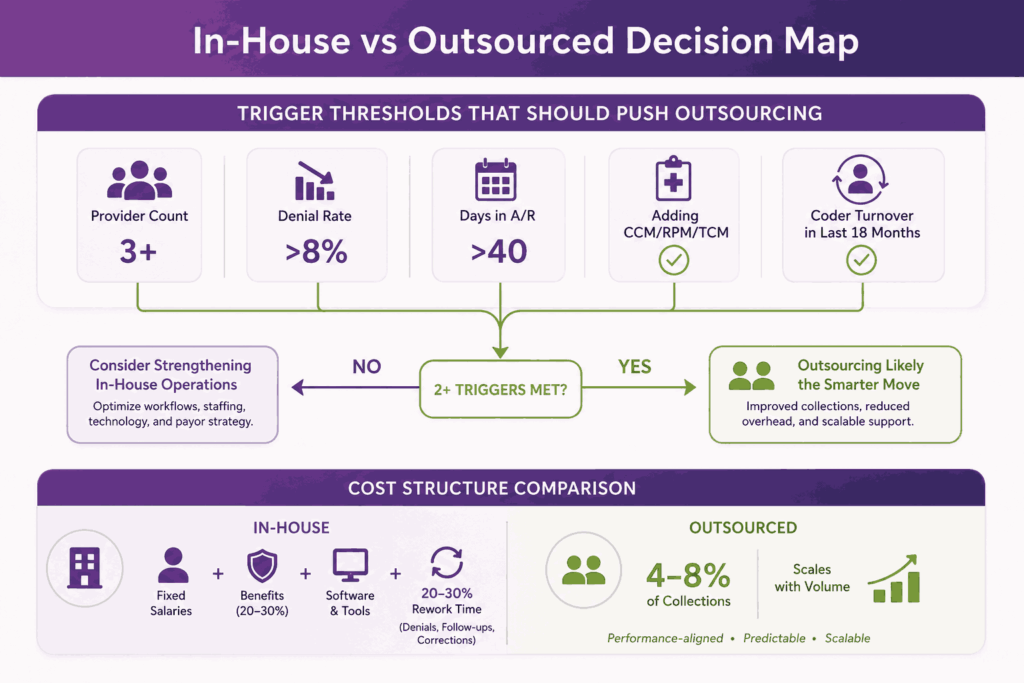
The in-house vs outsourced billing decision in internal medicine mainly depends on claim volume, staffing stability, and denial complexity. Internal medicine practices process large volumes of low-dollar E/M claims, so even a small denial rate can create significant revenue leakage over time.
Quick Comparison
The two models differ across five key operational areas that directly impact internal medicine performance.
| Factor | In-House Billing | Outsourced Billing |
|---|---|---|
| Cost Structure | Fixed salary, benefits, and software | 4 to 8 percent of monthly collections |
| Scalability | Limited by headcount | Scales with claim volume |
| IM Coding Expertise | Depends on staff experience | Specialist coders across IM workflows |
| Tech Stack | Practice-owned and maintained | Included in service |
| Compliance Risk | Fully on the practice | Shared under BAA |
When In-House Works
In-house billing is viable for smaller internal medicine practices with stable workflows and limited complexity. It works best when claim volume is predictable and coding needs are well controlled.
- 1–2 provider practice with steady patient flow
- Simple payer mix with low complexity
- Certified coder already on staff
- Clean claim rate above 95%
- No CCM, RPM, TCM, or similar programs
When Outsourcing Wins
Outsourcing becomes more effective when complexity, scale, or staffing pressure increases. Internal medicine practices reach this point quickly when they expand services or grow provider count.
- 3+ providers or active expansion
- Medicare-heavy mix with MIPS or ACO participation
- Days in A/R above 40 or denial rate above 8%
- Coding backlog or staff turnover
- Adding CCM, RPM, TCM, or AWV services
Meeting any combination of these criteria indicates that a practice has outgrown its current operational capacity. Transitioning to professional internal medicine billing services helps stabilize revenue protection during these high-volume scaling phases.
The Hidden Cost of In-House
The real cost of in-house billing is often not visible in salary reports. It shows up in operational drag, rework, and compliance exposure. Coder turnover typically occurs every 18–22 months, which creates recurring disruption in coding consistency and workflow stability.
Partnering with dedicated internal medicine billing companies removes this human resources burden, ensuring specialized coverage across all billing workflows. Practices also end up managing multiple software tools for eligibility, denial tracking, and reporting, which adds complexity and overhead.
A significant share of staff time, often 20 to 30 percent, is consumed by denial rework instead of active billing work. On top of this, full HIPAA and audit liability remains entirely with the practice, increasing operational and compliance risk.
2026 Regulatory and Operational Shifts to Watch
Several CMS and payer changes affect internal medicine billing operations in 2026 and 2027. These are operational shifts, not coding changes. The coding implications sit in the companion guide.
The biggest shift is prior authorization transparency. CMS now requires payers to publish denial and approval metrics. This gives practices new data for contract negotiation and appeal strategy.
Key 2026 Shifts
These five items shape the billing operations roadmap for most internal medicine practices over the next 12 to 18 months.
- CMS prior auth transparency rule: Payers must publish PA approval and denial metrics
- API-enabled prior auth: Mandatory by 2027 for Medicare Advantage and marketplace plans
- HCC V28 phased rollout: Operational documentation impact for risk adjustment workflows
- Annual Medicare PFS update: Conversion factor changes affect every fee schedule rebuild
- No Surprises Act enforcement: Ongoing audits on good faith estimates and balance billing
Telehealth Coverage Status
Telehealth coverage for Medicare patients has been extended multiple times since 2020. The current extension covers most internal medicine telehealth services. Check the latest CMS guidance before publishing patient-facing materials.
Commercial payers continue to cover telehealth at parity with in-person visits in most states. State laws vary, and audio-only coverage has tightened in some markets, so payer-specific verification matters.
Conclusion
Internal medicine billing in 2026 rewards operational discipline over coding speed. Practices that perform well treat eligibility, prior authorization, documentation, denials, and A/R as one connected system. Strong process control is what separates a 5 percent denial rate from a 12 percent rate, which often translates into six to seven figures in annual revenue impact.
Recent changes are widening this gap. CMS prior authorization transparency rules, the HCC V28 rollout, and a 2.8 percent Medicare Physician Fee Schedule cut are all adding pressure to margins at the same time. Practices that strengthen upstream processes protect revenue, while those relying on downstream rework continue to lose ground each quarter. In most cases, the build vs. buy decision becomes clear once denial rates cross the 10 percent threshold.
Frequently Asked Questions
What is the difference between internal medicine billing and primary care billing?
Internal medicine billing focuses on adult patients with a heavier Medicare mix and more chronic condition complexity. Primary care is broader and often spans pediatrics. Internal medicine carries higher prior auth volume and audit exposure.
Why are denial rates higher in internal medicine?
Internal medicine has more prior auth needs, more chronic care service billing, and more time-based services. Each of these adds documentation and process steps where errors can happen. Active denial management closes the gap.
How long should internal medicine claims take to get paid?
Clean claims paid by Medicare typically post within 14 to 21 days. Commercial payers run 21 to 45 days. Days in A/R below 35 days is the operational target for a healthy internal medicine billing team.
Can internal medicine practices bill for chronic care management and office visits together?
Yes, when the documentation supports both services and the time tracking is clear. The process side is what matters here. Care plan updates, time logs, and patient consent must all be in place. Codes are covered in the companion guide.
What is a healthy A/R days target for an internal medicine practice?
Below 35 days in total A/R, with less than 15 percent of A/R aged past 90 days. Practices hitting these targets have strong eligibility, scrub, and follow-up workflows operating in sync.
Should small internal medicine practices outsource billing?
Often, yes, once the practice grows past 3 to 4 providers or denial rates climb above 10 percent. Smaller practices with strong in-house leadership and a simple payer mix can run billing in-house at a competitive cost.
How often should an internal medicine practice audit its billing?
Monthly internal audits on a 10-claim sample plus quarterly payer-level reviews. Add an annual full compliance review with a Medicare Physician Fee Schedule rebuild. This cadence catches drift before payer audits find it.